 Bioelectrical impedance analysis and skinfold thickness for the estimation of body fat: a population-based study in southern Brazil
SUMMARY
OBJECTIVE: The objective of this study was to compare bioelectrical impedance analysis and skinfold measurements for the estimation of body fat in adults.
METHODS: We analyzed data from 292 adult participants enrolled in a cross-sectional population-based study. Four skinfold measurements were performed, and body fat percentage was estimated using the Petroski formula. Bioelectrical impedance analysis was performed using a tetrapolar electrical bioimpedance device. The measurements were compared using Student's t-test, Robinson's coefficient of agreement, Cronbach's alpha, and linear regression models (slope and intercept).
RESULTS: The mean percentage of body fat estimated by skinfold measurements was higher compared to bioelectrical impedance analysis (29.0 vs. 27.9; p<0.001), but the agreement between the methods is good (alpha=0.88; Robinson's coefficient of agreement=0.91). Linear regression models showed a good correlation (r2=0.69). Bland-Altman analysis showed a mean difference of −1.02 (−1.54 vs. −0.50) between the two techniques. The agreement was better in women, those aged 20-39 years, those with a body mass index<25, and those with a waist-to-height ratio<50.
CONCLUSION: The two methods showed a good agreement between the mean values of body fat percentage and can be used in population studies. However, their results should be considered with caution in men, people aged 40 years and older, overweight people, and those with a waist-to-height ratio≥50.
KEYWORDS:
Body composition; Bioelectrical impedance; Skinfold thickness; Body fat distribution; Cross-sectional study; Epidemiology
INTRODUCTION
The search for accurate methods of estimating body composition is a constant concern of the medical and scientific community, with the aim of obtaining information that will allow a consistent diagnosis of the nutritional status of individuals and populations1,2.
Hydrostatic weighing, densitometry, air displacement plethysmography, and magnetic resonance imaging are considered gold standard methods for estimating body fat3. However, the use of these methods in epidemiological studies is limited due to the technical qualification required to perform them, the time required, and the high cost2,3.
Bioelectrical impedance analysis (BIA) has been used in clinical practice and epidemiological studies because it is a non-invasive method and provides rapid estimates of body composition3,4. However, its findings may be influenced by hydration status, hydroelectrolyte balance, and some clinical conditions of the individual, and may vary between ethnic groups5.
Skinfold measurements provide a simple estimate of body composition by assessing the thickness of the subcutaneous fat in millimeters. Previously validated formulae are applied on these measurements to estimate the percentage of body fat6,7. The accuracy of skinfold measurements depends on the technical quality of the measures taken and on using appropriate formulae to the population studied8.
Studies have shown a good correlation between BIA and skinfold methods for estimating fat mass9,10. However, these studies were conducted in clinical settings11,12 and in specific populations such as young adults13, children and adolescents14, elderly15, and military personnel16 and/or have small sample sizes. Therefore, studies comparing these two methods in population-based epidemiological studies are needed.
Hence, this study aimed to compare the BIA and skinfold measurement methods for estimating body fat in adults enrolled in a population-based study in southern Brazil.
METHODS
Study design
Data were derived from the baseline of the cohort "Study of Health in Pomerode (SHIP-Brazil)" described previously17. In short, a stratified sample of 2,488 individuals of both sexes and aged between 20 and 79 years, who had lived in Pomerode (SC) for at least 6 months, were included in the study. Participants were assessed by trained and certified staff in the University Hospital of Blumenau. The data collection procedures were described in the standard operating procedures, available at www.furb.br/vspomerode. All participants signed a written informed consent. The SHIP-Brazil was approved by the Research Ethics Board of the University of Blumenau (CAAE: 99559118.0.0000.5370) and complied with the Declaration of Helsinki.
Of the 1,755 SHIP-Brazil adult participants (20 and 59 years), 1,490 (85%) had weight and height measurements, 1,484 (84.6%) had waist measurements, 1,035 had skinfold measurements, and 448 had BIA testing. Finally, 292 participants had all measurements and were included in this study. There were no statistically significant differences between the participants included in the study and those who did not have all the measurements available for the variables studied.
Anthropometric measurements
Body mass (in kilograms) was measured using a W300 electronic scale (WELMY®, Brazil). Participants stepped onto the center of the platform barefoot, wearing minimal clothing and no jewelry. Height (in centimeters) was measured using a stadiometer with a rod attached to the scale. Body mass index (BMI) was calculated by dividing the body mass (kg) by the square of height (meters).
Waist circumference was measured with an inelastic tape measure (Cescorf®, Brazil) graduated in centimeters. The tape measure was positioned in the abdominal region at the medial point between the last rib and the right superior iliac crest. The waist-to-height ratio (WtHR) was calculated by dividing the waist circumference by the height (centimeters). Participants with a WtHR<0.50 were considered to be at low cardiometabolic risk18.
Skinfolds were measured with a scientific adipometer (Cescorf®) graduated in tenths of millimeters. The skinfold measurements were taken parallel to the longitudinal axis of the measured segment and in the standing position. The triceps and the subscapular, suprailiac, and medial calf folds were measured.
Body fat percentage
We adopted the body density formulae proposed by Petrosky6,7 to estimate body fat from skinfolds since they have been validated in a sample of adults from southern Brazil, namely:
-
Men (18-66 years old): 1.10726863—(0.00081201*X4)+(0.00000212*X42)—(0.00041761*age);
-
Women (18-51 years old): 1.02902361—(0.00067159*X4)+(0.00000242*X42)—(0.00026073*age)—(0.00056009*weight)+(0.00054649*height), where X4=sum of the subscapular, triceps, suprailiac, and calf folds.
The Siri equation19 was used to convert body density into body fat percentage.
A tetrapolar bioimpedance device (Bodystat 1500MDD, UK) was used to estimate the percentage of body fat. All possible factors that could interfere with the results were checked before the examination. The participants were placed in the supine position with the legs and arms away from the body, without contact with any metal objects. The skin of the limbs was cleaned, and electrodes were placed and connected to the cables of the BIA device.
Statistical analysis
The Bland-Altman plot was used to analyze the residuals between BIA body fat percentage and skinfold body fat percentage measurements. This approach was further stratified by sex, age group, and BMI.
Student's t-test was used to compare means. Cronbach's alpha test was used to estimate the internal consistency of each measure, and RAC was used to estimate the correlation between the BIA body fat percentage and skinfold body fat percentage (perfect agreement=1). Linear regression models were fitted between the BIA body fat percentage and skinfold body fat percentage crude and stratified for sex, age group, BMI, and WtHR. A perfect agreement was defined as a regression line slope of 1.0 and a regression line intercept at zero. Differences in slope from 1.0 and intercept from zero were tested for significance using a Student's t-test. A p<5% was considered statistically significant.
RESULTS
The mean age of the participants was 41.7 years (dp=9.9), and 162 (55.5%) of them were male. Men were older (44.2 vs. 38.7; p<0.001), with a higher BMI (28.9 vs. 27.4; p<0.001) and a higher WtHR (54.7 vs. 50.7; p<0.001).
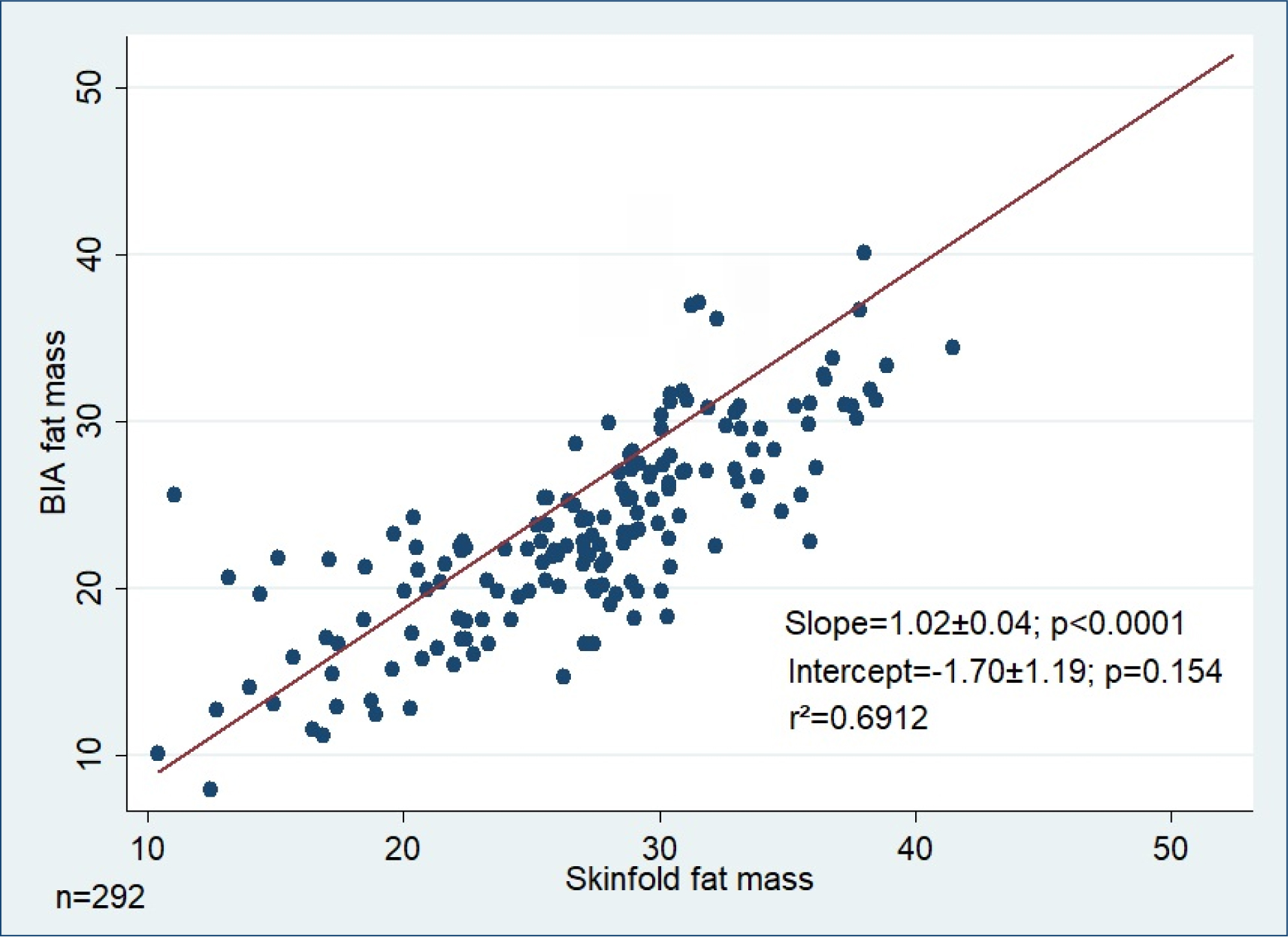
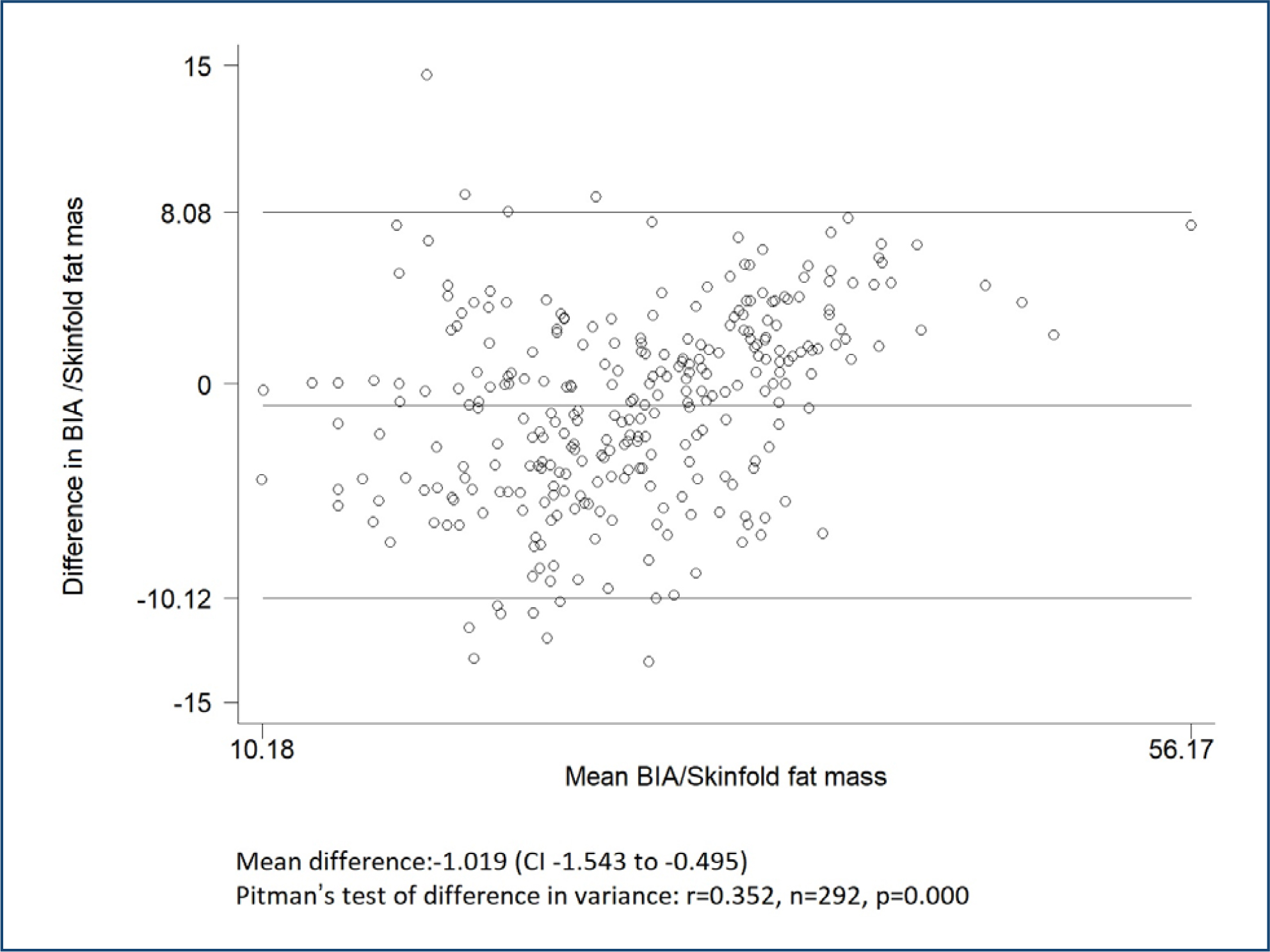
The linear regression model of mean skinfold and BIA body fat percentages showed a good correlation with r2=0.69. There was a significant deviation from the line of unity (1.02±0.04, p=0.001). The intercept did not differ from zero (−1.70±1.19) (p=0.154). The Bland-Altman analysis revealed a mean difference of −1.02 (−1.54 vs. −0.50) between the two techniques. Figures 1 and 2 show the agreement analysis between the methods using linear regression models and the Bland-Altman plots.
A linear regression model comparing bioelectrical impedance analysis fat mass and skinfold fat mass. BIA: bioelectrical impedance analysis.
Bland-Altman plot of differences between bioelectrical impedance analysis fat mass and skinfold fat mass. BIA: bioelectrical impedance analysis; CI: confidence interval.
The mean body fat percentage was lower when estimated by BIA (27.9 vs. 29.0, p<0.001). The internal consistency (alpha) between the measurements was =0.8978. The RAC was 0.9072. The full comparison of mean skinfold and BIA body fat percentages, their RAC, and internal consistency by study variables is shown in Table 1.
Comparison of body fat percentages by bioelectrical impedance analysis and skinfold measurements, Robinson's coefficient of agreement, and Cronbach's alpha for the study variables, Study of Health in Pomerode-Brazil, 2014-2018 (n=292).
The analysis of agreement between BIA and skinfold methods stratified by sex, age group, BMI, and WtHR revealed better agreement in women (mean difference=2.104, 95% confidence interval [CI] 1.602; 2.607), those aged 20-39 (mean difference=-0.708, 95%CI −1.536; 0.119), those with a BMI<25 (mean difference=0.001, 95%CI −1.001; 1.002), and those with a WtHR<50 (mean difference=0.154, 95%CI −0.665; 0.973).
DISCUSSION
In our study, the mean value of the skinfold-based calculation of body fat percentage was higher than that estimated by BIA. The mean differences between the two measurements ranged from 1.2 to 3.5% points. Participants aged between 20 and 39 years, with a BMI of up to 25 kg/m2, with a high cardiovascular risk as estimated by the waist circumference and WHtR, and with a low cardiovascular risk had similar mean values for both skinfold and BIA body fat percentages. These methods showed better agreement and good internal consistency in the mean values of body fat percentages. Better agreement was observed in the following subgroups: women, participants aged 20-39 years, participants with a BMI<25, and participants with a WtHR<50.
The methods evaluated in this study showed better agreement (RAC=0.9072; alpha=0.898; r2 adjusted=0.69) than other studies with similar age groups or sample sizes (r2=0.630 and =0.525, respectively)10,20. However, our results were similar to those of previous studies with other populations, such as adult women (r2=0.900)9 and people older than 18 years with kidney disease (r2=0.860)11. In this study, age below 40 years showed the best agreement values between methods, perhaps because there is greater accuracy in younger people and also in women. Regression analysis showed that skinfold-based body fat percentage was strongly correlated with BIA-based body fat percentage. This result was consistent with that of others in different contexts10,11.
BIA has been considered a good alternative method for estimating the percentage of body fat because of its strong agreement with dual-energy X-ray absorptiometry (DEXA); however, individual characteristics must be analyzed, such as obesity level and race/ethnicity1. In obese individuals, BIA showed a variable correlation with DEXA in estimating the percentage of body fat21. DEXA and BIA methods may be interchangeable at the population level, but at the individual level, different BMI values may reduce the agreement between them21.
Skinfold measurements have also shown good accuracy and correlation with gold standard methods in adults20. Given the high concordance with BIA found here, the skinfold measurement method may be more viable for use in public health services with limited financial resources. Despite these positive aspects, the validity of skinfold measurements is highly dependent on the training of the examiners, the formula used, the number of skinfolds measured, and the degree of obesity present, as excess subcutaneous fat may prevent or limit a correct skinfold measurement22.
In this study, agreement is lower at the extremes of older age, higher BMI, and higher WHtR, possibly due to the greater operational difficulty of skinfold measurements of body fat in these groups. The mean values of body fat percentage using skinfold and BIA were different in individuals with a BMI≥25 kg/m2 (p<0.001) and in those with an adequate and high WHtR (p<0.001), although they still showed good internal consistency, with Cronbach's alpha of 0.885 and 0.877, respectively.
These results underline the importance of careful training of examiners and supervision while measuring skinfolds, especially in older people and those who are overweight or obese. Furthermore, the two methods studied estimate the percentage of total body fat but not visceral and subcutaneous fat. In this sense, the use of combined measurements such as abdominal circumference, waist-to-hip ratio, or WHtR is recommended in clinical and research practice for a more accurate assessment of metabolic and cardiovascular risks.
A potential strength of this study is that the body fat percentage estimated by BIA and skinfold measurements was compared in a population-based study of adults in southern Brazil. Although both methods seem feasible, the results should be treated with caution due to differences in BIA device types, skinfold measurement protocols, sample sizes, and target populations.
A potential limitation of the study was the lack of use of gold standard methods such as DEXA, which did not allow a direct comparison between the two methods used here. However, tetrapolar BIA can be considered an accurate and precise method for estimating body fat percentage.
CONCLUSION
Our results indicate a good agreement between the mean values of the skinfold and tetrapolar BIA methods for estimating the body fat percentage in a population-based study of adults in southern Brazil. The highest agreement between the methods was found in younger individuals, women, individuals with a low WtHR risk, and eutrophic adults.
-
Funding:
SHIP-Brazil was supported by the Santa Catarina State Foundation for Research Support (FAPESC), the Department of Science and Technology of the Ministry of Health in Brazil (MS-DECIT), the National Council for Scientific and Technological Development (CNPq), and Santa Catarina State Health Department (SES-SC) through the Research Program for the Brazilian Unified Health System (PPSUS) (grant number: 003/2012).
-
ETHICAL APPROVAL
SHIP-Brazil was approved by the Research Ethics Board of the University of Blumenau and complied with the Declaration of Helsinki (CAAE: 99559118.0.0000.5370). All participants signed a written informed consent.
-
CONSENT FOR PUBLICATION
The authors approve of publishing this article.
AVAILABILITY OF DATA AND MATERIALS
The authors confirm that most of the data used in this article can be found in Table 1 and Figures 1 and 2. Any additional data are available on request.
ACKNOWLEDGEMENTS
SHIP-Brazil has been conducted thanks to the efforts of many health workers and institutions. First, we thank the Santa Catarina State Foundation for Research Support (FAPESC), the University of Blumenau, and the City of Pomerode for funding. Second, we thank the Institute of Community Medicine of the University of Medicine of Greifswald, especially the heads of the "Study of Health in Pomerania" (SHIP) who support SHIP-Brazil as part of the SHIP-International project with knowledge and experience in data collection, quality assurance, and data analysis. Third, the contribution to data collection made by all healthcare workers (interviewers, examiners, supervisors, and laboratory workers) is gratefully acknowledged. Last but not least, we thank all the study participants and families who have made this project possible.
REFERENCES
-
1 Blue MNM, Tinsley GM, Ryan ED, Smith-Ryan AE. Validity of body-composition methods across racial and ethnic populations. Adv Nutr. 2021;12(5):1854-62. https://doi.org/10.1093/advances/nmab016
» https://doi.org/10.1093/advances/nmab016 -
2 Siedler MR, Rodriguez C, Stratton MT, Harty PS, Keith DS, Green JJ, et al. Assessing the reliability and cross-sectional and longitudinal validity of fifteen bioelectrical impedance analysis devices. Br J Nutr. 2023;130(5):827-40. https://doi.org/10.1017/S0007114522003749
» https://doi.org/10.1017/S0007114522003749 -
3 Borga M, West J, Bell JD, Harvey NC, Romu T, Heymsfield SB, et al. Advanced body composition assessment: from body mass index to body composition profiling. J Investig Med. 2018;66(5):1-9. https://doi.org/10.1136/jim-2018-000722
» https://doi.org/10.1136/jim-2018-000722 -
4 Brunani A, Perna S, Soranna D, Rondanelli M, Zambon A, Bertoli S, et al. Body composition assessment using bioelectrical impedance analysis (BIA) in a wide cohort of patients affected with mild to severe obesity. Clin Nutr. 2021;40(6):3973-81. https://doi.org/10.1016/j.clnu.2021.04.033
» https://doi.org/10.1016/j.clnu.2021.04.033 -
5 Lee MM, Jebb SA, Oke J, Piernas C. Reference values for skeletal muscle mass and fat mass measured by bioelectrical impedance in 390 565 UK adults. J Cachexia Sarcopenia Muscle. 2020;11(2):487-96. https://doi.org/10.1002/jcsm.12523
» https://doi.org/10.1002/jcsm.12523 -
6 Petroski EL, Neto CSP. Validação de equações antropométricas para a estimativa da densidade corporal em mulheres. Rev Bras Ativ Fís Saúde. 1995;1(2):65-73. https://doi.org/10.12820/rbafs.v.1n2p65-73
» https://doi.org/10.12820/rbafs.v.1n2p65-73 -
7 Petroski EL, Neto CSP. Validação de equações antropométricas para a estimativa da densidade corporal em homens. Rev Bras Ativ Fís Saúde. 1996;1(3):5-14. https://doi.org/10.12820/rbafs.v.1n3p5-14
» https://doi.org/10.12820/rbafs.v.1n3p5-14 -
8 Ripka WL, Cintra-Andrade JH, Ulbricht L. A century of skinfolds for body composition estimation: what we learned? Rev Bras Cineantropom Desempenho Hum. 2022;24:e85412. http://doi.org/10.1590/1980-0037.2022v24e85412
» http://doi.org/10.1590/1980-0037.2022v24e85412 - 9 Martins KA, Monego ET, Paulinelli RR, Freitas-Junior R. Comparison of methods to evaluate total body fat and its distribution. Rev Bras Epidemiol. 2011;14(4):677-87. PMID: 22218666
-
10 Yeşil E, Köse B, Özdemir M. Is body adiposity index a better and easily applicable measure for determination of body fat? J Am Coll Nutr. 2020;39(8):700-5. https://doi.org/10.1080/07315724.2020.1727378
» https://doi.org/10.1080/07315724.2020.1727378 -
11 Flores-García AL, Sánchez-Ramírez CA, Newton-Sánchez ÓA, Rojas-Larios F. Correlation between skinfold thickness and bioelectrical impedance analysis for the evaluation of body composition in patients on dialysis. Nutr Hosp. 2018;35(1):117-22. https://doi.org/10.20960/nh.1284
» https://doi.org/10.20960/nh.1284 -
12 Abreu AM, Wilvert LC, Wazlawik E. Comparison of body mass index, skinfold thickness, and bioelectrical impedance analysis with dual-energy X-ray absorptiometry in hemodialysis patients. Nutr Clin Pract. 2020;35(6):1021-8. https://doi.org/10.1002/ncp.10481
» https://doi.org/10.1002/ncp.10481 -
13 Guedes DP, Calabrese JC, Pirolli PM. Use of different segmental multi-frequency bioelectrical impedance devices for analysis of body composition in young adults: comparison with bioelectrical spectroscopy. Nutr Hosp. 2019;36(3):618-25. https://doi.org/10.20960/nh.2376
» https://doi.org/10.20960/nh.2376 -
14 Silva DR, Ribeiro AS, Pavão FH, Ronque ER, Avelar A, Silva AM, et al. Validity of the methods to assess body fat in children and adolescents using multi-compartment models as the reference method: a systematic review. Rev Assoc Med Bras (1992). 2013;59(5):475-86. https://doi.org/10.1016/j.ramb.2013.03.006
» https://doi.org/10.1016/j.ramb.2013.03.006 -
15 Silveira EA, Barbosa LS, Rodrigues APS, Noll M, Oliveira C. Body fat percentage assessment by skinfold equation, bioimpedance and densitometry in older adults. Arch Public Health. 2020;78:65. https://doi.org/10.1186/s13690-020-00449-4
» https://doi.org/10.1186/s13690-020-00449-4 -
16 Neves EB, Ripka WL, Ulbricht L, Stadnik AMW. Comparison of the fat percentage obtained by bioimpedance, ultrasound and skinfolds in young adults. Rev Bras Med Esporte. 2013;19(5):323-7. https://doi.org/10.1590/S1517-86922013000500004
» https://doi.org/10.1590/S1517-86922013000500004 -
17 Santa Helena ET, Sousa CA, Silveira JLGC, Nunes CRO, Azevedo LC, Nilson LG, et al. Study of Health in Pomerode (SHIP-Brazil): aims, methodological issues and descriptive results. SciELO Preprints. 2023. https://doi.org/10.1590/scielopreprints.7276
» https://doi.org/10.1590/scielopreprints.7276 -
18 Castanheira M, Chor D, Braga JU, Cardoso LO, Griep RH, Molina MDCB, et al. Predicting cardiometabolic disturbances from waist-to-height ratio: findings from the Brazilian Longitudinal Study of Adult Health (ELSA-Brasil) baseline. Public Health Nutr. 2018;21(6):1028-35. https://doi.org/10.1017/S136898001700338X
» https://doi.org/10.1017/S136898001700338X - 19 Siri WE. Body composition from fluid space and density: analyses of methods. In: Brozek J, Hanschel A, editors. Techniques for measuring body composition. Washington, DC: National Academy of Science; 1961. p. 223-4.
-
20 Segheto W, Coelho FA, Cristina Guimarães Silva D, Hallal PC, Marins JC, Ribeiro AQ, et al. Validity of body adiposity index in predicting body fat in Brazilians adults. Am J Hum Biol. 2017;29(1). https://doi.org/10.1002/ajhb.22901
» https://doi.org/10.1002/ajhb.22901 -
21 Achamrah N, Colange G, Delay J, Rimbert A, Folope V, Petit A, et al. Comparison of body composition assessment by DXA and BIA according to the body mass index: a retrospective study on 3655 measures. PLoS One. 2018;13(7):e0200465. https://doi.org/10.1371/journal.pone.0200465
» https://doi.org/10.1371/journal.pone.0200465 -
22 Kogure GS, Silva RC, Ribeiro VB, Mendes MC, Menezes-Reis R, Ferriani RA, et al. Concordance in prediction body fat percentage of Brazilian women in reproductive age between different methods of evaluation of skinfolds thickness. Arch Endocrinol Metab. 2020;64(3):257-68. https://doi.org/10.20945/2359-3997000000246
» https://doi.org/10.20945/2359-3997000000246