
 Breast Cancer in Mato Grosso: Epidemiological Profile and Incidence from 2001 to 2018
ABSTRACT
Introduction: Breast cancer belongs to the group of non-communicable chronic diseases and is the most common among women in Brazil.
Objective: To describe the incidence of female breast cancer according to sociodemographic characteristics, in the state of Mato Grosso, between 2001 and 2018.
Method: Descriptive study using data from the Population-Based Cancer Registry from 2001 to 2018. New cases of female breast cancer diagnosed in Mato Grosso were taken into account, whose underlying cause belongs to Chapter II of the ICD-10, referring to cancers (tumors) and identified by the code C.50 (breast cancer). The relative frequencies were calculated according to race/skin color, age, marital status, and schooling, as well as the adjusted average breast cancer rates per municipality.
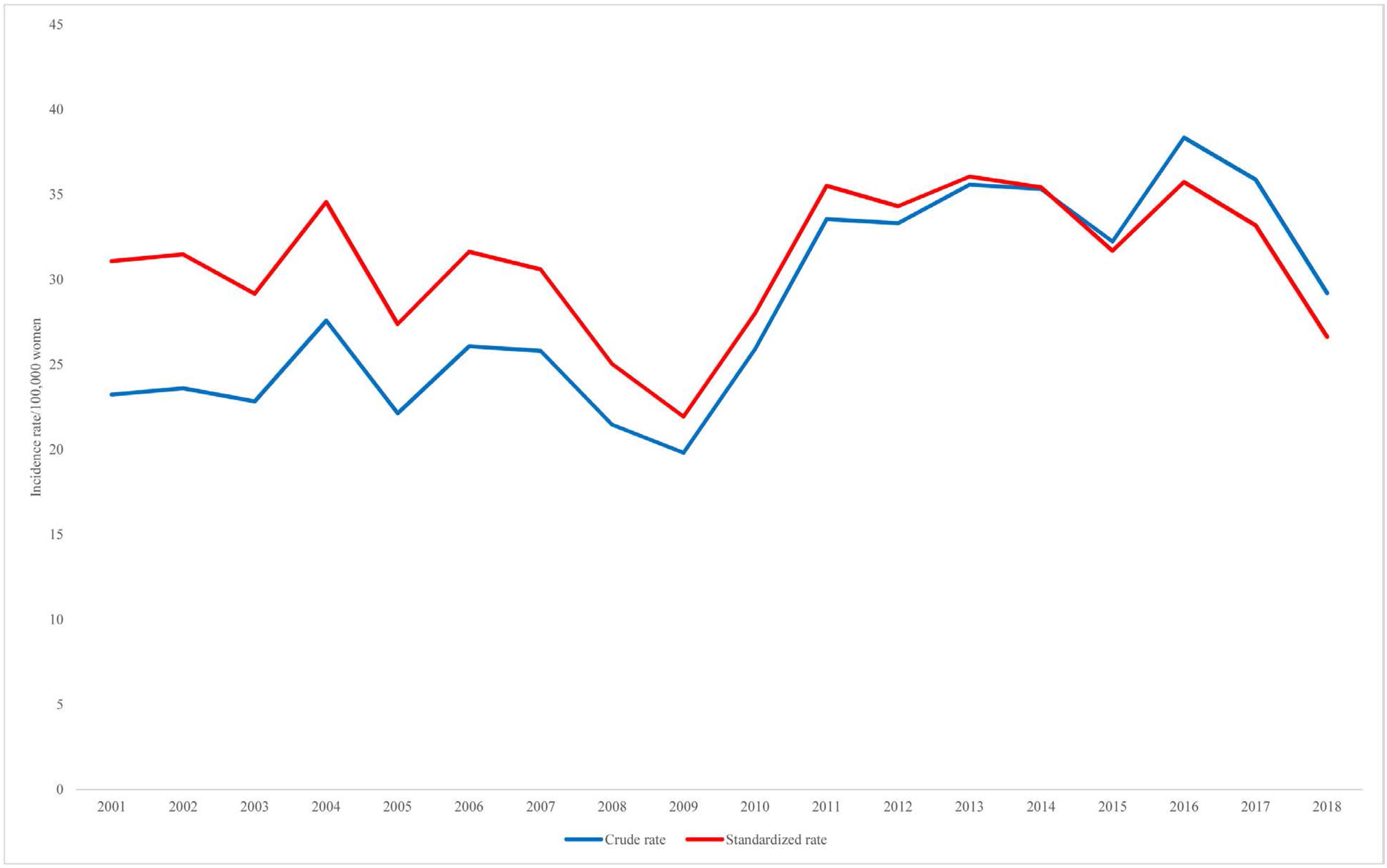
Results: There were 7,748 new cases of female breast cancer between 2001 and 2018. The highest frequency occurred in brown women (41.9%), aged 40-59 (53.9%), married (25.4%), with a primary school education (9.1%). The category with no schooling information was 59.8 per cent and for marital status, 46.9 per cent. In 2001, the adjusted rate was 31.08, while the crude rate was 23.23 per 100,000 women. In 2018, the crude rate increased by 26 per cent (29.2/100,000 women), while the adjusted rate fell by 14 per cent (26.63/100,000 women).
Conclusion: The results revealed that breast cancer continues to be a major concern in the state, with 7,748 new cases over 18 years and an average incidence rate of 28.7/100,000 women.
Key words:
Breast Neoplasms; Carcinoma, Ductal, Breast; Breast Carcinoma in situ; Incidence; Demography
RESUMO
Introdução: O câncer de mama pertence ao grupo das doenças crônicas não transmissíveis, sendo o mais incidente entre as mulheres no Brasil.
Objetivo: Descrever a incidência do câncer de mama feminina segundo características sociodemográficas, no Estado de Mato Grosso, no período de 2001 a 2018.
Método: Estudo descritivo utilizando dados do Registro de Câncer de Base Populacional no período de 2001 a 2018. Foram considerados os novos casos diagnosticados por câncer de mama feminina residentes em Mato Grosso, cuja causa básica pertence ao Capítulo II da CID-10, referente aos cânceres (tumores) e identificados pelo código C.50 (câncer de mama). Foram calculadas as frequências relativas segundo raça/cor da pele, idade, estado civil e escolaridade, assim como as taxas médias ajustadas de câncer de mama por município.
Resultados: Ocorreram 7.748 novos casos de câncer de mama feminina nos anos de 2001 a 2018. A maior frequência se deu em mulheres pardas (41,9%), 40-59 anos (53,9%), casadas (25,4%), com ensino fundamental I (9,1%). A categoria sem informação para escolaridade foi de 59,8% e para estado civil das pacientes, 46,9%. Em 2001, a taxa ajustada foi de 31,08, enquanto a taxa bruta foi de 23,23 por 100 mil mulheres. Já em 2018, a taxa bruta aumentou 26% (29,2/100 mil mulheres), enquanto a taxa ajustada reduziu 14% (26,63/100 mil mulheres).
Conclusão: Os resultados revelaram que o câncer de mama continua sendo uma preocupação importante no Estado, com 7.748 novos casos ao longo de 18 anos e taxa de incidência média de 28,7/100 mil mulheres.
Palavras-chave:
Neoplasias da Mama; Carcinoma Ductal de Mama; Carcinoma de Mama in situ; Incidência; Demografia
RESUMEN
Introducción: El cáncer de mama pertenece al grupo de las enfermedades crónicas no transmisibles y es el cáncer más frecuente entre las mujeres en el Brasil.
Objetivo: Describir la incidencia de cáncer de mama femenina según características sociodemográficas en Mato Grosso entre 2001 y 2018.
Método: Estudio descriptivo con datos del Registro de Cáncer de Base Poblacional de 2001 a 2018. Se tomaron en cuenta los casos nuevos de cáncer de mama femenina según características sociodemográficas diagnosticados en el estado de Mato Grosso, cuya causa subyacente pertenece al Capítulo II de la CIE-10, referente a cánceres (tumores) e identificados por el código C.50 (cáncer de mama). Se calcularon las frecuencias relativas en función de la raza/color de piel, la edad, el estado civil y la educación, así como las tasas medias ajustadas de cáncer de mama por municipio.
Resultados: Hubo 7748 nuevos casos de cáncer de mama femenina entre 2001 y 2018. La mayor frecuencia se dio en mujeres pardas (41,9%), de entre 40 y 59 años (53,9%), casadas (25,4%), con educación primaria (9,1%). La categoría sin información para la educación fue del 59,8% y para el estado civil, del 46,9%. En 2001, la tasa ajustada fue de 31,08, mientras que la tasa bruta fue de 23,23 por cada 100 000 mujeres. En 2018, la tasa bruta aumentó un 26% (29,2/100 000 mujeres), mientras que la tasa ajustada disminuyó un 14% (26,63/100 000 mujeres).
Conclusión: Los resultados revelaron que el cáncer de mama sigue siendo una de las principales preocupaciones en el estado, con 7748 nuevos casos en 18 años y una tasa media de incidencia de 28,7/100 000 mujeres.
Palabras clave:
Neoplasias de la Mama; Carcinoma Ductal de Mama; Carcinoma de Mama in situ; Incidencia; Demografía
INTRODUCTION
Chronic non-communicable disease (NCDs) is the name given to the group of diseases that originate from several genetic, behavioral, occupational, and environmental factors that constitute the greatest group of diseases in Brazil. They cause morbidity, premature mortality, individual incapacitation, harm to quality of life, and impact familial coexistence. NCDs are composed of a group of diseases that originate from multiple factors and, currently, stand out as one of the main health issues worldwide, being the greatest cause of morbidities1.
Cancer is part of the NCD group and, generally, most frequent cases are commonly found in low-income countries, affecting, even more, the lives of people afflicted by chronic diseases1. Cancer is the terminology that refers to a group of over ten diseases characterized by uncontrolled cell growth that tends to invade adjacent tissues and organs2.
Breast cancer, like other neoplasms, results from genetic DNA alteration, which causes disordered multiplication of mutated breast cells. Breast cancer cases do not occur due to a single cause, but due to a variety of factors that are associated with neoplasm development, exposure, heredity, and other factors3.
Female breast cancer detection usually initiates when the patient notices some abnormality in her breast, thus seeking medical attention so she can undergo tests and receive a diagnosis. Breast cancer, until detectable through palpation, can take years, since carcinogenesis is a slow process and can manifest in diverse ways in each patient3.
Female breast cancer is currently the most frequent worldwide, with 2.3 million new cases4,5. In Brazil, breast cancer is the most frequent across all Regions, when disregarding non-melanoma skin cancer. A total of 78,610 (71.57/100 thousand women) new breast cancer cases are estimated for each year of the 2026-2028 triennium6.
In the State of Mato Grosso, according to data from the National Cancer Institute (INCA), breast cancer was the most frequent among women, with about 930 estimated cases6. A crucial factor to consider in the increase in cancer incidence in Mato Grosso over the years may be the intensive farming of soybeans, cotton, corn, and other commodities in the region, as these crops are major consumers of agrochemicals. Studies have proved that exposure to agrochemicals is related to an increase in cancer cases7-9.
Studies already conducted in the State of Mato Grosso presented data that show breast cancer as the most frequent among women10. Oliveira et al.11 reported a higher frequency of female breast cancer from 2007 to 2011; Alves et al.12, in a study on the spatial distribution of cancer incidence rate (2001-2016), verified that breast cancer among women was the most frequent, with 6,971 cases, and Modesto et al.13 found an upward trend from 2009 to 2016 (31.1 to 39.4/100 thousand women). However, there is a need for conducting research to update academic content according to more recent data, that is, until 2018.
According to the International Classification of Diseases for Oncology (ICD-O)14, third edition, breast cancer is classified with the C50 code and can range from C50.0 to C50.9, according to the specific anatomical location of the tumor. The Population-Based Cancer Registry (RCBP) stores population-based cancer incidence data with information on disease case characteristics. Distribution of the temporal base is done through collected data, referring to the population from the area of collection15.
Thus, in this study, the data collected have been analyzed and classified with the intention of producing information and statistics, so that possibilities of intervening in the number of cases can be studied, to describe the incidence of female breast cancer according to sociodemographic characteristics, in the state of Mato Grosso, between 2001 and 2018.
METHOD
Descriptive epidemiological study, with data from new breast cancer cases recorded in the Mato Grosso RCBP, composed of the Cuiabá and Interior RCBP, between 2001 and 2018.
The study was conducted in the State of Mato Grosso, located in the Central-West Region of the country. The estimated population, in 2022, was 3,658,813 inhabitants. It is the third most extensive State in the country, with a high Human Development Index (HDI) (0.736). The State of Mato Grosso is composed of 141 municipalities, of heterogeneous spatial distribution, of which only five have a population over 100 thousand inhabitants. Cuiabá, the State capital, is the greatest municipality, with 650,912 inhabitants16.
Regarding the cancer care network, Mato Grosso has five services classified as High-Complexity Oncology Unit (Unacon), three of which are in the capital, and two in inner State cities (Sinop and Rondonópolis). The diagnosis network, which makes available pathological anatomy, immuno-histochemical, ultrasounds, computerized tomographies, and magnetic resonance tests, is concentrated in the higher demographic density municipalities: Cuiabá, Várzea Grande, Rondonópolis, and Sinop17,18.
This study considered new cases of female breast cancer of residents in Mato Grosso, whose underlying cause belongs to Chapter II of the International Classification of Diseases and Related Health Problems (ICD-10)19, referring to cancers (tumors) and identified by the code C.50. These cases refer to women of all ages residing in the State.
The study used data from the RCBP, provided by the Mato Grosso State Health Secretariat (SES-MT), through the research project "Cancer and its associated factors: analysis of Mato Grosso's hospital and population-based registries". The project has a partnership with SES-MT and authorization to conduct data analyses.
The following sociodemographic variables were selected from the tumor notification sheet: race/skin color (white, black, yellow, brown, indigenous, no information); age, in years; age group (0-4, 5-9, 10-14, 15-19, 20-29, 30-39, 40-49, 50-59, 60-69, 70-79, and 80+ years); education (no formal education, elementary school, middle school, high school, incomplete higher education, complete higher education, no information); marital status (single, married, widow, judicially separated, consensual union, no information) and place of residence (141 Mato Grosso municipalities).
The variables referring to the tumor and follow-up were: morphology (according to ICD-O – third edition); means of diagnosis (Only through Death Certificate – ODC, clinical, tumoral markers clinical research, cytology, metastasis histology, primary tumor histology, no information); disease extent (localized, metastasis, in situ, not applicable, no information), and date of diagnosis (year).
Specific incidence rates by age, crude, mean, and age-standardized were calculated, expressed per 100 thousand women. Rate standardization was done through the direct method and used the standard world population proposed by Segi20 and reviewed by Doll, Payne, and Waterhouse21. The population estimates were collected from the Department of Informatics of the National Health System (DATASUS) for the 2001-2018 period.
Data was organized on a Microsoft Excel spreadsheet. Categorical variables were expressed in absolute and relative values and presented in tables and graphs. The "age" variable was expressed through central trend measures. Variables that did not have records in the studied period were excluded from the analysis. Due to the incompleteness of the Mato Grosso RCBP database, the "in situ" category of the "extent" variable did not present records in the analyzed period; therefore, it was not described. Whereas the "marital status" and "education" variables, despite presenting incomplete information, were maintained in the study to characterize the problem.
This study is part of the "Cancer and its associated factors: analysis of Mato Grosso's hospital and population-based registries" research, which was approved by the Federal University of Mato Grosso's (UFMT) Health Area Research Ethics Committee, report number 4.858.521 (CAAE (submission for ethical review): 48121421.0.0000.8124), in compliance with Resolution 466/2012 of the National Health Council22.
RESULTS
During the 2001-2018 period, a total of 7,748 new female breast cancer cases were recorded in the RCBP. It is important to highlight that, of those cases, about 4,994, that is, 64.5% of cases, occurred in women who live in the inner Mato Grosso State. Upon further analyzing the data, it can be observed that the age group with the highest percentage of cases was the 40-59 years, representing 53.9% of the total of recorded cases in the analyzed period, the average age of women with breast cancer being 51 years old, and a standard deviation of 13 years (Table 1).
Distribution of sociodemographic characteristics of new breast cancer cases, Mato Grosso, 2001 to 2018 (n=7,748)
It is important to highlight that 46.9% of cases did not have available information on the marital status of patients, and the variable "married" corresponded to 25.4% (1,971 cases) recorded in RCBP. Of the patients included in the study, the variable "race/skin color brown" represented 41.9% of the total. Next came the category "white", with a representativeness of 34.7% (Table 1).
Regarding education, 59.8% of patients did not have information available on their formal education status. However, there was a record of 749 new cases among women with high school education, representing 9.7% of the participants total, and 755 patients with elementary school, also corresponding to 9.7% (Table 1).
In Mato Grosso, the main morphology of female breast cancer recorded in RCBP was infiltrating ductal carcinoma, with 5,619 cases and a percentage of 72.5%, followed by carcinoma NOS (not otherwise specified), with 8.2% of the total. Regarding means of diagnosis, 89.0% of cases were diagnosed by histology of the primary tumor. However, the ODC means of diagnosis was recorded in 6.9% of cases. Regarding tumor extent, 39.9% of cases were localized tumors, while 17.3% had metastasis (Table 2).
Distribution of characteristics of new breast cancer cases, according to morphology, means of diagnosis, and disease extent, Mato Grosso, 2001 to 2018 (n=7,748)
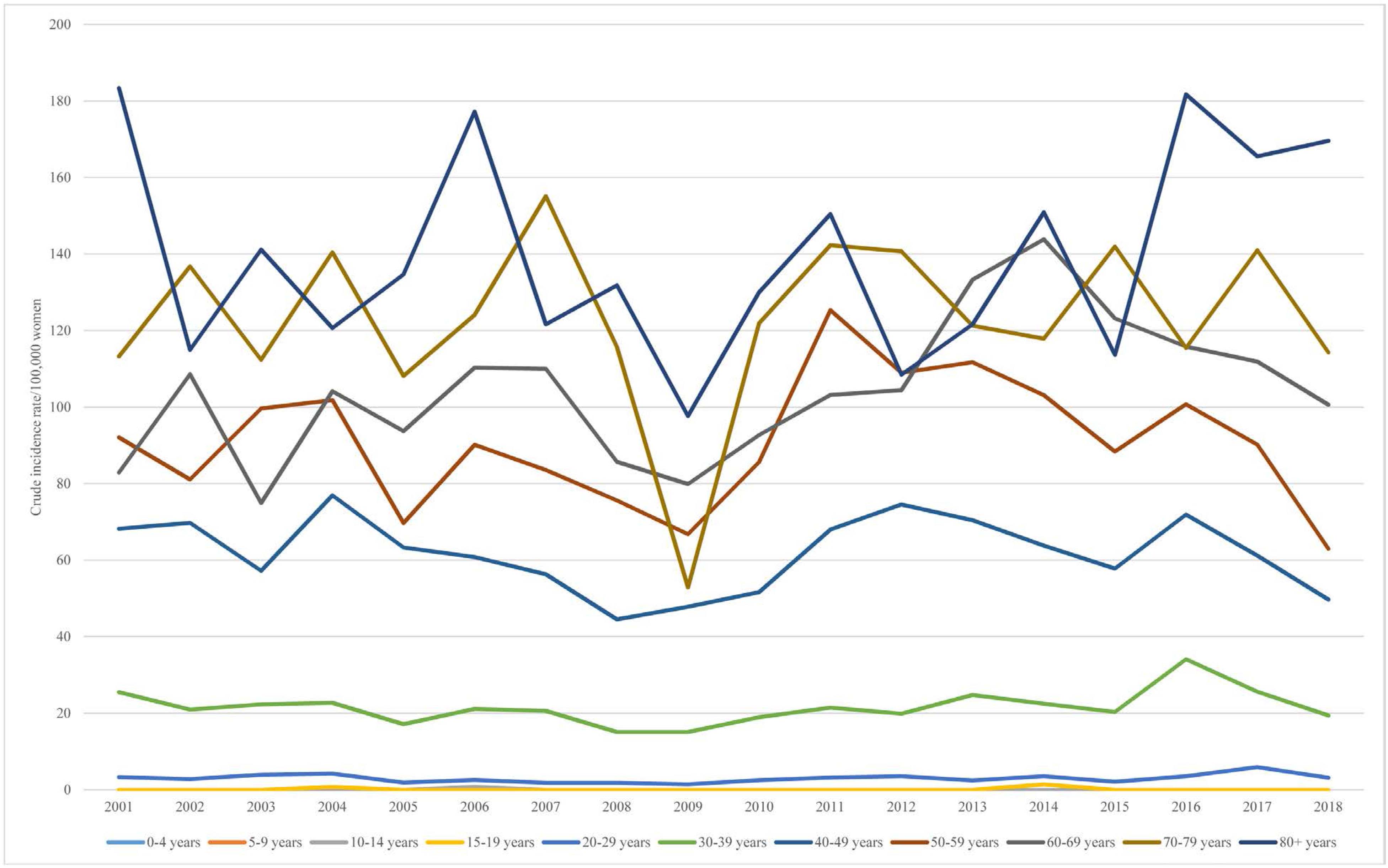
In Figure 1, we verify an increasing gradient as the age group progresses. In younger age groups (0 to 29 years), the occurrence was from zero (minimum) to 5.93 per 100 thousand women (maximum) in 2017. The more expressive growth occurred from the 40-49 years age group, with incidence of 44.53 per 100 thousand women (2008) and 74.53 per 100 thousand women (2012). The following age groups maintained the incidence-increase pattern, with a notable increase in the 80-year age group. In 2001, the incidence was 183.38, but there were variations throughout the years. In 2009, the rate dropped to 97.63, but it began increasing again and reached 169.55 in 2018.
Crude incidence rate of female breast cancer (per 100 thousand women), according to age group, Mato Grosso, 2001 to 2018
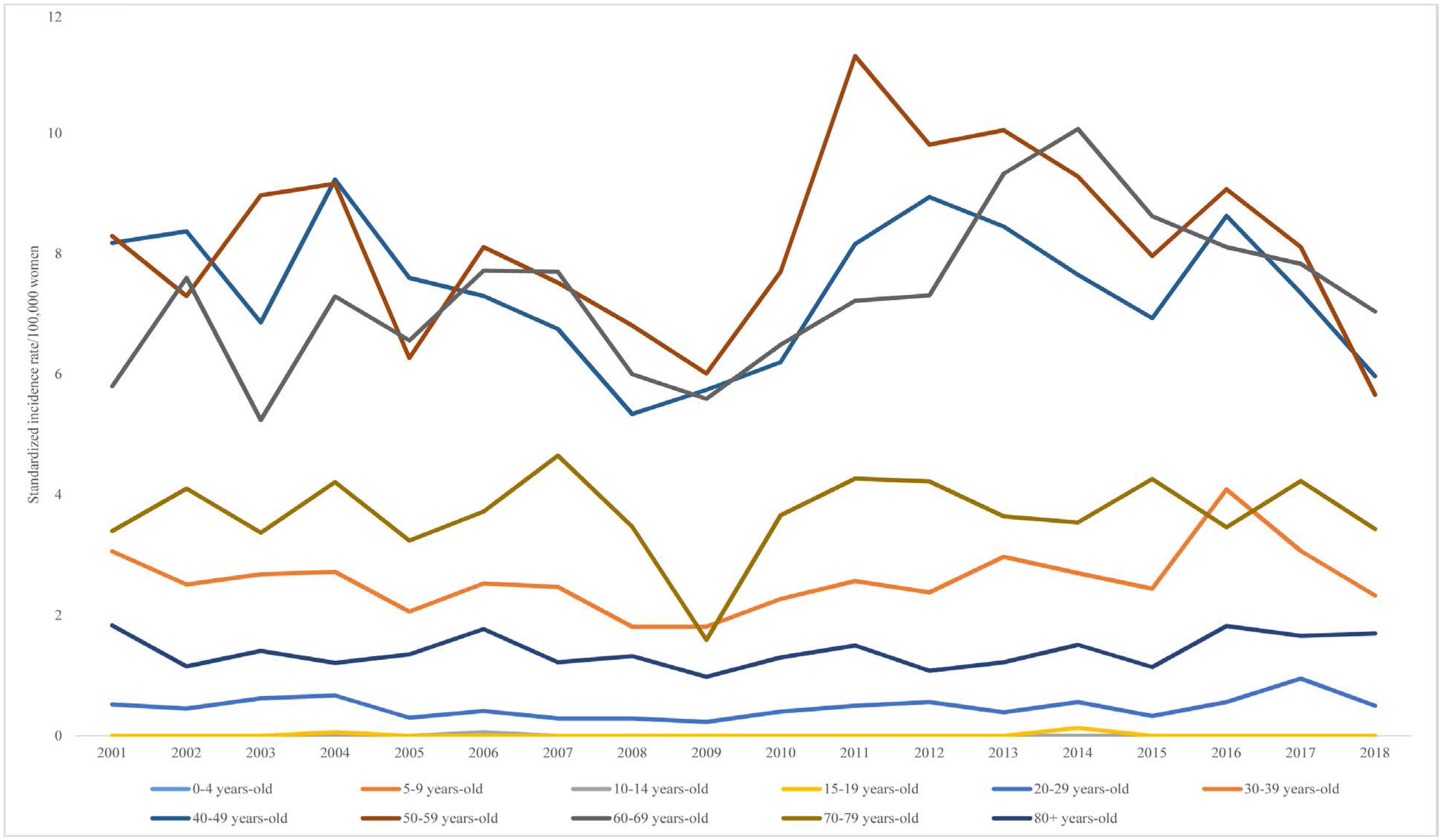
Figure 2 analysis reveals that female breast cancer reached peak incidence in different years for different age groups. Women aged 50-59 years had the highest number of cases in 2011, while those aged 60-69 years peaked in 2014, and those aged 40-49 years peaked in 2004. The other age groups kept lower incidence standards. In the 2001-2018 period, the breast cancer incidence rate decreased in 31.72% per 100 thousand women. The rate increased 21.37% for women aged 50-59 years, while it decreased by 27.01% for those aged 60-69 years and reduced by 27.01% for those aged 40-49 years.
Age-adjusted incidence rate (per 100 thousand women) for female breast cancer, Mato Grosso, 2001 to 2018
In Figure 3, for the year 2001, the standardized rate was 31.08, while the crude rate was 23.23. Whereas in 2018, the crude rate increased by 26% (29.2/100,000 women) and the standardized rate fell by 14% (26.63/100,000 women). The year 2009 recorded the lowest incidence rates in the period (21.94/100 thousand women).

Crude and standardized incidence rate for female breast cancer (per 100 thousand women), Mato Grosso, 2001 to 2018
DISCUSSION
With the present study, it was possible to describe the main epidemiological characteristics that characterize women with breast cancer residing in the State of Mato Grosso, between the years 2001 and 2018. This period recorded 7,748 new female breast cancer cases. The age group with the highest incidence was the 40-49 years age group, representing 27.2% of cases, followed by the 50-59 years age group, with 26.7% of cases. Regarding race/skin color, 41.9% of cases occurred in brown women, while 34.7% were in white women. The socio-demographic variables "marital status" and "education" have presented low completion quality in cancer registries, as verified in other databases, like SIM24, the Live Birth Information System (Sinasc), and the Notifiable Diseases Information System (Sinan)25.
The number of breast cancer diagnoses in the State of Mato Grosso was higher in the 40-49 years age group, confirming other studies by other researchers26,27. The result from this research confirms the incidence of new cases in women aged 50 and over, reinforcing the idea of the prevention screening program, indicated for women in the 50-69 years age group, which must be done every two years28.
Regarding the "marital status" and "education" variables, crucial to the sociodemographic characteristics of women with cancer, most records showed "no information", with 46.9% and 59.8%, respectively. Rocha et al.29, in a study conducted in the cities of Goiânia and Aparecida de Goiânia — in Goiás —, from 2008 to 2012, reported that 43% had "no information" for "marital status", as in the results from the current study. Pinto et al.30 verified a poor completion of the variable "degree of instruction" when analyzing completeness and consistency of data from hospital-based cancer registries in Brazil. It was also validated by Gomez et al.31, who demonstrated that 75% of hospitals never collected information on the patients’ education in the region of the Great São Francisco Bay. We underscore the neglect in correctly filling this information during data collection in the Mato Grosso RCBP sheet, which results in a knowledge gap, impairing better interventions.
Regarding race/skin color, in this study, the highest proportion was in brown women, with 41.9%. This result is in line with other works in the literature, such as the study conducted in Piauí, in the Northeast Region, where the greatest proportion was in self-declared brown women, with 58.1%32. However, in a study conducted in Rio Grande do Sul, in Brazil's Southern Region, 93.6% of the sample was composed of white women33. These results show the different population contexts of Brazilian Regions, reflecting the demographic and ethnic structure of these States. While the Southern States, like Rio Grande do Sul, have a significantly larger proportion of self-declared white population, the Central-West and Northeast States, where Mato Grosso and Piauí are located, respectively, have the greatest proportion of brown and black people.
In a study conducted in Goiânia-GO, in 2011, by Nunes et al.34, which addressed the description of breast cancer cases between 1989 and 2003, the most frequent morphology was infiltrating ductal carcinoma, with 80.6%. In the present study, for the same morphology, there was 72.5%, the highest percentage. However, the years studied differ from those analyzed by Nunes et al.34 and the present study. From 1989 to 2003, the second most common morphology was infiltrating lobular carcinoma in the study by Nunes et al.34, with 4.8%. In the present study, from 2001 to 2018, the second most common morphology was carcinoma NOS, with 8.2%. In addition to the different years studied, there is also a difference regarding the geographic Regions studied.
As underscored in previous studies, Souza et al.35 identified that infiltrating ductal carcinoma, also known as invasive, is the most common morphological variable. In the study by Souza et al.35, of the 148 women diagnosed with invasive ductal carcinoma, 65.54% of them were aged over 50. To the authors, this was a significantly concerning factor. In our study, there was a total of 5,619 cases of invasive ductal carcinoma, representing 72.5% of the total; however, no specific information was provided on age group distribution.
In a study elaborated by Santos et al.27, an investigation was conducted on the prevalence and associated factors to the diagnosis of breast cancer in advanced stage among 18,890 women cared at a specialized hospital in the capital of the Rio de Janeiro State, Brazil, from 1999 to 2016. The study also analyzed the diagnosis method by histological tumor type, including infiltrating ductal carcinoma and infiltrating lobular carcinoma. In the present study, regarding means of diagnosis, 89.0% of cases were diagnosed by histology of the primary tumor. However, the ODC means of diagnosis was recorded in 6.9% of cases.
Regarding the variable "disease extent", the following was observed in the present study: 39.9% of cases were classified as "localized", "metastasis" (17.3%) and "no information" (42.8%). In a study on the analysis of survival of women with breast cancer, conducted in the city of Goiânia-GO, using the RCBPGO database, disease extent was 59.8% for localized cases36. As observed, there was a difference of 20 percentage points between the two studies, which can be related to the "no information" category, which accounted for almost half the data (42.8%), and no record for "in situ". It should be noted that the "disease extent" variable is mandatory and must not be left blank when filling out the sheet for the following codes: "localized"; "metastasis"; "in situ"; "not applicable" and "no information"15, demonstrating failures in the filling of data, which reflects on the quality of the Mato Grosso RCBP.
The evolution of the crude incidence and age-standardized rates for breast cancer across the years showed variations between age groups and years. In women, crude and standardized rates above 50 years increased in this study. A similar pattern was observed in a study conducted in Cuiabá-MT, by Oliveira et al.37, which had an upward trend from 2008 to 2016.
The estimate done by INCA, for each year of the 2026-2028 triennium, showed a higher incidence of female breast cancer in the Southeast Region (88.29/100 thousand women), followed by the South (77.91/ 100 thousand women), Central-West (61.32/100 thousand women), Northeast (58.02/100 thousand), and North (31.28/100 thousand women) Regions6. The mean incidence rate found in this study for the Mato Grosso State was 28.73 per 100 thousand women for the 2001-2018 period.
The capital city Cuiabá-MT, despite standing out with the highest number of absolute cases in the State (2,753 breast cancer cases in the 2001-2018 period), ranks 105 regarding crude incidence rate (53.52/100 thousand women). Extreme values usually stand out for presenting fluctuations in the less dependable and random rates38.
This rate increase can be attributed to the higher exposure of women to risk factors related to lifestyle, such as smoking, excessive alcohol intake, inappropriate diet and sedentary lifestyle, reproductive factors, like delayed gestation, lower number of children, and shorter exclusive breastfeeding period. The increase can also be partially attributed to the degree of early detection and access to breast cancer screening39,40.
Breast cancer incidence rates are higher in regions with higher HDI41. In Mato Grosso, municipalities with the highest HDI17, like Rondonópolis, Primavera do Leste, Sorriso, and Lucas do Rio Verde, presented mean incidence rates of 37.96/100 thousand; 35.10/100 thousand; 25.37/100 thousand, and 23.91/100 thousand, respectively. According to Sung et al.5, breast cancer incidence rates in women are significantly high in high-HDI nations, reaching 55.9 cases per 100 thousand inhabitants, as well as in low or medium-HDI countries, reaching 29.7 cases per 100 thousand inhabitants.
In the spatial distribution of the average rate, it is noticeable that the highest rates are concentrated in areas of intensive agriculture. These agricultural regions use a lot of agrochemicals (pesticides and fertilizers), which are considered carcinogenic agents. The International Agency for Research on Cancer (IARC) reclassified 13 agrochemical-active ingredients (AAI) regarding their carcinogenic potential worldwide between 2012 and 2019, citing Dieldrin and Aldrin, Parathion and Glyphosate as possible cancer agents for breasts, specifically42.
Considering the use of secondary data to describe the results in this study, some limitations must be considered due to the lack of information on the RCBP form. Incomplete filling of the variables in the form may cause a gap in this and future studies, like in the "marital status" and "education" variables, which mostly have no information. The lack of data can generate limitations in the organization and distribution of healthcare services since it impairs the proper follow-through of the managing organization and creates obstacles to fighting breast cancer incidence43.
Finally, studies on breast cancer incidence rates enable the reflection on the importance of prevention strategies and early diagnosis of this type of cancer, mainly in the age groups that the Ministry of Health recommends access to screening.
CONCLUSION
In this study, it was possible to perceive the distribution of female breast cancer characteristics in the State of Mato Grosso for the studied period, more frequent in brown, married women, aged 40-59 years, with elementary education.
The most affected age group was 40-49 years, followed by the 50-59 years age group. This reinforces the importance of screening tests and awareness programs for this age group to ensure early diagnosis and better treatment chances. Regarding race/skin color, there was a greater proportion among brown women, followed by white women. This data can be related to socioeconomic factors and access to healthcare services, which reinforces the importance of public policies aiming to reduce inequalities in this sense.
The lack of information on patients’ education needs attention. The availability and record of this data can contribute to a better understanding of the characteristics associated with breast cancer and to planning more appropriate prevention and treatment strategies. Regarding marital status, the lack of information was once more an obstacle. However, among patients with available data, there was a predominance of married women. This can indicate the importance of family support during the diagnosis and treatment of the disease.
The analysis of the spatial distribution of average crude incidence rates for female breast cancer shows that, despite only three municipalities having not recorded any incidence in the studied period, five presented rates over 100 per 100 thousand women. The capital Cuiabá, despite holding the highest absolute number of cases, ranks 105th regarding crude incidence rate.
The presence of high incidence rates was notorious in areas of intense farming, regions that used agrochemicals at large scale, considered carcinogenic agents. Such a fact suggests the need for more in-depth studies to understand the relationship between the use of agrochemicals and breast cancer incidence. This analysis is a crucial step in understanding the epidemiology of breast cancer and can provide valuable information for the implementation of public healthcare policies.
One of the limitations of the study was the amount of data in the category "no information" in the variables: "education", "marital status", and "extent". This demonstrates the fragility of Mato Grosso's RCBP, weakening the analysis and impairing adequate planning for disease prevention, awareness, and control. For such, health professionals and cancer registers must be periodically trained so that registry information accurately reproduces the reality of cancer incidence in Mato Grosso.
Finally, these results are relevant to public health, since they highlight the need for prevention and awareness actions targeted at the most affected age groups that seek to reduce social inequalities and improve access to healthcare services. It is fundamental that health managers use the data presented in this study to ground their implementation of breast cancer prevention and control strategies in Mato Grosso, aiming to reduce incidence and mortality from this disease.
-
FUNDING SOURCES
Mato Grosso State Health Secretariat (SES-MT) – Extension Project "Vigilância de câncer e seus fatores associados: atualização de registro base populacional e hospitalar" (Cancer vigilance and its associated factors: update of hospital and population-based registries) via contract 088/2016 with UFMT, in force from April 2016 through March 2021. Public Ministry of Work 23rd Region – Research Project "Câncer e seus fatores associados: análise de registro base populacional e hospitalar" (Cancer and its associated factors: analysis of hospital and population-based registries) through the Technical Cooperation Agreement N. 08/2019, in force from July 2019 through July 2023.
DATA AVAILABILITY STATEMENT
All the contents associated with the article are included in the manuscript.
References
- 1 Ministério da Saúde (BR), Secretaria de Vigilância em Saúde, Departamento de Análise em Saúde e Vigilância de Doenças Não Transmissíveis. Plano de Ações Estratégicas para o enfrentamento das doenças crônicas e agravos não transmissíveis no Brasil 2021-2030. Brasília, DF: Ministério da Saúde; 2021.
-
2 Instituto Nacional de Câncer [Internet]. Rio de Janeiro: INCA; 2022. O que é câncer? 2022 maio 31 [acesso em 2023 ago 27]. Disponível em: https://www.gov.br/inca/pt-br/assuntos/cancer/o-que-e-cancer
» https://www.gov.br/inca/pt-br/assuntos/cancer/o-que-e-cancer - 3 Ministério da Saúde (BR). Secretaria de Atenção à Saúde. Departamento de Atenção Básica. Controle dos cânceres do colo do útero e da mama. 2. ed. Brasília, DF: Editora do Ministério da Saúde; 2013.
-
4 Ferlay J, Colombet M, Soerjomataram I, et al. Cancer statistics for the year 2020: an overview. Int J Cancer. 2021;149(4):778-89. doi: https://doi.org/10.1002/ijc.33588
» https://doi.org/10.1002/ijc.33588 -
5 Sung H, Ferlay J, Siegel RL, et al. Global cancer statistics 2020: GLOBOCAN estimates of incidence and mortality worldwide for 36 cancers in 185 countries. CA Cancer J Clin. 2021;71(3):209-49. doi: https://doi.org/10.3322/caac.21660
» https://doi.org/10.3322/caac.21660 -
6 Instituto Nacional de Câncer. Estimativa 2026 incidência de câncer no Brasil [Internet]. Rio de Janeiro: INCA; 2026 [acesso 2026 fev 10]. Disponível em: https://ninho.inca.gov.br/jspui/bitstream/123456789/17914/1/Estima2026_completo%20%281%29.pdf
» https://ninho.inca.gov.br/jspui/bitstream/123456789/17914/1/Estima2026_completo%20%281%29.pdf -
7 Pignati WA, Soares MR, Lara SS, et al. Exposição aos agrotóxicos, condições de saúde autorreferidas e vigilância popular em saúde de municípios mato-grossenses. Saúde debate. 2022;46(esp2):45-61. doi: https://doi.org/10.1590/0103-11042022E203
» https://doi.org/10.1590/0103-11042022E203 -
8 Soares MR, Corrêa MLM, Andrade ACS, et al. Environmental and occupational exposure to pesticides according to sociodemographic factors that affect cancer patients in Mato Grosso, Brazil. Saúde debate. 2024;48(141):e8514. doi: https://doi.org/10.1590/2358-289820241418514PI
» https://doi.org/10.1590/2358-289820241418514PI -
9 Silva AMC, Soares MR, Silva NA, et al. Environmental and occupational exposure among cancer patients in Mato Grosso, Brazil. Rev bras epidemiol. 2022;25(Supl 1):e220018. doi: https://doi.org/10.1590/1980-549720220018.supl.1
» https://doi.org/10.1590/1980-549720220018.supl.1 -
10 Galvão ND, Souza RAG, Souza BSN, et al. Cancer surveillance in Mato Grosso, Brazil: methodological and operational aspects of a university extension/research project. Rev bras. Epidemiol. 2022;25(Supl 1):e220002. doi: https://doi.org/10.1590/1980-549720220002.supl.1
» https://doi.org/10.1590/1980-549720220002.supl.1 -
11 Oliveira JFP, Lima FCS, Galvão ND, et al. Cancer incidence in Mato Grosso state, Brazil: analysis of population-based registries (2007 a 2011). Rev bras epidemiol. 2022;25(Supl 1):e220010. doi: https://doi.org/10.1590/1980-549720220010.supl.1
» https://doi.org/10.1590/1980-549720220010.supl.1 - 12 Alves MR, Silva GM, Souza PCF, et al. Distribuição espacial da taxa de incidência por câncer em Mato Grosso, 2001-2016. In: Roccon PC, Del Bel H, Costa AAS, et al., organizadores. Ambiente, saúde e agrotóxicos: desafios e perspectivas na defesa da saúde humana, ambiental e do(a) trabalhador(a). São Carlos: Pedro & João Editores; 2023. p. 133-47.
-
13 Modesto VC, Galvão ND, Souza RAG, et al. Tendências temporais na incidência de câncer no estado de Mato Grosso, Brasil, de 2001 a 2016. Ciênc saúde coletiva. 2025;30(3):e05932023. doi: https://doi.org/10.1590/1413-81232025303.05932023
» https://doi.org/10.1590/1413-81232025303.05932023 - 14 Organização Mundial da Saúde. CID-O: Classificação Internacional de Doenças para Oncologia. 3. ed. São Paulo: Editora da Universidade de São Paulo: Fundação Oncocentro de São Paulo; 2005.
- 15 Instituto Nacional de Câncer José Alencar Gomes da Silva, Coordenação Geral de Prevenção e Vigilância. Divisão de Vigilância e Análise da Situação. Manual de rotinas e procedimentos para registros de câncer de base populacional. 2. ed. rev. atual. Rio de Janeiro: INCA; 2012.
- 16 Instituto Brasileiro de Geografia e Estatística. Censo Brasileiro de 2023. Rio de Janeiro: IBGE; 2023.
- 17 Ministério da Saúde (BR). Portaria SAES/MS nº 1.399 de 17 de dezembro de 2019. Redefine os critérios e parâmetros referenciais para a habilitação de estabelecimentos de saúde na alta complexidade em oncologia no âmbito do SUS. Diário Oficial da União, Brasília, DF. 2019 dez 19; Edição 245; Seção1:173.
-
18 Secretaria de Estado de Saúde (MT). Resolução CIB/MT Ad referendum nº 001, de 20 de fevereiro de 2017. Dispõe sobre a aprovação do Plano de Ação da Atenção Oncológica no estado de Mato Grosso 2017 a 2019 [Internet]. 2017 fev 20 [acesso em 2023 jul 15]. Disponível em: http://www.saude.mt.gov.br/storage/old/files/ad-referendum-n-001-[13146-230317-SES-MT].pdf
» http://www.saude.mt.gov.br/storage/old/files/ad-referendum-n-001-[13146-230317-SES-MT].pdf - 19 Organização Mundial da Saúde. CID-10: Classificação Estatística Internacional de Doenças com disquete. São Paulo: Edusp; 2008. vol. 3.
- 20 Segi M. Cancer mortality for selected sites in 24 countries (1950-1957). Sendai: Tohoku University School of Medicine; 1960.
- 21 Doll R, Waterhouse J, Payne P. Cancer incidence in five continents: a technical report. Berlin: International Agency for Research on Cancer; 1966.
- 22 Conselho Nacional de Saúde (BR). Resolução nº 466 de 12 de dezembro de 2012. Aprova diretrizes e normas regulamentadoras de pesquisas envolvendo seres humanos. Diário Oficial da União, Brasília, DF. 2013 jun 13; Edição 112; Seção 1:59.
-
23 Registro de Câncer de Base Populacional [Internet]. Rio de Janeiro: INCA. [2012] – [acesso 2025 maio 20]. Disponível em: https://www.inca.gov.br/BasePopWeb/CAUPrepararLogin.action
» https://www.inca.gov.br/BasePopWeb/CAUPrepararLogin.action -
24 Romero DE, Cunha CB. Avaliação da qualidade das variáveis socioeconômicas e demográficas dos óbitos de crianças menores de um ano registrados no Sistema de Informações sobre Mortalidade do Brasil (1996/2001). Cad Saúde Pública. 2006;22(3):673-81. doi: https://doi.org/10.1590/S0102-311X2006000300022
» https://doi.org/10.1590/S0102-311X2006000300022 -
25 Lima CRA, Schramm JMA, Coeli CM, et al. Revisão das dimensões de qualidade dos dados e métodos aplicados na avaliação dos sistemas de informação em saúde. Cad Saúde Pública. 2009;25(10):2095-109. doi: https://doi.org/10.1590/S0102-311X2009001000002
» https://doi.org/10.1590/S0102-311X2009001000002 -
26 Rodrigues GM, Carmo CN, Bergmann A, et al. Desigualdades raciais no estadiamento clínico avançado em mulheres com câncer de mama atendidas em um hospital de referência no Rio de Janeiro, Brasil. Saúde Soc. 2021;30(3):e200813. doi: https://doi.org/10.1590/S0104-12902021200813
» https://doi.org/10.1590/S0104-12902021200813 -
27 Santos TB, Borges AKM, Ferreira JD, et al. Prevalência e fatores associados ao diagnóstico de câncer de mama em estágio avançado. Ciênc saúde coletiva. 2022;27(2):471-82. doi: https://doi.org/10.1590/1413-81232022272.36462020
» https://doi.org/10.1590/1413-81232022272.36462020 -
28 Instituto Nacional de Câncer [Internet]. Rio de Janeiro: INCA; 2022. Mamografias no SUS, 2022 set 29 [acesso em 2023 ago 30]. Disponível em: https://www.gov.br/inca/pt-br/assuntos/gestor-e-profissional-de-saude/controle-do-cancer-de-mama/dados-e-numeros/mamografias-no-sus
» https://www.gov.br/inca/pt-br/assuntos/gestor-e-profissional-de-saude/controle-do-cancer-de-mama/dados-e-numeros/mamografias-no-sus -
29 Rocha ME, Silva LN, Soares PR, et al. Câncer de mama: caracterização quanto a idade e aos aspectos tumorais (tipo de tumor e extensão). Braz J Develop. 2020;6(1):2375-87. doi: https://doi.org/10.34117/bjdv6n1-175
» https://doi.org/10.34117/bjdv6n1-175 - 30 Pinto IV, Ramos DN, Costa MCE, et al. Completude e consistência dos dados dos registros hospitalares de câncer no Brasil. Cad Saúde Colet. 2012;20(1):113-20.
- 31 Gomez SL, Satariano W, Le GM, et al. Variability among hospitals and staff in collection of race, ethnicity, birthplace, and socioeconomic information in the greater San Francisco Bay Area. J Registry Manag. 2009;36(4):105-10.
-
32 Sousa SMMT, Carvalho MGFM, Santos Júnior LA, et al. Acesso ao tratamento da mulher com câncer de mama. Saúde debate. 2019;43(122):727-41. doi: https://doi.org/10.1590/0103-1104201912206
» https://doi.org/10.1590/0103-1104201912206 -
33 Moraes AB, Zanini RR, Turchiello MS, et al. Estudo da sobrevida de pacientes com câncer de mama atendidas no hospital da Universidade Federal de Santa Maria, Rio Grande do Sul, Brasil. Cad Saúde Pública. 2006;22(10):2219-28. doi: https://doi.org/10.1590/S0102-311X2006001000028
» https://doi.org/10.1590/S0102-311X2006001000028 -
34 Nunes RD, Martins E, Freitas-Junior R, et al. Descriptive study of breast cancer cases in Goiânia between 1989 and 2003. Rev Col Bras Cir. 2011;38(4):212-16. doi: https://doi.org/10.1590/S0100-69912011000400002
» https://doi.org/10.1590/S0100-69912011000400002 -
35 Souza JLP, Oliveira LGM, Silva RCG, et al. Perfil histopatológico e molecular do câncer de mama em mulheres assistidas em centro de oncologia do Agreste Pernambucano. Vittalle. 2019;31(2):38-46. doi: https://doi.org/10.14295/vittalle.v31i2.8942
» https://doi.org/10.14295/vittalle.v31i2.8942 -
36 Freitas Júnior R, Nunes RD, Martins E, et al. Prognostic factors and overall survival of breast cancer in the city of Goiania, Brazil: a population-based study. Rev Col Bras Cir. 2017;44(5):435-43. doi: https://doi.org/10.1590/0100-69912017005003
» https://doi.org/10.1590/0100-69912017005003 -
37 Oliveira JCS, Castelo LM, Soares MR, et al. Incidência e mortalidade pelos principais tipos de câncer no município de Cuiabá, Mato Grosso, entre os anos de 2008 e 2016. Rev bras epidemiol. 2022;25(Supl 1):e220011. doi: https://doi.org/10.1590/1980-549720220011.supl.1.1
» https://doi.org/10.1590/1980-549720220011.supl.1.1 - 38 Cressie NAC. Statistics for spatial data. Hoboken: John Wiley & Sons, Inc.; 1993.
-
39 Instituto Nacional de Câncer [Internet]. Rio de Janeiro: INCA; 2022. Fatores de risco: Fatores relacionados ao aumento do risco de desenvolver o câncer de mama; 2022 set 16 [acesso em 2023 jul 9]. Disponível em: https://www.gov.br/inca/pt-br/assuntos/gestor-e-profissional-de-saude/controle-do-cancer-de-mama/fatores-de-risco#:~:text=O%20c%C3%A2ncer%20de%20mama%20n%C3%A3o,et%20al.%2C%202008
» https://www.gov.br/inca/pt-br/assuntos/gestor-e-profissional-de-saude/controle-do-cancer-de-mama/fatores-de-risco#:~:text=O%20c%C3%A2ncer%20de%20mama%20n%C3%A3o,et%20al.%2C%202008 -
40 Instituto Nacional de Câncer [Internet]. Rio de Janeiro: INCA; 2022. Fatores de risco câncer de mama: saiba como reconhecer os 5 sinais de alerta; 2021 out 8 atualizado em 2022 nov 4. [acesso em 2023 ago 30]. Disponível em: https://www.gov.br/saude/pt-br/assuntos/saude-brasil/prevencao-ao-cancer/cancer-de-mama-saiba-como-reconhecer-os-5-sinais-de-alerta
» https://www.gov.br/saude/pt-br/assuntos/saude-brasil/prevencao-ao-cancer/cancer-de-mama-saiba-como-reconhecer-os-5-sinais-de-alerta - 41 Instituto Nacional de Câncer. Estimativa 2023: incidência de câncer no Brasil. Rio de Janeiro: INCA; 2022.
-
42 International Agency for Research on Cancer. Pentachlorophenol and some related compounds [Internet]. Lyon: IARC; 2019 [acesso em 2024 abr 1]. v. 117 (Série IARC Monographs on the Evaluation of Carcinogenic Risks to Humans). Disponível em: https://publications.iarc.fr/Book-And-Report-Series/Iarc-Monographs-On-The-Identification-Of-Carcinogenic-Hazards-To-Humans/Pentachlorophenol-And-Some-Related-Compounds-2019
» https://publications.iarc.fr/Book-And-Report-Series/Iarc-Monographs-On-The-Identification-Of-Carcinogenic-Hazards-To-Humans/Pentachlorophenol-And-Some-Related-Compounds-2019 -
43 Silva DM, Castro RCMB, Fernandes AFC, et al. Factors associated with the time to treat breast cancer in the pandemic period: an observational study. Rev Bras Enferm. 2023;76(Supl 1):e20220428. doi: https://doi.org/10.1590/0034-7167-2022-0428
» https://doi.org/10.1590/0034-7167-2022-0428
Edited by
-
Associate editor:
Jeane Tomazelli. Orcid iD: https://orcid.org/0000-0002-2472-3444
-
Scientific-editor:
Anke Bergmann. Orcid iD: https://orcid.org/0000-0002-1972-8777

 Source: Authors based on the RCBP/SES-MT
 Source: Authors based on the RCBP/SES-MT
 Source: Authors based on the RCBP/SES-MT