 Prevalence of Active Play in Brazilian children and adolescents: an updated systematic review for the Brazil´s Report Card
Abstract
Abstract The objective of the present study was to identify, synthesize, and evaluate Brazilian studies that address active play in children and/or adolescents. Electronic databases PubMed, SciELO, Web of Science, and LILACS were searched for the period from 2020 to 2024. As inclusion criteria, studies were considered if they involved Brazilian children and/or adolescents up to 19 years of age; were observational (cross-sectional or longitudinal); were published between 2020 and 2024 in English, Spanish, or Portuguese; and addressed active play and/or active leisure activities. Studies conducted with athletes and/or involving structured or school-based physical activity were excluded. Initially, 914 studies were identified. Considering the inclusion criteria, 15 studies were analyzed, comprising a total of 552,172 children/adolescents aged 0 to 19 years. The prevalence of leisure-time physical activity/active play among children ranged from 41.3% to 76%, with a mean daily duration of 34 minutes when measured by accelerometry and 188.7 minutes when assessed using questionnaires. Among adolescents, the mean prevalence of leisure-time physical activity/active play was 45.2%. In both children and adolescents, the mean prevalence of active play/leisure-time physical activity was higher in boys compared with girls. Playing outdoors, living in houses with a yard, and attending schools with courtyards and playgrounds were associated with higher levels of movement and moderate-to-vigorous physical activity. The prevalence of active play varied across the studies analyzed, was higher among boys, but some methodological gaps indicate caution in the interpretation of the findings.
Key words:
Leisure activities; Brazil; Play; Observational study
Resumo
O objetivo do presente estudo foi identificar, sintetizar e avaliar os estudos brasileiros que abordam brincadeiras ativas em crianças e/ou adolescentes. Foram consultadas as bases de dados eletrônicas Pubmed, Scielo, Web of Science e Lilacs, no período delimitado de 2020 a 2024. Como critério de inclusão, foram considerados estudos com crianças e/ou adolescentes brasileiros com até 19 anos de idade, observacionais (transversal ou longitudinal), publicados de 2020 a 2024 em inglês, espanhol ou português, que abordassem brincadeiras ativas e/ou atividades de lazer ativo. Foram excluídos estudos realizados com atletas e/ou com atividade física estruturada ou escolar. Inicialmente, foram identificados 914 estudos. Considerando-se os critérios de inclusão, foram analisados 15 estudos que incluíram 552.172 crianças/adolescentes com idades de 0 a 19 anos. A prevalência de atividade física no lazer/active play em crianças variou de 41,3% a 76%, com tempo médio diário de 34 minutos, quando medido por acelerometria, e 188,7 minutos, quando avaliado por questionários. Nos adolescentes, a prevalência média de atividade física no lazer/active play foi de 45,2%. Tanto em crianças quanto em adolescentes, a prevalência média de atividade física no lazer/active play/ foi superior nos meninos se comparada à prevalência média nas meninas. Brincar ao ar livre, residir em casas com quintal e frequentar escolas com pátio e playground estiveram associados a níveis maiores de movimento e de atividade física moderada a vigorosa. A prevalência de active play variou entre os estudos analisados e mostrou-se maior nos meninos, mas algumas lacunas metodológicas indicam cautela na interpretação dos achados.
Palavras-chave:
Atividades de lazer; Brasil; Brincadeiras; Estudo observacional
INTRODUCTION
The decline in physical activity levels and the increase in sedentary behavior among children and adolescents have been frequently discussed in the literature1-4. Specifically in Brazil, data from the most recent National School-Based Health Survey (PeNSE)5, conducted in 2019, revealed that only 31.1% of ninth-grade students in elementary school met the recommendation of 300 minutes per week of physical activity proposed by the World Health Organization (WHO)1. Conversely, 61.6% of these students remained seated for more than three hours per day, and 40.0% watched more than two hours of television daily5.
Even among young populations, such as children and adolescents, low levels of physical activity have been associated with conditions such as obesity, diabetes, dyslipidemia, and others6. Additionally, studies have shown that engaging in physical activity throughout childhood and adolescence promotes important benefits for individual development7. These benefits are not limited to improvements in physical capacities but also encompass psychological and social aspects8.
In this context, among the possibilities for engaging in physical activity, active play emerges as an important tool for promoting a more active lifestyle. Previous studies using interventions based on active play have reported increases in physical activity levels and improvements in the development of fundamental movement skills and cognitive function in children9-11.
In Brazil, two systematic review studies on the prevalence of active play among children and adolescents have been published. In the first, seven studies were included, revealing an active play prevalence of 36.0%12. In the second, only two studies were included in the systematic review, and the findings were conflicting13.
In light of the above, the objective of the present study was to identify, synthesize, and evaluate Brazilian studies that address unstructured active play, at any intensity, in indoor or outdoor environments, among children and/or adolescents. Additionally, this study sought to identify the percentage of children/adolescents who participate in active play, the time spent in these activities, and the most frequently performed active play activities.
METHODS
This systematic review is part of the research project Report Card Brazil: Health indicators for children and adolescents (4th edition). The macro-project protocol is registered on an open access platform and can be accessed at https://osf.io/y2q8z/. This systematic review represents an update of the systematic review on Active Play published in 2021 by Westphal et al.13, and followed the Preferred Reporting Items for Systematic Reviews and Meta-Analyses (PRISMA) guidelines14. The research question was formulated using the PI(E)COS strategy, encompassing Population (children and adolescents up to 19 years of age), Exposure (active play), Comparison/Control (not applicable), Outcome (prevalence of active play, playtime, and related outcomes), and Study design (observational). The PI(E)COS question focused on identifying the percentage of Brazilian children and adolescents who engage in active play, the duration of active play, as well as exploring its associations with physical and psychosocial health outcomes in children and adolescents.
Eligibility criteria
The criteria used to determine article eligibility were: (1) inclusion of Brazilian children and/or adolescents up to 19 years of age; (2) addressing active play and/or active leisure activities; (3) observational studies (cross-sectional or longitudinal); and (4) publication between 2020 and 2024 in English, Spanish, or Portuguese. Studies conducted with athletes (members of competitive sports teams); studies involving structured or school-based physical activity; studies with overlapping samples (e.g., adolescents and adults combined without separation in the analyses); review studies; editorials, commentaries, case studies and protocols; books and book chapters; and theses and dissertations were excluded.
Search strategy, study selection, data extraction, and data synthesis
The systematic search for studies was conducted in the PubMed, SciELO, Web of Science, and LILACS databases, with no language restrictions. The search began in May 2025 and was completed in June 2025. The search was conducted independently by two authors, and a third reviewer was responsible for resolving discrepancies. Three descriptor blocks were used in the search: Block 1: (“active play”) OR (“active behavior”) OR (“unstructured physical activity”) OR (“active leisure”) OR (“active free time”) OR (“leisure time”) OR (“active video game”) OR (“exergames”) OR (“playground activity”); Block 2: (“children”) OR (“adolescents”) OR (“youth”); Block 3: (“Brasil”) OR (“Brazil”). Within each block, the Boolean operator “OR” was used, and between blocks, the operator “AND” was applied. The search was performed using descriptors in English and Portuguese. Quotation marks were used to search for exact terms or expressions. An asterisk was used to search for all words derived from the same prefix. The automatic filters “publication date,” “article type (observational study),” and “age (0–19 years)” were applied. The reference lists of the included studies and previous reviews were examined to identify any additional relevant articles.
The search results from each database were exported to an Excel spreadsheet, and duplicates were removed. Subsequently, data were extracted and entered into a customized spreadsheet that included author names, age range, sample size, location, study objective, and main findings.
It should be noted that, because the term active play is not consistently established in the literature, studies addressing physical activity performed during leisure time, at any intensity, were considered, provided that it was practiced in a free and unstructured manner. Such studies were included because most studies involving adolescents do not investigate active play specifically and because there is a scarcity of studies that analyze active play separately from overall physical activity.
Quality assessment
The methodological quality assessment of observational (cross-sectional) studies was conducted using the Joanna Briggs Institute (JBI) tool, which consists of nine questions. For all criteria, there are four possible response options for each question: “Yes,” “No,” “Unclear” (when it was not clear how the topic was addressed), and “Not applicable” (when the item does not apply to what is being analyzed). The documents guiding the application of the tool do not specify a cutoff point for interpretation; however, they indicate that the research team should make the criteria explicit and reach consensus to determine whether a study is of “Low,” “Moderate,” or “High” quality15.
In the present study, methodological quality was categorized as “Low” when the study received up to four “Yes” responses for the assessed items; “Moderate” when the study received five to seven “Yes” responses; and “High” when the study achieved eight or more “Yes” responses. Two independent reviewers (DTS and ESN) assessed study quality, and a third reviewer (YLF) was consulted to resolve discrepancies.
RESULTS
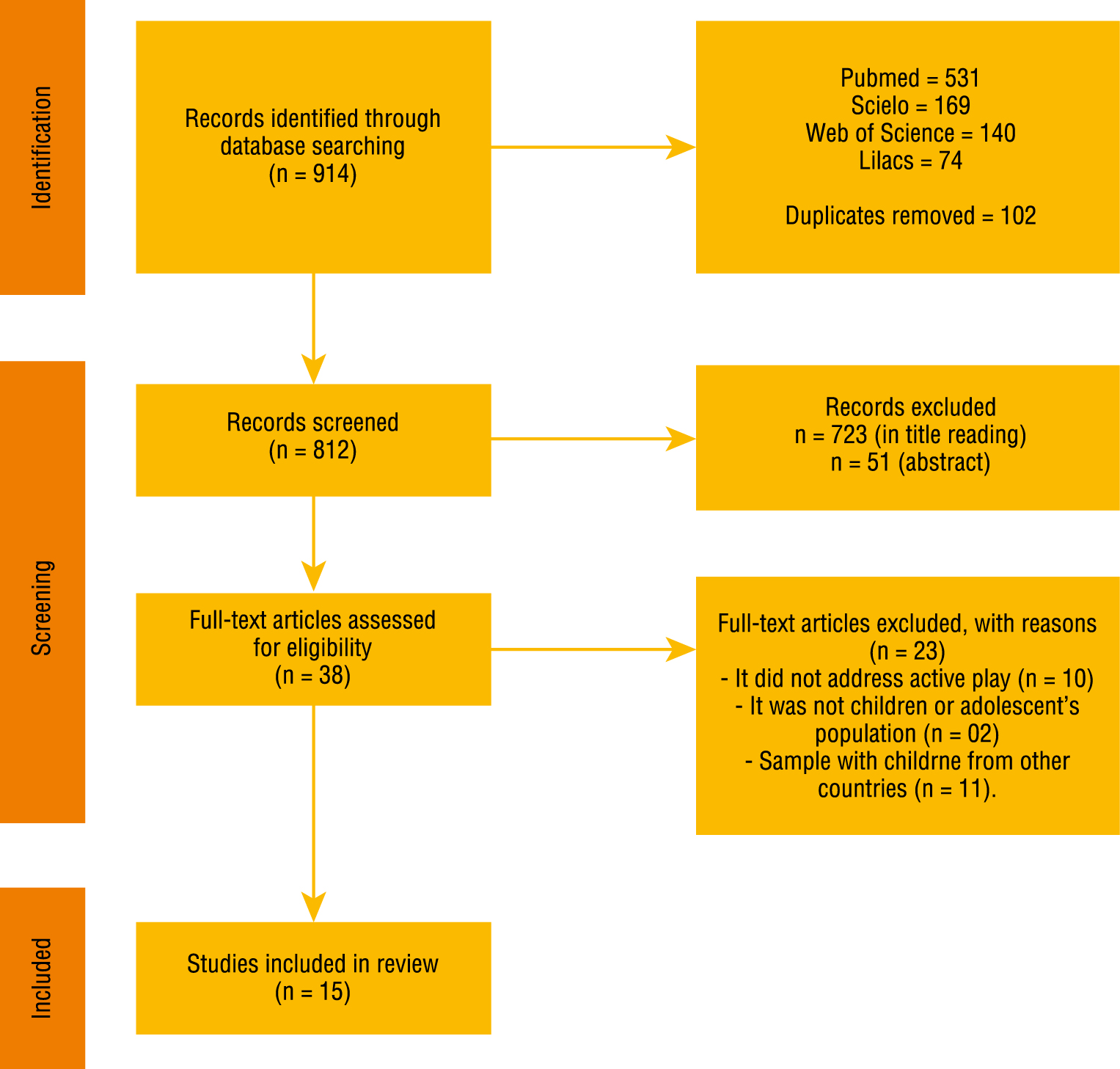
A total of 914 articles were identified (PubMed = 531; SciELO = 169; Web of Science = 140; LILACS = 74), but 102 were removed due to duplication. After screening titles and abstracts, 38 articles were read in full. Of these, 15 were included in this review4,16-29 (Figure 1).
Four studies included participants from different regions of Brazil; three were conducted in the Northeast region; four in the South region; one in the Southeast; one in the Midwest; one included international data; and one did not report the exact location. Only one study had a longitudinal design16, while the remaining studies were characterized as cross-sectional. Sample sizes ranged from 51 to 74.589 participants, and the age range varied from 0 to 18 years. The main characteristics of the studies are presented in Table 1.
The methodological quality of the studies is presented in Table 2. Among the included studies, four showed moderate methodological quality and two showed low methodological quality. Aspects related to the sampling process (Q1; Q2; Q3) were not adequately reported, particularly in studies of low and moderate quality.
Note: Methodological quality was categorized as “Low” when a study obtained up to four “Yes” responses for the assessed items; “Moderate” when a study obtained five to seven “Yes” responses; and “High” when a study achieved eight or more “Yes” responses.
When analyzing the objectives of the selected studies, it was identified that only three mentioned active play in their objectives. Most studies focused on investigating physical activity, including leisure-time physical activity, and associated factors. Active play and/or leisure activities were analyzed secondarily in order to identify the types and settings of physical activity practices most frequently performed by children and adolescents17,19,23,27.
Regarding the prevalence of children’s participation in active play, values ranged from 41.3%24 to 76%17. The mean time spent in active play ranged from 34 minutes/day when measured by accelerometry25 to 188.7 minutes per day when assessed using a parent-reported questionnaire23. Girls spent less time in active play (28 min/day) than boys (40 min/day)25. The percentage of Brazilian children who reported playing/spending time outdoors every day was 41.3%24. The only study conducted with infants (zero to two years of age) indicated that parental practices, including active play, are protective factors for motor development28.
Among adolescents, the prevalence of leisure-time physical activity was 45.2%, being higher among boys (60.9%) compared with girls (29.6%)20, and not studying/working was associated with a higher prevalence of leisure-time physical activity26. The mean leisure-time physical activity duration was 125.3 minutes/week, being higher in boys (160.6 min/week) than in girls (87.7 min/week)4.
Regarding physical activity intensity, playing outdoors, living in houses with a yard and indoor space, and attending schools with courtyards and playgrounds appear to favor opportunities for children to experience moderate-to-vigorous physical activity27. Among adolescents, the prevalence of low-intensity leisure-time physical activity was 44.4%, and 50.8% for moderate-to-vigorous intensity29.
Three studies18,22,24,29 addressed leisure-time physical activity and psychosocial aspects. Another study indicated that having two or more physical education classes per week increased the likelihood of engaging in active play outside school19. Gender-related issues were also addressed in the studies, indicating that girls presented lower values for active play and/or active leisure than boys4,20,21,23,25.
The only longitudinal study16 showed an increase in leisure-time activities at moderate-to-vigorous intensity after a 2-year follow-up (107.72 min/week to 165.85 min/week) among children and adolescents. Small fluctuations in leisure-time physical activity were also identified in the results of the National School-Based Health Survey (PeNSE) in the 2012 (122 min/week), 2015 (115.4 min/week), and 2019 (138.5 min/week) editions4.
Regarding the assessment of active play, three studies used accelerometers and questionnaires25-27, one used a pedometer and questionnaire23 one used the observational method17, and ten studies used self-report questionnaires. The main results of each study are presented in Chart 1.
DISCUSSION
This review evaluated Brazilian studies that addressed unstructured active play, at any intensity, in indoor or outdoor environments, among children and/or adolescents. In addition, it identified the percentage of children/adolescents who participate in active play, the time spent in these activities, and the most frequently performed active play activities.
Based on the 15 studies included in this review, active play remains underexplored despite the existence of studies related to physical activity in children and adolescents. Active play as a primary variable was identified in only three studies, whereas the remaining studies addressed it as a secondary outcome or included it within broader physical activity groups17,19,23,27. This finding supports international evidence emphasizing the limited focus on active play, despite its importance for children’s socioemotional, cognitive, and motor development30.
The prevalence of leisure-time physical activity/active play among children ranged from 41.3% to 76%, and among adolescents it was 45.2%. In addition, a significant difference between sexes was identified. Boys showed higher levels of leisure-time physical activity/active play (60.9%) and a higher mean time (160.6 minutes/week) spent in these activities than girls (prevalence = 29.6%; mean time = 87.7 minutes/week). This result demonstrates a slight increase in the overall prevalence of active play among Brazilian children and adolescents compared with the findings of Mendes et al.12, who reported a mean prevalence of 36%. Moreover, this result is consistent with findings reported in the literature: boys are less physically inactive (47% to 80%) than girls (26% to 91%)12,31, and these differences become more pronounced with increasing age. The social and family context provides greater support for exploratory and physically vigorous habits among boys, whereas gender stereotypes as well a social norms limit girls’ autonomy in active play and make them more susceptible to sedentary activities21,32. Furthermore, studies on gender socialization emphasize that caregivers tend to impose more restrictions on girls’ active play within the home, a finding consistent with the studies included in this review.
In addition to individual factors, the present review highlighted a strong influence of the physical environment. Factors such as access to playgrounds, school courtyards, safe communal spaces, and living in houses with yards were associated with higher levels of movement and moderate-to-vigorous physical activity. Corroborating these findings, international evidence indicates that environments conducive to motor opportunities promote voluntary movement behaviors and stimulate children’s autonomy33. Similarly, one of the strongest predictors of total physical activity in children is outdoor play30.
An essential aspect that emerged from this study was the influence of parental practices. The studies included in the review showed that restricting activities—particularly in indoor environments—reduces opportunities for active play, whereas parental support, such as logistical support and permission to play outdoors, considerably increases participation. Evidence supports that caregivers are the primary mediators of motor opportunities in childhood and that their habits, values, and concerns significantly influence children’s active behavior30,32. This effect is more pronounced in preschool-aged children due to the physical and organizational dependence children have on adults.
Among adolescents, the studies included in the review indicated a high prevalence of leisure-time inactivity and a significant sex difference—a pattern observed in several countries. According to the literature, there appears to be a nearly universal decline in physical activity levels during adolescence, and this phenomenon generally coincides with increased sedentary behavior, high screen use, and reduced voluntary play34. The association found in the studies between leisure-time physical activity and mental health is supported by meta-analyses showing positive effects of physical activity on depressive symptoms, anxiety, and mental well-being in young people35. Additionally, positive effects on children’s mental and socioemotional health are endorsed by the pediatric community30. However, as observed in the present study, most evidence derives from cross-sectional studies, which limits causal inference.
Only one longitudinal study reported a long-term increase in moderate-to-vigorous physical activity, but without an association with future cardiometabolic risk16. Similar findings have been reported in international studies, which highlight that cardiometabolic impacts are subject to prolonged exposure during childhood and adolescence, in addition to maturational factors. Thus, the follow-up duration may have been insufficient to identify more robust physiological changes.
Findings from time-series data (e.g., PeNSE) report variability and a tendency toward a decline in leisure-time physical activity—a pattern similar to that observed in other countries, which have recorded reductions in spontaneous movement among children and adolescents over recent years, followed by increased screen time31.
The high methodological heterogeneity observed among the studies - emphasized by the use of both objective and subjective measures (direct observation, self-report, pedometers, and accelerometers) - contributed to considerable variation in estimates of active play duration. Less pronounced results were observed in investigations using accelerometry, whereas more pronounced results were found in studies using questionnaires. This incongruence is well documented in the literature, which suggests that indirect measures tend to overestimate physical activity levels, whereas direct measures are more accurate for assessing intensity but less precise in differentiating specific movements. Therefore, the wide range of time identified in the present study (34–188.1 min/day) corroborates ranges previously observed in international studies.
The diversity in methodological quality among the analyzed studies should also be considered. Several studies presented biases in the sampling process, such as insufficient sampling details or lack of sample size calculation18-20,22,29. Brazilian reviews on childhood physical activity have previously reported similar limitations, highlighting methodological challenges that restrict comparisons and inferences. Furthermore, causal analysis between active play, health, environmental factors, and child development is limited because only one longitudinal study was identified. Likewise, the lack of longitudinal studies is a common limitation in the global literature35.
The present study has limitations that should be considered. First, due to its cross-sectional design, causal inference is not possible. The use of self-report questionnaires, as reported in the studies included in this review, is susceptible to recall and social desirability biases, which may generate error in estimates. The breadth of categories used (e.g., active leisure vs. passive leisure) may be insufficient to differentiate or capture the various domains of physical activity (e.g., active transportation or household tasks). However, strengths include large and representative samples of Brazilian adolescents; the use of validated instruments and, in many cases, objective measures (accelerometry); and the performance of multivariable analyses considering confounding factors (e.g., age, sex). Finally, in some studies, stratification of physical activity (volume and intensity) enabled a more precise understanding of the association between different levels of practice and outcomes.
CONCLUSION
This systematic review is an update of Brazilian studies that address unstructured active play in children and adolescents. The study showed a prevalence of physical activity/active play of up to 76% among Brazilian children and 45.2% among adolescents. In addition, it was observed that boys present greater engagement and higher levels of leisure-time physical activity/active play than girls.
However, due to some gaps observed in the Brazilian literature—such as the scarcity of studies with a specific focus on active play, the absence of a conceptual and instrumental standard for active play, the lack of sample size calculation, the shortage of studies involving infants and preschool children, and the absence of longitudinal studies—the findings should be interpreted with caution.
Finally, the findings suggest an urgent need for interventions aimed at promoting active play, especially for children and adolescents in situations of greater socioeconomic vulnerability and with lower participation in active behaviors, to be undertaken by policymakers, schools, health professionals, and caregivers.
Data Availability Statement
The data that support the findings of this study are available from the corresponding author, upon reasonable request.
-
How to cite this article
Nascimento ES, Silva DT, Farias LES, Santos RP, Oliveira DB, Oliveira RVB, Oliveira FJF, Moraes JFVN, Fidelix YL. Prevalence of Active Play in Brazilian children and adolescents: an updated systematic review for the Brazil´s Report Card. Rev Bras Cineantropom Desempenho Hum 2026, 28:e112168. DOI: https://doi.org/10.1590/1980-0037.2026v28e112168
-
Funding
This research did not receive any specific grant from funding agencies in the public, commercial, or not-for-profit sectors. This study was funded by the authors.
-
Ethical approval
This research is in accordance with the standards set by the Declaration of Helsinki
REFERENCES
-
1 WHO: World Health Organization. Guidelines on physical activity and sedentary behaviour. Geneva: WHO; 2020 [cited 2025 Sep 23]. Available from: https://www.who.int/publications/i/item/9789240015128
» https://www.who.int/publications/i/item/9789240015128 -
2 Saudi L, Lameky VY. A systematic review of physical activity, sedentary behavior, and screen time in youth aged 7-18. J Pubnursing Sci. 2025;3(01):30-41. https://doi.org/10.69606/jps.v3i01.218
» https://doi.org/10.69606/jps.v3i01.218 -
3 Atkin AJ, Sherar LB, Ekelund U, Hansen BH, Andersen LB, Anderssen S, et al. Age-related change in children’s physical activity and sedentary time: the International Children’s Accelerometry Database (ICAD). PLoS One. 2025;20(9):e0327394. https://doi.org/10.1371/journal.pone.0327394 PMid:40929102.
» https://doi.org/10.1371/journal.pone.0327394 -
4 Soares CAM, Leão OAA, Freitas MP, Hallal PC, Wagner MB. Tendência temporal de atividade física em adolescentes brasileiros: análise da Pesquisa Nacional de Saúde do Escolar de 2009 a 2019. Cad Saude Publica. 2023;39(10):e00063423. https://doi.org/10.1590/0102-311xpt063423 PMid:37971097.
» https://doi.org/10.1590/0102-311xpt063423 -
5 IBGE: Instituto Brasileiro de Geografia e Estatística. Pesquisa nacional de saúde do escolar: análise de indicadores comparáveis dos escolares do 9º ano do ensino fundamental municípios das capitais: 2009/2019. Rio de Janeiro: IBGE; 2022 [cited 2025 Sep 23]. Available from: https://biblioteca.ibge.gov.br/visualizacao/livros/liv101955.pdf
» https://biblioteca.ibge.gov.br/visualizacao/livros/liv101955.pdf -
6 Zhang D, Zhang B, Wu Q, Peng X, Shao Y, Xu R. Exploring the associations between physical inactivity and cognitive function, mental health, and metabolic parameters in US adolescents: results stratified by sex. BMC Public Health. 2025;25(1):3036. https://doi.org/10.1186/s12889-025-24321-8 PMid:40903721.
» https://doi.org/10.1186/s12889-025-24321-8 -
7 Alves JGB, Alves GV. Effects of physical activity on children’s growth. J Pediatr (Rio J). 2019;95(Suppl 1):72-8. https://doi.org/10.1016/j.jped.2018.11.003 PMid:30593790.
» https://doi.org/10.1016/j.jped.2018.11.003 -
8 Hallal PC, Victora CG, Azevedo MR, Wells JCK. Adolescent physical activity and health: a systematic review. Sports Med. 2006;36(12):1019-30. https://doi.org/10.2165/00007256-200636120-00003 PMid:17123326.
» https://doi.org/10.2165/00007256-200636120-00003 -
9 Moghaddaszadeh A, Belcastro AN. Guided active play promotes physical activity and improves fundamental motor skills for school-aged children. J Sports Sci Med. 2021;20(1):86-93. https://doi.org/10.52082/jssm.2021.86 PMid:33707991.
» https://doi.org/10.52082/jssm.2021.86 -
10 Jiang S, Zeng N, Ng JYY, Chong KH, Zeng T, Leung SKY, et al. Effects of physical activity interventions on fundamental movement skills and cognitive function in early childhood: a systematic review and network meta-analysis. J Sport Health Sci. 2025;15:101085. https://doi.org/10.1016/j.jshs.2025.101085 PMid:40962027.
» https://doi.org/10.1016/j.jshs.2025.101085 -
11 Zhang X, Tang C, Geng M, Li K, Liu C, Cai Y. The effects of active play interventions on children’s fundamental movement skills: a systematic review. BMC Pediatr. 2025;25(1):40. https://doi.org/10.1186/s12887-024-05385-8 PMid:39825269.
» https://doi.org/10.1186/s12887-024-05385-8 -
12 Mendes AA, Lopes WA, Locateli JC, Oliveira GH, Bim RH, Simões CF, et al. The prevalence of active play in Brazilian children and adolescents: a systematic review. Rev Bras Cineantropom Desempenho Hum. 2018;20(4):395-405. https://doi.org/10.5007/1980-0037.2018v20n4p395
» https://doi.org/10.5007/1980-0037.2018v20n4p395 -
13 Westphal G, Pereira IAS, Borim MLC, Charal CMS, Nardo N Jr. Prevalence of active play in Brazilian children and adolescents: an updated systematic review for the Brazil’s Report Card. Rev Bras Cineantropom Desempenho Hum. 2021;23:e84442. https://doi.org/10.1590/1980-0037.2021v23e84442
» https://doi.org/10.1590/1980-0037.2021v23e84442 -
14 Page MJ, McKenzie JE, Bossuyt PM, Boutron I, Hoffmann TC, Mulrow CD, et al. A declaração PRISMA 2020: diretriz atualizada para relatar revisões sistemáticas. Rev Panam Salud Publica. 2023;46:e112. https://doi.org/10.26633/RPSP.2022.112 PMid:36601438.
» https://doi.org/10.26633/RPSP.2022.112 -
15 Tufanaru C, Munn Z, Aromataris E, Campbell J, Hopp L. Systematic reviews of effectiveness. In: Aromataris E, Lockwood C, Porritt K, Pilla B, Jordan Z, editors. JBI Manual for Evidence Synthesis. Adelaide: JBI; 2024. https://doi.org/10.46658/JBIMES-24-03
» https://doi.org/10.46658/JBIMES-24-03 -
16 Sehn AP, Silveira JF, Brand C, Lemes VB, Borfe L, Tornquist L, et al. Screen time, sleep duration, leisure physical activity, obesity, and cardiometabolic risk in children and adolescents: a cross-lagged 2-year study. BMC Cardiovasc Disord. 2024;24(1):525. https://doi.org/10.1186/s12872-024-04089-2 PMid:39354336.
» https://doi.org/10.1186/s12872-024-04089-2 -
17 Albuquerque DD, Günther ID. Apropriação dos espaços urbanos na infância e na velhice em Brasília (DF). Psicologia (Cons Fed Psicol). 2023;43:e255684. https://doi.org/10.1590/1982-3703003255684
» https://doi.org/10.1590/1982-3703003255684 -
18 Volz PM, Corrêa LQ, Alexandrino EG, Rodrigues R, Silva MP, Dumith SC. Is physical activity associated with a higher degree of wisdom? Cross-sectional study with high school students. J Phys Educ (Maringá). 2024;34(1):e3457. https://doi.org/10.4025/jphyseduc.v34i1.3457
» https://doi.org/10.4025/jphyseduc.v34i1.3457 -
19 Jesus GM, Araujo RHO, Dias LA, Barros AK, Araujo LDS, Assis MAA. Attendance in physical education classes, sedentary behavior, and different forms of physical activity among schoolchildren: a cross-sectional study. BMC Public Health. 2022;22(1):1461. https://doi.org/10.1186/s12889-022-13864-9 PMid:35915433.
» https://doi.org/10.1186/s12889-022-13864-9 -
20 Andrade ML, Oliveira JD, Souza NP, Costa EC, Tavares FC, Cabral PC, et al. Birth-related and current factors associated with physical inactivity in the leisure time in Brazilian adolescents. PLoS One. 2022;17(9):e0273611. https://doi.org/10.1371/journal.pone.0273611 PMid:36083895.
» https://doi.org/10.1371/journal.pone.0273611 -
21 Jesus GM, Dias LA, Barros AKC, Araujo LDMS, Schrann MMF. Do girls wash dishes and boys play sports? Gender inequalities in physical activity and in the use of screen-based devices among schoolchildren from urban and rural areas in Brazil. BMC Public Health. 2024;24(1):196. https://doi.org/10.1186/s12889-024-17672-1 PMid:38229021.
» https://doi.org/10.1186/s12889-024-17672-1 -
22 Ferreira VR, Jardim TV, Póvoa TI, Viana RB, Sousa AL, Jardim PC. Physical inactivity during leisure and school time is associated with the presence of common mental disorders in adolescence. Rev Saude Publica. 2020;54:128. https://doi.org/10.11606/s1518-8787.2020054001888 PMid:33295594.
» https://doi.org/10.11606/s1518-8787.2020054001888 -
23 Valentini NC, Souza PS, Souza MS, Nobre GC. Individual and environmental parameters in children with and without developmental coordination disorder: associations with physical activity and body mass index. Front Pediatr. 2023;11:1202488. https://doi.org/10.3389/fped.2023.1202488 PMid:37920789.
» https://doi.org/10.3389/fped.2023.1202488 -
24 Gomez-Baya D, Gaspar T, Corrêa R, Nicoletti JA, Garcia-Moro FJ. Leisure time activities and subjective happiness in early adolescents from three Ibero-American countries: the cases of Brazil, Chile and Spain. Children (Basel). 2023;10(6):1058. https://doi.org/10.3390/children10061058 PMid:37371289.
» https://doi.org/10.3390/children10061058 -
25 Goncalves WSF, Byrne R, Lira PIC, Viana MT, Trost SG. Parental influences on physical activity and screen time among preschool children from low-income families in Brazil. Child Obes. 2023;19(2):112-20. https://doi.org/10.1089/chi.2021.0305 PMid:35653741.
» https://doi.org/10.1089/chi.2021.0305 -
26 Confortin SC, Rocha PR, Silva BG, Menezes AM, Horta BL, Gonçalves H, et al. Physical activity in birth cohorts of three Brazilian cities, Ribeirão Preto, Pelotas, and São Luís: a cross-sectional study. Rev Bras Epidemiol. 2022;25:e220024. https://doi.org/10.1590/1980-549720220024 PMid:36074452.
» https://doi.org/10.1590/1980-549720220024 -
27 Nobre JN, Morais RL, Prat BV, Fernandes AC, Viegas ÂA, Figueiredo PH, et al. Physical environmental opportunities for active play and physical activity level in preschoolers: a multicriteria analysis. BMC Public Health. 2022;22(1):340. https://doi.org/10.1186/s12889-022-12750-8 PMid:35177034.
» https://doi.org/10.1186/s12889-022-12750-8 -
28 Dall’Alba SC, Zanella LW, Valentini NC. Parental practices and knowledge: an associative study on children’s motor skills acquisitions. Saude Debate. 2022;46:114-24. https://doi.org/10.1590/0103-11042022e510
» https://doi.org/10.1590/0103-11042022e510 -
29 Coledam DH, Arruda GA, Dos-Santos JW, Ré AHN. The role of volume and intensity on the association between physical activity and mental health among adolescents: a cross-sectional study. Rev Paul Pediatr. 2023;41:e2022010. https://doi.org/10.1590/1984-0462/2023/41/2022010 PMid:37042941.
» https://doi.org/10.1590/1984-0462/2023/41/2022010 -
30 Beaulieu E, Beno S. Healthy childhood development through outdoor risky play: navigating the balance with injury prevention. Paediatr Child Health. 2024;29(4):255-69. https://doi.org/10.1093/pch/pxae016 PMid:39045477.
» https://doi.org/10.1093/pch/pxae016 -
31 Guthold R, Stevens GA, Riley LM, Bull FC. Global trends in insufficient physical activity among adolescents: a pooled analysis of 298 population-based surveys with 1.6 million participants. Lancet Child Adolesc Health. 2020;4(1):23-35. https://doi.org/10.1016/S2352-4642(19)30323-2 PMid:31761562.
» https://doi.org/10.1016/S2352-4642(19)30323-2 -
32 O’Connor TM, Cerin E, Hughes SO, Robles J, Thompson DI, Mendoza JA, et al. Psychometrics of the preschooler physical activity parenting practices instrument among a Latino sample. Int J Behav Nutr Phys Act. 2014;11(1):3. https://doi.org/10.1186/1479-5868-11-3 PMid:24428935.
» https://doi.org/10.1186/1479-5868-11-3 -
33 Branje K, Stevens D, Hobson H, Kirk S, Stone M. Impact of an outdoor loose parts intervention on Nova Scotia preschoolers’ fundamental movement skills: a multi-methods randomized controlled trial. AIMS Public Health. 2021;9(1):194-215. https://doi.org/10.3934/publichealth.2022015 PMid:35071678.
» https://doi.org/10.3934/publichealth.2022015 -
34 Dumith SC, Gigante DP, Domingues MR, Kohl HW 3rd. Physical activity change during adolescence: a systematic review and a pooled analysis. Int J Epidemiol. 2011;40(3):685-98. https://doi.org/10.1093/ije/dyq272 PMid:21245072.
» https://doi.org/10.1093/ije/dyq272 -
35 Biddle SJH, Ciaccioni S, Thomas G, Vergeer I. Physical activity and mental health in children and adolescents: an updated review of reviews and an analysis of causality. Psychol Sport Exerc. 2019;42:146-55. https://doi.org/10.1016/j.psychsport.2018.08.011
» https://doi.org/10.1016/j.psychsport.2018.08.011
Edited by
-
Scientific Editor:
Diego Augusto Santos Silva