 Use of Elastic Suture for the Closure of Complex Wounds
Abstract
The management of complex wounds remains a challenge, with impacts on the biological, psychological, social, and financial aspects of patients and healthcare institutions. Although traditional methods (such as grafts and flaps) are widely used, limitations, including infection, necrosis, and excessive tension, require effective alternatives. Elastic suture, introduced by Raskin in 1993, has emerged as an innovative approach. This technique uses sterile elastics to apply controlled tension and approximate wound edges, leveraging the skin's elasticity and compliance. The uniform tension distribution minimizes tissue necrosis and optimizes wound healing, reducing the risk of complications associated with invasive methods. We herein report three cases of patients treated in an emergency-care setting using elastic sutures for complex wound closure. In all cases, the evolution was satisfactory, with favorable esthetic and functional outcomes. The approach demonstrated effectiveness in wound closure, promoting adequate healing and functional preservation, reinforcing its viability as an effective alternative to manage complex wounds. With advantages such as low cost, simplified execution, applicability in several body regions, and reduced morbidity and mortality, elastic suture emerges as a promising and efficient alternative. Its benefits include a decreased need for invasive procedures, greater reproducibility in outpatient settings, and significant improvement in patients' quality of life.
Keywords
rubber; suture techniques; sutures; wound closure techniques; wound healing; wounds and injuries
Resumo
O manejo de feridas complexas permanece um desafio que tem impacto sobreas esferas biológicas, psicológicas, sociais e financeiras do paciente e das instituições de saúde. Apesar de métodos tradicionais como enxertos e retalhos serem amplamente utilizados, limitações como infecção, necrose e tensão excessiva requerem alternativas eficazes. A sutura elástica, introduzida em 1993 por Raskin, destaca-se como uma abordagem inovadora. Essa técnica utiliza elásticos estéreis para tensionar e aproximar as bordas das feridas ao explorar a elasticidade e complacência da pele. A distribuição uniforme da tensão minimiza a necrose tecidual e otimiza a cicatrização, o que reduz o risco de complicações associadas a métodos invasivos. Relatamos três casos de pacientes atendidos no pronto atendimento por meio da técnica de suturas elásticas para o fechamento de feridas complexas. Em todos os casos, observou-se uma evolução satisfatória, com resultados estético-funcionais adequados. A abordagem demonstrou eficiência no fechamento das lesões, ao promover cicatrização adequada e preservação da funcionalidade, o que corrobora a viabilidade do método como alternativa eficaz no manejo de feridas complexas. Com vantagens como baixo custo, execução simplificada, aplicabilidade em diferentes regiões do corpo e redução da morbimortalidade, a sutura elástica emerge como uma alternativa promissora e eficiente. Seus benefícios incluem menor necessidade de procedimentos invasivos, maior reprodutibilidade em contextos ambulatoriais e melhora significativa na qualidade de vida dos pacientes.
Palavras-chave
borracha; cicatrização; ferimentos e lesões; suturas; técnicas de fechamento de ferimentos; técnicas de sutura
Introduction
Complex wound treatment remains a significant challenge in the clinical practice, with repercussions in multiple (including biological, psychological, social, and financial) aspects of the patient's life. In addition, it has a direct impact on healthcare systems. This complexity fostered the development of several therapeutic approaches to promote effective, accessible, and reproducible care, enabling better clinical outcomes and improved quality of life.
Plastic surgery offers a myriad of techniques for tissue reconstruction, including grafts, flaps, and expanders, aiming to preserve functionality and esthetics.1 However, primary closure is still the first choice whenever possible. If unfeasible due to lesion extent, infection, necrosis, inflammation, or lack of viable edges, for example, physicians need alternative approaches for proper closure that do not exert excessive tension on the wound bed.2,3
In this context, we highlight elastic suturing, a technique introduced by Raskin in 1993,4 which involves sterile elastics intertwined at the edges of the lesion to benefit from the biomechanical properties of the skin, such as elasticity and compliance, for gradual tissue tension and approximation. This process stimulates local metabolic activity, induces the secretion of growth factors, and promotes regeneration. Elastic suturing also provides homogeneous pressure distribution over tissues, preventing ischemia and necrosis. These conditions are frequent when conventional techniques result in excessive tension.
The current article aims to present and discuss the use of elastic sutures in the closure of complex lesions, illustrating its application in a series of three clinical cases treated in an emergency-room setting.
Materials and Methods
The Research Ethics Committee of Instituto Presbiteriano Mackenzie approved the present study (under CAAE: 82764524.8.0000.0103). For the theoretical background, we conducted a systematic review following the protocol of the 2020 Preferred Reporting Items for Systematic Reviews and Meta-Analyses (PRISMA) statement. The searches were conducted on the SciELO, LILACS, Cochrane Library, and PubMed databases, using descriptors in English, Portuguese, and Spanish, including suture techniques, wound healing, rubber, and wound closure techniques, according to the medical subject headings (MeSH) and their equivalent health science descriptors (descritores em ciências da saúde, DeCS, in Portuguese).
In the initial search, we retrieved 41 articles, but we excluded 29 that did not meet the inclusion criteria. The remaining 12 articles underwent a comprehensive analysis for their inclusion in the qualitative synthesis. The analysis of the references of these studies did not result in any new inclusions.
Case Presentation
Case 1
We herein report the case of a 40-year-old male patient who presented with complaints of pain and edema in the submandibular region, which worsened and radiated to the chest. He was a smoker with no other known comorbidities. A physical examination revealed extensive necrosis of the anterior chest wall, from the chin to the xiphoid process. A computed tomography scan showed an abscess and subcutaneous emphysema, requiring initial treatment with antibiotic therapy and intensive care unit (ICU) admission (Figs. 1-3).

Appearance of the lesion after debridement in the surgical center; note the granulation tissue.

Appearance, on the first postoperative day, of the new debridement with edge approximation using elastic suture.

The patient underwent resection of the necrotic tissue through a thoracotomy, sparing the pectoralis major muscles. As the primary closure of the surgical incision was unfeasible, we performed a second intervention for debridement and application of elastic sutures to approximate the edges, followed by a graft taken from the thigh. The clinical evolution and scar healing process were satisfactory (Fig. 4).

Case 2
We herein report the case of a 20-year-old male patient who sustained a motorcycle accident and presented with an open fracture of the left femur and extensive laceration of the thigh. He underwent debridement and external fixation. The patient developed rhabdomyolysis, renal failure, and femoral arterial occlusion, culminating in supracondylar amputation (Fig. 5). Postoperatively, the stump presented with necrosis, requiring a new intervention to adjust the edges and subsequently apply elastic sutures to approximate the edges of the incision. The outpatient follow-up revealed progressive improvement, with effective healing (Figs. 6-8).



Case 3
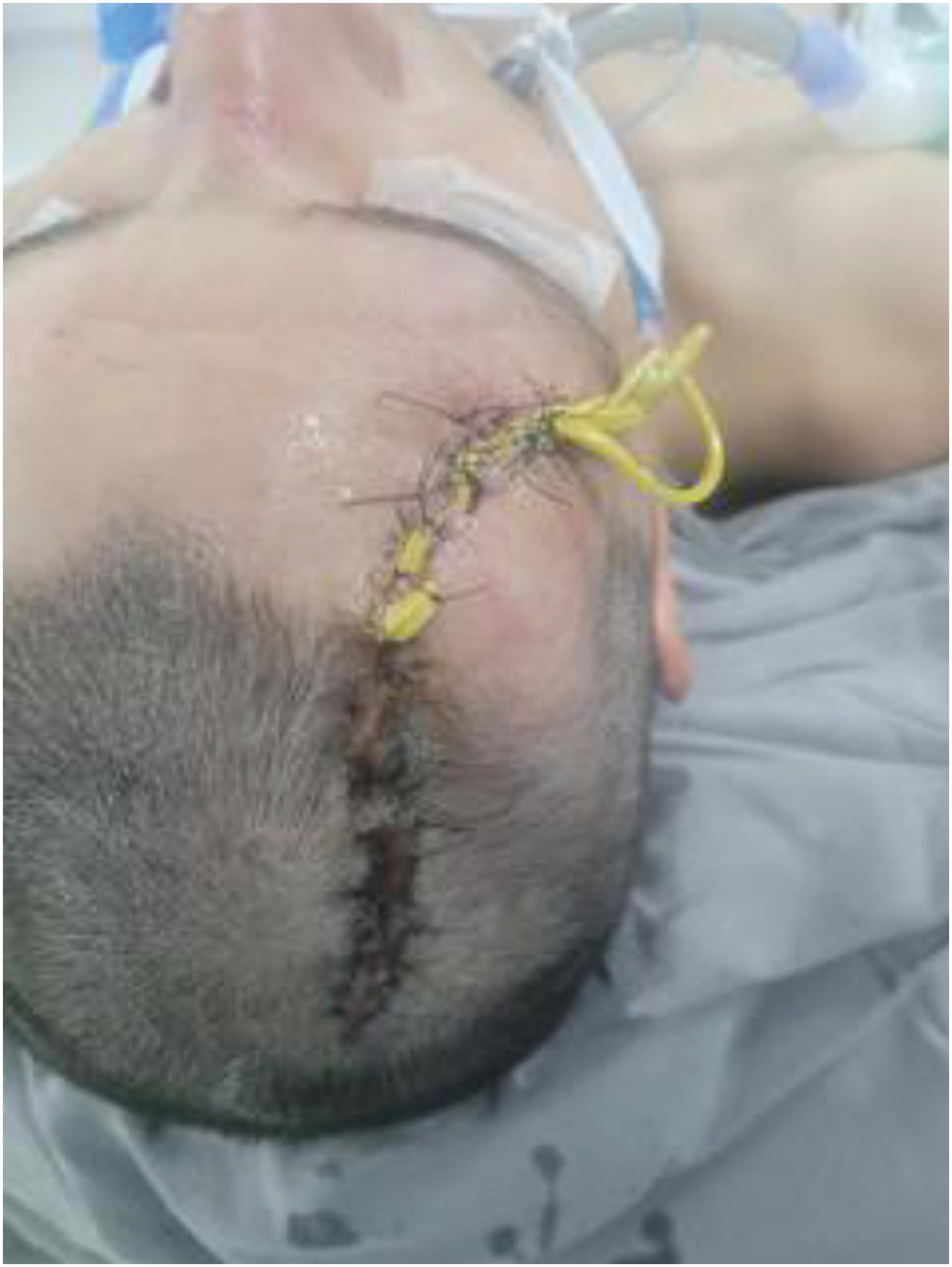
We herein report the case of a 28-year-old male patient, a victim of a bicycle accident, who presented with extensive lacerations on his forehead and myiasis. His hospitalization was late, as this patient lived in a homeless shelter, was a smoker, and an alcoholic (Fig. 9) The patient underwent surgical debridement and removal of the larvae. We performed partial edge approximation with elastic sutures, since primary closure was unfeasible. After 7 days, we removed the elastic and proceeded to a conventional closure with nylon sutures. The patient showed excellent progress, with proper healing and a satisfactory esthetic outcome (Figs. 10-11)



Discussion
Managing complex wounds is a multifaceted challenge in the clinical practice, requiring approaches for proper closure while minimizing morbidity and optimizing long-term esthetic and functional outcomes. In this context, elastic suturing stands out as a valuable tool, especially when immediate primary closure is not a viable option. Elastic suturing is an inexpensive, minimally-invasive, and remarkably-effective alternative.
The primary indications for elastic suturing include lacerations with significant tissue loss or situations in which excessive tension makes conventional primary closure unfeasible, since it can compromise tissue viability and lead to ischemia, necrosis, or dehiscence. Its applicability is broad, ranging from extensive traumatic injuries, as in cases 2 and 3 herein reported, to larger defects resulting from oncological resections, as in case 1, as well as areas of tissue necrosis requiring gradual approximation. This technique is also advantageous when there is contamination or infection, as the progressive approximation of the wound edges enables a more effective control of the infectious process, favoring safe secondary closure after sanitation. In patients with comorbidities, elastic suturing reduces the need for complex reconstructive procedures, offering greater safety in scenarios with high anesthetic risk. Moreover, it is advantageous in regions with limited skin availability, including the face, joints, and extremities, in which the inherent elasticity of the tissue can reduce the need for grafts or flaps. Its versatility also extends to acute and chronic injuries, as it adapts to different clinical contexts, promoting healing in situations that demand dynamic approaches.
The main advantage of elastic sutures is the physiological and gradual approximation of tissues, which differs from conventional sutures by using the biomechanical properties of the skin, including elasticity, compliance, and viscoelasticity, to progressively approximate the wound edges. This dynamic process optimizes the marginal coaptation and favors the creation of a microenvironment conducive to tissue regeneration. The controlled and homogeneous tension stimulates angiogenesis, local metabolic activity, and the release of growth factors, minimizing the risks of ischemia and necrosis observed in primary closures under high tension.2,3 Another relevant point is the superior cost-benefit profile, since elastic suture uses low-cost materials and is easy to perform. It can be applied in several clinical settings, including emergency rooms and outpatient clinics, often under local anesthesia, which reduces hospital costs, the need for highly-complex surgical resources such as operating rooms or complete teams, and decreases the length of hospital stay.5,6 As such, it has a positive impact on the sustainability of healthcare services.
The esthetic and functional outcomes of elastic suturing are also superior, as the technique prevents hypertrophic scars or keloids resulting from excessive tension, while promoting healing closer to the physiological conditions of the skin. The functional recovery of the affected area is optimized, since gradual tension enables natural tissue adaptation, reducing the risk of stiffness or scar contracture. The technique also reduces morbidity and provides greater patient comfort, as it is less invasive, generates less surgical trauma, causes less pain and discomfort in the postoperative period, and it results in faster recovery, with lower requirement for potent analgesics compared with flaps or grafts. Furthermore, the possibility of performing the procedure in an outpatient setting, as demonstrated in the cases herein reported, reduces patient psychological stress and the risk of hospital infections, contributing to a more humanized recovery experience. Its versatility also enables its combination with other therapies, such as vacuum-assisted wound therapy (also known as negative-pressure wound therapy, NPWT), which enhances the formation of granulation tissue, reduces edema, and removes exudates, accelerating the healing process, even in larger skin defects.7,8 Studies7 report success rates exceeding 95% for this type of combination, with a low occurrence of complications such as ischemia and dehiscence.
In comparison with other therapeutic options, such as grafts and flaps, elastic suturing demonstrates significant advantages. Primary closure, although ideal, is often unfeasible in extensive, infected, or necrotic ulcers due to excessive tension. In these situations, elastic suturing can be used as a bridge for definitive closure or as a single method, eliminating the risks associated with high tension.2,3 Regarding skin grafts, which require a well-vascularized bed and can leave scars in the donor area, elastic suturing reduces or eliminates the need for these procedures by gradually approximating the tissue edges. Compared with flaps, which provide robust tissue to cover exposed vital structures but involve more complex surgical procedures and higher morbidity, elastic suturing is a less-invasive alternative, and it can even prepare the bed for a smaller, safer flap.1 In contrast to tissue expanders, which generate additional skin with good esthetic outcomes but require multiple steps and prolonged time, elastic suturing is a faster solution, especially when the patient's clinical condition or the urgency of the case does not enable such an approach. The combination with NPWT becomes particularly effective, as this modality optimizes the tissue under treatment and elastic suture promotes the gradual approximation of the edges, ensuring effective closure.8
The technique described by Raskin in 19934 has been improved over time, with variations that include fixing the elastic band to planes, such as the superficial fascia or the subcutaneous tissue, to enhance tension distribution, provide greater stability, and reduce the risk of pressure necrosis at the skin edges.9 Other significant modifications include the use of polypropylene mesh as an anchor to increase adhesion to tissues and decrease the chances of dehiscence or migration of the device, making the approximation process safer.10 The use of skin stretching devices with elastic bands also demonstrates promising results, especially in large lesions, achieving success rates of 95.45% and reducing the risk of dehiscence and edge ischemia.7 These advances confirm the adaptability of the technique and its potential for continuous refinement.
In light of this evidence, elastic suturing is becoming an indispensable resource in the arsenal of plastic and reconstructive surgery. Its intrinsic ability to promote gradual and physiological closure, combined with its low cost, minimal invasiveness, and superior esthetic and functional outcomes, makes it an effective option as a standalone technique and in combination with other reconstructive modalities. It is a promising and easy-to-perform method, whose applicability to different body regions and the possibility of performing it in an outpatient setting under local anesthesia further enhance its clinical relevance. These aspects corroborate the role of elastic suturing as a robust and effective strategy to treat complex wounds, offering benefits to the patient and the healthcare system.8
Conclusion
Elastic suturing represents a promising alternative to close complex lesions. Easy to perform, low-cost, and providing excellent functional and esthetic outcomes, it is reproducible in an outpatient setting using local anesthesia. Its use reduces the need for invasive techniques, minimizes complications, and contributes to efficient patient rehabilitation, with positive impacts on quality of life and hospital costs.
Data Availability
Data will be available upon request to the corresponding author.
References
-
1 Teixeira N Neto, Chi A, Paggiaro AO, Ferreira MC. Tratamento cirúrgico das feridas complexas. Rev Med (São Paulo) 2010;89(3/4):147–152. Doi: 10.11606/issn.1679-9836.v89i3/4p147-151
» https://doi.org/10.11606/issn.1679-9836.v89i3/4p147-151 -
2 Vogels RR, Lambertz A, Schuster P, et al. Biocompatibility and biomechanical analysis of elastic TPU threads as new suture material. J Biomed Mater Res B Appl Biomater 2017;105(01):99–106. Doi: 10.1002/jbm.b.33531
» https://doi.org/10.1002/jbm.b.33531 -
3 Helmedag M, Heise D, Eickhoff R, et al. Cross-section modified and highly elastic sutures reduce tissue incision and show comparable biocompatibility: in-vitro and in-vivo evaluation of novel thermoplastic urethane surgical threads. J Biomed Mater Res B Appl Biomater 2021;109(05):693–702. Doi: 10.1002/jbm.b.34734
» https://doi.org/10.1002/jbm.b.34734 - 4 Raskin KB. Acute vascular injuries of the upper extremity. Hand Clin 1993;9(01):115–130
-
5 Ferrari JB, Machado R Junior, Rocha ALM, et al. Sutura elástica como uma alternativa para tratamento de feridas traumáticas na urgência: um relato de caso. Revistaft 2024;28(132):21. Doi: 10.5281/zenodo.10777121
» https://doi.org/10.5281/zenodo.10777121 -
6 Petroianu A, Sabino KR, Alberti LR. Closure of large wound with rubber elastic circular strips - case report. Arq Bras Cir Dig 2014;27(01):86–87. Doi: 10.1590/s0102-67202014000100021
» https://doi.org/10.1590/s0102-67202014000100021 -
7 Cheng LF, Lee JT, Hsu H, Wu MS. Simple Skin-Stretching Device in Assisted Tension-Free Wound Closure. Ann Plast Surg 2017;78(3, Suppl 2)S52–S57. Doi: 10.1097/SAP.0000000000001006
» https://doi.org/10.1097/SAP.0000000000001006 -
8 Tonatto AJ Filho, Moraes JLd, Giacomazzo CM, Bossardi A, Lopes MC, Freitas RdS. Uso concomitante de sutura elástica associada ao curativo a vácuo no fechamento de grandes perdas de partes moles. Rev Bras Cir Plást 2022;37(04):463–466. Doi: 10.5935/2177-1235.2022RBCP.491-pt
» https://doi.org/10.5935/2177-1235.2022RBCP.491-pt -
9 Leite NM, Reis FBd, Christian RW. Tratamento de ferimentos deixados abertos com o método da sutura elástica. Rev Bras Ortop 1996;31(08):687–689 Disponível em: https://www.rbo.org.br/Content/pdf/31-8/1996_ago_87.pdf
» https://www.rbo.org.br/Content/pdf/31-8/1996_ago_87.pdf -
10 Vidal MA, Mendes CEDS Junior, Sanches JA. Sutura elástica - uma alternativa para grandes perdas cutâneas. Rev Bras Cir Plást 2014;29(01):146–150. Doi: 10.5935/2177-1235.2014RBCP0024
» https://doi.org/10.5935/2177-1235.2014RBCP0024
Edited by
-
Editor-in-Chief:
Dov Charles Goldenberg.