
 Factors associated with specialty choice among Medical students: implications for social accountability
ABSTRACT
Introduction: Residency is the main model of medical specialization in Brazil, based on supervised training and professional certification. Although essential to medical education, it faces regional inequalities and a mismatch between the supply of specialists and the demands of the Unified Health System (SUS), requiring policies guided by equity and social needs.
Objective: To describe the factors associated with the choice of medical specialty among medical students at the University of Brasília, considering sociodemographic, academic, and vocational characteristics.
Methods: A cross-sectional study was conducted using a stratified probabilistic sample by course stage (early, intermediate, and internship). Among 350 eligible students, 202 (58%) responded to the electronic questionnaire. A weighting procedure was applied to correct for nonresponse and preserve the representativeness of strata. The instrument included sociodemographic, academic, and socioeconomic variables, as well as influencing factors for specialty choice assessed on a Likert scale. Analyses comprised absolute and relative frequencies, 95% confidence intervals (95%CI), and Student’s t, Mann-Whitney, and Pearson’s Chi-square tests. A 5% significance level was adopted.
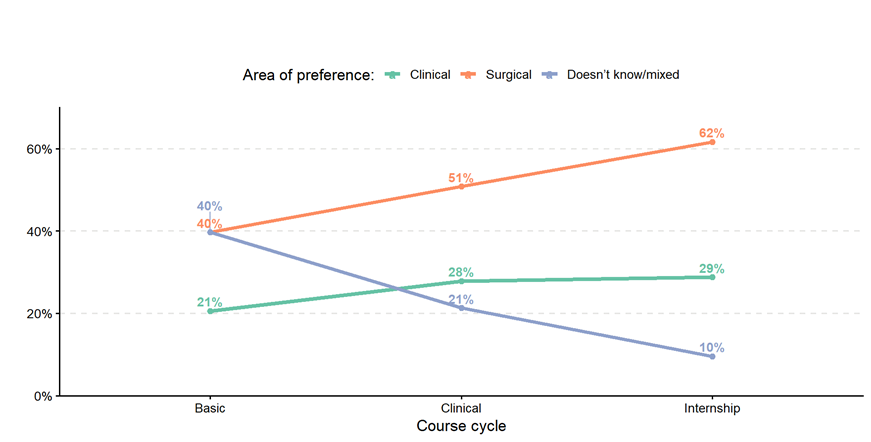
Result: Most participants were male (54.0%) and aged between 21 and 24 years (52.0%). Admission occurred mainly through the quota system (48.2%), and more than half attended public high schools (52.1%). The majority (96.7%) intended to pursue a medical residency, with a predominance of clinical (50.6%) and surgical (25.4%) areas. A significant association was found between course stage and preferred area (p = 0.001), with an increase in surgical preference (62.0%) and a decrease in indecision (10%) during the internship. Gender differences indicated a higher appreciation of leisure time among women (p = 0.036).
Conclusion: Specialty choice was influenced by quality of life and professional practice, highlighting socially responsible medical training aligned with the Brazilian Unified Health System (SUS).
Keywords:
Medical Education; Medical Students; Internship and Residency; Medical Specialties; Cross-sectional Study
RESUMO
Introdução: A residência é o principal modelo de especialização médica no Brasil e fundamenta-se no treinamento supervisionado e na certificação profissional. Apesar de essencial à formação, enfrenta desigualdades regionais e descompasso entre oferta de especialistas e demandas do SUS, exigindo políticas orientadas por equidade e necessidades sociais.
Objetivo: Este estudo descreve os fatores associados à escolha da especialidade médica entre estudantes de Medicina da Universidade de Brasília, considerando características sociodemográficas, acadêmicas e vocacionais.
Método: Trata-se de um estudo transversal com amostra probabilística estratificada por ciclo do curso (inicial, intermediário e internato). Dos 350 estudantes elegíveis, 202 (58%) responderam ao questionário eletrônico. Aplicou-se procedimento de ponderação para correção de não resposta e preservação da representatividade dos estratos. O instrumento contemplou variáveis sociodemográficas, acadêmicas, socioeconômicas e fatores de influência na escolha da especialidade em escala Likert. As análises incluíram frequências absolutas e relativas, intervalos de confiança de 95% (IC95%), testes t de Student, Mann-Whitney e qui-quadrado de Pearson. Adotou-se nível de significância de 5%.
Resultado: A maioria dos participantes era do sexo masculino (54,0%) e tinha entre 21 e 24 anos (52,0%). O ingresso ocorreu principalmente pelo sistema de cotas (48,2%), e mais da metade cursou ensino médio em escolas públicas (52,1%). A maioria (96,7%) pretende realizar residência médica, com destaque para as áreas clínica (50,6%) e cirúrgica (25,4%). Observou-se associação significativa entre ciclo do curso e área de preferência (p = 0,001), com aumento da escolha pela área cirúrgica (62,0%) e redução da indefinição (10%) no internato. Diferenças por sexo indicaram maior valorização do tempo para lazer entre mulheres (p = 0,036).
Conclusão: A escolha da especialidade foi influenciada pela qualidade de vida e pela prática profissional, destacando a formação médica socialmente responsável e alinhada ao SUS.
Palavras-chave:
Educação Médica; Estudantes de Medicina; Residência Médica; Especialidades Médicas; Estudo Transversal
INTRODUCTION
Medical residency (MR) in Brazil is regulated by Law N. 6,932, of July 7, 19811, configuring itself as a specialization modality intended exclusively for graduates of the Medicine course. It is based on supervised in-service training and constitutes the main route for certification of medical specialties, whose updates are standardized by the Federal Council of Medicine (CFM, Conselho Federal de Medicina), in accordance with the attribution conferred by Law N. 3,268, of September 20, 19562.
Since 1977, the accreditation of MR programs has been conducted by the National Medical Residency Commission (CNRM, Comissão Nacional de Residência Médica)3, which establishes parameters aligned with the socio-epidemiological profile of the Brazilian population and the principles of the Unified Health System (SUS, Sistema Único de Saúde)4. In 2024, the CFM, through the Joint Commission of Specialties, officially recognized 55 medical specialties, whose training period varies between two and five years5.
Although not a mandatory requirement for practicing medicine, residency is widely recognized as the “gold standard” for entering and consolidating one’s career. In this context, most graduates choose to enter residency, and the choice of specialty is a complex process influenced by multiple factors, such as individual aptitude, desired lifestyle, labor market conditions, expectations of financial return, social prestige, the degree of competitiveness of programs, and the level of difficulty in obtaining approval in certain areas 6),(7.
In a country of continental dimensions like Brazil, marked by local and regional contexts that interact with social, economic, cultural, political, environmental, and epidemiological specificities, it becomes essential to understand the singularities that permeate the choice of medical residency. Universidade de Brasília (UnB) was a pioneer in implementing affirmative action policies for access, including quotas for Black people, low-income students, Indigenous people, and people over 60 years of age. Therefore, the institution promotes the convergence of students from different backgrounds and socio-cultural contexts, both at the undergraduate and postgraduate levels.
Organizing the training of human resources in the health field is a constitutional prerogative, enshrined in Article 200 of the Federal Constitution8. It is up to the SUS to develop policies to encourage medical specialties necessary to address health inequities in response to social needs.
The distribution of doctors in Brazil shows a marked territorial inequality: high concentration in capitals and large municipalities, progressive reduction in medium-sized cities and critical scarcity in small municipalities9. This pattern reinforces disparities in access to health care, especially in localities with fewer than 10,000 inhabitants.
The Organization for Economic Co-operation and Development (OECD, Organização para a Cooperação e Desenvolvimento Econômico) reports an average of 3.7 doctors per 1,000 inhabitants for its member countries. Although Brazilian diversities do not allow for comparison with OECD parameters, it is still worth noting that Brazil has a rate of 2.98 doctors per 1,000 inhabitants 9.
The Capital/Interior Doctor Distribution Index (IDCI), a specific metric for Brazil to analyze the concentration of doctors in urban centers versus rural areas, reveals a strong concentration of professionals in the capitals compared to the interior, with a national average of 3.66, indicating that the capitals concentrate 366% more doctors per 1,000 inhabitants compared to the municipalities in the interior of each state. Regional disparities are significant, with the Northeast (7.32) and North (5.07) standing out as the regions with the greatest inequality in the distribution of doctors between the capital and the interior, while the South (4.37), Midwest (4.27), and Southeast (2.78) have the lowest indices, that is, they concentrate fewer doctors in the capitals 9.
The increase in medical specialists in a given area does not necessarily reflect the demand for these specialists in the SUS. One example is Family and Community Medicine (FCM), which registered a growth of 549.7% in 13 years, going from 2,392 to 15,542 specialists, driven by policies to expand medical residency. Despite this, the increase in FCM was insufficient to meet the needs of Primary Health Care in the SUS - more than 50,000 Family Health teams in 2024 - and some residency positions remained vacant due to low enrollment. Only the specialty of Internal Medicine surpasses the milestone of 50,000 specialists in the country 9.
In this sense, the choice of medical specialties by students is crucial to meet the health needs of the population, especially in Brazil, where there is a shortage and poor distribution of doctors. The influences of this choice affect not only the graduate, but the whole society. The choice of basic areas, such as internal medicine, general surgery, and pediatrics, may be influenced by their being prerequisites for accessing other specialties. Broader or more specific knowledge about the specialty, patient contact, professional practice location, and lifestyle after medical residency are determining factors, while quality of life, financial return, doctor-patient relationship, and third-party influences determine other graduates in their choice of medical specialty10.
International literature, especially North American and European, has extensively documented the motivations of students in different countries, highlighting aspects such as financial return, quality of life, social prestige, doctor-patient relationship, academic opportunities, and residency workload 11)-(18. In contrast, in Brazil, although there are studies on determinants of specialty choice 10),(19)-(31, many focus on institutions in the South-Southeast region, and there are still gaps in knowledge about federal universities located in other regions of the country.
Given this scenario, the present study sought to analyze the factors that influence the choice of medical specialty among students at Universidade de Brasília, located in the midwest region, in addition to identifying factors within the undergraduate program that bring students closer to or distance them from a particular specialty, and to analyze socioeconomic and family factors (such as sex, age, relationship status, and family income) that may influence the choice of medical specialty.
METHOD
Design and target population
A cross-sectional survey study was conducted, targeting students regularly enrolled in the Medicine course at Universidade de Brasília (UnB). Students from all three cycles of the course were included: initial, intermediate, and internship.
Ethical Considerations
The research followed the ethical principles of Resolution N. 466/2012 of the National Health Council. Participation was voluntary, with acceptance recorded via the Informed Consent Form (ICF). The anonymity of respondents was ensured. The project was approved by the Research Ethics Committee (CEP) of the Faculty of Health Sciences (CEP/FS/UnB), under opinion number 7.266.175.
Sampling and Sample Size
The sampling used was the stratified probabilistic type, considering the three cycles of the course as strata. The eligible sample consisted of 350 students, of whom 202 responded the electronic questionnaire, resulting in an overall response rate of 58%. The specific response rates were: 49% in the initial cycle (44/90), 69% in the intermediate cycle (85/124), and 54% in the internship (73/136).
To minimize potential non-response biases and ensure more representative estimates, a weighting procedure based on the inverse of the probability of response in each stratum was adopted. This same weighting procedure was maintained in all subsequent analyses, allowing greater weight to be given to underrepresented groups and preserving the proportionality of the studied population.
Data collection instrument
Data collection was carried out using a self-administered electronic questionnaire, specifically designed for this study. The instrument included socio-demographic questions (age, sex, marital status, race/color), academic characteristics (course cycle, form of entry), and an assessment of the importance of different factors in choosing a medical specialty, on a Likert scale from 1 (not very important) to 5 (very important).
Study Variables
The instrument included sociodemographic variables, including sex (male, female), age group (18-20, 21-24, 25-29, ≥30 years), marital status/relationship (single, dating for less than two years, dating for more than two years, engaged or married), and race/skin color (white, brown, black, yellow/indigenous). Socioeconomic and educational variables were also investigated, such as monthly family income (up to R$ 5,000, between R$ 5,000-10,000, between R$ 10,000-15,000, between R$ 15,000-20,000, between R$ 20,000-30,000, above R$ 30,000), type of high school attended (public, private, mixed), and method of university admission (universal system, quota system, transfer).
In the academic and vocational context, the following were evaluated: the student’s course cycle (basic, clinical, internship), intention to pursue specialization/medical residency (yes, not yet decided), desired specialty (yes, multiple options, not yet decided), area of interest (clinical, surgical, don’t know/mixed), whether the specialty corresponded to a direct access area (yes, no, don’t know), and the moment when the choice occurred (before entry, basic cycle, clinical cycle, internship, not yet decided). Information was also collected on family influence on the medical career, including the presence of a mother who was a physician, a father who was a physician, or other medical relatives, as well as the intention to follow the same specialty as the family member (yes, no, don’t know).
Statistical analysis
The data were analyzed descriptively, with calculation of absolute (n) and relative (%) frequencies and 95% confidence intervals (95% CI). Comparisons between groups according to sex were performed using hypothesis tests appropriate to the nature of the variables. Initially, the distribution of scores assigned to each importance factor was verified using the Shapiro-Wilk test to assess normality. For variables with approximately normal distribution, Student’s t-tests for independent samples were applied. For variables with non-normal distribution, the non-parametric Mann-Whitney test (Wilcoxon rank-sum test) was used. For categorical variables, differences between groups were assessed using Pearson’s chi-square test. In all analyses, a significance level of 5% (α = 0.05) was adopted.
All estimates were calculated weighted by sample weights, using the svy module of the survey package in R software, version 5.0.
RESULTS
The study included 202 medical students from Universidade de Brasília, distributed among the basic (n=68; 33.7%), clinical (n=61; 30.2%), and internship (n=73; 36.1%) cycles. The overall response rate was 58%, ranging from 49% in the basic cycle to 69% in the clinical cycle, with weighting correction for differences in representativeness. The sample was predominantly composed of students aged 21 to 24 years (n=108; 52.0%) and male (n=109; 54.0%). Regarding socioeconomic and educational profile, family income was concentrated between 5,000 and 20,000 reais (n=97; 47.8%), and high school education was completed in public (n=104; 52.1%) or private (n=94; 46.0%) schools. Admission was primarily through the quota system (n=97; 48.2%), followed by the universal system (n=77; 38.0%) and transfer (n=28; 13.7%). Only 6 (2.9%) students had a mother who was a doctor and 5 (2.4%) had a father who was a doctor, although almost a third (n=59; 29.6%) reported having a relative who was a doctor. The vast majority (n=196; 96.7%) stated their intention to pursue medical residency, with a particular preference for specialties in the clinical area (n=103; 50.6%), as shown in Table 1.
Preference for major medical areas showed significant variation throughout undergraduate studies. The statistical analysis confirmed a significant association between the course cycle and the area of preference (Pearson’s Chi-square test; χ²(4) = 18.2596; p-value = 0.001). As shown in Figure 1, in the basic cycle, indecision (40%) and preference for the surgical area (40%) were predominant, while the clinical area was less cited (21%). As the course progressed, the preference for the surgical area increased sharply, reaching 62% during the internship. The clinical area also grew, representing 29% of the choices at this stage, while indecision decreased drastically to 10%.
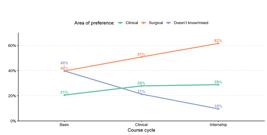
Evolution of preference for major medical areas (Clinical and Surgical) according to cycles of the medical course.
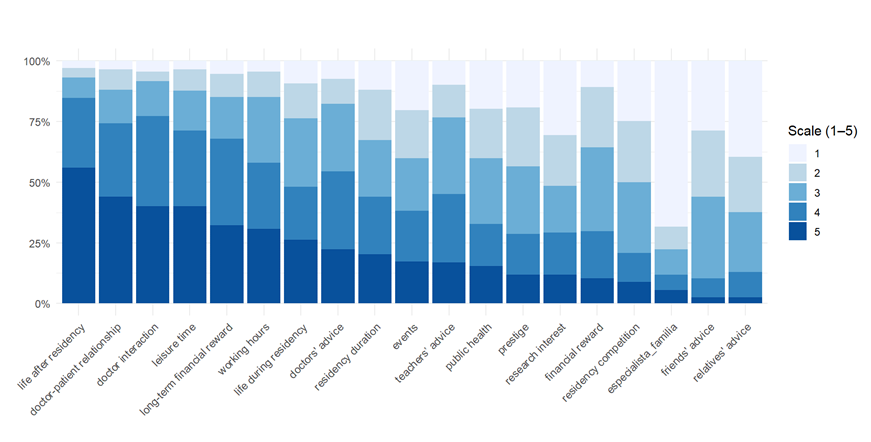
The assessment of the importance of factors influencing the choice of specialty is shown in Figure 2. Aspects related to quality of life and professional practice received the highest average scores, especially life after residency, doctor-patient relationship, interaction with other doctors, and leisure time. In contrast, factors linked to external influence, such as advice from relatives, advice from friends, and having a specialist in the family, were the least valued.
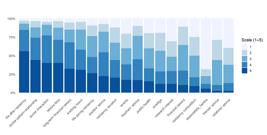
Students’ perception of the relevance of factors influencing the choice of medical specialty.
Stratification by sex revealed statistically significant differences in perception (Figure 3). Female students attributed greater importance to lifestyle-related factors, such as leisure time (p-value = 0.036). Male students highlighted factors of financial return and status, such as life after residency (p-value = 0.489), long-term financial reward (p-value = 0.639), and prestige (p-value = 0.406). These factors did not show a statistically significant difference between the sexes.
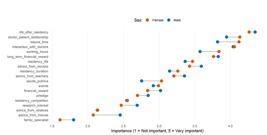
Comparative analysis of the importance of factors in choosing a medical specialty, according to the students’ gender.
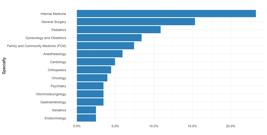
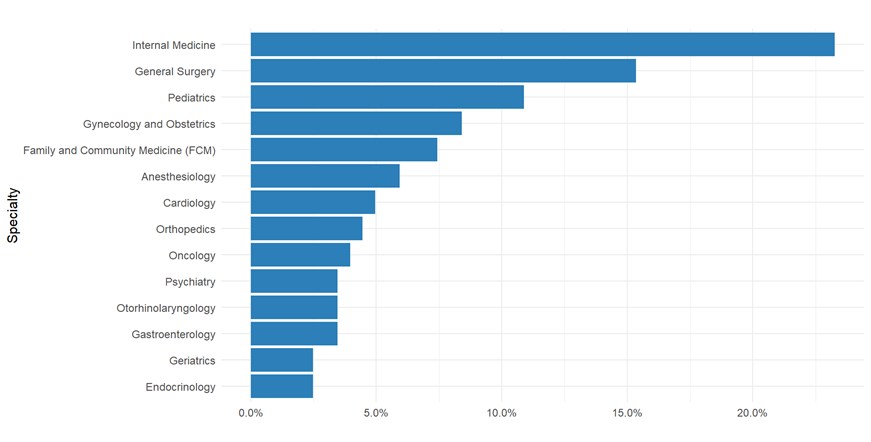
The distribution of the most frequently cited medical specialties is shown in Figure 4. It was observed that most indications were concentrated in a few specialties: Internal Medicine was the most frequently mentioned (23%), followed by General Surgery (15%) and Pediatrics (11%). The three most cited specialties accounted for approximately half of the responses, highlighting a concentration of preferences/indications in the areas mentioned above. In contrast, specialties such as Geriatrics and Endocrinology were the least mentioned (< 3% each).
DISCUSSION
The findings of this study partially confirm trends already described in the national and international literature but also reveal nuances specific to the context of Universidade de Brasília (UnB), offering original contributions.
Firstly, it was observed that the doctor-patient relationship was the most valued factor by students in all cycles, with consistently high averages. This result is in line with previous studies that point to the interpersonal bond as a central element in professional choice12),(23. The maintenance of this value throughout the course contrasts, however, with studies that showed a progressive decline in medical idealism and greater weight for pragmatic factors, such as financial return, as students advance in their undergraduate studies11),(14.
Another relevant point was the importance attributed to leisure time, which remained high throughout the undergraduate program, reaching its peak in the clinical cycle. This finding reinforces a trend already reported in Brazil and abroad that new generations of doctors seek a better balance between personal life and career18),(28. This information is similar to that found by Costa et al.22, who associated curricular changes and academic experiences with the increasing appreciation of quality of life. Thus, it can be inferred that the so-called “millennial generation” of doctors tends to value self-care and flexibility, as opposed to the model of full-time dedication predominant in previous generations.
On the other hand, the low value of social prestige and immediate financial return represents a finding that diverges from the international literature. Status and remuneration are central factors in the specialty decision 9),(16),(17. In the present study, both factors showed lower averages and a progressive decline throughout the cycles. This result may reflect Brazilian cultural characteristics, in which the social image of the doctor has been undergoing recent transformations, as well as a socioeconomic context in which the stability of the medical profession is considered “guaranteed”, reducing the need to emphasize prestige or immediate return as a decision criterion.
Another relevant finding was the influence of the presence of doctors in the family. Students with family members who are doctors attributed less importance to factors such as financial reward, social prestige, leisure time, and even the doctor-patient relationship, when compared to those who do not have doctors in the family. This result corroborates findings by Alencar et al.19 and Corsi et al.29, which suggest that exposure to medical practice tends to reduce idealized and romanticized expectations about the profession.
The gender differences found are also in line with the literature. Women attributed greater importance to free time and interpersonal relationships with patients, while men valued social prestige and financial return more. Previous studies point to the same pattern15),(23),(27. However, in this study there was no statistically significant association between gender and preference for clinical or surgical specialties, which suggests a possible shift in vocational trends and deserves further investigation.
The analysis by course cycle showed interesting trends, with a progressive decrease in the importance attributed to social prestige and immediate financial return, as well as the stability of the value of the doctor-patient relationship, which differs from international studies that describe the inverse process11),(16. This may indicate specificities of the Brazilian context, but it may also reflect the cross-sectional nature of the research, in which different strata of students were evaluated simultaneously.
Finally, the high proportion of undecided students (31%) reinforces a critical aspect already reported in other national studies 25),(26: the need for structured vocational guidance strategies from the first years of undergraduate studies. Considering that a large part of the choices occur in the clinical cycle, as our data also demonstrated, educational interventions and practical experiences during this period can have a decisive impact on professional direction.
Study limitations
This study has limitations inherent to its cross-sectional design, which prevent causal inferences or the interpretation of the observed differences between course cycles as individual changes over time. Comparisons between students in the initial, intermediate, and internship cycles reflect distinct profiles of groups evaluated at the same time and are subject to temporal bias and cohort effect.
Furthermore, despite the stratified probability sampling, the overall response rate of 58% may introduce selection and non-response bias, particularly if undecided or less academically engaged students are underrepresented. To mitigate this risk, a weighting procedure was adopted using the inverse of the probability of response in each stratum, preserving the proportionality of the eligible population.
The use of a self-administered and anonymized questionnaire reduces, but does not eliminate, possible information biases and social desirability biases, especially in the declaration of preferences for more prestigious specialties.
Finally, it is recognized that the preference for specialization is a dynamic construct, which may undergo modifications throughout the educational trajectory, reinforcing the need for longitudinal studies to increase the understanding of these processes.
Study contributions and advances
Despite the limitations, the study makes relevant contributions to medical education and to the debate on social accountability in the training of specialists. The use of stratified probabilistic sampling, with correction by sample weighting, stands out, a strategy still little explored in national studies on the choice of medical specialty.
The integrated analysis of sociodemographic, academic, and vocational factors, associated with stratification by course cycles, allows us to illuminate critical moments in training in which preferences are consolidated or modified. Additionally, by focusing on a public university in the Midwest region, marked by a strong affirmative action policy, the study contributes to reducing gaps in the literature predominantly concentrated in the South-Southeast axis.
The findings reinforce the centrality of factors related to quality of life and professional practice and directly engage with the contemporary debate on aligning medical training with the needs of the SUS (Brazilian Unified Health System), offering empirical support for vocational guidance policies, curriculum design, and strategies for providing socially committed specialists.
CONCLUSION
The choice of medical specialty among students at Universidade de Brasília was shown to be more influenced by factors related to quality of life and identification with professional practice than by status or financial return. Practical experience throughout the course played a decisive role in the choices, highlighting the importance of permanent vocational guidance strategies and early insertion into diverse scenarios within the SUS. These results can support institutional vocational guidance strategies and the planning of training programs aligned with social needs and the SUS.
The high proportion of students still undecided about their specialty reinforces the need for training processes that encourage critical reflection on the social role of the physician and co-responsibility in reducing health inequalities. Variations in preferences throughout the course cycles indicate that internships and academic experiences exert a central influence on decisions.
It is recommended that longitudinal and multicenter studies be carried out to investigate how choices are linked to social demands and policies for providing specialists in Brazil, contributing to the training of physicians who are socially committed to equity and the strengthening of the SUS.
References
-
1 Brasil. Lei nº 6.932, de 7 de julho de 1981. Dispõe sobre as atividades do médico e dá outras providências. Diário Oficial da União; 9 jul 1981 [acesso em: 16 mar 2026]. Disponível em: Disponível em: https://www.planalto.gov.br/ccivil_03/leis/l6932.htm
» https://www.planalto.gov.br/ccivil_03/leis/l6932.htm -
2 Brasil. Lei nº 3.268, de 20 de setembro de 1957. Dispõe sobre os Conselhos de Medicina, e dá outras providências. Diário Oficial da União ; 1º out 1957 [acesso em: 16 mar 2026]. Disponível em: Disponível em: https://www.planalto.gov.br/ccivil_03/leis/l3268.htm
» https://www.planalto.gov.br/ccivil_03/leis/l3268.htm -
3 Brasil. Decreto nº 80.281, de 5 de setembro de 1977. Regulamenta a Residência Médica, cria a Comissão Nacional de Residência Médica e dá outras providências. Diário Oficial da União ; 6 set 1977 [acesso em: 16 mar 2026]. Disponível em: Disponível em: https://www.planalto.gov.br/ccivil_03/decreto/1970-1979/d80281.htm
» https://www.planalto.gov.br/ccivil_03/decreto/1970-1979/d80281.htm -
4 Brasil. Decreto nº 7.562, de 15 de setembro de 2011. Dispõe sobre a Comissão Nacional de Residência Médica e o exercício das funções de regulação, supervisão e avaliação de instituições que ofertam residência médica e de programas de residência médica. Diário Oficial da União ; 16 set 2011 [acesso em: 16 mar 2026]. Disponível em: Disponível em: https://www.planalto.gov.br/ccivil_03/_ato2011-2014/2011/decreto/d7562.htm
» https://www.planalto.gov.br/ccivil_03/_ato2011-2014/2011/decreto/d7562.htm -
5 Conselho Federal de Medicina. Resolução CFM nº 2.380, de 24 de junho de 2024. Homologa a Portaria CME nº 1/2024, que atualiza a relação de especialidades e áreas de atuação médicas aprovadas pela Comissão Mista de Especialidades. Diário Oficial da União ; 24 jun 2024 [acesso em: 16 mar 2026]. Disponível em: Disponível em: https://sistemas.cfm.org.br/normas/visualizar/resolucoes/BR/2024/2380
» https://sistemas.cfm.org.br/normas/visualizar/resolucoes/BR/2024/2380 -
6 Pereira Júnior GA, Colleoni Neto R, Giampani Júnior J, Guedes JG, Fujita RR, Mendes Júnior AF, et al. Contexto atual e avaliação dos programas de residência médica: experiência de seis Sociedades Médicas Brasileiras. Rev Col Bras Cir. 2025;51:e20243861 2024 [acesso em: 16 mar 2026]. Disponível em: https://doi.org/10.1590/0100-6991e-20243861-en.
» https://doi.org/https://doi.org/10.1590/0100-6991e-20243861-en -
7 Maciel Júnior EP, Oliveira MSR, Quintanilha LF. Fatores norteadores da escolha pela especialidade médica entre estudantes de Medicina. Graduação em Movimento - Ciências da Saúde. 2022;1(1):89-100 [acesso em: 16 mar 2026]. Disponível em: Disponível em: https://periodicos.uniftc.edu.br/index.php/gdmsaude/article/view/130
» https://periodicos.uniftc.edu.br/index.php/gdmsaude/article/view/130 -
8 Brasil. Constituição da República Federativa do Brasil de 1988. Diário Oficial da União ; 5 out 1988 [acesso em: 16 mar 2026]. Disponível em: Disponível em: http://www.planalto.gov.br/ccivil_03/constituicao/constituicao.htm
» http://www.planalto.gov.br/ccivil_03/constituicao/constituicao.htm -
9 Scheffer M, coordenador. Demografia médica no Brasil 2025. Brasília: Ministério da Saúde, Faculdade de Medicina da Universidade de São Paulo, Associação Médica Brasileira; 2025 [acesso em: 16 mar 2026]. Disponível em: Disponível em: https://bvsms.saude.gov.br/bvs/publicacoes/demografia_medica_brasil_2025.pdf
» https://bvsms.saude.gov.br/bvs/publicacoes/demografia_medica_brasil_2025.pdf -
10 Leite IB, Falleiros BP, Mendes GJ, Lima GLR, Soares LC, Oliveira SV. Especialidades mais desejadas e fatores que influenciam essa escolha numa faculdade pública brasileira. Rev Bras Educ Med. 2025;49(3):e085 [acesso em: 16 mar 2026]. Disponível em: https://doi.org/10.1590/1981-5271v49.3-2024-0187.
» https://doi.org/https://doi.org/10.1590/1981-5271v49.3-2024-0187 -
11 Abdulghani HM, Al-Shaikh G, Alhujayri AK, Alohaideb NS, Alsaeed HA, Alshohayeb IS, et al. What determines the selection of undergraduate medical students to the specialty of their future careers? Med Teach. 2013;35(Suppl 1):S25-S30 [acesso em: 16 mar 2026]. Disponível em: https://doi.org/10.3109/0142159X.2013.765548.
» https://doi.org/https://doi.org/10.3109/0142159X.2013.765548 -
12 Chang P-Y, Lin Y-H, Chen C-H, Chou P, Sung S-L. Factors influencing medical students’ choice of specialty. J Formos Med Assoc. 2006;105(6):489-96 [acesso em: 16 mar 2026]. Disponível em: https://doi.org/10.1016/S0929-6646(09)60189-3.
» https://doi.org/https://doi.org/10.1016/S0929-6646(09)60189-3 -
13 Feifel D, Moutier CY, Swerdlow NR. Attitudes toward psychiatry as a prospective career among students entering medical school. Am J Psychiatry. 1999;156(9):1397-402 [acesso em: 16 mar 2026]. Disponível em: https://doi.org/10.1176/ajp.156.9.1397.
» https://doi.org/https://doi.org/10.1176/ajp.156.9.1397 -
14 Hauer KE, Durning SJ, Kern DE, Fagan MJ. Factors associated with medical students’ career choices regarding internal medicine. JAMA. 2008;300(10):1154-64 [acesso em: 16 mar 2026]. Disponível em: https://doi.org/10.1001/jama.300.10.1154.
» https://doi.org/https://doi.org/10.1001/jama.300.10.1154 -
15 Takeda Y, Tamura Y, Maeshima A, Kobayashi S, Nishigori H. Characteristic profiles among students and junior doctors with specific career preferences. BMC Med Educ. 2013;13:107 [acesso em: 16 mar 2026]. Disponível em: Disponível em: https://link.springer.com/article/10.1186/1472-6920-13-125
» https://link.springer.com/article/10.1186/1472-6920-13-125 -
16 Yang Y, Wang Y, Wang J, Zhang G, Li W, Fu Y, et al. Factors influencing subspecialty choice among medical students: a systematic review and meta-analysis. BMJ Open. 2019;9(3):e022097 [acesso em: 16 mar 2026]. Disponível em: https://doi.org/10.1136/bmjopen-2018-022097.
» https://doi.org/https://doi.org/10.1136/bmjopen-2018-022097 -
17 Ibrahim M, Eady K, Hossain A, Mohammed A, Chakrabarti A, Enoch S. What factors influence British medical students’ career intentions? Med Teach . 2014;36(12):1064-72 [acesso em: 16 mar 2026]. Disponível em: Disponível em: https://www.tandfonline.com/doi/full/10.3109/0142159X.2014.923560
» https://www.tandfonline.com/doi/full/10.3109/0142159X.2014.923560 -
18 Svirko E, Lambert TW, Goldacre MJ. Career progression of men and women doctors in the UK NHS: a questionnaire study of the UK medical qualifiers of 1993 in 2010/2011. JRSM Open. 2014;5(11):2054270414554050[acesso em: 16 mar 2026]. Disponível em: https://doi.org/10.1177/2054270414554050.
» https://doi.org/https://doi.org/10.1177/2054270414554050 -
19 Alencar AAR, Lima GLR, Miranda ED, Silva JLS, Soares LC, Oliveira SV. Fatores preditivos na escolha da especialidade na residência médica. Jornal Memorial da Medicina. 2021;3(2):6-14 [acesso em: 16 mar 2026]. Disponível em: Disponível em: https://www.jornalmemorialdamedicina.com/index.php/jmm/article/view/61
» https://www.jornalmemorialdamedicina.com/index.php/jmm/article/view/61 -
20 Bellodi PL. Surgery or general medicine: a study of the reasons underlying the choice of medical specialty. São Paulo Med J. 2004;122(3):81-6[acesso em: 16 mar 2026]. Disponível em: https://doi.org/10.1590/S1516-31802004000300002.
» https://doi.org/https://doi.org/10.1590/S1516-31802004000300002 -
21 Oliveira PRBP. A escolha da especialidade por ingressantes na residência médica do estado de Minas Gerais [dissertação]. Campinas: Universidade Estadual de Campinas; 2015 [acesso em: 16 mar 2026]. Disponível em: Disponível em: https://sucupira.capes.gov.br/sucupira/public/consultas/coleta/trabalhoConclusao/viewTrabalhoConclusao.jsf?popup=true&id_trabalho=2294687
» https://sucupira.capes.gov.br/sucupira/public/consultas/coleta/trabalhoConclusao/viewTrabalhoConclusao.jsf?popup=true&id_trabalho=2294687 -
22 Costa JRB, Romano VF, Costa RR, Junqueira TS, Andrade SR, et al. A transformação curricular e a escolha da especialidade médica. Rev Bras Educ Med . 2014;38(1):47-58 [acesso em: 16 mar 2026]. Disponível em: Disponível em: https://doi.org/10.1590/S0100-55022014000100007
» https://doi.org/10.1590/S0100-55022014000100007 -
23 Cruz JAS, Sandy NS, Vannucchi TR, Gouveia EM, Passerotti CC, Bruschini H, et al. Fatores determinantes para a escolha da especialidade médica no Brasil. Rev Med (São Paulo). 2010;89(1):32-42 [acesso em: 16 mar 2026]. Disponível em: https://doi.org/10.11606/issn.1679-9836.v89i1p32-42.
» https://doi.org/https://doi.org/10.11606/issn.1679-9836.v89i1p32-42 -
24 Cruz EMTN. A escolha da especialidade em medicina [tese]. Campinas: Universidade Estadual de Campinas; 1976 [acesso em: 16 mar 2026]. Disponível em: https://doi.org/10.47749/T/UNICAMP.1976.47579.
» https://doi.org/https://doi.org/10.47749/T/UNICAMP.1976.47579 -
25 Silva Junior ES da, Santos JSS, Dourado JX, Araújo PAP, Dias VM, Rodrigues LCS. Fatores que influenciam na escolha da especialidade médica na Universidade do Estado do Pará campus-VIII. Braz J Health Rev. 2021;4(6):29277-88 [acesso em]. Disponível em: https://ojs.brazilianjournals.com.br/ojs/index.php/BJHR/article/view/41981
» https://ojs.brazilianjournals.com.br/ojs/index.php/BJHR/article/view/41981 -
26 Reis MO, Silva DFL, Silva JLP, et al. Avaliação dos fatores determinantes na escolha da especialidade médica entre os alunos do internato da Faculdade de Medicina de Valença-RJ. Brazilian Journal of Surgery and Clinical Research. 2017;20(2):29-35 [acesso em: 16 mar 2026]. Disponível em: Disponível em: https://www.mastereditora.com.br/bjscr20-2
» https://www.mastereditora.com.br/bjscr20-2 -
27 Figueiredo JF, Rodrigues MLV, Cianflone ARL. Influence of gender on specialty choices in a Brazilian medical school. Acad Med. 1997;72(1):68-70 [acesso em: 16 mar 2026]. Disponível em:Disponível em: https://pubmed.ncbi.nlm.nih.gov/9008574/
» https://pubmed.ncbi.nlm.nih.gov/9008574/ -
28 Martins JB, Perotta B, Barreto S, Girardi-de-Mendonça JM, Tempski P, Martins MA. Fatores que influenciam a escolha da especialização médica pelos estudantes de Medicina em uma instituição de ensino de Curitiba (PR). Rev Bras Educ Med . 2019;43(2):152-8 [acesso em: 16 mar 2026]. Disponível em: Disponível em: https://www.scielo.br/j/rbem/a/TknnPvRhHB5RHbQbwSPN8hK/
» https://www.scielo.br/j/rbem/a/TknnPvRhHB5RHbQbwSPN8hK/ -
29 Corsi PR, Fernandes ARC, Zucoloto ML, Peres CM, Guerra LM, Bellodi PL. Fatores que influenciam o aluno na escolha da especialidade médica. Rev Bras Educ Med . 2014;38(2):213-20 [acesso em: 16 mar 2026]. Disponível em: Disponível em: https://www.scielo.br/j/rbem/a/4S57YZSQDKV6tyGY8SXJJdw/
» https://www.scielo.br/j/rbem/a/4S57YZSQDKV6tyGY8SXJJdw/ -
30 Pinheiro E, Maciel Júnior EP, Oliveira MSR, Quintanilha LF. Fatores norteadores da escolha pela especialidade médica entre estudantes de medicina. Graduação em Movimento - Ciências da Saúde . 2022;1(1):89-100 [acesso em: 16 mar 2026]. Disponível em: Disponível em: https://periodicos.uniftc.edu.br/index.php/gdmsaude/article/view/130
» https://periodicos.uniftc.edu.br/index.php/gdmsaude/article/view/130 -
31 Vasconcelos RRA, Medeiros VVS, Oliveira CL, Araújo DMB. Os fatores decisivos na escolha dentre as carreiras médicas: qual é o papel da universidade? [monografia]. Campina Grande: Universidade Federal de Campina Grande; 2019 [acesso em: 16 mar 2026]. Disponível em: Disponível em: https://dspace.sti.ufcg.edu.br/handle/riufcg/30554?mode=full
» https://dspace.sti.ufcg.edu.br/handle/riufcg/30554?mode=full
-
9
Evaluated by double blind review process.
-
SOURCES OF FUNDING
This study was supported by the National Council for Scientific and Technological Development (CNPq) through an undergraduate research grant awarded to a medical student at Universidade de Brasília during the transition from the intermediate cycle to the internship. CNPq had no involvement in the study design, data collection, analysis or interpretation, manuscript writing, or the decision to submit it for publication.

 Source: The authors, 2025.
 Source: The authors, 2025.
 Source: The authors, 2025.
 Source: The authors, 2025.