 Impact of oral health problems on daily activities and quality of life of adolescents in Brazil
ABSTRACT
Objective: To analyze the impact of oral health conditions on quality of life and daily activities among adolescents according to the Oral Impacts on Daily Performances (OIDP) and its domains.
Methods: This cross-sectional study was based on data from the Brazilian National Oral Health Survey (SB Brasil 2023) and included 8,054 adolescents aged 15 to 19 years from all regions of the country. The outcome was oral health-related quality of life assessed using the OIDP instrument. Associations between OIDP and its domains with the presence of untreated caries, tooth loss, odontalgia, need for prostheses, gingival bleeding, and dental calculus were analyzed. Statistical analyses were performed considering the complex sample design, using the Rao-Scott adjusted F-test and multiple logistic regression considering a 95% confidence interval (CI).
Results: A negative impact of oral health on quality of life was observed in 37.2% of adolescents, with a higher frequency among those with lower family income and education level. All oral health problems analyzed showed a significant association with an OIDP≥1. After adjusting for sociodemographic factors, dental pain in the last 6 months was the condition most strongly associated with a negative impact on quality of life (OR=9.06; 95%CI 6.32–13.0), followed by the need for a prosthesis (OR=3.86; 95%CI 2.31–6.43), untreated dental caries (OR=2.39; 95%CI 1.87–3.05), tooth loss (OR=1.56; 95%CI 1.07–2.26), gum bleeding (OR=1.62; 95%CI 1.14–2.29), and dental calculus (OR=1.33; 95%CI 1.03–1.71).
Conclusion: Oral health problems represent a limiting factor in the quality of life and daily activities of Brazilian adolescents.
Keywords:
Oral health; Dental caries; Adolescent; Quality of life
RESUMO
Objetivo: Analisar o impacto dos agravos em saúde bucal na qualidade de vida e nas atividades diárias de adolescentes conforme o Oral Impacts on Daily Performances (OIDP) e seus domínios.
Métodos: Trata-se de um estudo transversal baseado em dados da Pesquisa Nacional de Saúde Bucal (SB Brasil 2023) envolvendo 8.054 adolescentes de 15 a 19 anos de todas as regiões do país. O desfecho foi a qualidade de vida relacionada à saúde bucal avaliada pelo instrumento OIDP. Foram analisadas as associações entre o OIDP e seus domínios com a presença de cárie não tratada, perda dentária, odontalgia, necessidade de prótese, sangramento gengival e cálculo dental. As análises estatísticas foram realizadas considerando-se o desenho amostral complexo, utilizando-se o teste F ajustado de Rao-Scott e de regressão logística múltipla com intervalo de confiança (IC) de 95%.
Resultados: Observou-se impacto negativo da saúde bucal na qualidade de vida em 37,2% dos adolescentes, com maior frequência entre aqueles de menor renda familiar e escolaridade. Todos os agravos bucais analisados apresentaram associação significativa com o OIDP≥1. Após ajuste por fatores sociodemográficos, a dor dentária nos últimos seis meses foi o agravo mais fortemente associado ao impacto negativo na qualidade de vida (odds ratio — OR=9,06; IC95% 6,32–13,0), seguida da necessidade de prótese (OR=3,86; IC95% 2,31–6,43), cárie dentária não tratada (OR=2,39; IC95% 1,87–3,05), perda dentária (OR=1,56; IC95% 1,07–2,26), sangramento gengival (OR=1,62; IC95% 1,14–2,29) e cálculo dentário (OR=1,33; IC95% 1,03–1,71).
Conclusão: Os agravos bucais representam um fator limitante na qualidade de vida e nas atividades diárias dos adolescentes brasileiros.
Palavras-chave:
Saúde bucal; Cárie dentária; Adolescente; Qualidade de vida
INTRODUCTION
Adolescence is a transitional period between childhood and adulthood, marked by intense biological, psychological, and social transformations, during which individuals become particularly susceptible to risk factors that can generate cumulative impacts1. Experiences related to identity formation during adolescence significantly influence the development of behavioral and emotional patterns, with potential repercussions for well-being and life trajectory2.
It is common to observe, during adolescence, greater neglect regarding health care3,4 and a higher prevalence of behaviors that pose a risk for both oral and systemic diseases5,6. In addition to aspects inherent to this developmental stage itself, individual biological factors as well as the socioeconomic and cultural context can influence oral health behaviors7,8. Consequently, the occurrence of oral diseases during adolescence is also shaped by the specific context in which the adolescent is embedded9.
Although an improvement in the epidemiological landscape of oral health among Brazilian adolescents has been observed over the years10, it is important to highlight the heterogeneous distribution of oral health conditions within the population over time — a reflection of socioeconomic and racial inequities across Brazil's various regions10–13. This scenario underscores the importance of continuous monitoring of the oral health of Brazilian adolescents, as well as the strengthening of health policies and strategies designed to ensure comprehensiveness and equity in oral health care.
Oral health conditions, such as the presence of untreated dental caries and dental pain, demonstrate a strong correlation with negative impacts on individuals' quality of life; these impacts can encompass physical, psychological, and social dimensions, thereby highlighting the significance of assessing oral health-related quality of life (OHRQoL) within the field of public health14–16. This concept, which encompasses the perception of oral health status, functional and emotional well-being, and satisfaction with dental care16,17, also bears a direct relationship to socioeconomic characteristics across all age groups18.
To assess OHRQoL, the use of specific instruments is essential, such as oral impacts on daily performances (OIDP), a sociodental indicator that has been widely used to evaluate the frequency and severity of oral impacts affecting individuals' daily performance16,17,19.
Although studies have evaluated OHRQoL and the impacts of oral health conditions on various aspects of the lives of Brazilian adolescents20–24, such studies remain scarce and limited in terms of population and territorial scope, particularly when considering the diversity and vastness of Brazil. This gap hinders a comprehensive understanding of the actual effects of these issues on the quality of life of young Brazilians, as well as the formulation of more effective care strategies for this demographic.
Given that the National Oral Health Survey (SB Brasil) collects demographic and socioeconomic data, along with data on various oral health outcomes and OHRQoL, at both national and specific age-group levels, it has emerged as a key oral health surveillance tool. Furthermore, it serves as a vital data source for assessing the oral health status of Brazilian adolescents, identifying related contextual factors, and examining potential negative consequences associated with oral diseases10.
Against this backdrop, the present study aimed to analyze the impact of oral health conditions on the quality of life and daily activities of adolescents aged 15 to 19, utilizing the OIDP index and its specific domains, on the basis of data derived from the SB Brasil 2023 survey.
METHODS
The present study was a cross-sectional study utilizing secondary data derived from the National Oral Health Survey, namely SB Brasil 202310. As these are secondary data in the public domain, submission to a Research Ethics Committee (CEP) was not required, in accordance with Resolution No. 510/2016 of the National Health Council (CNS).
The survey employed a probabilistic, stratified, and multi-stage cluster sampling design. Sample selection involved households randomly drawn from previously defined census tracts, ensuring proportionality based on population size (capital cities and interior regions). The survey covered 422 municipalities, including the 27 capital cities and various interior cities. Data collection was designed to ensure statistical representativeness at the national, regional, and state levels, encompassing both capital cities and regional interior areas. Additional details regarding the methodology are available in the technical publications of SB Brasil 202310,25.
The sample consisted of 8,054 adolescents aged 15 to 19, who were interviewed and examined in their homes. The dependent variable was constructed based on the impact of oral health on quality of life, assessed using the OIDP index — previously validated for the Brazilian population — which encompasses nine domains investigating difficulties attributed to oral problems in daily activities: eating, speaking, cleaning teeth, sleeping, smiling, studying or working, engaging in leisure activities, maintaining social relationships, and feeling emotionally affected. Possible responses were: "yes," "no," and "don't know."
A global dichotomous variable was created to measure the impact of oral health on quality of life; the presence of at least one affected domain (OIDP≥1) was classified as "with impact," while the absence of any impact across the nine domains (OIDP=0) was classified as "without impact." The association of each domain was also evaluated individually, on the basis of the adolescents' self-reported responses ("yes" = with impact; "no" = without impact).
The independent variables included sociodemographic characteristics (sex, age group, skin color/race, education level, and family income) and oral health conditions (presence of untreated dental caries, tooth loss, toothache, need for prosthetics, gingival bleeding, and presence of dental calculus). Chart 1 details the variables used and the categorization process. The categories "don't know," "didn't answer," and "no information" were treated as missing values and were not included in the statistical analyses.
Statistical analyses were performed using the Statistical Package for the Social Sciences (SPSS®) software, version 20, using the complex samples module and accounting for the sample weights present in the dataset. Initially, a descriptive analysis of the variables was conducted, involving the calculation of weighted proportions. Subsequently, bivariate analyses were performed to investigate associations between OIDP (both globally and by domain) and the independent variables, using the Rao-Scott independence test — an adjusted version of Pearson's χ2 test designed for complex samples.
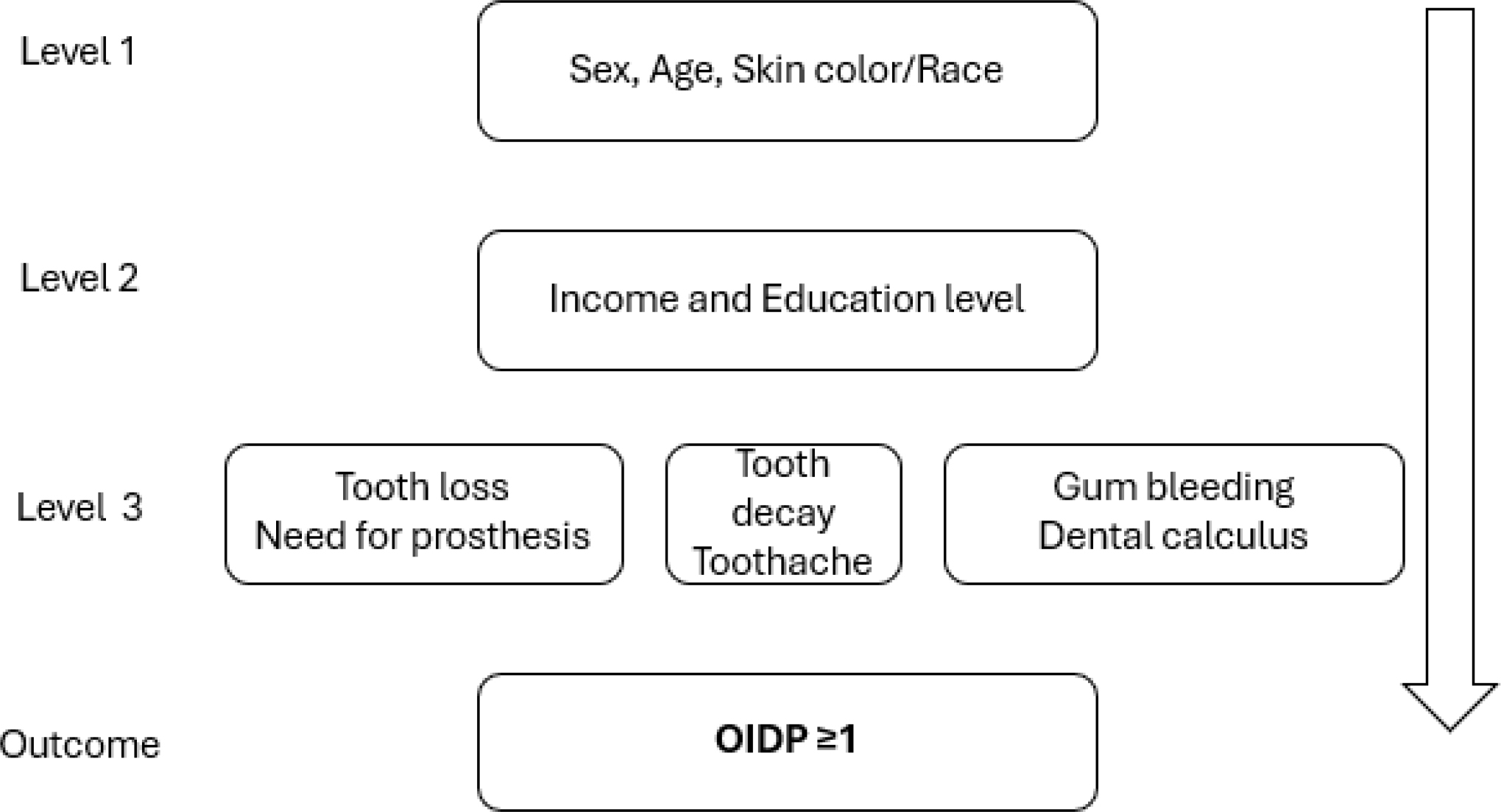
Multiple logistic regression was based on a theoretical model using a hierarchical approach26, wherein the first level included demographic variables (sex, age, and skin color/race), the second level consisted of socioeconomic variables (income and education level), and the third level encompassed oral health conditions (Figure 1). Initially, unadjusted odds ratios (ORs) were calculated for all independent variables. Only those variables that yielded p<0.20 in the bivariate analysis were included in the adjusted models. Following adjustment, only independent variables with a p<0.20 remained in the final model. The final models estimated adjusted ORs, along with their respective 95% confidence interval (CI), adopting a significance level of 5% (p<0.05).

To minimize the influence of variables exhibiting conceptual or statistical interrelationships, the adjusted models were structured into three groups of oral health conditions; this approach served to reduce redundancy among predictors and enhance model stability.
Multicollinearity among the independent variables included in the final models was assessed using tolerance values, the variance inflation factor (VIF), and condition indices. No values indicative of collinearity were observed, with tolerance values ranging from 0.64 to 0.99, VIF values between 1.01 and 1.57, and a maximum condition index of 16.33. These results indicate an absence of multicollinearity, allowing the variables to remain in the models.
Data Availability Statement:
The entire dataset supporting the results of this study is made available within the article itself.
RESULTS
The sample consisted of adolescents of both sexes, with a slight male predominance (50.2%), a majority self-identifying as brown (47.9%), and who reported a family income of one to three minimum wages (49.0%). It was found that 43.7% had one or more decayed teeth, 13.5% had lost at least one tooth due to caries, toothache within the previous six months was reported by 21.2% of the adolescents, 9.3% required a prosthesis, 35.3% showed dental calculus, and 34.4% presented with gum bleeding (Table 1).
Association between socioeconomic variables, oral health conditions, and Oral Impacts on Daily Performance (OIDP)≥1 among Brazilian adolescents aged 15 to 19.
Table 1 reveals an impairment in quality of life among 76.1% of those reporting toothache within the last six months; 67.2% of those requiring dental prostheses; 53.7% of those presenting with at least one missing tooth; 49.6% of those with one or more decayed teeth; 46.3% of those presenting with gingival bleeding; and 42.8% of those with the presence of dental calculus. A greater impairment of quality of life was also observed among individuals with a family income of up to one minimum wage (46.4%).
Table 2 presents the association between oral health conditions and the daily activities of adolescents. It is observed that having one or more decayed teeth, one or more missing teeth, a history of toothache, and the need for a prosthesis were associated with all three dimensions evaluated — physical/functional, psychological/emotional, and social — whereas the presence of dental calculus showed no association with any of these dimensions.
Association between dental caries, tooth loss, toothache, need for prosthesis, gum bleeding, and presence of calculus in daily activities among Brazilian adolescents aged 15 to 19.
Having one or more decayed teeth was associated (p<0.001) with difficulty eating (30.0%), sleep disturbances (30.0%), and nervousness/irritability (25.7%). Tooth loss was associated (p<0.001) with sleep disturbances (37.6%), difficulty eating (32.4%), and nervousness/irritability (31.7%). Regarding toothache, more than half (52.0%) of the affected adolescents reported difficulty eating and experienced sleep disturbances (52.3%), while 46.6% felt nervous or irritable, with a statistically significant difference (p<0.001). The need for a dental prosthesis was associated (p<0.001) with difficulty eating (46.1%), sleep disturbances (45.3%), and nervousness/irritability (43.3%). Among adolescents with gingival bleeding, 24.6% reported difficulty eating (p=0.005); 21.9% experienced sleep disturbances (p=0.029); and 20.5% felt embarrassed to smile or speak (p=0.017) (Table 2).
In unadjusted logistic regression analysis, associations were observed between OIDP≥1 and income, education level, and oral health conditions. Adolescents with lower income were 2.31 times more likely to report an impact on quality of life, while those with lower education level were 2.19 times more likely. Among the oral health conditions, all were associated with the outcome, with dental pain being the most significant factor, increasing the odds of OIDP≥1 by nearly nine times. The need for prostheses also demonstrated a strong association, increasing the odds of impact by nearly four times. Furthermore, the presence of untreated caries raised the odds by 2.57 times, tooth loss by 2.20 times, gingival bleeding by 1.80 times, and dental calculus by 1.44 times, as shown in Table 3.
Logistic regression model (unadjusted) for the presence of Oral Impacts on Daily Performances (OIDP)≥1, associated with sociodemographic variables and oral health conditions, among Brazilian adolescents aged 15 to 19.
In the adjusted models, the variables of income and education lost significance; however, oral health conditions maintained a strong association with OIDP≥1. In Model 1, adolescents with untreated caries had 2.39 times higher odds of experiencing an impact, while those with dental calculus showed a 1.33-fold increase in odds. In Model 2, dental pain remained the condition most strongly associated with the outcome, increasing the odds by more than nine times, whereas tooth loss raised the odds by 1.56. In Model 3, the need for prostheses stood out, increasing the odds of OIDP≥1 by nearly four times, and gum bleeding increased the odds by 1.62. The various oral health conditions maintained a significant association with the adolescents' quality of life, even after adjusting for sociodemographic factors (Table 4).
Logistic regression model for Oral Impacts on Daily Performances (OIDP) ≥1, adjusted for sex, income, education level, and oral health conditions, in Brazilian adolescents aged 15 to 19.
DISCUSSION
The results of this study revealed a significant association between nearly all the analyzed variables regarding oral health conditions and the quality of life of Brazilian adolescents. These findings align with the study by Peres et al.27 who, upon analyzing adolescents aged 15 to 19 participating in the SB Brasil 2010 survey, identified that the presence of toothache, tooth loss, and untreated carious lesions was associated with significant impacts on quality of life.
Toothache was the condition that most impacted the adolescents' quality of life, being primarily associated with eating, sleep, and irritability. It serves as a significant public health marker, frequently used to assess the consequences and particularly of dental caries, and it is also considered one of the primary motivations for seeking care, as well as a reflection of the conditions regarding access to oral health services28,29.
Given that it affects various aspects related to the quality of life of children and adolescents14, toothache is of particular concern during the school years, as it is associated with impaired performance and school absenteeism and is considered an indicator of distress and social vulnerability30.
Untreated dental caries, commonly the cause of toothache, showed a high prevalence among adolescents, impacting all dimensions assessed by OIDP; this finding corroborates a meta-analysis that highlighted the negative impact of carious lesions on the daily activities of adolescents31. Reinforcing this relationship, a recent literature review demonstrated that the greater the severity of carious lesions, the greater the impairment of oral health-related quality of life in adolescents15.
As noted by Gerritsen et al.32 in a meta-analysis, tooth loss is also associated with unfavorable scores regarding oral health-related quality of life (OHRQoL)32. Furthermore, among the adolescents surveyed in the SB Brasil 2023 study, it was observed that the loss of at least one tooth impacted various domains related to the evaluated outcome, specifically sleep disturbances, difficulties with eating, and emotional changes such as nervousness or irritability.
As a consequence of tooth loss, it was observed that 9.3% of adolescents required dental prostheses; although this represents a low prevalence, it warrants greater attention given that it concerns such a young population. It is crucial to recognize that tooth loss occurring during adolescence constitutes a serious issue, as there is a tendency for it to progressively worsen throughout an individual's lifetime33, particularly when considering the chronic nature of the primary oral diseases that lead to tooth loss. It is important to emphasize that uncompensated tooth loss can substantially compromise the physical and psychological well-being of young people, as identified by the analyses in the present study, thereby underscoring the critical importance of rehabilitative interventions for this age group.
Of the periodontal changes investigated, only gingival bleeding affected the adolescents' daily activities, albeit to a lesser degree compared to other health issues. Some studies have identified an association between the presence of gingivitis and dental calculus and impacts on smiling, school performance, and social interactions at age 1234, which were also linked to impairments in smile aesthetics at age 1525. However, Ripardo et al.35 highlight that, although periodontal diseases are common during adolescence, there is a low perception of their severity, making it difficult to establish a direct link between these conditions and impairments in daily life.
The observed profile — characterized by a high prevalence of untreated caries among adolescents whose OHRQoL is primarily impacted by toothache and the need for prostheses — reveals potential weaknesses in preventive measures targeting this demographic, as well as in early diagnosis and continuity of care. A lack of treatment during the early stages can trigger a cumulative effect, leading to disease progression, increased pain, and in many cases tooth loss, thereby progressively compromising the adolescents' well-being.
Notwithstanding the attention currently directed toward adolescent health care, a revision of care strategies; including more effective intersectoral initiatives, is deemed necessary. Strengthening the role of oral health teams within the scope of the Health in School Program (Programa Saúde na Escola), for instance, presents a strategic opportunity for promoting and protecting oral health, given that a significant portion of this age group remains within the school environment. The implementation of educational and preventive measures, along with initiatives for the early detection of health issues specifically tailored to the unique needs of adolescents, could contribute significantly to improving the observed oral health landscape, thereby yielding positive repercussions on the quality of life of this population.
Regarding the sociodemographic variables assessed, it was observed that girls were more likely to report a negative impact of oral health on their quality of life — particularly within the statistical model adjusted for the need for prostheses and gingival bleeding. Similar results were identified by Santos et al.28, in a systematic review with meta-analysis, in which girls showed higher odds of reporting toothache, and by Militi et al.36, who identified a greater impact of dental appearance on girls' psychological well-being and self-confidence. This may indicate heightened self-perception and, consequently, a greater likelihood of self-reporting the impact of oral health on quality of life, particularly during adolescence.
Although the variables of income and education did not show an association with OIDP in the adjusted models, this result does not invalidate their social relevance. The literature consistently demonstrates a relationship between poorer levels of these variables and lower levels of oral health literacy, poorer self-care habits, reduced access to dental services, and a higher incidence of oral diseases7–9,37, suggesting that income and education may influence OHRQoL more indirectly, mediated by the presence of clinical conditions and the utilization of health services. Furthermore, in the Brazilian context, the provision of public oral health services may partially attenuate the direct effect of income on self-reported impact, without however eliminating the underlying social inequalities.
This study highlighted the impacts of oral health conditions on the quality of life of adolescents at a national level; however, certain limitations must be considered. The cross-sectional design precluded the establishment of causal relationships between the analyzed variables, thereby restricting inferences to statistical associations. Furthermore, data regarding quality of life were obtained via self-report, which may be subject to recall bias, as well as the underestimation or overestimation of symptoms.
Consequently, it is recommended that future studies adopt longitudinal designs capable of tracking the progression of oral health conditions over time and their cumulative repercussions on quality of life. Qualitative approaches could deepen the understanding of adolescents' subjective experiences regarding the limitations imposed by oral health problems, thereby contributing to the development of more sensitive and integrated care strategies. Investigations that incorporate social determinants of health, such as education level, geographic location, race/skin color, and access to public policies, are equally relevant for enhancing intersectoral initiatives aimed at promoting adolescent oral health across diverse sociocultural contexts.
In summary, the findings of this study broaden our understanding of the primary oral health conditions affecting Brazilian adolescents and their implications for quality of life. These findings provide health managers with epidemiological evidence that can inform the planning, monitoring, and rational allocation of resources, thereby strengthening oral health surveillance within the framework of the National Oral Health Policy. For oral health teams, these findings help in identifying priority health conditions, enhancing risk stratification, scheduling organization, and the targeting of preventive, diagnostic, and resolution-oriented measures in the country.
-
ETHICS COMMITTEE:
There was no need to submit this study to a research ethics committee, as it involved the analysis of secondary data. It should be noted that the SB Brasil 2023 study was previously approved by the National Research Ethics Commission (Conep) on July 3, 2021, under CAAE No. 34497120.6.3001.0008, with Opinion No. 4.823.054.
-
FUNDING:
none.
ACKNOWLEDGMENTS:
We thank the Ministry of Health for making available the data from the SB Brasil 2023 epidemiological survey, which were essential for the conduct of this study.
REFERENCES
-
1 World Health Organization. Growing up unequal: gender and socioeconomic differences in young people's health and well-being: health behaviour in school-aged children (HBSC) study: international report from the 2013/2014 survey [Internet]. Copenhagen: WHO; 2016 [accessed on Jul 29, 2025] Available at: https://www.who.int/europe/publications/i/item/9789289051361
» https://www.who.int/europe/publications/i/item/9789289051361 -
2 Becht AI, Nelemans SA, Branje SJT, Vollebergh WAM, Meeus WHJ. Daily identity dynamics in adolescence shaping identity in emerging adulthood: an eleven-year longitudinal study on continuity in development. J Youth Adolesc 2021; 50(8): 1616-33. https://doi.org/10.1007/s10964-020-01370-3
» https://doi.org/10.1007/s10964-020-01370-3 -
3 Pazos CTC, Austregésilo SC, Goes PSA. Self-esteem and oral health behavior in adolescents. Ciên Saúde Coletiva 2019; 24(11): 4083-92. https://doi.org/10.1590/1413-812320182411.02492018
» https://doi.org/10.1590/1413-812320182411.02492018 -
4 Jurišić S, Vukojević M, Martinović V, Ćubela M, Šarac Z, Ivanković Z, et al. Attitudes towards and habits in oral health of adolescents in Herzegovina. Acta Clin Croat 2021; 60(1): 96-102. https://doi.org/10.20471/acc.2021.60.01.14
» https://doi.org/10.20471/acc.2021.60.01.14 -
5 Patton GC, Coffey C, Cappa C, Currie D, Riley L, Gore F, et al. Health of the world's adolescents: a synthesis of internationally comparable data. Lancet 2012; 379(9826): 1665-75. https://doi.org/10.1016/S0140-6736(12)60203-7
» https://doi.org/10.1016/S0140-6736(12)60203-7 -
6 Malta DC, Morais EAH, Silva AG, Souza JB, Gomes CS, Santos FM, et al. Changes in tobacco use and associated factors among Brazilian adolescents: National Student Health Survey. Ciên Saúde Coletiva 2024; 29(9): e08252023. https://doi.org/10.1590/1413-81232024299.08252023
» https://doi.org/10.1590/1413-81232024299.08252023 -
7 Peixoto AMCL, Melo TQ, Ferraz LAA, Santos CFBF, Godoy F, Valença PAM, et al. Demand for health services or professionals among adolescents: a multilevel study. Ciên Saúde Coletiva 2021; 26(7): 2819-27. https://doi.org/10.1590/1413-81232021267.08582021
» https://doi.org/10.1590/1413-81232021267.08582021 -
8 Davoglio RS, Aerts DRGC, Abegg C, Freddo SL, Monteiro L. Fatores associados a hábitos de saúde bucal e utilização de serviços odontológicos entre adolescentes. Cad Saude Publica 2009; 25(3): 655-67. https://doi.org/10.1590/S0102-311X2009000300020
» https://doi.org/10.1590/S0102-311X2009000300020 -
9 Yousaf M, Aslam T, Saeed S, Sarfraz A, Sarfraz Z, Cherrez-Ojeda I. Individual, family, and socioeconomic contributors to dental caries in children from low- and middle-income countries. Int J Environ Res Public Health 2022; 19(12): 7114. https://doi.org/10.3390/ijerph19127114
» https://doi.org/10.3390/ijerph19127114 -
10 Brasil. Ministério da Saúde. Secretaria de Atenção Primária à Saúde. Departamento de Estratégias e Políticas de Saúde Comunitária. SB Brasil 2023: Pesquisa Nacional de Saúde Bucal: relatório final [Internet]. Brasília: Ministério da Saúde; 2025 [accessed on Jul 28, 2025] Available at: https://bvsms.saude.gov.br/bvs/publicacoes/sb_brasil_2023_relatorio_final_1edrev.pdf
» https://bvsms.saude.gov.br/bvs/publicacoes/sb_brasil_2023_relatorio_final_1edrev.pdf -
11 Drummond AMA, Ferreira EF, Gomes VE, Marcenes W. Inequality of experience of dental caries between different ethnic groups of Brazilians aged 15 to 19 years. PLoS One 2015; 10(12): e0145553. https://doi.org/10.1371/journal.pone.0145553
» https://doi.org/10.1371/journal.pone.0145553 -
12 Cunha RO, Correia PSM, Nogueira MC, Leite ICG. Iniquidades raciais em saúde bucal na população brasileira: uma análise da Pesquisa Nacional de Saúde de 2019. Ciên Saúde Coletiva 2025; 30(9): e07662023. https://doi.org/10.1590/1413-81232025309.07662023
» https://doi.org/10.1590/1413-81232025309.07662023 -
13 Teixeira AKM, Souza Júnior PRB. Evolution of socioeconomic inequalities in oral health and use of dental services in adult population of Brazil between 2013 and 2019. Cad Saude Publica 2025; 41(8): e00162324. https://doi.org/10.1590/0102-311XEN162324
» https://doi.org/10.1590/0102-311XEN162324 -
14 Barasuol JC, Santos PS, Moccelini BS, Magno MB, Bolan M, Martins-Junior PA, et al. Association between dental pain and oral health-related quality of life in children and adolescents: a systematic review and meta-analysis. Community Dent Oral Epidemiol 2020; 48(4): 257-63. https://doi.org/10.1111/cdoe.12535
» https://doi.org/10.1111/cdoe.12535 -
15 Chimbinha ÍGM, Ferreira BNC, Miranda GP, Guedes RS. Oral-health-related quality of life in adolescents: umbrella review. BMC Public Health 2023; 23(1): 1603. https://doi.org/10.1186/s12889-023-16241-2
» https://doi.org/10.1186/s12889-023-16241-2 -
16 Bettie NF, Ramachandiran H, Anand V, Sathiamurthy A, Sekaran P. Tools for evaluating oral health and quality of life. J Pharm Bioallied Sci 2015; 7(Suppl. 2): 414-9. https://doi.org/10.4103/0975-7406.163473
» https://doi.org/10.4103/0975-7406.163473 -
17 Alvarez-Azaustre MP, Greco R, Llena C. Oral health-related quality of life in adolescents as measured with the Child-OIDP questionnaire: a systematic review. Int J Environ Res Public Health 2021; 18(24): 12995. https://doi.org/10.3390/ijerph182412995
» https://doi.org/10.3390/ijerph182412995 -
18 Knorst JK, Sfreddo CS, Meira GF, Zanatta FB, Vettore MV, Ardenghi TM. Socioeconomic status and oral health-related quality of life: a systematic review and meta-analysis. Community Dent Oral Epidemiol 2021; 49(2): 95-102. https://doi.org/10.1111/cdoe.12616
» https://doi.org/10.1111/cdoe.12616 - 19 Locker D. Measuring oral health: a conceptual framework. Community Dent Health 1988; 5(1): 3-18.
-
20 Peres KG, Barros AJ, Anselmi L, Peres MA, Barros FC. Does malocclusion influence the adolescent's satisfaction with appearance? A cross-sectional study nested in a Brazilian birth cohort. Community Dent Oral Epidemiol 2008; 36(2): 137-43. https://doi.org/10.1111/j.1600-0528.2007.00382.x
» https://doi.org/10.1111/j.1600-0528.2007.00382.x -
21 Sfreddo CS, Moreira CHC, Nicolau B, Ortiz FR, Ardenghi TM. Socioeconomic inequalities in oral health-related quality of life in adolescents: a cohort study. Qual Life Res 2019; 28: 2491-500. https://doi.org/10.1007/s11136-019-02229-2
» https://doi.org/10.1007/s11136-019-02229-2 -
22 Ortiz FR, Emmanuelli B, Campos AM, Ardenghi TM. Oral health-related quality of life determinants throughout adolescence: a cohort study in Brazil. Qual Life Res 2022; 31: 2307-17. https://doi.org/10.1007/s11136-022-03130-1
» https://doi.org/10.1007/s11136-022-03130-1 -
23 Bulgareli JV, Faria ET, Cortellazzi KL, Guerra LM, Meneghim MC, Ambrosano GMB, et al. Factors influencing the impact of oral health on the daily activities of adolescents, adults and older adults. Rev Saúde Pública 2018; 52: 44. https://doi.org/10.11606/S1518-8787.2018052000042
» https://doi.org/10.11606/S1518-8787.2018052000042 -
24 Albuquerque LS, Queiroz RG, Abanto J, Bönecker MJS, Forte FDS, Sampaio FC. Dental caries, tooth loss and quality of life of individuals exposed to social risk factors in Northeast Brazil. Int J Environ Res Public Health 2023; 20(17): 6661. https://doi.org/10.3390/ijerph20176661
» https://doi.org/10.3390/ijerph20176661 -
25 Brasil. Ministério da Saúde. Secretaria de Atenção Primária à Saúde. Departamento de Saúde da Família. SB Brasil 2020: Pesquisa Nacional de Saúde Bucal: projeto técnico [Internet]. Brasília: Ministério da Saúde; 2022 [accessed on Jul 19, 2025]. Available at: https://www.gov.br/saude/pt-br/composicao/saps/brasil-sorridente/arquivos/2022/projeto-tecnico-sb-brasil-2020.pdf
» https://www.gov.br/saude/pt-br/composicao/saps/brasil-sorridente/arquivos/2022/projeto-tecnico-sb-brasil-2020.pdf -
26 Victora CG, Huttly SR, Fuchs SC, Olinto MT. The role of conceptual frameworks in epidemiological analysis: a hierarchical approach. Int J Epidemiol 1997; 26(1): 224-7. https://doi.org/10.1093/ije/26.1.224
» https://doi.org/10.1093/ije/26.1.224 -
27 Peres KG, Cascaes AM, Leão ATT, Côrtes MIS, Vettore MV. Sociodemographic and clinical aspects of quality of life related to oral health in adolescents. Rev Saude Publica 2013; 47(Supl. 3): 1-9. https://doi.org/10.1590/S0034-8910.2013047004361
» https://doi.org/10.1590/S0034-8910.2013047004361 -
28 Santos PS, Barasuol JC, Moccelini BS, Magno MB, Bolan M, Martins-Junior PA, et al. Prevalence of toothache and associated factors in children and adolescents: a systematic review and meta-analysis. Clin Oral Investig 2022; 26: 1105-19. https://doi.org/10.1007/s00784-021-04255-2
» https://doi.org/10.1007/s00784-021-04255-2 -
29 Noro LRA, Roncalli AG, Mendes Júnior FIR, Lima KC, Teixeira AKM. Toothache and social and economic conditions among adolescents in Northeastern Brazil. Ciên Saúde Coletiva 2014; 19(1): 105-14. https://doi.org/10.1590/1413-81232014191.2110
» https://doi.org/10.1590/1413-81232014191.2110 -
30 Darley RM, Karam SA, Costa FDS, Correa MB, Demarco FF. Association between dental pain, use of dental services and school absenteeism: 2015 National School Health Survey, Brazil. Epidemiol Serv Saúde 2021; 30(1): e2020108. https://doi.org/10.1590/S1679-49742021000100011
» https://doi.org/10.1590/S1679-49742021000100011 -
31 Botelho-Filho CR, Bordin GM, Paula ICSF, Stroparo JLO, Baratto SSP, Caldarelli PG, et al. Impact of dental caries on the quality of life of adolescents: a systematic review and meta-analysis. Rev Bras Epidemiol 2025; 28: e250018. https://doi.org/10.1590/1980-549720250018
» https://doi.org/10.1590/1980-549720250018 -
32 Gerritsen AE, Allen PF, Witter DJ, Bronkhorst EM, Creugers NH. Tooth loss and oral health-related quality of life: a systematic review and meta-analysis. Health Qual Life Outcomes 2010; 8: 126. https://doi.org/10.1186/1477-7525-8-126
» https://doi.org/10.1186/1477-7525-8-126 -
33 Motta BB, Nogueira AV, Toassi RFC. Perfil epidemiológico do uso e necessidade de prótese dentária em usuários de uma Unidade de Saúde da Família de Porto Alegre, Rio Grande do Sul, Brasil. Arq Odontol 2014; 50(4): 170-7. https://doi.org/10.7308/aodontol/2014.50.4.03
» https://doi.org/10.7308/aodontol/2014.50.4.03 -
34 Krisdapong S, Prasertsom P, Rattanarangsima K, Sheiham A. Relationships between oral diseases and impacts on Thai schoolchildren's quality of life: Evidence from a Thai national oral health survey of 12- and 15-year-olds. Community Dent Oral Epidemiol 2012; 40(6): 550-9. https://doi.org/10.1111/j.1600-0528.2012.00705.x
» https://doi.org/10.1111/j.1600-0528.2012.00705.x -
35 Ripardo ACG, Queiroz AC, Herkrath APCQ, Herkrath FJ, Rebelo Vieira JM, Pereira JV, et al. The association between periodontal status, oral health-related quality of life and self-rated oral health in socially underprivileged adolescents. Community Dent Oral Epidemiol 2025; 53(3): 278-85. https://doi.org/10.1111/cdoe.13028
» https://doi.org/10.1111/cdoe.13028 -
36 Militi A, Sicari F, Portelli M, Merlo EM, Terranova A, Frisone F, et al. Psychological and social effects of oral health and dental aesthetic in adolescence and early adulthood: an observational study. Int J Environ Res Public Health 2021; 18(17): 9022. https://doi.org/10.3390/ijerph18179022
» https://doi.org/10.3390/ijerph18179022 -
37 Altaş ZM, Sezerol MA, Halaç Ş, Aslan MN. The relationship between oral and dental health literacy and health-seeking behaviors: a multicenter community-based study. BMC Public Health 2025; 25(1): 3650. https://doi.org/10.1186/s12889-025-24904-5
» https://doi.org/10.1186/s12889-025-24904-5
Edited by
-
ASSOCIATE EDITOR:
Márcia Pereira Alves dos Santos https://orcid.org/0000-0003-0349-8521
-
SCIENTIFIC EDITOR:
Antonio Fernando Boing https://orcid.org/0000-0001-9331-1550
The entire dataset supporting the results of this study is made available within the article itself.