
 Rethinking Platform Urbanization from the Perspective of Latin American Cities: Theoretical Insights and Empirical Contributions of Regional Research on Airbnb
Abstract
Increasingly integrated into urban economies, digital platforms are reshaping how space is produced in cities. In Latin America, geographies of platforms intersect with region-specific urban dynamics such as peripheral urbanization, spatial inequality, land informality, and urban extractivism. Although most of the urban literature on Airbnb has focused on the Global North, the Latin American experience offers both empirical contributions and theoretical insights. This article combines bibliometric and content analyses of studies on Airbnb across Latin America, emphasizing regional urban theories in the study of platformization. Data gathered show that the literature is consolidating regionally through the efforts of two main poles (one comprising Argentina, Brazil, and Chile and the other made up of different geographical contexts) which constitute the core of the literature network structure. Based on this body of work, the present study maps the relevance of long-lasting inequality, persistent informality, political fragility, and accelerated financialization as key elements shaping the spatialization of Airbnb in Latin America.
Keywords:
Airbnb; Latin American Urbanization; Regional Space; Technological Innovation; Urban Theories
Resumo
Cada vez mais integradas às economias urbanas, as plataformas digitais estão remodelando a forma como o espaço é produzido nas cidades. Na América Latina, as geografias das plataformas interagem com dinâmicas urbanas específicas, como urbanização periférica, desigualdade espacial, informalidade da terra e extrativismo urbano. Embora a maior parte da literatura urbana sobre o Airbnb tenha se concentrado no Norte Global, a experiência latino-americana oferece tanto contribuições empíricas quanto inovações teóricas. Este estudo alia análises bibliométricas e de conteúdo de artigos sobre o Airbnb na América Latina, destacando as teorias urbanas regionais no estudo da plataformização. Os dados coletados demonstram que a literatura está se consolidando regionalmente por meio dos esforços de dois polos (um deles composto por Argentina, Brasil e Chile e o outro por contextos geográficos distintos) que constituem o centro da estrutura de rede da literatura. Com base nessa literatura, este trabalho mapeia a relevância da desigualdade persistente, da informalidade contínua, da fragilidade política e da financeirização acelerada como elementos fundamentais para a espacialização do Airbnb na América Latina.
Palavras-chave:
Espaço Urbano; Direito à Cidade; Insurgências Urbanas; Monumentalidade; Airbnb; Espaço Regional; Inovação Tecnológica; Teorias Urbanas; Urbanização Latino-Americana
Introduction
Airbnb is one of the leading drivers of global platformization. Its presence has expanded across Latin America and is now widespread in the region; however, scholarship analyzing its dynamics is still incipient, which calls for wider theorization (Rongvaux; Rodriguez, 2023). The Latin American debate has situated its local experiences within broader global literature on the platform, which focuses mostly on the European (Adamiak, 2018) and North American (Jiao; Bai, 2020) contexts. Barcelona (Gutiérrez et al., 2017), Lisbon (Cocola-Gant; Jover, 2023), London (Ferreri; Sanyal, 2018), and New York (Stabrowski, 2017) are examples of the main cities that informed most discussions on platformization centered on Airbnb. Thus, to broaden what is known about the latter from a decentered urban perspective (Robinson, 2022), it is crucial to advance a discussion that takes the local specificities of Latin America as a starting point for theoretical development.
Digital platforms “[...] mediate spatial interactions, and thereby exert immense power over local economic geographies” (Graham, 2020, p. 453). As a global process, platformization guides local urban dynamics by imposing demands (such as infrastructure and specialization) and new challenges (externalities related to economic development and pressure on urban resources, as well as socio-spatial transformations) for cities. Platform economies are “[...] a strain of innovation firmly rooted in urban geography, with a flow of information through technology that remains highly dependent upon the spatial dimensions of the market relationships it facilitates” (Davidson; Infranca, 2016, p. 222). In this sense, the local urban dynamics also influence platformization, given the geohistorical specificities constituting territories where platform agents reproduce their practices. The interdependence between relational and territorial geographies (McCann; Ward, 2010) suggests that Latin American urbanization can be diversified by platformization, and, at the same time, platformization can be complexified in the Latin American context.
Urbanization in Latin America has been historically conditioned by its position in the peripheries of global power (Maricato, 2008), from colonized territories to contemporary forms of dependence. Latin American cities are becoming increasingly relevant as nodes of a networked economy (Sassen, 2018), in which they facilitate the flow of capital, people, information, and resources across the world. The region’s urban specificities and how academia approaches this subject must be considered to analyze the constitution of platform capitalism (Srnicek, 2017) and platform urbanism (Sadowski, 2020a) from a wider perspective. Rather than a process without friction, platformization gains new contours as it enters such a vast and heterogeneous territory. As we will argue ahead, spatial inequality (Kanai, 2025), land informality (Jaramillo, 2008), peripheral urbanization (Caldeira, 2017), and urban extractivism (Arboleda, 2016), among others, are all crucial dimensions of the production of space in Latin America and can enrich the general urban debate and the wider theorization on platformization.
The guiding questions of this paper are: (a) how does platformization through Airbnb interact with urbanization in Latin America, and (b) how can urban literature on both Airbnb and Latin America advance by engaging in this discussion? The main objectives of this study are: (a) to review the urban literature on Airbnb in Latin America, and (b) to promote exchanges between the ongoing global research agenda on Airbnb and the historical conceptions concerning Latin American urbanization. The methodology used combined bibliometric (origin of references and most common research problems) and content analyses (Airbnb through the lens of spatial inequality, land informality, peripheral urbanization, and urban extractivism), and the literature review summarized evidence from urban scholarship on Airbnb in Buenos Aires, Havana, Lima, Mexico City, Rio de Janeiro, and São Paulo.
This paper supports the idea that insights from Airbnb’s dynamics can help invigorate Latin American urban theory, considering it is a contemporary force of change in many of the region’s main cities. The various contexts found in Latin America might serve as examples (or even laboratories) of how platform power operates in the present urban conjuncture. For Grohmann (2025, p. 7), “[...] Latin America is not simply a site of research, but a generative space for theoretical and methodological innovation.” Without essentializing conceptions through exceptionalism, the region should not be taken as a homogeneous territory, considering its diverse spatiality (full of contradictions), which expands the notion of “platformization” to various possible “platformizations”.
Despite its plurality, the Latin American territory is also deeply embedded in global dynamics and subject to its power relations, based on a dialectical interconnection between internal specificities and dominant international processes. Although theories produced in the Global North contribute to the study of platforms as an urban phenomenon, such ideas are always geographically situated and should not be applied to the study of other regions without further attention. While questioning platformization conceptions from the Global North due to the universalization of knowledge from a fragmented perspective and challenging the tropicalization (Siles et al., 2025) of the term to analyze the Global South, this work provides a new framework based on southern theories and evidence, especially promoting South-South dialogues. This approach can inspire future debates on a research agenda regarding Airbnb and Latin American urban thinking.
1. Literature review
1.1. Urban scholarship on Latin America
Latin America is one of the most urbanized regions in the world, with a large share of its population residing in metropolitan areas, intermediate cities, and smaller urban settlements. Nevertheless, it exhibits some of the most extreme socio-spatial inequalities worldwide. Although many countries are classified as middle-income or emerging markets, income distribution is still highly uneven, which can be noticed in both globalized cities (where affluence coexists with deprivation) and peripheral regions (marked by poverty amid expanding agricultural and extractive industries) (Cobos, 2014; Kanai, 2025). Kanai (2025) argues that the main drivers of urbanization, such as population growth, spatial expansion, and economic or administrative centrality, are deeply intertwined with inequality and segregation.
From the 1930s to the 1970s, the region experienced rapid urban growth, linked to industrialization, modernization, and political mobilization (Almandoz, 2014; Roberts, 2020). However, urban development was spatially unequal, concentrating in contexts like Mexico City, Buenos Aires, Bogotá, and Santiago due to colonial legacies and centralized investment (Chase-Dunn, 1985). Migration, such as that from northeastern Brazil to Rio de Janeiro and São Paulo, fed informal settlements and precarious labor markets (Valladares, 2005). Urban planning proved exclusionary and inadequate (Maricato, 2000). As the limitations of the modern industrial metropolis became evident, critical urban scholarship in the region shifted from technical planning approaches to structural analyses of uneven development rooted in social science and political economy (Fix; Arantes, 2022; Gorelik, 2016).
The dominant lens in Latin American urban studies has been historical and structural, situating urbanization within dependent capitalist development. This explains characteristics such as urbanization without industrialization, persistent informality, and State weakness (Calderón, 1999; Jaramillo, 2008). Calderón (1999) highlights four distinguishing features: (a) extreme inequality and self-built settlements; (b) plural land tenure forms; (c) disconnection between legal norms and popular rights; and (d) centralized State control despite weak local governance. Jaramillo (2008) emphasizes rapid urban growth amid low-wage earners and enduring noncapitalist activities, leading to land and housing market insolvency, widespread informality, and deep patterns of social segregation in urban spaces.
Since the second half of the 20th century, urbanization has largely occurred through informal settlements, driven by rural exodus, dependent industrialization, and neoliberal reforms (Davis, 2006). With limited access to formal housing, the poor continue to self-build in precarious legal conditions, creating territories marked by permanent transience (Rolnik, 2019; Caldeira, 2017). These residents, often organized in social movements, become agents of urbanization and “insurgent citizens” (Holston, 2008). Brazilian scholars interpret informality as a structural effect of peripheral capitalism, inequality, and selective legality (Fix; Arantes, 2022). Planning ideals imported from the Global North have reinforced exclusion, with rigid regulation in core areas and widespread illegality on the margins (Maricato, 2000).
According to Kanai (2025), urbanization in Latin America since the late 20th century has been reshaped by crises and the transformations brought about by global capitalism-especially financialization and digital platforms. Following the collapse of import substitution and the debt crisis, neoliberal reforms encouraged market-led urbanization, growing inequality, and spatial polarization (Portes; Roberts, 2005; Schindler; Kanai, 2019). Entrepreneurial urban planning favored elites and global capital, leading to exclusionary redevelopment and gentrification (Janoschka; Sequera, 2016), rising violence, and the criminalization of the poor (Caldeira, 2000). Despite political contestation, neoliberalism has changed and persists in different forms (Gago; Mezzadra, 2017), driving extended urbanization into remote areas through extractive infrastructure and planning focused on economic outputs (Monte-Mór, 2014; Arboleda, 2016; Kanai; Schindler, 2022). Endogenous critical scholarship continues to develop alternatives grounded in regional realities (Kanai, 2025).
Building on Latin American critical traditions, Caldeira (2017) defines “peripheral urbanization” as a heterogeneous mode of city making based on self-building and transversal engagements with markets and the State. Her notion of “transversal logics” captures how residents redefine property, labor, and regulation. Recent literature echoes this complexity, rejecting binary notions of legality/informality and expanding the vocabulary of urbanization (Schmid et al., 2018). The Latin American concept of “popular urbanization” (Streule et al., 2020) complements Caldeira’s approach by emphasizing collective action and self-managed production of space in urban territories.
Meanwhile, scholars have turned to the commodification and speculative dynamics of informality (Anguelov, 2020). While Roy (2011) frames informality as a logic of exception through which value is extracted, Banks, Lombard, and Mitlin (2020) call for political economy approaches that examine the role of not only the poor but also the elites, the businesses, and the State in shaping informal urbanization. Gago (2017) introduces the idea of “neoliberalism from below,” capturing speculative practices in popular territories. Tonucci (2023) builds on this by proposing “property-led informality,” referring to peripheral speculative and rentier dynamics driving informal urban expansion in Global South metropolises. Informal land markets have expanded across Latin America (Calderón, 1999; Jaramillo, 2008). In Brazil, new processes of peripheral urbanization include favela densification (Abramo, 2019), informal renting (Guerreiro; Rolnik; Marín-Toro, 2022), intersections with criminal economies (Canettieri, 2024), clandestine subdivisions (Tonucci, 2023), and housing occupations (Tonucci; Castriota, 2022). However, less attention has been paid to how informal urbanization intersects with urban platformization in the peripheries, especially through Airbnb.
Urban extractivism has emerged as a conceptual bridge linking peripheral urbanization to broader critiques of accumulation in the Global South. Drawing from resource extractivism, this framework (Arboleda, 2016; Kanai; Schindler, 2022) describes how land, housing, and urban infrastructures are mined for value, often through dispossession, speculation, and financialization. It captures how cities are reshaped not only by productive investment but also by rentiership, debt, and algorithmic governance. In this light, informal and peripheral urbanization, especially when dominated by rent-seeking and speculative dynamics (Tonucci, 2023), can be seen as part of an extractivist urban logic, in which the margins become sites of accumulation through dispossession and exploitation.
1.2. Urban scholarship on Airbnb
Ranging from different theoretical and disciplinary backgrounds, global urban scholarship on Airbnb has covered many issues. Some works on the spatial distribution of Airbnb in cities have found a center-periphery pattern (Gutiérrez; Domènech, 2020; Ioannides; Röslmaier; van der Zee, 2018; Valente et al., 2023). In contrast, other studies have found Airbnb concentration in residential areas apart from the center, such as neighborhoods with a strong touristic appeal, marked by a bohemian lifestyle (Gyódi, 2023), close to the coastline (Gutiérrez et al., 2017) or previously gentrified (Adamiak; Marjavaara, 2023). The literature on Airbnb has argued that its geography depends on the characteristics of each territory, which act as a political and economic layer with which the platform interacts (Anselmi; Chiappini; Prestileo, 2021). Our question concerns how the spatial distribution of Airbnb interacts with the geographies of Latin American cities, considering the latter are profoundly heterogeneous. Such territories are fragmented into unequal clusters of wealth and poverty (Maricato, 2008), a contrast stemming from the way class and racial divisions were spatialized in the region.
Academic works on the Airbnb’s market dynamics are usually based on territories where the formal economy is dominant, so most of them normally do not tackle the role of economic and urban informality. It is understood that “digitally mediated housing formalise, normalise and extend formerly disconnected, hidden or self-managed housing geographies [...]” (Ferreri; Sanyal, 2021, p. 1041-2). It is also known that the company is responsible for the expansion of the informal tourism sector (Guttentag, 2013), considering that its activities are not subject to specific regulations in many cities worldwide. Informality is an important feature of the production of space in Latin America and acts as a determinant of labor, land, and housing relations (Jaramillo, 2008), conditioning urban development in the region. According to Rolnik, Guerreiro, and Marín-Toro (2021), housing in Latin America has increasingly been produced in the frontiers between formal and informal markets. In this context, rental housing was influenced by the logic of financialization due to its flexibility, given that it is based on a private contractual relation that does not depend on full urban legality. Rental housing can be thought of as a mechanism that promotes the link between the built stock and financialized private management, even in informal conditions.
Most recent studies on platformization centered on Airbnb are based on contexts that have been subject to specific urban, housing, and economic regulation for some years. Many American and European cities, for example, have different forms of regulation for Airbnb in place (Bei; Celata, 2023), shaping how they deal with the phenomenon. In contrast, specific regulation pertaining to Airbnb’s activities in most Latin American cities is nonexistent or incipient, sometimes directly benefiting the company’s expansion without many constraints. In general, renting through Airbnb is lucrative because the platform detects rises in tourism demand in specific areas, driving real estate prices up. In Latin America, however, the enterprise’s profitability is also tied to the fact that short-term rental markets remain less regulated than the more established long-term ones, as exemplified in the case of Buenos Aires (Lerena et al., 2024).
2. Methodology
This study combines quantitative and qualitative approaches, developed through bibliometric and content analyses. The bibliometric analysis mapped the scientific production on Airbnb in Latin America, allowing the identification of the geographical places from which most discourses emerged, their main research problems, and possible interconnections. The objective of the content analysis was to bring together different Latin American theoretical backgrounds and case studies. The analysis was carried out through the processing of the Web of Science, Scopus, Latindex, and Google Scholar databases, among others, chosen for being the main sources encompassing global and Latin American indexed literature.
Considering the title, abstract, and keywords of documents, the search in Web of Science (Core Collection), Scopus, and Latindex was conducted in September 2025, using the query “Airbnb AND Latin America OR America Latina” to map references in Portuguese and Spanish (main Latin American languages) as well as in English (due to its relevance in the academic field). In addition, between September 2022 and September 2025, Google Scholar was used to identify other references, searching for the same query or each of the region’s countries individually. The process continued until the tenth page, when new articles stopped appearing. Moreover, participation in conferences and in the Red Iberoamericana de Investigación en Políticas Públicas, Conflictos y Movimientos Urbanos facilitated the mapping of other references. Finally, snowball sampling was also employed to identify relevant works.
Only peer-reviewed articles from an urban perspective were selected for this research, resulting in 34 works that investigated Airbnb in Latin American cities. It is important to consider that while peer review is an indicator of quality, adopting this filter might have excluded other relevant references (theses, book chapters, working papers, reports, or articles published in conference proceedings). For the bibliometric analysis, all 34 references were considered and analyzed, enabling the establishment of a framework about Airbnb-led platformization in Latin America comprising distinct perspectives. These references were then organized in a dataset containing standardized metadata for processing in VOSviewer 1.6.19. This required data cleaning and harmonization of the bibliographic records (such as authors, DOI, title, keywords, country, and references) on R version 4.5.1. Additionally, references were deduplicated using the bibliometrix package on the same statistical environment to merge overlaps, referenced by the articles’ Digital Object Identifier (DOI). Finally, a second level of verification was performed through fuzzy matching, which identified duplicate references based on a similarity of article title and year of publication above 90%. In those cases, the references were standardized to allow future data crossing.
With this dataset,2 VOSviewer was used to perform both a bibliographic coupling by country and an analysis of co-occurrence of terms. The first mapped the prevalence of certain countries of affiliation of authors publishing about Airbnb in Latin America and their possible connections (based on common references), highlighting whether countries and their authors are establishing debates that are linked, which reveals international academic networks or the lack thereof. The second mapped the main thematic clusters of the research, based on articles’ keywords, enabling the identification of correlations between the analyses of the different articles and their main axes. For the bibliographic coupling by country, the minimum number of documents was set to 1, resulting in 11 nations out of 12, as Ecuador was excluded for presenting a total link strength equal to 0. This approach was chosen because a higher value would have excluded relevant contexts in the case of a dataset with limited size, searching for similarity rather than volume alone. For the co-occurrence of keywords, the minimum number of occurrences was set to 2, resulting in 14 keywords, excluding geographical locations (Latin America and Cuba), since the focus was conceptual, and the merge of similar terms (“real estate” and “real estate market”). This approach aimed at identifying relevant thematic elements in a small dataset, while still reducing noise.
The results of the two analyses were represented employing overlay visualization, showing a relative temporal trend, instead of an absolute chronology. This approach highlighted the distribution of year of publication, evidencing the main patterns regarding the production of knowledge on the topic and how they shifted throughout time. The network maps were generated using force-based layout (LinLog/modularity), an algorithm-based tool that simulates forces of attraction and repulsion among nodes based on common references and keyword association. The size of the nodes indicates the volume of articles or use of terms, while the thickness of the lines connecting them shows the strength of their links. Minor layout adjustments (corrections to overlapping labels) were performed to ensure legibility; however, changes were limited to visualization improvements that did not alter analytical results.
For the content analysis, only the 18 articles covering Buenos Aires, Havana, Lima, Mexico City, Rio de Janeiro, and São Paulo were selected, a choice based on sample saturation, academic relevance, and availability of empirical evidence. While these cases are only fragments (especially considering there are mostly South American cities in the analyzed sample) of the vast, diverse, and complex territory that is Latin America, they can provide powerful insights into how the region’s urbanization pathways interact with global platformization processes. Therefore, only the works that analyzed those cities were used in the systematic literature review. This process considered four distinct concepts (spatial inequality, land informality, peripheral urbanization, and urban extractivism) from urban scholarship in Latin America. These concepts are relevant entry points to discuss how Airbnb-induced platformization interacts with the production of space in the region, but do not cover all issues pertaining to such debate.
The mapping and processing of references through bibliometric analysis provided a global and regional overview of the literature on Airbnb in Latin America, including the temporal mapping of the main geographical and thematic trends. In turn, the content analysis facilitated a deeper investigation of such literature, searching for evidence from Latin American urbanization that could enrich regional conceptions and the wider scientific knowledge. These approaches coupled the urban debate on both Airbnb and Latin America, mobilizing concepts from the latter to interpret the former.
3. Results
3.1. Bibliometric analysis
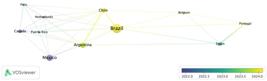
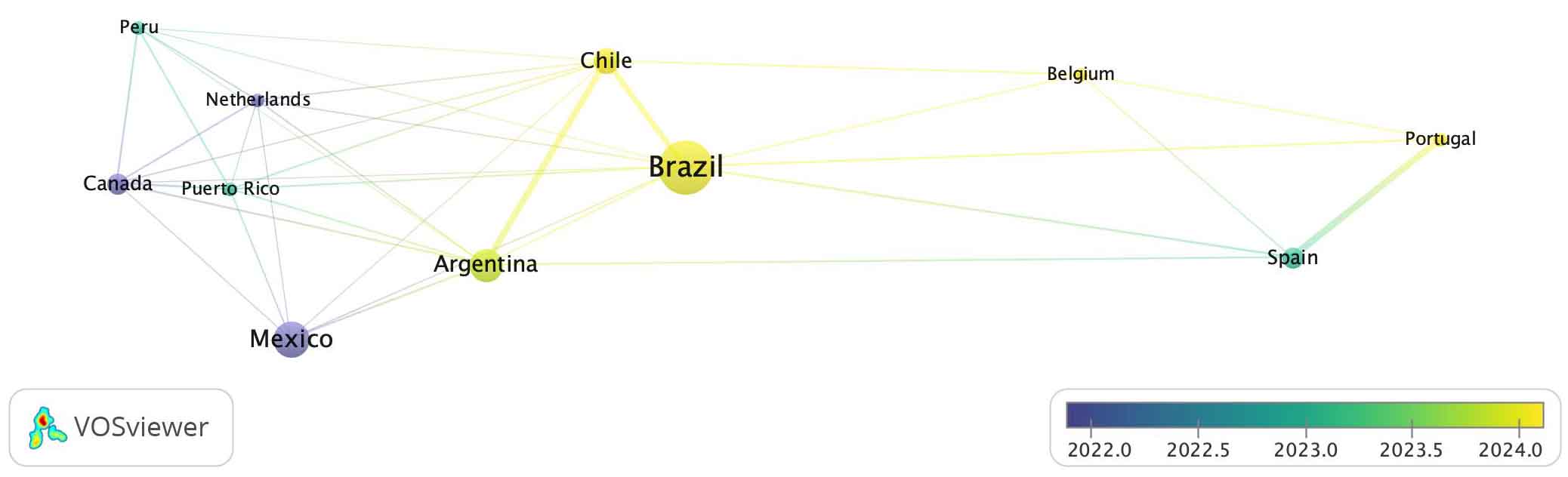
The map portraying the bibliographic coupling by country (Figure 1) represents the geographical network of research on Airbnb in Latin America, based on common cited references. The map portrays a network of eleven main countries organized in three clusters of academic work patterns. Brazil corresponds to the biggest node, with the largest volume of articles in the dataset, structurally connecting different parts of the network. Brazil, Chile, and Argentina form the main Latin American research cluster, with strong literature similarity. The second cluster highlights the similarities between Canada, Mexico, the Netherlands, Peru, and Puerto Rico, representing a network with multiple internal links as well as various connections with the main cluster, which suggests that these countries share bibliographic references and constitute a secondary pole within the network, also shaping the intellectual structure of the field. The last cluster has fewer links with the Latin American debate and comprises European academic works, in which Portugal and Spain share notable similarities and Belgium acts as an intermediary within the network core.
The network structure reveals that there are two main poles structuring the research in the field: a South American debate and a debate by a diverse group of countries, in dialogue with European contexts. This configuration reveals that research on Airbnb in Latin America is anchored on its regional perspectives, while still connected to wider global debates. In terms of temporal trends, it is clear that the diverse pole is more associated with older publications and that the countries most central to the network are the ones with more recent publications in the dataset. This means that Latin American scholarship is increasingly being produced by researchers from the region aware of the global literature, strengthening their position in the academic debate.
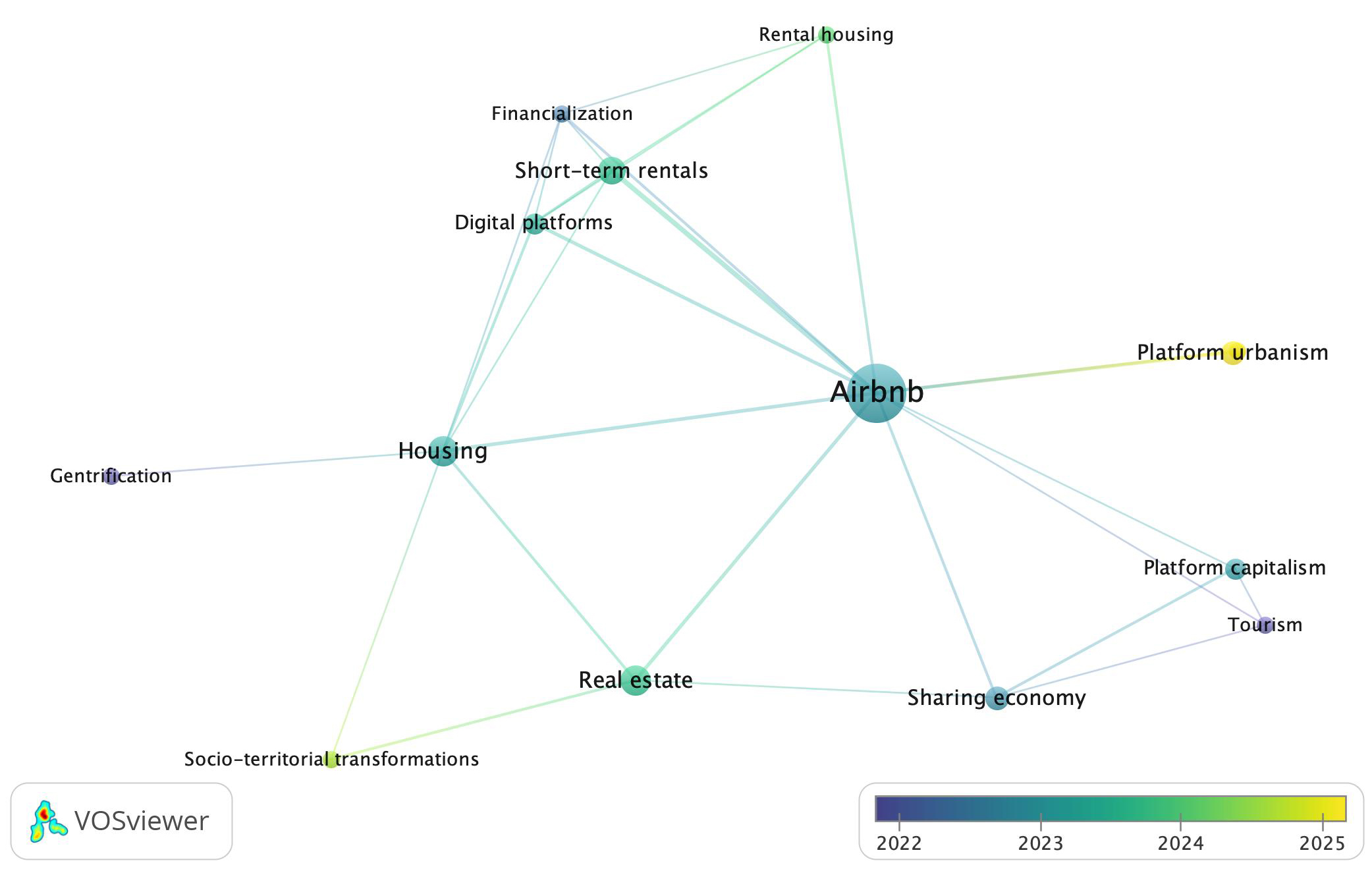
The analysis of the co-occurrence of keywords (Figure 2) highlights the conceptual structure of urban scholarship on Airbnb in Latin America, a network containing fourteen keywords organized around Airbnb as a central node and connected to four clusters with various links among them. The first cluster is related to research on the role of digital platforms in rental markets and their influence on financialization processes. The second focuses on housing from different perspectives, such as real estate market, urban changes, and gentrification. The third is associated with platform economy, debating the mechanisms of capitalism, the sharing discourse, and tourism dynamics. Finally, the fourth cluster is represented only by the term “platform urbanism”, whose peripheral position in the network indicates an emerging concept instead of a dominant analytical framework. The temporal analysis shows that the literature on Airbnb in Latin America has evolved from discourses on tourism and gentrification to wider debates concerning transformations in digital economy and, more recently, housing markets and urban changes.
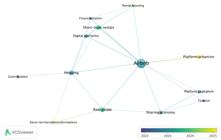
Both network maps reveal the degrees of scholarly connectivity and thematic focus in research on Airbnb in Latin America. Interpreting the two maps, it is possible to state that as academic production on the topic becomes denser, other research problems emerge. In addition, Latin American literature is regionally and globally interconnected, aware of local dynamics but in dialogue with international experiences. The regional scholarship is consolidating in two main axes: (a) Argentina, Chile, and Brazil, and (b) different geographical contexts. Next, the articles selected from the analyzed sample are discussed in depth, based on concepts from Latin American urban scholarship.
3.2. Content analysis
Short-term rental platforms like Airbnb deepen inequality patterns as they reproduce socio-spatial heterogeneities (Mermet, 2021), a challenge for Latin American cities, strongly marked by disparities in their organization and the living conditions of their population. Evidence from Airbnb in Rio de Janeiro shows that its spatial distribution is associated with areas characterized by a stronger presence of women, white residents, older populations, highly educated individuals, and higher income levels, along with a greater percentage of apartments, particularly those under rental tenure (Ferreira; Cocola-Gant; López-Gay, 2026). Based on this context, Airbnb is reinforcing socio-spatial heterogeneities that historically constrain the production of space in Rio de Janeiro, a process that mostly benefits already privileged groups (those with property and social capital).
In Lima, social classes condition a spatial heterogeneity expressed in housing conditions and access to basic services, among other factors (Castillo; Klaufus, 2019). For example, the Barranco district is subdivided into three zones: Zone A is close to the coast, where most luxury properties are located; Zone B is inhabited by the middle classes; and a population below the middle stratum lives in Zone C. This means that areas of extreme wealth are located right next to places where less privileged housing prevails, which are therefore subject to different dynamics. Barranco has undergone a construction boom since 2007, promoting its bohemian, cultural, and artistic image, a process that fostered the expansion of short-term rental accommodations, mostly located in Zones A and B. In Buenos Aires, in turn, these accommodations initially emerged in Palermo, Recoleta, and the city center and expanded into areas closer to the north, reinforcing tourism in zones where access to housing was already difficult due to high prices (Rongvaux, 2022). The distribution of accommodations in the city is linked to the unequal geographical pattern of urban attributes, mostly concentrated in the central area and in the northern axis (Lerena et al., 2024), although still present in peripheral areas that house populations in the medium and low socioeconomic strata (Lerena-Rongvaux; Orozco, 2025).
Additionally, Mexico City shows a clear heterogeneity in terms of the distribution of Airbnb listings, as there are no advertisements for listings in 38% of the spatial units, unlike most European and North American cities, where the platform covers the whole metropolitan area, albeit concentrated in certain areas (López-Gay et al., 2019). In the Mexican capital, Airbnb is present in the central areas, as well as in neighborhoods characterized by leisure and entertainment activities (Loyde, 2024), inhabited mainly by medium and high socioeconomic groups, a segregated feature of the city that is reinforced by the platform’s dynamics (López-Gay et al., 2019). In certain alcaldías, up to 30% of the housing stock is listed on Airbnb, limiting access to residential space (Garrido-Rodríguez, 2025). Finally, after experiencing the fastest growth in Airbnb’s history, Havana’s market is characterized by strong segregation, as accommodations of different qualities coexist in certain areas (Wijburg; Pallas; Aalbers, 2024). For example, family homestays (casas particulares) alongside fully renovated properties are instances of the deepening of socio-spatial inequalities due to the increasing commodification of housing induced by tourism in the city.
Land and housing informality is widely present in Latin American cities (Jaramillo, 2008), interacting daily with digital platforms as both constraints and opportunities. In Rio de Janeiro, there is a correlation between the presence of Airbnb and informal territories, such as favelas (Ferreira; Cocola-Gant; López-Gay, 2026). Various favelas (like Vidigal, Parque Chico Mendes, Rocinha, Morro dos Cabritos, and Cantagalo) are situated in areas with high tourism demand, notably the south of Rio de Janeiro, where Airbnb’s offer is also heavily present. The platform’s coverage in informal territories is limited, with most of the offerings distributed along their borders, which poses a challenge for the expansion of the company’s activities in areas characterized by high levels of informality.
In geographic terms, Lima is organized into two different areas (Castillo; Klaufus, 2019): Central Lima, where most of the housing, infrastructure, and services are located, Peripheral Lima, characterized by informal occupation through self-construction. Although square-meter prices increased citywide during the housing boom, rates in Central Lima were still three times higher than those in Peripheral Lima, indicating how informality relates to the real estate market in Latin American cities, as it is subject to commercial interest, but only to a certain extent, given features such as housing precarity and illegality. This is relevant in the case of short-term rentals, since platforms operate on that political and economic layer, facing land and housing informality as a challenge to the development of tourism accommodations.
Before 2011, properties were being informally exchanged in Havana by means of housing swaps (permutas), including an “under the table” payment or material compensation for the use of rooms or parts of someone’s home (Wijburg; Pallas; Aalbers, 2024). After 2011, Decree-Law n. 288 opened the city’s property market, legalizing housing exchange based on market prices, something that already happened informally. Consequently, since then, highly professionalized short-term rental agents have entered the small-scale market based on family homestays from the 1990s, making it more complex. Tourism property development in Havana depends on foreign investment, challenging government control of housing markets and intensifying urban rehabilitation and transnational gentrification (Jolivet, 2023; Jolivet; Alba-Carmichael, 2021). Besides transnational remittances, Cuban hosts also depend on assistance from informal social ties and access to supplies from informal markets to operate their accommodations (Santiago-Bartolomei, 2023).
In contexts where Airbnb is under regulation, the platform can still reproduce informal practices due to noncompliance with local norms. Rental regulation in Buenos Aires, governed by now revoked Law n. 27.551, implied more control over the market, inhibiting landlords from participating in the long-term rental market and, consequently, driving them to migrate to short-term rentals (Lerena et al., 2024). Afterwards, Law n. 6.225, from 2019, regulated temporary rentals for touristic purposes in the city, requiring landlords to register in public offices, platforms to inform host compliance with public norms, and public administration to control the market (Lerena et al., 2024). However, according to official data from Buenos Aires, only 2% of Airbnb offers in the city were registered with the public administration and therefore licensed to perform their activities as short-term rental accommodations.
In the City of São Paulo Strategic Master Plan, the Structuring Axes of Urban Transformation highlight how urban policy can also be co-opted by investors in the short-term rental market (Tavolari; Puppio, 2025). Instead of fostering demographic increase, the policy resulted in denser areas only in terms of construction parameters. Various units developed under the regulation were Airbnb accommodations rather than permanent housing, due to the ambiguity of the legal nature of the platform, lying somewhere between commercial activity and residential space. The companies investing in built-to-rent housing in São Paulo are supported by national and foreign capital (Marín-Toro; Rolnik, 2025). This shows that a fragile regulatory system can be absorbed by real estate agents to further urban extractivism. It is widely known that platformization not only reinforces urban extractivism but also complexifies it through new digital mechanisms (Sadowski, 2020b). For example, the underinvested built environment in historic Havana is experiencing a rise in urban renewal practices, a profitable market whose rent can be captured based on the conversion of residential housing into tourism accommodations (Wijburg; Pallas; Aalbers, 2024). The case of Lima reveals the growing financial power of the middle classes who get into real estate not for housing purposes, but as an investment (Castillo; Klaufus, 2019). Therefore, the local market has been shifting from demand-based to speculation-based logics.
In this context, real estate developers have created investment portfolios based on small apartments (more accessible to young professionals), coupled with the management of properties through subsidiary firms that use short-term rental platforms as a channel of distribution. These developers capture ground rent twice: from the properties they sell and from the tourists who request accommodation. This is specifically the case of the district of Barranco, where short-term rental platforms have expanded due to a rise in demand not absorbed by the traditional accommodation infrastructure. Lima’s urban development is not guided by a master plan that governs real estate projects, so the municipality negotiates regulations directly with the private sector. This means that the property markets in Lima are being reshaped through public-private alliances, connected to the rehabilitation of historical centers and the tourism industry (Guerra, 2023). As a result, some districts have weaker regulations for buildings to attract developers, as is the case in Barranco, where the loosening of construction parameters has resulted in a rise of competition levels in terms of project development in the city (Castillo; Klaufus, 2019).
Through monetary policy, the Cuban government at the same time controls and reinforces tourism investment, as it is a channel to capture inflows of foreign currency and to increase State-owned property values (Wijburg; Pallas; Aalbers, 2024). The presence of governmental dollar shops, financial institutions that coordinate transactions, and the requirement of State-issued magnetic cards are all forms of State intervention in the coalition between tourism investment and property markets. Fincimex, one of these institutions, collects foreign currency paid by Airbnb to Cuban hosts, who also use local bank cards credited with moneda libremente convertible (MLC), a local currency based on the dollar that can only be used at State retailers. In turn, in Argentina, the unfavorable position of the national currency in the global economy leads local agents to Airbnb, as users can collect rent in dollars, a financial strategy to protect themselves from local currency devaluation and the precarity of work (Lerena et al., 2024). This process has been possible using quick and flexible online payment systems, such as PayPal and Wise. In this case, platforms act upon global financial circuits, facilitating the flow of money from Buenos Aires to the United States, where Airbnb headquarters are located. Although these financial strategies seek to collect potentially higher housing rents through Airbnb, the low levels of occupation in Buenos Aires can act as a limitation for investors (Lerena-Rongvaux; Orozco, 2025).
In Rio de Janeiro, Lima, Buenos Aires, Havana, Mexico City, and São Paulo, Airbnb interacts with different Latin American dynamics of the production of space, showing that urbanization in the region can create opportunities and challenges for the platform’s spatial reproduction. In sum, it is possible to affirm that platformization is a global, but also a context-dependent and multifaceted, phenomenon, considering the diverse experiences found in Latin America that both complement and contrast with the urban scholarship from the Global North. In this sense, the present analysis promotes scientific innovation in urban studies focusing on platformization from a Global South perspective, therefore contributing to the emerging debate in the region associated with platform capitalism geographies.
Conclusions
Latin America is one of the most urbanized regions in the world, yet it remains deeply marked by socio-spatial inequalities across globalized metropolises and peripheral territories. Its urbanization, shaped by dependent capitalist development, combined rapid population growth and peripheral industrialization, resulting in a heterogeneous landscape of informality, precarity, and segregation, within which rural-urban migration and self-built neighborhoods expanded beyond State planning and inclusive governance (Caldeira, 2017; Kanai, 2025). Critical urban theory in the region has long stressed the specificity of these dynamics, rooted in colonial legacies, income polarization, weak State capacities, and the coexistence of capitalist and noncapitalist forms of labor and property (Fix; Arantes, 2022; Gorelik, 2016). More recent analyses interpret informality not as a residue but as a transversal process linking grassroots initiatives, speculative markets, and State practices-relations that intensified under neoliberalism, which reinforced market-oriented governance and deepened polarization. A new wave of scholarship thus seeks to theorize Latin American urbanization through frameworks grounded in its own historical, political, and economic specificities, challenging northern epistemologies (Ortiz, 2023).
The bibliometric analysis shows the emergence and advancement of urban scholarship on Airbnb in Latin America, with Argentina, Chile, and Brazil playing an important role in structuring regional thinking, but also with a strong participation of other countries, especially Mexico. These countries raised various research problems that enriched the debate, such as the financialization of rental markets, conflicts concerning housing, and the urban political economy of platformization. Despite the territorial heterogeneity across Latin America, the dominant global phenomenon of platformization carried out by Airbnb reveals certain patterns in the region, as shown by the content analysis. These patterns and their underlying dynamics can shed light on the way platforms are reshaping urban space beyond literature focused on the Global North. The contexts of fragile regulation governing platform-mediated short-term rentals in Latin America set the ground for the intense expansion of Airbnb in the region. Spatial inequality due to Airbnb platformization is present in Rio de Janeiro, Lima, Mexico City, and Havana, based respectively on sociodemographic indicators, urban zoning, service distribution, and housing conditions.
In relation to land informality and peripheral urbanization, the cases of Rio de Janeiro, Lima, Havana, and Buenos Aires highlight informal territories as barriers to tourism demand and platformization expansion. Nonetheless, the informal circuit can offer opportunities for various kinds of investors, especially given noncompliance with urban regulation. Therefore, the informal circuit can be considered an ambiguous dimension in the urbanization of Airbnb, acting as both a constraint and an opportunity. In Havana, Lima, and Buenos Aires, the platform also functions as a mechanism for urban extractivism through financialized speculation and housing commodification. Finally, economic and monetary instability in Latin American countries, such as Cuba and Argentina, mobilizes property owners and/or managers using Airbnb to strategically protect themselves from local currency devaluation, collecting rent in currencies that are stronger in the global economy (i.e. the U.S. dollar).
Overall, these dynamics suggest that short-term rental platformization in Latin America is affected by long-lasting inequality, persistent informality, political fragility, and accelerated financialization. The intersections between Airbnb and Latin American urbanization demand a broader rethinking of contemporary urban phenomena, highlighting the importance of situated, critical perspectives in understanding the evolving geographies of platform capitalism. Future research should move beyond describing patterns to address how platforms intertwine with the region’s structural conditions of inequality, informality, financialization, and political fragility. Scholars should examine how Airbnb interacts with informal housing markets, reconfigures socio-spatial hierarchies, and integrates local urban economies into global financial circuits. Studies comparing Latin American cities with one another and with other Global South contexts can reveal how platform urbanism takes various forms. The urban research agenda concerning Airbnb in Latin America must not consider the region merely as a subject of research; it must reinforce Latin America as an epistemological place to foster theoretical innovation on platformization.
Open Data
The data supporting the findings of this study are available on the SciELO Data platform at https://doi.org/10.48331/SCIELODATA.XEERIO
References
- ABRAMO, P. The Informal COMP-FUSED City: Market and Urban Structure in Latin American Metropolises. Bulletin of Latin American Research, v. 38, n. S2, p. 20-40, 2019.
- ADAMIAK, C. Mapping Airbnb Supply in European Cities. Annals of Tourism Research, v. 71, p. 67-71, 2018.
- ADAMIAK, C.; MARJAVAARA, R. Airbnb and Urban Population Change: An Empirical Analysis of the Case of Stockholm, Sweden. Urban Research & Practice, v. 17, n. 5, p. 654-80, 2023.
- ALMANDOZ, A. Modernization, Urbanization and Development in Latin America, 1900s-2000s New York: Routledge, 2014.
- ANGUELOV, D. Urban Informality. In: PECK, J.; SHEPPARD, E. S.; LEITER, H. (Orgs.). Urban Studies Inside/Out: Theory, Method, Practice. Los Angeles: Sage, 2020.
- ANSELMI, G.; CHIAPPINI, L.; PRESTILEO, F. The Greedy Unicorn: Airbnb and Capital Concentration in 12 European Cities. City, Culture and Society, v. 27, n. 1, e100412, 2021.
- ARBOLEDA, M. Spaces of Extraction, Metropolitan Explosions: Planetary Urbanization and the Commodity Boom in Latin America. International Journal of Urban and Regional Research, v. 40, n. 1, p. 96-112, 2016.
- BANKS, N.; LOMBARD, M.; MITLIN, D. Urban Informality as a Site of Critical Analysis. The Journal of Development Studies, v. 56, n. 2, p. 223-38, 2020.
- BEI, G.; CELATA, F. Challenges and Effects of Short-Term Rentals Regulation: A Counterfactual Assessment of European Cities. Annals of Tourism Research , v. 101, e103605, 2023.
- CALDEIRA, T. City of Walls: Crime, Segregation, and Citizenship in São Paulo. Berkeley: University of California Press, 2000.
- CALDEIRA, T. Peripheral Urbanization: Autoconstruction, Transversal Logics, and Politics in Cities of the Global South. Environment and Planning D: Society and Space, v. 35, n. 1, p. 3-20, 2017.
- CALDERÓN, J. Algunas consideraciones sobre los mercados ilegales e informales de suelo urbano en América Latina Lincoln Institute of Land Policy, v. Reporte de investigación, n. LP99Z16, p. 20, 1999.
- CANETTIERI, T. Peripheral Urbanization, Informal Real Estate Markets and Criminal Activities in Belo Horizonte (MG, Brazil). Journal of Illicit Economies and Development, v. 6, n. 1, 2024.
- CASTILLO, M. L.; KLAUFUS, C. Rent-seeking Middle Classes and the Short-Term Rental Business in Inner-city Lima. Urban Studies, v. 57, n. 12, p. 2547-63, 2019.
- CHASE-DUNN, C. The Coming of Urban Primacy in Latin America. Comparative Urban Research, v. 11, n. 1-2, p. 14-31, 1985.
- COBOS, E. P. La ciudad capitalista en el patrón neoliberal de acumulación en América Latina. Cadernos Metrópole, v. 16, n. 31, p. 37-60, 2014.
- COCOLA-GANT, A.; JOVER, J. The Political Economy of Housing Investment in the Short-Term Rental Market: Insights from Urban Portugal. Antipode, v. 55, n. 1, p. 134-55, 2023.
- DAVIDSON, N.; INFRANCA, J. The Sharing Economy as an Urban Phenomenon. Yale Law & Policy Review, v. 34, n. 2, p. 215-79, 2016.
- DAVIS, M. Planet of Slums London; New York: Verso, 2006.
- FERREIRA, P.; COCOLA-GANT, A.; LÓPEZ-GAY, A. Aluguéis temporários como motores de desigualdade: uma análise sociodemográfica do Airbnb no Rio de Janeiro. Revista Eure, v. 52, n. 155, p. 1-24, 2026.
- FERRERI, M.; SANYAL, R. Platform Economies and Urban Planning: Airbnb and Regulated Deregulation in London. Urban Studies , v. 55, n. 15, p. 3353-68, 2018.
- FERRERI, M.; SANYAL, R. Digital Informalisation: Rental Housing, Platforms, and the Management of Risk. Housing Studies, v. 37, n. 6, p. 1035-53, 2021.
- FIX, M.; ARANTES, P. F. On Urban Studies in Brazil: The Favela, Uneven Urbanisation and Beyond. Urban Studies , v. 59, n. 5, p. 893-916, 2022.
- GAGO, V. Neoliberalism from Below: Popular Pragmatics and Baroque Economies. Durham: Duke University Press Books, 2017.
- GAGO, V.; MEZZADRA, S. A Critique of the Extractive Operations of Capital: Toward an Expanded Concept of Extractivism. Rethinking Marxism, v. 29, n. 4, p. 574-91, 2017.
- GARMANY, J.; RICHMOND, M. A. Hygienisation, Gentrification, and Urban Displacement in Brazil. Antipode , v. 52, n. 1, p. 124-44, 2020.
- GARRIDO-RODRÍGUEZ, L. ¿Expansión o invasión? El auge de Airbnb en la Ciudad de México, 2019-2023. Revista Eure , v. 51, n. 154, p. 1-25, 2025.
- GORELIK, A. Pan-American Routes: A Continental Planning Journey between Reformism and the Cultural Cold War. Planning Perspectives, v. 32, n. 1, p. 47-66, 2016.
- GRAHAM, M. Regulate, Replicate, and Resist-The Conjunctural Geographies of Platform Urbanism. Urban Geography, v. 41, n. 3, p. 453-7, 2020.
- GROHMANN, R. Latin American Critical Data Studies. Big Data & Society, v. 12, n. 2, p. 1-9, 2025.
- GUERRA, J. Vivienda e informalidad urbana: el caso de Airbnb y sus posibles impactos en un distrito de Lima. La Colmena, n. 16, p. 19-33, 2023.
- GUERREIRO, I.; ROLNIK, R.; MARÍN-TORO, A. Gestão neoliberal da precariedade: o aluguel residencial como nova fronteira de financeirização da moradia. Cadernos Metrópole , v. 24, p. 451-76, 2022.
- GUTIÉRREZ, A.; DOMÈNECH, A. Understanding the Spatiality of Short-Term Rentals in Spain: Airbnb and the Intensification of the Commodification of Housing. Geografisk Tidsskrift-Danish Journal of Geography, v. 120, n. 2, p. 98-113, 2020.
- GUTIÉRREZ, A. et al. The Eruption of Airbnb in Tourist Cities: Comparing Spatial Patterns of Hotels and Peer-to-Peer Accommodation in Barcelona. Tourism Management, v. 62, p. 278-291, 2017.
- GUTTENTAG, D. Airbnb: Disruptive Innovation and the Rise of an Informal Tourism Accommodation Sector. Current Issues in Tourism, v. 18, n. 12, p. 1192-217, 2013.
- GYÓDI, K. The Spatial Patterns of Airbnb Offers, Hotels and Attractions: Are Professional Hosts Taking over Cities? Current Issues in Tourism , v. 27, n. 17, p. 2757-82, 2023.
- HOLSTON, J. Insurgent Citizenship: Disjunctions of Democracy and Modernity in Brazil. Princeton, NJ: Princeton University Press, 2008.
- IOANNIDES, D.; RÖSLMAIER, M.; VAN DER ZEE, E. Airbnb as an Instigator of “Tourism Bubble” Expansion in Utrecht’s Lombok Neighbourhood. Tourism Geographies, v. 21, n. 5, p. 822-40, 2018.
- JANOSCHKA, M.; SEQUERA, J. Gentrification in Latin America: Addressing the Politics and Geographies of Displacement. Urban Geography , v. 37, n. 8, p. 1175-94, 2016.
- JARAMILLO, S. Reflexiones sobre la “informalidad” fundiaria como peculiaridad de los mercados del suelo en las ciudades de América Latina. Territorios, n. 18-19, 2008.
- JIAO, J.; BAI, S. An Empirical Analysis of Airbnb Listings in Forty American Cities. Cities, v. 99, e102618, 2020.
- JOLIVET, V. Havana’s Transnational Gentrification: Highest and Best Use from Elsewhere. Tijdschrift voor Economische en Sociale Geografie, v. 115, n. 1, p. 142-54, 2023.
- JOLIVET, V.; ALBA-CARMICHAEL, M. Reinvesting in Havana: Housing Commodification and Gentrification in the Central Neighbourhoods of a Socialist City in the Global South. International Journal of Cuban Studies, v. 13, n. 2, p. 248-74, 2021.
- KANAI, J. M. Urbanization. In: HALVORSEN, J. (Ed.). Latin American Geographies [S.l.]: Routledge, 2025.
- KANAI, J. M.; SCHINDLER, S. Infrastructure-Led Development and the Peri-Urban Question: Furthering Crossover Comparisons. Urban Studies , v. 59, n. 8, p. 1597-617, 2022.
- LERENA, N. et al. Los alquileres temporarios como nuevas formas de valorización inmobiliaria: miradas desde Buenos Aires. Geo Uerj, i. 44, e83551, 2024.
- LERENA-RONGVAUX, N.; OROZCO, H. Alquileres a corto plazo como nuevos patrones de acumulación territorial. Airbnb en Buenos Aires y Santiago de Chile. Scripta Nova, v. 29, n. 2, p. 141-76, 2025.
- LÓPEZ-GAY, A. et al. Apartamentos turísticos, ciudad y población en América Latina. Los casos de Ciudad de México y São Paulo. Revista Latinoamericana de Población, v. 13, n. 25, p. 5-35, 2019.
- LOYDE, R. G. Los oferentes de Airbnb en la financiarización de la vivienda en las áreas centrales de la Ciudad de México. Revista de Estudios Urbanos y Ciencias Sociales, v. 13, n. 1, p. 101-7, 2023.
- LOYDE, R. G. Consolidación y profesionalización de Airbnb en áreas centrales de la Ciudad de México. Punto Sur, v. 11, p. 118-37, 2024.
- MARICATO, E. As ideias fora do lugar e o lugar fora das ideias: planejamento urbano no Brasil. In: ARANTES, O.; VAINER, C.; MARICATO, E. (Orgs.). A cidade do pensamento único: desmanchando consensos. Petrópolis: Editora Vozes, 2000. p. 121-92.
- MARICATO, E. Globalização e política urbana na periferia do capitalismo. Territorios , v. 18-19, p. 183-205, 2008.
- MARÍN-TORO, A.; ROLNIK, R. Financiarización de la vivienda en arriendo: la emergencia de un nuevo activo inmobiliario-financiero en Santiago y São Paulo. Revista Eure , v. 51, n. 154, p. 1-24, 2025.
- MCCANN, E.; WARD, K. Relationality/Territoriality: Toward a Conceptualization of Cities in the World. Geoforum, v. 41, n. 2, p. 175-84, 2010.
- MERMET, A. C. Who Is Benefiting from Airbnb? Assessing the Redistributive Power of Peer-to-Peer Short-Term Rentals. The Professional Geographer, v. 73, n. 3, p. 553-66, 2021.
- MONTE-MÓR, R. L. Extended Urbanization and Settlement Patterns in Brazil: An Environmental Approach. In: BRENNER, N. (Ed.). Implosions/Explosions: Towards a Study of Planetary Urbanization. Berlin: Jovis, 2014. p. 109-20.
- NERI, R. La gentrificación turística de Airbnb: análisis socioespacial de dos monumentos en la Ciudad de México. Persona&Sociedad, v. 34, n. 1, p. 45-70, 2020.
- ORTIZ, C. Writing the Latin American City: Trajectories of Urban Scholarship. Urban Studies , v. 61, n. 3, p. 399-425, 2023.
- PORTES, A.; ROBERTS, B. R. The Free-Market City: Latin American Urbanization in the Years of the Neoliberal Experiment. Studies in Comparative International Development, v. 40, p. 43-82, 2005.
- ROBERTS, B. The Making of Citizens: Cities of Peasants Revisited. New York: Routledge , 2020.
- ROBINSON, J. Comparative Urbanism: Tactics for Global Urban Studies . Hoboken: Wiley, 2022.
- ROLNIK, R. Urban Warfare: Housing under the Empire of Finance. London; New York: Verso , 2019.
- ROLNIK, R.; GUERREIRO, I.; MARÍN-TORO, A. El arriendo - formal e informal - como nueva frontera de la financiarización de la vivienda en América Latina. Revista Invi, v. 36, n. 102, p. 19-53, 2021.
- RONGVAUX, N. L. Tendencias de mercantilización de la vivienda en América Latina: el submercado de alquileres temporarios a través de plataformas digitales. Airbnb en Ciudad de Buenos Aires. Geograficando, v. 18, n. 2, e115, 2022.
- RONGVAUX, N. L.; RODRIGUEZ, L. Airbnb in Latin America: A Literature Review from an Urban Studies Perspective. Journal of Urban Affairs, v. 46, n. 6, p. 1146-60, 2023.
- ROY, A. Slumdog Cities : Rethinking Subaltern Urbanism. International Journal of Urban and Regional Research , v. 35, n. 2, p. 223-38, 2011.
- SADOWSKI, J. Cyberspace and Cityscapes: On the Emergence of Platform Urbanism. Urban Geography , v. 41, n. 3, p. 448-52, 2020a.
- SADOWSKI, J. The Internet of Landlords: Digital Platforms and New Mechanisms of Rentier Capitalism. Antipode , v. 52, n. 2, p. 562-80, 2020b.
- SANTIAGO-BARTOLOMEI, R. Labor Formalization and Digital Platforms: Entrepreneurship and Short-Term Rentals in Havana’s Housing Markets. Urban Geography , v. 44, n. 8, p. 1654-76, 2023.
- SANTOS, M. Planning Underdevelopment. Antipode , v. 9, n. 3, p. 86-98, 1977.
- SASSEN, S. Cities in a World Economy Thousand Oaks, London, New Delhi: Pine Forge Press, 2018.
- SCHINDLER, S.; KANAI, J. M. Getting the Territory Right: Infrastructure-Led Development and the Re-emergence of Spatial Planning Strategies. Regional Studies, v. 55, n. 1, p. 40-51, 2019.
- SCHMID, C. et al. Towards a New Vocabulary of Urbanisation Processes: A Comparative Approach. Urban Studies , v. 55, n. 1, p. 19-52, 2018.
- SILES, I. et al. Tropicalizing Platformization? Tensions in Research on Algorithms and Platforms in Latin America. International Journal of Cultural Studies, v. 28, n. 1, p. 332-40, 2025.
- SRNICEK, N. Platform Capitalism Cambridge, Malden: Polity Press, 2017.
- STABROWSKI, F. “People as Businesses”: Airbnb and Urban Micro-entrepreneurialism in New York City. Cambridge Journal of Regions, Economy and Society, v. 10, n. 2, p. 327-47, 2017.
- STREULE, M. et al. Popular Urbanization: Conceptualizing Urbanization Processes beyond Informality. International Journal of Urban and Regional Research , v. 44, n. 4, p. 652-72, 2020.
- TAVOLARI, B.; PUPPIO, M. Regulação de plataformas: distorções no planejamento urbano e zoneamento em São Paulo. Cadernos Metrópole , v. 27, n. 64, e6469495, 2025.
- TONUCCI, J. Property-Led Informality: Shifting Informal Land Development from Popular Housing to Middle-Class and Elite Speculation in Belo Horizonte. International Journal of Urban and Regional Research , v. 47, n. 4, p. 527-45, 2023.
- TONUCCI, J.; CASTRIOTA, R. Occupy the Periphery: Housing Occupations and the Production of Urban Commons in Belo Horizonte. In: REIS, N.; LUKAS, M. (Orgs.). Beyond the Megacity: New Dimensions of Peripheral Urbanization in Latin America. Toronto: University of Toronto Press, 2022.
- VALENTE, R. et al. Short-Term Rentals and Long-Term Residence in Amsterdam and Barcelona: A Comparative Outlook. Cities , v. 136, e104252, 2023.
- VALLADARES, L. A invenção da favela: do mito de origem a favela.com. Rio de Janeiro: Editora FGV, 2005.
- VEGLIÒ, S. Postcolonizing Planetary Urbanization: Aníbal Quijano and an Alternative Genealogy of the Urban. International Journal of Urban and Regional Research , v. 45, n. 4, p. 663-78, 2021.
- WIJBURG, G.; PALLAS, M. C. G.; AALBERS, M. B. Tourism-Led Housing Commodification: Transnational Real Estate Networks and State-Permeated Property Investment in Havana, Cuba. Housing, Theory and Society, v. 42, n. 3, p. 1-21, 2024.
-
1
This work was supported by the Foundation for Science and Technology (FCT, I.P.) — project reference 2022.13276.BD and DOI 10.54499/2022.13276.BD. The authors would like to thank Luiza Nunes for assistance in organizing the database.
-
2
The entire anonymized dataset that supports the findings of this study will be made available on SciELO Data: https://doi.org/10.48331/SCIELODATA.XEERIO.
-
Information on the use of artificial intelligence
Search, systematization, and final organization of references: No.Organization of databases and the respective production of charts, tables, and graphs: No.Final text proofreading for grammar and spelling improvement, in accordance with standard language norms: ChatGPT.
-
Editors:
Maria do Livramento Miranda Clementino - https://orcid.org/0000-0001-7972-4869Rodrigo José Firmino - https://orcid.org/0000-0002-0831-6603Sara Raquel Fernandes Queiroz de Medeiros - https://orcid.org/0000-0003-0712-6135
-
Dossier Editors:
Jeroen Johannes Klink - https://orcid.org/0000-0001-6264-001XVictor Ramiro - https://orcid.org/0000-0002-4854-7553Guillermo Jajamovich - https://orcid.org/0000-0001-9628-2468

 Source: Authors (2026).
 Source: Authors (2026).