 Progressive resistance training and muscle strength in older men with prostate cancer undergoing androgen deprivation therapy: systematic review
Abstract
Objective To synthesize the evidence on the effects of progressive resistance training on muscle strength in older men with prostate cancer undergoing androgen deprivation therapy.
Methods A systematic review of randomized clinical trials was carried out in the PubMed, Scopus, Embase, LILACS and ClinicalTrials databases. Studies of older men aged 60 years or older with prostate cancer undergoing androgen deprivation therapy comparing progressive resistance training to an active control group were included. Risk of bias and quality of evidence were assessed using the RoB 2.0 and GRADE tools, respectively.
Results Ten randomized clinical trials were included, with a total of N=481 participants. Progressive resistance training promoted significant gains in muscle strength, ranging from 7,0% to 23,0%. Supervised protocols, with structured load progression, high adherence and a minimum duration of 12 weeks, showed the most consistent gains. In contrast, home-based or unsupervised interventions showed inconsistent or non-significant results. The one-repetition maximum test was the most sensitive method for detecting changes in dynamic muscle strength. None of the interventions resulted in serious adverse events.
Conclusion Progressive resistance training is a safe and effective therapeutic strategy for increasing muscle strength in older men with prostate cancer undergoing androgen deprivation therapy. Supervised and structured protocols are superior and should be integrated as a standard component in oncology rehabilitation programs for this population.
Keywords
Prostate Cancer; Androgen Antagonists; Resistance Training; Muscle Strength; Aged.
Resumo
Objetivo Sintetizar evidências sobre os efeitos do treinamento de força progressivo na força muscular de homens idosos com câncer de próstata submetidos à terapia de privação androgênica.
Métodos Revisão sistemática de ensaios clínicos randomizados nas bases de dados PubMed, Scopus, Embase, LILACS e ClinicalTrials. Foram incluídos estudos com pessoas de 60 anos de idade ou mais, com câncer de próstata em terapia de privação androgênica, que compararam o treinamento de força progressivo a um grupo controle ativo. O risco de viés e a qualidade da evidência foram avaliados pelas ferramentas RoB 2.0 e GRADE, respectivamente.
Resultados Foram incluídos 10 ensaios clínicos randomizados, em um total de N=481 participantes. O treinamento de força progressivo promoveu ganhos significativos de força muscular, entre 7,0% e 23,0%. Protocolos supervisionados, com progressão de carga estruturada, alta adesão e duração mínima de 12 semanas, apresentaram os ganhos mais consistentes. Em contraste, intervenções domiciliares ou não supervisionadas demonstraram resultados inconsistentes ou não significativos. O teste de uma repetição máxima foi o método mais sensível para detectar alterações na força muscular dinâmica. Nenhuma intervenção resultou em eventos adversos graves.
Conclusão O treinamento de força progressivo é uma estratégia terapêutica segura e eficaz para aumentar a força muscular em pessoas idosas com câncer de próstata sob terapia de privação androgênica. Protocolos supervisionados e estruturados são superiores e devem ser integrados como componente padrão nos programas de reabilitação oncológica para essa população.
Palavras-chave
Câncer de Próstata; Antagonistas de Androgênios; Treinamento de Força; Força Muscular; Idoso.
INTRODUCTION
Prostate cancer (PCa) is the most common solid malignant neoplasm in men and poses a growing challenge for health systems1,2. An estimated 60-70% of cases are diagnosed in older men aged ≥ 60 years, where PCa accounts for 13.5% of all malignant neoplasms among males in Brazil, ranking the second-leading cause of mortality from cancer in this group2-4. Androgen deprivation therapy (ADT), widely used in the treatment of advanced stage PCa, although effective for tumor control, is associated with significant side-effects, such as low muscle strength, loss of total muscle mass (TMM), and increased risk of sarcopenia, negatively impacting functioning, independence, and quality of life in this group5-9.
Previous systematic reviews (SR) have shown that the effectiveness of progressive resistance training (PRT) for improving muscle strength in oncologic populations depends on factors such as professional supervision, moderate-to-high intensity, frequency of 2-3 weekly sessions, and controlled increased load, where these elements impact the magnitude of strength gains10-13. Nevertheless, there is no consensus on the standard dose of PRT for older men receiving ADT, limiting the establishment of evidence-based clinical recommendations12,13.
Although associations such as the American College of Sports Medicine (ACSM) recommends PRT for individuals with cancer, no SRs were found solely analyzing the effects of this training on muscle strength in older men undergoing ADT12,14-18. Thus, the present study is the first investigation to synthesize the evidence for this population. Therefore, the objective of this SR was to synthesize the available evidence on the effects of PRT on muscle strength in older men receiving ADT to inform clinical recommendations and guide future investigations.
METHOD
A systematic review (SR) was conducted in accordance with the recommendations of the Joanna Briggs Institute19 (JBI). The SR was registered on the PROSPERO platform, under protocol CRD42024590545.
Randomized Clinical Trials (RCT) investigating the effects of progressive resistance training (PRT) on muscle strength in older men with prostate cancer (PCa) undergoing androgen deprivation therapy (ADT) involving quantitative analysis were selected. The research question was structured using the PICO20 (Population, Intervention, Comparison, Outcome) strategy, where (P) older men with PCa on ADT; (I) PRT; (C) active control group; and (O) effects on muscle strength. Thus, the research question guiding the study was: “What are the effects of PRT on muscle strength in older men with PCa undergoing ADT, compared to an active control group (CG) that performed usual or minimal activities? ”.
The studies were selected based on the following inclusion criteria: regarding design, only RCT were include. The population had to comprise older men (age ≥60 years) diagnosed with PCa and undergoing ADT. The intervention had to be PRT, applied alone or in combination with other modalities. As a comparator, RCT had to include an active CG instructed to continue usual activities or engage in only minimal interventions. Lastly, searches were conducted in three languages (English, Portuguese and Spanish) using equivalent descriptors in each language, for reports published between 2014 and 2024, in order to ensure the clinical relevance of evidence. The search targeted studies with a focus on training protocols and usual care practices reflecting the state of the art, given the theory on resistance training in older adults has undergone significant changes. The following exclusion criteria were applied: review studies, theses, dissertations, book chapters, technical reports, and letters to the Editor. In addition, the exclusion of the gray literature ensured that all RCT included had rigorous methodological description, elements that allow proper assessment of risk of bias, thereby guaranteeing the validity of data extracted for synthesis.
The search for RCT was carried out in March 2025 on the following databases: National Center for Biotechnology Information (NCBI/PubMed), Literatura Latino-Americana e do Caribe em Ciências da Saúde (LILACS), Excerpta Medica Database (EMBASE), Scopus, and ClinicalTrials. The RCT search strategy involved the use of a combination of controlled and uncontrolled descriptors, as indicated for each database. The search for RCT on PubMed used controlled descriptors from Medical Subject Headings (MeSH); on EMBASE used Embase Subject Headings (EMTREE), whereas Descritores em Ciências de Saúde (DeCS) were employed for the search on LILACS. Additionally, the descriptors selected for searching Scopus and ClinicalTrials were used. For these searches, the terms “prostate cancer”; “antiandrogen therapy”; “resistance training”; “muscle strength”; and “older adults” were used. The full search strategy for each database is presented in Chart 1.
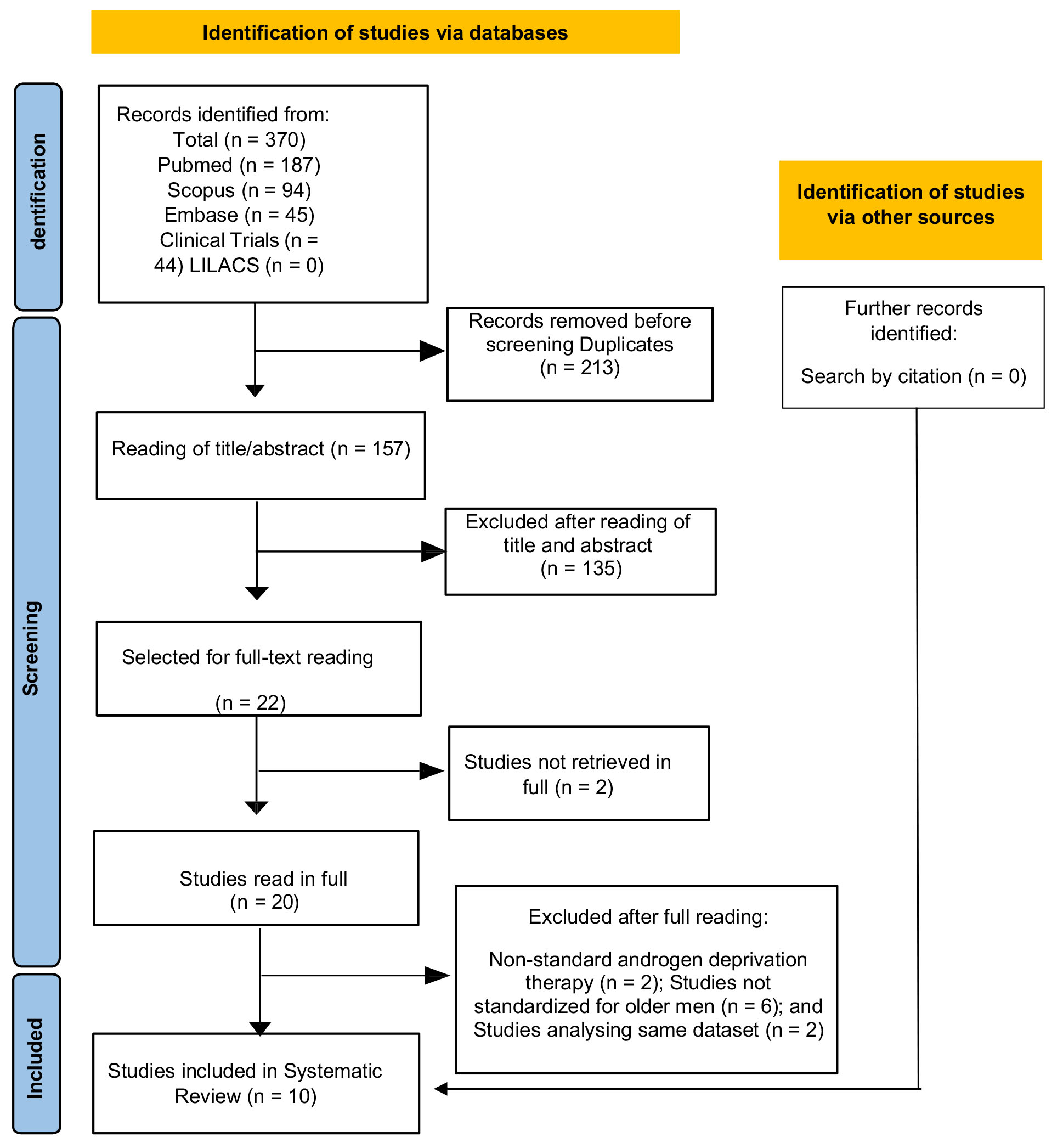
Study selection was managed on the Rayyan platform21. The search strategy and procedures for selecting RCT, from databases to decision to screen titles and abstracts or full reading, were conducted according to JBI methodological guidelines19. The process of identification, screening, and inclusion of articles was reported according to PRISMA22 (Figure 1).
Flow diagram of selection process of randomized clinical trials included in systematic review on the effects of resistance training in older men with prostate cancer on androgen deprivation therapy. Brazil, 2025.
Two reviewers (AHHS and JPMA) independently screened titles and abstracts, where any disagreements were settled by consensus or a third reviewer (FGC). Potentially eligible articles were read in full for the final decision based on the inclusion criteria. Data extraction was also carried out independently by the same reviewers, using a standardized form devised using the Cochrane Handbook for Systematic Reviews of Interventions and adapted to the domains of the PICO question of the present SR (Higgins et al., 2024)23. The extracted variables were: (1) study characteristics (design, source of funding); (2) participant characteristics (sample size, age, ADT duration, Gleason Score); (3) details of the intervention and comparator (duration, frequency, supervision, load progression); and (4) muscle strength outcomes (absolute mean and standard deviation values pre and post-intervention or comparative data for groups, such as the difference in means and its p-value). For RCT that reported quantitative data, the effects of the intervention were extracted as the group difference in means, with respective confidence intervals and p-values.
A narrative synthesis was chosen for this SR, because clinical and methodological heterogeneity found in the RCT, particularly with respect to intervention protocols, methods of measuring muscle strength outcomes, differing intervention periods and CG, precluded statistical pooling (meta-analysis).
In cases of RCT whose data were missing or unavailable, the respective authors were contacted to obtain further information. Data extraction was based solely on the information published, whereby any given data item found to be unavailable was recorded as Not Reported (NR). For multicenter RCT, the percentage values reported by the authors were maintained24,25. Data were treated descriptively and assessed for certainty of evidence using the Grading of Recommendations, Assessment, Development and Evaluation (GRADE) system26.
Risk of Bias 2.0 (RoB 2.0)27 assessment was conducted for each main outcome, and results included in the certainty of evidence assessment. As per GRADE26, the certainty of evidence was rated based on five domains: Risk of bias, Inconsistency, Indirect evidence, Imprecision, and Publication bias. Drawing on the findings, results were organized to provide a descriptive synthesis of the data (see Tables 1 and 2).
DATA AVAILABILITY
The data set underpinning the study results is available from the Figshare repository at https://doi.org/10.6084/m9.figshare.29442248.v5.
RESULTS
The initial search of the databases identified 370 studies. The process of removal of duplicate publications was performed using the Rayyan – Intelligent Systematic Review. Subsequently, assessment took place by examining titles and abstract and then full reading of the selected RCT. A final total of 10 RCT met the eligibility criteria and were included in the present SR. Also, a manual search of the reference lists of all RCT included in the final synthesis was carried out. This process, however, failed to identify any further RCT that met the eligibility criteria, as depicted in the flow diagram (Figure 1).
The present SR included 10 RCT, involving a total of N=481 participants, all older men, diagnosed with PCa, undergoing ADT during interventions with PRT28-35, and predominantly with high Gleason Score (7-8)24,25,30,32-35. All eligible RCT were published in English24,25,28-35, with no eligible studies identified in Portuguese or Spanish.
The RCT were widely distributed geographically, having been conducted in 10 different countries, with the majority carried out in Europe24,25,28,31,32,35, Ásia30,33, North America29, and África34.
ADT duration varied, from start of treatment33,34 to long-term exposure28-30, with unequal groups in some RCT28,29,32.
Duration of RCT ranged from 12 weeks28,29,32,35 to 56 weeks25, with frequency of 2 to 3 sessions weekly24,24,28-35, and adherence rates were between 70.80% and 93.80%24,25,28,35.
Load progression was set according to different criteria, including fixed linear models29,31, automated32, periodized25,35, and individual approaches28,30,33. Some studies used individualized approaches, with adjustments based on the Rating of Perceived Exertion scale (RPE) or on participation adaptation to PRT28,30,33. More specifically, Houben et al.24 used a design with two PRT groups (protein and placebo), pooled together in this SR for having shown no significant differences in muscle strength outcomes (see Tables 1 and 2).
The intervention characteristics, methods of assessing muscle strength, and comparative effects are summarized in Table 2.
General and clinical characteristics of studies included in systematic review on effects of resistance training among older men with prostate cancer. Brazil, 2025.
Intervention protocols, assessment methods, and main outcomes of randomized clinical trials reviewed. Brazil, 2025.
The RCT that used direct supervision reported the highest adherence rates of 80%, and more consistent gains in muscle strength24,25,29,31,35. By contrast, home-based or unsupervised interventions, despite showing good adherence in some RCT, promoted no significant improvements in muscle strength30,32-34. The interventions exhibited high safety, with no reports of serious adverse events in the RCT31,33. The side-effects reported were mild, including transient muscle discomfort and a single case of tendinitis, which did not lead to discontinuation of the protocol25,28,31,33.
In general, the highest intragroup gains in maximal strength were seen in lower limbs (LL) 28,29,35. Gains in upper limbs were lower, albeit consistent28,29,31. Conversely, hand-grip strength showed only slight differences or decreases30,32,34, while muscle strength, as measured using the Chair-sit test, improved in the IG30. In the multicenter RCT, authors reported percentage change, allowing internal comparability but revealing heterogeneity in measures across studies24,25.
Assessment of Risk of Bias
Detailed assessment of risk of bias of the 10 RCT, performed using the Cochrane RoB 2.0 tool27, revealed disparities: 3 RCT were classified as having "Low risk" 24,29,34, 3 as "Some concerns" 28,31,32, and 4 as "High risk" 25,30,33,35 of general bias. The global classification proved the highest risk among the outcomes (Table 3).
Effects of progressive resistance training on muscle strength in older men with prostate cancer: synthesis of assessment between groups and of quality of evidence. Brazil, 2025.
The Randomization process (D1) proved a strength in most of the RCT, with 9 out of 10 trials rated as “low risk” 24,25,28,29,31-35. In contrast, most of the “high risk” was attributed to the domains Deviations from intended interventions (D2)33,35 and Missing outcome data (D3)24,25, indicating problems in handling loss to follow-up.
The Measurement of the outcome domain (D4) was rated predominantly as “low risk” ”24,25,29,32,34 or "Some concerns"28,30,31,33,35, where the latter associated with lack of blinding of assessors in exercise trials. Lastly, the risk of bias in the Selective Reporting domain (D5) was consistently low across all RCT reviewed24,25,28-35. These individual assessments justify the risk of general bias ratings and support the downgrading of certainty of evidence in the GRADE analysis26.
Assessment of Quality of Evidence (GRADE)
A synthesis of the findings for each RCT reviewed is provided in Table 3, outlining the effect of the intervention, assessment of risk of bias27 and the factors underpinning the rating of certainty of evidence, as per the GRADE methodology26.
Muscle strength of LL/UL in supervised RCT on the maximal resistance test showed clinically relevant effects24,25,28,29,31,35, while results for grip strength were inconsistent30,33,34 and evidence for functional strength limited30, as this parameter was measured in only one RCT with a high risk of bias30. The heterogeneity observed stemmed largely from differences in protocols, methods of measurement and forms of reporting24,25,35, showing imprecision and inconsistency26. The greatest gains in muscle strength were observed in RCT with structured interventions and well-defined load progression protocols. One RCT showed an average increase from 121.3 kg to 142.4 kg in the IG, whereas the CG, engaged in stretching, was unchanged29. Another RCT failed to report the p-value between the groups, but observed increased muscle strength in the IG relative to the CG28.
Dawson et al.35 showed that the use of a periodized load progression model resulted in greater gains compared to linear progression protocols, with increases in leg press strength of up to 13.3%.
However, home-based RCT, and those with less supervised control, promoted only slightly improved outcomes31,32. The study of Lam et al.33, involving a 56-week intervention, reported a significant reduction in muscle strength for LL of the groups, despite good adherence. Nevertheless, Villumsen et al.32 observed improvement in aerobic resistance, yet no significant improvement in muscle strength (p=0.070).
The results obtained by Ndjavera et al.34, in spite of well-structured PRT, did not reach statistical significance.
Intervention duration was another determining factor: most RCT with a duration ≥12 weeks and supervised interventions showed marked gains in muscle strength24,25,28,29,31,35, where all RCT reviewed involved periods greater than or equal to 12 weeks24,25,28-35. The study by Houben et al.24 reported average gains of 13.2% and 15.1% in muscle strength for leg press and leg extension at 24 weeks, respectively.
Houben et al.25 also noted that, after cessation of supervised PRT, there was partial loss of the gains obtained, although values in the IG remained higher than those in the active CG.
A number of different sources of funding were identified, including funding agencies and financial support from industry24,25,28-35. Interventions in the CG (Table 2) consisted mainly of usual physical exercises or stretching protocols, both low intensity.
DISCUSSION
The objective of this SR was to synthesize the knowledge with respect to the effects of PRT on muscle strength in older men with PCa undergoing ADT. The findings revealed that PRT promotes consistent gains in muscle strength for this population compared to active controls. The importance of these findings lies in their clinical relevance, although the certainty of evidence of the RCT reviewed ranged from very low to high. Absolute gains in muscle strength, exceeding 20.0 kg on the 1RM leg press test in multiple RCT, represents a direct functional impact28,29,35.
Moreover, these findings corroborate the results of other reviews in oncologic populations, identifying professional supervision as a determining factor for the effectiveness of PRT, lending further support to this notion by confirming this principle in the specific context of ADT-induced anabolic resistance in older men10,12. The superiority of supervised protocols was clear. Home-based interventions, however, showed inconsistent results, despite the low drop-out rate (8.7%-15.4%)28,32,33, while protocols with structured and periodized load progression led to greater gains in muscle strength, indicating higher effectiveness in neuromuscular adaptation with periodic changes in intensity and volume24,25,34.
Conversely, more imprecise models, such as those used in domestic settings with load progression based on the rating of perceived exertion scale or on automated systems with low chance of progression, have proven less effective28,32,33. Additionally, the gains attained tend to decline after supervision ceases, highlighting the need for continuity of exercises to maintain benefits for muscle strength25. This suggests that supervision is a leading factor to ensure adequate load progression, constituting a more important element for the effectiveness of PRT than program adherence alone.
The data suggest that supervision of PRT sessions, standardization of load progression, and choice of objective methods of assessing muscle strength were directly associated with lower risk of bias, higher quality of evidence, and greater muscle strength gain in the RCT analyzed. These methodological elements confer greater consistency to findings and strengthen the evidence that supervised PRT promotes consistent effects on the muscle strength domain in older men on ADT. The superiority of PRT is further supported by the analyses of interventions in CG, involving usual care or stretching, stimuli that proved insufficient to mitigate ADT-induced declines in muscle strength.
Nevertheless, it is noteworthy that the effects of PRT vary among older men, being influenced by previous trainability. Hitherto sedentary older men, or those with low cardiorespiratory fitness, tend to have lower tolerance to initial overload and greater susceptibility to adverse effects, requiring monitored gradual interventions10,13.
The variability in muscle strength gains observed among the RCT, including for supervised protocols, coupled with the fact that most participants were previously detrained, reinforces the need for an initial functional evaluation to personalize the intensity of load progression, in an effort to guarantee both the safety and effectiveness of the intervention10,13,28,29,31,35. The heterogeneity in methods for assessing muscle strength directly influenced results4,25,28-35. RCT that used maximal strength tests displayed greater sensitivity for detecting changes in dynamic strength and had lower risk of measurement bias, compared to functional tests or indirect measures, which were found to be less able to capture the specific changes in muscle strength promoted by the intervention25,28-32,34,35.
Total protein intake was shown to be more relevant for muscle strength gain than supplementation alone24,35. No significant differences in muscle strength was found between groups using whey protein or placebo supplementation, a finding attributed to the groups having a similar level of total daily protein intake24,25.
The magnitude of gains in muscle strength observed in the RCT reviewed was influenced by physiological, clinical, and methodological variables. ADT promotes an accentuated catabolic state, due to inhibition of androgen hormones, resulting in loss of TMM and decline in muscle strength. This condition hinders neuromuscular adaptation to PRT, as it requires greater control over the mechanical stimuli imposed by the intervention29,35. The stimuli from PRT, however, is able to activate signaling pathways for muscle protein synthesis, even in an environment of hormonal inhibition10,12,24,25. Also, comorbidities such as arterial hypertension, sarcopenia, and obesity can influence tolerance and adherence to PRT29,30.
With regard to safety, none of the RCT reported serious adverse events. Besides objective gains in muscle strength, the interventions exhibited clinical relevance as they were associated with preservation of functional independence, reduced risk of falls, and improved overall quality of life in older men on ADT5,25,29,36.
Nonetheless, major knowledge gaps exist in the literature, particularly with regard to the sustainability of long-term effects of PRT, given that few RCT assessed outcomes after cessation of supervised interventions.
Another relevant point pertains to the durability of effects of PRT. Although the study by Houben et al.25 showed partial maintenance of muscle strength gains after transition to the home environment, scant data are available on the long-term impact of PRT, such as functional reintegration, risk of hospitalization, and survival12,25. RCT with longer follow-ups are needed to investigate the longevity of effects and their impact on global clinical outcomes.
The geographic diversity of the RCT reviewed is noteworthy12,25. However, the generalization of findings is limited, because the lack of RCT in low-income countries leaves doubts as to the applicability of results in these settings.
With respect to the limitations of this SR, the small sample size of some of the RCT, and absence of meta-analysis, precluded an estimate of pooled effect size. Moreover, the lack of reply from authors reduced precision and was factored into the GRADE assessment26. Lastly, the systematic non-inclusion of gray literature may have increased publication bias, allowing possible overestimation of effects.
In the RCT reviewed, a population was identified that had a Gleason Score classified as intermediate-to-high (7-8)24,25,30,32-35. While this demonstrates the benefits of PRT in the group older men with aggressive disease, it limits generalization of the findings to other populations of older men 0,13 . The benefit of PRT, in this context, is to serve as a direct countermeasure for the catabolic state and anabolic resistance imposed by ADT24,25,30,32-35. Conditions differ among low-risk older adults not undergoing systemic therapy, preventing extrapolation of findings and suggesting benefit of other ways of manipulating external loads10,13.
RCTs that used home-based interventions failed to ensure an equal level of prior training32,33. In addition to these trials, two other RCTs did not perform this control, and although the latter showed good results for muscle strength, this may have increased sample heterogeneity.
Based on the results, PRT programs that are supervised, have 2-3 sessions weekly, progressive intensity of 60.0-85.0% 1RM, and duration of ≥12 weeks, should be implemented for consistent results for muscle strength10,35. Progression should be structured and individualized, as most of the older men assessed by the RCT either did not engage in PRT or performed physical exercise less frequently than recommended by the ACSM28-31,34,35. This factor highlights the importance of multi-professional follow-up, centering on motor learning for detrained older men to increase the adaptation promoted by PRT.
Thus, the use of objective methods of assessing dynamic muscle strength are recommended, accompanied by nutritional support, with an emphasis on adequate protein intake24,25. Implementing these programs in clinical practice calls for a multi-disciplinary approach, with referral to specialists. These recommendations can help enhance the clinical effectiveness of interventions and ensure that they are applied safely and effectively in different settings.
CONCLUSION
This systematic review revealed that progressive resistance training is a safe, effective strategy for older men with prostate cancer undergoing androgen deprivation therapy. However, the study findings should be interpreted with caution, given that the certainty of evidence, as assessed using the GRADE methodology26, was rated as moderate for muscle strength gains in lower limbs, and as low-to-very low for the outcomes assessed. In addition, intervention protocols that were supervised, had structured load progression, and a minimum duration of 12 weeks, promoted consistent gains in muscle strength, besides additional benefits in functioning and fall prevention, compared to the usual activities in the control group.
Implementing supervised programs poses a challenge for public health, particularly in middle-to-low income countries with limited access. Therefore, in order to improve the applicability of the findings, hybrid models (supervised sessions with remote monitoring) could be implemented as a cost-effective strategy for overcoming access barriers in different environments.
Future studies investigating the long-term effects of progressive resistance training (≥24 weeks), associated with external load parameters for this clinical population, should be conducted.
ACKNOWLEDGEMENTS
The authors extend thanks to the Graduate Program in Gerontology of the Universidade Católica de Brasília, and to the Fundação de Apoio à Pesquisa do Distrito Federal (FAPDF), for the institutional support and funding provided for the study.
References
- 1 Pierre-Victor D, Pinsky PF, Miller E, Parnes H. Other and All-Cause Mortality among Men Diagnosed with Prostate Cancer in the PLCO Trial. J Urol [Internet]. maio de 2021;205(5):1372–8. Disponível em: https://pubmed.ncbi.nlm.nih.gov/33350321/. doi: https://doi.org/10.1097/JU.0000000000001531
- 2 Bray F, Laversanne M, Sung H, Ferlay J, Siegel RL, Soerjomataram I, et al. Global cancer statistics 2022: GLOBOCAN estimates of incidence and mortality worldwide for 36 cancers in 185 countries. CA Cancer J Clin [Internet]. maio de 2024;74(3):229–63. Disponível em: https://pubmed.ncbi.nlm.nih.gov/38572751/. doi: https://doi.org/10.3322/caac.21834
-
3 Instituto Nacional de Câncer (INCA). Estimativa 2023: incidência de câncer no Brasil. Rio de Janeiro, RJ: Instituto Nacional De Câncer; 2023. [citado 4 de outubro de 2025]. 160 p. Disponível em: https://www.inca.gov.br/sites/ufu.sti.inca.local/files//media/document//estimativa-2023.pdf
» https://www.inca.gov.br/sites/ufu.sti.inca.local/files//media/document//estimativa-2023.pdf - 4 Filho AM, Laversanne M, Ferlay J, Colombet M, Piñeros M, Znaor A, et al. The GLOBOCAN 2022 cancer estimates: Data sources, methods, and a snapshot of the cancer burden worldwide. Int J Cancer [Internet]. abril de 2025;156(7):1336–46. Disponível em: http://www.ncbi.nlm.nih.gov/pubmed/39688499. doi: https://doi.org/10.1002/ijc.35278
- 5 Cruz-Jentoft AJ, Bahat G, Bauer J, Boirie Y, Bruyère O, Cederholm T, et al. Sarcopenia: Revised European consensus on definition and diagnosis. Age Ageing [Internet]. janeiro de 2019;48(1):16–31. Disponível em: https://pubmed.ncbi.nlm.nih.gov/30312372/. doi: https://doi.org/10.1093/ageing/afy169
- 6 Gómez Rivas J, Fernandez L, Abad-Lopez P, Moreno-Sierra J. Androgen deprivation therapy in localized prostate cancer. Current status and future trends. Actas Urol Esp (Engl Ed) [Internet]. setembro de 2023;47(7):398–407. Disponível em: https://pubmed.ncbi.nlm.nih.gov/37667894/. doi: https://doi.org/10.1016/j.acuroe.2022.08.009
- 7 Wenzel M, Hoeh B, Chun FKH, Mandel P. Androgen deprivation therapy plus chemotherapy ± androgen receptor-targeting agents for metastatic hormone-sensitive prostate cancer. Urologie [Internet]. abril de 2023;62(4):360–8. Disponível em: https://pubmed.ncbi.nlm.nih.gov/36763112/. doi: https://doi.org/10.1007/s00120-023-02029-0
- 8 Kim J, Freeman K, Ayala A, Mullen MK, Sun Z, Rhee JW. Cardiovascular Impact of Androgen Deprivation Therapy: from Basic Biology to Clinical Practice. Curr Oncol Rep [Internet]. setembro de 2023;25(9):965–77. Disponível em: https://pubmed.ncbi.nlm.nih.gov/37273124/. doi: https://doi.org/10.1007/s11912-023-01424-2
- 9 Sayer AA, Cruz-Jentoft A. Sarcopenia definition, diagnosis and treatment: Consensus is growing. Age Ageing [Internet]. outubro de 2022;51(10):afac220. Disponível em: https://pubmed.ncbi.nlm.nih.gov/36273495/. doi: https://doi.org/10.1093/ageing/afac220
- 10 Lopez P, Taaffe DR, Newton RU, Galvão DA. Resistance Exercise Dosage in Men with Prostate Cancer: Systematic Review, Meta-analysis, and Meta-regression. Med Sci Sports Exerc [Internet]. março de 2021;53(3):459–69. Disponível em: https://pubmed.ncbi.nlm.nih.gov/32890199/. doi: https://doi.org/10.1249/MSS.0000000000002503
- 11 Sweegers MG, Altenburg TM, Brug J, May AM, van Vulpen JK, Aaronson NK, et al. Effects and moderators of exercise on muscle strength, muscle function and aerobic fitness in patients with cancer: A meta-analysis of individual patient data. Br J Sports Med [Internet]. julho de 2019;53(13):812-21. Disponível em: https://pubmed.ncbi.nlm.nih.gov/30181323/. doi: https://doi.org/10.1136/bjsports-2018-099191
- 12 Lee J. The effects of resistance training on muscular strength and hypertrophy in elderly cancer patients: A systematic review and meta-analysis. J Sport Health Sci [Internet]. março de 2022;11(2):194–201. Disponível em: https://pubmed.ncbi.nlm.nih.gov/33592324/. doi: https://doi.org/10.1016/j.jshs.2021.02.002
- 13 Zhai H, Wei H, Xia J, Wang W. Dose-response relationship of resistance training for muscle morphology and strength in elderly cancer patients: A meta-analysis. Front Med [Internet]. abril de 2023;10:1049248. Disponível em: https://pubmed.ncbi.nlm.nih.gov/37089606/. doi: https://doi.org/10.3389/fmed.2023.1049248
- 14 Campbell KL, Winters-Stone KM, Wiskemann J, May AM, Schwartz AL, Courneya KS, et al. Exercise Guidelines for Cancer Survivors: Consensus Statement from International Multidisciplinary Roundtable. Med Sci Sports Exerc [Internet]. novembro de 2019;51(11):2375–90. Disponível em: https://pubmed.ncbi.nlm.nih.gov/31626055/. doi: https://doi.org/10.1249/MSS.0000000000002116
- 15 Fragala MS, Cadore EL, Dorgo S, Izquierdo M, Kraemer WJ, Peterson MD, et al. Resistance training for older adults: Position statement from the national strength and conditioning association. J Strength Cond Res [Internet]. agosto de 2019;33(8):2019–52. Disponível em: https://pubmed.ncbi.nlm.nih.gov/31343601/. doi: https://doi.org/10.1519/JSC.0000000000003230
- 16 Papadopoulos E, Mina DS, Culos-Reed N, Durbano S, Ritvo P, Sabiston CM, et al. Effects of six months of aerobic and resistance training on metabolic markers and bone mineral density in older men on androgen deprivation therapy for prostate cancer. J Geriatr Oncol [Internet]. setembro de 2020;11(7):1074–7. Disponível em: https://pubmed.ncbi.nlm.nih.gov/32143995/. doi: https://doi.org/10.1016/j.jgo.2020.02.013
- 17 Roberts MD, McCarthy JJ, Hornberger TA, Phillips SM, Mackey AL, Nader GA, et al. Mechanisms of mechanical overload-induced skeletal muscle hypertrophy: current understanding and future directions. Physiol Rev [Internet]. outubro de 2023;103(4):2679–757. Disponível em: https://pubmed.ncbi.nlm.nih.gov/37382939/. doi: https://doi.org/10.1152/physrev.00039.2022
- 18 Sande-Rivadulla M, Alonso-Calvete A, Soto-González M. Effects of Muscle Strength Training in Prostate Cancer: A Systematic Review. Arch Esp Urol [Internet]. janeiro de 2024;77(1):1–15. Disponível em: https://pubmed.ncbi.nlm.nih.gov/38374007/. doi: https://doi.org/10.56434/j.arch.esp.urol.20247701.1
- 19 Aromataris E, Riitano D. Constructing a search strategy and searching for evidence. A guide to the literature search for a systematic review. Am J Nurs [Internet]. maio de 2014;114(5):49–56. Disponível em: https://pubmed.ncbi.nlm.nih.gov/24759479/. doi: https://doi.org/10.1097/01.NAJ.0000446779.99522.f6
-
20 Aromataris E, Lockwood C, Porritt K, Pilla B, Jordan Z. JBI Manual for Evidence Synthesis. JBI; 2024. [citado 4 de outubro de 2025]. Disponível em: https://synthesismanual.jbi.global. doi: https://doi.org/10.46658/JBIMES-24-01
» https://synthesismanual.jbi.global. doi: https://doi.org/10.46658/JBIMES-24-01 - 21 Ouzzani M, Hammady H, Fedorowicz Z, Elmagarmid A. Rayyan-a web and mobile app for systematic reviews. Syst Rev [Internet]. dezembro de 2016;5(1):1–10. Disponível em: https://systematicreviewsjournal.biomedcentral.com/articles/10.1186/s13643-016-0384-4. doi: https://doi.org/10.1186/s13643-016-0384-4
- 22 Page MJ, McKenzie JE, Bossuyt PM, Boutron I, Hoffmann TC, Mulrow CD, et al. The PRISMA 2020 statement: An updated guideline for reporting systematic reviews. BMJ [Internet]. março de 2021;372:n71. Disponível em: https://pubmed.ncbi.nlm.nih.gov/33782057/. doi: https://doi.org/10.1136/bmj.n71
-
23 Higgins JPT, Thomas J, Chandler J, Cumpston M, Li T, Page MJ, Welch VA, et al. Cochrane Handbook for Systematic Reviews of Interventions. Version 6.5 [Internet]. Cochrane; 2024. [citado 4 de outubro de 2025]. Disponível em: https://www.cochrane.org/authors/handbooks-and-manuals/handbook/current
» https://www.cochrane.org/authors/handbooks-and-manuals/handbook/current - 24 Houben LHP, Overkamp M, van Kraaij P, Trommelen J, van Roermund JGH, de Vries P, et al. Resistance Exercise Training Increases Muscle Mass and Strength in Prostate Cancer Patients on Androgen Deprivation Therapy. Med Sci Sports Exerc [Internet]. abril de 2023;55(4):614–24. Disponível em: https://pubmed.ncbi.nlm.nih.gov/36534950/. doi: https://doi.org/10.1249/MSS.0000000000003095
- 25 Houben LHP, Overkamp M, Senden JMG, van Roermund JGH, de Vries P, de Laet K, et al. Benefits of resistance training are not preserved after cessation of supervised training in prostate cancer patients on androgen deprivation therapy. Eur J Sport Sci [Internet]. janeiro de 2024;24(1):116–26. Disponível em: https://onlinelibrary.wiley.com/doi/10.1002/ejsc.12050. doi: https://doi.org/10.1002/ejsc.12050
- 26 Guyatt GH, Oxman AD, Vist GE, Kunz R, Falck-Ytter Y, Alonso-Coello P, et al. GRADE: An emerging consensus on rating quality of evidence and strength of recommendations. BMJ [Internet]. abril de 2008;336(7650):924–6. Disponível em: https://pubmed.ncbi.nlm.nih.gov/18436948/. doi: https://doi.org/10.1136/bmj.39489.470347.AD
-
27 Sterne JAC, Savović J, Page MJ, Elbers RG, Blencowe NS, Boutron I, et al. RoB 2: A revised tool for assessing risk of bias in randomised trials. BMJ [Internet]. agosto de 2019; 366:l4898. Disponível em: https://pubmed.ncbi.nlm.nih.gov/31462531/ doi: https://doi.org/10.1136/bmj.l4898
» https://pubmed.ncbi.nlm.nih.gov/31462531/ - 28 Buffart LM, Galvão DA, Chinapaw MJ, Brug J, Taaffe DR, Spry N, et al. Mediators of the resistance and aerobic exercise intervention effect on physical and general health in men undergoing androgen deprivation therapy for prostate cancer. Cancer [Internet]. janeiro de 2014;20(2):294-301. Disponível em: https://pubmed.ncbi.nlm.nih.gov/24122296/. doi: https://doi.org/10.1002/cncr.28396
- 29 Winters-Stone KM, Dobek JC, Bennett JA, Dieckmann NF, Maddalozzo GF, Ryan CW, et al. Resistance training reduces disability in prostate cancer survivors on androgen deprivation therapy: Evidence from a randomized controlled trial. Arch Phys Med Rehabil [Internet]. janeiro de 2015;96(1):7–14. Disponível em: https://pubmed.ncbi.nlm.nih.gov/25194450/. doi: https://doi.org/10.1016/j.apmr.2014.08.010
- 30 Kim SH, Seong DH, Yoon SM, Choi YD, Choi E, Song Y, et al. The effect on bone outcomes of home-based exercise intervention for prostate cancer survivors receiving androgen deprivation therapy: a pilot randomized controlled trial. Cancer Nurs [Internet]. setembro de 2018;41(5):379–88. Disponível em: https://pubmed.ncbi.nlm.nih.gov/28731882/.
- 31 Gazova A, Samakova A, Laczo E, Hamar D, Polakovicová M, Jurikova M, et al. Clinical utility of miRNA-1, miRNA-29g and miRNA-133s plasma levels in prostate cancer patients with high-intensity training after androgen-deprivation therapy. Physiol Res [Internet]. novembro de 2019;68(Suppl 2):S139–147. Disponível em: https://pubmed.ncbi.nlm.nih.gov/31842577/. doi: https://doi.org/10.33549/physiolres.934298
- 32 Villumsen BR, Jorgensen MG, Frystyk J, Hørdam B, Borre M. Home-based ‘exergaming’ was safe and significantly improved 6-min walking distance in patients with prostate cancer: a single-blinded randomised controlled trial. BJU Int [Internet]. outubro de 2019;124(4):600–8. Disponível em: https://pubmed.ncbi.nlm.nih.gov/31012238/. doi: https://doi.org/10.1111/bju.14782
- 33 Lam T, Cheema B, Hayden A, Lord SR, Gurney H, Gounden S, et al. Androgen deprivation in prostate cancer: benefits of home-based resistance training. Sports Med Open [Internet]. dezembro de 2020;6(1):59. Disponível em: https://pubmed.ncbi.nlm.nih.gov/33315154/. doi: https://doi.org/10.1186/s40798-020-00288-1
- 34 Ndjavera W, Orange ST, O’Doherty AF, Leicht AS, Rochester M, Mills R, et al. Exercise-induced attenuation of treatment side-effects in patients with newly diagnosed prostate cancer beginning androgen-deprivation therapy: a randomised controlled trial. BJU Int [Internet]. janeiro de 2020;125(1):28–37. Disponível em: https://pubmed.ncbi.nlm.nih.gov/31605663/. doi: https://doi.org/10.1111/bju.14922
- 35 Dawson JK, Dorff TB, Tuzon C, Rice JC, Schroeder ET, Lane CJ, et al. Effect of Periodized Resistance Training on Skeletal Muscle During Androgen Deprivation Therapy for Prostate Cancer: A Pilot Randomized Trial. Integr Cancer Ther [Internet]. julho de 2021;14(3):386-92. Disponível em: https://pmc.ncbi.nlm.nih.gov/articles/PMC8312192/. doi: https://doi.org/10.1177/15347354211035442
- 36 Padilha CS, Cella PS, Chimin P, Voltarelli FA, Marinello PC, de Jesus Testa MT, et al. Resistance Training’s Ability to Prevent Cancer-induced Muscle Atrophy Extends Anabolic Stimulus. Med Sci Sports Exerc [Internet]. agosto de 2021;53(8):1572–82. Disponível em: https://pubmed.ncbi.nlm.nih.gov/33731662/. doi: https://doi.org/10.1249/MSS.0000000000002624
Edited by
-
Edited by
Andressa Coelho Gomes