
 Musical Education in the context of Law 5.692/71 in the State of Guanabara: resistance to the reformist movement
Abstract
This article aims to analyze the marks of resistance in the discourse of the Music Education Service (SEMA) regarding the creation of the Art Education discipline within the context of Law No. 5,692/71 in the state of Guanabara. This documentary and bibliographical research is situated within the field of new cultural history, drawing on the history of school subjects, the concept of tactics in everyday life theory, and studies of reform processes in the school context as its theoretical framework. The main research sources were SEMA publications, among which four issues of the magazine TEMA (published between 1969 and 1974) stand out; newspaper reports from the period; and official documents from the Guanabara government on the educational reform. The procedures for analyzing the sources considered the context, the author or authors (personal or institutional), the authenticity and reliability of the document, its nature and the key concepts present in the text, as well as its internal logic. The results indicate that SEMA’s primary tactic of resistance was to publicly support the reform while simultaneously seeking to incorporate its own conception of music education into the regulations governing its implementation. In this way, despite losing ground, music continued to be practiced in schools in Guanabara even after the creation of Art Education as a subject.
Keywords:
educational reform; military dictatorship; artistic education; musical education; history of school subjects
Resumo
O presente artigo tem como objetivo analisar as marcas de resistência no discurso do Serviço de Educação Musical (SEMA), perante a criação da disciplina Educação Artística no contexto da lei nº 5.692/71, no estado da Guanabara. A pesquisa, de cunho documental e bibliográfico, se insere no âmbito da nova história cultural, com o referencial teórico apoiado no campo da história das disciplinas escolares, no conceito de tática da teoria do cotidiano e nos estudos dos processos reformistas no contexto escolar. As principais fontes de pesquisa foram publicações do SEMA, dentre as quais se destacam quatro números da revista TEMA (lançadas entre 1969 e 1974); reportagens de jornais da época; e documentos oficiais do governo da Guanabara sobre a reforma do ensino. Os procedimentos de análise das fontes consideraram o contexto, o autor ou autores (pessoais ou institucionais), a autenticidade e a confiabilidade do documento, sua natureza e os conceitos-chave presentes no texto, bem como sua lógica interna. Os resultados apontam que a principal tática de resistência do SEMA foi declarar apoio à reforma, ao mesmo tempo que tentava inserir sua concepção de educação musical nas regulamentações produzidas para a sua implementação. Dessa forma, mesmo perdendo espaço, a música continuou sendo praticada nas escolas da Guanabara mesmo depois da criação da disciplina Educação Artística.
Palavras-chave:
reforma educacional; ditadura militar; educação artística; educação musical; história das disciplinas escolares
Resumen
Este artículo tiene como objetivo analizar las marcas de resistencia en el discurso del Servicio de Educación Musical (SEMA), frente a la creación de la disciplina de Educación Artística en el contexto de la Ley nº 5.692/71, en el Estado de Guanabara. La investigación, de carácter documental y bibliográfico, se enmarca en el ámbito de la nueva historia cultural, con un marco teórico basado en la historia de las disciplinas escolares, el concepto de táctica en la teoría cotidiana y estudios de los procesos de reforma en el contexto escolar. Las principales fuentes de investigación fueron publicaciones de SEMA, incluyendo cuatro números de la revista TEMA (publicados entre 1969 y 1974); artículos periodísticos de la época; y documentos oficiales del gobierno del estado de Guanabara sobre la reforma educativa. El análisis de las fuentes consideró el contexto, el autor o los autores (personales o institucionales), la autenticidad y fiabilidad del documento, su naturaleza y los conceptos clave presentes en el texto, así como su lógica interna. Los resultados indican que la principal táctica de resistencia de la SEMA fue declarar su apoyo a la reforma, al mismo tiempo que intentaba insertar su concepción de educación musical en las normas elaboradas para su implementación. De esta manera, a pesar de perder espacio, la música continuó practicándose en las escuelas de Guanabara incluso después de la creación de la disciplina de Educación Artística.
Palabras clave:
reforma educativa; dictadura militar; educación artística; educación musical; historia de las materias escolares
Introduction
Law No. 5,692, of August 11, 1971, was the main intervention of the military government in Brazilian basic education. The law reorganized the structure of the provision of the former primary, secondary, and middle school education1 into 1st and 2nd grade education. Like all actions of the dictatorial government, the reform did not go through any instance of collaboration with the education systems or the population in general. The drafting of the bill involved the participation of a small group of intellectuals from the Federal Council of Education (CFE)2, who, while recognizing the importance of educational reform, were ultimately aligned with the interests of the government.
When we observe the political and economic context of the period between 1964 and 1971, Martinoff (2013) situates the reform of primary and secondary education as a necessary action of a government that needs to control all areas. Thus, “[...] education was not immune to all these changes, because, as happens in all authoritarian regimes, the school was the target of special attention, due to its important role in the field of ideological dissemination” (Martinoff, 2013, p. 4). It is in this context, added to the political context of the existence of the state of Guanabara, that we seek to understand the resistance movements of the individuals involved in music education for the maintenance of their space in basic education.
The state of Guanabara existed between 1960 and 1975. With the inauguration of Brasília and the transfer of the federal capital, the current municipality of Rio de Janeiro was elevated to the status of a state within the federation. Thus, there was the state of Rio de Janeiro, with its capital in Niterói, and the state of Guanabara, whose capital was Rio de Janeiro. This maintained the city of Rio de Janeiro in a position of prominence, allowing it to remain a showcase for the nation and a “laboratory of the Republic” (Motta, 2001, p. 23), where developments tended to occur first and from which trends and attitudes spread to the rest of Brazil. The school system, previously under municipal jurisdiction (within the Federal District), became state-level, expanding its reach and the need for network expansion.
In terms of music education, Rio de Janeiro was, in fact, an important showcase for the rest of Brazil. Music was present in the curricula of regular schools as a subject, through Orpheonic Singing since 1931. The proposal, conceived by the composer Heitor Villa-Lobos, which envisioned musical education through the collective singing of civic songs based on national folklore, emerged during the Public Instruction Reform of the Federal District, led by Anísio Teixeira, in the early 1930s, and became a national project, being embraced by the government of Getúlio Vargas3.
In 1932, the Superintendency of Musical and Artistic Education (SEMA) was created4, and it was responsible for the entire pedagogical organization of choral singing instruction. SEMA5 was responsible for the continuing education of teachers, the production of teaching materials, the distribution of music to be used in the school context, the allocation of teachers, and also for granting credentials to work as choral singing teachers.
One of his great initiatives was the Orpheonic Gatherings, held especially at the São Januário Stadium, on the occasion of civic holidays. The music was defined by SEMA (the Municipal Secretariat for Music and Arts), sent to the teachers who worked on it throughout the year, and sung together by all the students, under the direction of Villa-Lobos himself. These events not only disseminated the musical work done in schools, but also served to promote the nationalist and totalitarian ideals of the Vargas government.
[...] Villa-Lobos' music, written for school choirs or large civic gatherings, can be considered propaganda art, at the service of the Getúlio Vargas dictatorship. And, in parallel, this project aimed to bring together, in a single location - a football stadium, for example - large concentrations of popular masses. In general, many songs performed by 60,000 people, for example, metaphorically symbolized the corporatism of the Estado Novo: firefighters, civil police, students, workers... (Contier, 2007, p. 7, emphasis in the original).
With Getúlio Vargas' departure from power in 1945, choral singing lost momentum and "educational-musical activities gradually slowed down" (Galinari, 2007, p. 167). A handwritten letter (Figure 1), located in the collection of the Sectoral Archive of the Center for Letters and Arts (CLA) of the Federal University of the State of Rio de Janeiro (UNIRIO)6, dated January 23, 1948, and signed by Aristides Freire Allemão, demonstrated that, during the Third National Congress of Private Educational Establishments, held in São Paulo, the maintenance of choral singing in private educational institutions underwent "serious and dangerous debates," but, by vote, it was still maintained in the curricula.
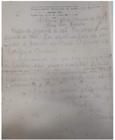
Letter addressed to Heitor Villa-Lobos defending the position of Orpheonic Singing in schools and high schools during the Third National Congress of Private Educational Establishments of São Paulo
This demonstrates that, in addition to the loss of political support, the project also suffered from the discontent of students and part of society who no longer aligned themselves with a closed educational proposal focused on the development of civic and disciplinary aspects, rather than artistic, creative, and musical ones. In this sense, Fuks (1991, p. 139) states that
[...] when creativity emerged, choral singing was already weakened, as the suggestions that SEMA sent to music teachers were seen by most of them as 'recipes', which, due to the numerous repetitions, caused boredom among the students of the school and the music teacher.
The reform undertaken by the Law of Guidelines and Bases of National Education (LDBEN) No. 4,024/61 transformed music into a non-mandatory educational practice in the school context, leaving it up to the education systems to choose whether or not to keep it. Furthermore, maintaining Orpheonic Singing as a priority methodology for music education in schools was no longer mandatory, and the term "Music Education" was adopted.
The LDBEN 4.024/1961 eliminated the remnants of the nationalist educational policy proposed by the Getúlio Vargas government. Criticism questioned Orpheonic Singing due to similar practices in Nazi Germany and Fascist Italy; in other words, it was considered an educational practice resulting from authoritarianism. This distrust ultimately undermined the discipline's structure (Lemos Júnior, 2017, p. 115).
The resistance of SEMA (Superintendency of Musical and Artistic Education) and music teachers to the educational reforms of the 1960s and 1970s began with Law No. 4,024/61 and intensified following the enactment of Law No. 5,692/71. It was not merely a confrontational resistance, but was carried out through the linking of a discourse that sought to emphasize its importance in the field of education and, consequently, the need for its maintenance. Regarding disciplinary structures, Viñao Frago (2008) states that the importance of a discipline and its place in the school hierarchy, that is, its weight in the curricula and its academic consideration, depends on whether the discourse elaborated by its members, in struggle with others, is accepted in the institutional decision-making centers.
[...] such discourses, delivered in solemn academic ceremonies, in the media, in introductions, prologues or preliminary warnings that sometimes appear in textbooks, in the daily life of educational institutions or in the daily conversations that take place in the school world, shape both the disciplinary content and the practices and the way in which they are taught (Viñao Frago, 2008, p. 207).
When analyzing a discourse produced in a dictatorial context, the marks of resistance are even more veiled. Lourenço (2010, p. 101) warns that “[...] it is necessary to be clear that there are intentionalities on the part of the military regime, that there are intentionalities in the interpretations made in the elaboration of curricula for schools, that there are intentionalities in the actions of teachers”. Therefore, this article aims to analyze the marks of resistance in the SEMA discourse regarding the creation of the Art Education discipline within the context of the implementation of Law No. 5.692/71 in the public education system of the state of Guanabara. To this end, it will also be necessary to investigate the movement of adherence to reformist ideas on the part of the state government.
The methodology used was bibliographic and documentary research, in which we triangulated historical documentary sources of different natures with bibliographic works from the academic field of study. Initially, we conducted a bibliographic review of the subject matter, as well as the definition and study of the theoretical framework. Concomitantly, we examined historical documents, understood not merely as remnants of the past, but as "[...] a product of the society that produced it according to the power relations that held sway there" (Le Goff, 2013, p. 495). Seeking evidence of these relations is especially important in studies of the history of education, in which reforms and proposals are imposed and impact the daily life of schools for several generations.
Thus, we base ourselves on Certeau 's postulate (2017, p. 27) which states that, "founded on the cut between a past, which is its object, and a present, which is the place of its practice, history never ceases to find the present in its object and the past in its practices." From this perspective, the present study is situated within the field of new cultural history, drawing on the history of school subjects (Chervel, 1990; Goodson, 1997; Viñao Frago, 2008), the concept of tactics in everyday life theory (Certeau, 2009), and studies of reform processes in the school context (Tyack & Cuban, 1995).
Certeau (2017) states that viewing history as an operation implies understanding it in relation to a social place, a practice, and a writing. The place and time of our research are circumscribed within the context of Law No. 5.692/71 in the State of Guanabara. The documentary analysis procedures considered, as indicated by Cellard (2012), the context, the author or authors (personal or institutional sources), the authenticity and reliability of the document, its nature and the key concepts present in the text, as well as its internal logic. These elements were analyzed in light of the research problem and the study’s theoretical framework, resulting in the present text, with the understanding that “while research is endless, the text must have an end, and this structure of pause extends to the introduction, already shaped by the need to conclude” (Certeau, 2017, p. 90).
Finally, we return to the sources. We consider Cellard 's definition of a document (2012, p. 297), described as “[...] any written text, handwritten or printed, recorded on paper. More precisely, we will consider primary or secondary sources, which, by definition, are explored - and not created - in the context of a research procedure.” Thus, the public documents (Cellard, 2012) that constituted the sources of our research were: the TEMA magazine7, a publication of SEMA (released between 1969 and 1974); newspaper reports from the time, made available by the Digital Newspaper Library of the National Library (BN); and publications from the Guanabara government on education reform8.
The process of implementing the reform in the state of Guanabara
Between 1971 and 1975, the final period of its existence, the state of Guanabara was governed by Antônio de Pádua Chagas Freitas, who had previously been a federal deputy and was the founder of the newspaper O Dia. He was affiliated with the Brazilian Democratic Movement (MDB)9 and was elected indirectly at the end of 1970, after his candidacy was accepted by General Emílio Garrastazu Médici, then in power, with the support of Francisco Negrão de Lima (his predecessor) and some generals (Keller & Xavier, n.d.); he took office on March 15, 1971. His government was marked by clientelism, that is, the practice of offering advantages in exchange for political support. While still a congressman, “[...] he developed a style that would become a model for his followers: no conflict with the federal and state governments, and, at the same time, good relations with the national leadership of the MDB [...]” (Keller & Xavier, n.d., SP), a motto also used during his time as governor of Guanabara.
It is possible to identify remnants of this Chagas Freitas practice also in the implementation process of the educational reform promoted by Law No. 5,692/71. The first Secretary of Education in the Chagas Freitas government was Fernando de Carvalho Barata10, who initiated the implementation process by creating a working group (WG) to develop a preliminary plan for the application of the Reform in Guanabara. The WG was designated through Ordinance “P” SED 483/71 (Reforma do Ensino no Estado da Guanabara, 1971, p. 11) and was formed by eleven members, including teachers and technicians11. The result of the WG's work was published in the Correio da Manhã newspaper on November 8, 1971, in a report entitled Working Group Defines Educational Reform in Guanabara (1971, p. 4):
After 124 days since its creation, the Working Group established to develop an implementation plan for the 1st and 2nd grade Education Reform delivered yesterday to the Secretary of Education, Fernando Barata, the final document that defines the position of official education in Guanabara in relation to Law 5.692. [...] After delivering the document to Secretary Fernando Barata, the president of the Working Group outlined to the journalists present at the ceremony the main topics of the Reform Implementation Plan.
The plan's development took into account the educational reality of Guanabara and the achievements already implemented by the Department of Education. Professor Lucy Vereza cited as examples the start of schooling at age six, the elimination of the entrance exam since 1969, the introduction of vocational training, and the implementation of supplementary education.
The document proposed the creation of a pilot project in 58 schools, followed by a gradual expansion culminating in the full implementation by 1975. It also highlights, through the words of Professor Lucy Vereza, the pioneering character of the Guanabara education system, which was already carrying out several of the measures later formalized by law. According to the GT's proposal, the pilot project would begin in March 1972. However, a new report in the same newspaper, dated February 6 and 7, 1972, shows that the proposals were not accepted by the government (A Educação de Hoje Projetada no Futuro, 1972).
Due to the reform, the start of the 1972 school year was delayed, and the press attributed the difficulty of implementation to “[...] the maladaptation of Rio de Janeiro's teaching staff to the changes introduced in primary and secondary education by the reform” (Aulas na Rede Oficial Começam Mesmo Dia, 1972, p. 2). However, other problems also affected the system, such as the lack of teachers, the need to adapt the physical space of the school, and the readjustment of the curriculum. We thus recognize the stages presented by Tyack and Cuban (1995, p. 112) in the development of a reformist process:
The first stage in reform was to convince citizens that the present system of schooling was inefficient, anachronistic, and irrational. The second stage was to claim sure-fire solutions. This has long been a strategy of utopians who condemned existing arrangements in order to persuade others to adopt their blueprint for a transformed future.
The article “Falta Comunicação” ("Lack of Communication") from Correio da Manhã, February 6th and 7th, 1972, addresses the need to better communicate the objectives of the reform to society. This movement was fundamental to ensuring society's adherence to an education project aligned with the principles of a dictatorial government.
For the average person, for the head of the family and for mothers, as well as for most students, the reform of primary and secondary education has not yet been well understood, just as the Law of Guidelines and Bases was not - whose potential was not properly exploited by educators. It must be acknowledged that efforts were made to publicize the law. And there was no shortage of contributions from the press, radio, and television. But in truth, there is a tremendous lack of communication between the interested party (student/parents) and the system (School/Department of Education/State). Everyone wants to know, but nobody knows how to provide information (Falta Comunicação, 1972, p. 5).
How, in fact, can one learn and master, in such a short time, something that was completely imposed, without any kind of contribution from those who actually make the school exist? This becomes very difficult when the interests driving the reform are not related to a commitment to providing an emancipatory education, nor do they involve those most interested.
Reforms of education needs to be anchored in a realistic understanding of the institutional character of schools, but this alone is not enough. School reform is also a prime arena for debating the shape of the future of the society. Such debate is a broad civic and moral enterprise in which all citizens are stake-holders. In recent years, however, discourse about the purposes of education has been impoverished by linking it insistently to the wealth of nations. The underlying rationale of most recent reforms - to use schooling as an instrument of international economic competitiveness - is not new, but its dominance in policy talk is unprecedented (Tyack & Cuban, 1995, p. 136).
In July 1972, the government of the state of Guanabara split the Secretariat of Education and Culture into two departments: the Secretariat of Education and the Secretariat of Culture, Sports and Tourism, by means of a decree signed on July 18, 1972 (Celso Kelly é Secretário de Educação e Barata de Turismo, 1972). With this division, Fernando Barata assumed the Secretariat of Culture, Sports and Tourism, and Celso Kelly, who worked in the Directorate of Culture, assumed the Secretariat of Education.
The pressure on the Department of Education was immense, and Fernando Barata was unable to maintain a good relationship with the media and members of the school communities. The arrival of Celso Kelly was hopeful for a change in this regard, since he had already worked in other areas of education, including teaching at the Rio de Janeiro Institute of Education (IERJ), and had several former students as colleagues. His main commitment to the department was to complete the implementation of the reform. In August 1972, through decree “E” SED nº 21, of August 1, 1972 (Subsídios..., nd.), he appointed the State Curriculum Commission to work on the reformulation of the primary education curriculum. The result was the publication of the book Subsídios para a elaboração dos currículos plenos dos estabelecimentos oficiales de ensino de 1º grau (Subsidies for the elaboration of full curricula for official primary education establishments), by the publisher Bloch Educação.
Even with these advances in implementing the reform, the Chagas Freitas government continued to be attacked. In early 1973, Congressman Álvaro Valle sent a letter to the governor denouncing the chaos in education (Professor-Deputado Mostra a Chagas o Caos do Ensino, 1973). These attacks resonated in the Ministry of Education and Culture (MEC), and in April of the same year, the Secretary-General of the agency, Professor Confúcio Pamplona, sent the minister a memorandum with several criticisms of the education being promoted in Guanabara. The secretary represented “[...] the team of directors, teachers and rural communities organizing it” (Memorial do MEC Critica Severamente Ensino na GB, 1973, p. 2). In addition to the Minister of Education, the memorandum was also sent to the president of the State Commission of the CFE, the governor of Guanabara, the president of the State Council of Education (CEE) of Guanabara, and the leaders of the Legislative Assembly. The memorandum contained the following denunciation:
With the advent of Law No. 5,692/71 - the Golden Law of our century - which established new guidelines and bases for primary and secondary education, the hopes of educators, parents, and students for the success of Brazilian educational policy were renewed. The country's development, generated by the seriousness and correctness of the socio-economic policy of the Revolution, lacked a solid foundation that would guarantee future generations their conscious and productive participation in educational progress. [...] Most states quickly grasped the vital importance of the new educational system for the country. It was expected that the State of Guanabara, once a pioneer in the methodological application of modern educational techniques and processes and a leader in national culture, would assume the position that rightfully belonged to it for the implementation of the new law. However, with deep regret, we educators, parents, and members of representative community entities witness, daily, the loss of our state's vanguard status. [...] Educators, parents of students and community representatives, identified with the goals of the federal government, see in the actions of Minister Jarbas Passarinho and in the administrative efforts of Governor Chagas Freitas and in the dynamism of public authorities the hope of a timely solution to the educational crisis in which Guanabara finds itself immersed (MEC Memorial severely criticizes education in GB, 1973, p. 2).
Despite all the attacks, Celso Kelly continued with the proposal to implement the Reform in Guanabara's schools. He held new competitive exams, expanded vocational training positions, worked to offer supplementary education, and was present in various activities, always very helpful and diplomatic. However, the number of places offered by the public system did not meet the demand, and this continued to be one of the major problems in Guanabara's education. Even so, Celso Kelly managed to stabilize tensions and remained in office. A report in the Jornal do Brasil, dated March 15, 1973, states that, "According to information provided by the press officer of the Ministry of Education, the Secretary of Education of Guanabara, Professor Celso Kelly, has already reached an understanding, by correspondence, with Minister Jarbas Passarinho" (MEC Segue Passos da Educação no Rio, 1973, p. 23). This demonstrates the alignment of the secretary and, consequently, of the Guanabara government with the dictatorial government. It is within this vibrant and complex context that we turn our attention to the movement undertaken by SEMA to try to maintain the space for music in Guanabara schools.
Music in the context of Arts Education
Regarding arts education, Law No. 5,692/71 established the subject of Art Education. Sectors linked to the arts had discussed aspects related to the renewal of its teaching. The Escolinha de Arte do Brasil (Little Art School of Brazil)12, for example, developed proposals based on the idea of creativity and free expression, practices that were incorporated into the pedagogical work of some teachers. In the field of music, such ideas were widely disseminated by Professor Cecília Conde, who offered an introductory music course for teachers at the Brazilian Conservatory of Music (CBM). It was not a mandatory course for working in regular schools, but it offered continuing and diversified training to interested teachers.
The discourse on artistic education was based on the modernist concept (expansion of the sound universe, musical expression committed to practice and free experimentation); furthermore, this type of experience can be credited with encouraging the release of emotions, valuing folklore and Brazilian popular music, as well as the interpenetration of different artistic languages. [...] The spontaneity of the proposal replaced the scientism of the early 20th century and the jingoism of the nationalist phase. Improvisation replaced the rigor of the method. [...] Teachers operate with a minimum of rules and their main concern is not to stifle the expression of their students. Free expression is the watchword (Fonterrada, 2008, p. 218, emphasis in the original).
Paradoxically, the reform undertaken by the military government in 1971 appropriated the term Art Education. However, it propagated a practice quite different from what was originally envisioned by the teachers involved in the art-education movement. Subtil (2012, p. 127) analyzes the moment and states:
One hypothesis is that art, an area historically linked to the exercise of freedom and creative expression, should remain under control, becoming an instrument in favor of conservation and the developmental objectives advocated by the military dictatorship. Evidently, the mandatory nature of art education came cloaked in a discourse centered on the individual development of students, based on a technical-scientific character and with rigorous planning that concealed criticism and contradiction.
Ana Mae Barbosa (2015, p. 20), one of the leading figures in the art education movement in Brazil, in the field of visual arts, analyzes the context as follows:
It was the period of the Military Dictatorship: it lasted 20 years, suppressed freedom of expression, imprisoned, tortured, killed, exiled, and made the teaching of multidisciplinary art mandatory. It was outrageous. The 1971 Education Law (Law No. 5,692) was extremely technocratic, aiming to provide vocational training in secondary education - but it used art as a humanistic mask or alibi. They defended themselves against the technocratic nature of Law No. 5,692 by reminding us that it was this law that instituted the mandatory teaching of art.
The military government selectively adopted elements of the proposal that aligned with its interests, without any clear or systematic effort to define the objectives of Art Education as a discipline. Corrêa (2007, p. 110) states that “[...] with regard to art education, in general, they perceive the demands of current legislation and understand that, for the development of the discipline, the change of methods and their valorization are essential, although this fact is not present in practice”. From this perspective, SEMA develops resistance tactics (Certeau, 2009) based on discourse and experience to try to maintain the space for music in the Guanabara curriculum. For Certeau (2009), the tactic is a response to the action of the strategy of those in power - here represented by the reform undertaken by the government, which was oblivious to the demands and proposals emanating from daily school life. In this sense, Certeau (2009, p. 95) identifies tactics as the action that “[...] takes advantage of 'opportunities' and depends on them, without a basis for accumulating benefits, increasing property, and predicting exits. [...] It has to vigilantly utilize the gaps that particular circumstances open up in the vigilance of proprietary power.”
Therefore, SEMA's action will not be in opposition to the reform, but will seek to insert its practice and ideas into the gaps of the reformist documents. Analyzing the transformations that school subjects undergo in the context of curricular reform, Goodson (1997, p. 27) states that "[...] school discipline is constructed socially and politically, and the actors involved employ a range of ideological and material resources to carry out their individual and collective missions." It is important to highlight that, since the promulgation of LDBEN No. 4,024/61, SEMA has defended its ideals and managed to maintain its activities and the presence of music in schools. Even before the promulgation of Law No. 5,692/71, they were already seeking to adapt to emerging ideas, while safeguarding their space. The transformation of SEMA's bulletins into the TEMA magazine in 1969 (Figure 2) is an example of this.
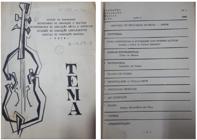
In the presentation of the first volume of what they identify as a " mini-magazine"13, it is explained that the acronym TEMA stands for "Work, Education, Music, and Art" (Serviço de Educação Musical, 1969, p. 32). The chosen terms already integrate music into the proposals that will later be valued in the 1971 reform. The editors continue: "[...] officially presented, it remains for TEMA to convey to everyone its message of faith in Work, Education, Music, and the Arts in general and, above all, in the union of efforts and ideals to win, fighting for the greatness of Brazil" (Music Education Service, 1969, p. 32). Despite the change in nomenclature, the format and type of content of the TEMA magazine remained the same as the SEMA bulletins: articles with formative content for teachers, suggestions for activities, repertoires and materials, as well as a broad inventory of musical activities carried out in schools. In this way, SEMA consolidated and registered the disciplinary code of music in Guanabara, which, according to Viñao Frago (2008) defines it as the key element that organizes and orders a discipline. The components of this code, such as: (i) the contents, (ii) its discourses, arguments and utilities, as well as (iii) its professional practices, are transmitted within the academic or professional community to which they belong, from one generation to another (Viñao Frago, 2008).
An analysis of TEMA magazine across its years of publication reveals the presence of the three components identified by Viñao Frago (2008) within the body of materials produced. Furthermore, it was common to have reports in newspapers of the time about the activities developed within the scope of music education in Guanabara, which contributed to the consolidation of musical work within society. In the Jornal de Serviço of November 6, 1970, for example, the following news item appears:
MUSIC WEEK - The “23rd Music Week,” organized by students of the official secondary and primary school network of the State of Guanabara, began yesterday, the 5th, and will continue until the 12th of this month. During the week, choirs, choral groups, bands, musical and folkloric ensembles will perform, in addition to lectures, in schools and colleges. The opening ceremony was a solemn mass at the São José do Jardim Botânico Church in Lagoa, where the Music Education Teachers' Choir sang the "Missa em Fuga" by Cacilda Borges Barbosa, head of the State's Music Education Service (Music Week, 1970, p. 4).
At the time of the implementation of the 1971 education reform, SEMA initiated an internal debate on the inclusion of music education within the context of Law No. 5,692/71. The 1972 issue of the magazine TEMA was dedicated to disseminating the results of these discussions, as well as transcribing the report produced by the Working Group responsible for developing what they called the Diretrizes e Bases da Educação Musical para o 1º e 2º graus, consideradas relevantes pela Divisão e pelo Serviço de Educação Musical (Guidelines and Bases of Music Education for the 1st and 2nd grades, considered relevant by the Division and the Music Education Service) (Serviço de Educação Musical, 1972 , p. 9), which, according to the article's introduction, was sent to the governor of Guanabara, Chagas Freitas. In this introduction, entitled "Music Education and Law 5692," SEMA exposes the tactic that will permeate its action: to praise the reform, but highlighting the importance of music education in achieving the objectives proposed by the legislators.
Currently, the entire Brazilian teaching profession is focused on Law 5692, of August 11, 1971, a national hope for an education more connected to the realities of the country, capable of promoting the real development of our potential, establishing ourselves in the world. The new horizons to be explored-along with flexibility, curricular choice, and the encouragement of creativity and appreciation among educators-have generated enthusiasm within the teaching profession and, it is hoped, among students and the broader public. Ultimately, only a positive attitude across all social groups will enable the effective implementation of the reform and, over time, the incorporation of necessary modifications and adaptations. The teachers of the Guanabara Music Education Service, imbued with equal enthusiasm, have been working since the end of 1971 to try to situate Music Education within the updating of teaching (a term preferred by Professor Valnir Chagas, instead of "Reform"), not only in terms of the cultural aspect, but also in the professional sector (Music Education Service, 1972, p. 8).
This introduction already provides us with several points for analysis. Firstly, it highlights the initial euphoria surrounding the reform and a belief in its success, initial hallmarks of reformist processes in school contexts (Tyack & Cuban, 1995). Secondly, it emphasizes the need for students and the general population to engage with the process, conditioning the success of its implementation on this involvement. Finally, it demonstrates the desire to maintain music education within the context of regular schools, expanding its scope to the vocational sector as well. In the memorandum, subsequently transcribed in the TEMA magazine, SEMA requests that music education be included in all levels of schooling, “[...] based on the conceptualization, objectives and philosophy of work that guide this discipline” (Serviço de Educação Musical, 1972, p. 10), that is, not submitting to the conceptualizations, objectives and philosophy of Art Education.
Next, it details the proposed inclusion in the 1st and 2nd levels. In the 1st level, it indicates that it should be present in all grades, “[...] as an integral part of the Common Core, within the aspect of Communication and Expression” (Serviço de Educação Musical, 1972, p. 11). For the first grades of the 1st level, it recommends prioritizing formative objectives in a structure of vertical integration of areas, with a connection between the subjects of the Common Core and with the organization of a central core to be adapted in each school by “[...] teachers, principals, Music Education coordinator and the liaison with the Central Body of this competence” (Serviço de Educação Musical, 1972, p. 14). From this perspective, SEMA is directly involved in the decision-making process for defining the work to be carried out in the schools of the initial grades of the 1st grade.
For the final years, it even suggests its presence as an elective subject, with a professionalizing focus. For the 5th and 6th years, it plans a more informative part, "in order to allow the exploration of aptitudes, in terms of theoretical and practical knowledge" (Serviço de Educação Musical, 1972, p. 13) and an approach to general culture through Musical Appreciation and Music History. For the 7th and 8th years, it foresees a "[...] diversification of qualifications with a professionalizing focus and, if possible, a certain terminality [...] with encouragement for continuity and improvement in secondary education" (Serviço de Educação Musical, 1972, p. 13). The proposal is to start an offer focused on the initial training of tuners, copyists and/or instrumentalists, which would be consolidated in the professionalizing secondary education in these areas, whose plans were presented in this same report.
After presenting proposals for the creation of a professional secondary level in music, they conclude the document by indicating the creation of the Department of Musical Education (Serviço de Educação Musical, 1972), an autonomous body, including in terms of budget. The report ends with praise for the reform, but also for the ideals that have always guided the work of SEMA: the same ideals propagated by Villa-Lobos in the development of Orpheonic Singing.
We are driven by no other interest than the cause of Education and the purpose of collaborating in the implementation of the Reform. We do not seek financial advantages or positions, only the favorable conditions created for us to continue our activities, many of which are of exceptional educational and artistic value, thus achieving, in this phase of renewal and progress, the great ideal of Villa-Lobos: "Education of the masses through Music!" (Serviço de Educação Musical, 1972, p. 19).14
Throughout the entire memorial, there is an emphasis on the technical and professional aspects of music rather than the characteristics of free expression, as foreshadowed by the art-education movement discussed earlier. SEMA sought to adapt, by any means necessary, to the precepts of the reform, so as not to lose its place of activity, even if, to do so, it had to corroborate the training principles foreseen by the dictatorial government.
Nevertheless, what marks the teacher's performance is a "restraint": once again, the "daring" practiced within the "limits" of what was possible appears. Here, the situation of the dictatorship appears in a disguised but ever-present way, infiltrating school rituals through civic ceremonies and molding bodies and minds to the established limits (Lourenço, 2010, p. 111).
Beyond its strategy of incorporating the reform, SEMA had other means of action that helped ensure its proposals were heard. It had a strong and significant faculty, with professors who also worked in the artistic field, such as composers and conductors. The head of SEMA at the time of the reform's implementation, Professor Cacilda Borges Barbosa, was a renowned composer whose work was performed in the city's concert halls. Her successor, Professor José Vieira Brandão, was also a composer and concert pianist, with a large presence in the state's cultural scene. Furthermore, SEMA always held activities open to the public and every year promoted Music Week, generally in November, which brought together various schools in performances throughout the state of Guanabara. This was an important showcase of the quality of artistic and musical work developed by Guanabara's music teachers.
Furthermore, SEMA maintained a good relationship with the Secretary of Education, Professor Celso Kelly, who in previous publications had already recognized that “[...] [music] provides an environment for the human condition of feeling, being moved, dreaming. This is the reason for the receptivity it enjoys. Along with this receptivity, it develops the attributes and virtues of the species” (Kelly, n.d., p. 87) and, whenever possible, was present at events and actions promoted by SEMA (Figure 3).
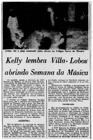
News report about the participation of the Secretary of Education, Celso Kelly, in the opening of the Music Week promoted by SEMA in 1972, in Diário de Notícias (October 26, 1972)
Upon analyzing the guiding document for the development of full primary school curricula, we found that only a small portion of SEMA's requests were met. The Subsídios para a elaboração dos currículos plenos dos estabelecimentos oficiais de ensino de 1º grau (The guidelines for the development of full curricula for official primary schools) envisioned a curriculum organization by activities, from literacy classes to the 4th grade, as indicated by SEMA. From the 5th to the 8th grade, the curriculum would be organized by areas of study (Subsídios..., n.d.). In the activity-based organization, the areas were integrated, and there was no offering of specific subjects. Therefore, Art Education and/or Music Education were not included as subjects in the organization of the initial grades of primary school, but they could be integrated into the work carried out through activities developed with the students.
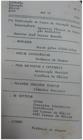
From the 5th grade onwards, the organization becomes based on areas of study. The designated areas are: Social Studies, Communication and Expression, Science, and Mathematics. The study plan (Figure 4) for the proposed curriculum for the first level of education had the following structure:
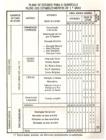
From the 5th grade onwards, Art Education should be offered with two weekly periods scheduled, organized as follows:
2 - Art Education
2.1 - We suggest three modalities, perhaps the most feasible: Music Education, Visual Arts, and Dramatic Arts. The school may, if it has the resources, expand the offerings. However, it will never offer fewer than two. In any case, the student will always have:
2.1.1 - In the 5th and 6th grades, two modalities;
2.1.2 - In the 7th and 8th grades, students must choose one of two, three, or more options offered by the school. (This does not mean that, if the school has the resources, a 7th or 8th grade student who wishes to do so cannot participate in more than one option).
2.2 - The inclusion in the curriculum, from 5th to 8th grade, of 2 weekly hours for each modality of Art Education does not mean that the way in which this type of education is provided to the student must be rigid.
The creative school can provide such opportunities in various ways, with great flexibility. It is essential that each modality be offered annually to its students, with a minimum of 60 hours (Subsídios...). nd., pp. 285-286).
In this way, it would be possible to offer the subject of Music Education, with the organization determined by the possibilities of each school. Despite maintaining the subject, the organization proposed in the subsidy differs from what was indicated by SEMA and allows for greater flexibility in choosing whether or not to include Music Education. The objectives and minimum content defined for the subject in the document also differ from what was indicated by SEMA.
All musical activity should be practical and playful, enabling students to experience the fundamental elements of rhythm and sound through songs and canons, instrumental performance-particularly rhythmic-choral ensembles, and activities involving movement, games, and dance, while consistently encouraging exploration and creative expression.
5th and 6th Grades
Expanding experiences through a constantly diversified approach to problems already encountered and seeking to enrich them with new experiences, the student should listen to and practice: singing, playing - alone and in groups - a diverse repertoire in terms of form, genre, style, and era, observing in the choice of the repertoire the difficulty of the pieces, the aspect to be addressed (a rhythmic, melodic, or harmonic element, the use of a specific scale, characteristics and frequency of the folklore of a region, polyphonic or monophonic aspects) and, above all, the choice of texts that should be of interest to the students, corresponding to their age and the demands of the environment. It is obvious that the practical side, live music, and sonic experience are what matters, and never the theory, but the student can, and enjoys, learning if guided in a way that allows them to accept it.
7th and 8th Grades
Over the last two years, the student will complement their musical education by continuing the practice of all their previous experience in a more comprehensive way: performing and appreciating, conducting research, mainly related to a better understanding of the History of Music (Subsídios..., nd., pp. 172-173, emphasis in the original).
The concept of music education is completely opposed to the proposal of SEMA. The guiding principles of the recommended resources were closer to the original ideas of art education, based on practice, experience, and experimentation. The only point of convergence between what was determined in the resources and the SEMA recommendation was the possibility of studying the History of Music in the final grades. All other recommendations were not considered.
The vocational high school program in music within the Guanabara state government schools also did not materialize. The curriculum organization for high school was more complex and diverse due to the offering of vocational subjects. CFE No. 853, of November 12, 1971, established the common core for the primary and secondary school curricula, based on the previously presented organization by areas (Communication and Expression, Social Studies, and Sciences). For high school, subjects to be covered in each area were established:
Article 1 [...] § 1 - For the purposes of the mandatory nature of the core curriculum, the following are included as specific contents of the subjects covered:
a) in Communication and Expression - The Portuguese Language;
b) in Social Studies - the Geography, History, and Social and Political Organization of Brazil;
c) in the Sciences - Mathematics and the Physical and Biological Sciences.
§ 2 - Physical Education, Art Education, Moral and Civic Education, Health Programs and Religious Education are also required, the latter being mandatory for official establishments and optional for students (Parecer nº 853, 1971).
The offering of subjects should be “[...] tailored according to the professional qualifications sought by the students” (Parecer nº 853, 1971). In this way, each vocational modality of secondary school could have a differentiated distribution of time for each subject. Thus, it was common for Art Education to be restricted to only one year of secondary school. In Guanabara, schools that had music teachers offered Art Education with a focus on music, or even the subject of Music Education.
In the 1974 issues of TEMA magazine to which we had access, a change in SEMA’s nomenclature is evident. The Music Education Service became the Technical Advisory Service for Artistic Education (Music Education), subordinate to the Professional Training and Technical Guidance Advisory Service, which in turn was linked to the General Education Advisory Service of the Secondary Education Department. The request to create the Music Education Department was not granted and, in reality, SEMA was further weakened by being subordinated only to the Secondary Education Department, even while still operating in the final grades of primary school. Despite all these changes, when analyzing the index of the 1974 magazine (Figure 5), we find that the sector maintains the same type of content as previous publications:
This may indicate that, despite the changes brought about by the reform process, many old practices continued to be followed. Tyack and Cuban (1995) warn that legal mandates do not guarantee implementation and that laws can be discreetly ignored in everyday school life.
Final remarks
The implementation of the educational reform promoted by the military government in public schools in the state of Guanabara was marked by power struggles and political influence. The creation of a working group to guide the process, followed by the disregard of its proposals, indicates a lack of genuine interest in the participation of teachers and other stakeholders committed to the school system. Furthermore, concrete problems plagued the Guanabara education system: a lack of teachers, demand exceeding the capacity of the schools, lack of infrastructure, and others.
The political dispute between the Arena and MDB parties was also reflected in the educational field. There were accusations of stagnation and disinterest in the implementation process of the reform, again a constant practice of the dictatorial government, and all this happened beyond the daily school routine. In fact, this was the least of the concerns of the groups associated with the military government: “Education presents itself as an important space of political tensions because it involves ideological and economic dimensions that generate power” (Martinoff, 2013, p. 7).
It is crucial to emphasize that the apparent political tranquility that seems to reign in the documents is the result of violent repression. Lourenço (2010, p. 107) states that “[...] in a regime of exception, which was established after AI-5, any carelessness could be fatal. Thus, it is clear that the norms are internalized and the school system itself, and those who participate in it, will be responsible for monitoring them.” In this sense, the movement we witnessed in Guanabara is a small part of what actually happened in schools and among the individuals involved in the educational process.
In this context, we followed the resistance movement promoted by SEMA in an attempt to maintain its discipline in school curricula. The main tactic of resistance was to declare support for the reform, while simultaneously trying to insert its conception of music education into the regulations produced for its implementation. During a period of dictatorial regime, this form of action guaranteed its existence. Thus, even losing ground, music continued to be practiced in regular schools in Guanabara even after the creation of the Art Education discipline.
Chervel (1990, p. 198) identifies the following as factors contributing to the solidity and permanence of school subjects: “[...] fidelity to objectives, tried and tested methods, progressions without shocks, adequate and renowned textbooks, teachers who are all the more experienced as they reproduce with their students the teaching methods that trained them [...] and consensus between the school and society [...]”. It is possible to identify these factors in the actions of SEMA; perhaps the consensus between the school, its constituent elements, and society was the most difficult to achieve, but, in some way, the artistic actions and presentations they carried out brought their ideals closer to society, which delighted in what was presented.
Even in the 2020s, the field of music struggles to remain in school curricula. Today, the public education systems of Rio de Janeiro lack an organization like SEMA, centralizing the demands and needs of the music faculty. With the merging of the state of Guanabara with the state of Rio de Janeiro in 1975 and the consequent departure of older teachers, mainly due to retirement, this organization has become fragmented. Therefore, we share Goodson 's perspective (1997, p. 15) that "[...] our historical consciousness involves recognizing that the past is part of our everyday discourse, structuring what can be said and the possibilities of the present time".
References
- A educação de hoje projetada no futuro. (1972, February 6-7). Correio da Manhã, Anexo, p. 5.
- Aulas na rede oficial começam mesmo dia. (1972, February 27). Diário de Notícias, 4º caderno, p. 2.
- Bacarin, L. M. B. P. (2005). O movimento de arte-educação e o ensino de arte no Brasil: História e política (Dissertação de mestrado, Universidade Estadual de Maringá).
- Barata, a paixão pelo magistério. (1972, July 20). Jornal do Brasil, 2º caderno, p. 29.
- Barbosa, A. M. (2015). Redesenhando o desenho: Educadores, política e história. Cortez.
- Cellard, A. (2012). A análise documental. In J. Poupart, J.-P. Deslauriers, L.-H. Groulx, A. Laperrière, R. Mayer, & Á. P. Pires (Orgs.), A pesquisa qualitativa: Enfoques epistemológicos e metodológicos (pp. 295-316). Vozes.
- Celso Kelly é secretário de educação e Barata de turismo. (1972, July 20). Jornal do Brasil, 2º caderno, p. 29.
- Certeau, M. (2009). A invenção do cotidiano: Artes de fazer (Vol. 1). Vozes.
- Certeau, M. (2017). A escrita da história. Forense.
- Chervel, A. (1990). História das disciplinas escolares: Reflexões sobre um campo de pesquisa. Teoria & Educação, (2), 177-229.
- Contier, A. D. (2007). Canto orfeônico, Villa-Lobos e as manifestações culturais do período getulista (1930-1945). In História e multidisciplinaridade: Territórios e deslocamentos. Unisinos.
- Corrêa, C. C. M. (2007). Atitudes e valores no ensino da arte: Após a Lei nº 4.024/61 até a atual Lei de Diretrizes e Bases da Educação Nacional - Lei nº 9.394/96. EccoS Revista Científica, 9(1), 97-113.
- Falta comunicação. (1972, February 6-7). Correio da Manhã, Anexo, p. 5.
- Fonterrada, M. T. O. (2008). De tramas e fios: Um ensaio sobre música e educação. UNESP; Funarte.
- Fuks, R. (1991). O discurso do silêncio. Enelivros.
- Galinari, M. M. (2007). A era Vargas no pentagrama: Dimensões político-discursivas do canto orfeônico de Villa-Lobos (Tese de doutorado, Universidade Federal de Minas Gerais).
- Germano, J. W. (1994). Estado militar e educação no Brasil. Cortez.
- Gómez, J. M. (Org.). (2018). Lugares de memória: Ditadura militar e resistências no estado do Rio de Janeiro. PUC-Rio.
- Goodson, I. F. (1997). A construção social do currículo. Educa.
- Grupo de trabalho define reforma do ensino na GB. (1971, November 8). Correio da Manhã, 1º caderno, p. 4.
-
Keller, V., & Xavier, L. (n.d.). Antônio de Pádua Chagas Freitas. In Dicionário biográfico. FGV/CPDOC. https://www18.fgv.br/CPDOC/acervo/dicionarios/verbete-biografico/antonio-de-padua-chagas-freitas
» https://www18.fgv.br/CPDOC/acervo/dicionarios/verbete-biografico/antonio-de-padua-chagas-freitas - Kelly, C. (n.d.). Política da educação. Reper.
- Kelly lembra Villa-Lobos abrindo Semana da Música. (1972, 26 de outubro). Diário de Notícias, p. 5.
- Le Goff, J. (2013). História e memória (7th ed.). Editora da Unicamp.
- Lemos Júnior, W. (2017). História da formação de professores de música: O contexto paranaense. Appris.
- Lourenço, E. (2010). O ensino de história encontra seu passado: Memórias da atuação docente durante a ditadura civil-militar. Revista Brasileira de História, 30(60), 97-120.
-
Martinoff, E. H. S. (2013). A música na escola durante a ditadura militar: Um ensaio. https://core.ac.uk/reader/267967692
» https://core.ac.uk/reader/267967692 - MEC segue passos da educação no Rio. (1973, March 15). Jornal do Brasil, 1º caderno, p. 23.
- Memorial do MEC critica severamente ensino na GB. (1973, April 28). Correio da Manhã, p. 2.
- Motta, M. S. (2001). O Rio de Janeiro: De cidade-capital a estado da Guanabara. FGV.
- Parecer nº 853, de 12 de novembro de 1971. (1971). Núcleo comum para os currículos do ensino de 1º e 2º graus: A doutrina do currículo na Lei 5.692. Documenta, 132, 166-195.
- Penna, M. M. (1987, May 16). O mundo de Villa-Lobos. Manchete, (1830), 36-47.
- Professor-deputado mostra a Chagas o caos do ensino. (1973, February 25-26). Correio da Manhã, p. 3.
- Reforma do ensino no estado da Guanabara. (1971). Ensino de 1º e 2º graus: Resultado do trabalho do GT. Conquista.
- Semana da música. (1970, November 6). Jornal de Serviço, p. 4.
- Serviço de Educação Musical. (1969). TEMA, 1(1).
- Serviço de Educação Musical. (1972). TEMA, 3(4).
- Subsídios para a elaboração dos currículos plenos dos estabelecimentos oficiais de ensino de 1º grau. (n.d.). Bloch Educação.
- Subtil, M. J. D. (2012). A lei n. 5.692/71 e a obrigatoriedade da educação artística nas escolas: Passados quarenta anos, prestando contas ao presente. Revista Brasileira de História da Educação, 12(30), 125-151.
- Tyack, D. B., & Cuban, L. (1995). Tinkering toward utopia: A century of public school reform. Harvard University Press.
- Viñao Frago, A. (2008). A história das disciplinas escolares. Revista Brasileira de História da Educação, (18), 173-215.
-
Peer review rounds:
R1: two invitations; one review received.R2: two invitations; one review received.
-
How to cite this article:
Castro, V. W. de. A. Musical Education in the context of Law 5.692/71 in the State of Guanabara: resistance to the reformist movement. Revista Brasileira de História da Educação, 26, e409. DOI: https://doi.org/10.4025/rbhe.v26.2026.e409en
-
Funding:
The RBHE has financial support from the Brazilian Society of History of Education (SBHE) and the Editorial Program (Call No. 30/2023) of the National Council for Scientific and Technological Development (CNPq).
-
Licensing:
This article is published under the Creative Commons Attribution 4.0 (CC-BY 4) license.
-
Data availability:
All data generated or analyzed during this study are included in this published article.
-
1
Law No. 4,024 of December 20, 1961, the Law of Guidelines and Bases of National Education (LDBEN), structured the education system into primary education (a minimum of four grades, compulsory from age seven) and secondary education, divided into gymnasium and high school cycles, encompassing academic, technical, and teacher training programs for primary and pre-primary education. Pre-primary education was to be offered in nursery schools or kindergartens. Law No. 5,692/71 combined primary and gymnasium education into first-level education, with eight school years of duration, and high school education into second-level education, with three or four annual grades and compulsory technical training.
-
2
According to Germano (1994), the Working Group for the drafting of the bill that gave rise to Law No. 5,692/71 was formed by: Father José de Vasconcellos, Valmir Chagas, Aderbal Jurema, Clélia de Freitas Capanema, Eurides Brito da Silva, Geraldo Bastos da Silva, Gildásio Amado, Magda Soares Guimarães and Nise Pires.
-
3
In 1935, Anísio Teixeira was accused of involvement with communist ideals and was removed from his position as Secretary of Education. Many of the proposals he developed in his reform were abandoned by the following administration; however, the Orpheonic Singing project was maintained, since Villa-Lobos agreed to continue in his position in subsequent administrations.
-
4
In 1936 it was transformed into the Musical and Artistic Education Service of the Department of Complementary Education (Fuks, 1991), a name and structure maintained in the state of Guanabara. From 1974 onwards, SEMA appears in documents as the Professional Training and Technical Guidance Advisory Service - Musical Education Sector. However, the acronym SEMA was maintained over the years, as it quickly identified the sector responsible for managing music education.
-
5
Within the time frame of this article, the 1970s, the predominant name was Musical Education Service of the State of Guanabara. Therefore, we will refer to SEMA using the masculine article, which refers to the service.
-
6
The Sectoral Archive of the CLA at UNIRIO holds all the documentary collection of the National Conservatory of Orpheonic Singing (CNCO) since its founding in 1946. The CNCO became the institution responsible for training Orpheonic Singing teachers for regular schools. Its first director was Heitor Villa-Lobos himself. In 1967, through Decree No. 61,400 of September 22, the CNCO was renamed the Villa-Lobos Institute (IVL), later being incorporated into UNIRIO and currently housing the institution's higher music courses.
-
7
TEMA magazine was an internal publication of SEMA (the Superintendency of Musical and Artistic Education) that replaced the SEMA bulletins, which had been published since the 1940s. These were simple publications, A5 size, with about 30 pages, printed at the printing press of the Rio de Janeiro Institute of Education (IERJ). The objective was to provide training content for music teachers in the state network, as well as to record SEMA events and activities in state schools. The magazine was first published in 1969, and the last volume we had access to was from 1974.
-
8
In particular the books: Education Reform in the State of Guanabara (1971), published by Conquista publishing house; and Subsídios para a elaboração dos currículos plenos dos estabelecimentos oficiais de ensino de 1º grau (n.d.), published by Edições Bloch Educação.
-
9
With Institutional Act No. 2 (AI-2), of October 27, 1965, the military government abolished political parties and dictated rules for the existence of parties that could only be met by the National Renewal Alliance (Arena) and the MDB, thus creating the so-called two-party system. The first was based on the military government and the second was considered a permitted opposition (Gómez, 2018).
-
10
Holding a degree in Philosophy, he was the director of the southern section of Colégio Pedro II (now Humaitá Campus), worked in the Cultural Sector of the State University of Guanabara (UEG), now the State University of Rio de Janeiro, and was a professor at higher education institutions (Barata, a paixão pelo magistério, 1972).
-
11
The working group was formed by Lucy Serrano Vereza (state education advisor), Wilson Choeri (high school teacher), Sérgio Guerra Duarte (director of the Institute of Educational Research), Henrique Carlos Ferrão (high school teacher), Déa Hanszmann de Souza Neves (teacher in a teacher training course), Sérvula de Souza Paixão (primary education technician), Cybele de Moraes Miranda (high school teacher), Lia Fonseca de Carvalho Neiva (high school teacher), Nair Adell Mello (primary education technician), Maria Avany da Gama Rosa (primary education technician), and Alexandre Mendes dos Reis (high school teacher).
-
12
The Escolinha de Arte do Brasil was created by Augusto Rodrigues, Lúcia Alencastro Valetim, and Margareth Spencer in 1948, inspired by the experience of "education through art," popularized as the art-education movement by Herbert Read (Bacarin, 2005).
-
13
Although the editors identified it as a "mini-magazine," we chose to identify it as a "magazine," recognizing the importance it truly holds for the history of music education in Guanabara.
-
14
The following individuals signed the memorial: Lucy Mesquita Munk, Niobe Marques da Costa, and Edna Almeida Del Valle.
All data generated or analyzed during this study are included in this published article.

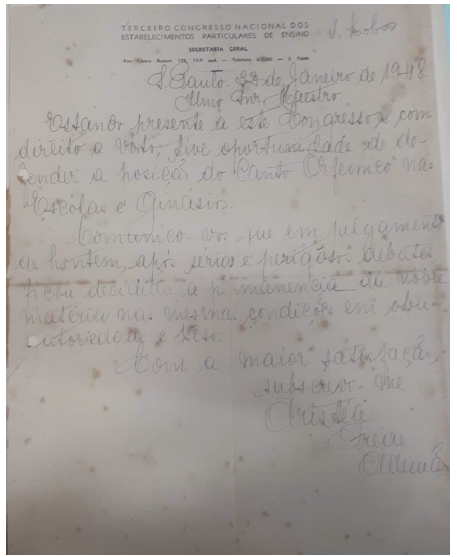 Note. Sectoral Archive of CLA - UNIRIO.
 Note. National Library. Catalog of Serial Publications (physical collection).
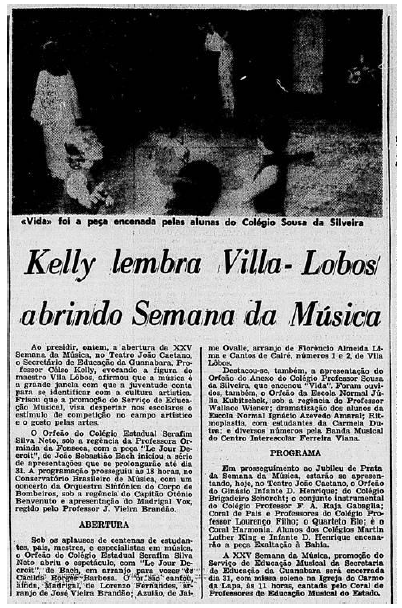 Note. Reproduced from Kelly lembra Villa-Lobos abrindo Semana da Música, Diário de Notícias, October 26, 1972, p. 5.
 Nota. Adapted from Subsídios para a elaboração dos currículos plenos dos estabelecimentos oficiais de ensino de 1º grau (n.d., p. 284). Bloch Education.
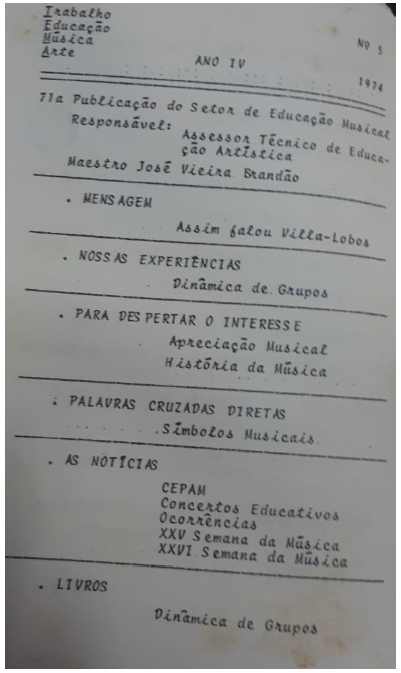 Note. National Library. Catalog of Serial Publications (physical collection).