 Prison Literature in Translation: Challenges and Strategies of Translating Torture-Related Expressions in Mustafa Khalifah’s The Shell: Memoirs of a Hidden Observer
Abstract:
This study investigates the challenges of translating traumatic and torture-related expressions in Mustafa Khalifah’s novel The Shell: Memoirs of a Hidden Observer (2008). These expressions are classified into three main categories: descriptive language, idioms and metaphors, and religious or cultural references. The article also examines the stylistic features commonly associated with the language of trauma, such as repetition, sentence fragments, brevity, silence, and metaphor. The research therefore evaluates the effectiveness of the English translation in conveying both the linguistic and emotional depth of Khalifah’s portrayal of trauma within each category. The study adopts a qualitative methodology grounded in Vinay and Darbelnet’s translation model. The research conducts a comparative textual analysis of the Arabic source text and its English translation to assess semantic accuracy, stylistic fidelity, and cultural equivalence. The analysis reveals that the translator primarily employs direct literal translation, transposition, equivalence, and borrowing. The findings also show that while the English translation generally preserves semantic accuracy, it compromises several stylistic and cultural elements. Although the English translation maintains the documentary function of the source text and reflects the protagonist’s voice and cultural context, certain linguistic and cultural nuances are diminished. Excessive borrowing weakens the intended meaning of some expressions, which potentially hinders the reader’s understanding and diminishes the emotional and existential depth of the source text.
Keywords:
prison; literature; translation; trauma; challenges; torture; Mustafa Khalifah;
The Shell
Resumo:
Este estudo investiga os desafios da tradução de expressões traumáticas e relacionadas à tortura no romance de Mustafa Khalifah, The Shell: Memoirs of a Hidden Observer (A concha: memórias de um observador oculto) (2008). Essas expressões são classificadas em três categorias principais: linguagem descritiva, expressões idiomáticas e metáforas, e referências religiosas ou culturais. O artigo também examina as características estilísticas comumente associadas à linguagem do trauma, como repetição, fragmentos de frases, brevidade, silêncio e metáfora. A pesquisa, portanto, avalia a eficácia da tradução para o inglês em transmitir a profundidade linguística e emocional da representação do trauma por Khalifah em cada categoria. O estudo adota uma metodologia qualitativa fundamentada no modelo de tradução de Vinay e Darbelnet. A pesquisa realiza uma análise textual comparativa do texto original em árabe e sua tradução para o inglês para avaliar a precisão semântica, a fidelidade estilística e a equivalência cultural. A análise revela que o tradutor emprega principalmente tradução literal direta, transposição, equivalência e empréstimo linguístico. Os resultados também mostram que, embora a tradução para o inglês geralmente preserve a precisão semântica, ela compromete diversos elementos estilísticos e culturais. Embora a tradução para o inglês mantenha a função documental do texto original e reflita a voz do protagonista e o contexto cultural, certas nuances linguísticas e culturais são atenuadas. O excesso de empréstimos enfraquece o significado pretendido de algumas expressões, o que potencialmente dificulta a compreensão do leitor e diminui a profundidade emocional e existencial do texto original.
Palavras-chave:
prisão; literatura; tradução; trauma; desafios; tortura; Mustafa Khalifah;
The Shell
1 Prison Literature in Translation: Voices of Resistance Across Cultures
Prison literature provides insight into the lives, thoughts, injustices, persecution, and resistance of prisoners. It is a literary genre through which imprisoned activists, writers, and intellectuals express their needs and yearning for freedom and address their social, psychological, and political issues. Prison writings reflect the intersection of human experience with broader societal challenges, encompassing cultures, regions, and historical periods. Parray and Magray (2022, p. 93) define prison literature as “the body of fictional and non-fictional work that incarcerated writers and thinkers have produced behind bars”. They also contend that “Poetry, novels, plays, letters and much of non-fictional staff is now referred to as Prison Literature or studied as Prison Literature” (Parray; Magray, 2022, p. 93). According to Magray and Farooq (2020, p. 1100),
Prison Literature could be defined as a body of literature written by writers in prison, jail, lock-up, prisoner’s camp, concentration camp and house arrest for different reasons. The jail does not only mean iron bars and high walls, it also means restrictions on one’s physical and mental freedom, dislocation from social, cultural, and political life.
Wringer (2019) asserts that, through prison literature, authors typically convey their personal or collective struggle against repressive regimes. The genre, therefore, is a written record of oppression and resistance that showcases different aspects of violence within a given sociopolitical environment.
The writings of imprisoned political activists and their opponents have garnered significant attention worldwide, particularly in the Western context. Within this context, translation researchers have recognized the importance of translating prison literature in exposing constitutional injustices and providing a means for resistance. Therefore, prison literature has been considered a reflection of the human spirit in the face of persecution. According to Franklin (1998), prison literature often addresses issues of imprisonment, identity, and political disobedience. Parray and Magray (2022) argue that every piece of writing created behind prison walls presents a harrowing portrayal of physical and psychological torture. Thus, the genre offers an uplifting look into human bravery, persistence, and a solid determination to be free.
In the United States, prison writings overlap with the debate over race and systemic oppression. African-American prisoners’ writings, such as those of George Jackson’s Soledad Brother (1970), are sharply critical of racial injustices and the prison-industrial complex. According to Delaney (2022, p. 1), “Soledad Brother is a poignant collection of letters written by George Jackson during his time in California prisons […] Jackson’s experience reflects the profound injustices faced by African Americans in the penal system”. Alexander (2012) contends that prison writings in the United States are a response to institutional racism and minority communities’ marginalization, serving as a counter-narrative to mainstream ideas.
Within the context of the Arab World, Arabic prison literature in translation is rooted in the political upheavals and revolutions of the twentieth and twenty-first centuries, including the Palestinian Nakba, the Lebanese Civil War, the Algerian War for independence, and the oppression of some Arab regimes in Syria and Egypt. Al Zayat (2022, p. 1) explains that “the political events that the Arab world experienced have positively affected the content of various literary forms such as autobiographies, novels, and further forms, especially after the defeat or the stages of defeat”. Arabic prison literature showcases the experiences of incarcerated Arab writers and political activists who were imprisoned for their political dissent, intellectual freedom, or ideological differences. According to Geula Elimelekh (2014), Arabic prison literature is distinguished by its emphasis on torture, psychological endurance, and the struggle for identity under authoritarian governments.
Among the most acclaimed and prolific writers who excelled in Arabic prison literature in the Arab World is Abdul Rahman Munif. The novel Sharq al-Mutawassit (East of the Mediterranean) (1975) is one of his most important and controversial works, representing the harsh experiences of political prisoners in the Arab World. The novel is an explicit condemnation of authoritarian regimes and the suppression of free thought. Another example is the revolutionary writings of Mahmoud Darwish, Ghassan Kanafani, Mureed Albarghouti, and Samih al-Qasem, who portray the collective struggle of political prisoners under the yoke of the Israeli occupation. Palestinian prison literature combines personal pain with the broader national struggle, emphasizing themes of perseverance, optimism, sacrifice, and resistance (Daghamin, 2024).
Ayman Al-Atoum is a Jordanian poet and novelist who has made significant contributions to the field of prison literature. His literary works focus on the psychological and physical suffering that Arab prisoners endure. His oeuvres, which include the notable Ya Sahebay Alsijn (O Two Companions of Prison) (2012) and Yasme’oon Haseesaha (They Hear the Slightest Sound of Hell) (2012), describe the traumatic experiences of political prisoners, shedding light on the harsh reality of imprisonment under authoritarian governments. Yasme’oon Haseesaha is a horrific novel whose events take place in Tadmor Prison in Syria and describes terrible jail conditions through realistic and brutal portrayals. The novel portrays the horrors of political imprisonment in Syria and recounts the real story of the main character, Iyad Asaad, a Syrian doctor imprisoned for seventeen years from 1980 to 1997. Accordingly, Yasme’oon Haseesaha and Mustafa Khalifah’s The Shell: Memoirs of a Hidden Observer represent important examples of prison literature, revealing the harsh reality of political imprisonment under oppressive regimes. They illustrate harsh torture, psychological collapse, and dehumanization of prisoners. In addition, they highlight the destructive effects of detention on identity and mental health. Both novels, Yasme’oon Haseesaha and The Shell, adopt a deep and direct narrative style. The Shell employs a diary-like account, while Yasme’oon Haseesaha employs poetic realism. However, both novels contain a strong condemnation of authoritarianism and emphasize resilience and survival, depicting the prisoners’ perseverance as a testament to human strength. They serve as essential historical records, ensuring that the voices of the oppressed are not lost.
Translation is a crucial tool for transferring literary texts between languages, and prison literature translation enables people worldwide to share a common experience, regardless of language barriers. It also encourages people to appreciate the written works of diverse cultures. Prison literature affects people’s hearts all around the world because it deals with human tragedies that, as in the case of The Shell, might represent an entire society’s suffering from injustice or dehumanization. The novel reflects the suffering of Syrians for over fifty years, until the outbreak of the Syrian revolution in late 2024. Due to its international popularity, the current novel has been translated into more than ten languages, allowing many people worldwide to experience the traumatic experiences that thousands of Syrian prisoners endured.
Mustafa Khalifah’s The Shell: Memoirs of a Hidden Observer is a semi-autobiographical novel that recounts the tormenting experiences of a political prisoner in Syria’s Tadmor Prison. Commenting on Tadmor prison, Al-Zayat (2022, p. 19) asserts that “Tadmor prison is the most famous Syrian prison ever, as it was a common factor among some authors of Syrian prison literature. It was a witness to the suffering of many prisoners, perhaps the most prominent of them is […] Mustafa Khalifa”. The Shell, therefore, is both a personal witness and a historical record of political repression, making it an important addition to Arabic prison literature.
World and Arabic prison literature explores themes of oppression, resistance, and the longing for freedom. Prison writings highlight the significance of prison literature as a voice for the voiceless and oppressed prisoners. However, World and Arabic prison literature differ both culturally and historically. While global prison writing usually exposes systemic injustice in democratic or colonial settings, Arabic prison literature concentrates on the challenges of authoritarian regimes and the suppression of political dissent. World prison literature encompasses a diverse range of genres, including autobiography, poetry, and philosophical treatises. Harlow (1992) notes that Arabic prison literature often employs metaphors and symbolism to circumvent censorship. This contrast highlights the writers’ adaptive methods under oppressive circumstances.
Translation studies offer a considerable body of critical thinking about cultural production and consumption, as well as a proven track record of multidisciplinary application. According to contemporary translation theory, translation is more than merely the transfer of language. It also involves culture, context, mediation, and interpretation. The translator communicates not only language but also culture, which includes cultural references, history, beliefs, and conventions (March, 2022). It is essential to classify Mustafa Khalifah’s novel, The Shell: Memoirs of a Hidden Observer, within the genre of prison literature to understand the unique challenges posed by its translation. According to Al Zayat (2022), The Shell is regarded as one of the most genuine pieces of writing in prose, poetry, or other forms due to its foundation in a sincere, lived experience and the understanding that suffering is essential for creativity. As a genre, prison writing frequently uses raw, unfiltered language to describe psychological and physical suffering, notably in depictions of torture and confinement. The Shell demonstrates this with its sparse yet strong vocabulary, fragmented narrative, and emotionally charged depictions of pain. These stylistic and thematic qualities make it challenging for translators to strike a balance between linguistic accuracy and cultural and emotional relevance. Examining genre conventions provides a comprehensive understanding of how the novel defies conventional narrative frameworks, necessitating complex translation procedures that preserve its intensity and realism. Thus, consideration of prison literature is not only important but also necessary for a comprehensive understanding of the challenges in interpreting Mustafa Khalifah’s writing.
Prison literature serves as a critical mirror, helping readers understand the lives of prisoners. Literary translation studies emphasize the importance of this genre in combating injustice, advocating for justice, and upholding the dignity of prisoners. Analyzing prison literature provides researchers and readers with a valuable insight into the complex interplay between literature, politics, and human rights. Translation studies play a significant role in this genre as they ensure that prison literature reaches global audiences while maintaining its authenticity, cultural context, and emotional depth. However, translators face challenges in preserving the original tone, political nuances, and linguistic complexities. Therefore, these difficulties might affect how these works are received across different cultures. Based on Khalifah’s personal confinement, The Shell explores themes of persecution and isolation under an authoritarian regime. The protagonist was falsely accused of being a member of the Muslim Brotherhood. Al Zayat (2022, p. 18) argues that “Examples of these Christian authors are the Syrian Mustafa Khalifa who was imprisoned for 13 years in ‘Tadmor’ prison, as well as Sednaya prison, on charges of joining the Muslim Brotherhood”. The author was subjected to firm abuse and dehumanization, providing a personal account of the harsh realities within Syria’s notorious prison system.
2 Trauma Narratives in Translation
In literary studies, trauma refers to the psychological and emotional effects of deeply traumatic experiences faced by characters or narrators. Caruth (2016) emphasizes that trauma is not fully recognized at the moment of its occurrence but instead returns later in recurring, uncontrollable ways. Trauma has been explored as a fundamental theme in literary works, as it reflects profound political repression and offers profound insights into human suffering. Qiushi Gu (2024, p. 79) elaborates that translated traumatic literary works “enable the audience to access unspeakable horror and reflect on the social background that generates trauma”. In Arabic prison literature, trauma is complicatedly woven into narratives that address colonialism, war, and oppression under an authoritarian regime. The present study investigates how prison literature, shaped by trauma, is represented in Mustafa Khalifah’s novel, The Shell.
Trauma might be conveyed, disseminated, and altered through translation. The intersectionality of trauma narratives and translation has garnered increasing attention from literary criticism and translation studies. Translators should consider the point of view from which the narrative is told, characterization, metaphor, and imagery used to depict trauma when translating trauma narratives in literary works. Scholars have not extensively examined the translation of trauma narratives in modern Arabic literature, particularly in Mustafa Khalifah’s novel, The Shell: Memoirs of a Hidden Observer (2008). Trauma in literary works serves as a critical instrument that investigates the psychological effects left by the experience of oppression, dehumanization, suffering, violence, and similar situations. It can be expressed through repetition, fragments, short sentences, silence, and metaphor. Linguistic accuracy is not enough for translating prison literature, which also includes emotional sensitivity, cultural specificity, and, most importantly, ethical commitment to transfer torture, pain, silence, suffering, and memory.
In the narrative, Mustafa Khalifah deploys some techniques that reflect the trauma he endures. For example, the use of first-person narration enables the reader to experience the narrator’s internal world of suffering, isolation, and oppression. Furthermore, he uses the diary format to make it a witness to his sufferings, as well as the suffering of other prisoners. Short sentences, fragments, and repetitive structures reflect the fragmented nature of traumatic memory. Moreover, the time framework is absent in his work, which reflects the endless suffering and traumatic experiences inside Syrian prisons. The novel’s title, The Shell, has symbolic implications. It reflects the traumatic experience of the writer, symbolizing emotional detachment and alienation. The protagonist, like a snail inside its shell, is alienated from the other prisoners because he is the only Christian detainee among a group of Muslim prisoners, mostly from the Muslim Brotherhood. This symbolism highlights his psychological withdrawal and the deep trauma he experiences. According to Farag (2025, p. 8),
Meanwhile, not only is the narrator of Syrian author Mustafa Khalifa’s The Shell (2006/2017) isolated from the world beyond the prison due to its walls, isolation, and sadistically violent regime, he is also shunned by his fellow prisoners – Islamists all – when, in an attempt to prove his innocence on accusations of belonging to an Islamist militant group, he declares that he cannot, for not only is he a Christian but an atheist. Instead of leading to his freedom, this pronouncement compels his torturer to redouble his beatings and results in “several years of total isolation, and treatment like that accorded to insects, if not worse,” by his cell mates.
Trauma manifests through features such as repetition, fragmentation, short sentences, silence, and metaphor. These features make the translation process more complex because the translator has to transfer them, in addition to the unspeakable emotions, into another language that can be different from the source language (SL). Trauma, in the translation process, is not only the content of the source text (ST), but also a real challenge for the translator. This type of translation raises some questions that should be taken into consideration: how can the translator keep his loyalty to the emotional and psychological level of trauma? What are the potential risks of destroying or oversimplifying traumatic expressions? Can trauma be generalized, or does it carry a special cultural meaning? These questions are important when translating literary works that carry traumatic language.
The main challenges in translating trauma, as in the present study, stem from the fact that some Arabic traumatic expressions lack direct equivalence in English. In addition, they are usually rooted to a specific Arabic cultural, political, historical, and religious context. They also lack a clear structure in the SL, which creates a real problem for the translator. In the case of The Shell: Memoirs of a Hidden Observer, the translator carries a great responsibility, as his translation must preserve the testimonial function of the novel and should be ethically charged and politically important. Within this context, Alqunaibet (2018) contends that translation between Arabic and English presents significant challenges due to the distinct linguistic families to which each language belongs; Arabic is a Semitic language, whereas English is Germanic. The two languages therefore differ distinctly in terms of structure, morphology, and lexicon. In addition, each language carries unique cultural concepts that often lack direct equivalents in the other. Accordingly, such linguistic and cultural gaps pose considerable difficulties for translators, particularly when working with literary texts.
Prison literature often uses stark, unembellished language to portray suffering; thus, translators must maintain the text’s rawness and authenticity while neither overinterpreting nor weakening its impact. Furthermore, cultural and political settings influence the way that such works are interpreted globally. For example, different audiences understand themes of oppression and resistance based on their own historical and sociopolitical experiences. The Shell is a significant case study of how translation can serve as both a bridge and a filter, enabling global readers to access previously restricted voices while exposing the power dynamics involved in conveying suffering across languages.
From a translation studies perspective, it can be argued that The Shell demonstrates the ethical and technical issues associated with translating traumatic narratives. It is also considered an effective example of trauma depiction in the field of prison literature. It reflects the psychological destruction caused by the long period of imprisonment, suffering, and violence. The Shell is a testimony that represents a clear image of the crimes of the authoritarian regime in Syria. Therefore, it can be said that this novel functions as an archive and a weapon against the Syrian regime, especially after the collapse of this regime, which became wanted for international trial by the oppressed Syrian people and the new Syrian government. Presented in a narrative framework, the novel, set in a Syrian prison, was selected due to its significance in the field of prison literature in translation, having been translated into more than ten languages. It represents traumatic narratives that best address the main idea for the present study.
3 Research Methodology
The corpus of the research consists of the Arabic novel alqawqaea, yawmiaat mutalasis by Mustafa Khalifah, along with its English translation, The Shell: Memoirs of a Hidden Observer by Paul Starky (2016). The study is carried out with Vinay and Darbelnet’s model as its theoretical framework. In Comparative Stylistics of French and English: A Methodology for Translation, Vinay and Darbelnet (1995) developed their model of translation procedures and classified translation strategies into two main categories: direct translation and oblique translation. Within these two main categories, Vinay and Darbelnet adopt seven translation procedures that can aid in analyzing and evaluating the translation of the novel under examination. These procedures include borrowing, calque, literal translation, transposition, modulation, reformulation or equivalence, and adaptation. Through the lens of Vinay and Darbelnet’s model of translation strategies, the research conducts a comparative textual analysis of the Arabic source text and its English translation to assess the effectiveness of the English translation in conveying both the linguistic and emotional depth of Khalifah’s portrayal of trauma within descriptive language, idioms and metaphors, and religious or cultural references. Based on Vinay and Darbelnet’s model, the study seeks to evaluate the stylistic features used to express the psychological and traumatic effects, namely, repetition, fragments, short sentences, silence, and metaphor. It also investigates how linguistic, cultural, and stylistic features, especially those that reflect trauma and emotional depth, are translated and whether their impact is preserved, altered, or lost in the target text. This model thus provides a structured approach for examining the strategies employed in translating the source text.
The data consists of 16 examples extracted from the novel, along with their corresponding English translations. The examples are representative samples that reflect recurring patterns of translation strategies across the novel. They were chosen based on their relevance to the study’s objective, i.e., trauma and linguistic representation, ensuring both depth and variety. This study examines the translation of torture-related expressions in Mustafa Khalifah’s The Shell: Memoirs of a Hidden Observer from Arabic into English, with a particular focus on how linguistic and cultural nuances are conveyed. The analysis classifies these expressions into three main groups: descriptive language, idioms and metaphors, and religious or cultural references. For descriptive language, the study examines how expressions representing pain, confinement, and interrogation are translated into English while preserving the original Arabic’s strength. For idioms and metaphors, the study examines whether figurative expressions of suffering and dehumanization are translated literally, adapted for cultural equivalence, or modified to conform to English linguistic norms. Finally, the research explores how religious and cultural references are represented in translation, considering whether they are maintained, reinterpreted, or overlooked. The study aims to explore these three areas to determine how effectively the translation conveys the linguistic depth and emotional impact of Khalifah’s depiction of torture. Moreover, the analysis attempts to investigate whether the translation preserves the function of the selected expressions in the target language (TL), and whether the translator was able to produce the same functional effect in the TL. The methodological approach adopted in this study identifies not only recognized successful translation choices but also instances where meaning, intensity, or nuance were altered, indicating potential areas for improvement to achieve a more faithful and powerful rendering of the original text.
The methodology adopted for this research is suitable and relevant for the aims of our study. The analysis is grounded in Vinay and Darbelnet’s model of translation procedures, a structured and well-established theoretical framework that captures the nuanced shifts that occur during the translation process. Moreover, this model effectively supports the investigation of linguistic, stylistic, and cultural elements – mainly those central to conveying the traumatic experience in the novel under examination – and offers precise tools for categorizing and interpreting translation choices. Furthermore, the comparative textual analysis with the focused selection of 16 illustrative examples allows for a detailed investigation of how expressions related to pain, suffering, and cultural specificity are tackled in the English translation. Overall, this methodology enables a critical assessment of the translator’s strategies and their impact. It also offers insights into both successful renderings and areas where the original meaning or emotional resonance may have been diminished. Accordingly, it is well-aligned with the research objectives and provides a comprehensive lens through which the effectiveness of the translation can be evaluated.
4 Analysis and Discussion
The following analysis explores three main categories of torture-related and traumatic expressions in the novel.
4.1 Descriptive Language
Khalifah’s novel is realistic and direct, which allows readers to feel the amount of pain, confinement, and brutality that the protagonist experiences. Dynamic and honest descriptions of torture, confinement, and interrogation immerse the reader in the protagonist’s traumatic journey. The use of sensory details and violent images in the novel highlights the severity of pain and torture. This category covers words that refer to wounds, bodily harm, isolation, and forced questioning.
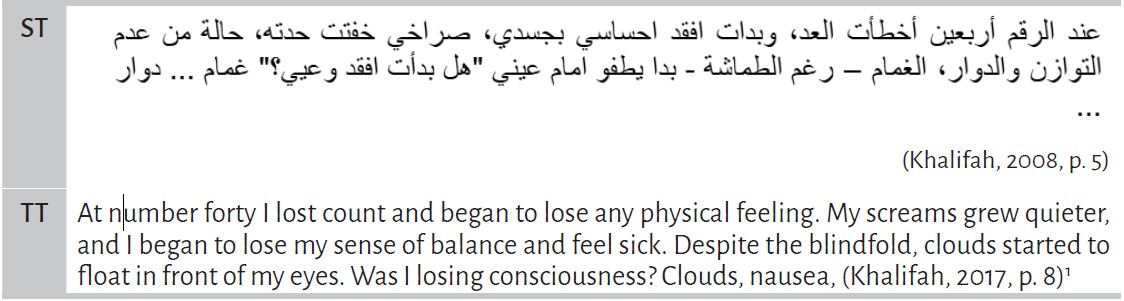
1
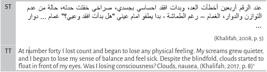
This scene captures the trauma that the protagonist undergoes. It is clear in the use of fragments and short sentences. The translation effectively conveys the general meaning of the original Arabic text, but there are some shifts in meaning and omissions. The loss of physical sensation “بدأت افقد احساسي بجسدي” is correctly translated as “began to lose any physical feeling”. The gradual fading of screams “صراخي خفتت حدته” is rendered as “My screams grew quieter”, maintaining the intended effect. The floating clouds, despite the blindfold, are retained in translation, ensuring that the hallucinatory aspect is clear. While “عند الرقم أربعين أخطأت العد” (“At number forty, I lost count”) is translated accurately, “أخطأت العد” (“I miscounted”) implies struggling to keep track before losing count altogether, whereas the translation simplifies this as an immediate loss of count. “حالة من عدم التوازن والدوار” is translated as “I began to lose my sense of balance and feel sick”. The translator uses transposition procedure; he changes the word class from a noun phrase in Arabic into a verbal phrase. However, “حالة من عدم التوازن” conveys disorientation, which is adequately translated as a state of imbalance. “الدوار” (“dizziness”) is mistranslated as “feel sick”; while dizziness can cause nausea, the Arabic term explicitly refers to vertigo, not just general sickness. “رغم الطماشة” is accurately translated as “Despite the blindfold”, though “الغمام” (clouds/mist/fog) appearing in front of the eyes might imply hallucination or vision distortion, which the English does not emphasize enough. Moreover, the Arabic passage uses short, fragmented phrases to reflect the narrator’s weakened state and disorientation, but the English version smooths these into more conventional sentence structures, reducing the immersive effect. The Arabic gradually builds up a sense of losing control, with each phrase contributing to physical and mental deterioration. The English translation simplifies some of these effects, making the experience seem more linear and less immersive. The phrase “غمام... دوار...” in Arabic emphasizes the narrator’s fading consciousness through its ellipsis and isolated words, whereas in English, “Clouds, nausea,” is less effective because it lacks the trailing effect that mirrors fading thoughts.
Suggested translation:
“At number forty, I miscounted and began to lose all sensation in my body. My screams grew weaker. A wave of imbalance and dizziness took over. Despite the blindfold, a haze started floating before my eyes. Was I losing consciousness? Haze… dizziness…”
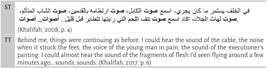
A most descriptive feature of trauma narrative is the use of repetition and fragment, as in this example. The author, in this passage, still keeps the image of torture in his mind as if he couldn’t forget the traumatic experience he has suffered. This is clear in this novel and in prison literature in general. It reflects the author’s concentration on the sensory perception. The simple fragments in this example are able to convey the expressive, annoying feeling of the ST. The translator uses direct translation to convey this image of torture through a fragmented language that is able to convey the meaning and mirror the scene in the TL.
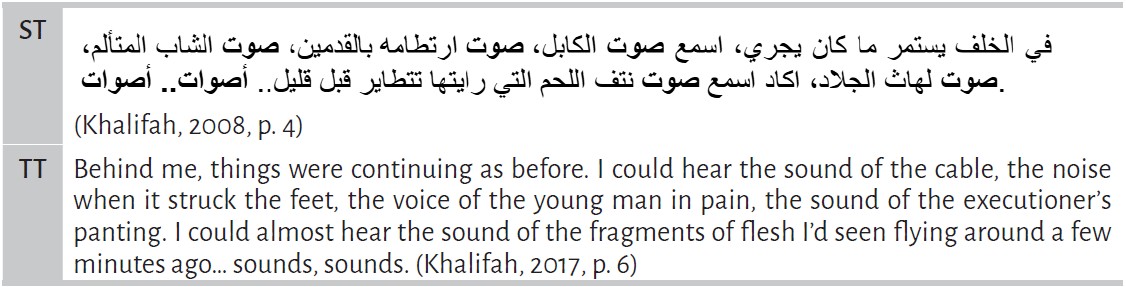
As for repetition, the ST repeats صوت seven times, which helps to create a terrific image that he suffered. Repetition here is not for decoration; it is essential to express the author’s inability to overcome this traumatic, overwhelming experience. As a result, the translator was able to produce a target text (TT) that carries the scenery of torture and suffering and keeps the compulsive and fragmented quality of traumatic remembering.
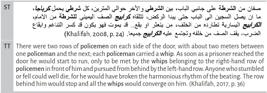
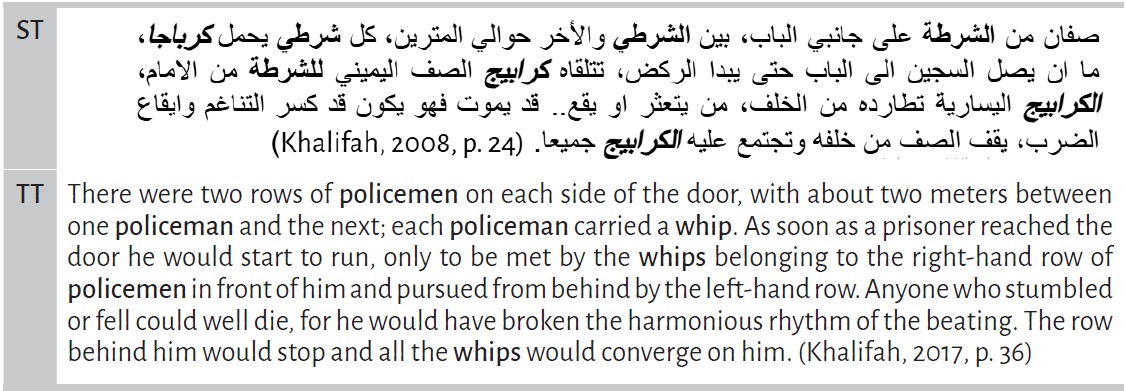
In this example, both the ST and TT use dramatic and intense descriptive language to convey the brutality of the situation, which is the function of the ST. This example is one of hundreds of examples that reflects the symbol of the endless cycle of suffering inside the prison. He repeats “الشرطي” and “كرابيج” four times to express the terrifying moments that prisoners suffer when they see a policeman. The translator uses direct translation to transfer these two lexical items into the TL and to transfer the whole scene. However, there are some differences in how each language presents the imagery and rhythm of the scene. To illustrate, the Arabic ST uses short, sharp phrases and a rhythmic structure to show the relentless, mechanical nature of the beatings. Words like “الكرابيج اليسارية تطارده من الخلف” and “whips pursued him from behind by the left-hand row” create a sense of pursuit and inescapability, reinforcing the prisoner’s helplessness. The passive tone in phrases such as “قد يموت” makes the situation feel even more matter of fact and merciless. The ST also emphasizes strict coordination and order in the beatings with “كسر التناغم وإيقاع الضرب” (“breaking the harmony and rhythm of the beating”) portraying torture as an instrumented and systematic act rather than chaotic violence.
On the other hand, the TT successfully retains much of the meaning but presents the description in a slightly more explanatory manner. The phrase “anyone who stumbled or fell could well die” maintains the deadly consequences of falling but softens the certainty compared to “قد يموت” in Arabic. Similarly, “all the whips would converge on him” is a less intense visual than “اجتمعت عليه الكرابيج جميعًا” in Arabic, which more strongly implies a chaotic, merciless offensive. While both texts successfully portray the horrific nature of the beatings, the ST is more sudden, rhythmic, and direct, whereas the TT smooths out some of the intensity to make it more natural for an English-speaking audience. The TT preserves the sense of dehumanization and suffering but with slight modifications that make the violence feel somewhat less immediate and chaotic than in the original Arabic.
Suggested translation:
“Two rows of policemen stood on each side of the door, with about two meters between one policeman and the next; each policeman carried a whip. As soon as a prisoner reached the door, he started to run; the right-hand row whips stroked him from the front, and the left-hand whips chased him from behind. Anyone who stumbled or fell… might die because he would have broken the rhythm and harmony of the beatings. The row behind him stopped, and all the whips converged on him”.
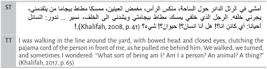
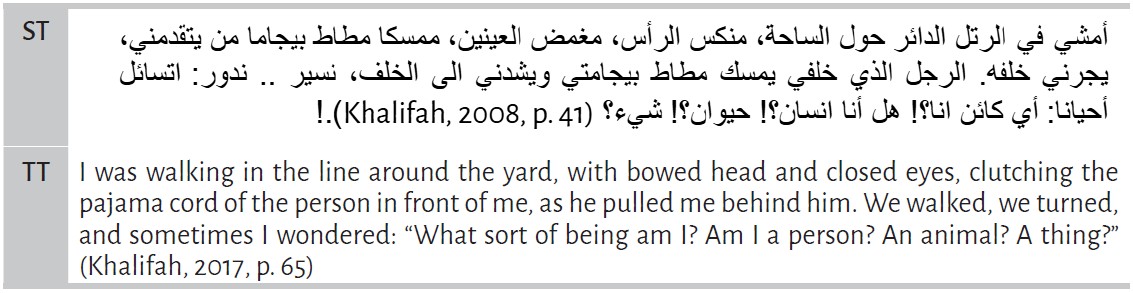
One feature of the repeated structures in this novel is the usage of questions that reflect the feeling of uncertainty and shock. These questions best show the traumatic experience that the protagonist suffered. This type of repetition is called interrogative repetition. In this form, the protagonist noticeably repeats questions that reflect the traumatic experience. The translator focuses on both the form and content of the ST. In translating these questions, he uses direct translation.
This image of dehumanization is one of hundreds of images that is presented on every page of this novel. The main actions and emotions – walking in a forced march, being physically restrained, and questioning one’s humanity – are well conveyed. However, there are minor omissions. The phrase “ممسكا مطاط بيجاما من يتقدمني، يجرني خلفه” is translated as “clutching the pajama cord of the person in front of me, as he pulled me behind him”. The verb “يجرني” (dragging me) has a stronger connotation than “pulled me behind him”, which softens the sense of helplessness in the English version. Furthermore, “الرجل الذي خلفي يمسك مطاط بيجامتي ويشدني الى الخلف” is omitted in the translation, which means that the reader loses the full sense of being pulled from both directions. The imagery of prisoners holding onto each other’s pajama cords like a human chain is highly effective, as it evokes forced submission and loss of agency. This remains intact in the English translation. However, the omission of the man behind pulling backward reduces the sense of being trapped in a cycle of oppression, which is crucial in the original Arabic. The rhythm of Arabic is fragmented, emphasizing exhaustion and a sense of loss of control. The repetition of “نسير .. ندور” in Arabic, meaning “We walked, we turned,” is preserved in English, successfully maintaining the mechanical, trance-like tone. The rhetorical questions at the end closely mirror those in Arabic, maintaining the sense of identity crisis and dehumanization.
Suggested translation:
“I walked in the line around the yard, head bowed, eyes shut, gripping the elastic cord of the pajama of the man in front of me as he dragged me forward. Behind me, another man clutched my pajama cord, pulling me back. We walked; we turned. Sometimes, I wonder: What sort of being am I? Am I human? An animal? A thing?”
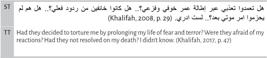
The ST uses yes/no questions to reflect the traumatic experience and the uncertainty about the situation the protagonist has suffered. Its usage is significant in this novel because it reflects the conflict and dilemma inside him. These questions express the endless cycle of torture, dehumanization, suffering, and other unforgettable situations.
4.2 Idioms and Metaphors
Figurative language, such as expressions of suffering and dehumanization, sheds light on the emotional and psychological consequences of torture. By comparing pain to hunger, death, or darkness, Khalifah demonstrates how prisoners’ identities were stripped away and reduced to mere shadows of their former selves. Idioms and metaphors in novels often serve to depict suffering poetically or symbolically. Rather than directly stating the pain, these expressions evoke powerful imagery that illustrates the depth of dehumanization and agony experienced in prison.
It is essential to mention that Mustafa Khalifah uses motifs in this novel. This type of repetition deals with a repeated element in any literary work. It can be an image, memory, situation, symbol, or phrase. In the case of The Shell as a novel, the motif could be presented in different ways, most importantly the use of the symbol of the shell and of violence and torture words and expressions. These symbols reflect the effect of trauma on the protagonist. Every symbol has its negative psychological impact. The first one is the use of the symbol of the shell in describing himself inside the prison. He was in imprisonment and alone because he is Christian and all prisoners are Muslims. This atmosphere creates isolation from others, which makes him introverted, as if he lives inside a shell. The protagonist explains how this shell was built when he says:
As the days passed, a shell began to grow around me, made up of two walls. One wall was formed of their hatred for me. I was swimming in a sea of hatred, loathing and revulsion, trying as hard as I could not to drown. The second wall was made up of my fear of them. I opened a window in the hard wall of the shell and began to spy on the dormitory from the inside, the only thing that I could do.
(Khalifah, 2017, p. 48).
This symbol is repeated many times in the novel, as the following examples illustrate:
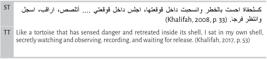

The translator, in these two examples, uses direct translation – mainly calque – to convey the symbol of the shell. This strategy conveys the image into the target language and produces a meaningful English sentence. It reflects the traumatic life that he has lived during his imprisonment, which the translator successfully transfers into the TL.
The second symbol is the repetition of violence and torture expressions. The novel is full of these expressions. There isn’t nearly any page that lacks the use of violence and torture expressions. The writer was able to describe the images, sounds, and places around him.

The ST clearly describes a scene of torture, particularly the pain inflicted by a cable blow to the feet of a restrained prisoner. It reflects the traumatic experience the protagonist has witnessed. The Arabic sentence has a realistic style. It dynamically captures the sequence of events. In this scene, the translator has to focus on the image of torture with the same effect. Therefore, he has to focus on the semantics of the ST. The TT mostly preserves the meaning by using direct translation but rearranges the sentence structure. However, there are some shifts in meaning: “فاجأتني” (surprised me) is translated as “a loud cry of pain hit me”, which maintains the emotional impact but slightly shifts the focus from unexpectedness (فاجأتني) to a more general sensation of being affected (hit me). In addition, the ST places the scream at the beginning – “فاجأتني صرخة” – to emphasize its sudden impact, whereas the English translation delays the mention of the scream. The Arabic conveys a continuous action, which reflects the trauma of the protagonist, while the English breaks it down into separate ideas. This restructuring results in a less immediate and immersive experience. The description of torture using a car tire, “المحشور في دولاب سيارة خارجي”, is preserved, ensuring that the reader grasps the brutality of the act. However, the translation of “رجلاه مرتفعتان في الهواء” as “his feet raised in the air” is slightly neutralized compared to the original, which implies helplessness and forced exposure in a more striking way. The translation effectively conveys the main imagery of torture and preserves much of the original meaning. The translator here uses transposition from a noun phrase in the ST into a verbal one in the TT, and in translating ضربة كابل into “There was a blow of a cable”. The translator uses transposition to overcome the syntactic differences between Arabic and English. On the other hand, some emotional and stylistic differences are weakened due to restructuring, the omission of unexpectedness, and a slight softening of impact. As a result, it can be said that the translation strategies used in this example are direct translation, transposition, and deletion.
Suggested translation:
“A loud cry of pain suddenly startled me as a cable struck the feet of the man lying on the ground, trapped inside an old car tire, his legs raised helplessly in the air”.
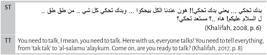
This example includes one of the colloquial Arabic structures, which is the repetition of a lexical item or expression more than one time for emphasis (بدك تحكي ... يعني بدك تحكي!!). In this example, the translator keeps the repetition of the phrase, but he conveys the meaning of the ST in a different way in the TL (“You need to talk, I mean, you need to talk”). The insistence, coercion, and compulsion are not translated. The verb ‘need’ indicates the meaning of necessity, and it does not carry the meaning of compulsion. “هون عندنا الكل بيحكوا” (“Here with us, everyone talks!”) correctly conveys forced confessions in a coercive setting. In the example “هاه ..؟ مستعد تحكي” (“Come on, are you ready to talk?”), ‘Come on’ adds a taunting tone, which aligns with the interrogator’s aggressive approach. However, in the example “من طق طق .. ل السلام عليكم” (“from ‘tak tak’ to ’al-salamu ’alaykum”), “tak tak” is not a standard English phrase, making the expression unclear. This sounds unnatural in English. This approach is called a borrowing strategy. The Arabic phrase means “from beginning to end”, implying an absolute and exhaustive confession. In translating such idioms, there is no need for borrowing because there is an equivalent translation for this idiom: “From A to Z”. It is worth mentioning that the translator uses unnecessary borrowing in this novel in more than one context, like mujahid, ustaz, falaqas, Sheikh Mukhabarat, shabehah, and fedayeen.
Suggested translation:
“You have to talk, I mean, you have to talk! Here, everyone talks. You have to spill everything, from start to end (or from A to Z). Come on, are you ready to talk?”
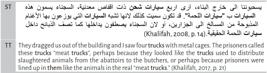
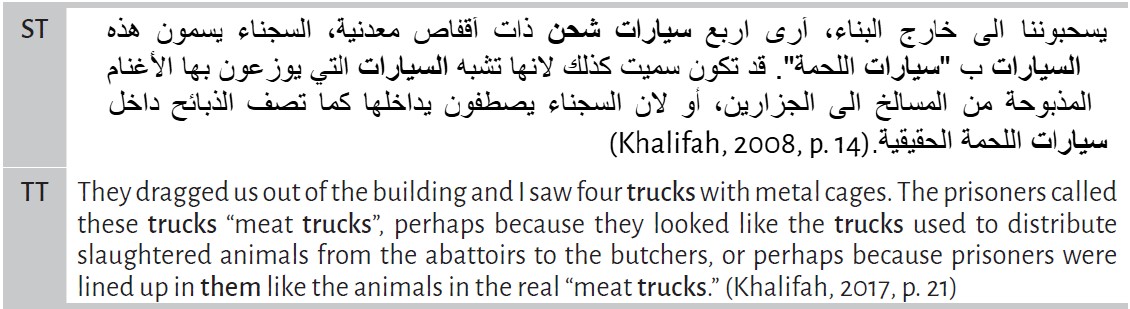
In this scenario, the protagonist describes an unforgettable situation of dehumanization. The repeated usage of the term “سيارات” (“trucks”) reflects the traumatic moments he has witnessed. The translation largely preserves the meaning and imagery of the Arabic text; however, as in the previous examples, some shifts and omissions affect the intensity of the description. The main elements of the scene, which include prisoners being dragged outside, trucks with metal cages, and the comparison to trucks carrying slaughtered animals, are effectively conveyed. Furthermore, the term “meat trucks” is correctly translated, ensuring that the dehumanizing metaphor of prisoners as livestock is kept. “قد تكون سميت كذلك” is translated by using transposition. It is a shift from a verbal clause into one lexical item, “perhaps”, which does not affect the meaning. The phrase “تصف الذبائح داخل سيارات اللحمة الحقيقية” is translated as “like the animals in the real ‘meat trucks’”, but the word “ذبائح” (slaughtered animals) is not explicitly mentioned in English, reducing the gruesomeness of the metaphor. The dehumanization aspect could be further emphasized, especially with the missing “slaughtered” reference. The nickname ‘meat trucks’ in Arabic is not just a metaphor but also a prisoner-coined term with a deeply ingrained horror. The translation retains it but could have emphasized how widespread and normalized this terminology became among the prisoners, who referred to them as “meat trucks”. The Arabic builds suspense, presenting the nickname first and then explaining its gruesome implications. The English, by slightly altering word order, makes it feel more explanatory than immersive. The translation strategies employed here include transposition and direct translation.
Suggested translation:
“They hauled us outside, and I saw four trucks fitted with iron cages. The prisoners called them ‘meat trucks’—perhaps because they resembled the ones used to distribute slaughtered livestock from abattoirs to butchers, or perhaps because prisoners were crammed inside them just like carcasses in real meat trucks”.

This situation reflects a vague description of scenery and includes a feature of prison literature writing called temporal suspension. The writer is unconscious of the time he spent under torture in that situation, which reflects the amount of pain he suffered. The author uses repetition to reflect this harrowing situation by repeating توقف (stop) and خدر (numbness) twice. Also, he repeats قد تكون to emphasize the case of being uncertain about the time he spent. However, the translator deletes the exclamation marks that are parts of the meaning. It would have been better to keep them in the TL. These marks reflect the wondering and lost case of the protagonist during that situation. The translator uses direct translation to transfer this scene.
4.3 Religious and Cultural References
Many prisoners use religion, fate, and endurance as coping methods, drawing on cultural and religious traditions to make sense of their suffering. However, the work raises doubts about divine justice, as some characters struggle to reconcile their faith in God with the horrific cruelty they face. Given the deeply religious and cultural background of the Middle East, the novel includes references to fate (القدر), endurance (الصبر), and divine justice (العدالة الإلهية). These expressions help prisoners make sense of their suffering, offering either a sense of hope or resignation.
In addition, the novel is full of insulting expressions that are considered culturally specific ones.

This expression is repeated in the novel numerous times. It is mentioned ten times in one page. It is usually used for strongly dehumanizing, underestimating, and insulting someone. The Arabic text uses ولا to impolitely refer to someone. It is not used for negation here. There are many examples with the same structure, such as ولا كلب (‘you dog’) and ولا حيوان (‘you animal’). The use of ‘you’ in the TL is considered more polite than ولا. It does not reflect the same sharpness of insulting meaning.حقير also carries a very strong contempt. Therefore, the translator can use a stronger expression that reflects the near degree of insulting meaning, such as ‘you worthless bastard’.

In this example there is anadiplosis, which is a kind of repetition. الله ends the first clause and starts the second. This type of repetition is used to put emphasis on the repeated lexical item. In this religious expression, the speaker emphasizes the idea of keeping faith in Allah’s ability and not to lose hope in him. In this example, there is a faithful rendering of the core meaning. The translator attempts to convey the religious significance. The original Arabic has a Quranic and religious resonance, and the translation keeps a solemn, faith-based tone. The translation maintains the intended meaning of the original statement in translating “من يكن مع الله فان الله سيكون معه” as “Whoever is with God, God will be with him”. The conditional structure is also preserved. The same applies to translating “لا تيأس يا أخي” as “Don’t despair, my brother!”. Here, “لا تيأس” is correctly translated as “Don’t despair,” maintaining the tone of reassurance. “يا أخي” is accurately rendered as “my brother”, which conveys both religious and emotional solidarity. The phrase “Whoever is with God, God will be with him” mirrors the biblical and Quranic syntactic style, making it feel natural and appropriate in English. The Arabic phrase reminds us of the Quranic language of support and reliance on God.
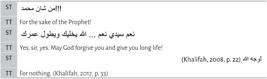
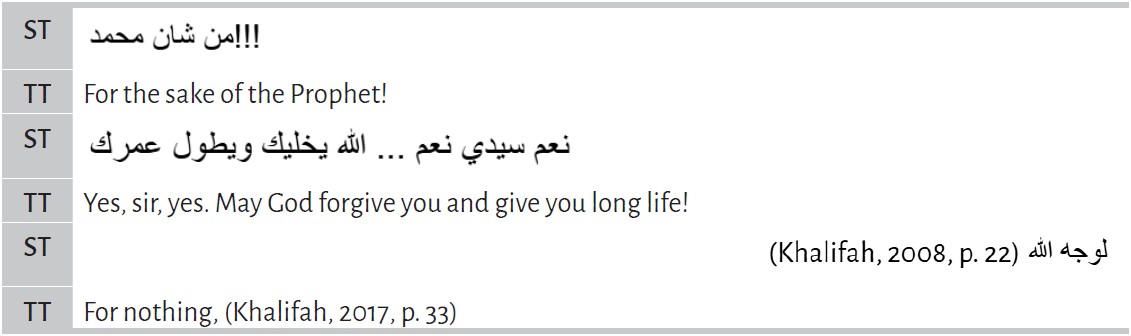
The function here is to transfer the religious meaning of the expression into the TL. The translation accurately conveys the intended religious plea, as “من شان” means ‘for the sake of’ and “محمد” refers to Prophet Muhammad. This maintains the meaning and keeps it natural in English. It is a good calque because it keeps the religious plea. “الله يخليك ويطول عمرك” literally means “May God keep you and prolong your life,” but the translator renders it as “May God forgive you and give you long life”. ‘May God forgive you’ is not an accurate equivalent since the original phrase is a form of respectful supplication rather than a plea for forgiveness. A better translation could be “Yes, sir, yes. May God protect you and grant you a long life!”, “لوجه الله” (“For nothing”). The phrase “لوجه الله” literally means ‘For the sake of God’ and implies that something is done purely for religious or moral reasons without expecting anything in return. The translation loses the religious and cultural significance of the phrase. A better translation could be ‘For the sake of God’ or ‘For God’s sake (without expecting anything in return)’. The first two translations mostly retain the formal tone and religious connotation of the original text. However, “For nothing” completely removes the spiritual aspect of “لوجه الله,” which is a significant cultural and religious expression in Arabic. This sentence is mistranslated and should be revised to reflect its religious and cultural significance.
Suggested translation:
For the sake of the Prophet Muhammad!
Yes, sir, yes.
May God protect you and grant you a long life!
For God’s sake
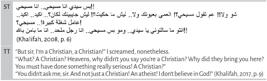
This example represents one of the major repeated conflicts for the protagonist; he is Christian and atheist and has been accused along with Muslim Brotherhood members. He used to say that he is Christian and atheist for the police officers to release him, but no one helped him. Being Christian among others made him spend his 13 years of imprisonment alone, as a snail inside its shell. The translator uses direct literal translation for translating these two lexical items into English.
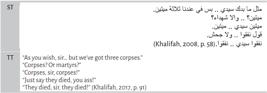
This example illustrates the horror that the officer instils in the protagonist. The traumatic effect is clear through his obedience to the officer. “مثل ما بدك سيدي” correctly translates to “As you wish, sir.” “في عندنا ثلاثة ميتين” is translated as ‘We’ve got three corpses’. While “corpses” is a literal translation of “ميتين”, it lacks the indifference conveyed in Arabic. The Arabic “ميتين” (literally dead) is more neutral compared to the stronger connotation of “corpses” in English. It could be translated as ‘We’ve got three dead men’. The Arabic sentence, “ميتين؟ .. والا شهداء؟” (“Corpses? Or martyrs?”), implies a sharp contrast between being simply “dead” and being “martyrs”, which has a strong cultural and religious meaning. The religious significance of “martyrs” (شهداء) is crucial in Arabic, as it implies that the person died honorably and will be rewarded in the afterlife. The translation captures the basic contrast but does not fully reflect the weight of calling someone a “martyr” in Arabic culture. The Arabic phrase repeats “ميتين” for emphasis, which the English translation keeps by repeating “corpses”. However, since “corpses” sounds harsher in English, it might be more natural to say: “Dead, sir, just dead.” The translation of “قول نفقوا .. ولا جحش.” as “Just say they died, you ass!” is partially accurate but loses some differences: “نفقوا” literally means ‘expired/died like animals’, which conveys dehumanization in Arabic. “Just say they died” does not fully capture the derogatory meaning. “ولا جحش” (literally ‘you donkey’) is a strong insult in Arabic, but “you ass” is a good cultural equivalent in English.
Suggested translation:
“…but we’ve got three dead bodies/men”
“Dead? Or are they martyrs?”
“Dead, sir, just dead.”
“Just say they expired, you ass!”
“They expired, sir, they expired!”
5 Final Remarks and Recommendations
This piece of research contributes to broader discussions in literary translation studies, trauma theory, and Middle Eastern prison literature. It also offers valuable insight into the role of the translator as a mediator of culturally charged and emotionally intense traumatic narratives. In light of Vinay and Darbelnet’s translation model, the analysis of traumatic and torture-related expressions in The Shell: Memoirs of a Hidden Observer indicates a clear commitment to literal translation and transposition. The analysis also reveals that the novel’s translator, Paul Starky, attempts to preserve the cultural and linguistic features of the Arabic text, which allows readers to engage with the novel through Syrian sociopolitical reality. It is also observed that the translator preserves the autobiographical nature of the novel, treating it as a documentary that maintains the original language (SL) cultural context. The challenges in translating this novel are not restricted to linguistic challenges only; there are also moral, emotional, political, and social challenges that should be transferred in the TL. Prison literature serves as proof of the crimes and violence that prisoners have faced during their imprisonment. As a result, the translator works as a witness and has to faithfully transfer all prison’s occurrences into the TL.
However, there are key challenges in translating descriptive language, idioms and metaphors, and religious or cultural references from Arabic into English. The English translation prioritizes clarity and readability, but at times, this comes at the expense of the full emotional and ideological depth found in the original Arabic text. In terms of descriptive language, the translation effectively conveys the physical brutality of pain, imprisonment, and interrogation, although some differences in sensory details and intensity may be softened.
Regarding idioms and metaphors, the translation varies in its approach; some expressions of suffering and dehumanization are translated literally, preserving the original imagery, while few others are borrowed from English, which resulted in losing a part of the meaning and potentially causing misunderstanding for the TL readers. However, in cases where Arabic metaphors carry deep cultural connotations, their full importance may be lost in translation. Finally, religious and cultural references present significant challenges, as expressions related to fate, tolerance, and sacred justice often have strong spiritual or philosophical undertones that may not have direct equivalents in English.
The Shell: Memoirs of a Hidden Observer is an important example of translated prison literature because it conveys the harsh realities of political imprisonment. Furthermore, it demonstrates the challenges of translating such narratives into another language. However, translating prison narratives, such as The Shell, demands more than simply linguistic accuracy; it also requires preserving the original work’s emotional intensity, cultural complexity, and political context. Therefore, translators must navigate challenging issues, such as maintaining the protagonist’s detached yet horrifying tone, utilizing regional vocabulary, handling traumatic language, and addressing the narrative’s historical weight to ensure that foreign readers understand the novel’s depiction of suffering and resistance.
Further studies on prison literature in translation should adopt more comprehensive models of translation strategies to address and identify other challenges and problems in the translation of the prison literature genre. Additionally, it is recommended for future studies to examine the role of translators as cultural mediators, mainly in assessing how they navigate the complexities of politically charged and historically rooted texts. Furthermore, literary translation researchers should investigate how various translation approaches affect the reception of prison narratives across cultures, particularly in preserving the rawness and authenticity of trauma-related language. Moreover, further investigations on challenges of prison literature translation are recommended on larger research samples. Finally, translators are encouraged to accurately and sensitively translate the traumatic narratives of imprisonment, especially those from marginalized voices in the Arab world and beyond, to ensure a more comprehensive representation of prison literature in global discourse. For example, works by Ayman Al-Atoum are recommended for translation since they are very popular in Arab countries. Therefore, their translation will undoubtedly contribute to enriching the field of prison literature.
References
-
AL ZAYAT, H. Arabic Books of Prison Literature During (1948-2020): An Analytical Bibliometric Study. International Journal of Library and Information Sciences, v. 9, n. 4, 2022. DOI: https://doi.org/10.21608/ijlis.2021.108310.1123 .
» https://doi.org/10.21608/ijlis.2021.108310.1123 - AL-ATOUM, A. Ya sahibay alsijn [O Two Companions of Prison]. Beirut: Arab Foundation for Studies and Publishing, 2012a.
- AL-ATOUM, A. Yasmaeun hasisaha [They Hear Its Hissing]. Beirut: Arab Foundation for Studies and Publishing, 2012b.
- ALEXANDER, M. The New Jim Crow: Mass Incarceration in the Age of Colorblindness. New York: The New Press, 2012.
-
ALQUNAIBET, S. I. An Application of Vinay and Darbelnet’s Translation Model to the English Translation of Ghassan Kanafani’s Novel Men in the Sun: A Descriptive Analytical Study. 2018. Thesis (Master’s Degree in Translation) – College of Languages and Translation, Al-Imam Mohammad Ibn Saud Islamic University, Saudi Arabia, 2018. Retrieved from Arab World English Journal, (ID Number: 234), p. 1-90, June 2019. DOI: https://dx.doi.org/10.24093/awej/th.234 .
» https://doi.org/10.24093/awej/th.234 - CARUTH, C. Unclaimed Experience: Trauma, Narrative, and History. Baltimore: Johns Hopkins University Press, 2016.
-
DAGHAMIN, R. Understanding the Poetics of Resistance and the Politics of Existence: A Comparative Study of African American and Palestinian Poetic Traditions. The International Journal of Literary Humanities, v. 22, n. 3, p. 155-176, 2024. DOI: https://doi.org/10.18848/2327-7912/CGP/v22i03/155-176 .
» https://doi.org/10.18848/2327-7912/CGP/v22i03/155-176 -
DELANEY, B. Soledad Brother by George Jackson. [S. l.]: EBSCO, 2022. Available at: https://www.ebsco.com/research-starters/literature-and-writing/soledad-brother-george-jackson . Accessed on: Apr. 20, 2025.
» https://www.ebsco.com/research-starters/literature-and-writing/soledad-brother-george-jackson - ELIMELEKH, G. Arabic Prison Literature: Resistance, Torture, Alienation and Freedom. Wiesbaden: Harrassowitz, 2014.
-
FARAG, J. Prison Sentences: Spaces of Liberation in Arab Prison Writing. CLCWeb: Comparative Literature and Culture, v. 25, n. 1, 2025. DOI: https://doi.org/10.7771/1481-4374.4887 .
» https://doi.org/10.7771/1481-4374.4887 - FRANKLIN, H. B. Prison Literature in America: The Victim as Criminal and Artist. New York: Oxford University Press, 1998.
-
GU, Q. The Application of Trauma/PTSD Studies to Translation: Take Several Japanese Novels as an Example. Theory and Practice in Language Studies, v. 14, n. 1, p. 79-87, 2024. DOI: https://doi.org/10.17507/tpls.1401.09 .
» https://doi.org/10.17507/tpls.1401.09 - HARLOW, B. Barred: Women, Writing, and Political Detention. Hanover; London: Wesleyan University Press, 1992.
- JACKSON, G. Soledad Brother: The Prison Letters of George Jackson. New York: Random House, 1970.
- KHALIFAH, M. The Shell: Memoirs of a Hidden Observer. Beirut: Arab Foundation for Studies and Publishing, 2008.
- KHALIFAH, M. The Shell: Memoirs of a Hidden Observer. Translated by P. Starkey. Northampton: Interlink Books, 2017.
- MAGRAY, A. U. H.; FAROOQ, A. A Stylistic Study of Prison Narratives: A Critical Approach. Journal of Language and Linguistic Studies, v. 16, n. 2, p. 1100-1107, 2020.
-
MARCH, E. Narratives of Translators: The Translational Function of Prisoner Writing. Life Writing, v. 19, n. 4, p. 573-591, 2022. DOI: https://doi.org/10.1080/14484528.2021.1959853 .
» https://doi.org/10.1080/14484528.2021.1959853 - PARRAY, M.; MAGRAY, A. Prison Literature in Perspective: A Study of the Consolation of Philosophy as a Prison Narrative. Journal for Re Attach Therapy and Developmental Diversities, v. 5, n. 2, p. 93-98, 2022.
- VINAY, J. P.; DARBELNET, J. A Methodology for Translation. In: VENUTI, L. (ed). The Translation Studies Reader. London; New York: Routledge, 2000. p. 84-93.
- VINAY, J. P.; DARBELNET, J. Comparative Stylistics of French and English: A Methodology for Translation. Amsterdam; Philadelphia: John Benjamins Publishing, 1995. v. 11.
-
WRINGER, A. de. I’jaam: An Iraqi Rhapsody – Defying Violence with Words. [S. l.]: Academia.edu, 2019. Available at: https://www.academia.edu/40400673/Ijaam_An_Iraqi_Rhapsody_Defying_Violence_with_Words . Accessed on: Mar. 20, 2025.
» https://www.academia.edu/40400673/Ijaam_An_Iraqi_Rhapsody_Defying_Violence_with_Words
-
1
All English-language citations of Khalifah (2017) were translated by P. Starkey.
-
Data Availability Statement
The contents underlying the research are included in the article and available in the list of references.
-
Use of AIAll content, reflections, and interpretations are the authors’ own. No AI tools were used to generate or analyze data.
Edited by
-
Responsible Editor
Junot de Oliveira Maia, Universidade Federal de Minas Gerais (UFMG), Belo Horizonte, Minas Gerais/MG, Brazil. Lattes: http://lattes.cnpq.br/9606848154032239, ORCID: https://orcid.org/0000-0002-9645-0027, e-mail: junotmaia@gmail.com.
Review 1
About the reviewerAs part of the commitment made by the Brazilian Journal of Applied Linguistics to Open Science, the journal publishes the reviews issued regarding its published works, when authorized by all parties involved.
I have conducted a thorough reading and evaluation of the manuscript entitled: Prison Literature in Translation: Challenges and Strategies of Translating Torture-Related Expressions in Mustafa Khalifah’s The Shell: Memoirs of a Hidden Observer, submitted for consideration for publication in Revista Brasileira de Linguistica Aplicada. I have examined the manuscript and wish to provide my insights and remarks concerning its quality, contributions, and possible enhancements. I hope the researcher finds my views constructive and insightful. Below is my detailed review of the article, including suggestions and recommendations for improvement.
The research examines the difficulties involved in translating torture and trauma-related expressions in Mustafa Khalifaha’s magnum opus novel, The Shell through the lens of Nord and Schjoldager’s models. The study evaluates the effectiveness of the English translation of the novel in conveying both the linguistic and emotional depth of Khalifah’s portrayal of torture -related expression within the following categories: descriptive language, idioms and metaphors, and religious or cultural references. The findings of the study reveal that while the English translation preserves semantic accuracy, it compromises stylistic and cultural elements. The findings of the study indicate that although the English translation maintains the documentary function of the source text and reflects the protagonist’s voice and cultural context, certain linguistic and cultural nuances are diminished.
The focus on trauma translation in the selected novel is both timely and significant. In my opinion, the study is original, timely, and innovative. It is in line with contemporary research on prison literature genre and the challenges of literary translation; therefore, the subject is worth addressing as it contributes significantly to literary translation research and knowledge. The research is based on well-knit and close textual and comparative analysis (source text vs target text), it also is carried out in light of a significant theoretical frameworks. Besides, the article is well supported by adequate and contemporary references. Here is a brief breakdown on the main strengths of the article:
The title of the research is fit and inclusive, and it rightly reflects the content of the article.
The abstract is well-written and comprehensive; it reflects the gist of the study. Also, the keywords are sufficient, suitable, and inclusive.
The article relates to a clear introduction and thorough literature review on the prison literature genre and traumas in translation.
The article develops and applies a coherent and cogent analysis.
The article is well written and well-structured.
The article follows a logical organization: Introduction, Literature review, theoretical framework, discussion, conclusion, and references.
The findings of the study are well-supported by sufficient examples from the novel.
The references are appropriate, recent, well-cited, and varied. The author has included the following in the references section: edited books; a peer-reviewed publication (book, journal, or other); c) an academic journal; d) a university press publication (book, journal, or other).
Recommendations and suggestions:
The researcher is strongly recommended to adopt for their study Vinay and Darbelnet’s translation model as a theoretical framework instead of Nord and Schjoldager’s models. Vinay and Darbelnet’s model is ideal for literary translation studies and narratives of trauma. This suggested model is particularly suited to this study as it categorizes translation strategies, such as direct translation, transposition, equivalence, and borrowing which are essential for identifying how different types of trauma-related expressions are handled.
It is recommended that the researcher engages with more pragmatic recommendations related to the intersectionality of prison literature and literary translation for future studies and research.
Please consider this heading for the first part of the research: Prison Literature in Translation: Voices of Resistance Across Cultures
Consider revising the conclusion, it should be drawn on the analysis. Please revise it to ensure that it is directly based on and clearly reflects the findings of the analysis.
- Recommendation: Accept Submission
The contents underlying the research are included in the article and available in the list of references.