 Integrating Knowledge Management and Active Learning: A Transversal Model for Higher Education Institutions
ABSTRACT
Introduction: In the contemporary knowledge economy, higher education institutions act as both producers and consumers of knowledge. They face the dual challenge of harnessing their collective expertise while encouraging learners to become active creators of new ideas. Integrating knowledge management (KM) practices with active learning methodologies is a strategic approach to strengthening knowledge creation, sharing, and application in academic environments.
Objective: This paper proposes a transversal knowledge management model tailored for universities. The aim is to integrate KM principles with active learning methodologies to foster continuous cycles of knowledge creation, capture, socialization, and application. Methodology: The study is based on a theoretical and conceptual analysis of the literature on knowledge management, tacit and explicit knowledge conversion, collaborative learning, and problem-based learning. In addition, the model is informed by empirical insights arising from the cross-fertilization between Information Science and Education, combining well-established theoretical frameworks with innovative pedagogical practices.
Results: The proposed model highlights continuous cycles of knowledge creation through active learning, systematic capture of intellectual outputs, socialization, and the combination of knowledge through collaborative practices, and ongoing application and evaluation. The framework provides universities with an integrated structure to strengthen organizational culture, enhance decision-making processes, and improve learning outcomes.
Conclusion: The proposed integration between knowledge management and active learning contributes to both KM theory and educational practice. It offers a strategic pathway for higher education institutions to leverage their intellectual capital to promote innovation, organizational learning, and sustainable development.
KEYWORDS
Knowledge management; Active learning; Collaborative learning; Tacit knowledge; Knowledge capture.
RESUMO
Introdução: Na economia contemporânea do conhecimento, as instituições de ensino superior atuam simultaneamente como produtoras e consumidoras de conhecimento. Elas enfrentam o desafio de mobilizar sua expertise coletiva enquanto incentivam os alunos a se tornarem criadores ativos de novas ideias. Nesse contexto, integrar práticas de gestão do conhecimento (GC) e metodologias ativas de aprendizagem surge como estratégia para fortalecer os processos de criação, compartilhamento e aplicação de conhecimento em ambientes acadêmicos.
Objetivo: Propõe-se um modelo transversal de GC voltado para universidades, que integra princípios de GC e metodologias ativas, promovendo ciclos contínuos de criação, captura, socialização e aplicação do conhecimento. Metodologia: Realizou-se uma análise teórica e conceitual da literatura sobre GC, conversão de conhecimento tácito e explícito, aprendizagem colaborativa e baseada em problemas. O modelo foi desenvolvido a partir de insights empíricos oriundos da fertilização cruzada entre os campos da Ciência da Informação e da Educação, alinhando teorias consolidadas e práticas pedagógicas inovadoras.
Resultados: O modelo destaca ciclos contínuos de criação de conhecimento por meio da aprendizagem ativa, captura sistemática dos resultados intelectuais, socialização e combinação via práticas colaborativas, além da aplicação e avaliação permanentes. Ele fornece uma estrutura integrada que fortalece a cultura organizacional, otimiza decisões e melhora os resultados de aprendizagem.
Conclusão: A integração entre GC e metodologias ativas contribui para o avanço teórico da GC e para a prática educacional, oferecendo um caminho estratégico para potencializar o capital intelectual e promover inovação e desenvolvimento sustentável no ensino superior.
PALAVRAS-CHAVE
Gestão do conhecimento; Aprendizagem ativa; Aprendizagem colaborativa; Conhecimento tácito; Captura do conhecimento.
1 INTRODUCTION
The 21st century has been characterized by a shift from industrial to knowledge-based economies, in which intangible assets, such as expertise, creativity, and innovation, are valued more highly than physical resources (Moser et al., 2008; Davenport and Prusak, 1998; Valentim, 2004). In this context, universities and colleges occupy a strategic position as they train the workforce, conduct research, and generate knowledge. To remain relevant, these institutions must effectively manage knowledge and adopt pedagogical approaches that foster critical thinkers and lifelong learners (Moran, 2015; Hounsell and Gasparini, 2007).
Knowledge management (KM) is the systematic process of capturing, organizing, storing, sharing, and utilizing an organization’s collective knowledge so that it is accessible when needed. In higher education, KM aims to improve task quality and efficiency, develop human resources, and expand the institution’s knowledge base. Meanwhile, educational theorists have advocated shifting from passive, lecture-based teaching to active learning strategies that engage students in constructing their own understanding.
Brazil's educational policy emphasizes innovation, quality, and inclusion. However, many institutions still operate according to traditional hierarchical models that prioritize individual work and top-down information flow (Paro, 2012). The pandemic further highlighted these models' weaknesses by forcing institutions to adopt remote and hybrid teaching. This revealed gaps in knowledge sharing and organizational memory, including the absence of structured mechanisms to record and disseminate pedagogical practices. These weaknesses are evident in the loss of information continuity, reliance on individual initiatives, and limited systematization of institutional experiences. Beatriz Rosa Pinheiro dos Santos's (2024) thesis identified the need to integrate Information Science and Education methods to address these challenges. By examining the intersection of knowledge management and active learning, the thesis proposed a conceptual model forming the basis of this article.
This article aims to: (1) review literature on knowledge management, tacit and explicit knowledge, and active learning methodologies; (2) analyze how these concepts interact in higher education; (3) propose a cross-cutting knowledge management model based on active learning strategies; and (4) discuss the methodological considerations and potential benefits of implementation. In doing so, the article contributes to academic discussions on KM and education while offering practical guidance to institutions seeking to utilize knowledge more effectively.
2 LITERATURE REVIEW
2.1 Knowledge Management: Concepts
Knowledge management emerged as a formal field in the early 1990s, drawing on contributions from Information Science, Business Administration, Library Science, and Computer Science (McInerney and Roberts, 2004; Choo, 1998). Knowledge management offers a structured approach to capturing, organizing, storing, sharing, and utilizing an organization’s collective knowledge. As an interdisciplinary discipline, it integrates different fields of knowledge and emphasizes the strategic use of knowledge to promote performance, innovation, and organizational learning (Choo, 1998; Dalkir, 2011). KM and OL are complementary fields, though they have distinct emphases. OL focuses on collective learning processes and transforming organizational practices based on experience (Senge, 1990), while KM emphasizes structuring, storing, sharing, and applying knowledge as a strategic organizational resource (Choo, 1998; Dalkir, 2011). KM can thus be understood as a set of practices and processes that operationalize learning outcomes at the organizational level.
Research on knowledge management (KM) has produced various theoretical frameworks that distinguish the types and dimensions of knowledge (Dalkir, 2011). A synthesis of the literature reveals that explicit knowledge is information encoded and recorded in documents, manuals, or databases. Implicit knowledge is defined as routines and processes embedded in organizational culture. Finally, tacit knowledge is described as personal know-how acquired through practice and experience (Nonaka and Takeuchi, 1995; Polanyi, 1966; Dalkir, 2011). Nonaka and Takeuchi’s SECI model distinguishes between tacit and explicit knowledge and describes how organizational knowledge is created through four conversion modes: socialization (sharing tacit knowledge through joint activities), externalization (making tacit knowledge explicit through articulation), combination (merging different bodies of explicit knowledge), and internalization (converting explicit knowledge into tacit knowledge as individuals learn by doing). The model emphasizes the dynamic interaction between individuals and organizations, as well as the importance of context, conversation, and reflection.
Other KM frameworks emphasize processes such as acquiring, storing, disseminating, and applying knowledge. Choo's (2003) sense-making model illustrates how organizations acquire information, convert it into knowledge, and base decisions on meaning. Dalkir (2011) integrates the processes of capture, sharing, and creation into a cyclical model. The intellectual capital approach emphasizes human, structural, and relational capital as components of organizational value. These models converge on the idea that effective KM requires interaction among people, processes, and technology. It should be noted that technology - including digital repositories, communication platforms, and analytical tools - provides support but does not replace human action.
KM initiatives in higher education have generally focused on building institutional repositories, promoting open access, and creating communities of practice among faculty. However, these initiatives often neglect students’ perspectives and the potential to integrate learning activities into the knowledge-creation process. When KM is disconnected from pedagogy, institutions miss opportunities to train reflective professionals and capture tacit knowledge generated in classrooms and laboratories. The challenge lies in designing KM processes that leverage learning activities and incorporate them into institutional knowledge systems.
2.1.1 Historical Development of Knowledge Management
The evolution of modern knowledge management (KM) can be traced back to early practices aimed at preserving organizational memory through learning, mentoring, and corporate libraries. Although the term "knowledge management" gained prominence in the early 1990s (Choo, 2003; Davenport and Prusak, 1998), its core principles are rooted in historical practices such as communities of practice and learning organizations (Nonaka and Takeuchi, 1995).
Early KM initiatives in corporations focused on capturing "best practices" and lessons learned, often through debriefing sessions or after-action reviews (Davenport and Prusak, 1998). With the advent of computer networks, groupware, and intranets, large organizations could store documents centrally and facilitate information sharing.
The notion of intellectual capital-understood as the set of intangible assets that generate organizational value-has roots predating the consolidation of knowledge management and gained greater visibility starting in the 1990s. During this period, the fields of intellectual capital and knowledge management evolved in a convergent manner, reinforcing the centrality of knowledge as a strategic organizational resource (Stewart, 1997; Edvinsson and Malone, 1997). This movement even led to the creation of roles such as Chief Knowledge Officer, which focus on managing and leveraging these assets.
2.1.2 Dimensions and frameworks
In addition to Polanyi's (1966) concept of tacit knowledge, which Nonaka and Takeuchi (1995) later elaborated upon by distinguishing between tacit and explicit knowledge, researchers have proposed additional dimensions of knowledge. One such framework distinguishes between embedded knowledge, which is stored in systems, processes, and routines, and embodied knowledge, which is encoded in the body and nervous system as skills and habits (Madhavan and Grover, 1998). Another framework distinguishes between exploratory knowledge, or innovation, and exploitative knowledge, or the optimization of existing practices (March, 1991). Hayes and Walsham (2003) contrast content-based and relational perspectives-the former treats knowledge as a commodity that can be codified and stored. The latter emphasizes the social context and relationships that enable knowledge sharing. These conceptual frameworks remind us that knowledge is multifaceted and that KM systems must accommodate diverse knowledge types and learning processes.
2.1.3 Knowledge Management Strategies
Effective knowledge management (KM) requires selecting strategies that align with organizational objectives and the nature of knowledge. A codification strategy emphasizes capturing and storing knowledge in databases and documents. It relies on information infrastructure and formal processes to codify knowledge for reuse (Hansen, Nohria, and Tierney, 1999). In contrast, personalization focuses on direct person-to-person knowledge sharing, recognizing that tacit knowledge is difficult to codify (Hansen et al., 1999). Personalization involves mentoring, networking, communities of practice, and storytelling. Many organizations adopt a hybrid approach, using codification for routine knowledge and personalization for complex, context-dependent knowledge. Other KM strategies include knowledge acquisition (learning from external sources), knowledge exploration (innovating and creating new knowledge), knowledge exploitation (applying existing knowledge), knowledge mapping (identifying where knowledge resides), and knowledge retention (preventing loss when employees leave) (Choo, 2003; Alavi and Leidner, 2001). Tools such as expert directories, best-practice repositories, and after-action reviews support these strategies (Davenport and Prusak, 1998).
2.1.4 Intellectual Capital and Learning Organizations
According to Edvinsson and Malone (1997) and Stewart (1997), intellectual capital comprises three components: human capital (individuals’ skills, competencies, and experiences); structural capital (institutionalized knowledge, such as processes, patents, and databases); and relational capital (networks and relationships with stakeholders). Universities are rich in intellectual capital because they employ experts in their fields, maintain libraries and laboratories, and cultivate partnerships with industries and communities. Learning organizations, a concept popularized by Peter Senge (1990), continually expand their capacity to achieve desired results through collective learning. These organizations exhibit systems thinking, personal mastery, mental models, shared vision, and team learning-Senge's five disciplines (Senge, 1990). Knowledge management provides the infrastructure and culture for learning organizations, ensuring that individual learning is captured, shared, and incorporated into organizational routines.
2.1.5 Knowledge Management Life Cycle
Another way to conceptualize knowledge management (KM) is through the knowledge lifecycle. This model describes the sequential phases that knowledge undergoes within an organization. Creation and acquisition involve generating new knowledge or obtaining it from external sources, such as research, consulting, or partnerships (Wiig, 1993). Organization and storage refer to categorizing, indexing, and preserving knowledge in repositories, databases, and document management systems (Dalkir, 2011). Sharing and dissemination involve distributing knowledge to those who need it using channels such as seminars, wikis, newsletters, mentoring, and social media. Use and application refer to the integration of knowledge into decision-making, problem-solving, and innovation processes. Evaluation and updating ensure that knowledge remains current, relevant, and accurate (Dalkir, 2011). The life cycle is iterative; feedback from the application informs new cycles of knowledge creation. Understanding these phases helps institutions design processes and technologies that support continuous learning.
2.1.6 Knowledge Management in Higher Education
Higher education institutions are unique knowledge ecosystems that generate knowledge through research and academic production, disseminate it through teaching and publications, and apply it through engagement with society (Rowley, 2000). Despite the centrality of knowledge, however, their knowledge management (KM) practices often lack coordination and systemic integration, resulting in fragmented initiatives.
This fragmentation is evident in the concentration of KM efforts in specific units, such as university libraries, which have traditionally played a central role in acquiring and organizing academic information. While initiatives such as institutional and teaching and learning repositories have increased access to and visibility of academic output, the collection of tacit knowledge produced in teaching and research activities remains limited (Kebede, 2010).
Consequently, knowledge produced in everyday academic life, especially in the classroom and during collaborative activities, tends to remain scattered and poorly systematized. Organizational and cultural barriers reinforce this scenario, including disciplinary silos, fear of exposure and peer criticism, concerns about intellectual property, and a lack of institutional incentives for knowledge sharing. In this context, integrating KM into strategic planning and institutional evaluation systems is key to overcoming these limitations.
2.2 Active Learning Methods
Active learning is a student-centered approach in which students engage directly with the content through discussion, problem-solving, writing, and other activities that require them to process and apply what they are learning (Moran, 2015; Antunes, 2014). This contrasts with traditional lecture-based classes, in which students passively receive information. Active learning is based on constructivist theory, which posits that individuals construct knowledge through interaction with their environment and social context. Research shows that active learning improves retention, critical thinking, and motivation.
A key component of active learning is collaborative learning, which encourages students to work with peers and support each other’s learning (Moran, 2015; Hounsell and Gasparini, 2007). Cooperative learning, on the other hand, is a more structured form of group work characterized by task division, interdependence among participants, and individual responsibility. Thus, while collaborative learning tends to be more open and flexible, cooperative learning involves greater organization of activities. Both promote the socialization of knowledge, which is an essential process for converting tacit knowledge in the SECI model.
Problem-based learning (PBL) is another form of active learning. In PBL, students work in groups to solve open-ended problems, boosting motivation and learning. PBL fosters skills such as teamwork, project management, communication, critical thinking, and research. PBL aligns with the externalization and internalization phases of the SECI model because it requires students to articulate their understanding and apply their knowledge to practical situations. Other active methodologies that encourage students to take responsibility for their learning and build knowledge collaboratively include flipped classrooms, case studies, simulations, and project-based learning.
Although active learning has gained prominence in higher education, its integration with knowledge management (KM) remains limited. Although active learning produces valuable outcomes, such as student reflections, group projects, reports, and prototypes, these outcomes often remain isolated within courses and are not systematically captured or shared. Without mechanisms for retention and dissemination, the knowledge generated dissipates after the course ends. Integrating active learning with KM can institutionalize the capture and use of student knowledge, thereby enriching organizational memory and promoting continuous improvement.
2.2.1 Types of active learning
Active learning encompasses a wide range of strategies, including collaborative learning. One such strategy is Problem-Based Learning (PBL), which involves students in solving open-ended problems. Project-based learning engages students in extensive projects that culminate in tangible products or performances (Mergendoller, Maxwell, and Bellisimo, 2006). These projects often address real-world problems and require interdisciplinary knowledge, planning, and teamwork. Case-based learning uses real or hypothetical scenarios to stimulate analysis, discussion, and decision-making (Herreid, 2007). Service-learning combines community service with academic instruction to promote civic engagement and reflection (Bringle and Hatcher, 1996). Experiential learning involves practical experiences such as internships, laboratories, fieldwork, and simulations (Kolb, 1984).
Game-based learning uses game mechanics to motivate and engage students (Kiili, 2005). Flipped classrooms reverse the traditional lecture model by delivering content through pre-class readings or videos, using class time for activities and discussion (Bishop and Verleger, 2013). Peer instruction involves students explaining concepts to one another, often facilitated by clicker questions or polls (Mazur, 1997). Each strategy fosters active engagement, critical thinking, and collaboration, but also presents challenges related to planning, assessment, and resource requirements. Active learning fundamentally requires students to think, discuss, investigate, and create. Research shows that incorporating active learning strategies improves learning experiences (Prince, 2004).
2.2.2 Benefits and Challenges of Active Learning
Research shows that active learning improves knowledge retention, critical thinking skills, problem-solving abilities, and motivation (Freeman et al., 2014). Students who engage in active learning are more likely to take responsibility for their education, establish connections between theory and practice, and develop interpersonal skills, such as communication and teamwork (Prince, 2004). Active learning promotes inclusion by offering multiple forms of engagement for different student profiles. It also aligns with employers’ demands for graduates who can adapt, collaborate, and innovate.
However, active learning presents challenges. Group work can result in unequal participation and conflict (Oakley et al., 2004). Planning and facilitating active learning activities requires time and professional development. Additionally, assessment can be complex because instructors must evaluate both the process and the product while balancing individual and collective contributions (Knight and Wood, 2005). Some students who are accustomed to passive learning, as well as teachers who fear losing control of the classroom, may resist active approaches. Institutions must address these challenges by providing training, establishing clear expectations, implementing supportive policies, and developing assessment frameworks.
2.2.3 Active learning enhanced by technology
Digital technologies expand the possibilities of active learning. Online discussion forums and collaborative documents enable students to generate knowledge asynchronously and from different locations. Interactive simulations and virtual labs allow students to experiment with complex systems (Wieman and Adams; Perkins, 2008). Learning analytics provide instructors with insights into student engagement and understanding, enabling them to intervene promptly (Siemens and Long, 2011). Audience response systems (clickers) encourage class participation by collecting real-time feedback and have been shown to increase engagement (Martyn, 2007). Serious games and gamified platforms motivate students through challenges and rewards. Social media platforms facilitate informal learning communities (Deterding et al., 2011). However, technology should serve pedagogy and not be adopted for its own sake. When implementing technology-enhanced learning, institutions must consider accessibility, privacy, and data security.
2.3 The Relationship Between Knowledge Management and Education
Education and knowledge management have overlapping interests in how knowledge is created, stored, shared, and used. Both fields recognize the value of tacit knowledge and the social processes through which knowledge is constructed. However, their approaches have developed in parallel rather than converging. Information science focuses on organizing and retrieving information, while education emphasizes learning processes and knowledge construction. Combining these perspectives creates a cross-disciplinary model that bridges the gap between institutional knowledge management (KM) and pedagogy.
Integrating KM and active learning benefits both students and institutions. Participation in the creation and sharing of knowledge promotes deeper learning, metacognitive awareness, and professional skills for students. For institutions, capturing the outcomes of active learning enriches knowledge repositories, informs curriculum design, and improves decision-making processes. This model also aligns with organizational learning because it involves multiple stakeholders, such as students, faculty, and administrators, in continuous cycles of reflection and improvement. The model emphasizes communities of practice, where members collectively develop expertise and identity. Furthermore, integrating KM into teaching fosters a culture of openness and collaboration that supports innovation and adaptation.
3 METHODOLOGY
This article is based on a qualitative, exploratory, and descriptive approach, synthesizing the theoretical literature and empirical insights from the doctoral dissertation that inspired the study. The methodology comprises three phases: (1) literature review, (2) model development, and (3) reflection on the application.
3.1 Literature Review
This study's literature review is a qualitative, interpretive narrative review that synthesizes and integrates theoretical contributions on knowledge management, tacit and explicit knowledge, active learning strategies, and collaborative and cooperative learning in higher education. The review covered academic articles, books, and reports in these areas. Keywords related to knowledge management and active learning were used to search databases such as Scopus, Web of Science, Google Scholar, and SciELO. To capture both fundamental theories and recent developments, the review emphasized sources published between 1990 and 2025. Particular attention was given to the works of Nonaka and Takeuchi, Choo, and Dalkir, as well as authors from the fields of education and information science.
3.2 Model Development
The cross-cutting model was developed using Soft Systems Methodology (SSM), a technique well-suited for complex, human-centered problems. The SSM process involves iterative stages: exploring the problem situation, creating a conceptual model, comparing the model with reality, and identifying feasible and desirable changes. Insights from the literature review were combined with the thesis's findings, which included interviews and surveys with faculty and students at Brazilian universities. These data highlighted challenges such as a lack of integration between learning and knowledge management, difficulty sharing tacit knowledge, and the absence of systematic documentation of student work. Through iterative cycles, the four pillars of the model were defined and refined.
3.3 Reflections on Implementation
To evaluate the model's practical application, it was tested against real institutional contexts. The authors reviewed institutional policies, digital infrastructure, and curricular frameworks at representative universities. They evaluated stakeholder readiness, potential barriers and facilitators, and the necessary resources for implementation. While a full empirical test of the model is beyond the scope of this article, this reflective analysis informed the discussion of potential benefits and challenges.
3.4 Details of the Soft Systems Methodology
Peter Checkland and his colleagues developed the Soft Systems Methodology (SSM) to address complex, ill-defined problems involving systems of human activity (Checkland and Scholes, 1990). In its classic form, SSM comprises seven stages: (1) entering the problem situation, (2) expressing the problem situation, (3) formulating root definitions of activity systems and their purposes, (4) constructing conceptual models of activities that would achieve these definitions, (5) comparing these models with the real world to identify differences, (6) identifying feasible and desirable changes, and (7) taking measures to improve the situation. In the context of knowledge management (KM) and education, SSM helps stakeholders articulate diverse perspectives on learning and knowledge processes, build shared models, and negotiate changes.
4 RESULTS
The results presented in this section were derived from applying the Soft Systems Methodology (SSM) during problem situation exploration, conceptual modeling, and the identification of desirable change stages. Each element of the proposed model reflects the systematization of the empirical and theoretical findings analyzed during these stages.
Based on the SECI framework and active learning methodologies, the proposed model creates a cycle of knowledge creation, capture, sharing, and application within higher education institutions. The model acknowledges that universities are complex adaptive systems through which knowledge flows via formal and informal channels. Operating at the intersection of individual and organizational learning, the model emphasizes reflexivity, inclusion, and continuous improvement.
The model is grounded in the intersection of theoretical frameworks of knowledge management and education and the application of SSM. Theoretically, the model's pillars derive from integrating the SECI model of knowledge creation (Nonaka and Takeuchi, 1995), knowledge management processes (Choo, 1998; Dalkir, 2011), and active learning approaches discussed in the educational literature. Methodologically, the pillars emerge from the systematization of findings from the SSM stages of problem-situation exploration, conceptual modeling, and identification of feasible changes. In this context, the model is based on four pillars.
-
• (1) Knowledge creation through active learning. This pillar was identified during the exploratory phase of the problem-based learning (PBL) approach. This approach highlighted the central role of learning activities in generating knowledge in higher education institutions. Learning activities such as collaborative projects, problem-based tasks, and discussions serve as catalysts for knowledge creation. Through these activities, students and faculty engage in socialization and externalization by sharing experiences, articulating insights, and reflecting on practice. The tacit knowledge generated in these interactions is captured and transformed into explicit knowledge through documentation and evaluation.
-
• (2) Knowledge Capture and Documentation: This pillar stems from the conceptual modeling stage of SSM, which emphasizes the necessity of establishing institutional mechanisms to record and organize generated knowledge. Institutions require systematic processes for documenting and organizing learning outcomes. These mechanisms may include digital portfolios, learning journals, reflective journals, collaborative documents, audiovisual recordings, and repositories. Knowledge capture ensures that tacit insights are not lost and that explicit knowledge is structured for retrieval. Metadata, tagging, and indexing facilitate discovery and reuse.
-
• (3) Knowledge sharing and socialization. This pillar is based on an analysis of the interactions between actors and the flow of knowledge during the conceptual modeling of SSM. Captured knowledge must be disseminated and recombined. Communities of practice, seminars, workshops, online forums, and peer mentoring provide spaces for sharing and discussion. These activities correspond to the combination and internalization stages in the SECI model. They integrate explicit knowledge from various sources and allow individuals to internalize it through practice. Sharing also encourages feedback loops that refine knowledge artifacts.
-
• (4) Application and evaluation of knowledge. This pillar is associated with identifying feasible and desirable changes in SSM. In this stage, we sought to understand how knowledge can be utilized effectively in institutional practice. Knowledge should inform decision-making, policy development, and educational practice. Evaluation mechanisms assess the effectiveness of learning strategies and knowledge management processes. Indicators can measure participation rates, the quality of knowledge artifacts, student performance, satisfaction, innovation outcomes, and organizational improvements. Continuous evaluation closes the cycle by informing revisions to teaching strategies and KM policies.
4.1 Structural components
The structural components of the model were defined during the conceptual modeling stage of the Soft Systems Methodology (SSM), which aimed to depict the primary elements of a knowledge management system in a higher education context. This definition is supported by references in the knowledge management literature that emphasize the interaction between people, processes, technologies, and culture as fundamental to the effectiveness of KM (Choo, 1998; Dalkir, 2011). In this sense, the model comprises several interrelated components.
-
• Actors include students, teachers, librarians, administrators, and external stakeholders. Students contribute tacit and explicit knowledge through active learning. Teachers facilitate learning and knowledge capture. Librarians manage repositories. Administrators ensure resources and policies. External stakeholders provide real-world problems and feedback.
-
• Processes: Knowledge creation (learning activities), knowledge capture (documentation), knowledge sharing (dissemination), and knowledge application (implementation). Each process aligns with the phases of the SECI model and utilizes the appropriate tools and practices.
-
• Technologies include learning management systems (LMS), digital repositories, collaborative platforms, e-portfolios, and analytics tools. Technology should support, but not dominate, the process; the focus remains on human interaction and pedagogy.
-
• Culture: Values of openness, collaboration, reflexivity, and continuous improvement. Institutional culture influences stakeholders’ willingness to share and use knowledge. Training and incentives can reinforce desired behaviors.
4.2 Visual representation
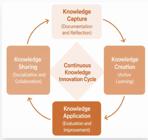
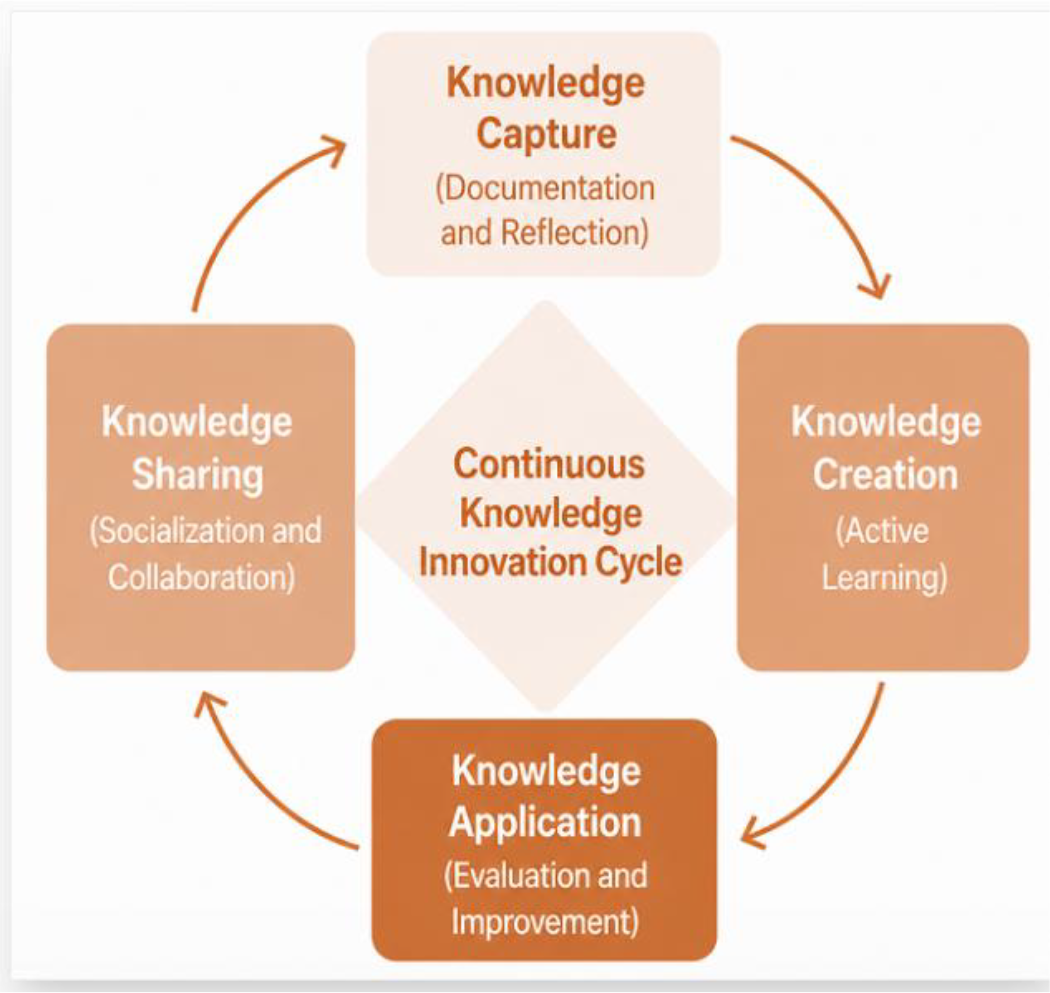
The figure below illustrates the proposed model. It depicts a cycle in which knowledge creation through active learning drives knowledge capture, sharing, and application. Arrows indicate the cyclical flow and feedback loops between these phases. The model integrates SECI processes into higher education by clarifying the correspondence between active learning stages and Nonaka and Takeuchi's (1995) phases of knowledge conversion: socialization through collaborative student activities; externalization through articulating ideas in discussions and academic work; combination through organizing and integrating content; and internalization through applying knowledge. Thus, active learning energizes and sustains this cycle of knowledge conversion.
The model in Figure 1 presents four sequential phases-knowledge creation (active learning), knowledge capture (documentation and reflection), knowledge sharing (socialization and collaboration), and knowledge application (evaluation and improvement)-linked in a continuous cycle of innovation.
4.3 Implementation Considerations
The considerations for implementing the model were derived from the final stage of the Soft Systems Methodology (SSM), which focuses on identifying feasible and desirable changes within an analyzed context. The findings of the literature review and the empirical insights from the dissertation on which this study is based complement this stage, enabling the identification of the institutional, organizational, and cultural conditions necessary for the model’s implementation. Thus, implementing the cross-cutting model requires strategic planning, stakeholder engagement, and continuous adaptation.
-
1. Policy Alignment: Institutional policies should acknowledge that knowledge generated through teaching and learning is valuable intellectual capital. Policies should encourage open access and data sharing, as well as the ethical use of student work.
-
2. Infrastructure: Institutions should invest in repositories and collaborative platforms that support capturing and sharing knowledge. This infrastructure should integrate with learning management systems (LMS) and existing administrative systems to avoid duplication.
-
3. Training: Faculty and students need training in active learning methods, reflective practices, and knowledge documentation. Librarians and IT staff require training in metadata, indexing, and preservation.
-
4. Change Management: The transition to a knowledge-centered culture requires overcoming resistance. Leadership must communicate the vision, provide incentives, and involve stakeholders in the planning process. Highlighting early successes can build momentum.
-
5. Evaluation: Continuous monitoring using qualitative and quantitative indicators is essential to assess the effectiveness of the model. This evaluation should include student feedback, analysis of repository usage, and assessment of learning outcomes and organizational improvements.
Implementing the cross-curricular model requires translating its conceptual pillars into concrete practices. To foster knowledge creation, curricula must incorporate active learning across all subjects (Prince, 2004). Faculty development programs can teach instructors how to design collaborative projects, case studies, and problem-based activities. Learning outcomes should emphasize higher-order thinking skills such as analysis, synthesis, and evaluation. Students should be encouraged to reflect on their learning processes through journals, blogs, or portfolios (Boud and Keogh; Walker, 1985).
Institutions can develop guidelines for documenting student work to capture knowledge, including templates for project reports, reflective essays, and multimedia artifacts (Choo, 2003). Digital portfolios can aggregate artifacts across courses and semesters, providing a longitudinal view of student learning. Faculty can contribute teaching notes, lesson plans, and assessments to repositories for reuse. Libraries can curate collections of exemplary student work while ensuring compliance with copyright and privacy policies (Rowley, 2000).
Knowledge sharing can be promoted through exhibitions, symposia, and digital platforms. Communities of practice support ongoing discussions about teaching strategies and subject-specific content (Wenger, 1998). To apply knowledge, governance structures must ensure that insights from captured knowledge inform decision-making. Curriculum committees can review repository data to identify gaps and update programs. Evaluation should be continuous and participatory, involving students and faculty in defining indicators and interpreting data (Checkland and Scholes, 1990).
To evaluate the effectiveness of the cross-cutting model, institutions require metrics that capture both processes and outcomes. Possible indicators include participation metrics (e.g., the number of courses using active learning and the number of artifacts submitted to repositories); quality indicators (e.g., peer reviews and alignment with learning outcomes); impact indicators (e.g., improvements in grades and retention and evidence of knowledge reuse); cultural indicators (e.g., surveys assessing perceptions of collaboration, trust, and willingness to share); and operational indicators (e.g., system usage logs and time spent on documentation). These metrics should be interpreted both qualitatively and quantitatively, and adapted to the context. Mixed-methods approaches combining data analysis with interviews and focus groups can provide comprehensive insights (Siemens and Long, 2011).
4.4 Results and Discussion
The literature review confirms that knowledge management (KM) and active learning are based on the same constructivist and social learning theories. Both emphasize the active role individuals play in constructing knowledge through experience and social interaction. In practice, however, KM and pedagogy often operate in silos within universities. Librarians and administrators oversee repositories and knowledge flows, while educators concentrate on curricula and teaching methods.
The proposed model seeks to bridge these gaps by integrating processes across organizational boundaries. One finding from the thesis data is that although faculty members recognize the importance of capturing and sharing knowledge, they lack the time and incentives to do so. Many faculty members assign group projects and problem-based tasks, yet they do not systematically collect or disseminate the results.
Students often view these projects as mere tasks to be completed rather than as contributions to a broader knowledge base. In interviews, some students expressed a desire to see examples of previous work to guide their projects, but such resources were rarely available. This underscores the necessity of establishing repositories and supportive policies. Another finding is that active learning fosters the sharing of tacit knowledge. During group discussions, students share experiences and strategies that aren't written in textbooks.
Instructors noted that peer explanations often resonate more than those provided by the instructor. However, without recording these interactions, knowledge remains fleeting. Institutions can encourage students to keep reflective journals or produce summary reports that capture their learning processes. Digital portfolios can store artifacts from various disciplines and demonstrate students' development.
The proposed model offers several potential benefits. First, it enhances institutional memory by capturing the various perspectives and results of learning activities. Second, it supports evidence-based decision-making. Administrators can analyze data from these repositories to identify effective teaching strategies, common challenges, and opportunities to improve the curriculum. Third, the model fosters a culture of collaboration and continuous improvement. When students see their work valued and reused, they are more likely to invest effort and engage in reflective practices. Fourth, it aligns with open science and open education initiatives by promoting transparency and knowledge sharing.
However, challenges remain, including ensuring the quality and relevance of captured knowledge, protecting intellectual property and privacy, and providing sufficient support for participants. There is a risk of overburdening teachers and students with documentation tasks, so processes must be simplified and integrated into existing workflows. Another challenge is maintaining engagement after the initial enthusiasm wanes. Gamification, recognition, and integration into assessment can help sustain participation.
5 CONCLUSION
This article proposes an integrated approach to knowledge management and active learning in higher education. Through a review of knowledge management theories and active learning methodologies, and a synthesis of insights from a doctoral dissertation on the topic, the article proposes a model that connects the creation, capture, sharing, and application of knowledge. The model is based on the SECI framework, which emphasizes the conversion between tacit and explicit knowledge, as well as on active learning strategies that empower students as co-creators of knowledge.
The main contributions of this study are:
-
• (1) the conceptual integration of GC and pedagogy, highlighting synergies between social learning and knowledge processes;
-
• (2) a practical framework with four pillars and associated processes; and
-
• (3) a discussion of implementation considerations and potential benefits. Although the model has not yet been fully implemented, it offers a roadmap for institutions seeking to leverage their intellectual capital to improve learning and organizational effectiveness.
Future research should empirically test the model in various contexts by examining variables such as institutional size, culture, and disciplinary differences. Studies may use action research, design-based research, or case studies to evaluate impacts on learning outcomes, knowledge-sharing behaviors, and organizational performance. Additionally, further work is needed to develop metrics and tools to evaluate knowledge capture and utilization in educational settings.
Ultimately, integrating knowledge management and active learning is essential for universities aspiring to become learning organizations that contribute to sustainable development. Recognizing students and faculty as co-creators of knowledge and institutionalizing the capture and reuse of learning artifacts can help universities build resilient knowledge ecosystems that adapt to changing social needs and technological advances.
-
Funding:
This study was funded by the São Paulo Research Foundation (FAPESP) - Grant No.: 2025/22206-7
-
Ethical approval:
Not applicable.
-
Article submitted to the similarity system
-
Declaration of AI tool use:
I declare that no Artificial Intelligence tools were used in the preparation of this manuscript.
-
Image:
Retrieved from the Lattes platform.
-
Translation:
S. Iacovacci Translation Service.
-
JITA:
FJ. Knowledge management
-
SDG:
4. Quality education
Availability of data and materials:
Not applicable.
References
-
ABREU, José Ricardo Pinto. Contexto atual do ensino médico: metodologias tradicionais e ativas: necessidades pedagógicas dos professores e da estrutura da escola. 2009. Dissertação (Mestrado em Ciências da Saúde) - Universidade Federal do Rio Grande do Sul, Porto Alegre, RS. Disponível em: https://lume.ufrgs.br/bitstream/handle/10183/18510/000729487.pdf Acesso em: 13 out. 2025.
» https://lume.ufrgs.br/bitstream/handle/10183/18510/000729487.pdf -
ALAVI, Maryam; LEIDNER, Dorothy E. Knowledge management and knowledge management systems: conceptual foundations and research issues. MIS Quarterly, Minneapolis, v. 25, n. 1, p. 107-136, 2001. Disponível em: https://doi.org/10.2307/3250961
» https://doi.org/10.2307/3250961 - ANTUNES, Celso. Professores e professores: reflexões sobre uma aula e práticas pedagógicas diversas. Petrópolis, RJ: Vozes, 2014.
- BISHOP, Jacob Lowell; VERLEGER, Matthew A. The flipped classroom: a survey of the research. In: AMERICAN SOCIETY FOR ENGINEERING EDUCATION ANNUAL CONFERENCE, 120., 2013, Atlanta. Anais [...] Washington, DC: ASEE, 2013.
- BOUD, David; KEOGH, Rosemary; WALKER, David. Promoting reflection in learning: a model. In: BOUD, David; KEOGH, Rosemary; WALKER, David. Reflection: turning experience into learning. London: Routledge, 1985. p. 18-40.
- BRINGLE, Robert G.; HATCHER, Julie A. Implementing service-learning in higher education. Journal of Higher Education, Columbus, v. 67, p. 221-239, 1996.
- CHECKLAND, Peter; SCHOLES, Jim. Soft systems methodology in action Chichester: John Wiley & Sons, 1990.
- CHOO, Chun Wei. The knowing organization New York: Oxford University Press, 1998.
- CHOO, Chun Wei. Information management for the intelligent organization 3. ed. Medford, NJ: Information Today, 2003.
- DALKIR, Kimiz. Knowledge management in theory and practice 2. ed. Cambridge, MA: MIT Press, 2011.
- DAVENPORT, Thomas H.; PRUSAK, Laurence. Working knowledge Boston: Harvard Business School Press, 1998.
- DETERDING, Sebastian et al. From game design elements to gamefulness. In: INTERNATIONAL ACADEMIC MINDTREK CONFERENCE, 15., 2011. Anais [...] New York: ACM, 2011. p. 9-15.
- EDVINSSON, Leif; MALONE, Michael. Intellectual capital New York: Harper Business, 1997.
-
FREEMAN, Scott et al. Active learning increases student performance in science, engineering, and mathematics. Proceedings of the National Academy of Sciences, Washington, DC, v. 111, n. 23, p. 8410-8415, 2014. Disponível em: https://doi.org/10.1073/pnas.1319030111
» https://doi.org/10.1073/pnas.1319030111 - HANSEN, Morten T.; NOHRIA, Nitin; TIERNEY, Thomas. What’s your strategy for managing knowledge? Harvard Business Review, Boston, v. 77, n. 2, p. 106-116, 1999.
- HAYES, Niall; WALSHAM, Geoff. Knowledge sharing and ICTs. In: EASTERBY-SMITH, Mark; LYLES, Marjorie A. The Blackwell handbook of organizational learning and knowledge management Malden, MA: Blackwell, 2003. p. 54-77.
- HERREID, Clyde Freeman. Start with a story Arlington, VA: NSTA Press, 2007.
- HOUNSELL, Marcelo da Silva; GASPARINI, Isabela. Colaboração e cooperação. Revista Produção Online, Florianópolis, v. 7, n. 3, p. 1-15, 2007.
- KNIGHT, Jennifer K.; WOOD, William B. Teaching more by lecturing less. Cell Biology Education, Bethesda, v. 4, n. 4, p. 298-310, 2005.
- KIILI, Kristian. Digital game-based learning. The Internet and Higher Education, Amsterdam, v. 8, n. 1, p. 13-24, 2005.
- KOLB, David A. Experiential learning Englewood Cliffs, NJ: Prentice-Hall, 1984.
- MADHAVAN, Ravindranath; GROVER, Rajiv. From embedded knowledge to embodied knowledge. Journal of Marketing, Chicago, v. 62, p. 1-12, 1998.
- MARCH, James G. Exploration and exploitation in organizational learning. Organization Science, Hanover, v. 2, n. 1, p. 71-87, 1991.
- MARTYN, Margie. Clickers in the classroom. EDUCAUSE Quarterly, Boulder, v. 30, n. 2, p. 71-74, 2007.
- MAZUR, Eric. Peer instruction Upper Saddle River, NJ: Prentice Hall, 1997.
- MCINERNEY, Claire; ROBERTS, Tim S. Collaborative or cooperative learning. In: ROBERTS, Tim S. Online collaborative learning Hershey, PA: Idea Group Publishing, 2004.
- MERGENDOLLER, John R.; MAXWELL, Nan L.; BELLISIMO, Yolanda. The effectiveness of problem-based instruction. Journal of Educational Research, London, v. 99, n. 6, p. 333-345, 2006.
- MORAN, José. Metodologias ativas para uma educação inovadora São Paulo: Papirus, 2015.
- MOSER, Paul K.; MULDER, Dwayne H.; TROUT, J. D. A teoria do conhecimento São Paulo: WMF Martins Fontes, 2008.
- MOTA, Francisco; ROSA, Adriano. Gestão do conhecimento e inovação em instituições de ensino superior Porto Alegre: Poisson, 2018.
- NONAKA, Ikujiro; TAKEUCHI, Hirotaka. The knowledge-creating company New York: Oxford University Press, 1995.
- OAKLEY, Barbara et al Turning student groups into effective teams. Journal of Student Centered Learning, Stillwater, v. 2, n. 1, p. 9-34, 2004.
- PARO, Vitor Henrique. Gestão democrática da escola pública São Paulo: Cortez, 2012.
- POLANYI, Michael. The tacit dimension London: Routledge, 1966.
- PRINCE, Michael. Does active learning work? Journal of Engineering Education, Washington, DC, v. 93, n. 3, p. 223-231, 2004.
- ROWLEY, Jennifer. From learning organization to knowledge entrepreneur. Journal of Knowledge Management, Bingley, v. 4, n. 1, p. 7-15, 2000.
- SENGE, Peter M. The fifth discipline New York: Doubleday, 1990.
- SIEMENS, George; LONG, Phillip. Penetrating the fog. EDUCAUSE Review, Boulder, v. 46, n. 5, p. 30-40, 2011.
- STEWART, Thomas A. Intellectual capital New York: Doubleday, 1997.
- VALENTIM, Marta Lígia Pomim. Gestão da informação e gestão do conhecimento Londrina: Infohome, 2004.
- WIEMAN, Carl E.; ADAMS, Wendy K.; PERKINS, Katherine K. PhET. Science, Washington, DC, v. 322, n. 5902, p. 682-683, 2008.
- WENGER, Etienne. Communities of practice Cambridge: Cambridge University Press, 1998.
- WIIG, Karl M. Knowledge management foundations Arlington, TX: Schema Press, 1993.
-
KEBEDE, Gashaw. Knowledge management: an information science perspective. International Journal of Information Management, Amsterdam, v. 30, n. 5, p. 416-424, 2010. Disponível em: https://doi.org/10.1016/j.ijinfomgt.2010.02.004
» https://doi.org/10.1016/j.ijinfomgt.2010.02.004
Edited by
-
Editor:
Gildenir Carolino Santos https://orcid.org/0000-0002-4375-6815

 Source: Prepared by the authors (2026).