 Exploring the Integration of Sustainability and Digital Transformation as an Organizational Strategy: A Systematic Literature Review and Guidance for Future Research
ABSTRACT
Purpose Digital Transformation (DT) and sustainability have attracted significant interest from researchers and professionals, sparking debates about their interaction. However, the literature still lacks a comprehensive analysis of this connection. This study examines the relationship between DT and sustainability, aiming to fill this gap and provide a holistic view of these interactions.
Design/methodology/approach A Systematic Literature Review (SLR) was conducted based on the protocol of Tranfield, Denyer, and Smart (2003), analyzing academic studies that discuss the interaction between DT and sustainability.
Findings The results highlight that DT is crucial in advancing corporate sustainability goals by streamlining administrative processes, enhancing efficiency, boosting competitiveness, and driving innovation.
Originality/value This study offers a comprehensive analysis of the interaction between DT and sustainability, proposes a future research agenda, and provides valuable insights for companies and researchers interested in exploring these synergies.
Keywords
Sustainability; Digital Transformation; Organizational Strategy; Systematic Literature Review
RESUMO
Finalidade A transformação digital e a sustentabilidade têm despertado grande interesse entre pesquisadores e profissionais, gerando debates sobre sua interação. No entanto, a literatura ainda carece de uma análise abrangente sobre essa conexão. Este estudo examina as relações entre transformação digital e sustentabilidade, buscando preencher essa lacuna e oferecer uma visão holística dessas interações.
Desenho/metodologia/abordagem Realizou-se uma Revisão Sistemática da Literatura (RSL) baseada no protocolo de Tranfield, Denyer e Smart (2003), analisando estudos acadêmicos que discutem a interação entre transformação digital e sustentabilidade.
Resultados Os resultados evidenciam que a transformação digital desempenha um papel crucial no avanço dos objetivos de sustentabilidade empresarial, simplificando processos administrativos, promovendo eficiência, aumentando a competitividade e impulsionando a inovação.
Originalidade/valor Este estudo oferece uma análise abrangente da interação entre transformação digital e sustentabilidade, propondo uma agenda de pesquisa futura e fornecendo insights relevantes para empresas e pesquisadores interessados em explorar essas sinergias.
Palavras-chave
Sustentabilidade; Transformação Digital; Estratégia Organizacional; Revisão Sistemática da Literatura
1 INTRODUCTION
In recent decades, digital transformation (DT) has gained increasing attention from researchers and practitioners (Gonçalves et al., 2023; Truong, 2022). While professionals explore its applications in business, academia seeks to deepen the theoretical understanding of DT by investigating its intersections with management, open innovation, and sustainability (Robertson & Lapina, 2023).
With the rapid advancement of information technology (IT), society and the economy are increasingly shaped by digital technologies, such as big data, artificial intelligence (AI), and cloud computing (Ji et al., 2023). DT represents the organizational and societal shift driven by these technologies, including the Internet of Things (IoT), blockchain, and others (Vial, 2019). It enables new forms of value creation and business logic (Gonçalves et al. 2023; Gong & Ribiere, 2021).
At the same time, organizations and researchers seek effective approaches to achieving sustainability (Barros et al., 2025; El Hilali et al., 2020), which is understood as the integration of economic, environmental, and social development to ensure present well-being without compromising future generations (Baumgartner & Rauter, 2017; Ghobakhloo, 2020; Guandalini, 2022). Despite long-standing discussions about resource exploitation and sustainable development, challenges such as population growth, resource scarcity, and public pressure reinforce the urgency of these issues (Fontoura et al., 2025; Leite & Hourneaux, 2024; Robertsone & Lapina, 2023).
The relationship between DT and sustainability has sparked debates in the literature, revealing both potential synergies and tensions (Truong, 2022). Despite this growing interest, few studies have explored this interaction in an integrated and systematic way (El Hilali et al., 2020; Truong, 2022). This gap motivates the present study, which aims to provide a comprehensive understanding of how DT relates to sustainability in the academic literature.
Based on a Systematic Literature Review (SLR), this research answers the following question: What are the relationships between DT and sustainability evidenced by the academic literature? The study pursues three specific objectives: (1) to identify associations between DT and sustainability; (2) to examine how DT can be a strategic tool for sustainability; and (3) to propose a future research agenda.
The article is structured into seven sections: the introduction contextualizes the topic and presents the research question (RQ) and objectives; the second section presents the theoretical foundation; the third details the methodology; the fourth presents the bibliometric analysis; the fifth discusses the content analysis of the results; the sixth proposes a future research agenda; and the seventh provides final considerations and implications.
2 SUSTAINABILITY AND DIGITAL TRANSFORMATION
Sustainability has gained increasing relevance in response to the negative impacts of human activity on the environment and on quality of life (Barros et al., 2025; Bocken & Geradts, 2020; Leite & Hourneaux, 2024). It involves the integration of economic development, environmental preservation, and social justice, ensuring that the needs of current generations do not compromise those of future ones (Avesani, 2020).
In the business context, adopting sustainable practices has become essential, encompassing resource efficiency, use of recyclable materials, and social responsibility (Lüdeke-Freund et al., 2018; Ritala et al., 2018). These practices also demand innovation, driving the need for new technologies and business models that reduce environmental impact (Bocken & Geradts, 2020).
In this scenario, DT emerges as a strategic tool to improve the efficiency and transparency of administrative processes (Senyo, Effah, & Osabutey, 2021). DT modifies traditional management and production processes (Llopis-Albert, Rubio, & Valero, 2021), requiring constant adaptation in a rapidly evolving digital landscape. It also offers opportunities for innovation, enhanced customer relationships, and competitiveness (Fernández-Rovira et al., 2021; Liu et al., 2023).
Technologies such as AI, IoT, Big Data, and cloud computing improve the quality and efficiency of products and services (Gonçalves et al. 2023; Zhuo & Chen, 2023). They also revolutionize customer interaction and support new business models and personalized experiences (Gonçalves et al. 2023; Zhang, Xu & Ma, 2023).
The synergy between DT and sustainability becomes evident as digital tools support the implementation of sustainable practices (Camodeca & Almici, 2021), reduce environmental impact, and contribute to the development of more efficient and responsible business models (Liu et al., 2023). For example, in supply chain management, digitalization enables better data collection and analysis, leading to more sustainable decision-making (Hassanin & Hamada, 2022).
Moreover, DT is seen as an ambidextrous innovation, capable of driving a positive relationship between digitalization and sustainability (Ying & Jin, 2023). However, realizing its long-term benefits depends on effective and continuous management of the implementation of this technology (Huy & Phuc, 2023; Ying & Jin, 2023).
3 METHOD
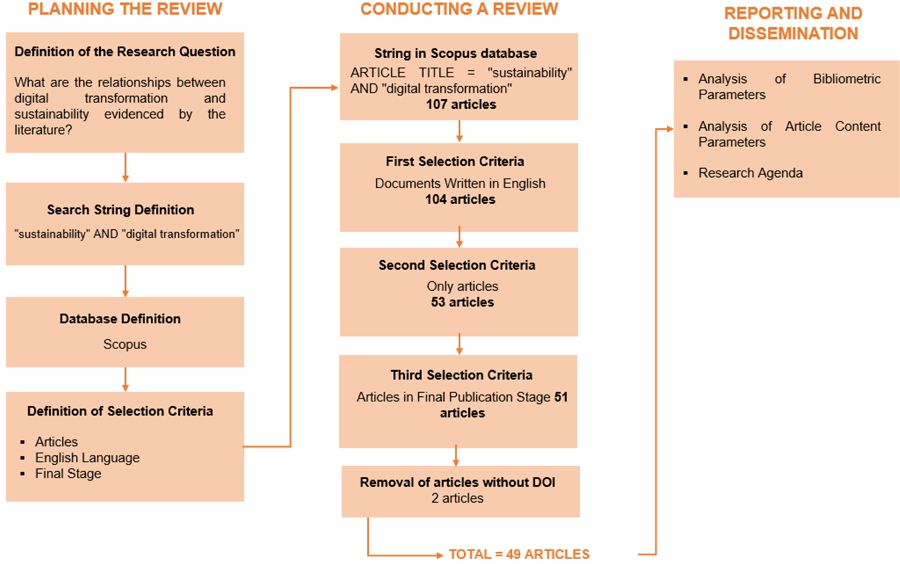
Tranfield, Denyer, and Smart (2003) developed an innovative methodology for the conduction of SLRs through a rigorous process designed to synthesize and support the critical analysis of literature, primarily in the fields of management and business. Their method ensures that “all stages of the review are documented systematically, but without imposing rigid structures incompatible with qualitative research” (Saunders, Lewis, & Thornhill, 2015, p. 450). According to Adams, Smart, and Huff (2017), the SLR approach proposed by Tranfield, Denyer, and Smart (2003) is particularly valuable for the identification of theoretical trends within a field of study, mapping contradictions and gaps in the existing literature, as well as proposing new research directions based on critical synthesis. The protocol is shown in Figure 1.
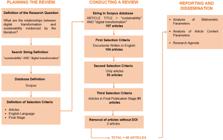
The RQ that guided this review was: What are the relationships between DT and sustainability evidenced by the academic literature? To address this question, a search string using the “AND” connector was applied to identify studies that addressed both terms simultaneously. The Scopus database was selected for this review due to its wide interdisciplinary coverage, particularly in social sciences, business, and management, and its inclusion of reputable journals (Baas et al., 2020; Harzing & Alakangas, 2016; Gusenbauer & Haddaway, 2020; Paul et al., 2021). It indexes more journals than WoS, including a broader range of international and open access outlets (Bakkalbasi et al., 2006; Falagas et al., 2008). Moreover, unlike Google Scholar, it provides integrated bibliometric tools, avoids predatory journals, and ensures more consistent search results (Burnham, 2006; Paul et al., 2021).
The initial search yielded 107 articles. Then, selection criteria were applied to identify the most relevant studies. Only articles written in English, published in peer-reviewed journals, and available in their final version were included. No temporal delimitation was established, since this review aims to examine the relationships evidenced in the literature over the entire available time span. After applying these criteria, 51 articles remained.
As an exclusion criterion, two articles without Digital Object Identifiers (DOI) were removed, resulting in a final corpus of 49 articles. Bibliometric analysis was performed using the Bibliometrix tool, part of the R package (Aria & Cuccurullo, 2017), while content analysis was carried out using the VOSviewer software, which allows for the creation and exploration of maps based on network data (Arruda et al., 2022).
4 DESCRIPTIVE ANALYSIS OF THE RESEARCH CORPUS
This section presents bibliometric indicators of the research corpus, with data on publication volume, authorship, citations, and trends shown in Figure 2.
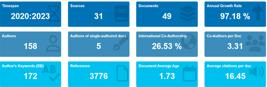
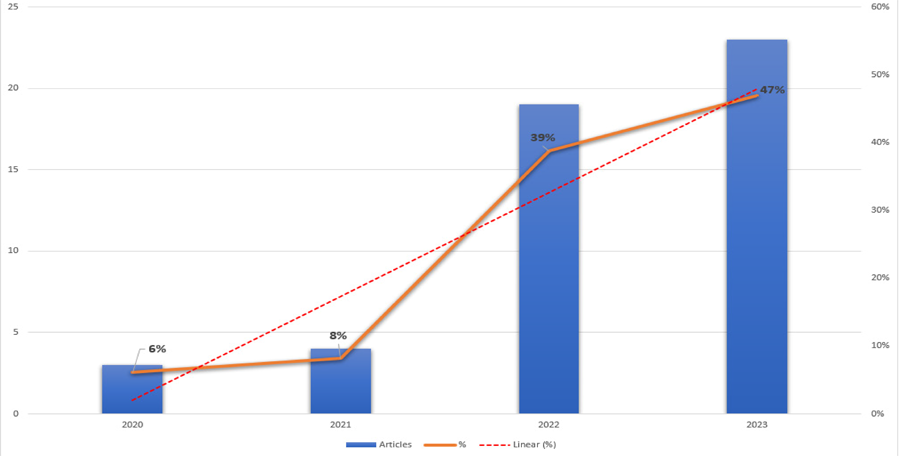
The sample period covers publications from 2020 to 2023, encompassing 31 journals and 49 scientific articles. The data reveals an average annual growth rate of 97.18% in publications, indicating rising academic interest in the intersection between DT and sustainability. The corpus includes 158 authors, 5 of whom are sole authors. International co-authorship represents 26.53% of the sample, and the average number of co-authors per document is 3.31. The final database includes 172 keywords and 3776 cited references, resulting in an average of 1.73 documents per year and 16.45 citations per document. This reflects not only the quantitative growth of the field but also its increasing academic relevance.
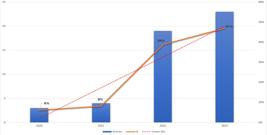
The annual distribution of publications (Figure 3) shows a steady pattern between 2020 and 2021, followed by a sharp increase in 2022—which accounts for 39% of the studies, including contributions from Díaz & Montalvo (2022) and Nadkarni & Haider (2022). The upward trend continues in 2023, with recent works such as Ying & Jin (2023) and Yang et al. (2023), representing 47% of the publications. The trend line in red reinforces the growing relevance of DT and sustainability in the academic literature. Thus, it is evident that the scientific production related to the themes of DT and Sustainability presents a growth in the literature, highlighting the contemporary relevance of these topics.
5 CONTENT ANALYSIS OF THE RESEARCH CORPUS
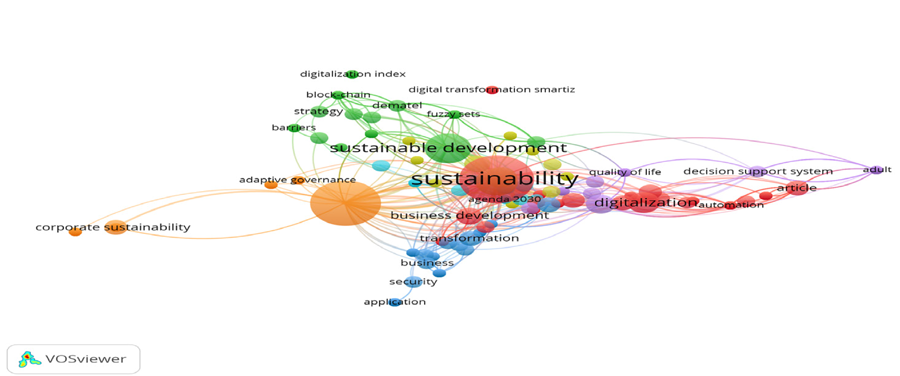
The content analysis of the research corpus was guided by the identification of clusters based on keyword co-occurrence and document citation patterns. This analytical strategy enabled the visualization of thematic connections and emerging research streams in the field. As illustrated in Figure 4, seven clusters of frequently occurring keywords were identified. Each cluster groups terms that share semantic and thematic proximity, revealing dominant conceptual axes that structure the intersection between DT and sustainability. The most prominent keywords in each cluster are:

Cluster 1 (Red – 83 items): The largest and most central cluster, it integrates themes such as “sustainability”, “digitalization”, and “article”. This concentration suggests a strong academic orientation, with studies focused on conceptual discussions and literature-based frameworks that position DT as integral to sustainability discourse.
Cluster 2 (Green – 50 items): Focused on applied approaches, this cluster emphasizes operational practices like “circular economy” and “supply chain management” within the broader theme of “sustainable development”. It reflects efforts to integrate sustainability into business logistics and production systems, supported by digital tools, such as IoT and blockchain, to enhance efficiency and traceability.
Cluster 3 (Dark Blue – 45 items): It centers on technological infrastructure with keywords like “information technology”, “transformation”, and “business”. It reflects studies on how information technology affects organizational performance, decision-making, and strategic positioning, particularly through the transformation of business models.
Cluster 4 (Yellow – 43 items): Focused on “small and medium-sized enterprises” (SMEs), it reflects interest in the unique barriers and opportunities these firms face in adopting digital and sustainable practices. Its peripheral position in the network suggests a still-fragmented subfield with limited integration into broader strategic discussions.
Cluster 5 (Lilac – 41 items): It adds technical and regional dimensions, with keywords such as “decision support system”, “digital environment”, and “China”. These studies examine data-driven approaches to sustainability, often tied to public planning, policy implementation, and national development initiatives. The notion of a “digital environment” reflects the infrastructural and systemic conditions that support such applications.
Cluster 6 (Light Blue – 35 items): It aligns with institutional and global frameworks. Keywords like “digital technologies”, the “2030 Agenda”, and “digital business” reflect how digital technologies are embedded into business operations and strategies that respond to international sustainability goals.
Cluster 7 (Orange – 33 items): It emphasizes governance and organizational transformation. Terms such as “business model”, “digital transformation”, and “adaptive governance” reveal how firms are rethinking internal structures to integrate digital technologies in response to sustainability imperatives.
Taken together, the clusters reveal a progression from conceptual intersections (Cluster 1) to sector-specific applications (Clusters 2 and 4), strategic and technological enablers (Clusters 3 and 7), and broader institutional frameworks (Clusters 5 and 6), indicating a maturing field moving toward integrative, system-level analyses.
The strong thematic linkage between Clusters 1, 2, 3, and 7 suggest convergence around the strategic role of DT in enabling sustainability. In contrast, the peripheral positioning of Clusters 4 and 5 highlights the fragmented attention to SMEs and national contexts, reinforcing the need for cross-disciplinary integration and more unified frameworks capable of bridging these fragmented subfields.
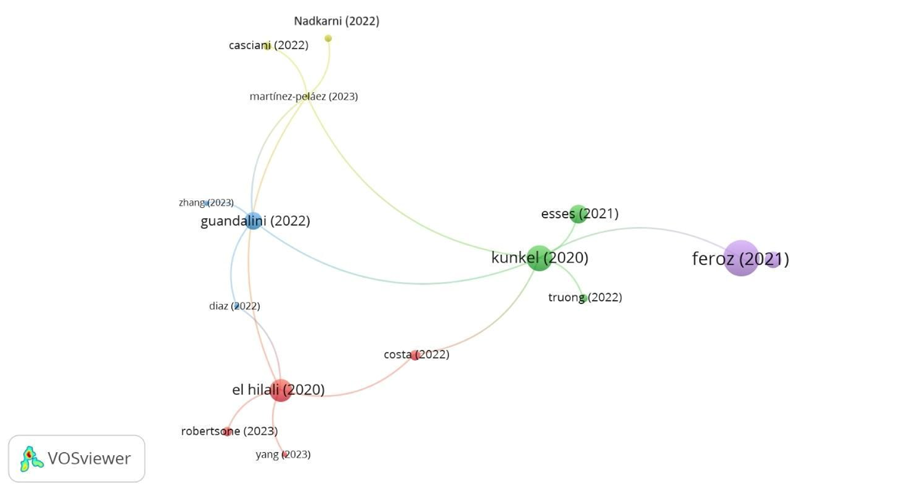
Figure 5 shows the citation clusters, mapping the intellectual organization of research on DT and sustainability. Unlike keyword co-occurrence, which captures thematic proximities, citation clusters reveal epistemological and methodological affinities between authors. The five main clusters highlight diverse perspectives and research foci. The citation network shows a central convergence around DT’s strategic role in advancing sustainable development, though emphases differ. Studies such as Guandalini (2022) and Robertson and Lapiņa (2023) address this alignment conceptually and systemically, viewing DT as a catalyst for sustainable innovation and organizational change. Conversely, works like El Hilali et al. (2020) and Diaz and Montalvo (2022) provide sectoral and corporate evidence in which sustainability gains arise indirectly through digitalization processes.
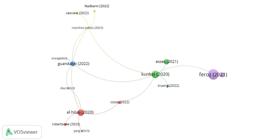
Theoretical orientations also diverge. One line of research (e.g., Ying & Jin, 2023; Zhang & Jin, 2023) adopts an instrumental–progressive lens, framing DT as an inherent enabler of sustainability, often mediated by factors such as innovation ambidexterity, workforce skills, or governance. Another line (e.g., Yang et al., 2023; Costa et al., 2022) follows a contingency-based view, emphasizing that DT’s sustainability impact depends on institutional settings, virtual agglomerations, regional capabilities, and long-term strategic alignment. This contrast reflects two paradigms: one assuming natural synergy between DT and sustainability, and another cautioning that technological advances alone cannot deliver sustainability without supportive institutional and systemic conditions.
Cross-cluster connections emerge most clearly between conceptual–systemic works (e.g., Clusters 1 and 3) and sectoral–empirical studies (e.g., Clusters 2 and 4), with Cluster 5 acting as a bridge through its focus on institutional and regional contexts. However, integration remains partial, especially when it comes to linking governance insights with concrete operational practices. This indicates that theoretical advances have yet to fully translate into cohesive frameworks connecting different levels of analysis. Bridging this gap will require future studies in order to align macro-level policy perspectives with the realities of organizational transformation, ensuring that DT–sustainability synergies are effectively achieved in practice.
Despite such differences, the clusters offer complementary insights, revealing an evolution from fragmented, sector-specific findings toward integrative frameworks with policy and managerial relevance, in which empirical, conceptual, and critical perspectives interact, sometimes reinforcing and sometimes challenging each other. Building on the cluster analysis, we mapped the objectives and main contributions of the most representative articles in each group. This mapping demonstrates how different lines of research address the relationship between DT and sustainability. Table 1 presents this synthesis.
Cluster 1 (Red) brings together studies that conceptually and empirically examine the strategic role of DT in enabling sustainability. These contributions converge in showing that DT, when combined with organizational capabilities and strategic alignment, actuates systemic changes in business models, resource efficiency, and innovation practices. El Hilali et al. (2020) propose three key drivers for achieving sustainability in the digital era: adopting customer centricity, strengthening data analytics capabilities, and embedding innovation into business model design.
Costa et al. (2022) find that IoT and Big Data & Analytics consistently contribute to sustainability outcomes, while AI’s impact varies. They stress that, especially in emerging economies, achieving the Sustainable Development Goals (SDGs) requires developing both technological and managerial capabilities. Robertsone and Lapina (2023) highlight DT’s role in boosting resource efficiency, reducing waste, and enabling innovative models, such as the circular economy and cross-industry collaboration, allowing faster responses to ever-changing demands. Yang et al. (2023) show that DT enhances efficiency, decision-making, and innovation in socially and environmentally responsible ways, with regional virtual agglomeration mitigating early-stage challenges such as costs and resistance.
Overall, the cluster frames DT as a strategic driver of sustainability, in which technological adoption aligns with organizational capabilities. Customer centricity, data analytics, and business model innovation (El Hilali et al., 2020; Yang et al., 2023) intersect with IoT and Big Data & Analytics (Costa et al., 2022), as well as with macro-level enablers such as governance structures and cross-industry collaboration (Robertsone & Lapina, 2023). These perspectives emphasize that DT’s sustainability impact relies on the integration of digital tools with strategic, managerial, and institutional conditions that support lasting transformation.
Cluster 2 (Green) addresses the intersection of DT with policy frameworks, economic performance, and environmental sustainability. Kunkel & Matthews (2020) examine national ICT-related policies, noting that, while they emphasize indirect benefits, such as improved energy efficiency and resource management, they often overlook direct negative impacts like high energy consumption. Esses et al. (2021) show a positive correlation between digitalization and components of sustainable development, with higher DT levels linked to greater competitiveness, innovation, entrepreneurship, and GDP.
Truong (2022) highlights both environmental risks of DT, such as resource depletion and emissions, and its potential to mitigate them through technologies like AI, Big Data, IoT, and blockchain. Overall, the cluster shows that national ICT policies (Kunkel & Matthews, 2020) observed correlations between digitalization and socio-economic performance (Esses et al., 2021). Moreover, the dual environmental risks and mitigation potential of advanced technologies (Truong, 2022) converge in showing that DT plays a multifaceted role in sustainability, posing direct environmental challenges while offering powerful tools for systemic change.
Cluster 3 (Dark Blue) explores the organizational and operational pathways through which DT supports sustainability, emphasizing the integration of advanced technologies, strategic management, and workforce capabilities. Guandalini (2022) positions DT as a strategic driver by embedding big data, IoT, and ICT into business models, stressing the need for stronger organizational engagement and closer academia-industry collaboration to align digital strategies with sustainable development.
Zhang & Jin (2023) show that DT improves resource allocation, productivity, and business model transformation, generating sustainable competitive advantages when supported by skilled management, educated employees, and robust internal controls that mitigate risks and foster effective implementation. Díaz & Montalvo (2022) document how leading Mexican firms use AI, big data, cloud computing, biometrics, and e-commerce to boost efficiency, reduce paper use, optimize processes, promote digital inclusion, and align operations with multiple SDGs.
Collectively, the studies emphasize DT’s potential to deliver sustainability gains through the synergy of technological integration, managerial competence, and operational efficiency. Internal facilitators, such as skilled leadership, workforce expertise, and governance mechanisms (Zhang & Jin, 2023), intersect with the deployment of advanced digital tools across business models (Guandalini, 2022) and practical applications aligned with the SDGs (Díaz & Montalvo, 2022). Together, they show that DT’s contribution to sustainability depends not only on technology adoption but also on the strategic, human, and institutional capacities that ensure its effective and responsible implementation.
Cluster 4 explores how DT addresses sector-specific sustainability challenges in high-impact industries, including fashion, SMEs, and hospitality. Casciani et al. (2022) examine the fashion industry, showing how DT fosters sustainability through dematerialization, process optimization, and cultural change across supply chains. The study highlights cultural sustainability as a critical dimension, with 3DVD technologies reshaping design practices, promoting open knowledge and diversity, and driving organizational shifts that support long-term transformation in a sector with high environmental and social impacts.
Martínez-Peláez et al. (2023) focus on SMEs, identifying three priorities for sustainable DT: fostering a sustainability-oriented culture, engaging stakeholders as drivers of innovation, and leveraging big data for disruptive, informed decision-making. Combined with strong managerial capabilities, these elements are critical for lasting outcomes. Nadkarni & Haider (2022) analyze the UAE hospitality sector during COVID-19, showing how DT, sustainability, and operational efficiency drove innovation, resilience, and competitive advantage in a pandemic scenario, where operational restrictions, changes in consumer behavior, and economic challenges required organizations to adapt rapidly and strategically. They emphasize the role of proactive government policies in fostering digital innovation and sustainable practices during disruption.
Overall, the cluster shows that DT’s sectoral applications deliver sustainability gains when supported by context-specific facilitators, such as cultural transformation and supply chain redesign in fashion (Casciani et al., 2022), stakeholder engagement and data-driven decision-making in SMEs (Martínez-Peláez et al., 2023), the importance of DT and sustainability in a pandemic scenario, and the role of supportive policy frameworks (Nadkarni & Haider, 2022). These studies emphasize that lasting transformation depends on aligning digital tools with organizational culture, stakeholder ecosystems, and institutional support to meet each sector’s sustainability challenges.
Cluster 5 (Lilac) centers on the role of digital technologies in addressing environmental sustainability challenges, with a particular emphasis on decision-support systems and the digital environment. Feroz et al. (2021) identify four domains where DT is fostering significant change: pollution control, waste management, sustainable production, and urban sustainability. They show how IoT, cloud computing, and social media enable real-time monitoring, predictive analytics, and stakeholder engagement, transforming practices in sectors such as agriculture, food waste reduction, and environmental management.
Taken together, the clusters reveal a multifaceted research landscape in which DT is positioned as both a strategic driver and a facilitator of sustainability. Across the corpus, sustainability outcomes depend not merely on the adoption of digital tools, but on their integration with organizational capabilities, managerial competencies, stakeholder engagement, and the enablement of institutional frameworks. The evidence spans from conceptual explorations of DT-sustainability links (Cluster 1) to policy and economic perspectives (Cluster 2), strategic management and workforce capabilities (Cluster 3), sustainability challenges in environmentally high-impact sectors (Cluster 4), and decision-support systems and environmental management innovations (Cluster 5). This progression highlights a growing consensus: DT’s transformative impact is greatest when technology is strategically integrated with human and governance factors to support sustainable development.
6 FUTURE RESEARCH AGENDA
To advance the understanding of the relationship between DT and sustainability, future studies should address the theoretical, contextual, and methodological gaps identified across the literature. Building on the TCM framework (Paul et al., 2021), we propose a research agenda structured around three dimensions.
6.1 Suggestions for Future Research Based on Theory
The literature highlights the need for more robust theoretical frameworks to explain how DT enables or constrains sustainability outcomes. Current studies remain fragmented across technologies, industries, and sustainability dimensions, which limits theoretical consolidation (Guandalini, 2022). Future research could develop integrative models that explain the interplay between DT, innovation, and sustainability-oriented business models, including trade-offs between financial and environmental goals.
Another gap concerns the dual role of DT: while it generates efficiency and innovation gains, it also produces negative externalities, such as energy consumption (Kunkel & Matthews, 2020). Theoretical frameworks should, therefore, account for both enabling and constraining mechanisms of DT in sustainability transitions. Additionally, there is scope to connect DT more explicitly to the UN SDGs (Costa et al., 2022). While much of the literature emphasizes economic and environmental dimensions, the social pillar of sustainability remains underexplored (Feroz et al., 2021). Future research could investigate how DT contributes to goals such as reducing inequalities, promoting digital inclusion, and fostering decent work. Such studies would help clarify whether digitalization can advance social sustainability alongside environmental and economic objectives.
Another promising avenue is to verify how DT strategies, investments in digital technologies, and employees’ digital skills affect business performance and sustainable development (Diaz & Montalvo, 2022). This line of inquiry could illuminate the mechanisms through which digital adoption translates into both competitive advantage and long-term sustainability outcomes, offering valuable insights for managers seeking to align capability-building with broader sustainability goals. Understanding sociotechnological drivers and barriers to the DT will also provide critical insights into the systemic preconditions that must be established at the individual, corporate, interorganizational, and policy levels to anchor DT as a pathway to innovation and sustainability (Casciani et al., 2022).
Finally, further research should investigate the organizational capabilities required to embed sustainability principles into DT. This includes identifying the skills, resources, and transformation strategies that enable firms to align digitalization with sustainability objectives and enhance organizational performance (Feroz et al., 2021). Future research should also examine the role of policy and regulatory frameworks in shaping sustainable digital transitions, as national contexts influence how DT-related goals are implemented and achieved (Yang et al. 2023; Zhang & Jin, 2023). In parallel, scholars can deepen investigations into how digitalization enables the creation of sustainable business models that integrate innovation, value creation, and environmental goals (Guandalini, 2022; Feroz et al., 2021).
6.2 Context-Based Future Research Suggestions
Empirical research should broaden its scope to different organizational, sectoral, and geographical contexts. First, most studies focus on large firms or developed countries, while SMEs and organizations in emerging economies remain underexplored (El Hilal et al., 2020; Zhang & Jin, 2023). Comparative research across firm size, digital maturity, and regions could uncover context-specific pathways for sustainable digitalization. Moreover, recent work highlights the need to better understand how SMEs build critical capabilities for digital sustainability while also navigating internationalization processes (Martínez-Peláez et al., 2023). Future research could examine how multinationalization strategies interact with resource constraints, stakeholder pressures, and support mechanisms for SMEs, thereby expanding the scope of DT–sustainability studies.
Second, certain industries, such as fashion, hospitality, and manufacturing provide fertile ground to examine how DT reshapes supply chains, business models, and cultural sustainability (Casciani et al., 2022; Nadkarni & Haider, 2022). These sectors face unique challenges such as fast product cycles, resource-intensive operations, and globalized production networks. Future research could investigate how digitalization fosters transparency, circularity, and more resilient business models in these industries, while also exposing the trade-offs and unintended consequences of technology adoption.
Third, another promising avenue is to investigate how DT strategies influence sustainability practices in industries historically associated with adverse environmental impacts (Diaz & Montalvo, 2022). Understanding whether and how digital tools can mitigate, transform, or even legitimize practices in sectors such as extractive industries, chemicals, or fast fashion could provide critical insights. This line of research could also clarify the tensions between technological innovation and institutional pressures for environmental accountability.
Fourth, national and sectoral policy frameworks are critical but unevenly addressed in the literature (Kunkel & Matthews, 2020). Future studies should analyze how ICT-related sustainability policies are designed, implemented, and monitored, especially in low- and middle-income countries where industrial digitalization is still incipient. It is also recommended to conduct research that analyzes the development of technologies and businesses in emerging countries, with the aim of improving sustainability-related outcomes (Costa et al., 2022; Robertsone & Lapina, 2023). This line of research is crucial to understanding how developing countries are adopting and adapting digital technologies to promote sustainable practices in their economies.
Finally, cross-country and cross-sector comparisons could clarify how cultural, institutional, and regulatory contexts shape the DT-sustainability nexus (Guandalini, 2022; Camodeca & Almici, 2021). Such comparative approaches may reveal not only best practices but also systemic barriers that hinder the alignment between digitalization and sustainability across different contexts.
6.3 Method-Based Future Research Suggestions
Methodological limitations also open avenues for further research. Current studies are often based on quantitative surveys with limited generalizability (El Hilali et al., 2020). Greater use of qualitative and mixed methods (El Hilali et al., 2020; Díaz & Montalvo, 2022) could generate deeper insights into how digital strategies are enacted in practice and how organizational actors navigate tensions between digitalization and sustainability. Longitudinal and multi-level designs are also needed to capture the evolving impacts of DT, including short-term costs and long-term benefits.
Moreover, empirical studies should expand beyond traditional performance measures by incorporating multidimensional sustainability indicators (economic, social, and environmental) and assessing underexplored ecological impacts, such as biodiversity, land use, and resource depletion (Truong, 2022). Finally, comparative studies across firms with varying degrees of digital maturity, including experimental or quasi-experimental designs, could help establish causal links between DT adoption and sustainability outcomes (Díaz & Montalvo, 2022).
7 FINAL CONSIDERATIONS
This study confirms that DT plays a crucial role in advancing corporate sustainability goals. The bibliometric analysis demonstrates the rapid growth of research at this intersection, with an average annual increase of 97.18%, which reflects the rising relevance of the topic across academia and in practice. The global distribution of publications further underscores the international scope of these debates.
Content analysis shows that DT can enhance efficiency, competitiveness, and innovation while fostering sustainable practices across sectors. At the same time, it highlights that these outcomes depend on contextual factors such as organizational capabilities, policy frameworks, and stakeholder engagement. This reinforces the importance of adopting an integrated perspective that aligns digitalization with sustainability strategies.
Based on these findings, the study proposes a research agenda structured around theoretical, contextual, and methodological dimensions. This agenda not only advances academic debates but also provides practical guidance for managers and policymakers seeking to leverage DT as a driver of sustainable development.
As with any SLR, certain limitations should be acknowledged. First, the study focused on peer-reviewed journal articles indexed in Scopus. This choice ensures rigor, reliability, and comparability across studies, but it also excludes grey literature, such as industry reports and policy documents that could offer complementary practical insights. Second, the review relies solely on secondary data and does not provide empirical validation, emphasizing the need for future studies to test and expand these findings in organizational settings.
Despite these limitations, the study consolidates fragmented knowledge, highlights synergies and tensions between DT and sustainability, and points to promising avenues for future research. In doing so, it contributes both academically and managerially, supporting organizations and policymakers in the pursuit of sustainable digital transitions.
REFERENCES
-
Adams, R. J., Smart, P., & Huff, A. S. (2017). Shades of grey: guidelines for working with the grey literature in systematic reviews for management and organizational studies. International journal of management reviews, 19(4), 432-454. https://doi.org/10.1111/ijmr.12102
» https://doi.org/10.1111/ijmr.12102 -
Aria, M., & Cuccurullo, C. (2017). bibliometrix: An R-tool for comprehensive science mapping analysis. Journal of Informetrics, 11(4), 959-975. https://doi.org/10.1016/j.joi.2017.08.007
» https://doi.org/10.1016/j.joi.2017.08.007 -
Arruda, H., Silva, E. R., Lessa, M., Proença Jr., D., & Bartholo, R. (2022). VOSviewer and Bibliometrix. Journal of the Medical Library Association, 110(3), 392-395. https://doi.org/10.5195%2Fjmla.2022.1434
» https://doi.org/10.5195%2Fjmla.2022.1434 -
Avesani, M. (2020). Sustainability, sustainable development, and business sustainability. In Life Cycle Sustainability Assessment for Decision-Making (pp. 21-38). Elsevier. https://doi.org/10.1016/B978-0-12-818355-7.00002-6
» https://doi.org/10.1016/B978-0-12-818355-7.00002-6 -
Baas, J., Schotten, M., Plume, A., Côté, G., & Karimi, R. (2020). Scopus as a curated, high-quality bibliometric data source for academic research in quantitative science studies. Quantitative science studies, 1(1), 377-386. https://doi.org/10.1162/qss_a_00019
» https://doi.org/10.1162/qss_a_00019 -
Bakkalbasi, N., Bauer, K., Glover, J., & Wang, L. (2006). Three options for citation tracking: Google Scholar, Scopus and Web of Science. Biomedical digital libraries, 3(1), 7. https://doi.org/10.1186/1742-5581-3-7
» https://doi.org/10.1186/1742-5581-3-7 -
Barros, T. A. B. C. D., Bizerril, M. X. A., Schvartz, M. A., & Ávila, L. V. (2025). Scientific production on Environmental, Social, and Governance issues and the Sustainable Development Goals in universities. Revista de Administração da UFSM, 18(2), e2. https://doi.org/10.5902/1983465989041
» https://doi.org/10.5902/1983465989041 -
Baumgartner, R. J., & Rauter, R. (2017). Strategic perspectives of corporate sustainability management to develop a sustainable organization. Journal of Cleaner Production, 140 https://doi.org/10.1016/j.jclepro.2016.04.146
» https://doi.org/10.1016/j.jclepro.2016.04.146 -
Bocken, N. M., & Geradts, T. H. (2020). Barriers and drivers to sustainable business model innovation: Organization design and dynamic capabilities. Long range planning, 53(4), 101950. https://doi.org/10.1016/j.lrp.2019.101950
» https://doi.org/10.1016/j.lrp.2019.101950 -
Burnham, J. F. (2006). Scopus database: a review. Biomedical digital libraries, 3(1), 1. https://doi.org/10.1186/1742-5581-3-1
» https://doi.org/10.1186/1742-5581-3-1 -
Camodeca, R., & Almici, A. (2021). Digital Transformation and Convergence toward the 2030 Agenda's Sustainability Development Goals: Evidence from Italian Listed Firms. Sustainability, 13(21), 11831. https://doi.org/10.3390/su132111831
» https://doi.org/10.3390/su132111831 -
Casciani, D., Chkanikova, O., & Pal, R. (2022). Exploring the nature of digital transformation in the fashion industry: opportunities for supply chains, business models, and sustainability-oriented innovations. Sustainability: Science, Practice and Policy, 18(1), 773-795. https://doi.org/10.1080/15487733.2022.2125640
» https://doi.org/10.1080/15487733.2022.2125640 -
Costa, I., Riccotta, R., Montini, P., Stefani, E., de Souza Goes, R., Gaspar, M. A., Martins, F. S., Fernandes, A. A., Machado, C., Loçano, R., & Larieira, C. L. C. (2022). The Degree of Contribution of Digital Transformation Technology on Company Sustainability Areas. Sustainability, 14(1), 462. https://doi.org/10.3390/su14010462
» https://doi.org/10.3390/su14010462 -
Diaz, R., & Montalvo, R. (2022). Digital transformation as an enabler to become more efficient in sustainability: evidence from five leading companies in the Mexican market. Sustainability, 14(22), 15436. https://doi.org/10.3390/su142215436
» https://doi.org/10.3390/su142215436 -
El Hilali, W., El Manouar, A., & Janati Idrissi, M. A. (2020). Reaching sustainability during a digital transformation: a PLS approach. International Journal of Innovation Science, 12(1), 52-79. https://doi.org/10.1108/IJIS-08-2019-0083
» https://doi.org/10.1108/IJIS-08-2019-0083 -
Esses, D., Csete, M. S., & Németh, B. (2021). Sustainability and Digital Transformation in the Visegrad Group of Central European Countries. Sustainability, 13(11), 5833. https://doi.org/10.3390/su13115833
» https://doi.org/10.3390/su13115833 -
Falagas, ME, Pitsouni, EI, Malietzis, GA, & Pappas, G. (2008). Comparação entre PubMed, Scopus, Web of Science e Google Acadêmico: pontos fortes e fracos. Revista FASEB, 22 (2), 338-342. https://doi.org/10.1096/fj.07-9492LSF
» https://doi.org/10.1096/fj.07-9492LSF -
Fernández-Rovira, C., Valdés, J. Á., Molleví, G., & Nicolas-Sans, R. (2021). The digital transformation of business. Towards the datafication of the relationship with customers. Technological Forecasting and Social Change, 162, 120339. https://doi.org/10.1016/j.techfore.2020.120339
» https://doi.org/10.1016/j.techfore.2020.120339 -
Feroz, A. K., Zo, H., & Chiravuri, A. (2021). Digital Transformation and Environmental Sustainability: A Review and Research Agenda. Sustainability, 13(3), 1530. https://doi.org/10.3390/su13031530
» https://doi.org/10.3390/su13031530 -
Fontoura, D. G. D., Bonato, S. V., Junges, V. D. C., & Salomão, C. S. (2025). Environmental management systems: analysis of the degree of maturity of companies in the Rio Grande port complex. Revista de Administração da UFSM, 18(1), e10. https://doi.org/10.5902/1983465989619
» https://doi.org/10.5902/1983465989619 -
Ghobakhloo, M. (2020). Industry 4.0, digitization, and opportunities for sustainability. Journal of Cleaner Production, 252, 119869. https://doi.org/10.1016/j.jclepro.2019.119869
» https://doi.org/10.1016/j.jclepro.2019.119869 -
Gonçalves, C. A., Messias, C. O. D. S., Soares, J. L., & Peixoto, M. M. D. C. L. (2023). Adoption of Cloud Computing in the organizations: a bibliometric analysis of this technology within a digital transformation context. Revista de Administração da UFSM, 16(3), e1. https://doi.org/10.5902/1983465975326
» https://doi.org/10.5902/1983465975326 -
Gong, C., & Ribiere, V. (2020). Developing a unified definition of digital transformation. Technovation, 102217. https://doi.org/10.1016/j.technovation.2020.102217
» https://doi.org/10.1016/j.technovation.2020.102217 -
Guandalini, I. (2022). Sustainability through digital transformation: A systematic literature review for research guidance. Journal of Business Research, 148, 456-471. https://doi.org/10.1016/j.jbusres.2022.05.003
» https://doi.org/10.1016/j.jbusres.2022.05.003 -
Gusenbauer, M., & Haddaway, N. R. (2020). Which academic search systems are suitable for systematic reviews or meta-analyses? Evaluating retrieval qualities of Google Scholar, PubMed, and 26 other resources. Research synthesis methods, 11(2), 181-217. https://doi.org/10.1002/jrsm.1378
» https://doi.org/10.1002/jrsm.1378 -
Harzing, A.-W., & Alakangas, S. (2015). Google Scholar, Scopus and the Web of Science: a longitudinal and cross-disciplinary comparison. Scientometrics, 106(2), 787-804. https://doi.org/10.1007/s11192-015-1798-9
» https://doi.org/10.1007/s11192-015-1798-9 -
Hassanin, M. E., & Hamada, M. A. (2022). A Big Data strategy to reinforce self-sustainability for pharmaceutical companies in the digital transformation era: A case study of Egyptian pharmaceutical companies. African Journal of Science, Technology, Innovation and Development, 14(7), 1870-1882. https://doi.org/10.1080/20421338.2021.1988409
» https://doi.org/10.1080/20421338.2021.1988409 -
Huy, P. Q., & Phuc, V. K. (2023). Unfolding sustainable auditing ecosystem formation path through digitalization transformation: How digital intelligence of accountant fosters the digitalization capabilities. Heliyon, 9(2). https://doi.org/10.1016/j.heliyon.2023.e13392
» https://doi.org/10.1016/j.heliyon.2023.e13392 -
Ji, Z., Zhou, T., & Zhang, Q. (2023). The Impact of Digital Transformation on Corporate Sustainability: Evidence from Listed Companies in China. Sustainability, 15(3), 2117. https://doi.org/10.3390/su15032117
» https://doi.org/10.3390/su15032117 -
Kunkel, S., & Matthess, M. (2020). Digital transformation and environmental sustainability in industry: Putting expectations in Asian and African policies into perspective. Environmental Science & Policy, 112, 318-329. https://doi.org/10.1016/j.envsci.2020.06.022
» https://doi.org/10.1016/j.envsci.2020.06.022 -
Leite, P. F. D., & Hourneaux, F. (2024). Planetary boundaries as a way of assessing environmental performance: a methodological approach proposal. Revista de Administração da UFSM, 17(spe1), e7. https://doi.org/10.5902/1983465986895
» https://doi.org/10.5902/1983465986895 -
Liu, M., Li, H., Li, C., & Yan, Z. (2023). Digital transformation, financing constraints and enterprise performance. European Journal of Innovation Management https://doi.org/10.1108/EJIM-05-2023-0349
» https://doi.org/10.1108/EJIM-05-2023-0349 -
Llopis-Albert, C., Rubio, F., & Valero, F. (2021). Impact of digital transformation on the automotive industry. Technological Forecasting and Social Change, 162 https://doi.org/10.1016/j.techfore.2020.120343
» https://doi.org/10.1016/j.techfore.2020.120343 -
Lüdeke-Freund, F., Carroux, S., Joyce, A., Massa, L., & Breuer, H. (2018). The sustainable business model pattern taxonomy-45 patterns to support sustainability-oriented business model innovation. Sustainable Production and Consumption, 15, 145-162. https://doi.org/10.1016/j.spc.2018.06.004
» https://doi.org/10.1016/j.spc.2018.06.004 -
Martínez-Peláez, R., Ochoa-Brust, A., Rivera, S., Félix, V. G., Ostos, R., Brito, H., & Mena, L. J. (2023). Role of digital transformation for achieving sustainability: mediated role of stakeholders, key capabilities, and technology. Sustainability, 15(14), 11221. https://doi.org/10.3390/su151411221
» https://doi.org/10.3390/su151411221 -
Nadkarni, S., & Haider, I. (2022). Digital transformation, operational efficiency and sustainability: innovation drivers for hospitality's rebound in the United Arab Emirates. Worldwide Hospitality and Tourism Themes https://doi.org/10.1108/whatt-05-2022-0054
» https://doi.org/10.1108/whatt-05-2022-0054 -
Paul, J., Lim, W. M., O'Cass, A., Hao, A. W., & Bresciani, S. (2021). Scientific procedures and rationales for systematic literature reviews (SPAR-4-SLR). International Journal of Consumer Studies, 45(4). https://doi.org/10.1111/ijcs.12695
» https://doi.org/10.1111/ijcs.12695 -
Ritala, P., Huotari, P., Bocken, N., Albareda, L., & Puumalainen, K. (2018). Sustainable business model adoption among S&P 500 firms: A longitudinal content analysis study. Journal of cleaner production, 170, 216-226. https://doi.org/10.1016/j.jclepro.2017.09.159
» https://doi.org/10.1016/j.jclepro.2017.09.159 -
Robertsone, G., & Lapina, I. (2023). Digital Transformation as a Catalyst for Sustainability and Open Innovation. Journal of Open Innovation: Technology, Market, and Complexity, 100017. https://doi.org/10.1016/j.joitmc.2023.100017
» https://doi.org/10.1016/j.joitmc.2023.100017 - Saunders, M., Lewis, P., & Thornhill, A. (2015). Research methods for business students (7th ed.). Pearson Education.
-
Senyo, P. K., Effah, J., & Osabutey, E. L. C. (2021). Digital platformisation as public sector transformation strategy: A case of Ghana's paperless port. Technological Forecasting and Social Change, 162 https://doi.org/10.1016/j.techfore.2020.120387
» https://doi.org/10.1016/j.techfore.2020.120387 -
Tranfield, D., Denyer, D., & Smart, P. (2003). Towards a Methodology for Developing Evidence-Informed Management Knowledge by Means of Systematic Review. British Journal of Management, 14(3), 207-222. https://doi.org/10.1111/1467-8551.00375
» https://doi.org/10.1111/1467-8551.00375 -
Truong, T. C. (2022). The Impact of Digital Transformation on Environmental Sustainability. Advances in Multimedia, 2022, 1-12. https://doi.org/10.1155/2022/6324325
» https://doi.org/10.1155/2022/6324325 -
Vial, G. (2019). Understanding digital transformation: A review and a research agenda. The Journal of Strategic Information Systems, 28(2), 118-144. https://doi.org/10.1016/j.jsis.2019.01.003
» https://doi.org/10.1016/j.jsis.2019.01.003 -
Yang, J., Wu, R., & Yang, H. (2023). Digital Transformation and Enterprise Sustainability: The Moderating Role of Regional Virtual Agglomeration. Sustainability, 15(9), 7597. https://doi.org/10.3390/su15097597
» https://doi.org/10.3390/su15097597 -
Ying, Y., & Jin, S. (2023). Digital Transformation and Corporate Sustainability: The Moderating Effect of Ambidextrous Innovation. Systems, 11(7), 344. https://doi.org/10.3390/systems11070344
» https://doi.org/10.3390/systems11070344 -
Zhang, X., Xu, Y. Y., & Ma, L. (2023). Information technology investment and digital transformation: the roles of digital transformation strategy and top management. Business Process Management Journal, 29(2), 528-549. https://doi.org/10.1108/BPMJ-06-2022-0254
» https://doi.org/10.1108/BPMJ-06-2022-0254 -
Zhang, Y., & Jin, S. (2023). How Does Digital Transformation Increase Corporate Sustainability? The Moderating Role of Top Management Teams. Systems, 11(7), 355. https://doi.org/10.3390/systems11070355
» https://doi.org/10.3390/systems11070355 -
Zhuo, C., & Chen, J. (2023). Can digital transformation overcome the enterprise innovation dilemma: Effect, mechanism and effective boundary. Technological Forecasting and Social Change, 190 https://doi.org/10.1016/j.techfore.2023.122378
» https://doi.org/10.1016/j.techfore.2023.122378
-
Plagiarism Check:
The ReA/UFSM maintains the practice of submitting all documents approved for publication to the plagiarism check, using specific tools, e.g.: Turnitin.
-
Data availability statement:
Data will be available upon request
Edited by
-
Edited by:
Jordana Marques Kneipp
Data will be available upon request

 Source: Research data (2023)
 Source: Research data (2023)
 Source: Research data (2023)
 Source: Research data (2023)
 Source: Research data (2023) by VOSviewer