|
Author/Year
|
Objective
|
Main Results
|
|
Cluster 1
|
|
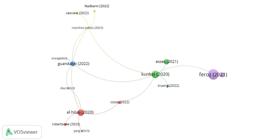
El Hilali et al., 2020 (Cluster Core Article) |
To investigate the effect of DT on sustainability with a focus on SMEs in Morocco. |
Working on customers, data, and innovation during DT improves sustainable practices in companies. Recommendation that companies should seize the opportunity of DT to achieve sustainability, as the implementation of these concepts requires radical changes in the business model. |
|
Costa et al., (2022)
|
To determine the degree of contribution of DT, enabling technologies to the sustainability areas of companies, with a specific focus on three pulp and paper manufacturing companies in Brazil. |
Among the technologies analyzed, the survey concluded that IoT and Big Data & Analytics were important in the three companies investigated. While AI was not relevant in two companies, it stood out as important in one of them. It is important for organizations to establish strategies and plan the integration of digital technologies to enhance sustainability outcomes. |
|
Robertsone & Lapina (2023)
|
To analyze how DT can foster open innovation and sustainability. |
DT contributes to sustainability and fosters open innovation. It’s a form of innovation that leverages digital technologies to transform how companies operate, meet stakeholder needs, and deliver value. |
|
Yang et al., (2023)
|
To analyze the impact of DT on the sustainable development of Chinese companies and the moderating role of regional virtual agglomeration. |
DT assists in the sustainable growth of companies. The regional virtual agglomeration moderates the initial negative impact of DT on business sustainability, improving the economic growth capacity of companies. |
|
Cluster 2
|
| Kunkel & Matthews (2020) (Cluster Core Article) |
To analyze the digital and industrial policies of several countries in Sub-Saharan Africa and East Asia in relation to the impacts of Information and Communication Technologies (ICTs) on environmental sustainability. |
Policies express a wide range of vague expectations, focusing more on the positive indirect impacts of ICT use—for example, for greater energy efficiency and resource management—than on the direct negative impacts of ICTs, such as ICT electricity consumption. In addition, expectations differ across countries, with no common theme across policies. |
|
Esses et al., (2021)
|
To explore the relationship between DT and sustainability in Visegrad Group countries, focusing on indicators such as the Digital Economy and Society Index (DESI) and the SDGs. |
Digitalization is correlated with components of sustainable development. The higher the DT, the more competitiveness, innovation, and entrepreneurship grow, which contributes significantly to economic development. The most digitized countries also have higher Gross Domestic Product (GDP). |
|
Truong (2022)
|
To discuss the impacts of DT on environmental sustainability, including positive and negative effects. |
Direct effects related to DT can cause resource depletion, water scarcity, greenhouse gas emissions, and pollution. They can also cause substantial pressures on biodiversity. However, the advancement of digital technologies, such as AI, Big Data, IoT, and blockchain can help alleviate the negative environmental effects. |
|
Cluster 3
|
|
Guandalini (2022) (Cluster Core Article) |
To understand the relationship between digitalization and sustainable development. |
Digitalization is a tool for the achievement of sustainability goals. In addition, the need to integrate academic research with business practice is highlighted, in pursuit of sustainability objectives, based on the use of digitalization. |
|
Zhang & Jin (2023)
|
To investigate the relationship between DT and the sustainable development of Chinese enterprises. |
DT enhances sustainable business development. In addition, skilled management and highly qualified employees reinforce the contribution of digitalization to sustainability. Effective internal controls have a positive influence on the DT and sustainable development of enterprises. |
|
Diaz & Montalvo (2022)
|
To understand how leading Mexican companies use DT to improve sustainability efficiency. |
DT can contribute to sustainability efforts in companies, resulting in economies of scale and operational improvements. Companies can improve efficiency, business models, communication channels, and decision-making through DT. |
|
Cluster 4
|
|
Casciani et al., (2022) (Cluster Core Article) |
To explore DT’s opportunities and influences in the fashion industry, with a focus on supply chains, business models, and sustainability-driven innovations. |
DT affects sustainability in all supply chain processes. DT in fashion enables the dematerialization of supply chains, drives innovations in business models, and increases sustainability through cultural shifts, product innovation, and operational optimization. |
|
Martínez-Peláez et al., (2023)
|
To identify how SMBs can start a sustainable DT project by focusing on the critical organizational capabilities needed for successful DT. |
Digitalization, stakeholder engagement, and big data are key capabilities for sustainability, enabling SMEs to seize new opportunities, foster growth, and generate positive social and environmental impacts. |
|
Nadkarni & Haider (2022)
|
To verify the importance of DT, operational efficiency, and sustainability as drivers of innovation for the hospitality industry in the UAE, in response to the challenges of the COVID-19 pandemic. |
DT, operational efficiency, and sustainability are key drivers of innovation in the hospitality industry. Proactive government policies and innovations adopted by hotel brands have been crucial in ensuring the viability and positive performance of the industry. |
|
Cluster 5
|
|
Feroz et al., (2021) (Cluster Core Article) |
To explore the impact of DT on environmental sustainability by identifying disruptions caused by digital technologies |
DT is prompting disruptions in environmental sustainability, outlined in key areas such as pollution control, waste management, sustainable production, and urban sustainability. DT improves environmental sustainability. Digital technologies such as IoT, cloud computing, and social media are transforming waste management, agriculture, food waste, and pollution control. |
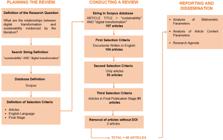
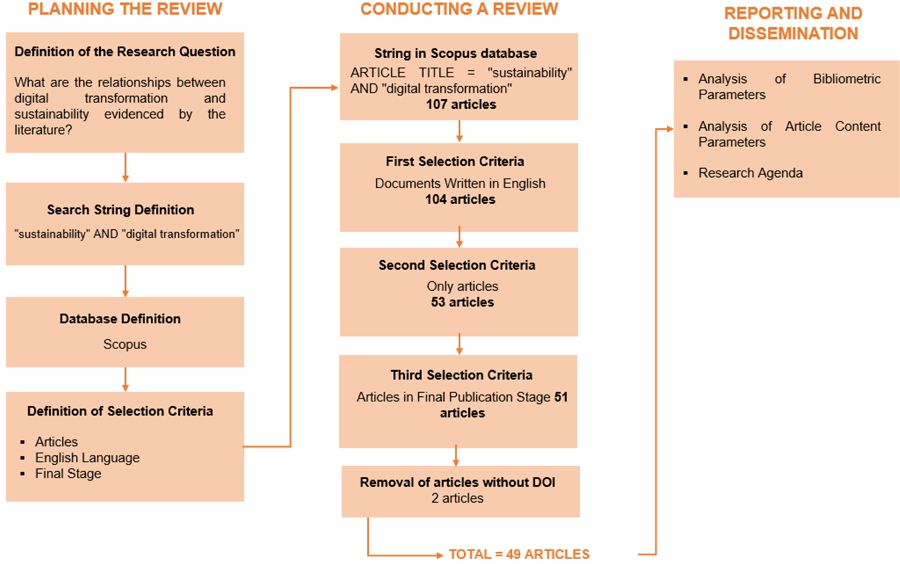
 Explorando a Integração da Sustentabilidade e Transformação Digital como Estratégia Organizacional: Uma Revisão Sistemática da Literatura e Orientação para Pesquisa Futura; Definition of methodological procedures
 Thumbnail
 Thumbnail
 Thumbnail
 Thumbnail
 Thumbnail
 Source: Research data (2023)
 Source: Research data (2023)
 Source: Research data (2023)
 Source: Research data (2023)
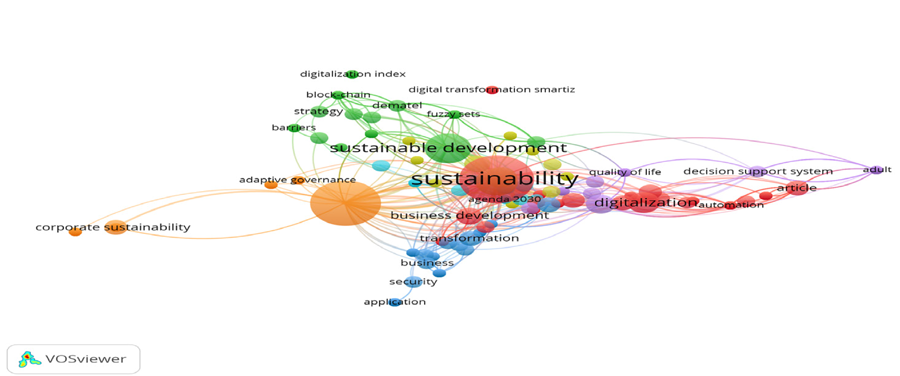
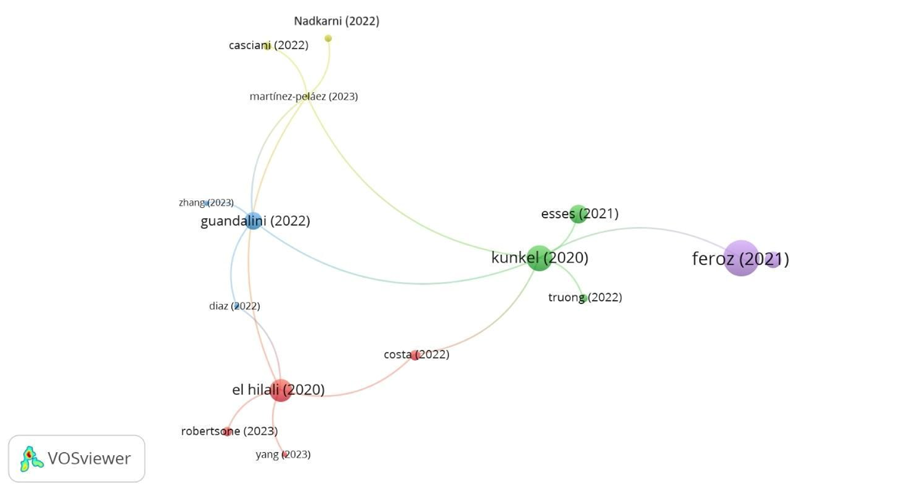 Source: Research data (2023) by VOSviewer