
 Clinical, epidemiological, and laboratory profile of people with tuberculosis in a referral center: a cohort study, Belo Horizonte, 2013-2021
Abstract
Objective To investigate the clinical, epidemiological, and laboratory profile of people with tuberculosis.
Methods This was an observational clinical-epidemiological cohort study of people with tuberculosis treated at the Secondary Referral Outpatient Clinic of the Hospital das Clínicas of the Federal University of Minas Gerais, from January 2013 to August 2021. The cases were evaluated from the diagnosis onward and followed after entry into the outpatient clinic until the second month of treatment, as well as at the end of treatment. Data were collected through interviews and/or review of medical records, the Notifiable Health Conditions Information System, and the Special Tuberculosis Treatment Information System.
Results A total of 227 cases were identified: 40.1% with pulmonary tuberculosis, 50.7% with extrapulmonary tuberculosis, and 9.2% with both forms. At the first visit, the main symptom among those with pulmonary tuberculosis was cough (76.9%); in extrapulmonary tuberculosis, symptoms were associated with the affected organ; and in pulmonary and extrapulmonary tuberculosis, anorexia was reported in 47.6% of cases. The most frequent comorbidity was diabetes (20.7%). By the end of the second month, clinical, laboratory, and radiological improvement was observed. Treatment outcome was cure in 92.5% of cases, and directly observed treatment was performed in 7.6%.
Conclusion Extrapulmonary tuberculosis was the most frequent form, directly observed treatment was rarely implemented, and the cure rate was high. Determining population profiles in Secondary Referral Centers identifies outcomes that may indicate the quality of care provided.
Keywords
Tuberculosis; Comorbidity; Secondary Care; Health Systems; Cohort Studies
Resumo
Objetivo Investigar o perfil clínico-epidemiológico e laboratorial de pessoas com tuberculose.
Métodos Estudo clínico epidemiológico com delineamento observacional. Trata-se de uma coorte de pessoas com tuberculose atendidas no Ambulatório de Referência Secundária do Hospital das Clínicas da Universidade Federal de Minas Gerais, de janeiro de 2013 a agosto de 2021. Os casos foram avaliados a partir do diagnóstico e acompanhados após a entrada no ambulatório até o segundo mês de tratamento, assim como no encerramento. Os dados foram coletados por meio de entrevista e/ou consulta de prontuários, do Sistema de Informação de Agravos de Notificação e do Sistema de Informação de Tratamento Especiais da Tuberculose.
Resultados Foram identificados 227 casos: 40,1% com tuberculose pulmonar; 50,7% com tuberculose extrapulmonar; e 9,2% com ambas as formas. Na primeira consulta, a principal sintomatologia das pessoas com tuberculose pulmonar foi tosse, em 76,9% dos casos; na tuberculose extrapulmonar, foi associada ao órgão acometido; na tuberculose pulmonar e extrapulmonar, foi anorexia, em 47,6% dos casos. A comorbidade mais frequente foi diabetes, em 20,7% dos casos. Ao final do segundo mês, houve melhora clínica, laboratorial e radiológica. O desfecho foi cura em 92,5% dos casos, e o tratamento diretamente observado foi realizado em 7,6% dos casos.
Conclusão A tuberculose extrapulmonar foi a mais frequente, a frequência de realização do tratamento diretamente observado foi baixa e a taxa de cura elevada. A determinação de perfis populacionais nas Referências Secundárias identifica desfechos que podem evidenciar a qualidade do cuidado ofertado.
Palavras-chave
Tuberculose; Comorbidade; Atenção Secundária à Saúde; Sistemas de Saúde; Estudos de Coortes
Resumen
Objetivo Investigar el perfil clínico-epidemiológico y de laboratorio de personas con tuberculosis.
Métodos Estudio clínico-epidemiológico con diseño observacional. Se trata de una cohorte de personas con tuberculosis atendidas en el Ambulatorio de Referencia Secundaria del Hospital de Clínicas de la Universidad Federal de Minas Gerais, de enero de 2013 a agosto de 2021. Los casos fueron evaluados a partir del diagnóstico y acompañados tras la entrada en el ambulatorio hasta el segundo mes de tratamiento, así como en el cierre. Los datos fueron recolectados mediante entrevista y/o consulta de historias clínicas, del Sistema de Información de Agravamientos de Notificación y del Sistema de Información de Tratamiento Especial de la Tuberculosis.
Resultados Se identificaron 227 casos: 40,1% con tuberculosis pulmonar; 50,7% con tuberculosis extrapulmonar; y 9,2% con ambas formas. En la primera consulta, la principal sintomatología de las personas con tuberculosis pulmonar fue tos, en el 76,9% de los casos; en la tuberculosis extrapulmonar, estuvo asociada al órgano afectado; en la tuberculosis pulmonar y extrapulmonar, fue anorexia, en el 47,6% de los casos. La comorbilidad más frecuente fue la diabetes, en el 20,7% de los casos. Al final del segundo mes, hubo mejoría clínica, de laboratorio y radiológica. El desenlace fue curación en el 92,5% de los casos, y el tratamiento directamente observado se realizó en el 7,6% de los casos.
Conclusión La tuberculosis extrapulmonar fue la más frecuente, la frecuencia de realización del tratamiento directamente observado fue baja y la tasa de curación elevada. La determinación de perfiles poblacionales en las Referencias Secundarias identifica desenlaces que pueden evidenciar la calidad de la atención ofrecida.
Palabras clave
Tuberculosis; Comorbilidad; Atención Secundaria de Salud; Sistemas de Salud; Estudios de Cohortes
This research respected ethical principles, having obtained the following approval data:
Research ethics committee: Universidade Federal de Minas Gerais
Opinion number: 5000382
Approval date: 27/9/2021
Certificate of submission for ethical appraisal: 95206318.3.0000.5149
Informed consent form: Obtained from all participants prior to data collection.
Introduction
Ancient, endemic, and universal, tuberculosis remains one of the oldest diseases that continues to challenge humanity (1). It has once again become the leading cause of death by a single infectious agent worldwide following the COVID-19 pandemic (2). Globally, an estimated 10.8 million people fell ill, and 1.09 million died in 2023 (3).
In Brazil, 84,308 new cases were reported in 2024. There was a 21% increase in new cases from 2020 to 2024 (4). In Minas Gerais, 4,503 new cases were reported in 2023. The metropolitan region of Belo Horizonte stands out for concentrating approximately one-third of the state’s notifications (5). In this capital city, the Tuberculosis Outpatient Clinic of the Hospital das Clínicas at the Federal University of Minas Gerais manages complex tuberculosis cases from the capital, the metropolitan region, and inland cities.
Given the epidemiological context and the consequences of the post-pandemic healthcare system disruption, tackling tuberculosis requires approaches at multiple levels: global, national, regional, local, and specific (1). Identifying the clinical-epidemiological and laboratory profile of tuberculosis cases reveals the clinical and social peculiarities of a given group, which can be compared to other realities. Thus, it is possible to detect and treat individuals in a tailored manner in each region, in addition to advancing the provision of universal care (6).
Studies evaluating the demographic and clinical characteristics of individuals with tuberculosis are essential, as they allow for the planning of effective strategies tailored to the specificities of each population (2,6). Therefore, the objective of this study was to investigate the clinical-epidemiological and laboratory profile of individuals with tuberculosis.
Methods
Design
This was an observational clinical-epidemiological cohort study. A cohort of individuals with tuberculosis was conducted, which involves monitoring cases with a common characteristic, exposed and unexposed to a specific factor until the occurrence of a future event (7). Follow-up continued until the end of treatment for the disease, which could last six, nine, or 12 months after determination by the medical team. The Strengthening the Reporting of Observational Studies in Epidemiology tool was used as a guide for reporting the study.
Setting
All cases from the Secondary Reference Outpatient Clinic (1) of the Hospital das Clínicas at the Federal University of Minas Gerais who received a tuberculosis diagnosis between January 2013 and August 2021 (baseline) were evaluated. After diagnosis and entry into the outpatient clinic, individuals were monitored at the end of the second month of treatment (first reassessment timepoint) and at the end of treatment (second reassessment timepoint) (Figure 1).
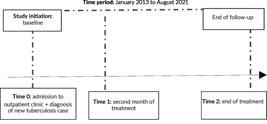
Temporal stratification of the cohort of individuals with tuberculosis treated at the Tuberculosis Outpatient Clinic of the Hospital das Clínicas at the Federal University of Minas Gerais. Belo Horizonte, 2013-2021
Participants
New tuberculosis cases aged 18 years or older who initiated and/or continued treatment at the outpatient clinic were included. Retreatment cases, cases with changed diagnoses, and people living with HIV (human immunodeficiency virus) were excluded, as the outpatient clinic is not a reference center for their care.
Variables
The variables assessed at baseline were
-
Sociodemographic characteristics: data collection method; place of origin; sex; race/skin color; marital status; age group; education level; and cohabitant evaluation (assessment of the participant’s cohabitant by a health professional. If the participant had pulmonary involvement, their cohabitant was considered a household contact; if they had extrapulmonary tuberculosis, their cohabitant could be the source case (1)).
-
Clinical-epidemiological characteristics: clinical form of tuberculosis (pulmonary, extrapulmonary, or both); general, pulmonary, and extrapulmonary symptoms (anorexia, asthenia, fever, night sweats, cough, duration of cough in weeks, sputum production, chest pain, dyspnea, other symptoms); contact with pulmonary tuberculosis in the last two years; comorbidities (treated with immunosuppressants, diabetes, chronic kidney disease, liver diseases, chronic obstructive pulmonary disease, neoplasia, mental disorders, presence of comorbidities); and lifestyle habits (smoking, considering former smokers those who quit at least one year ago; alcohol use, considering former drinkers those who quit at any time).
-
Laboratory and radiological data (8): sputum smear microscopy; mycobacterial culture; drug identification and susceptibility tests; rapid molecular test for tuberculosis; and chest X-ray (patterns: suggestive, atypical/other disease, or normal) (1). In the absence of a chest X-ray, chest computed tomography was considered (patterns: typical, other diseases, or normal) (9-11).
For cases without phenotypic and/or genotypic confirmation, the tuberculin skin test or Interferon Gamma Release Assay was performed. When positive in isolation, these tests indicate latent infection. When associated with epidemiological, clinical, laboratory, imaging, and histopathological data, and exclusion of other diagnoses, they may suggest active disease, especially in unconfirmed clinical forms (1,12).
The variables assessed during follow-up (at the end of the second month and at the end of treatment) were:
-
Treatment adherence; adverse drug reactions (nausea/vomiting, peripheral neuropathy, itching, red urine, abdominal pain, diarrhea, heartburn, dizziness, anorexia, joint pain, rash, insomnia/somnolence, headache, hepatotoxicity, none presented); symptoms (anorexia, fever, night sweats, cough, sputum production, chest pain, dyspnea); sputum smear microscopy; mycobacterial culture; chest X-ray; and implementation of directly observed treatment.
-
At the end of treatment, the following outcomes were evaluated: cure; treatment interruption; death due to tuberculosis; death due to other causes; transfer; and treatment failure (8).
Data sources and measurement
After confirming the inclusion criteria and medical consultation, individuals were invited to participate in an interview conducted at the outpatient clinic, guided by the completion of a questionnaire. Subsequently, or in the absence of the participant for the interview, the medical record was reviewed and similarly guided by the completion of the questionnaire. The Notifiable Health Conditions Information System and the Special Tuberculosis Treatment Information System were also consulted.
The questionnaires were entered into the REDCap platform of the Hospital das Clínicas at the Federal University of Minas Gerais (13). REDCap is an operational system that enables the collection and management of research data and was made available free of charge for the creation of the online database for this study (14), which was deposited in the SciELO Data repository (15).
Bias
Selection bias: To minimize it, research members would personally consult the opinion of the lead physician coordinator before inviting individuals for an interview or reviewing medical records. Cases that met the inclusion criteria after her assessment during the medical consultation were included in the study without loss in recruitment and with immediate reduction of this bias at entry.
Information bias: To minimize it, training of the team members was conducted by the coordinator. Researchers developed the questionnaire used from the Brazilian Tuberculosis Research Network. Training was provided for the application of the questionnaires and data entry into REDCap. Each case included in the research was de-identified and received a numerical code in the questionnaire and in REDCap. The information entered was checked and validated on this platform by the principal researcher.
Study size
It is a census study, comprising all individuals who received a tuberculosis diagnosis. To identify eligibility, all manual schedules with medical appointments booked by the lead coordinator were reviewed. To increase the accuracy of this procedure, at the end of each outpatient clinic day, research members reassessed case inclusion with the coordinator.
Statistical methods
Simple descriptive analyses were performed with the distribution of absolute (n) and relative (%) frequencies for categorical variables. For continuous variables, measures of central tendency and dispersion were used. Study participants were characterized regarding selected variables and stratified according to the clinical form of tuberculosis. Initially, the Shapiro-Wilk test was used to verify the normal distribution of the data and to justify the use of parametric tests in multiple comparison analyses. The chi-square test with Bonferroni correction was used to compare the three clinical forms in relation to sociodemographic variables (categorical variables), considering a statistical significance level of p-value 0.05. Analyses were conducted using the SAS software (16). Missing data were excluded.
Results
A total of 279 individuals were recruited. Of these, 52 were excluded: 39 were undergoing retreatment, 11 had a change in diagnosis, and two were HIV positive. After exclusions, 227 individuals proceeded.
In 2013, 25 individuals were included in the study; in 2014, 37; in 2015 and 2016, 16 each year; in 2017, 28; in 2018, 25; in 2019, 30; in 2020, 19; and in 2021, up to August, 31 individuals. Data collection was conducted through interviews and medical record review in 78.0% of cases, and through medical record review alone in 22.0% of cases.
A total of 40.1% were diagnosed with pulmonary tuberculosis, 50.7% with extrapulmonary tuberculosis, and 9.2% with both forms. At the end of the second month of treatment, 204 individuals were evaluated, as 23 were considered losses, of which: ten entered the outpatient clinic after the follow-up period; nine started treatment but were transferred before follow-up; two died; one was hospitalized; and one had a missing medical record and was not interviewed. At the end of treatment, 197 individuals were analyzed, as there were 30 losses from baseline: 17 were transferred, six died, three discontinued treatment, three missed their medical appointment, and one was hospitalized.
The sociodemographic characteristics of the 227 cases that initiated the study are described in Table 1. A higher frequency was observed among individuals residing in Belo Horizonte/metropolitan region (84.1%), male (50.7%), self-identified as Black/Brown (77.1%), and married/common-law marriage (52.0%). In the samples of individuals with extrapulmonary tuberculosis and both pulmonary and extrapulmonary tuberculosis, females prevailed in 53% and 61.9% of cases, respectively. A statistical difference was observed regarding race/skin color (Black/Brown vs. White) between individuals with extrapulmonary tuberculosis compared to those with pulmonary tuberculosis (p-value 0.035), and between individuals with extrapulmonary tuberculosis compared to those with both pulmonary and extrapulmonary tuberculosis (p-value 0.023). The median age was 52 years, with the most frequent age group being 30 to 69 years (76.6%). Regarding years of schooling, 93.9% of individuals studied for four years or more. Concerning the evaluation of cohabitants of individuals with extrapulmonary tuberculosis, in 43.4% of cases, there was no investigation for active disease.
Sociodemographic characteristics of individuals with tuberculosis treated at the Tuberculosis Outpatient Clinic of the Hospital das Clínicas at the Federal University of Minas Gerais. Belo Horizonte, 2013-2021 (n=227)
Clinical-epidemiological data from the first consultation are described in Table 2. The main symptoms among individuals with pulmonary tuberculosis were cough for more than two weeks and sputum production. The most frequent comorbidity was diabetes, present in 25.3% of cases. Among participants, 61.2% were former smokers or current smokers, while 56.2% were current or former alcohol users.
Clinical and epidemiological data of people with tuberculosis at their first consultation at the Tuberculosis Outpatient Clinic of the Hospital das Clínicas of the Federal University of Minas Gerais. Belo Horizonte, 2013-2021 (n=227)
In extrapulmonary tuberculosis, other symptoms were the most frequent: 85.2% of individuals presented other complaints related to the affected organ (Table 2). The affected extrapulmonary sites were: ocular, in 51.3% of cases; pleural, in 10.4%; genitourinary, in 8.7%; lymphatic, in 7.0%; disseminated disease, in 6.1%; osteoarticular, in 6.1%; meningoencephalic, in 5.2%; cutaneous, in 4.3%; and peritoneal, in 0.9% of cases. The most frequent comorbidity was diabetes, 13.0% of cases. Smoking habit was present in 39.6% of cases, and 48.6% of individuals were current or former alcohol users.
In pulmonary and extrapulmonary tuberculosis, the main symptoms were anorexia, cough for more than two weeks, and fever (Table 2). Comorbidities treated with immunosuppressants were the most frequent, in 47,6% of cases. Smoking habit was present in 25.0% of cases, and 42.1% of individuals were current or former alcohol users. The extrapulmonary sites involved were: disseminated disease in 33.3% of cases; pleural in 33.3%; lymphatic in 23.8%; meningoencephalic in 4.8%; and peritoneal in 4.8% of cases.
Regarding laboratory data for the diagnosis of pulmonary tuberculosis: smear microscopy was positive in 40/74 (54.0%) individuals; mycobacterial cultures were positive in 53/59 (89.8%); first-line drug susceptibility tests showed resistance in 8/45 (17.8%) – five to isoniazid (one of these associated with resistance to streptomycin), and three to streptomycin. The rapid molecular test for tuberculosis was detected in 29/42 (69.0%) individuals.
Regarding laboratory data for the diagnosis of extrapulmonary tuberculosis: smear microscopy was positive in 5/37 (13.5%) individuals; mycobacterial cultures were positive in 13/32 (40.6%); first-line drug susceptibility tests were sensitive in 7/7 (100%). The rapid molecular test for tuberculosis was detected in 13/16 (81.3%) individuals.
Laboratory data at the diagnosis of pulmonary and extrapulmonary tuberculosis were as follows: positive sputum smear microscopy in 4/17 (23.5%) individuals; positive cultures in 8/9 (88.9%); and, in drug susceptibility testing, 1/5 (20.0%) individuals were resistant (to streptomycin). The rapid molecular test for tuberculosis was detected in 4/5 (80%) individuals.
Chest imaging was performed in 87 individuals with pulmonary tuberculosis, 101 with extrapulmonary tuberculosis, and 21 with both pulmonary and extrapulmonary tuberculosis. Imaging was not assessed in 7.9% of cases. In cases with pulmonary involvement, images were suggestive of active tuberculosis (67/80, 83.75% of chest X-rays; and 27/27, 100% of chest CT scans).
Clinical, radiological, and laboratory data at the end of the second month of treatment are described in Table 3. A total of 89.9% of the individuals included in the study attended the follow-up visit. Of these, 95.6% adhered to treatment, and 9.3% received directly observed treatment. The most frequent adverse drug reaction was nausea/vomiting (42.6%), in all clinical forms.
Clinical, radiological, and laboratory data for people with tuberculosis treated at the Tuberculosis Outpatient Clinic of the Hospital das Clínicas of the Federal University of Minas Gerais at the end of the second month of treatment. Belo Horizonte, 2013-2021 (n=204)
Clinical, radiological, and laboratory data at the end of treatment are described in Table 4. Of the cases included at baseline, 86.8% attended the follow-up visit. Of these, 94.4% adhered to treatment. Directly observed treatment was performed in 7.6% of cases. The most frequent adverse drug reaction was red urine (17.3%), regardless of the clinical form. Clinical, laboratory, and radiological improvement was observed. The primary outcome was cure in 92.5% of individuals, and 1.3% discontinued treatment.
Clinical, radiological, and laboratory data of people with tuberculosis treated at the Tuberculosis Outpatient Clinic of the Hospital das Clínicas of the Federal University of Minas Gerais at the end of treatment. Belo Horizonte, 2013-2021 (n=197)
Discussion
This study revealed that the number of outpatient visits fluctuated and then recovered, even during the early years of the COVID-19 pandemic. Such recovery may be attributed to the uninterrupted functioning of the service and to active case-finding through telephone outreach. The service profile was characterized by residents of Belo Horizonte and its metropolitan region, self-identified as Black/Brown, middle-aged, with advanced literacy, presenting extrapulmonary tuberculosis associated with diabetes, and who used tobacco and alcohol. Follow-up was marked by the occurrence of minor adverse drug reactions (1), successful treatment, and the absence of directly observed treatment.
One of the study’s limitations was the use of secondary data, which may have interfered with the quality of the results (17) when medical records were incomplete or unavailable. However, there were a few cases in which data analysis relied solely on medical records and, even in these situations, data loss was minimal. Findings from this study should not be generalized to referral centers at other levels of complexity. Studies describing the profiles of patients seen in Secondary Referral Centers within the Brazilian National Health System make it possible to understand the realities of this level of care, which underscores the relevance of this study.
The most frequent clinical form of tuberculosis found was extrapulmonary tuberculosis, as this is within the scope of care provided by Secondary Referral Centers (1,18). It is the role of a Secondary Referral Center for tuberculosis to treat: cases with extrapulmonary involvement; cases associated with severe comorbidities or clinical complications; drug intolerance and/or significant adverse reactions to treatment not requiring hospitalization (1,18).
Most individuals came from the capital and the metropolitan region, which accounts for approximately one-third of tuberculosis cases in the state (5), and where the study site is located. Given this context, the highest demand for care was concentrated in this referral unit. It is believed that residents of this urban region have easier access to the outpatient clinic, which favors treatment adherence.
Tuberculosis mainly affects males (19). There is a correlation with national (4) and state (5) epidemiological data. In 2025, 68.2% of Brazilians with tuberculosis were male. In this study, when there was extrapulmonary involvement, females predominated. Factors that may impair immunity over time, such as fluctuations in estrogen levels, may increase the likelihood of infection by the mycobacterium, which can trigger active disease after years of latency in this sex (20). The extrapulmonary form is more prevalent among women and more difficult to detect (21).
This study revealed a predominance of Black/Brown people in all types of tuberculosis, corroborating national (4) and state (5) epidemiological data. In 2025, 65.8% of Brazilians with tuberculosis were Black/Brown individuals. In this study, the significance was greater in the extrapulmonary tuberculosis group, where predominance was even more evident. The prevalence of the disease among Black and Brown people may be explained by historical vulnerabilities in this group, related to lower income, limited access to the health system, and lower education levels compared to other races/skin colors (22).
The incidence of tuberculosis was higher among people of working age, those who were married/in common-law relationships, and those with more schooling. With regard to age group and marital status, the data were similar to national findings (4) and to those of a study conducted in Belo Horizonte, Minas Gerais (23). Regarding education, the data were similar to those reported in studies in Rondônia (24) and Espírito Santo (7), but diverged from studies conducted in Belo Horizonte (23) and Pernambuco (25). These divergences are probably due to the specific characteristics of the studies carried out in different Primary, Secondary, or Tertiary Care services (1).
Household contact evaluation was practical in cases with pulmonary involvement, given the importance of identifying individuals infected with Mycobacterium tuberculosis and those who developed the disease for effective disease control (1). The low proportion of cohabitants of people with extrapulmonary tuberculosis being tested may impact the detection of source cases, which hinders the prevention of new cases of tuberculosis (1).
The most frequent symptom of pulmonary tuberculosis was a cough lasting two weeks or more. This investigation is in line with the Clinical and Operational Protocol for Tuberculosis Control in Minas Gerais (18), which recommends suspicion of tuberculosis with this symptom duration. Thus, it is possible to exclude more acute causes of cough, such as those caused by viral diseases, as well as to identify transmissible tuberculosis cases earlier.
Few individuals reported contact with pulmonary tuberculosis cases, probably due to the stigma associated with the disease (1). Concerning extrapulmonary tuberculosis, ocular tuberculosis was predominant, possibly because the same facility houses an ophthalmology outpatient clinic specialized in ocular tuberculosis. The people treated in this sector are evaluated together with the professionals from Secondary Referral Care.
The most frequent comorbidity was diabetes, corroborating the findings of the World Diabetes Foundation, which reported an increase in this comorbidity associated with tuberculosis, especially in low-income countries, including Brazil (26). This observation may be related to the rising number of diabetes cases among Brazilians, together with the persistently high incidence of tuberculosis, a phenomenon described in the literature as the tuberculosis-diabetes syndemic (27-28). Living in households with more than two people per room, unemployment, and low per capita income are determinants related to this syndemic in the country (22).
The use of tobacco or alcohol was prevalent. These lifestyle habits are considered risk factors for the development of tuberculosis (29). Strategies targeting this population are a priority for the cessation of such unfavorable habits (29).
Regarding laboratory tests, not all individuals underwent rapid molecular testing, sputum smear microscopy, or mycobacterial culture, since most cases had no biological samples available for testing or were already under treatment. Among cultures positive for Mycobacterium tuberculosis, most were drug-sensitive.
Chest imaging should be part of the investigation of tuberculosis, regardless of the clinical form, with chest X-ray being the primary method of choice due to its availability. However, computed tomography has gained prominence for being more sensitive (1,18). In this study, chest X-ray was the most frequently performed method, and the most frequent pattern was suggestive of active disease, as was also observed with computed tomography. Some individuals did not have their X-rays assessed because the diagnosis had been made in other services, and they had not brought the images.
At the end of the second month and at the end of treatment, clinical, laboratory, and radiological improvement was observed. Adverse drug reactions were more frequent at the end of the second month, as found in another study conducted in Belo Horizonte (23).
Most individuals did not undergo directly observed treatment. The hospital-centered model at the Secondary Care level may hinder the implementation and evaluation of this strategy. Nevertheless, the most frequent outcome was cure (92.5%), which is above the World Health Organization (WHO) recommended threshold (greater than 85%) (2,29). The treatment discontinuation rate (1.32%) was consistent with the parameter established by the WHO (up to 5%) (2,29). In Brazil, in 2023, 66.0% of individuals were cured and 15.2% discontinued treatment (4).
One measure adopted by the service over the past decade was active follow-up, through telephone calls to individuals who missed follow-up visits. If this action was unsuccessful, the Municipal or State Health Departments were contacted to locate the individuals and reschedule them. It is believed that this active follow-up strategy influenced treatment adherence and, consequently, the high cure rate.
In this study, extrapulmonary tuberculosis was the most frequent form, the frequency of directly observed treatment was low, and the cure rate was high. Determining population profiles in Secondary Referral Centers should be encouraged, as it identifies particularities of individuals at higher risk of illness and outcomes that may indicate the quality of care provided.
-
Peer Review Administrator
Izabela Fulone (https://orcid.org/0000-0002-3211-6951)
-
Peer Reviewers
Erlon Gabriel Rego de Andrade (https://orcid.org/0000-0002-7109-6121), Vinícius Luís da Silva (https://orcid.org/0000-0001-6228-8124)
-
Data availability
The database and analysis codes used are available in the SciELO Data repository (15) via the link: https://doi.org/10.48331/scielodata.PIBCBT.
-
Use of generative artificial intelligence
Not used.
References
-
1 Brasil. Ministério da Saúde, Secretaria de Vigilância em Saúde. Departamento de Vigilância das Doenças Transmissíveis. Manual de Recomendações para o Controle da Tuberculose no Brasil [Internet]. Brasil; 2019 [cited 2025 Sep 01]. Avaliable from: https://bvsms.saude.gov.br/bvs/publicacoes/manual_recomendacoes_controle_tuberculose_brasil_2_ed.pdf
» https://bvsms.saude.gov.br/bvs/publicacoes/manual_recomendacoes_controle_tuberculose_brasil_2_ed.pdf -
2 WHO, World Health Organization. Tuberculosis [Internet]. World Health Organization; 2025 [cited 2025 Sep 01]. Avaliable from: https://www.who.int/news-room/fact-sheets/detail/tuberculosis
» https://www.who.int/news-room/fact-sheets/detail/tuberculosis -
3 WHO, World Health Organization. TB disease burden [Internet]. WHO; 2024 [cited 2025 Sep 01]. Available from: https://www.who.int/teams/global-programme-on-tuberculosis-and-lung-health/tb-reports/global-tuberculosis-report-2024/tb-disease-burden
» https://www.who.int/teams/global-programme-on-tuberculosis-and-lung-health/tb-reports/global-tuberculosis-report-2024/tb-disease-burden -
4 Brasil. Ministério da Saúde. Boletim Epidemiológico de Tuberculose - Número Especial | Mar. 2025 [Internet]. Brasil; 2025 [cited 2025 Sep 01]. Available from: https://www.gov.br/saude/pt-br/centrais-de-conteudo/publicacoes/boletins/epidemiologicos/especiais/2025/be-de-tuberculose-numero-especial-mar-2025.pdf/view
» https://www.gov.br/saude/pt-br/centrais-de-conteudo/publicacoes/boletins/epidemiologicos/especiais/2025/be-de-tuberculose-numero-especial-mar-2025.pdf/view -
5 Secretaria de Estado de Saúde de Minas Gerais. Tuberculose [Internet]. Minas Gerais; 2016 [cited 2025 Sep 01]. Available from: https://www.saude.mg.gov.br/tuberculose/
» https://www.saude.mg.gov.br/tuberculose/ -
6 Roveda WM de A, de Mendonça MA, Godinho JRG, Ceccatto C de P, Fregona G, Wittmer VL, Duarte H, Barbalho-Moulim MC, Paro FM. Perfil epidemiológico dos indivíduos com tuberculose em um centro de referência terciário e fatores associados aos resultados da baciloscopia e da radiografia do tórax [Internet]. REAS; 16 Jul 2020 [cited 2025 Sep 01]. Available from: https://doi.org/10.25248/reas.e3700.2020
» https://doi.org/10.25248/reas.e3700.2020 -
7 Levin KA. Study design IV: Cohort studies [Internet]. Evid Based Dent.; 2006 [cited 2025 Sep 01]. Available from: https://doi.org/10.1038/sj.ebd.6400407
» https://doi.org/10.1038/sj.ebd.6400407 -
8 Brasil, Ministério da Saúde. Manual de Recomendações para o Diagnóstico Laboratorial de Tuberculose e Micobactérias Não Tuberculosas de Interesse em Saúde Pública no Brasil [Internet]. Brasil; 2022 [cited 2025 Sep 01]. Available from: https://www.gov.br/saude/pt-br/centrais-de-conteudo/publicacoes/svsa/tuberculose/manual-de-recomendacoes-e-para-diagnostico-laboratorial-de-tuberculose-e-micobacterias-nao-tuberculosas-de-interesse-em-saude-publica-no-brasil.pdf
» https://www.gov.br/saude/pt-br/centrais-de-conteudo/publicacoes/svsa/tuberculose/manual-de-recomendacoes-e-para-diagnostico-laboratorial-de-tuberculose-e-micobacterias-nao-tuberculosas-de-interesse-em-saude-publica-no-brasil.pdf -
9 Silva DR, Rabahi MF, Sant’Anna CC, Silva-Junior JLR, Capone D, Bombarda S, et al. Diagnosis of tuberculosis: a consensus statement from the Brazilian Thoracic Association [Internet]. J Bras Pneumol.; 2021 [cited 2025 Sep 02]. Available from: https://www.jornaldepneumologia.com.br/details/3520/en-US/diagnosis-of-tuberculosis--a-consensus-statement-from-the-brazilian-thoracic-association
» https://www.jornaldepneumologia.com.br/details/3520/en-US/diagnosis-of-tuberculosis--a-consensus-statement-from-the-brazilian-thoracic-association - 10 Capone D, Capone RB, Souza RLP. Diagnóstico Por Imagem Da Tuberculose. Pulmão RJ. 2010;21(1):36-40.
- 11 Hansell DM, Bankier AA, MacMahon H, McLoud TC, Müller NL, Remy J. Fleischner Society: Glossary Of Terms For Thoracic Imaging. Radiology. 2008;246(3):697-722.
- 12 Kritski AL, Conde MB, Muzzy de Souza GR. Tuberculose Do Ambulatório À Enfermaria. Atheneu. 2000;2.:171-207.
-
13 Harris PA, Taylor R, Thielke R, Payne J, Gonzalez N, Conde JG. Research electronic data capture (REDCap) -- a metadata-driven methodology and workflow process for providing translational research informatics support [Internet]. J Biomed Inform.; 2009 [cited 2025 Sep 02]. Available from: https://pmc.ncbi.nlm.nih.gov/articles/PMC2700030
» https://pmc.ncbi.nlm.nih.gov/articles/PMC2700030 -
14 Brasil, Ministério da Educação. Research Eletronic Data Capture - REDCap [Internet]. Ebserh; 2021 [cited 2025 Sep 02]. Available from: https://www.gov.br/ebserh/pt-br/governanca/plataformas-e-tecnologias/redcap
» https://www.gov.br/ebserh/pt-br/governanca/plataformas-e-tecnologias/redcap -
15 Santos LB. Dados de replicação do trabalho “Perfil clínico-epidemiológico e laboratorial de pessoas com Tuberculose em Centro de Referência: estudo de coorte no Sudeste do Brasil de 2013 a 2021[Internet]. SciELO Data versão rascunho; 2025 [cited 2025 Sep 02]. Available from: https://data.scielo.org/dataset.xhtml?persistentId=doi:10.48331/SCIELODATA.PIBCBT&version=DRAFT
» https://data.scielo.org/dataset.xhtml?persistentId=doi:10.48331/SCIELODATA.PIBCBT&version=DRAFT -
16 Software de Analytics & Soluções® [Internet]. SAS; 2023[cited 2025 Sep 02]. Available from: https://www.sas.com/pt_br/home.html
» https://www.sas.com/pt_br/home.html - 17 Coeli CM. Sistemas De Informação Em Saúde E Uso De Dados Secundários Na Pesquisa E Avaliação Em Saúde. Cad Saúde Colet. 2010;18(3):335-6.
-
18 Universidade Federal de Minas de Minas Gerais, Faculdade de Medicina; Secretaria de Estado de Saúde de Minas Gerais, Diretoria de Vigilância de Condições Crônicas Coordenação de Tuberculose. Protocolo Clínico e Operacional para o Controle da Tuberculose em Minas Gerais [Internet]. UFMG; 2022 [cited 2025 Sep 02]. Available from: https://redetb.org.br/wp-content/uploads/2023/03/2811-E-book-PROTOCOLO-CLINICO-1.pdf
» https://redetb.org.br/wp-content/uploads/2023/03/2811-E-book-PROTOCOLO-CLINICO-1.pdf -
19 Moreira ASR, Kritski AL, Carvalho ACC. Social determinants of health and catastrophic costs associated with the diagnosis and treatment of tuberculosis [Internet]. J Bras Pneumol.; 2020 [cited 2025 Sep 02]. Available from: https://doi.org/10.36416/1806-3756/e20200015
» https://doi.org/10.36416/1806-3756/e20200015 -
20 Donald PR, Marais BJ, Barry CE 3rd. Age and the epidemiology and pathogenesis of tuberculosis [Internet]. Lancet; 2010 [cited 2025 Sep 02]. Available from: https://www.sciencedirect.com/science/article/pii/S0140673610605806?via%3Dihub
» https://www.sciencedirect.com/science/article/pii/S0140673610605806?via%3Dihub -
21 STOP TB PARNERSHIP. GENDER AND TB: a Stop TB Partnership Paper [Internet]. UNOPS; 2021 [cited 2025 Sep 02]. Available from: https://www.stoptb.org/sites/default/files/imported/document/TB-REACH_Gender2021-web.pdf
» https://www.stoptb.org/sites/default/files/imported/document/TB-REACH_Gender2021-web.pdf -
22 Soeiro VMDS, Vasconcelos VV, Caldas AJM. A comorbidade tuberculose-diabetes no Brasil, 2012-2018: análise espacial exploratória e modelagem estatística [Internet]. Rev Panam Salud Publica; 2022 [cited 2025 Sep 02]. Available from: https://iris.paho.org/bitstream/handle/10665.2/56005/v46e512022.pdf?sequence=1&isAllowed=y
» https://iris.paho.org/bitstream/handle/10665.2/56005/v46e512022.pdf?sequence=1&isAllowed=y -
23 Navarro PD, Haddad JPA, Rabelo JVC, Silva CHLe, Almeida IN, Carvalho WS, et al. The impact of the stratification by degree of clinical severity and abandonment risk of tuberculosis treatment [Internet]. J Bras Pneumol.; 2021 [cited 2025 Sep 02]. Available from: https://www.jornaldepneumologia.com.br/details/3583/en-US/the-impact-of-the-stratification-by-degree-of-clinical-severity-and-abandonment-risk-of-tuberculosis-treatment
» https://www.jornaldepneumologia.com.br/details/3583/en-US/the-impact-of-the-stratification-by-degree-of-clinical-severity-and-abandonment-risk-of-tuberculosis-treatment -
24 Silva LT da, Felipini MCC, Oliveira TB de, Brunello MEF, Orfão NH. Perfil epidemiológico da tuberculose no serviço de referência do estado de Rondônia [Internet]. Rev Epidemiol Control Infect.; 2019 [cited 2025 Sep 02]. Available from: https://doi.org/10.17058/reci.v9i1.12249
» https://doi.org/10.17058/reci.v9i1.12249 -
25 Albuquerque MFPM, Ximenes RAA, Lucena-Silva N, Souza WV, Dantas AT, Dantas OMS, Rodrigues LC. Factors associated with treatment failure, dropout, and death in a cohort of tuberculosis patients in Recife, Pernambuco State, Brazil [Internet]. Cad Saúde Pública; 2007 [cited 2025 Sep 02]. Available from: https://doi.org/10.1590/S0102-311X2007000700008
» https://doi.org/10.1590/S0102-311X2007000700008 -
26 Gil-Santana L, Almeida-Junior JL, Oliveira CAM, Hickson LS, Daltro C, et al. Diabetes Is Associated with Worse Clinical Presentation in Tuberculosis Patients from Brazil: A Retrospective Cohort Study [Internet]. PLOS ONE; 2016 [cited 2025 Sep 02]. Available from: https://doi.org/10.1371/journal.pone.0146876
» https://doi.org/10.1371/journal.pone.0146876 -
27 van Crevel R, Critchley JA. The Interaction of Diabetes and Tuberculosis: Translating Research to Policy and Practice [Internet]. Trop Med Infect Dis.; 2021 [cited 2025 Sep 02]. Available from: https://www.mdpi.com/2414-6366/6/1/8
» https://www.mdpi.com/2414-6366/6/1/8 -
28 WHO, World Health Organization. Operational handbook on tuberculosis - Module 6: Tuberculosis and comorbidities, third edition [Internet]. WHO; 2024 [cited 2025 Sep 02]. Available from: https://www.uiphp.org.ua/media/k2/attachments/WHO_TB_third_edition_2024.pdf
» https://www.uiphp.org.ua/media/k2/attachments/WHO_TB_third_edition_2024.pdf -
29 WHO, World Health Organization; International Union Against Tuberculosis and Lung Disease. A WHO / The Union Monograph on TB and Tobacco Control: joining efforts to control two related global epidemics [Internet]. WHO, 2007 [cited 2025 Sep 02]. Available from: https://theunion.org/sites/default/files/2020-08/9789241596220_eng.pdf
» https://theunion.org/sites/default/files/2020-08/9789241596220_eng.pdf
Edited by
-
Editor-in-Chief
Jorge Otávio Maia Barreto (https://orcid.org/0000-0002-7648-0472)
-
Scientific Editor
Everton Nunes da Silva (https://orcid.org/0000-0001-8747-4185)
-
Associate Editor
Wuelton Marcelo Monteiro (https://orcid.org/0000-0002-0848-1940)
The database and analysis codes used are available in the SciELO Data repository (15) via the link: https://doi.org/10.48331/scielodata.PIBCBT.

