 Hierarchical pore refinement and synergistic hydration: reinforcement mechanism of concrete modified with a composite of XYPEX and nano-calcium carbonate
ABSTRACT
The development of concrete with superior mechanical performance and enhanced durability remains a major challenge in structural engineering. This study proposes and experimentally validates a cross-scale enhancement strategy based on the combined action of hierarchical pore refinement and synergistic hydration, achieved through XYPEX crystalline admixture and nano-calcium carbonate (nano-CaCO3). By densifying pores from the nano- to micro-scale, the composite system significantly improves both mechanical properties and durability. With 1% XYPEX and 0.5% nano-CaCO3, the 28-day compressive strength reached 48.5 MPa, representing a 31.8% increase over the reference mix. A Synergistic Efficiency (SE) analysis confirmed that this enhancement exceeds the sum of the individual contributions (SE > 1.0). For durability, the mixture with 2% XYPEX and 1% nano-CaCO3 achieved the lowest water penetration depth of 17 mm, and the combination of 3% XYPEX and 1.5% nano-CaCO3 provided the best frost resistance, retaining 55.9% of relative dynamic elastic modulus after 100 freeze–thaw cycles. This enhancement is attributed to a physico-chemical synergy where nano-CaCO3 acts as a nucleation promoter accelerating hydration, while XYPEX consumes available Ca(OH)2 to form pore-blocking micro-crystals. This “cross-scale hierarchical collaboration” offers a promising paradigm for high-performance concrete design.
Keywords:
Modified concrete; Nano-CaCO3; XYPEX admixture; Synergistic effect; Mechanical properties; Durability; Pore structure.
1. OVERVIEW
Concrete, being the most extensively utilized building material across the globe, its mechanical properties (MPs) and durability govern the safety and service life of construction structures [1, 2]. Inadequate MP causes structural failure under design loads as stress exceeds the strength limit [3], while compromised durability results in early-stage deterioration of concrete amid severe environments such as long-term water immersion, chemical attack, or freeze-thaw cycles (FTCs). This not only incurs significant economic losses but also creates grave potential safety threats [4, 5]. As a result, developing advanced modification technologies to comprehensively enhance the concrete’s comprehensive properties has become a crucial research frontier in materials science and civil engineering.
Among the many modification technologies, crystalline waterproof admixtures, like XYPEX, have attracted much attention since their unique penetration crystallization mechanism [6, 7]. Its active chemical substances can react with cement hydration products to form water-insoluble dendrite-like crystals, which can effectively fill and block the micron-scale capillary channels and micro-cracks inside the concrete. Recent research has confirmed its efficacy: ZHANG et al. [7] suggested that adding XYPEX admixture had a positive effect on the frost resistance of concrete and could effectively lower the mass and strength loss rates. OZZIE and SUWONDO[8] confirmed that 1.2% XYPEX C blend can achieve the highest compressive strength (CS) at 28 d and improve its capacity to resist sulfate attack. WANG et al. [9] also indicated that a proper quantity of XYPEX can lift the CS and impermeability of dam face concrete. Its scanning electron microscope (SEM) photo intuitively revealed its good filling effect on internal pores. Nevertheless, these studies also revealed the limitations of XYPEX: its action scale is primarily limited to the micron level, and its ability to optimize pore structures at more microscopic scales like gel pores is limited. Moreover, its reinforcing effect is not linear, and excessive incorporation may cause local enrichment of crystals, forming stress concentration points and deteriorating the MPs of concrete.
Meanwhile, the development of nanotechnology provides the possibility to fundamentally strengthen the microstructure of cement-based materials [10,11,12,13]. Recent studies have highlighted the potential of nanomaterials not only to enhance mechanical performance [12] but also to impart smart self-healing capabilities to sustainable concrete infrastructure [13]. Among them, nano-calcium carbonate (nano-CaCO3) has become a research hotspot due to its dual mechanism of action. The nanoscale particle size of nano-CaCO3 endows it with the capability to fill the nanometric voids between cement grains (physical filling effect). Furthermore, its exceptionally high specific surface area (SSA) qualifies it as a perfect nucleation site (nucleation effect), expediting the cement hydration progress and promoting the formation of a denser C-S-H gel network [10,11,12,13,14,15]. This dual mechanism yields substantial performance improvements, which have been confirmed in diverse application scenarios: SLDOZIAN et al. [10] reported that the concrete strength enhanced proportionally with the increase of nano-CaCO3 content in their study on green concrete. WANG et al. [11] compared the effects of different nanomaterials and found that 2.0% nano-CaCO3 can lift the strength and elastic modulus of concrete at the same time. MOHAMMED et al. [14] specifically pointed out that adding 1-2% nano-CaCO3 can increase the CS of concrete bricks from 21 MPa to more than 33 MPa. The inherent challenges of nanomaterials cannot be ignored. Since the extremely high surface energy and van der Waals forces, nano-CaCO3 particles are easily agglomerated. As pointed out in the literature [15], if they are unevenly dispersed during the stirring process, these nanoaggregates will be unable to take advantage of their size while instead be introduced into the matrix as a source of microscopic defects, leading to performance degradation.
Although XYPEX and nano-CaCO3 each exhibit great properties, they operate at the micron and nanometer scales. When they are utilized in combination, whether their cross-scale interactions (CSIs) are synergistic or antagonistic is a key unresolved scientific question. Specifically, the following crucial uncertainties remain: May the microcrystals formed by XYPEX obstruct the uniform distribution of nanoparticles? In what way will the microstructural changes resulting from nanoparticles accelerating hydration influence the crystallization efficiency of XYPEX? These pivotal scientific problems have precluded the development of optimal composite modification strategies. To surmount this impasse and unleash the full potential of composite modification, a systematic exploration of the CSIs between XYPEX and nano-CaCO3 is essential. Consequently, this paper seeks to bridge this knowledge void by systematically examining their CSIs and clarifying the underlying synergistic enhancement mechanism.
Drawing on the above analysis, it advances the following scientific hypothesis: Dual cross-scale synergistic enhancement can be achieved via the combined utilization of XYPEX and nano-CaCO3. This synergy has 2 levels. (1) By optimizing micron-scale capillary pores with XYPEX, and simultaneously using nano-CaCO3 to optimize nanoscale C-S-H gel pores, a “physical graded filling effect” can be achieved; (2) By regulating the generation and consumption of key hydration products, a “chemical collaborative hydration control mechanism” can be built, thereby achieving a breakthrough in the comprehensive performance of concrete. This paper aims to systematically verify the hypotheses and elucidate its underlying mechanism.
2. TEST METHODOLOGIES AND MATERIALS
2.1. Materials and equipment
P.O 42.5 grade Portland cement (Sichuan Shuangma Cement Co., Ltd., Chengdu, China) is selected for the test, and the cement quality is stable (technical indicators: Table 1). The admixture is XYPEX C-1000 NF (Cybers Chemical Company, Vancouver, Canada), which is a high-performance concrete chemical admixture (data: Table 2). It uses unique crystallization technology to plug the concrete’s pores and micro-cracks from the inside, giving the concrete structure excellent overall waterproof performance, self-healing ability and durability [16].
In Table 1, the technical and chemical indicators of cement all meet the national standard: GB175-2023 “General Portland Cement”. XYPEX C-1000 NF is produced by Canadian Cypress Chemical Company and has been used in various important projects such as the Three Gorges Dam. The coarse aggregate of the concrete is crushed using local stones, and the fine aggregate is local river sand. Both coarse and fine aggregates meet the requirements of JGJ52 “Standards for the Quality and Inspection Methods of Sand and Stone for Ordinary Concrete”. Nano-CaCO3 (purity > 98%, mean particle size 60 ± 10 nm, SSA 30 m2/g, provided by Shanghai Aladdin Biochemical Technology Co., Ltd., Shanghai, China) [17].
The equipment selected for the test includes mixers and shaking tables, and the specific parameters are listed in Table 3.
The temperature calibration accuracy of the fully automatic freeze-thaw testing machine is 0.1 °C, and the temperature control range is –18~5 °C. The test concrete is first manually vibrated before forming. After the concrete is loaded into the mold, to improve its compactness, an LS-15 vibrating table is used to vibrate the concrete until the surface is slurry to make sure the uniformity and compactness of the test block (TB).
2.2. Concrete mix design
Before making concrete modified TBs, the mix proportion design needs to be carried out. The design is performed according to JGJ 55-2011 “Common Concrete Mix Proportion Design Regulations” and engineering practice experience [18]. First, the configuration strength of concrete fcu,o is calculated, as shown in equation (1).
In equation (1), fcu,k denotes the concrete design strength, and σ is the strength standard deviation (SD). After the fcu,o calculation is completed, the concrete water-cement ratio (WCR) is calculated as shown in equation (2).
In equation (2), W and B are the amount of water and cement. αa is the WCR coefficient, which is used to adjust the relationship between concrete strength and WCR. αb is the cement strength coefficient, which is used to adjust the relationship between cement strength and concrete strength. fb is the strength of the cementitious material, which is the 28-day CS of cement. The water consumption of concrete is initially determined based on the slump and stone particle size, and then adjusted according to the water reduction rate β of the water reducing agent. The water consumption and cement consumption of concrete (mw, mb0) are calculated as shown in equation (3).
In equation (3), mw0 is the preliminary determined water consumption. The concrete sand rate (βs) formula is shown in equation (4).
In equation (4), ρs/Vs and ρg/Vg are the apparent density and volume of fine and coarse aggregate. The amount of coarse and fine aggregate is calculated as shown in equation (5).
In equation (5), mb, mc, and md are the ratios of cement mass/fine aggregate mass/coarse aggregate mass and measured density in concrete. µ means the air content of concrete.
Table 4 displays the mix proportions of the benchmark concrete. Based on early exploratory tests and the effective dosage range reported in the reference [19], four dosages of XYPEX C-1000 NF (1%, 2%, 3%, 4% bwoc, i.e., by weight of cement, percentage of cement mass) and four dosages of nano-CaCO3 (0.5%, 1%, 1.5%, 2% bwoc) are designed. On this basis, a composite mixing test is carried out. The setting of this dosage range is designed to fully cover the entire range from the beginning of significant improvement in performance to the performance turning point that may occur due to excessive addition, so that the optimal dosage for single and composite additions can be accurately identified. The water-to-cement ratio (w/c ratio) of all samples is maintained at 0.43.
2.3. Preparation and maintenance of concrete TBs
The preparation of concrete specimens was carried out following a strict mixing protocol to ensure the uniform dispersion of admixtures, particularly the nanomaterials. The detailed process is as follows:
-
Dry Mixing: The mixer was first cleaned and dried. Coarse aggregate, fine aggregate, and cement were added sequentially and dry-mixed for 1 minute to ensure homogeneity. For the groups containing XYPEX C-1000 NF, the crystalline admixture (a micron-scale powder) was added at this stage and dry-mixed for an additional 0.5 minutes to ensure even distribution within the cementitious matrix.
-
Nanomaterial Dispersion: To address the agglomeration tendency of nanoparticles and ensure their effective nucleation sites [20], a pre-dispersion method was adopted. The required amount of nano-CaCO3 was not added directly to the dry mix; instead, it was added to the mixing water. This suspension was subjected to high-speed mechanical stirring (approx. 1000 rpm) for 2 minutes to break up large agglomerates and create a uniform suspension. This method was chosen to simulate practical engineering conditions where laboratory-scale ultrasonication is often not feasible.
-
Final Mixing: The water containing the dispersed nano-CaCO3 was then gradually added to the dry mixture in the mixer. The entire batch was stirred thoroughly for 3 minutes to achieve a uniform fresh concrete consistency.
-
Casting and Curing: The fresh concrete was filled into plastic molds (100 mm × 100 mm × 100 mm for compressive strength; prism molds for flexural tests). Prior to pouring, a release agent was applied to the inner walls (thickness < 0.05 mm). The molds were placed on a vibration table (Model LS-15) and vibrated until surface slurry appeared to ensure compaction and remove entrapped air [21]. The surface was leveled with a spatula. The specimens were covered to prevent moisture loss and left to stand for 24 h at 20 ± 5 °C. Finally, the specimens were demolded and transferred to a standard curing room (20 ± 2 °C, RH ≥ 95%) until the testing age.
2.4. Modified concrete test methods
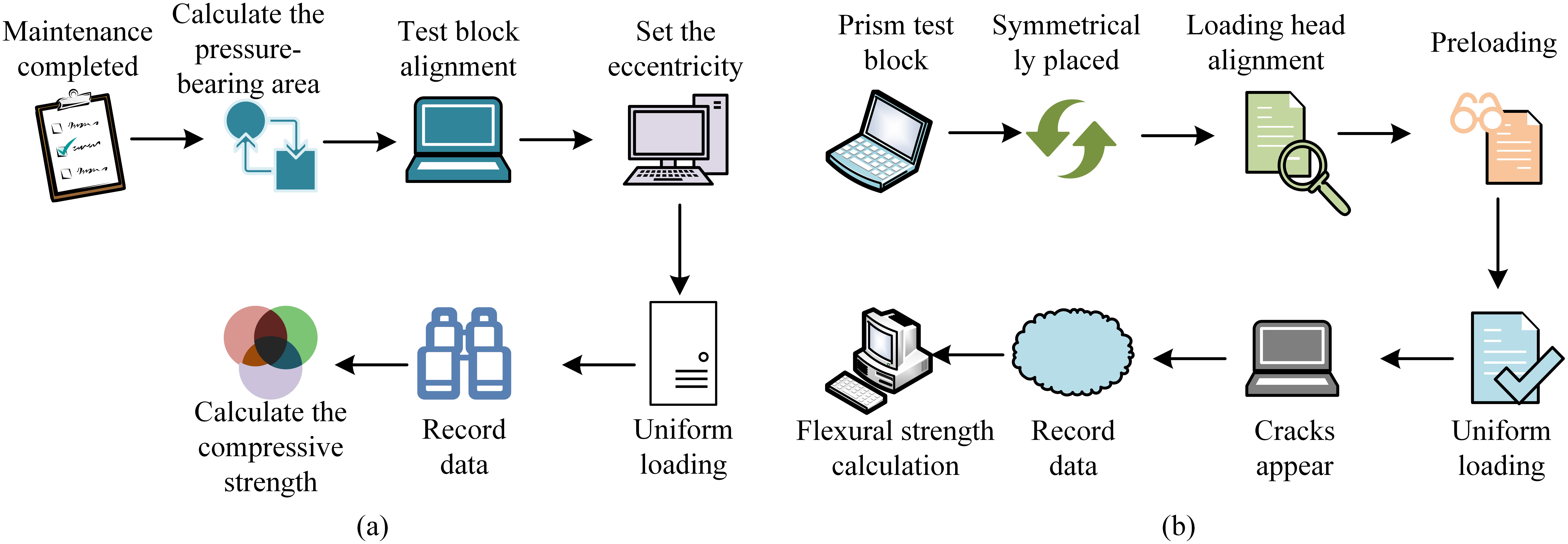
The specific steps for testing the MPs of modified concrete TBs are shown in Figure 1.
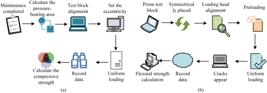
Test steps for MPs of modified concrete specimens, including (a) compressive strength test, (b) flexural strength test.
In Figure 1(a), step 1 is to take out the cured TB and dry the surface moisture, and measure the TB’s size to calculate the pressure-bearing area. During the test, the TB’s axis is aligned with the center of the pressure plate of the PTM, and the eccentricity is set to be less than or equal to ±5% of the side length of the TB. The next step is to start the PTM, set the loading rate to 0.05 MPa/s, load the TB continuously and evenly until it breaks, and record the maximum load and failure form of the TB. In Figure 1(b), the flexural test requires the concrete TB to be prepared into a prism with a size of 150 × 150 × 550 mm. For the test, the TB is placed symmetrically on the support of the anti-flexural device of the PTM, with the loading head aligned with the mid-span, and the deviation is ≤±1 mm. Subsequently, a load of ≤1 kN is applied for preloading, and during formal loading, 0.08 MPa/s is used for uniform loading until failure. The damage is judged based on the occurrence of a 0.2 mm mid-span crack. The FS of concrete (Ff) is calculated as equation (6) [22].
In equation (6), F is the concrete failure load. L denotes the distance between the anti-bending device supports. b and h are the width and height of the concrete TB. The specific steps of the durability performance test of the modified concrete TB are shown in Figure 2.

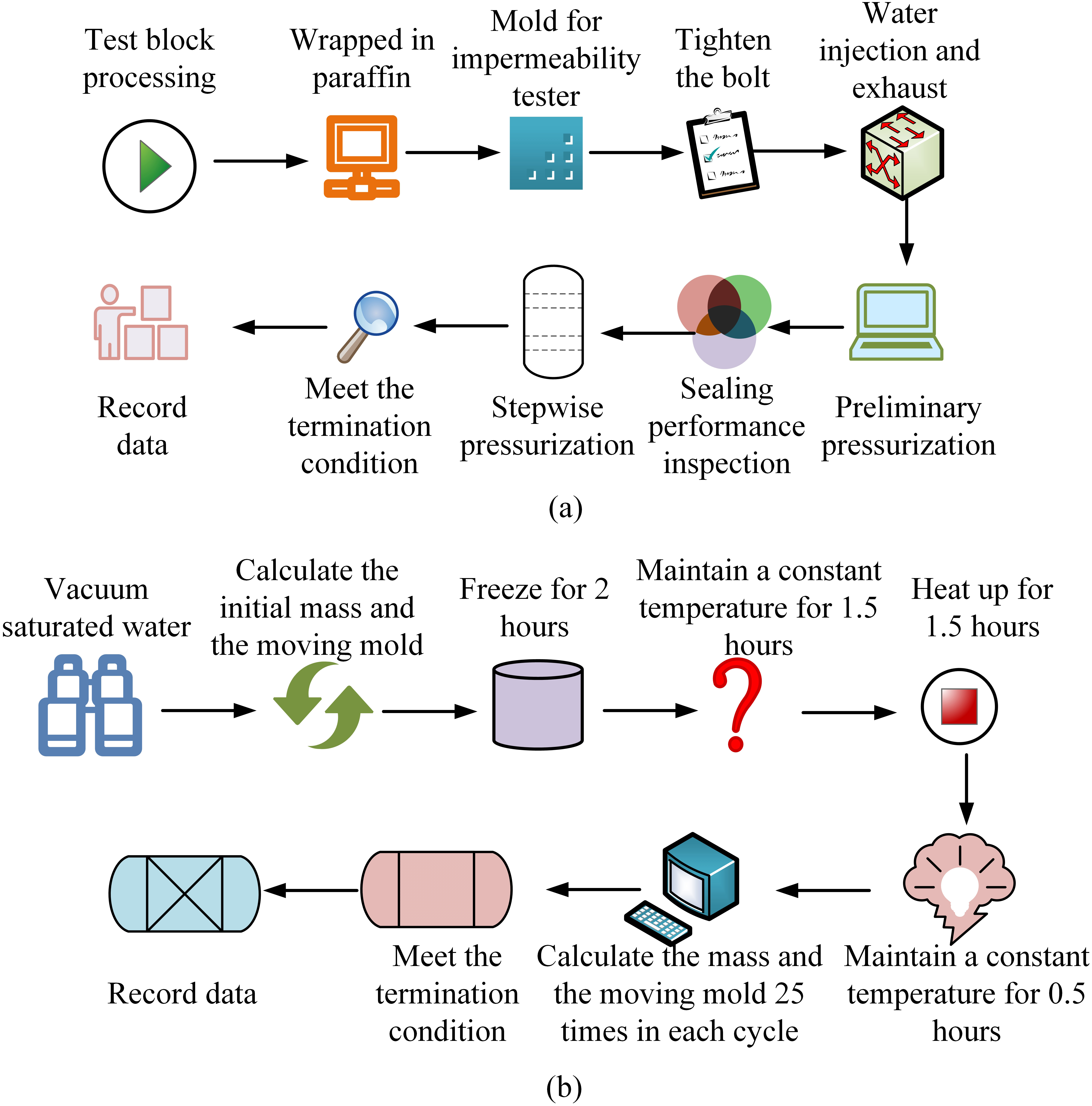
Durability test steps, including (a) impermeability performance test and (b) frost resistance performance test.
In Figure 2(a), the cured and cleaned TB is placed in melted paraffin so that the side of the TB is wrapped with 1 to 2 mm of paraffin to prevent water seepage on the side wall. The TB is then installed on the impermeability meter mold and the bolts are tightened symmetrically. The anti-permeability meter is opened and subjected to water injection and exhaust treatment. It is initially pressurized to 0.2 MPa, and the sealing performance of the instrument is checked for 24 hours under temperature and pressure. After the test started, the pressure is increased step by step, each step is increased by 0.1 MPa, and the pressure is stabilized for 8 hours. The test is terminated when 2/3 of the TBs has water seepage or the pressure reaches the design value, and the water seepage pressure value and water seepage height of each TB are recorded. In Figure 2(b), the anti-freeze test requires the TB to be in a vacuum-saturated state, and the initial mass and dynamic elastic modulus (DEM) of the TB are measured. A single freeze-thaw test is divided into two steps: freezing and thawing. When freezing, the center temperature of the TB is dropped to –18 °C within 2 h, maintained at a constant temperature for 1.5 h, then raised to 8 °C within 1.5 h, and kept at a constant temperature for 0.5 h. In the anti-freeze test, the mass and dynamic elasticity of the TB are measured after 25 cycles per cycle. The experiment is terminated when the TB meets any of the following conditions, that is, the DEM drops to 60% of the initial value, the mass loss rate is >5%, and the design cycle number is reached. The calculation of the dynamic modulus of the TB is shown in equation (7) [23].
In equation (7), E0 is the initial dynamic modulus, which represents the ability of concrete to resist elastic deformation and is the core index of frost resistance durability. L' is the clear distance between the supports of the prism specimen. m is the wet mass of the specimen after being saturated with water. f0 is the initial fundamental frequency of the TB. α is the cross-sectional side length of the TB.
2.5. Microscopic characterization methods
To explore the chemical mechanism of synergy, physical phase and thermogravimetric analysis (TGA) are conducted on cement paste samples cured for 28 days. Samples are hydrated with isopropyl alcohol and dried under vacuum before testing.
X-ray diffraction (XRD) analysis: Tests were conducted using a Bruker D8 Advance diffractometer using a Cu Kα radiation source at 40 kV and 40 mA. The scan range was 5–70° (2θ) with a step size of 0.02°. The Rietveld refinement method was used for quantitative phase analysis (QXRD).
TGA: A Mettler Toledo TGA/DSC 3+ analyzer was utilized, heated from 30 °C to 900 °C under a nitrogen atmosphere at a heating rate of 10 °C/min.
2.6. Statistical analysis
To ensure the reliability and reproducibility of the data, a consistent sample size of three replicates (n = 3) was maintained for all mechanical properties (compressive and flexural strength) and durability tests (permeability and frost resistance) across every mix proportion. All experimental results are presented as the mean value ± standard deviation (SD), represented by error bars in the figures. Data processing and graphical plotting were performed using OriginPro 2021 software. To determine the statistical significance of the improvements observed in the modified groups compared to the reference group, as well as the differences between single-doped and composite-doped groups, a one-way Analysis of Variance (ANOVA) was conducted. This was followed by Tukey’s HSD (Honestly Significant Difference) post-hoc test for multiple comparisons. A probability value of p < 0.05 was considered to indicate a statistically significant difference.
3. RESULTS
3.1. Modified concrete MPs
3.1.1. CS
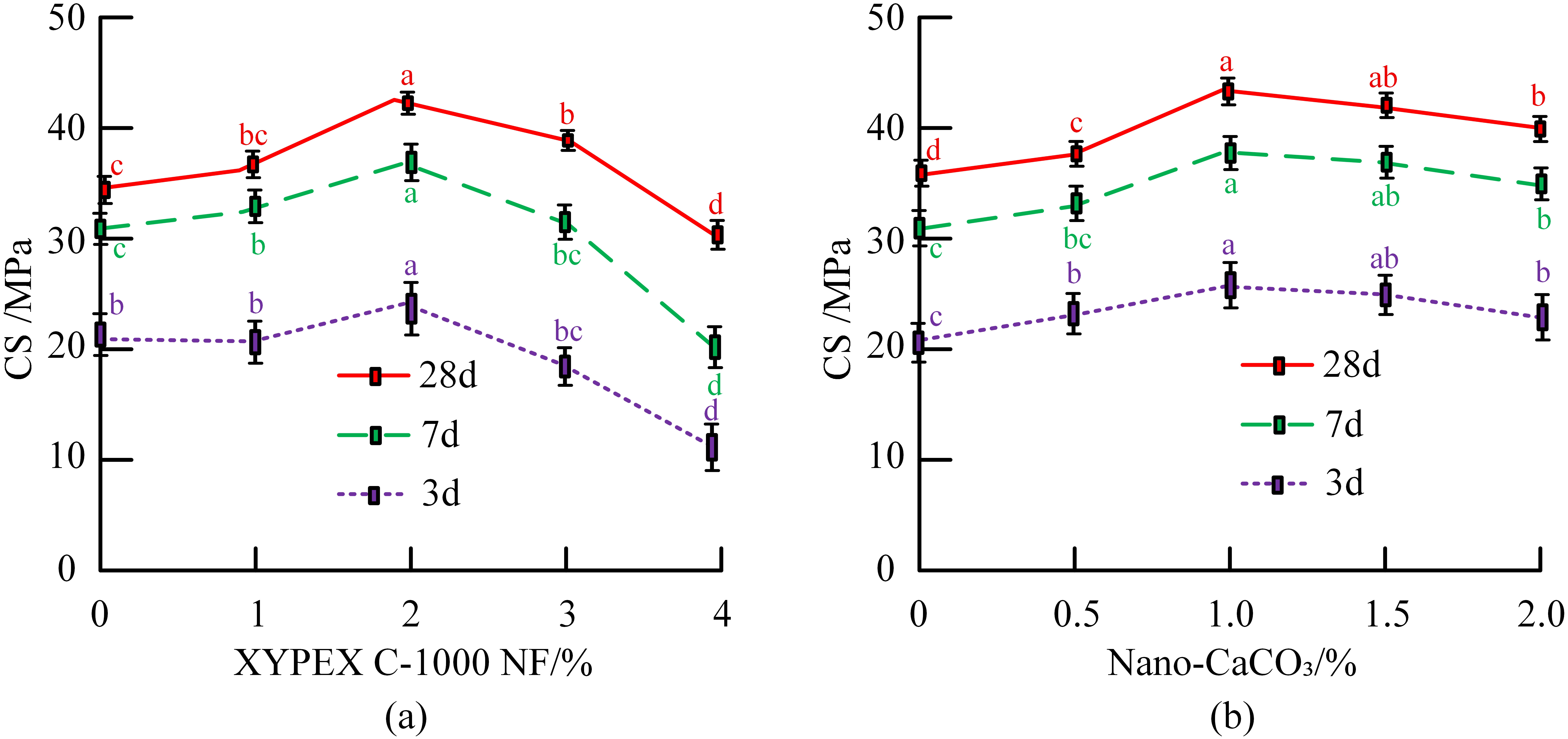
A fully automatic PTM was taken to test the CS of a cube TB with a side length of 100 mm. Figure 3 shows the change pattern of the CS of concrete when XYPEX C-1000 NF or nano-CaCO3 is added alone. In Figure 3(a), as the XYPEX content increased, the CS first increased and then decreased. At 2% dosage, the strength reached the peak at each age. After curing for 28 d, the CS of the 2% XYPEX group was 43.2 MPa, which was 6.4 MPa, 3.8 MPa, 1.7 MPa, and 11.5 MPa higher than those at 0%, 1%, 3%, and 4% dosage. This significant increase in strength could be attributed to XYPEX’s unique crystallization mechanism. Its active components reacted with cement hydration products to form dendritic crystals that were insoluble in water. These crystals effectively filled and blocked the micron-scale capillary pores and micro-cracks in the matrix, thereby improving the density of the concrete matrix and optimizing stress distribution. However, when the dosage exceeded 2%, excess crystals might be locally enriched, forming areas of stress concentration, which in turn became the weak points of the structure, causing a decrease in strength. In Figure 3(b), the CS of the concrete TB also increased first and then decreased as the content of nano-CaCO3 increased, but its changing trend was relatively slow. The maximum CS was achieved when the nano-CaCO3 content was 1%. The CS of the concrete TB with a curing age of 28 days was 43.5 MP, which was 5.3 MPa and 17.9 MPa higher than the TBs cured for 7 d and 3 d, and 6.7 MPa higher than the TB cured for 28 d and with a dosage of 0%. The enhancement mechanism lied in the filling effect and nucleation effect of nanoparticles, which promoted the formation of a denser C-S-H gel network. Similarly, when the dosage was too high (>1.0%), the nanoparticles were prone to agglomeration due to van der Waals forces and could not be uniformly dispersed, forming microscopic defects in the matrix, thereby weakening the reinforcement effect.

Effect of (a) XYPEX and (b) nano-CaCO3 alone on the CS of concrete. Data are presented as mean ± SD (n = 3). Different letters (a, b, c, d) indicate statistically significant differences between dosage groups at the same curing age (p < 0.05).
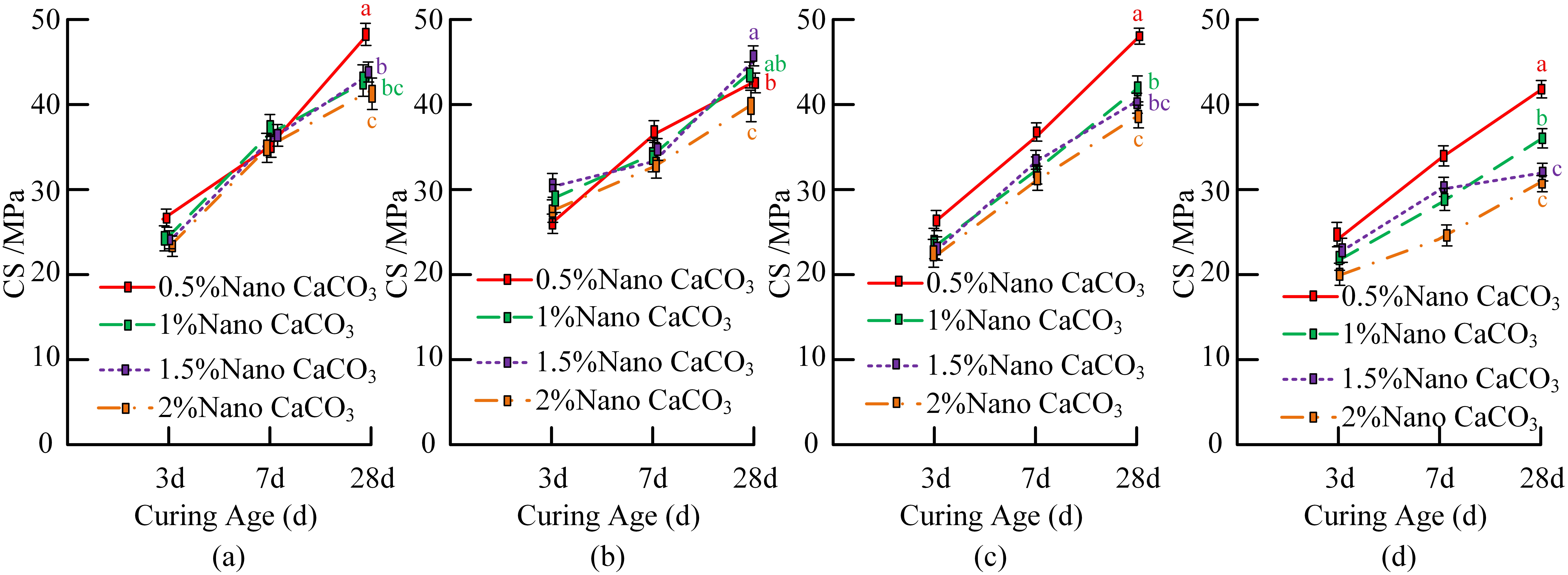
In Figure 4, composite doping shows a significant synergistic enhancement effect. In particular, the combination of 1% XYPEX and 0.5% nano-CaCO3 achieved the highest CS of 48.5 MPa at 28 d of age. This value was superior to the baseline group and exceeded the peak value in any single doping case, reflecting the significant synergy effect. The mechanism could be explained as follows: XYPEX blocks capillary channels at the micron scale, while nano-CaCO3 fills the pores between C-S-H gels at the nanoscale and accelerates hydration. This multi-scale pore optimization significantly reduced the total amount and size of internal structural defects in concrete, thereby significantly improving the macroscopic MPs. However, in Figure 4(d), when the dosage of XYPEX was too high, even if nano-CaCO3 was added to the composite, the strength decreased, which once again confirmed the negative impact that excessive crystals may bring. The combination of 1% XYPEX and 0.5% nano-CaCO3 was the best dosage combination for the CS of concrete, which could provide the best compressive performance for the TBs at different curing ages.
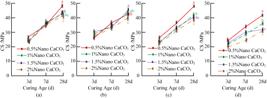
Impact and synergistic effect of XYPEX and nano-CaCO3 compound addition on the CS of concrete with (a) 1% XYPEX C-1000 NF, (b) 2% XYPEX C-1000 NF, (c) 3% XYPEX C-1000 NF, and (d) 4% XYPEX C-1000 NF, respectively. Data are presented as mean ± SD (n = 3). For visual clarity, statistical significance is annotated only at the 28-day curing age. Different colored letters (a, b, c) indicate statistically significant differences between nano-CaCO3 dosage groups within the same XYPEX content (p < 0.05).
3.1.2. FS and toughness

When XYPEX C-1000 NF or nano-CaCO3 was added alone, the FS comparison of concrete at different dosages is shown in Figure 5. The change pattern was similar to the CS. When two admixtures were added, the performance of the TB first increased and then decreased as the amount of admixture increased. In Figure 5(a) and (c), when the addition amount of nano-CaCO3 was 1.0%, the maximum FS was 6.2 MPa after curing for 28 d, which was 1.6 MPa higher than the control group. When the XYPEX addition amount was 2%, the maximum FS was 5.7 MPa after curing for 28 d, which was 0.9 MPa surpassed the control group. In Figure 5(b) and (d), the compression ratio of the concrete TB reflected the toughness and crack resistance of the concrete. The larger the compression ratio, the better the performance of the concrete. When the addition amount of nano-CaCO3 was 1.0%, the optimal compression ratio was 13.4% after 28 days of curing, which was 1.3% superior to the control group. When the XYPEX addition amount was 2%, the optimal folding ratio was 12.9% after curing for 28 d, which was 0.8% outperformed control group.
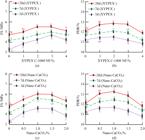
Effect of single addition of (a)–(b) XYPEX and (c)–(d) nano-CaCO3 on the FS and pressure drop ratio (PDR) of concrete. Data are presented as mean ± SD (n = 3). Different colored letters (corresponding to the curve colors) indicate statistically significant differences between dosage groups at the respective curing age (p < 0.05).

Figure 6 is a comparison of the FS of concrete TBs when compounded. In Figure 6(a)–(d), the combination of 1% XYPEX and 1% nano-CaCO3 achieved a maximum FS of 5.7 MPa when cured for 28 days. Incorporating an appropriate amount of modifier could increase the FS, indicating that the brittleness of the material is improved. This might be because the generated network structure of crystals and nanoparticles can effectively inhibit the expansion of microcracks and absorb more energy when the TB is bent, thereby improving its toughness. In Figure 6(e)–(h), the concrete TB was also cured for 28 days. The optimal compression ratio was obtained when the combination of 1% XYPEX and 1% nano-CaCO3 was used. The optimal compression ratio was 14.9%, which was 2.8% higher than the benchmark group without adding admixtures.
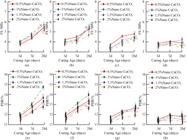
Synergistic effect of adding 1%, 2%, 3%, and 4% XYPESC-1000 NF in nano-CaCO3 compound on the (a)–(d) FS and (e)–(h) PDR of concrete. Data are presented as mean ± SD (n = 3). For visual clarity, statistical significance is annotated only at the 28-day curing age. Different colored letters (corresponding to the curve colors) indicate statistically significant differences between nano-CaCO3 dosage groups within the same XYPEX content (p < 0.05).
3.1.3. Synergistic efficiency analysis
To rigorously quantify the interaction between XYPEX and nano-CaCO3, rather than relying solely on comparative descriptions as seen in previous studies [11, 24], a Synergistic Efficiency (SE) index was introduced. This metric mathematically distinguishes between simple additive effects and true cross-scale synergy by comparing the performance gain of the composite mix against the sum of the gains provided by the individual admixtures. The SE index is calculated as per Equation (8):
Where:
-
Pcomb, Pref, PXY, and PNC represent the specific property value (e.g., 28-day Compressive Strength) of the composite modified concrete, reference concrete, single-doped XYPEX concrete, and single-doped nano-CaCO3 concrete, respectively.
-
Evaluation Criteria: SE > 1: Indicates positive synergy (The whole is greater than the sum of its parts, “1 + 1 > 2”). SE ≈ 1: Indicates a simple superposition (additive) effect. SE < 1: Indicates an antagonistic effect (negative interaction).
Analysis of Results:
Based on the experimental data presented in Section 3.1.1, for the optimal compressive strength mix (1% XYPEX + 0.5% nano-CaCO3):
-
The actual strength gain of the composite group is 11.7 MPa (an increase of 31.8% over the reference).
-
The sum of individual gains is only 3.3 MPa (comprising a 7.1% increase from 1% XYPEX and a 1.9% increase from 0.5% nano-CaCO3).
-
Substituting these values into Eq. (8) yields a remarkably high SE value of 3.55.
Since SE = 3.55 ≫ 1.0, this provides robust mathematical evidence of a strong positive cross-scale synergy. This high value reveals that while 0.5% nano-CaCO3 alone provides minimal physical reinforcement (1.9%), its role in the composite system is catalytic. It effectively acts as a nucleation promoter that accelerates the release of Ca(OH)2, which is then immediately consumed by XYPEX to form extensive pore-blocking crystals, resulting in a performance leap that far exceeds the sum of their individual contributions.
3.2. Modified concrete durability properties
3.2.1. Impermeability
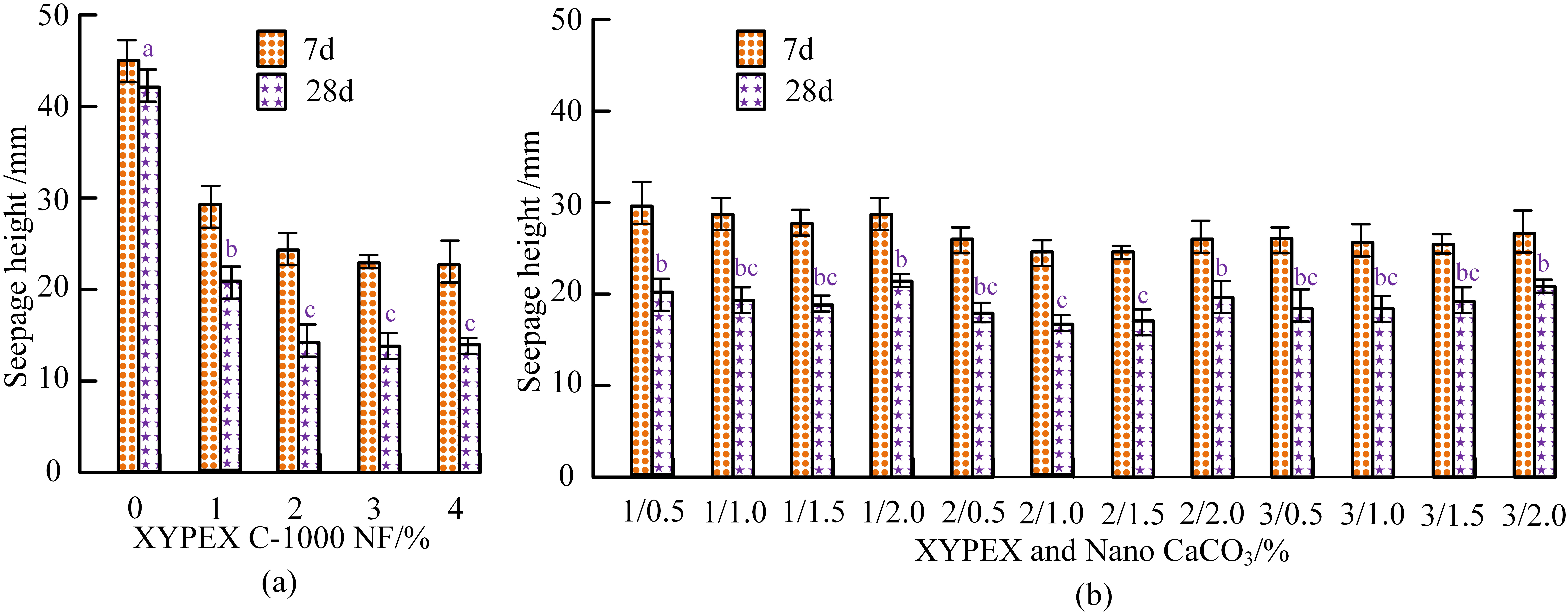
The comparison of the anti-permeability properties of concrete TBs when adding different admixtures is shown in Figure 7.
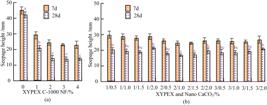
Comparison of concrete anti-permeability properties under (a) single XYPEX and (b) XYPEX and nano-CaCO3. Data are presented as mean ± SD (n = 3). For visual clarity, statistical significance is annotated only at the 28-day curing age. Different colored letters (purple) above the 28-day bars indicate statistically significant differences between dosage groups (p < 0.05).
The incorporation of XYPEX C-1000 NF significantly improved the impermeability of concrete, as shown by the continuous decrease in water seepage height as its dosage increased (Figure 7(a)). This enhancement effect was positively related to the XYPEX dosage, and the effect was particularly significant at low dosages. When no protection was provided, the water seepage heights after 7 d and 28 d of curing were 46 mm and 42 mm. When the dosage of XYPEX C-1000 NF was 1%, the water seepage height dropped by 21 mm after 28 d of curing. When the dosage of XYPEX C-1000 NF was 2%, the water seepage height dropped by 28 mm compared with the control group. As the dosage of XYPEX C-1000 NF continued to increase, the concrete water seepage height decreased slowly. This was because the crystals generated by XYPEX C-1000 NF could block the capillary channels of concrete and slow down the further penetration of the admixture. In Figure 7(b), when the dosage of XYPEX C-1000 NF was the same, the impermeability of concrete increased with nano-CaCO3, first increased and then decreased. The minimum water penetration height was obtained when 2% XYPEX C-1000 NF and 1.0% nano-CaCO3 were combined, and the minimum value was 17 mm.
3.2.2. Anti-freeze properties
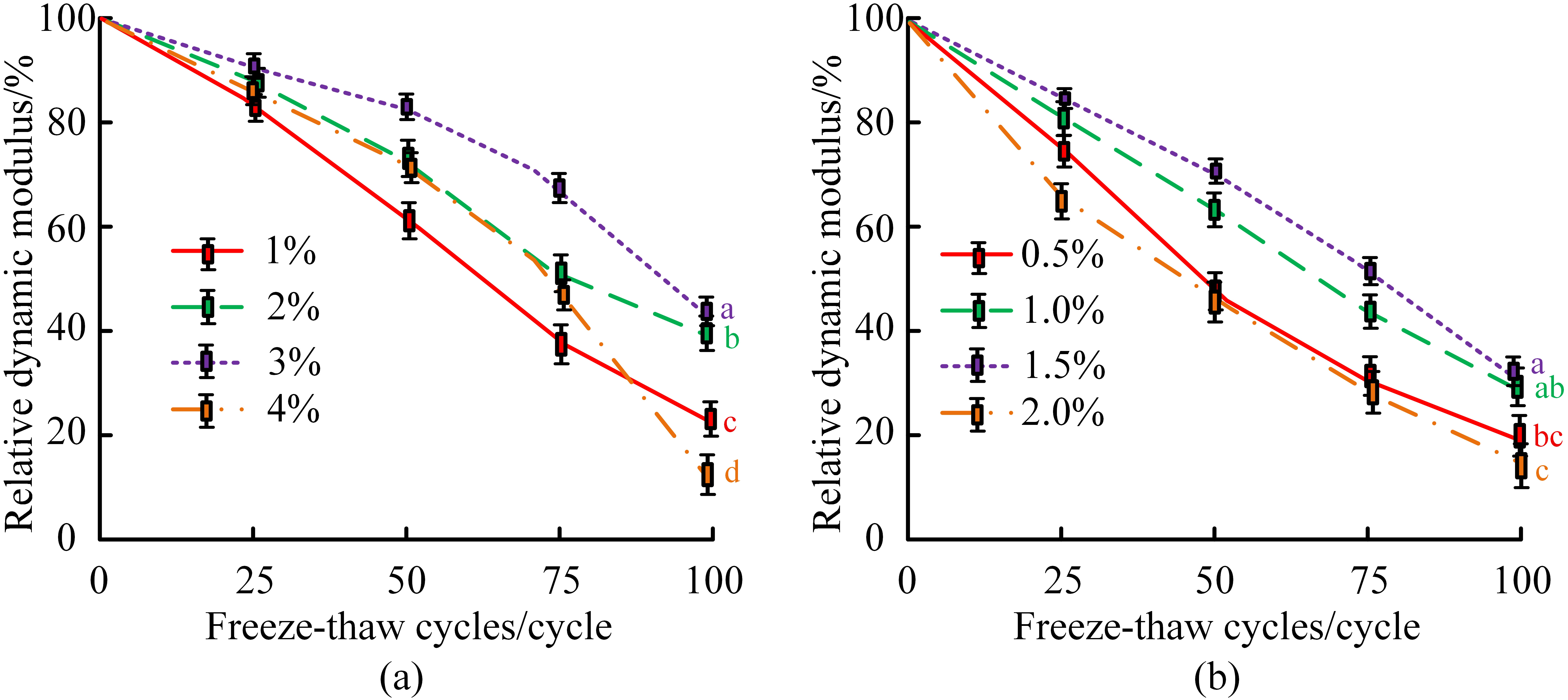
When XYPEX C-1000 NF or nano-CaCO3 is added alone, the comparison of the frost resistance performance of concrete at different dosages is shown in Figure 8.
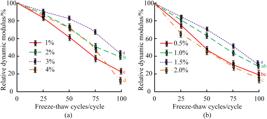
Comparison of concrete frost resistance under different dosages of (a) XYPEX and (b) nano-CaCO3, respectively. Data are presented as mean ± SD (n = 3). For visual clarity, statistical significance is annotated only at 100 freeze-thaw cycles. Different colored letters (corresponding to the curve colors) indicate statistically significant differences between groups (p < 0.05).
In Figure 8(a), the concrete TBs were tested after normal curing for 28 days. As the dosage of XYPEX C-1000 NF increased, the falling speed of concrete relative to the DEM first decreased and then increased, and the minimum falling speed was achieved at a dosage of 3%. The relative dynamic modulus after 100 FTCs at 3% content was 44.7%, which was 22.8%, 4.9% and 10.2% higher than that at 1%, 2% and 4% content. In Figure 8(b), when the nano-CaCO3 content was 0.5 and 2.0%, the relative DEM of concrete decreased the fastest, and the 1.5% content achieved the best frost resistance. When frozen and thawed 100 times, the relative elasticity modulus was 30.5%, which was 14.2% lower than 3% XYPEX C-1000 NF. When XYPEX C-1000 NF and nano-CaCO3 were added in compound, the frost resistance performance comparison of concrete TBs is shown in Table 5.
According to the single-addition test results (Figure 8), 4% XYPEX C-1000 NF and 2.0% nano-CaCO3 have shown a decreasing trend in anti-freeze performance, so these ratios were not included in the subsequent compound addition test (Table 5). At the beginning of the FTC, the relative DEM of the concrete TBs with various compound dosages was above 80%. Except for 1% XYPEX and 0.5% nano-CaCO3, the mass losses were all below 0.5%, indicating that the two admixtures can effectively improve the initial frost resistance of concrete. As the amount of FTCs increased, the relative DEM of all concrete TBs gradually decreased, and the mass loss continued to increase. The greatest improvement in the frost resistance of concrete TBs was the combination of 3% XYPEX C-1000 NF and 1.5% nano-CaCO3. When frozen and thawed 100 times, the relative DEM and mass loss of concrete were 55.9% and 0.6%.
3.3. Microstructural analysis
The micromorphology of concrete before and after modification is shown in Figure 9.
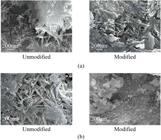
Comparison of microscopic morphology of concrete before and after modification, with curing times of (a) 3 days and (b) 28 days.
In Figure 9(a), the electron microscope image of the concrete before modification showed a large number of needle-like crystals, and there were lots of micron-sized pores and micro-cracks in the structure. Before modification, the concrete showed an amorphous flocculent structure with uneven distribution, and crystals were enriched in the transition zone, forming a weak layer. After modification, the needle-like crystals were greatly reduced, forming a more complete and concentrated gel, and the pores were blocked, which greatly improved the MPs and durability of concrete. In Figure 9(b), the concrete structure after full curing was more compact than after curing for 3 days, reducing the probability of larger pores. After modification, the crystals generated by XYPEX C-1000 NF filled the pores and formed a dense network structure with concrete. The nanoparticles filled the pores between cement particles and gel, significantly improving the density.
3.4. Chemical mechanism analysis
To further reveal the internal driving force of microstructure densification and macroscopic performance improvement from a chemical level, this study conducted QXRD and TGA analyses on representative samples after curing for 28 days.
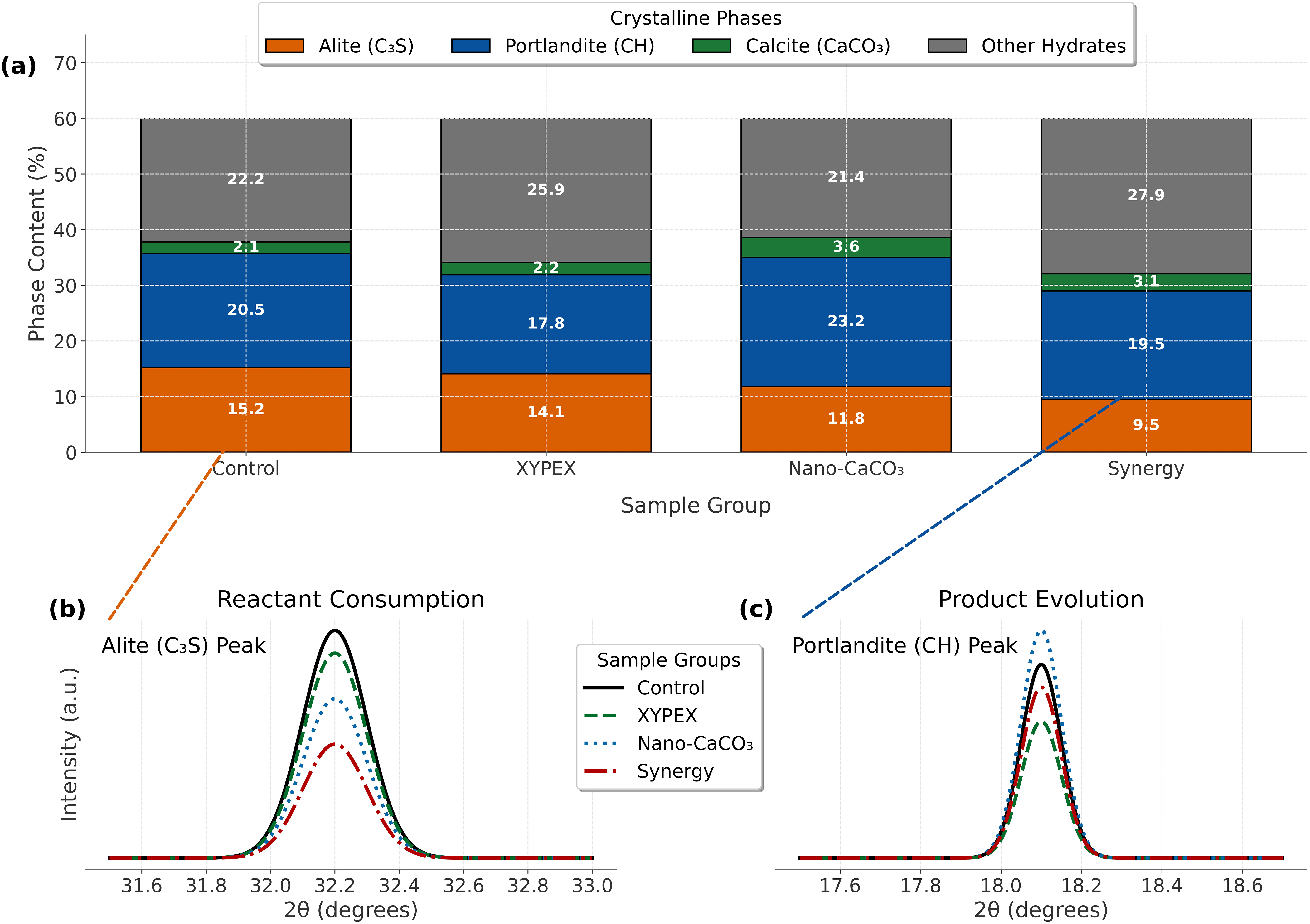
Figure 10 shows the quantitative analysis results of QXRD. The stacked bar chart in Figure 10(a) shows that the Synergy group exhibits the lowest residual alite (C3S) content, only 9.5%, which is significantly lower than the baseline group (15.2%). Figure 10(b) also qualitatively proved this weakened diffraction peak intensity, which provided direct chemical evidence that the composite admixture most effectively accelerates the cement hydration process. The evolution of the key hydration product CH offered the clearest insight into the synergistic mechanism. The sample group fusing nano-CaCO3 alone produced the most CH (23.2%), proving its role as a hydration accelerator, while incorporating XYPEX alone had a reduced CH content (17.8%), validating that it consumes CH for its pore-filling crystallization process. The synergistic group displayed a moderate CH content (19.5%). It proved an efficient “generation-consumption” dynamic equilibrium: nano-CaCO3 accelerated the CH generation. These generated CHs were then consumed by XYPEX to form additional crystalline product. Figure 10(c) shows this dynamic process. The CH peak of the synergy group was lower than the nano-CaCO3 group, but higher than the XYPEX group.

28 d effect of synergistic effect on cement hydration characterized by QXRD, including (a) quantitative phase composition of 4 groups, (b) C3S main peak’s original diffraction pattern detail (reactant consumption extent), and (c) CH main peak’s details (key hydration product’s evolution process).
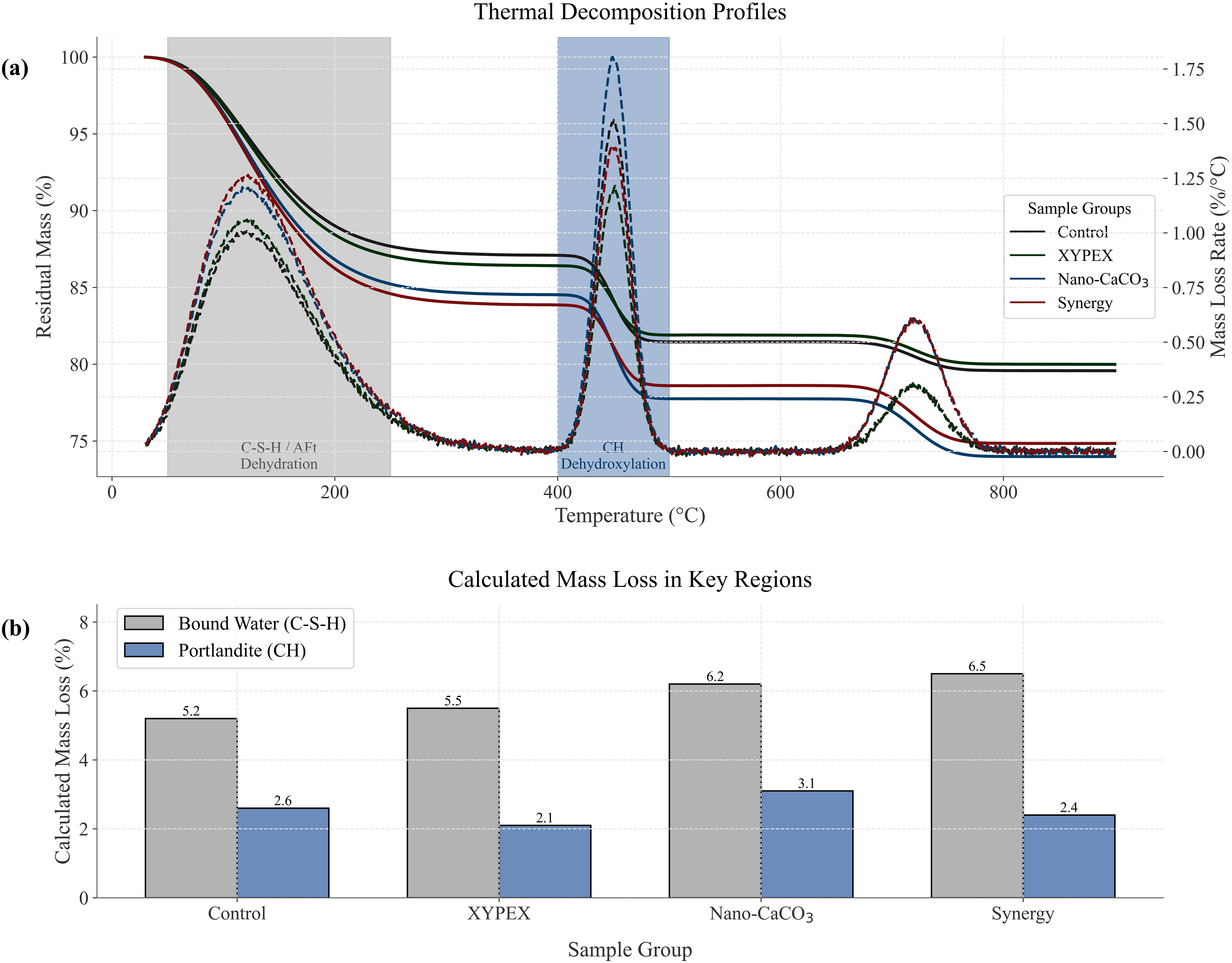
The TGA/DTG comparison illustrated in Figure 11 offers mutual validation and complementation for the preceding findings. In Figure 11(a), the synergistic group (red curve) demonstrated the maximum total weight loss, which stems from its highest chemical bound water content, further affirming its optimal hydration degree. In Figure 11(b), for elaborate quantification, the bar chart exhibited the calculated weight loss in key zones. The synergistic group achieved the highest bound water content (6.5%), corresponding to hydrates including C-S-H gel, while its CH content (2.4%) confirmed the QXRD observations: it is considerably < nano-CaCO3 (3.1%) but > XYPEX (2.1%).
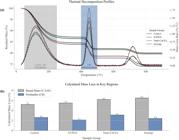
Synergistic effect on hydration products quantified by TGA/DTG, including (a) TGA and DTG curves for all sample groups (thermal decomposition characteristics). Shaded area: the interval between C-S-H/AFt dehydration and CH dehydroxylation and (b) calculated mass loss within critical intervals, providing quantitative comparison of hydration products.
The 2 chemical analyses together built a complete chain of evidence, confirming the chemical nature of the synergistic mechanism: nano-CaCO3 served as a nucleation accelerator to enhance reaction kinetics; XYPEX functioned as a reactive sink to efficiently utilize key by-products, finally maximizing the total volume of hydration products and the microstructure’s density.
4. DISCUSSION
The fusion of XYPEX admixture and nano-CaCO3 has an obvious synergistic enhancement effect on the concrete’s mechanical properties and durability. This leap in macroscopic performance is rooted in a profound chemical and physical synergy mechanism.
4.1. Physico-chemical synergy mechanism
Physically, this synergy is manifested as a “Hierarchical Filling Effect”. SEM analysis (Figure 9) demonstrates that the synergistic effect causes a denser microstructure. The micron-sized crystals generated by XYPEX fill and block capillary pores, while nano-CaCO3 particles fill the nanoscale pores between C-S-H gels, jointly building a densified structure from nanometer to micrometer scale.
This synergy delivers effects that go beyond the sum of their parts. For instance, the 31.8% increase in compressive strength achieved by the composite blending of 1% XYPEX and 0.5% nano-CaCO3 significantly exceeds the arithmetic sum of their individual contributions (~9%). This is quantitatively confirmed by the high Synergistic Efficiency index (SE = 3.55), offering direct mathematical evidence for the proposed mechanism.
Chemically, this synergistic effect acts as a “Synergistic Regulation of Hydration Process”. QXRD and TGA analysis (Figures 10 and 11) reveal the driving force for the first time in essence: nano-CaCO3 provides abundant nucleation sites for hydration products via heterogeneous nucleation, acting as a nucleation promoter to significantly accelerate cement hydration and the generation of Ca(OH)2. Simultaneously, XYPEX acts as a reactant consumer, efficiently utilizing this newly generated Ca(OH)2 through its active components to form additional pore-filling crystals. This process establishes an efficient “production-consumption” dynamic steady state, maximizing the overall hydration products and the efficiency of microstructural densification.
4.2. Comparison with existing modification strategies
To explicitly highlight the novelty of the “cross-scale hierarchical collaboration” proposed in this study, Table 6 compares the modification strategies and mechanisms reported in representative literature with the approach taken in this work.
Comparison of modification strategies and synergistic mechanisms between this study and representative literature.
As summarized in Table 6, distinct limitations exist in previous single-scale modification strategies. Studies focusing solely on crystalline admixtures, such as ROIG-FLORES et al. [25] and GOJEVIĆ et al. [26], confirmed their efficacy in healing micron-scale cracks but noted a limited capacity to densify the intrinsic nanoscale pore structure of the cement paste. Conversely, research on nano-composites, such as WANG et al. [11] and ARIYAGOUNDER and VEERASAMY [24], demonstrated excellent nanoscale pore refinement but lacked the active crystal growth mechanism necessary to seal larger capillary voids.
Recent attempts to combine chemical agents with nanoparticles, such as the work by REN et al. [27] using Nano-SiO2 and silicates, represent a step forward. However, a theoretical limitation in such systems is the competition for reactants: both the pozzolanic reaction of Nano-SiO2 and the crystallization reaction of the admixture consume Ca(OH)2, potentially leading to a depletion of reactants. In contrast, the unique novelty of the XYPEX + nano-CaCO3 system proposed in this study lies in its chemically complementary nature. Nano-CaCO3 acts primarily as a nucleation site to accelerate C3S hydration, thereby promoting the release of Ca(OH)2 rather than consuming it. This creates a calcium-rich environment that provides sufficient reactants for the XYPEX active chemicals, ensuring optimal crystallization efficiency. This “Generation-Consumption” synergy, combined with the physical “Hierarchical Filling” from nanometer to micrometer scales, explains the superior mechanical and durability performance (SE ≫ 1) observed in the composite group.
4.3. Optimization of mechanical and durability performance
The mechanical property outcomes confirm that the composite modified group is superior to the single-modified and baseline groups, indicating a functional complementarity. Interestingly, the optimal dosage for Compressive Strength (CS) (1% XYPEX + 0.5% NC) differs from that for Flexural Strength (FS) (1% XYPEX + 1.0% NC). This variation reveals the differentiated microstructural requirements for different mechanical properties. CS is primarily dependent on the Bulk Matrix Density. At 0.5% nano-CaCO3, the nucleation promoting effect is sufficient to form an efficient synergy with XYPEX’s micron-level filling, minimizing the overall porosity to achieve peak compressive strength. Conversely, FS is more sensitive to the strengthening of the Interfacial Transition Zone (ITZ) and the bridging effect across microcracks. A higher dosage (1.0%) of nano-CaCO3 is required to shape a denser nanofilling network within the porous ITZ region, thereby providing a more effective crack-bridging mechanism. This finding aligns with the observations of MOHAMMED et al. [14] regarding nanoparticle-strengthened ITZ.
Regarding durability, the improvements in impermeability and frost resistance further validate the efficacy of the hierarchical pore structure optimization. The group demonstrating the highest impermeability (2% XYPEX + 1.0% nano-CaCO3) indicates that a sufficient concentration of XYPEX is required to interrupt interconnected capillary networks, while nano-CaCO3 further reduces the critical pore radius. As noted by RIEG et al. [28], the connectivity and distribution of the pore system are decisive factors governing the permeability coefficient and mechanical resistance of concrete. For frost resistance, the optimal combination (3% XYPEX + 1.5% nano-CaCO3) provided the highest retention of dynamic elastic modulus. This suggests that a denser microstructure effectively relieves osmotic pressure during freezing. However, it is crucial to interpret these laboratory freeze-thaw results with caution regarding real-world applications. Standard accelerated freeze-thaw tests (e.g., rapid temperature cycles from –18°C to +8°C) induce hydraulic pressures that often exceed those encountered in natural environments. While the relative improvement over the control group is valid, the absolute service life prediction in actual engineering structures should consider coupled deterioration mechanisms, such as wetting-drying cycles and environmental load, which were not simulated in this isolated test.
Finally, it must be noted that excessive incorporation of either component induces performance deterioration. An excessive dosage of XYPEX (≥ 4%) may lead to the localized aggregation of crystals, creating stress concentration regions; whereas overuse of nano-CaCO3 (≥ 2%) is liable to cause agglomeration, introducing novel interfacial defects. This emphasizes that rigorous control of admixture dosage is essential in practical applications to balance the trade-off between material dispersibility and synergistic efficiency.
5. SUMMARY
This paper systematically explored the synergistic enhancement effect of XYPEX admixture and nano-CaCO3 on concrete properties. The main conclusions:
-
A novel paradigm of “graded synergy” and its dual mechanism are developed and clarified: The core contribution is to construct and verify a new paradigm of “graded synergy” that achieves cross-scale enhancement of concrete performance by the composite of XYPEX and nano-CaCO3. Its mechanism originates from the dual-synergy of physics and chemistry: Physically, it achieves “graded pore filling” from nanometers (nano-CaCO3 filling) to micrometers (XYPEX crystallization); Chemically, it establishes a “generation-consumption” dynamic balance in which nano-CaCO3 acts as a nucleation core to accelerate CH generation, and XYPEX functions as a chemical consumer to efficiently utilize CH for crystallization.
-
The optimal dosage combination under multiple performance objectives is determined: This article systematically assesses the impact of various dosage combinations on the MPs and durability of concrete, and determines the optimal ratio for specific performance goals, including: CS (1% XYPEX + 0.5% nano-CaCO3), FS (1% nano-CaCO3), and anti-freeze properties (3% XYPEX + 1.5% nano-CaCO3). These findings provide critical data support for the precise engineering design of high-performance concrete.
-
The negative effects of excessive incorporation and the key to control are revealed: This paper also clarifies that excessive incorporation of any component (XYPEX ≥ 4% or nano-CaCO3 ≥ 2%) will lead to performance degradation. The mechanisms lie in stress concentration caused by crystal enrichment and interface defects introduced by nanoparticle agglomeration. This emphasizes the importance of precise control of dosage to maximize synergistic effects in practical applications.
-
Future research directions and core challenges are identified. Although this study has achieved systematic results, future work should focus on two key areas to promote technology implementation: (1) Long-term service performance evaluation: performance evolution rules under real harsh conditions such as simulated marine environment (chloride ion erosion) and industrial waste gas environment (carbonization). (2) Breakthrough in the core bottleneck of industrial application: stable dispersion technology of nanomaterials that is economical, efficient, and highly compatible with existing admixture systems should be developed. In particular, achieving in-situ dispersion is a core challenge in promoting this cutting-edge technology from the laboratory to practical engineering applications. More importantly, the concept of “cross-scale hierarchical collaborative design” established in this study can be extended to other composite material systems such as polymers and ceramics, providing a highly promising design paradigm for the common scientific problem of controlling multi-scale defects.
6. ACKNOWLEDGEMENTS
The author would like to express sincere gratitude to Sen Yang (Sichuan Central Inspection Technology Inc.) for his valuable assistance and contributions during the preliminary stages of this research. Due to a recent job transition, he was unable to participate in the final stages of this manuscript, but his initial support is highly appreciated.
DATA AVAILABILITY
The data that support the findings of this study are available from the corresponding author upon reasonable request.
7. BIBLIOGRAPHY
-
[1] LU, D., ZHONG, J., “Carbon-based nanomaterials engineered cement composites: a review”, Journal of Infrastructure Preservation and Resilience, v. 3, n. 1, pp. 2, Jan. 2022. doi: https://doi.org/10.1186/s43065-021-00045-y.
» https://doi.org/10.1186/s43065-021-00045-y -
[2] KEDIR, A., GAMACHU, M., ALEX, A.G., “Cement‐based graphene oxide composites: a review on their mechanical and microstructure properties”, Journal of Nanomaterials, v. 2023, n. 1, pp. 6741000, Apr. 2023. doi: https://doi.org/10.1155/2023/6741000.
» https://doi.org/10.1155/2023/6741000 -
[3] BASHA, S.I., REHMAN, A.U., AZIZ, M.A., et al, “Cement composites with carbon-based nanomaterials for 3D concrete printing applications - a review”, Chemical Record : An Official Publication of the Chemical Society of Japan), v. 23, n. 4, pp. e202200293, Apr. 2023. doi: https://doi.org/10.1002/tcr.202200293.
» https://doi.org/10.1002/tcr.202200293 -
[4] YU, J., HOU, D.S., MA, H.Y., et al, “Nanomodified cement-based materials: review (2015-2020) of molecular dynamics studies”, Journal of Materials in Civil Engineering, v. 34, n. 3, pp. 3121002–3121015, Mar. 2022. doi: https://doi.org/10.1061/(ASCE)MT.1943-5533.0004056.
» https://doi.org/10.1061/(ASCE)MT.1943-5533.0004056 -
[5] ABDALLA, J.A., THOMAS, B.S., HAWILEH, R.A., et al, “Influence of nanomaterials on the workability and compressive strength of cement-based concrete”, Materials Today: Proceedings, v. 65, n. 9, pp. 2073–2076, Jan. 2022. doi: https://doi.org/10.1016/j.matpr.2022.06.429.
» https://doi.org/10.1016/j.matpr.2022.06.429 -
[6] KHAN, S.A., AMJAD, H., AHMAD, F., et al, “A scientometric review summarizing the impact of nanomaterials on the fresh, hardened, and durability properties of cement-based materials”, Advances in Civil Engineering, v. 2024, n. 1, pp. 8639483–8639492, Jan. 2024. doi: https://doi.org/10.1155/adce/8639483.
» https://doi.org/10.1155/adce/8639483 -
[7] ZHANG, H., ZHANG, R., LI, Y., “Analysis of the influence of XYPEX admixture on the frost resistance of nanometer CaCO3 concrete”, International Journal of Microstructure and Materials Properties, v. 17, n. 2-3, pp. 171–190, Apr. 2024. doi: https://doi.org/10.1504/IJMMP.2024.137976.
» https://doi.org/10.1504/IJMMP.2024.137976 - [8] OZZIE, V.V., SUWONDO, R., “Application of crystalline technology in concrete to increase its permeability and its resistance to sulphuric acid”, AIP Conference Proceedings, pp. 080020, Mar. 2024. doi: https://doi.org/10.1063/5.0199739.
-
[9] WANG, T., MA, X., MA, Y., et al, “Study on the effect of XYPEX admixture on the performance of panel concrete and microscopic mechanism”, Advances in Computer and Materials Scienc Research, v. 1, n. 1, pp. 57–65, Oct. 2024. doi: https://doi.org/10.70114/acmsr.2024.1.1.P57.
» https://doi.org/10.70114/acmsr.2024.1.1.P57 -
[10] SLDOZIAN, R.J.A., HAMAD, A.J., AL-RAWE, H.S., “Mechanical properties of lightweight green concrete including nano calcium carbonate”, Journal of Building Pathology and Rehabilitation, v. 8, n. 1, pp. 3, Nov. 2023. doi: https://doi.org/10.1007/s41024-022-00247-1.
» https://doi.org/10.1007/s41024-022-00247-1 -
[11] WANG, Z.-H., BAI, E.-L., XU, J.-Y., et al, “Effect of nano-SiO2 and nano-CaCO3 on the static and dynamic properties of concrete”, Scientific Reports, v. 12, n. 1, pp. 907, Jan. 2022. doi: https://doi.org/10.1038/s41598-021-04632-7. PubMed PMID: 35042890.
» https://doi.org/10.1038/s41598-021-04632-7 -
[12] RANGARAJAN, J., MATHISEKARAN, R., “Enhanced mechanical performance of reinforced concrete beams with nano-alumina: an experimental and analytical flexural study”, Matéria (Rio de Janeiro), v. 30, pp. e20250081, Aug. 2025. doi: https://doi.org/10.1590/1517-7076-rmat-2025-0081.
» https://doi.org/10.1590/1517-7076-rmat-2025-0081 -
[13] MOHAN, A.M.A., KALIAPPAN, S., NATRAYAN, L., et al, “Smart self-healing concrete infused with nanomaterials for sustainable construction and real-time structural monitoring”, Matéria (Rio de Janeiro), v. 30, pp. e20240969, Aug. 2025. doi: https://doi.org/10.1590/1517-7076-rmat-2024-0969.
» https://doi.org/10.1590/1517-7076-rmat-2024-0969 -
[14] MOHAMMED, A.-M.A., AL SAADI, H.K.H., FAHAD, A.-R.M., et al, “Influence of nano CaCO3 on pore structure and compressive strength in concrete bricks”, Journal of Building Engineering, v. 105, pp. 112520, May. 2025. doi: https://doi.org/10.1016/j.jobe.2025.112520.
» https://doi.org/10.1016/j.jobe.2025.112520 -
[15] GHAZANLOU, S.I., GHAZANLOU, S.I., GHAZANLOU, S.I., et al, “Multifunctional performance of core-shell rGO@Fe3O4 on the mechanical, electrical/thermal, EMI, and microstructure properties of cement-based composites”, Construction & Building Materials, v. 394, n. 5, pp. 132182–132190, Aug. 2023. doi: https://doi.org/10.1016/j.conbuildmat.2023.132182.
» https://doi.org/10.1016/j.conbuildmat.2023.132182 -
[16] ELMOGHAZY, Y., ABUELGASIM, E.M.O., OSMAN, S.A., et al, “Effective mechanical properties evaluation of unidirectional and bidirectional composites using virtual domain approach at microscale”, Archives of Advanced Engineering Science, v. 1, n. 1, pp. 27–37, Sep. 2023. doi: https://doi.org/10.47852/bonviewAAES32021723.
» https://doi.org/10.47852/bonviewAAES32021723 -
[17] ROBERT, U.W., ETUK, S.E., EKONG, S.A., et al, “Electrical characteristics of dry cement - based composites modified with coconut husk ash nanomaterial”, Advances in Materials Science, v. 22, n. 2, pp. 64–77, Jun. 2022. doi: https://doi.org/10.2478/adms-2022-0008.
» https://doi.org/10.2478/adms-2022-0008 -
[18] ZHANG, P., SUN, Y.W., WEI, J.D., et al, “Research progress on properties of cement-based composites incorporating graphene oxide”, Reviews on Advanced Materials Science, v. 62, n. 1, pp. 20220329–20220338, Jun. 2023. doi: https://doi.org/10.1515/rams-2022-0329.
» https://doi.org/10.1515/rams-2022-0329 -
[19] HERMAWAN, H., WIKTOR, V., SERNA, P., et al, “Modification of concrete mix design with crystalline admixture for self-healing improvement”, Journal of Advanced Concrete Technology, v. 22, n. 4, pp. 237–252, Apr. 2024. doi: https://doi.org/10.3151/jact.22.237.
» https://doi.org/10.3151/jact.22.237 -
[20] RECHES, Y., “Nanoparticles as concrete additives: review and perspectives”, Construction & Building Materials, v. 175, pp. 483–495, Jul. 2018. doi: https://doi.org/10.1016/j.conbuildmat.2018.04.214.
» https://doi.org/10.1016/j.conbuildmat.2018.04.214 -
[21] ZHAN, W.W., “Preparation and performance of carbon nanotube modified cement-based phase change material in steel bridge engineering”, Integrated Ferroelectrics, v. 229, n. 1, pp. 173–189, Oct. 2022. doi: https://doi.org/10.1080/10584587.2022.2074231.
» https://doi.org/10.1080/10584587.2022.2074231 - [22] MOUSAVI, M.A., SADEGHI-NIK, A., BAHARI, A., et al, “Cement paste modified by nano-montmorillonite and carbon nanotubes”, ACI Materials Journal, v. 119, n. 3, pp. 173–185, May. 2022.
- [23] SHI, T., LIU, Y.M., HU, Z.J., et al, “Deformation performance and fracture toughness of carbon nanofiber-modified cement-based materials”, ACI Materials Journal, v. 119, n. 5, pp. 118–127, Sep. 2022.
-
[24] ARIYAGOUNDER, J., VEERASAMY, S., “Experimental investigation on the strength, durability and corrosion properties of concrete by partial replacement of cement with Nano-SiO2, Nano-CaCO3 and Nano-Ca(OH)2”, Civil Engineering (Shiraz), v. 46, n. 1, pp. 201–222, Feb. 2022. doi: https://doi.org/10.1007/s40996-021-00584-0.
» https://doi.org/10.1007/s40996-021-00584-0 -
[25] ROIG-FLORES, M., MOSCATO, S., SERNA, P., et al, “Self-healing capability of concrete with crystalline admixtures in different environments”, Construction & Building Materials, v. 86, pp. 1–11, Jul. 2015. doi: https://doi.org/10.1016/j.conbuildmat.2015.03.091.
» https://doi.org/10.1016/j.conbuildmat.2015.03.091 -
[26] GOJEVIĆ, A., DUCMAN, V., NETINGER GRUBEŠA, I., et al, “The effect of crystalline waterproofing admixtures on the self-healing and permeability of concrete”, Materials (Basel), v. 14, n. 8, pp. 1860, Apr. 2021. doi: https://doi.org/10.3390/ma14081860. PubMed PMID: 33918567.
» https://doi.org/10.3390/ma14081860 -
[27] REN, Q., WANG, Q., WU, Z., et al, “Research on the properties of crystalline admixtures: Self-healing healing materials for concrete from multiple perspectives”, Construction & Building Materials, v. 453, pp. 139047, Nov. 2024. doi: https://doi.org/10.1016/j.conbuildmat.2024.139047.
» https://doi.org/10.1016/j.conbuildmat.2024.139047 -
[28] RIEG, A.F., PINHEIRO, I.G., PINHEIRO, A., “Analysis of the porous system structure, permeability coefficient and mechanical resistance of pervious concrete”, Matéria (Rio de Janeiro), v. 30, pp. e20240570, Jan. 2025. doi: https://doi.org/10.1590/1517-7076-rmat-2024-0570.
» https://doi.org/10.1590/1517-7076-rmat-2024-0570