 Nanoemulsion of essential oil from Baccharis reticularia antifungal effect on Aspergillus flavus and Aspergillus parasiticus
Abstract
Filamentous fungi are potential food contaminants due to their production of mycotoxins, making essential to control their growth through environmentally sustainable strategies. Essential oils have emerged as promising alternatives; however, their application is limited due to their lipophilicity. In this context, nanoemulsion systems are advantageous for improving their dispersion and efficacy. This study aimed to develop and characterize a nanoemulsion based on Baccharis reticularia essential oil and evaluate its antifungal activity against strains of Aspergillus species. The essential oil yielded 0.33%, with 21 identified compounds, with β-caryophyllene being the major component (26.37%). The resulting nanoemulsion had an average droplet size of 113.1 ± 1.45 nm, a polydispersity index of 0.190 ± 0.015, and a zeta potential of -19.74 ± 1.45 mV after preparation. For A. flavus, the essential oil inhibited 29.5%, while its nanoemulsion enhanced the inhibition by 33.9% within the first 24h. However, for A. parasiticus, no growth inhibition was observed. The findings of this study highlight the potential of nanoemulsions as a sustainable strategy for controlling A. flavus. The observed colloidal stability and antifungal activity indicate their potential contribution to eco-friendly food preservation approaches. Future perspectives for the work include evaluating the nanoemulsion antifungal efficacy under post-harvest storage conditions to confirm its practical applicability.
Key words:
Asteraceae; nanotecnology; nanodispersion; pesticide
Resumo
Fungos filamentosos são potenciais contaminantes alimentares devido à produção de micotoxinas, tornando essencial o controle do crescimento por meio de estratégias ambientalmente sustentáveis. Os óleos essenciais surgem como alternativas promissoras, porém sua aplicação é limitada devido à lipofilicidade. Nesse contexto, os sistemas nanoemulsionados representam uma abordagem vantajosa para melhorar sua dispersão e eficácia. Este estudo teve como objetivo desenvolver e caracterizar uma nanoemulsão de óleo essencial de Baccharis reticularia e avaliar sua atividade antifúngica contra cepas de Aspergillus. O óleo essencial apresentou um rendimento de 0,33%, com 21 compostos identificados, sendo o β-cariofileno o majoritário (26,37%). A nanoemulsão obtida apresentou tamanho médio de gotícula de 113,1 ± 1,45 nm, índice de polidispersão de 0,190 ± 0,015 e potencial zeta de -19,74 ± 1,45 mV após preparo. Para A. flavus, o óleo essencial inibiu 29,5%, enquanto sua nanoemulsão aumentou a inibição em 33,9% nas primeiras 24 horas. No entanto, para A. parasiticus, não foi observada inibição do crescimento. A estabilidade coloidal e a atividade antifúngica observada indica potencial contribuição para abordagens de preservação de alimentos ecologicamente corretas. As perspectivas futuras para o trabalho incluem a avaliação da eficácia antifúngica da nanoemulsão em condições de armazenamento pós-colheita para confirmar sua aplicabilidade prática.
Palavras-chave:
Asteraceae; nanotecnologia; nanodispersão; pesticida
Introduction
Mycotoxins from filamentous fungi are prominent food contaminants, accounting for about 25% of the loss of stored grains produced globally, according to the Food and Agriculture Organization of the United Nations (Eskola et al. 2020; Zinedine et al. 2019). The Aspergillus flavus Link and Aspergillus parasiticus Speare species also stand out for being producers of mycotoxins, especially Aflatoxin B1 (AFB1), which is associated with oncogenesis (Frisvad et al. 2019). There are more than 4 billion people worldwide exposed to aflatoxin, especially in developing countries (Wild & Gong 2010). Therefore, inhibiting fungal growth and mycotoxin production is fundamental to combat food spoilage and improving public health, thus aligning with the UN’s Sustainable Development Goals for 2030 (Tiwari & Park 2024).
The complex structure of fungi makes their control a challenge, being traditional methods relying on synthetic chemical additives. However, these additives are associated with health and environmental risks, including the emergence of resistance, cancer development, and toxic effects on non-target organisms (Almeida et al. 2024; Nasrollahzadeh et al. 2022). These concerns have led to the development of new eco-friendly alternatives, such as plant-based products, that may be less toxic due to the biodegradability of the substances derived from secondary metabolism (Maurya et al. 2021). Essential oils are complex mixtures of natural products with intrinsic volatile characteristics (Turek & Stintzing 2013).The lipophilic nature of essential oils impairs its dispersion in water. Addressing this issue through nanoemulsification has emerged as a technological strategy to enhance their stability and viability in aqueous media (Kumar et al. 2025)
Nanoemulsification is an encapsulation technique that enables the dispersion of essential oils as nanodroplets in an immiscible liquid, enhancing their bioavailability, stability, and efficacy (Chatzidaki & Mitsou 2025). Among the preparation methods, low-energy approach by phase inversion is an option that allows easy industrial scalability, due to cost-effective equipment with low maintenance, low energetic consumption (Anton & Vandamme 2009; Salager et al. 2004). The nanoemulsification at room temperature also prevents volatilization of the essential oil components. This type of nanoformulation consists of two phases (often oil in water) and is typically stabilized by surfactants. They are kinetically stable due to the small droplet diameter (20-200 nm), with a characteristic bluish reflection and translucent/transparent appearance (McClements & Jafari 2018).
The plant species Baccharis reticularia DC. (Asteraceae) is an aromatic scrub native and endemic to Brazil. It is present in the phytogeographic domains of Caatinga, Cerrado, and Atlantic Forest, with geographical distribution in the northeast, center-west, southeast, and south regions of Brazil. This plant is popularly known as “alecrim-da-areia”, “alecrim” and “alecrim-da-praia”. It can be found in the coastal areas of the Rio de Janeiro state in the Restinga de Jurubatiba National Park. The chemical profile of its essential oil was already described in the literature, presenting D-limonene, β-caryophyllene, bicyclogermacrene, β-myrcene, and β-eudesmol as major components (Botas et al. 2017; Lima et al. 2021). These same authors also reported the insecticidal potential of the nanoemulsion containing the B. reticularia essential oil against Aedes aegypti (Linnaeus 1762) larvae and Tribolium castaneum (Herbst 1797). However, its antifungal properties remain unexplored. Therefore, this work aimed to evaluate the inhibitory effects of the B. reticularia essential oil and its nanoemulsion in Aspergillus strains.
Material and Methods
Plant material
The plant was collected in the Restinga de Jurubatiba National Park, located in Carapebus, Rio de Janeiro, Brazil, at the following coordinates: 22°13.030’S-41°35.015’O, 22°13.0480’S-41°35.0650’O, and 22°13.0540’S-41°35.2400’O. Dr. Marcelo Guerra carried out botanical identification, and a voucher specimen was deposited at the herbarium of the Faculdade de Formação de Professores da Universidade do Estado do Rio de Janeiro (UERJ) under the registration number RFFP 2097. The collection and use for scientific research purposes were authorized by SISBio/ICMBio under the registration number 13659-20, and the Brazilian genetic heritage registry, SISGen, under the number A491A566.
Essential oil extraction and characterization
The Baccharis reticularia fresh leaves (1454.5 g) were separated from the stems and crushed in a blender (model SPL-052, Spolu-benesse, Itajobi, SP, Brazil) with 3 L of distilled water. After that, the crushed plant material was added to a 5 L round-bottom flask and subjected to hydrodistillation using a modified Clevenger-type apparatus for 3h. Then, the essential oil was dried with anhydrous sodium sulfate (Na₂SO₄, ≥ 99%, Sigma-Aldrich, St. Louis, MO, USA) and stored in an amber glass container under refrigeration (-20 ºC).
The chemical characterization was performed by using a GCMS-QP2010 (Shimadzu Corporation, Kyoto, Japan) gas chromatograph coupled to mass spectrometer. The essential oil was dissolved in CH2Cl2 (1,000 ppm) and injected (1 μL) into an RTX-5MS column (RESTEK Corp., Bellefonte, PA, USA: 0.25 mm ID x 30 m x 0.25 µm). Helium (White Martins Corp., Rio de Janeiro, Brazil) was used as the carrier gas, with an injection temperature of 260 °C and a 1 mL/min flow rate, employing a split injection (1:40). The oven temperature was initially set at 60 °C and then raised at a rate of 3 °C/min to a final temperature of 290 °C. The mass spectrometer conditions were electron ionization at 70 eV, and scan rate of 1 scan/s. Chemical identification was carried out by comparing the obtained fragmentation patterns (m/z) and the calculated retention index (RI) (van Den Dool & Dec. Kratz, 1963) with literature (Adams, 2007) and mass spectral database of the National Institute of Standards and Technology (NIST, Gaithersburg, MD, USA). The RI was calculated by comparing the retention times (RT) of a standard n-alkane mixture (C7-C40, Sigma-Aldrich, St. Louis, MO, USA) with the RT of the sample under identical conditions. The relative abundance of compounds was determined using GC-FID, following the same analytical conditions as those used for GC-MS except for FID temperature (290 °C).
Nanoemulsion preparation and characterization
The Baccharis reticularia nanoemulsion was prepared by a low-energy, solvent-free, and non-heating method (Botas et al. 2017; Lima et al. 2021). The composition was as follows: 91% (w/w) of deionized water, 0.9% (w/w) of essential oil, and 8.1% (w/w) of surfactant blend (sorbitan monolaurate and polysorbate 80). The nanoemulsification process was constituted by slowly dripping deionized water into the previously mixed essential oil/surfactants at continuous homogenization in a vortex homogenizer (3,000 rpm, Phoenix, model AP56, Araraquara, SP, Brazil).
The formulation was characterized by its average droplet size (nm) and the polydispersity index (PdI), obtained by dynamic light scattering (DLS) analysis. The zeta potential (ZP) and conductivity (mS/cm) were obtained by electrophoretic light scattering (ELS). DLS and ELS measurements were performed on a Zetasizer Advance Pro Blue (Malvern Panalytical, UK) at room temperature (25 °C), in triplicate after 1:20 sample dilution in deionized water. The analysis was conducted with an equilibration time of 30s, back scatter angle of detection, PCS8501 cell, and refractive index of 1.50. The macroscopical characteristics of the nanoemulsion were also evaluated (color, homogeneity, phase separation, creaming, sedimentation, and precipitation).
The nanoemulsion stability was evaluated by measuring the average droplet size (nm), PdI, and ZP after 0, 1, 7, 14, 21, and 28 days after preparation. For the analysis, the nanoemulsion was stored without direct light in 5 mL screw-top amber borosilicate glass vials with black polypropylene plastic caps, conditioned in a room with controlled temperature (25 ± 2 °C) and relative humidity (45 ± 2%). Furthermore, a thermal stress stability was conducted with a linear heating ramp in the Zetasizer Advance Pro Blue (Malvern Panalytical, UK) to observe the colloidal behavior of the nanoemulsion when exposed to increasing temperatures (20 to 80 °C/10 °C intervals).
Antifungal assay against Aspergillus sp.
The methods and concentrations used in the antifungal evaluation were adapted from the methodology described by Pinto et al. (2023). The strains used were both reference strains, A. flavus RC 2054 and A. parasiticus NRRL 2999, registered at the University of Rio Cuarto (Argentina) and the ARS Culture Collection in the United States of America.
The essential oil and nanoemulsion were tested at the lowest significant inhibitory concentration (1,024 µg/mL, expressed as essential oil content) to avoid hormesis. On plates containing 25 mL of Czapeck Yeast Agar (CYA) medium. After complete diffusion in the medium, 10 µL of the conidial suspension at 106 CFU/mL of each strain was inoculated. The plates were incubated at 27.5 ± 2 ºC for 96 hours with daily measurements of colony diameter. The same procedure was performed with fungal inoculum on plates, only with media containing aqueous dispersion of surfactants used in the preparation of the nanoemulsions as a control group. The Percent Inhibition of Growth in Diameter (PIGD) values were determined as follows:
Data evaluation was performed using Analysis of Variance (ANOVA). Tukey’s test was applied with a Confidence Interval of 95% to compare different product presentations and concentrations evaluated while considering incubation time variability. The analyses were conducted using the GraphPad Prism (version 8) program.
Results and Discussion
Essential oil extraction and characterization
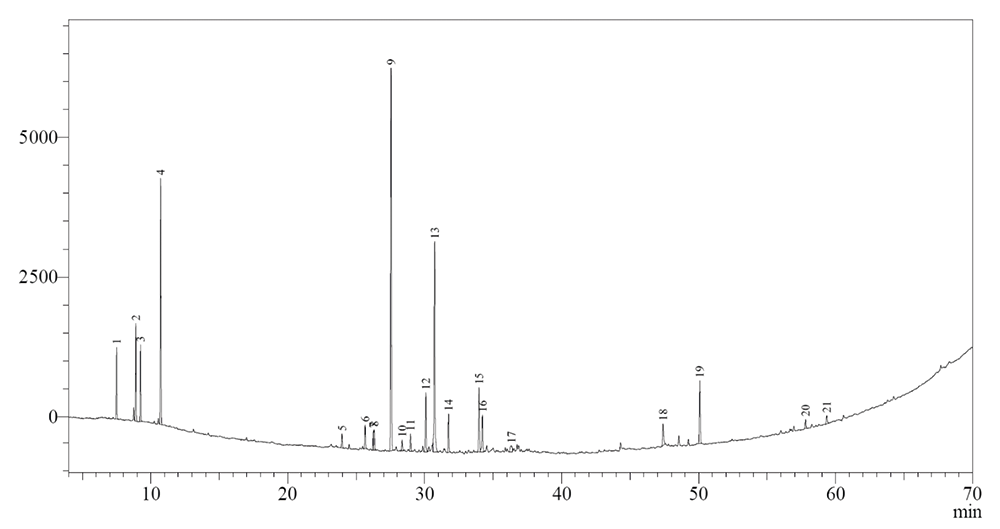
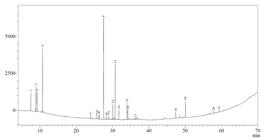
The essential oil from leaves of B. reticularia yielded 0.33 % (w/w), similar yields (0.28% and 0.30%) have been reported for the plant species by other authors in the literature (Da Botas et al. 2017; Lima et al. 2021). The oil was slightly greenish with a strong herbal odor. A total of 21 substances were detected (Fig. 1), and 89.76 % were identified. The sesquiterpenes represented the major compounds (58.63 %), and the chemical profile of the essential oil can be seen in Table 1.
The major compounds were the sesquiterpene β-caryophyllene (26.37 %), followed by bicyclogermacrene (16.43 %) and the monoterpene limonene (13.52 %) (Fig. 2a-c). The essential oil from leaves of B. reticularia was previously reported by Botas et al. (2017) showing D-limonene (25.7 %), β-caryophyllene (24.6 %), and bicyclogermacrene (11.3 %) as the major components, corroborating the chemical profile found in this study.
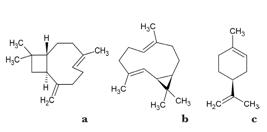
a-c. Chemical structure of the main compounds of the essential oil of Baccharis reticularia - a. β-caryophyllene 26.37 %; b. bicyclogermacrene 16.43 %; c. limonene 13.52 %.
Lima et al. (2021) described the major components as limonene (14.6 %), β-myrcene (12.6%), bicyclogermacrene (12.5 %), β-caryophyllene (10.7 %), and β-eudesmol (10.4 %) (Lima et al. 2021). Botas et al. (2017) and Lima et al. (2021) reported ten compounds identified in the essential oil analyzed in the present study. This similarity can be attributed to plant the collections being conducted within the Restinga de Jurubatiba National Park, where similar environmental pressures influenced plant growth and secondary metabolism (Verma & Shukla 2015).
Nanoemulsion characterization
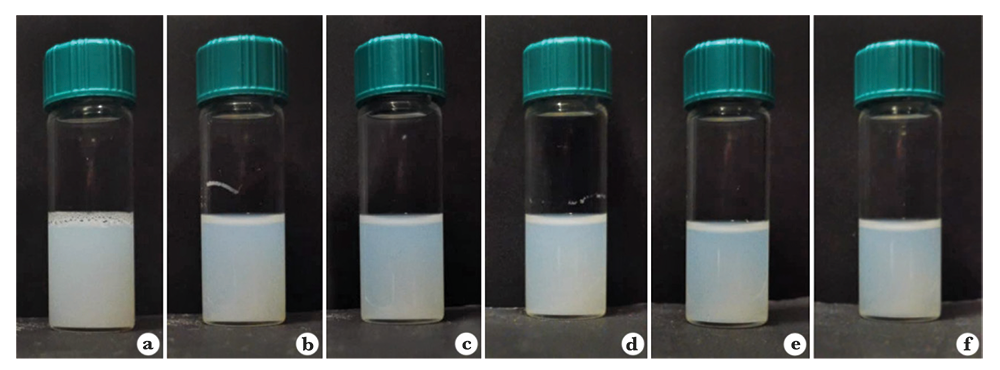
The Baccharis reticularia nanoemulsion presented a translucent appearance with a bluish reflection, a phenomenon associated with the Tyndall effect (Mushtaq et al. 2023). Macroscopically, over 28 days after preparation, there were no changes in appearance, suggesting promising kinetic stability (Fig. 3a-f).
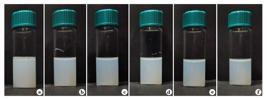
a-f. Macroscopical characteristic of the Baccharis reticularia nanoemulsion prepared with polysorbate 80 and monolaurate sorbitan - a. day 0 of preparation; b. after 1 day of preparation; c. after 7 days of preparation; d. after 14 days of preparation; e. after 21 days of preparation; f. after 28 days of preparation.
Nanoemulsions can be generated through various methods, classified into high-energy and low-energy input methods. High-energy methods use high disruptive forces to generate nanoemulsions, such as high-pressure valve homogenization, microfluidization, and ultrasonication. On the other hand, low-energy methods, such as spontaneous emulsification, phase inversion temperature method, and phase inversion composition method, generate nanometer-sized droplets with the chemical energy of the system (Mushtaq et al. 2023). In the present study, the low-energy method used is solvent-free and non-heating, contributing to an eco-friendly technique to obtain fine droplets.
Surfactants are amphiphilic substances that reduce the interfacial tension between the phases (aqueous phase and oil phase) under specific environmental conditions and generate a film around droplets (Ozogul et al. 2022; Unal et al. 2023). The selected non-ionic surfactants were polysorbate 80, which has a high hydrophilic character (HLB 15), and sorbitan monolaurate, a more lipophilic surfactant (HLB 8.6) (Marhamati et al. 2021). The mixture of surfactants resulted in a stable colloidal system with HLB 14.32. Considering the indicative of macroscopical appearance maintenance, it can be suggested that this HLB has the amount of co-surfactant capable of inhibiting Ostwald ripening.
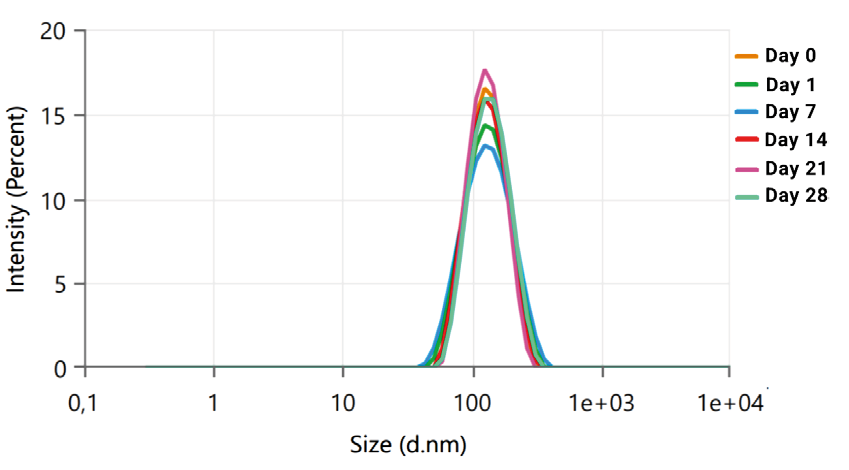
On the day of preparation (Day 0), the average droplet size, PdI, and zeta potential (ZP) were, respectively, 113.1 ± 1.455 nm, 0.1900 ± 0.0152, and -19.74 ± 1.448 mV (Tab. 2). For an emulsified system to be categorized as a nanoemulsion, the droplet size must have an average value between 20 and 200 nm (Preeti et al. 2023). Regarding the PdI, values lower than 0.3 are associated with homogeneous systems. In this context, the obtained formulation fits the criteria (dos Santos Matos et al. 2020; Marhamati et al. 2021), corroborating the macroscopical evaluation. As demonstrated in Figure 4, the droplet size diameter distribution by intensity exhibited a monomodal curve up to 28 days of observation, suggesting droplet uniformity. There was no significant influence (p > 0.05) on droplet size (112.4 ± 1.6460) until 21 days after preparation, and during all the analyzed periods, the variation was lower than 10 nm, which is in accordance with the limit of the technique. There was no statistical difference in the PdI (p > 0.05) after the 28 days. However, the ZP was statistically significant on day 21 (p < 0.05); the values after 28 days were similar, -19.74 ± 1.448 to -19.48 ± 1.600 (p > 0.05). Similar ZP values (EHL 15: -20.4 and -21.5 mV) have been described by Lima et al. (2021) for the B. reticularia essential oil nanoemulsions (Lima et al. 2021). Literature reports that -20 to -30 mV is an acceptable ZP value (Tayal et al. 2024). However, the lower the PZ values, the greater the coulombic repulsion forces between the droplets in the colloidal system, keeping the droplets in constant Brownian motion, together with the gravitational forces, thereby ensuring the system’s stability (Rai et al. 2018). It is important to note that a single low potential zeta value may even signal momentary stability, but only by maintaining the ZP value over time the electrostatic repulsion forces remain sufficient to prevent droplet aggregation (Zhang et al. 2021). Therefore, the constancy of the zeta potential between -19.74 and -19.48 mV over 28 days confirms that the system not only reaches a stable state but sustains it, thereby guaranteeing reproducible performance for practical applications. The conductivity analysis revealed values that remained virtually unchanged throughout the study period, indicating that the ionic conditions of the dispersant remained constant. This stability in conductivity confirms that there was no variation in the medium’s ionic strength, thereby reinforcing the reliability and reproducibility of the measured zeta potential, since any change in this parameter could directly influence the zeta potential value (Midekessa et al. 2020).
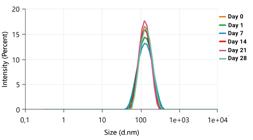
Overlay of the distribution of average droplet size diameter over 28 days of Baccharis reticularia nanoemulsion.
Botas et al. (2017) and Lima et al. (2021) obtained a colloidal system based on B. reticularia essential oil based on HLB 15. Utilizing this strategy, Botas et al. (2017) described the formulation with a white opaque aspect and the average droplet size (nm) of 92.9 ± 0.4 and PdI 0.412 ± 0.009. Lima et al. (2021) reported a white opaque aspect with a bluish reflection and an average size of 111 nm and PdI 0.24. In the present study, the formulation had a size diameter of around 110 nm and a translucent appearance, which was maintained over time. Other authors have not evaluated this information in the literature to date. The macroscopic and nanometric difference between the systems is probably due to the surfactant:essential oil ratio. Furthermore, the adjustment of the HLB values to approximately 14 was deemed more appropriate than the HLB 15 proposed by the authors. The high PdI may be associated with a rapid droplet growth modulated by Ostwald ripening. In this phenomenon, the more hydrophilic components of small droplets are transferred through the external phase to larger droplets, therefore destabilizing the system (Guo et al. 2024). Nanoemulsions prepared solely with polysorbate 80, which has a high HLB value, may have a facilitated mass transfer. In this context, the co-surfactant used in the present study may act to prevent this migration and act as an Ostwald ripening inhibitor due to its lower HLB value.
Thermal stress stability of the nanoemulsion
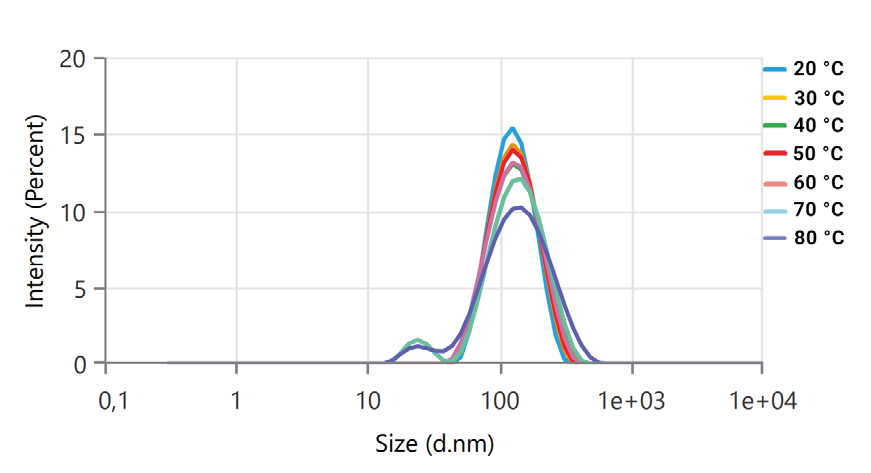
The thermal stress stability of the B. reticularia nanoemulsion resulted in no major differences in the macroscopical characteristics, maintaining the original aspects (homogeneous system with bluish reflection). Regarding the colloidal behavior, the nanoemulsion maintained the monomodal characteristic (Fig. 5) and droplet sizes from 20 °C (107.2 ± 0.8983 nm) to 60 ºC (106.2 ± 0.6224 nm), with no statistical difference in the average droplet size (p > 0.05). After that, at 70 °C and 80 °C, a second droplet size population (6.72 % and 6.39 % intensity, respectively) with a size around 30 nm emerged in the graph, resulting in a bimodal behavior (Tab. 3). This phenomenon can be explained by the increase in the entropy of the system (Abdullah et al. 2025), thus favoring the migration of the previously insoluble substances present in the internal phase (oil phase) to the external phase (deionized water), especially the sesquiterpenoid spathulenol (LogP 4.46). Therefore, favoring incorporation into micelles as indicated by the continuous increase (p < 0.05) of the PdI values (Tab. 3) according to the increase in temperature (initial 20 °C = 0.1936 ± 0.0046; final 80 °C = 0.2661 ± 0.0044). Moreover, high temperatures are close to the phase inversion point for the surfactants, therefore suggesting that the obtained nanoemulsion has stability towards Ostwald ripening when briefly exposed to high temperatures (Koroleva & Yurtov 2021).
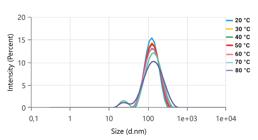
Droplet size diameter by intensity of the Baccharis reticularia nanoemulsion after the thermal stress (20-80 ºC).
Inhibitory effects
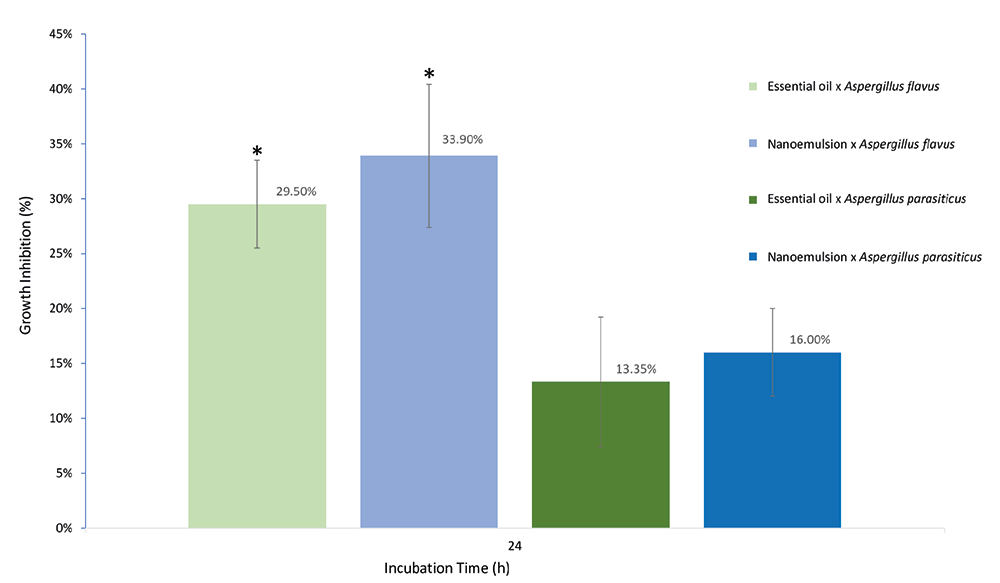
The blank nanoemulsion (dispersion of surfactants without essential oil) did not present a statistical difference (p > 0.05) when compared to the control group of both strains, indicating that no activity was observed in the presence of inert ingredients of the B. reticularia nanoemulsion. Both the bulk-essential oil and its nanoemulsion showed fungistatic activity at 24h with significant inhibition in the A. flavus colony development (p < 0.0001), as seen in Figure 6. However, no macro or microscopic morphological changes in the colony were observed. The nanoemulsion and the essential oil showed a reduction in the A. flavus colony diameter in the first 24 hours (p < 0.05). However, inhibition in A. parasiticus was not observed (p < 0.05). Although there was no significant difference between the bulk-essential oil and nanoemulsion groups, observing the maintenance of inhibitory activity after encapsulation was possible. Therefore, this study indicates the feasibility of obtaining a bioactive colloidal system through an eco-friendly approach.
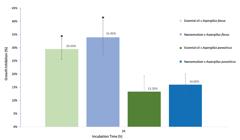
Comparison chart of growth of Aspergillus strains after application of essential oil and nanoemulsion compared to the control group.
The genus Baccharis has demonstrated promising fungistatic properties against Aspergillus species. Zimmermann et al. (2023) reported that the essential oils of B. dracunculifolia and B. uncinella DC. effectively inhibited the growth of A. niger, a finding corroborated by other studies (Cazella et al. 2019; Vannini et al. 2012; Zimmermann et al. 2023). However, these oils exhibited limited activity against A. flavus and notably lacked β-caryophyllene in their chemical profiles, a compound prominently present in the essential oil of B. reticularia. In contrast, Da Silva et al. (2023) highlighted the antifungal activity of Eugenia sulcata Spring ex Mart. essential oil, which predominantly contained β-caryophyllene (34.4%), against Aspergillus strains. Nevertheless, comparative assays using pure β-caryophyllene indicated that, although this compound exhibited bioactivity against Aspergillus species, the overall antifungal effectiveness observed with Eugenia sulcata oil must depend on additional bioactive constituents. Therefore, β-caryophyllene alone cannot account exclusively for the antifungal properties observed in the B. reticularia essential oil.
This study provides the first evidence that the essential oil of Baccharis reticularia and its corresponding nanoemulsion inhibit the growth of Aspergillus flavus. The β-caryophyllene, bicyclogermacrene, and limonene were the predominant constituents of the oil. In the nanoemulsion prepared with polysorbate 80, the inclusion of the co-surfactant reduced the polydispersity index, indicating a more homogeneous droplet population. These results demonstrate the oil’s antifungal potential and highlight the co-surfactant’s role in improving nanoemulsion uniformity, supporting further development of B. reticularia-based nanoformulations.
Acknowledgements
The authors are thankful to the National Council for Scientific and Technological Development (CNPQ) 304179/2021-3 and “Rede de Pesquisa em Biodiversidade e Sustentabilidade”(CNPq 406399/2022-0), for the financial support. We would also like to thank FAPERJ, for its support in financing the projects E-26/200.161/2025, E-26/200.162/2025 (304867), E-26/210.598/2023 (285944), and E-26/200.915/2022 (268191).
References
-
Abdullah NNA, Kamari A, Wong STS, Yusof N, Othman H, Hussein MZ, Phillip E & Din SM (2025) Cationic guar gum loaded with essential oil-based nanoemulsion formulations as mosquito repellents for fabrics against Aedes aegypti BioNanoScience 15: 1-21. DOI: 10.1007/s12668-024-01779-1
» https://doi.org/10.1007/s12668-024-01779-1 - Adams RP (2007) Identification of essential oil components by gas chromatography/mass spectroscopy. Biochemical Systematics and Ecology. 4th ed. Allured Publishing, Illinois. Pp. 100-778.
-
Almeida NA, Freire L, Carnielli-Queiroz L, Bragotto APA, Silva NCC & Rocha LO (2024) Essential oils: an eco-friendly alternative for controlling toxigenic fungi in cereal grains. Comprehensive Reviews in Food Science and Food Safety 23: 1-26. DOI: 10.1111/1541-4337.13251
» https://doi.org/10.1111/1541-4337.13251 -
Anton N & Vandamme TF (2009) The universality of low-energy nano-emulsification. International Journal of Pharmaceutics 377: 142-147. DOI: 10.1016/J.IJPHARM.2009.05.014
» https://doi.org/10.1016/J.IJPHARM.2009.05.014 -
Cazella LN, Glamoclija J, Soković M, Gonçalves JE, Linde GA, Colauto NB & Gazim ZC (2019) Antimicrobial activity of essential oil of baccharis dracunculifolia DC (Asteraceae) aerial parts at flowering period. Frontiers in Plant Science 10: 426371. DOI: 10.3389/fpls.2019.0002
» https://doi.org/10.3389/fpls.2019.0002 -
Chatzidaki MD & Mitsou E (2025) Advancements in nanoemulsion-based drug delivery across different administration routes. Pharmaceutics 2025 17: 337. DOI: 10.3390/PHARMACEUTICS17030337
» https://doi.org/10.3390/PHARMACEUTICS17030337 -
Da Botas GS, Cruz RAS, Almeida FB, Duarte JL, Araújo RS, Souto RNP, Ferreira R, Carvalho JCT, Santos MG, Rocha L, Pereira VLP & Fernandes CP (2017) Baccharis reticularia DC. and Limonene Nanoemulsions: promising larvicidal agents for Aedes aegypti (Diptera: Culicidae) control. Molecules 22: 1990. DOI: 10.3390/molecules22111990
» https://doi.org/10.3390/molecules22111990 - da Silva DS, Pinto LA, Keller LAM, Machado FP, Eiriz DN, Rocha L & Fernandes CP (2024) Inhibitory potential of Eugenia sulcata essential oil and its nanoemulsions against Aspergillus spp. Journal of Natural Pesticide Research 7: 100064.
-
Dos Santos Matos AP, Lopes DCDXP, Peixoto MLH, Silva Cardoso V, Vermelho AB, Santos-Oliveira R, Viçosa AL, Holandino C & Ricci-Júnior E (2020) Development, characterization, and anti-leishmanial activity of topical amphotericin B nanoemulsions. Drug Delivery and Translational Research 10: 1552-1570. DOI: 10.1007/s13346-020-00821-5
» https://doi.org/10.1007/s13346-020-00821-5 -
Eskola M, Kos G, Elliott CT, Hajšlová J, Mayar S & Krska R (2020) Worldwide contamination of food-crops with mycotoxins: validity of the widely cited ‘FAO estimate’ of 25%. Critical Reviews in Food Science and Nutrition 60: 2773-2789. DOI: 10.1080/10408398.2019.1658570
» https://doi.org/10.1080/10408398.2019.1658570 -
Frisvad JC, Hubka V, Ezekiel CN, Hong SB, Nováková A, Chen AJ, Arzanlou M, Larsen TO, Sklenář F, Mahakarnchanakul W, Samson RA & Houbraken J (2019) Taxonomy of Aspergillus section Flavi and their production of aflatoxins, ochratoxins and other mycotoxins. Studies in Mycology 93: 1-63. DOI: 10.1016/j.simyco.2018.06.001
» https://doi.org/10.1016/j.simyco.2018.06.001 -
Guo Y, Zhang X, Wang X, Zhang L, Xu Z & Sun D (2024) Nanoemulsions stable against Ostwald Ripening. Langmuir 40: 1364-1372. DOI: 10.1021/acs.langmuir.3c03019.
» https://doi.org/10.1021/acs.langmuir.3c03019 -
Koroleva MYu & Yurtov EV (2021) Ostwald ripening in macro- and nanoemulsions. Russian Chemical Reviews 90: 293-323. DOI: 10.1070/rcr4962
» https://doi.org/10.1070/rcr4962 -
Kumar A, Kanwar R & Mehta SK (2025) Nanoemulsion as an effective delivery vehicle for essential oils: properties, formulation methods, destabilizing mechanisms and applications in agri-food sector. Next Nanotechnology 7: 100096. DOI: 10.1016/J.NXNANO.2024.100096
» https://doi.org/10.1016/J.NXNANO.2024.100096 -
Lima LA, Ferreira-Sá PS, Garcia MDN, Pereira VLP, Carvalho JCT, Rocha L, Fernandes CP, Souto RNP, Araújo RS, Botas G & Cruz RAS (2021) Nano-emulsions of the essential oil of Baccharis reticularia and its constituents as eco-friendly repellents against Tribolium castaneum Industrial Crops and Products 162: 113282. DOI: 10.1016/j.indcrop.2021.113282
» https://doi.org/10.1016/j.indcrop.2021.113282 -
Marhamati M, Ranjbar G & Rezaie M (2021) Effects of emulsifiers on the physicochemical stability of oil-in-water nanoemulsions: a critical review. Journal of Molecular Liquids 340: 117218. DOI: 10.1016/j.molliq.2021.117218
» https://doi.org/10.1016/j.molliq.2021.117218 -
Maurya A, Prasad J, Das S & Dwivedy AK (2021) Essential oils and their application in food safety. Frontiers in Sustainable Food Systems 5: 653420. DOI: 10.3389/fsufs.2021.653420
» https://doi.org/10.3389/fsufs.2021.653420 -
McClements DJ & Jafari SM (2018) General aspects of nanoemulsions and their formulation. Nanoemulsions: formulation, applications, and characterization 2018: 3-20. DOI: 10.1016/B978-0-12-811838-2.00001-1
» https://doi.org/10.1016/B978-0-12-811838-2.00001-1 -
Midekessa G, Godakumara K, Ord J, Viil J, Lättekivi F, Dissanayake K, Kopanchuk S, Rinken A, Andronowska A, Bhattacharjee S, Rinken T & Fazeli A (2020) Zeta potential of extracellular vesicles: toward understanding the attributes that determine colloidal stability. ACS Omega 5: 16701-16710. DOI: 10.1021/acsomega.0c01582
» https://doi.org/10.1021/acsomega.0c01582 -
Mushtaq A, Mohd Wani S, Malik AR, Gull A, Ramniwas S, Ahmad Nayik G, Ercisli S, Alina Marc R, Ullah R & Bari A (2023) Recent insights into nanoemulsions: their preparation, properties and applications. Food Chemistry: X 18: 100684. DOI: 10.1016/j.fochx.2023.100684
» https://doi.org/10.1016/j.fochx.2023.100684 -
Nasrollahzadeh A, Mokhtari S, Khomeiri M & Saris PEJ (2022) Antifungal preservation of food by lactic acid bacteria. Foods 11: 395. DOI: 10.3390/FOODS11030395
» https://doi.org/10.3390/FOODS11030395 - Ozogul Y, Karsli GT, Durmuş M, Yazgan H, Oztop HM, McClements DJ & Ozogul F (2022) Recent developments in industrial applications of nanoemulsions. Advances in Colloid and Interface Science 304: 102685.
-
Preeti SS, Malik R, Bhatia S, Al Harrasi A, Rani C, Saharan R, Kumar S, Geeta & Sehrawat R (2023) Nanoemulsion: an emerging novel technology for improving the bioavailability of drugs. Scientifica 2023: 6640103. DOI: 10.1155/2023/6640103
» https://doi.org/10.1155/2023/6640103 -
Rai VK, Mishra N, Yadav KS & Yadav NP (2018) Nanoemulsion as pharmaceutical carrier for dermal and transdermal drug delivery: formulation development, stability issues, basic considerations and applications. Journal of Controlled Release 270: 203-225. DOI: 10.1016/j.jconrel.2017.11.049
» https://doi.org/10.1016/j.jconrel.2017.11.049 -
Salager JL, Forgiarini A, Márquez L, Peña A, Pizzino A, Rodriguez MP & Rondón-González M (2004) Using emulsion inversion in industrial processes. Advances in Colloid and Interface Science 108-109: 259-272. DOI: 10.1016/J.CIS.2003.10.008
» https://doi.org/10.1016/J.CIS.2003.10.008 -
Tayal S, Tiwari P, Singh UP, Dubey S, Vishwakarma R & Student FY (2024) A review on formulation, characterization and applications of nanoemulsion. Asian Journal of Applied Science and Technology 8: 67-84. DOI: 10.38177/ajast.2024.8106
» https://doi.org/10.38177/ajast.2024.8106 -
Tiwari P & Park KIl (2024) Advanced fungal biotechnologies in accomplishing sustainable development goals (SDGs): what do we know and what comes next? Journal of Fungi 10: 506. DOI: 10.3390/JOF10070506
» https://doi.org/10.3390/JOF10070506 -
Turek C & Stintzing FC (2013) Stability of essential oils: a review. Comprehensive Reviews in Food Science and Food Safety 12: 40-53. DOI: 10.1111/1541-4337.12006
» https://doi.org/10.1111/1541-4337.12006 -
Unal DN, Sadak S, Erkmen C, Selcuk Ö & Uslu B (2023) Review of surfactants, structural properties and their role in electrochemistry. Surfactant-Based Sensors in Chemical and Biochemical Detection 23: 1-18. DOI: 10.1039/BK9781837671182-00001
» https://doi.org/10.1039/BK9781837671182-00001 -
van Den Dool H & Dec Kratz P (1963) A generalization of the retention index system including linear temperature programmed gas-liquid partition chromatography. Journal of Chromatography A 11: 463-471. DOI: 10.1016/S0021-9673(01)80947-X
» https://doi.org/10.1016/S0021-9673(01)80947-X -
Vannini AB, Santos TG, Fleming AC, Purnhagen LRP, Lourenço LA, Butzke ETB, Kempt M, Begnini IM, Rebelo RA, Dalmarco EM, Cruz AB, Schmit AP, Cruz RCB, Yamanaka CN & Steindel M (2012) Chemical characterization and antimicrobial evaluation of the essential oils from Baccharis uncinella D.C. and Baccharis semiserrata D.C. (Asteraceae). Journal of Essential Oil Research 24: 547-554. 10.1080/10412905.2012.728092
» https://doi.org/10.1080/10412905.2012.728092 -
Verma N & Shukla S (2015) Impact of various factors responsible for fluctuation in plant secondary metabolites. Journal of Applied Research on Medicinal and Aromatic Plants 2: 105-113. DOI: 10.1016/J.JARMAP.2015.09.002
» https://doi.org/10.1016/J.JARMAP.2015.09.002 -
Wild CP & Gong YY (2010) Mycotoxins and human disease: a largely ignored global health issue. Carcinogenesis 31: 71-82. DOI: 10.1093/CARCIN/BGP264
» https://doi.org/10.1093/CARCIN/BGP264 -
Zhang R, Rupa EJ, Zheng S, Nahar J, Yang DC, Kang SC, & Wang Y (2021) Panos-fermented extract-mediated nanoemulsion: preparation, characterization, and in vitro anti-inflammatory effects on RAW 264.7 Cells. Molecules 27: 218. DOI: 10.3390/MOLECULES27010218
» https://doi.org/10.3390/MOLECULES27010218 -
Zimmermann RC, Poitevin CG, Luz TS, Mazarotto EJ, Furuie JL, Martins CEN, Amaral W, Cipriano RR, Rosa JM, Pimentel IC & Zawadneak MAC (2023) Antifungal activity of essential oils and their combinations against storage fungi. Environmental Science and Pollution Research 30: 48559-48570. DOI: 10.1007/s11356-023-25772-5
» https://doi.org/10.1007/s11356-023-25772-5 -
Zinedine A, El Akhdari S, Zinedine A & El Akhdari S (2019) Food safety and climate change: case of mycotoxins. In: Kahime K, El Hidan M, El Hiba O, Sereno D & Bounoua L (eds.) Handbook of research on global environmental changes and human health. IGI Global Scientific Publishing, Hershey. Pp. 74-97. DOI: 10.4018/978-1-5225-7775-1.CH005
» https://doi.org/10.4018/978-1-5225-7775-1.CH005
Data availability statement
In accordance with Open Science communication practices, the authors inform that there is no data sharing of this manuscript.