 Metabolic stability of in vitro plants derived from cryopreserved shoot tips of Passiflora suberosa - chromatographic analysis and assessment of antioxidant activity
Abstract
Passiflora suberosa, commonly known as corky passionflower or corky stem passion fruit, is a wild passion fruit species with agronomic, ornamental, and medicinal potentials. In a previous study, we developed an efficient protocol for long-term conservation of P. suberosa through the cryopreservation of shoot tips, using the V-Cryo-plate technique, and identified osmoprotection and cryoprotectant exposure as the critical stages influencing post-freezing recovery. The present work aimed to evaluate the effect of antioxidants on recovery rates and the metabolic stability of plants derived from cryopreserved shoot tips. The addition of different concentrations of ascorbic acid or glutathione during the osmoprotection and cryoprotection stages did not improve the recovery rates. High-Performance Liquid Chromatography (HPLC) analysis of in vitro plants derived from cryopreserved materials indicated that the biosynthetic capacity of the recovered plants was unaffected by the cryopreservation process. Furthermore, no significant changes were observed in the antioxidant potential of the recovered plants, as assessed by their ability to scavenge DPPH radicals and chelate metal ions. These results confirm that cryopreservation is an effective long-term conservation strategy for P. suberosa and provide new insights into the cellular responses of tropical plants to the stress induced by the procedures involved in V-Cryo-plate protocols.
Key words:
cryoprotection; oxidative stress; passion fruit; secondary metabolites; V-Cryo-plate
Resumo
Passiflora suberosa, conhecida popularmente como maracujazinho-cortiça, é uma espécie silvestre de maracujá com potencial agronômico, ornamental e medicinal. Em um trabalho anterior, foi desenvolvido um protocolo eficiente para a conservação em longo prazo de P. suberosa por meio da criopreservação de ápices caulinares, utilizando a técnica V-Crioplaca, sendo a osmoproteção e a exposição aos crioprotetores identificadas como etapas críticas. O objetivo do presente trabalho foi avaliar o efeito de antioxidantes nas taxas de recuperação pós-congelamento e na estabilidade metabólica das plantas recuperadas. A adição de diferentes concentrações de ácido ascórbico ou glutationa durante a osmoproteção e a exposição a crioprotetores não teve efeito positivo nas taxas de recuperação. A estabilidade metabólica das plantas derivadas de ápices criopreservados foi analisada por Cromatografia Líquida de Alta Eficiência (CLAE), indicando que sua capacidade biossintética não foi afetada pela criopreservação. Além disso, não foram observadas alterações na capacidade de captura do radical DPPH e da atividade quelante de íons metálicos. Esses resultados confirmam a eficiência da criopreservação como uma estratégia de conservação para P. suberosa e contribuem para a maior compreensão das respostas celulares de plantas tropicais ao estresse induzido pelos tratamentos que integram protocolos de V-Crioplaca.
Palavras-chave:
crioproteção; estresse oxidativo; maracujá; metabólitos secundários; V-Crioplaca
Introduction
Cryopreservation has been adopted as a complementary approach to the traditional methods of seed banks and field collections of Passiflora species (Pacheco et al. 2016; Simão et al. 2018; Araújo et al. 2019; Vianna et al. 2019; Generoso et al. 2019; Faria et al. 2020; Silva et al. 2022; Ferreira et al. 2024). This is particularly relevant considering the increasing genetic erosion within the genus, which has been exacerbated by the extensive land use for agricultural and industrial purposes (Faleiro et al. 2011).
Passiflora suberosa L. (Passifloraceae family, genus Passiflora, subgenus Decaloba) is an herbaceous, tendrilous climbing vine native to South and Central America, commonly known as corky passionflower or corky stem passion fruit. In Brazil, it mainly occurs in phytogeographic domains impacted by anthropic actions like the Amazon and Atlantic forests and Cerrado (Bernacci et al. 2015). Passiflora suberosa has great ornamental and agronomic potential, due to its exotic flowers, small purple fruits, and resistance to pathogens that affect the yellow passion fruit cultures (Gardner 1989; Otoni et al. 1996; Junqueira et al. 2005; Bernardes et al. 2020). It has also been used as a medicinal plant for the treatment of hypertension, diabetes, and inflammatory skin diseases, as well as a sedative (Dhawan et al. 2004; Bandara et al. 2018; Sudasinghe & Peiris 2018).
Several biotechnological studies have focused on establishing tissue culture systems for P. suberosa (Monteiro et al. 2000a; Garcia et al. 2011a; Rosa et al. 2016), which have laid the foundation for medium- and long-term in vitro conservation methods, including slow-growth storage and cryopreservation (Garcia et al. 2011b; Vianna et al. 2019). Garcia et al. (2011b) initially reported an encapsulation-vitrification protocol for P. suberosa shoot tips, which resulted in a regrowth rate of 28%. In a subsequent study using the same explants, the V-Cryo-plate technique reached a 60% recovery rate and a significant reduction in the plant recovery period. Furthermore, the levels of lipid peroxidation and antioxidant enzymes activities were higher after the osmoprotection and cryoprotection steps, when compared to the other stages of the protocol (Vianna et al. 2019).
Cellular damage induced by suboptimal cryopreservation conditions are collectively known as cryoinjury and arises from oxidative stress caused by the overproduction of reactive oxygen species (ROS), resulting in low post-freezing recovery rates and morphogenic and metabolic alterations (Wang et al. 2021). Therefore, the development of effective cryopreservation protocols for medicinal plants should also include the assessment of their post-freezing biosynthetic and bioactive capacities (Sharma et al. 2021; Wang et al. 2021; Markowski et al. 2024; Śliwińska et al. 2024). In the present work, we examined the effects of ascorbic acid and glutathione applied at the osmoprotection and cryoprotection stages of the V-Cryo-plate protocol for P. suberosa shoot tips. Additionally, we evaluated the metabolic stability of cryopreserved materials through qualitative and quantitative analyses of phytoconstituents and assessment of their antioxidant potential.
Material and Methods
Plant material and culture conditions
In vitro-grown plants of P. suberosa (Garcia et al. 2011a) maintained at the Plant Biotechnology Center of UERJ were used as sources of explants. Plants were monthly subcultured to solidified (0.7% w/v agar; Merck®) MSM basal medium (Monteiro et al. 2000b), containing half-strength of MSM salts and MS vitamins (Murashige & Skoog 1962), 1.5% (w/v) sucrose (Merck®), and devoid of growth regulators (1/2 MSM) (Garcia et al. 2011a). The pH of all media was adjusted for 5.8 before autoclaving for 15 min at 121 °C. All inorganic chemicals used were P.A. grade.
Cultures were maintained in a growth chamber at 25 °C ± 2 °C under a 16-h light photoperiod, with a total irradiance of 42 μmol m−2s−1 provided by white Light Emitting Diodes (LED).
Effect of antioxidants on shoot tips cryopreservation
Shoot tips were cryopreserved according to Vianna et al. (2019), using the V-Cryo-plate technique, with some modifications. To evaluate the effects of antioxidants on post-freezing recovery rates, different concentrations of ascorbic acid (0.15 mM, 0.30 mM) or glutathione (0.08 mM, 0.16 mM) (Sigma-Aldrich®, Brazil) were independently added to the loading solution or to PVS3. Recovery frequencies were recorded 60 and 90 days after rewarming.
Extracts preparation
Leaves excised from in vitro-grown plants maintained on 1/2 MSM medium, as well as those from plants derived from cryopreserved shoot tips with or without glutathione, were prepared separately in 40% ethanol (1:50 plant:solvent, w/v), under reflux for 1 h (Birk et al. 2005). The extracts were then filtered, dried in hot water bath (90 °C) and stored at -20 °C. Samples were subjected to ultrasound treatment using methanol (Tedia®, Brazil) as solvent for further phytochemical characterization and antioxidant potential assays.
HPLC Analysis
Qualitative chromatographic analyses were carried out by High-Performance Liquid Chromatography coupled to a UV detector (HPLC-UV) in an Agilent© 1260 Infinity, equipped with LC-10AD pump, DGU- 14A degasser, CTO-10AS oven, SCL-10A controller and SPD-M10A DAD-UV detector. The analyses were performed on a Thermo-Scientific© Hypersil Gold RP18 column (250 mm × 4.6 mm i.d.× 5Å particle size), at a flow rate of 1.0 mL/min and oven temperature at 23 °C. All samples were solubilized in methanol at a final concentration of 1.0 mg/mL and the injected volume was 10 μL. Solvent system consisted of ultrapure aqueous acetic acid solution, pH 3.0 (solvent A) and acetonitrile (solvent B) (Tedia®, Brazil), with the following gradient elution: 95% A and 5% B (0-3 min); 5 to 100% B (3-40 min); 100% B (40-45 min); 95% A and 5% B (45-47 min).
Determination of total phenolic content
Total phenolic content was determined using the Folin-Ciocalteau assay, with slight modifications (Holland et al. 2011), employing gallic acid (Sigma-Aldrich®, Brazil) as standard (mg/L). Briefly, 90 µL of extracts (0.25-2.5 mg/mL) resuspended in 0.5 mg/mL methanol were incubated with 10% (v/v) Folin-Ciocalteau solution (180 mL). After 5 min, 100 mM NaCO3 solution (730 mL) were added to the solution, which was further incubated for 2 h in the dark. Quantification was performed spectrophotometrically (Shimadzu UV-B382), at 765 nm. Total phenolic content was further compared to the antioxidant potential to determine the correlation between phenolic content and antioxidant activity (Rudnicki et al. 2007).
Determination of antioxidant capacity
DPPH assay
The antioxidant capacity was evaluated by the ability of the extracts to scavenge the DPPH radical (2,2-diphenyl-1-picrylhydrazyl) (Sigma-Aldrich®, Brazil), according to Sánchez-Moreno et al. (1998). Briefly, 25 μL of extracts diluted in 100% methanol (0.25-5 mg/mL) were added to a 60 μM DPPH MeOH solution (975 μL). The samples were incubated for 1 h in the dark, at room temperature, and the decrease in absorbance was spectrophotometrically quantified at 515 nm (Shimadzu UV-B382).
Iron chelating assay
The ability of extracts to chelate ferrous ion (Fe2+) was also determined, according to Santos-Tierno et al. (2021). Extracts (250 μL, 0.5-5 mg/mL) were incubated with 0.1 mM FeSO4 (Sigma-Aldrich®, Brazil) (250 μL) for 5 min, before the addition of 0.25 mM ferrozine solution (250 μL). The samples were incubated for 10 min, in the dark, and their absorbances were spectrophotometrically measured at 562 nm (UV-Vis BioMate 3 S, Thermo Scientific).
The extract concentration required for scavenging 50% of DPPH and for chelating 50% of the Fe2+(EC50) was calculated by non-linear regression from graphs of % DPPH scavenging capacity or % chelation ability versus sample concentration (mg/mL).
TLC-DPPH
The qualitative evaluation of the antioxidant capacity was carried out by TLC-DPPH (Simão et al. 2016). For TLC analysis, 20 µL of each extract (5 mg/mL) were directly applied on TLC aluminum plates (Si gel 60 UV254nm, Marcherey-Nagel, 20 × 20 cm plates). Flavonoid analysis was carried out using ethyl acetate:formic acid:acetic acid:water (100:11:11:26, v/v) as mobile phase (Wagner & Bladt 2001), whereas phenolic acids and saponins were analyzed using chloroform:ethyl acetate:acetone:formic acid (40:30:20:10 v/v) and chloroform:acetic acid:methanol:water (60:32:12:18, v/v) as the mobile phases, respectively (Simão et al. 2016; Jesionek et al. 2015). The solvents used for the TLC analyses were analytical grade. Methanol was purchased from Tedia®, Brazil, whereas ethyl acetate and chloroform were purchased from Labsynth®, Brazil, and formic acid, acetone and glacial acetic acid were purchased from Sigma-Aldrich®, Brazil. For evaluation of robustness the acetonitrile used was the Merck® brand.
To detect antioxidant activity, all plates were sprayed with 0.02 % DPPH methanolic solution, and maintained in the dark for 30 min. The presence of antioxidant compounds was evidenced by yellow spots against a purple background (Masoko & Eloff 2007).
Statistical analysis
Cryopreservation experiments were repeated at least twice, using twelve explants per treatment. The determination of total phenolics and the antioxidant assays were carried out in triplicates, in two independent experiments. Statistical evaluation of experimental data was performed by analysis of variance (ANOVA) and Tukey-Kramer comparison post-test (0.05% significance level), using GraphPad Instat (GraphPad Software Inc., San Diego, CA), or MStat-C statistical package. The correlation of the antioxidant potential and total phenolic content was carried out using Pearson Correlation Coefficient at 0.05% significance level using GraphPad Instat.
Results
Effect of antioxidants on shoot tips cryopreservation
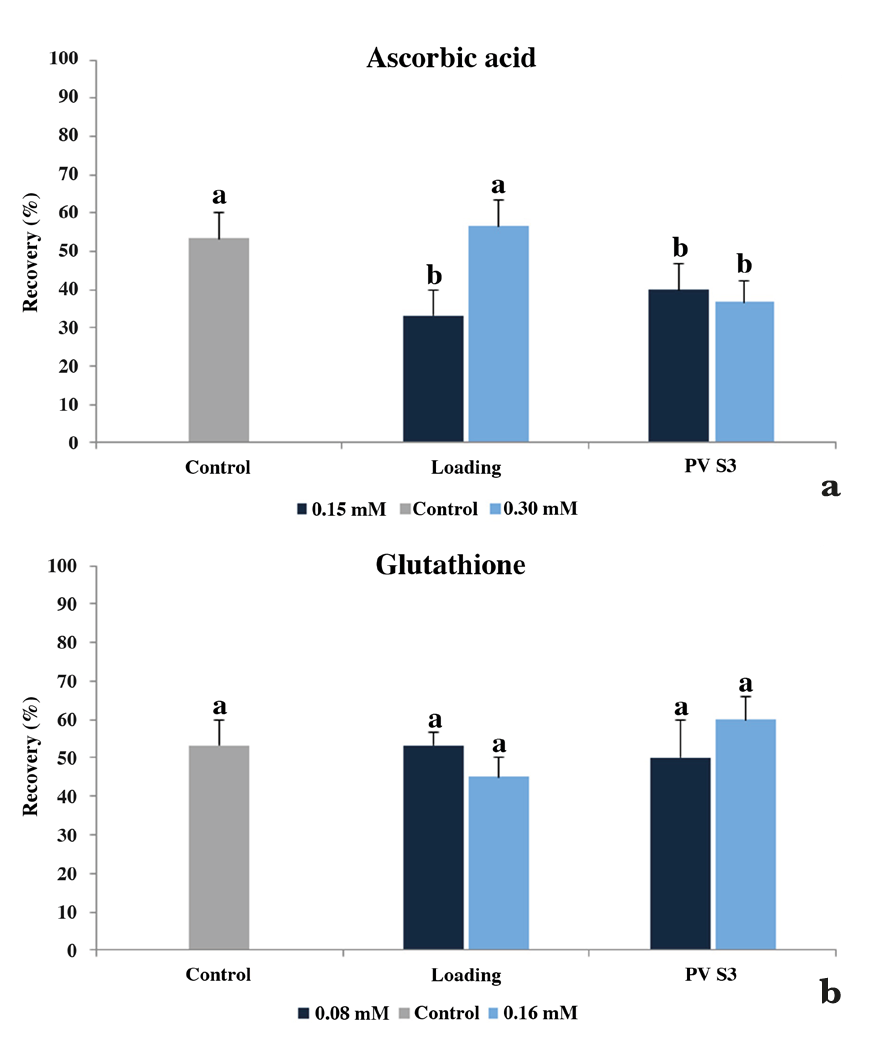
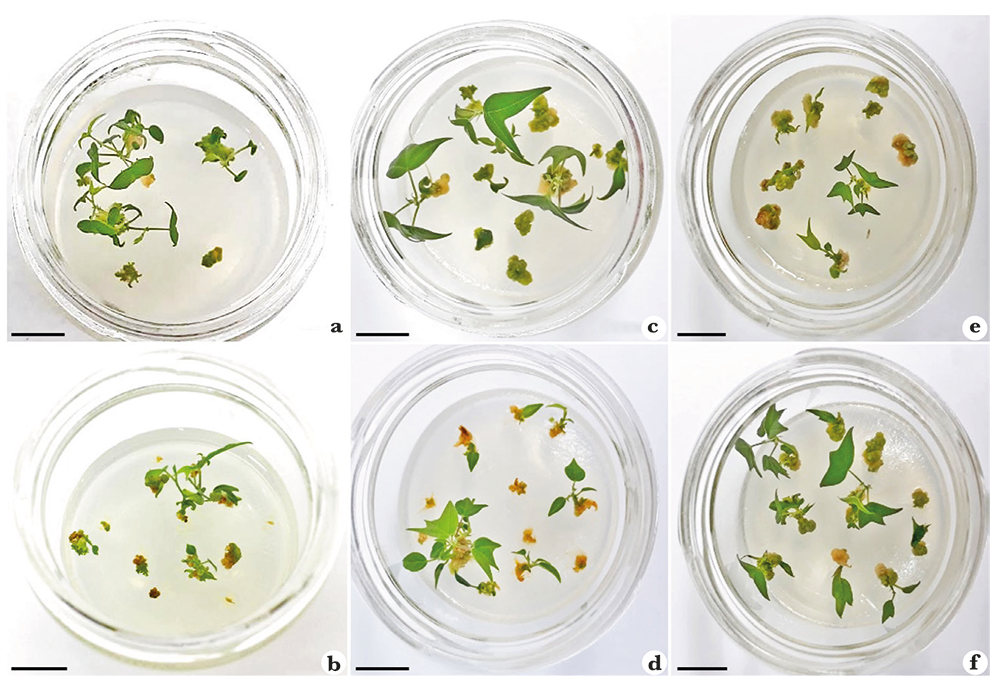
The addition of ascorbic acid significantly reduced regrowth rates, particularly when applied during the cryoprotection stage (Fig. 1). Additionally, whole plant regeneration was achieved 90 days after rewarming (Fig. 2). In contrast, glutathione supplementation accelerated regrowth, regardless of the stage of the cryopreservation protocol or the concentration used, with initial plant regeneration observed 30 days after rewarming and full development within 60 days (Fig. 1). Hence, only plants obtained from this treatment were further analyzed regarding metabolic stability.
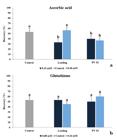
a-b. Effect of ascorbic acid and glutathione treatment during osmoproctection and cryoprotection stages of Passiflora suberosa shoot tips cryopreservation using the V-Cryo-plate protocol - a. recovery (%) after ascorbic acid treatment; b. recovery (%) after glutathione treatment.
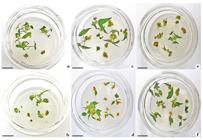
a-f. Shoot development from cryopreserved shoot tips of Passiflora suberosa after treatment with ascorbic acid or glutathione - a-b. Ascorbic acid (0.30 mM) - a. during loading; b. during PVS3 exposure; c-d. Glutathione (0.08 mM) - c. during loading; d. during PVS3 exposure; e-f. Glutathione (0.16 mM) - during loading; f. during PVS3 exposure. Scale bar = 1 cm.
Evaluation of metabolic stability after cryopreservation
HPLC analysis
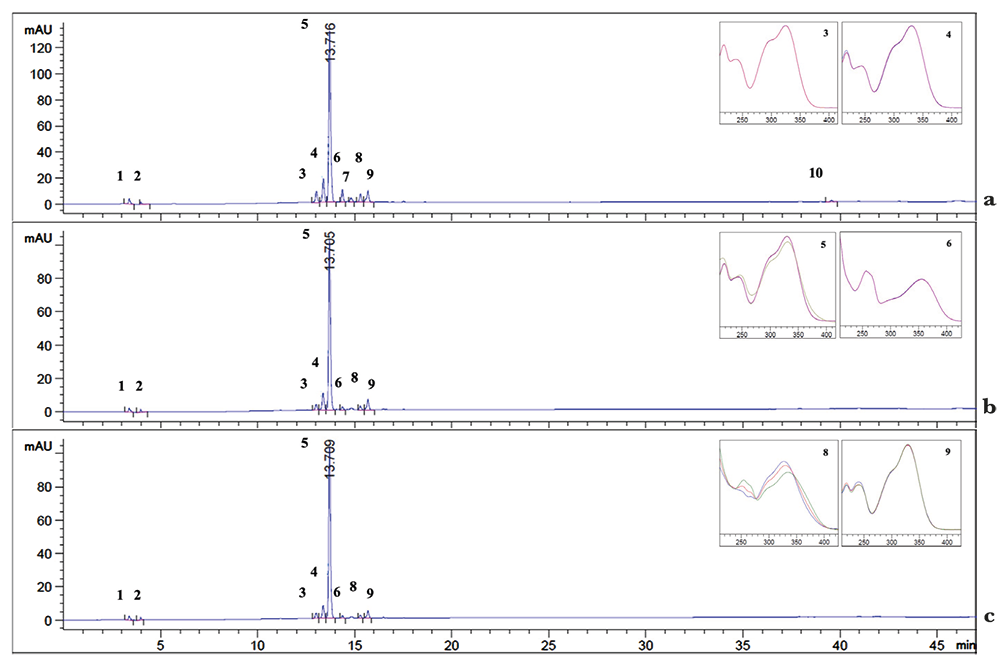
HPLC analysis of all samples revealed similar chromatographic patterns of distinct compounds, with retention times (Rt) ranging from 13 to 16 min. Leaves from non-cryopreserved plants showed the highest number of peaks, including two exclusive compounds (peaks 7 and 10, with = 14.8 and 39.5 min, respectively). All detected compounds showed absorption spectra compatible with phenolic acids or flavonoids (λmax~ 330 nm and 360 nm) (Fig. 3).
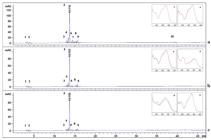
a-c. Chromatographic profile by HPLC-DAD-UV (UV340 nm) analysis of leaf extracts from non-cryopreserved and cryopreserved plants of Passiflora suberosa - a. leaves of in vitro plants derived from non-cryopreserved shoot tips; b. leaves of in vitro plants derived from cryopreserved shoot tips, without glutathione treatment; c. leaves of in vitro plants derived from cryopreserved shoot tips treated with glutathione. Details show the UV spectra of some peaks.
Compounds with the same retention time were compared based on their relative peak areas. Although there was a decrease in the intensity of all peaks from the cryopreserved-derived plant extracts when compared to non-cryopreserved samples, compound 5 (Rt ~ 13.71 min) showed a comparatively higher signal, suggesting its predominance in all extracts (Fig. 3).
Evaluation of the antioxidant potential and correlation with phenolic content
All extracts showed high antioxidant potential as assayed by the reduction of the DPPH radical, with EC50 ranging from 2.58 to 2.72 mg/mL. Extracts also showed high antioxidant potential as metallic ions chelators, with EC50 values between 0.92 and 0.99 mg/mL (Tab. 1).
The TLC-DPPH screening technique revealed yellow spots indicating DPPH scavenging activity in extracts from both cryopreserved and non-cryopreserved samples, regardless of the mobile phase used. Saponin analysis depicted three intense yellow spots, while phenolic acid and flavonoid analyses showed that all detected compounds exhibited antioxidant activity (data not shown).
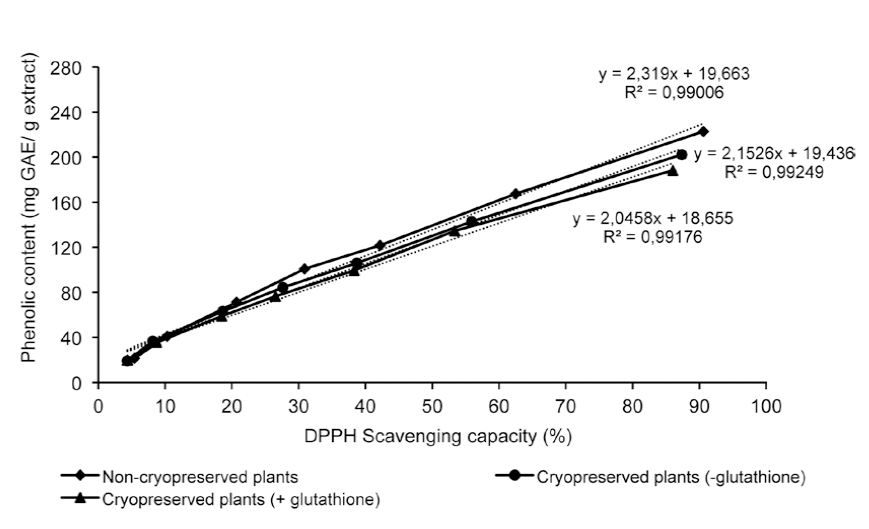
No significant differences in the total phenolic content were detected in plants derived from cryopreserved shoot tips in comparison to control samples (Tab. 1). Furthermore, there was a positive correlation between phenolic contents and antioxidant potential of all materials (Fig. 4).
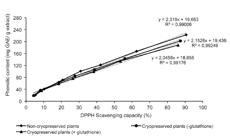
Correlation between total phenolic content and antioxidant activity of leaf extracts of non-cryopreserved and cryopreserved plants of Passiflora suberosa.
Discussion
The V-Cryo-plate technique has been widely adopted for plant cryopreservation due to the high post-freezing recovery rates (Niino et al. 2013; Yamamoto et al. 2011; Cordeiro et al. 2015; Rafique et al. 2015; Simão et al. 2018). The increased efficiency is mainly associated with the reduced amount of cryoprotectant solutions, and the temperature exchange rates at the aluminum base, which lead to lower toxicity and reduce the chance of physical damage caused by the formation of ice crystals (Niino et al. 2013; Yamamoto et al. 2015; Białoskórska et al. 2024). However, plant cryopreservation generally involves adaptations and adjustments in the protocols for each species aiming at reducing cryoinjury and, thus, enhancing regrowth.
The exogenous application of ascorbic acid and glutathione at specific steps of the cryopreservation protocol has been considered a key mechanism to complement the cellular antioxidant system and optimize recovery for several species (Uchendu et al. 2010; Zhang et al. 2015; Chen et al. 2016; Bi et al. 2018). In the present work, however, the addition of antioxidant compounds did not contribute to increasing recovery rates from cryopreserved P. suberosa shoot tips. Although the use of glutathione has not affected plant development rates after rewarming, the addition of ascorbic acid induced a significant decrease in plant recovery. Similar results have been reported for shoot tips cryopreservation of Nephelium ramboutan-ake (Chua & Normah 2011), Mentha × piperita L. (González-Benito et al. 2016), and orchid protocorms (Khor et al. 2020). On the contrary, Zhang et al. (2015) observed a positive effect in the cryopreservation of embryonic calluses of Agapanthus praecox, after treatment with ascorbic acid or glutathione during PVS2 exposure.
The evaluation of biosynthetic capacity after cryopreservation is essential for the long-term storage of plants with medicinal potential, as it ensures the preservation of metabolic traits and confirms that the biosynthesis of bioactive compounds remains unaffected. In this work, HPLC analysis revealed that although cryopreservation did not qualitatively affect the phytochemical composition of P. suberosa plants derived from cryopreserved shoot tips, two exclusive substances (peaks 7 and 10) were detected in leaves of non-cryopreserved plants, with absorption spectra compatible with flavonoids. On the contrary, Bruňáková & Cellárová (2017) observed a significant increase in hypericin and phloroglucinol levels in plants derived from cryopreserved shoot tips of Hypericum perforatum and H. tetrapterum, respectively, while Śliwińska et al. (2024) found an increase in chlorogenic acid content in hairy roots of Polyscias filicifolia after dehydration.
The preservation of the antioxidant potential in plants derived from P. suberosa cryopreserved shoot tips was another aspect evaluated in this work. Leaves from in vitro-grown plants and those derived from cryopreserved shoot tips, with or without glutathione, exhibited high antioxidant potential, as evidenced by both DPPH radical reduction and metal ion chelation. These findings, along with the TLC-DPPH assay results and the correlation between phenolic content and antioxidant capacity, suggest that the antioxidant activity of the extracts is primarily associated with phenolic compounds, particularly flavonoids and phenolic acids, as previously reported for other Passiflora species (Lugato et al. 2014).
Phenolic compounds are widely recognized for their antioxidant properties, primarily due to their reducing capacity, which enables them to effectively scavenge free radicals. Additionally, they can chelate metals, particularly iron and copper, thereby inhibiting free radical formation (Vuolo et al. 2019). However, their antioxidant efficiency varies depending on the number and arrangement of hydroxyl groups in their structure (Sroka & Cisowski 2003).
Interestingly, our TLC-DPPH analysis also suggests that the antioxidant capacity of P. suberosa leaf extracts may be influenced by the presence of saponins. Similar findings have been reported in various species (Francis et al. 2002; Ashraf et al. 2013; Chen et al. 2014), including Passiflora biotechnological materials, such as adventitious root cultures of P. pohlii (Simão et al. 2016).
Our results further support the effectiveness of cryopreservation as a long-term conservation strategy for P. suberosa and contribute to the growing body of knowledge on metabolic stability in cryopreserved tropical plants.
Acknowledgements
The authors acknowledge M.Sc. Eduardo Fonseca, for the assistance with the HPLC analyses. This work was supported by Fundação Carlos Chagas Filho de Amparo à Pesquisa do Estado do Rio de Janeiro (FAPERJ) (grant number E-26/210.997/2019); Conselho Nacional de Desenvolvimento Científico e Tecnológico (CNPq) (310238/2018-8) and Coordenação de Aperfeiçoamento de Pessoal de Nível Superior-Brazill (CAPES) (Finance Code 001).
References
-
Araújo DS, Soares FS, Sobrinho SP & Luz PB (2019) Crioprotetores na criopreservação de sementes de Passiflora mucronata Lam. Iheringia Série Botânica 74: e2019008. DOI: 10.21826/2446-82312019v74e2019008
» https://doi.org/10.21826/2446-82312019v74e2019008 -
Ashraf MF, Abd Aziz M, Stanslas J, Ismail I & Abdul Kadir M (2013) Assessment of antioxidant and cytotoxicity activities of saponin and crude extracts of Chlorophytum borivilianum Scientific World Journal 2013: 216894. DOI: 10.1155/2013/216894
» https://doi.org/10.1155/2013/216894 -
Bandara KRV, Padumadasa C & Peiris DC (2018) Potent antibacterial, antioxidant and toxic activities of extracts from Passiflora suberosa L. leaves. PeerJ 6: e4804. DOI: 10.7717/peerj.4804
» https://doi.org/10.7717/peerj.4804 -
Bernacci LC, Cervi AC, Milward-de-Azevedo MA, Nunes TS, Imig DC & Mezzonato AC (2015) Passifloraceae in Lista de Espécies da Flora do Brasil. Jardim Botânico do Rio de Janeiro. Available at < http://floradobrasil2015.jbrj.gov.br/jabot/floradobrasil/FB12523>. Access on 30 July 2015.
» http://floradobrasil2015.jbrj.gov.br/jabot/floradobrasil/FB12523 -
Bernardes PM, Nicoli CF, Alexandre RS, Guilhen JHS, Praça-Fontes MM, Ferreira A & Ferreira MFS (2020) Vegetative and reproductive performance of species of the genus Passiflora Scientia Horticulturae 265: 109193. DOI: 10.1016/j.scienta.2020.109193
» https://doi.org/10.1016/j.scienta.2020.109193 -
Bi WL, Hao XY, Cui ZH, Volk GM & Wang QC (2018) Droplet-vitrification cryopreservation of in vitro-grown shoot tips of grapevine (Vitis spp.). In Vitro Cellular & Developmental Biology - Plant. 54: 590-599. DOI: 10.1007/s11627-018-9931-0
» https://doi.org/10.1007/s11627-018-9931-0 -
Białoskórska M, Rucińska A & Boczkowska M (2024) Molecular mechanisms underlying freezing tolerance in plants: implications for cryopreservation. International Journal of Molecular Sciences 25: 10110. DOI: 10.3390/ijms251810110
» https://doi.org/10.3390/ijms251810110 -
Birk CD, Provensi G & Gosmann G (2005) TLC Fingerprint of flavonoids and saponins from Passiflora species. Journal of Liquid Chromatography & Related Technologies 28: 2285-2291. DOI: 10.1081/JLC-200064212
» https://doi.org/10.1081/JLC-200064212 -
Bruňáková K & Cellárová E (2017) Modulation of anthraquinones and phloroglucinols biosynthesis in Hypericum spp. by cryogenic treatment. Journal of Biotechnology 251: 59-67. DOI: 10.1016/j.jbiotec.2017.04.012
» https://doi.org/10.1016/j.jbiotec.2017.04.012 -
Chen G, Ren L, Zhang D & Shen X (2016) Glutathione improves survival of cryopreserved embryogenic calli of Agapanthus praecox subsp. orientalis Acta Physiologiae Plantarum 38: 250. DOI: 10.1007/s11738-016-2271-y
» https://doi.org/10.1007/s11738-016-2271-y -
Chen Y, Miao Y, Huang L, Li J, Sun H, Zhao Y, Yang J & Zhou W (2014) Antioxidant activities of saponins extracted from Radix trichosanthis: an in vivo and in vitro evaluation. BMC Complement Alternative Medicine 14: 86. DOI: 10.1186/1472-6882-14-86
» https://doi.org/10.1186/1472-6882-14-86 - Chua SP & Normah MN (2011) Effect of preculture, PVS2 and Vitamin C on survival of recalcitrant Nephelium ramboutan-ake shoot tips after cryopreservation by vitrification. CryoLetters 32: 506-515. PMID: 22227711
-
Cordeiro LS, Simões-Gurgel C, Albarello N & Engelmann F (2015) Cryopreservation of in vitro-grown shoot tips of Cleome rosea Vahl (Cleomaceae) using the V cryo-plate technique. In Vitro Cellular & Developmental Biology - Plant 51: 668-695. DOI: 10.1007/s11627-015-9714-9
» https://doi.org/10.1007/s11627-015-9714-9 -
Dhawan K, Dhawan S & Sharma A (2004) A Passiflora: a review update. Journal of Ethnopharmacology 94: 1-23. DOI: 10.1016/j.jep.2004.02.023
» https://doi.org/10.1016/j.jep.2004.02.023 - Faleiro FG, Junqueira NTV, Braga MF, Oliveira EJ, Peixoto JR & Costa AM (2011) Germoplasma e melhoramento genético do maracujazeiro - histórico e perspectivas. Embrapa Cerrados, Planaltina. 36p.
-
Faria A, Luz PB, Sobrino SP, Medeiros CM, Tavares AR & Soares FS (2020) Efficacy of passion fruit cryopreservation using cryoprotectant agents. International Journal of Fruit Science 20: S627-S635. DOI: 10.1080/15538362.2020.1753139
» https://doi.org/10.1080/15538362.2020.1753139 -
Ferreira MS, Costa EMR, Cruz CRP, Jesus ON & Souza FVD (2024) Strategy for establishing a pollen cryobank of wild species of Passiflora L. Genetic resources and crop evolution 71: 4779-4792. DOI: 10.1007/s10722-024-01935-2
» https://doi.org/10.1007/s10722-024-01935-2 -
Francis G, Kerem Z, Makkar HPS & Becker K (2002) The biological action of saponins in animal systems: a review. British Journal of Nutrition 88: 587-605. DOI: 10.1079/BJN2002725
» https://doi.org/10.1079/BJN2002725 -
Garcia RO, Pacheco G, Falcão E, Borges G & Mansur E (2011a) Influence of type of explant, plant growth regeneration, salt composition of basal medium, and light on callogenesis and regeneration in Passiflora suberosa (Passifloraceae). Plant Cell, Tissue and Organ Culture 106: 47-54. DOI: 10.1007/s11240-010-9892-4
» https://doi.org/10.1007/s11240-010-9892-4 - Garcia RO, Pacheco G, Vianna MG & Mansur E (2011b) In vitro conservation of Passiflora suberosa L. - slow growth storage and cryopreservation. CryoLetters 32: 377-882. PMID: 22020460
-
Gardner DE (1989) Pathogenecity of Fusarium oxyporum f. sp. passiflorae to Banana Poka and other Passiflora spp. in Hawaii. Plant Disease 73: 476-478. DOI: 10.1094/PD-73-0476
» https://doi.org/10.1094/PD-73-0476 -
Generoso AL, Carvalho VS, Walter R, Campbell G, Araújo LS, Santana JGS & Cunha M (2019) Mature-embryo culture in the cryopreservation of passion fruit (Passiflora edulis Sims) seeds. Scientia Horticulturae 256: 1-6. DOI: 10.1016/j.scienta.2019.108638
» https://doi.org/10.1016/j.scienta.2019.108638 -
González-Benito ME, Kremer C, Ibáñez MA & Martín C (2016) Effect of antioxidants on the genetic stability of cryopreserved mint shoot tips by encapsulation-dehydration. Plant Cell, Tissue and Organ Culture 127: 359-368. DOI: I 10.1007/s11240-016-1056-8
» https://doi.org/10.1007/s11240-016-1056-8 -
Holland KW, Balota M, Eigel WN, Mallikarjunan P, Tanko JM, Zhou K & O’keefe SF (2011) ORAChromatography and total phenolics content of peanut root extracts. Journal of Food Science 76: 380-384. DOI: 10.1111/j.1750-3841.2011.02069.x
» https://doi.org/10.1111/j.1750-3841.2011.02069.x -
Jesionek W, Majer-Dziedzic B & Choma I (2015) Separation, identification, and investigation of antioxidant ability of plant extract components using TLC, LC-MS, and TLC-DPPH. Journal of Liquid Chromatography & Related Technologies 38: 1147-1153. DOI: 10.1080/10826076.2015.1028295
» https://doi.org/10.1080/10826076.2015.1028295 - Junqueira NTV, Braga MF, Faleiro FG, Peixoto JR & Bernacci LC (2005) Potencial de espécies silvestres de maracujazeiro como fonte de resistência a doenças. In: Empresa Brasileira de Agropecuária - EMBRAPA. Maracujá: germoplasma e melhoramento genético. Embrapa Cerrados, Planaltina. 670p.
-
Khor SP, Yeow LC, Poobathy R, Zakaria R, Chew BL & Subramaniam S (2020) Droplet-vitrification of Aranda Broga Blue orchid: role of ascorbic acid on the antioxidant system and genetic fidelity assessments via RAPD and SCoT markers. Biotechnology Reports 26: e00448. DOI: 10.1016/j.btre.2020.e00448
» https://doi.org/10.1016/j.btre.2020.e00448 -
Lugato D, Simão MJ, Garcia R, Mansur E & Pacheco G (2014) Determination of antioxidant activity and phenolic content of extracts from in vivo plants and in vitro materials of Passiflora alata Curtis. Plant, Cell, Tissue and Organ Culture 118: 339-346. DOI: 10.1007/s11240-014-0486-4
» https://doi.org/10.1007/s11240-014-0486-4 -
Markowski M, Czarnomska Z, Tomiczak K, Mikuła A, Granica S, Podwyszyńska M & Szypuła W (2024) The influence of cryopreservation via encapsulation-dehydration on growth kinetics, embryogenic potential and secondary metabolite production of cell suspension cultures of Gentiana capitata Buch.-Ham. ex D.Don and Gentiana decumbents L.f. Industrial Crops and Products 212: 118349. DOI: 10.1016/j.indcrop.2024.118349
» https://doi.org/10.1016/j.indcrop.2024.118349 -
Masoko P & Eloff JN (2007) Screening of twenty-four South African Combretum and six Terminalia species (Combretaceae) for antioxidant activities. African Journal of Traditional, Complementary and Alternative Medicines 4: 231-239. DOI: 10.4314/ajtcam.v4i2.31213
» https://doi.org/10.4314/ajtcam.v4i2.31213 -
Monteiro ACBA, Nakazawa GT, Mendes BMJ & Rodriguez APM (2000a) In vitro regeneration of Passiflora suberosa from leaf discs. Scientia Agricola 57: 571-573. DOI: 10.1590/S0103-90162000000300033
» https://doi.org/10.1590/S0103-90162000000300033 -
Monteiro ACBA, Higashi EN, Gonçalves AN & Rodriguez APM (2000b) A novel approach for the definition of thein organic medium components for micropropagation of yellow passionfruit (Passiflora edulis Sims. f. flavicarpa Deg.). In vitro Cellular & Developmental Biology - Plant 36: 527-531. DOI: 10.1007/s11627-000-0094-3
» https://doi.org/10.1007/s11627-000-0094-3 -
Murashige T & Skoog F (1962) A revised medium for rapid growth and bioassays with tobacco tissue culture. Physiologia Plantarum 15: 473-497. DOI: 10.1111/j.1399-3054.1962.tb08052.x
» https://doi.org/10.1111/j.1399-3054.1962.tb08052.x - Niino T, Yamamoto SI, Fukui K, Castillo Martínez CR, Valle Arizaga MV, Matsumoto T & Engelmann F (2013) Dehydration improves cryopreservation of mat rush (Juncus decipiens Nakai) basal stem buds on cryo-plates. CryoLetters 34: 549-560. PMID: 24441366
- Otoni WC, Casali VWD, Power JB & Davey MR (1996) Isolamento de protoplastos de mesofilo de Passiflora suberosa L.: influência da idade das plantas matrizes. Revista Ceres 43: 157-164.
-
Pacheco G, Simão MJ, Vianna MG, Garcia RO, Vieira MLC & Mansur E (2016) In vitro conservation of Passiflora - a review. Scientia Horticulturae 211: 305-311. DOI: 10.1016/j.scienta.2016.09.004
» https://doi.org/10.1016/j.scienta.2016.09.004 - Rafique T, Yamamoto S, Fukui K, Mahmood Z & Niino T (2015) Cryopreservation of sugarcane using the V-Cryo-plate technique. CryoLetters 36: 51-59. PMID: 26017173
-
Rosa YBCJ, Monte-Bello CC & Dornelas M (2016) In vitro organogenesis and efficient plant regeneration from root explants of Passiflora suberosa L. (Passifloraceae). In Vitro Cellular and Developmental Biology - Plant 52: 64-71. DOI: 10.1007/s11627-016-9747-8
» https://doi.org/10.1007/s11627-016-9747-8 -
Rudnicki M, Oliveira MR, Pereira TV, Reginatto FH, Dal-Pizzol F & Moreira JCF (2007) Antioxidant and antiglycation properties of Passiflora alata and Passiflora edulis extracts. Food Chemistry 100: 719-724. DOI: 10.1016/j.foodchem.2005.10.043
» https://doi.org/10.1016/j.foodchem.2005.10.043 -
Sánchez-Moreno C, Larrauri JA & Saura-Calixto F (1998) A procedure to measure the antiradical efficiency of polyphenols. Journal of the Science of Food and Agriculture 76: 270-276. DOI: 10.1002/(sici)1097-0010(199802)76:2<270::aid-jsfa945>3.0.co;2-9
» https://doi.org/10.1002/(sici)1097-0010(199802)76:2<270::aid-jsfa945>3.0.co;2-9 -
Santos-Tierno R, Garcia R, Fonseca E, Faleiro F, Moreira D, Pacheco G & Mansur E (2021) Light quality and explant type modulate growth, antioxidant properties and bioactive compounds production of calluses of Passifora setacea cv BRS Pérola do Cerrado. Plant Cell, Tissue and Organ Culture 147: 635-646. DOI: 10.1007/s11240-021-02188-y
» https://doi.org/10.1007/s11240-021-02188-y - Sharma S, Parasher K, Mukherjee O & Sharma YP (2021) Cryopreservation of a threatened medicinal plant, Valeriana jatamansi Jones, using vitrification and assessment of biosynthetic stability of regenerants. CryoLetters 42: 300-308. PMID: 35363851
- Silva JJ, Junghans TG, Ledo CAS, Silva FL, Souza EH, Hongyu K & Souza FVD (2022) Cryopreservation and germinative behavior of Passiflora spp. Seeds. 3 Biotech 12, 276. DOI: 10.1007/s13205-022-03329-6
-
Simão M, Fonseca E, Garcia R, Mansur E & Pacheco G (2016) Effects of auxins and different culture systems on the adventitious root development of Passiflora pohlii Mast. and their ability to produce antioxidant compounds. Plant Cell, Tissue and Organ Culture 124: 419-430. DOI: 10.1007/s11240-015-0904-2
» https://doi.org/10.1007/s11240-015-0904-2 -
Simão MJ, Collin M, Garcia RO, Mansur E, Pacheco G & Engelmann F (2018) Histological characterization of Passiflora pohlii Mast. root tips cryopreserved using the V-Cryo-plate technique. Protoplasma 255: 741-750. DOI: 10.1007/s00709-017-1182-0
» https://doi.org/10.1007/s00709-017-1182-0 -
Śliwińska AA, Tomiczak K, Obrębski M, Wileńska B, Kiełkiewicz RM, Podwyszyńska M, Zieleźnicka JM, Mikuła A & Sykłowska-Baranek K (2024) An effective cryobanking approach preserving the genetic, physiological and phytochemical stability of Polyscias filicifolia Bailey hairy roots. Industrial Crops and Products 208: 117845. DOI: 10.1016/j.indcrop.2023.117845
» https://doi.org/10.1016/j.indcrop.2023.117845 -
Sroka Z & Cisowski W (2003) Hydrogen peroxide scavenging, antioxidant and anti-radical activity of some phenolic acids. Food and Chemical Toxicology 41: 753-758. DOI: 10.1016/s0278-6915(02)00329-0
» https://doi.org/10.1016/s0278-6915(02)00329-0 -
Sudasinghe HP & Peiris DC (2018) Hypoglycemic and hypolipidemic activity of aqueous leaf extract of Passiflora suberosa L. PeerJ 20: 6:e4389. DOI :10.7717/peerj.4389
» https://doi.org/10.7717/peerj.4389 -
Uchendu EE, Muminova M, Gupta S & Reed BM (2010) Antioxidant and anti-stress compounds improve regrowth of cryopreserved Rubus shoot tips. In Vitro Cellular & Developmental Biology - Plant 46: 386-393. DOI: 10.1007/s11627-010-9292-9
» https://doi.org/10.1007/s11627-010-9292-9 -
Vianna MG, Garcia RO, Mansur E, Engelmann F & Pacheco G (2019) Oxidative stress during the cryopreservation of Passiflora suberosa L. shoot tips using the V-cryo-plate technique: determination of the critical stages of the protocol. Plant Cell, Tissue and Organ Culture 139: 369-379. DOI: 10.1007/s11240-019-01690-8
» https://doi.org/10.1007/s11240-019-01690-8 - Vuolo MM, Lima VS & Maróstica Junior MR (2019) Phenolic compounds: structure, classification, and antioxidant power. In: Campos MRS (ed.) Bioactive compounds. Woodhead Publishing, Cambridge. Pp. 33-50.
- Wagner H & Bladt S (2001) Plant drug analysis: a thin layer chromatography atlas. 2nd ed. Springer, Berlin, Heidelberg. 546p.
-
Wang M-R, Bi W, Shukla MR, Ren L, Hamborg Z, Blystad D-R, Saxena PK & Wang Q-C (2021) Epigenetic and genetic integrity, metabolic stability, and field performance of cryopreserved plants. Plants 10: 1889. DOI: 10.3390/plants10091889
» https://doi.org/10.3390/plants10091889 - Yamamoto S, Rafique T, Priyantha WS, Fukui K, Matsumoto T & Niino T (2011) Development of a cryopreservation procedure using aluminum cryo-plates. CryoLetters 32: 256-265. PMID: 21766155
-
Yamamoto S, Wunna Rafique T, Arizaga MV, Fukui K, Gutierrez EJC, Martinez CRC, Watanabe K & Niino T (2015) The aluminum cryo-plate increases efficiency of cryopreservation protocols for potato shoot tips. American Journal of Potato Research 92: 250-257. DOI: 10.1007/s12230-014-9425-5
» https://doi.org/10.1007/s12230-014-9425-5 -
Zhang D, Ren L, Chen G, Zhang J, Reed BM & Shen X (2015) ROS-induced oxidative stress and apoptosis-like event directly affect the cell viability of cryopreserved embryogenic callus in Agapanthus praecox Plant Cell Report 34: 1499-1513. DOI: 10.1007/s00299-015-1802-0
» https://doi.org/10.1007/s00299-015-1802-0
Data availability statement
In accordance with Open Science communication practices, the authors inform that there is no data sharing of this manuscript.