
 Cerrado traditional herbalists at university and a training experience for the Unified Health System
ABSTRACT
In Brazil’s second largest biome, the Cerrado, traditional herbalists are guardians of ancestral knowledge and play a vital role at the intersection between popular and scientific knowledge. This report of an experience sets out to describe work carried out at the University of Brasilia (UnB) led by one male and two female traditional herbalists from the Cerrado, with discussion groups and workshops which addressed, among other topics, traditional knowledge about native Cerrado plants, the production of bottled phytomedicines, shower gels and syrups, and the selection and planting of Cerrado seedlings at UnB. The activity involved tutors and students from the PET-Saúde: Equity tutorial learning group at UnB, which innovatively includes students from the human sciences and/or applied social sciences, as well as health. Thus, a training space was created, which through inter-epistemic dialogues, contributed to the formation and ongoing education of present and future workers of the Unified Health System. Over the three days, participants learned not only about using typical Cerrado plants in health care, but also about the importance of conserving the biodiversity of the Cerrado.
KEYWORDS
Ecosystem; Traditional medicine practitioners; Medicine; traditional; Health human resource training.
RESUMO
No Cerrado, segundo maior bioma brasileiro, as/os raizeiras/os são guardiãs/ões de saberes ancestrais e desempenham papel essencial na interseção entre conhecimentos populares e científicos. Objetivou-se, neste relato de experiência, descrever a atividade realizada na Universidade de Brasília (UnB), conduzida por duas raizeiras e um raizeiro do Cerrado, com rodas de conversa e oficinas que abordaram, entre outros assuntos, os conhecimentos tradicionais sobre plantas nativas do Cerrado, a produção de garrafadas, banhos e xaropes, bem como a seleção e o plantio de mudas do Cerrado na UnB. A atividade contou com a participação de preceptoras e estudantes de grupo de aprendizagem tutorial do PET-Saúde: Equidade da UnB, o qual, de modo inovador, envolve estudantes vinculados à área de ciências humanas e/ou ciências sociais aplicadas, além da saúde. Criou-se, com isso, um espaço formativo que, por meio de diálogos interepistêmicos, contribuiu para a formação e educação permanente de trabalhadoras e futuras trabalhadoras do Sistema Único de Saúde. Nos três dias de atividade, os participantes aprenderam não apenas sobre o uso de plantas típicas do Cerrado no cuidado em saúde, mas também sobre a importância da conservação da biodiversidade do Cerrado.
PALAVRAS-CHAVE
Ecossistema; Profissionais de medicina tradicional; Sistemas médicos complexos tradicionais; Capacitação de recursos humanos em saúde.
Introduction
The Cerrado occupies about a quarter of Brazilian territory and concentrates 5% of all the world’s biodiversity. It is present in 12 Federative Units of the 5 macro-regions (Paraná, Minas Gerais, São Paulo, Tocantins, Rondônia, Bahia, Maranhão, Piauí, Mato Grosso, Mato Grosso do Sul, Goiás and the Federal District). Approximately 25 million people reside in its lands, distributed in more than a thousand municipalities1. Because it harbors 8 of the 12 Brazilian hydrographic regions and supplies 6 of the 8 major hydrographic basins of Brazil, the Cerrado is known as the ‘cradle of waters’2. According to the Cerrado Network1, there are approximately 10,000 plant species in the Cerrado, of which 44% are exclusive to the biome, in addition to an abundant fauna, with hundreds of species of mammals, birds, fish, reptiles and amphibians. Brazil’s second-largest biome is being replaced by extensive areas of monoculture, livestock farming, and urban areas, with more than half of its vegetation cover devastated, invariably compromising springs, rivers, streams, plants, and animals. Furthermore, this devastation has impacted the knowledge systems of traditional peoples and communities who create epistemologies and ways of living in respectful interaction with the biome.
Traditional herbalists are guardians of traditional knowledge involving medicinal plants, preparing home remedies and transmitting ancestral knowledge about the therapeutic use of herbs. In the Cerrado, traditional herbalists are recognized as part of traditional communities and play an essential role at the intersection of popular and scientific knowledge. In addition to producing natural medicines, they exercise community leadership, promoting health, education and sustainability practices in the regions where they live3-5.
Traditional herbalists promote the preservation of the Cerrado through a relationship based on respect and co-responsibility with the biome. Their sustainable practices include the conscious collection of medicinal plants, based on principles such as requesting permission for extraction - a request made to the plants and the Cerrado - and limiting the removal of roots, ensuring the regeneration of species. This approach reflects an ethic of care, in which the protection of the Cerrado is intrinsically linked to the well-being of the communities that depend on it and to a spiritual bond with the biome. By managing natural resources with knowledge and prudence, traditional herbalists contribute to maintaining ecological balance and the continuity of the biome, demonstrating an essential commitment to its conservation3.
Established in 2010, the Education through Work for Health Program (PET-Health) is an action promoted by the Ministries of Health and Education that fosters the integration of teaching-service-community. The theme of the 11th edition of PET-Health is equity (PET-Health: Equity), which innovatively includes the participation of students linked to the area of human sciences and/or applied social sciences, in addition to health. One of the thematic axes of PET-Health: Equity addresses “[...] gender, gender identity, sexuality, race, ethnicity, people with disabilities and intersectionalities in health work”6(189).
The objective of this experience report was to describe the activity carried out at the University of Brasília (UnB), conducted by two women traditional herbalists and one man from the Cerrado region, with discussion circles and workshops that addressed, among other topics, traditional knowledge about native Cerrado plants, the production of herbal remedies, baths and syrups, as well as the selection and planting of Cerrado seedlings at UnB. The activity involved the participation of two preceptors, one tutor, and ten students from the tutorial learning group of the PET-Health: Equity program at UnB, formed to discuss the social markers of difference, with an emphasis on ethnic diversity and the fight against racism. It also included the participation of 50 undergraduate and graduate students from UnB in various fields (social sciences, anthropology, sociology, biology, journalism, mathematics, pedagogy, forestry engineering, physiotherapy, nursing, public health, international relations, environmental sciences, and literature).
Through the establishment of interepistemic dialogues between guardians of ancestral knowledge related to the Cerrado and members of the university community, especially regarding the critical and humanized training of health professionals, the aim was to create a formative space that would allow participants to join the struggle for the defense of life in the Cerrado. The perspective of interepistemic dialogues stems from the discussion carried out by Carvalho7 when conducting the political-academic movement that brings together ethnic-racial quotas and the meeting of wisdoms. The latter is marked by the presence of masters of ancestral knowledge who teach classes and carry out a transformative movement, enabling a university open to new knowledge, subjects, and epistemologies. In this sense, the activities were entirely conducted by the traditional herbalists with the collaboration of a professor from the Department of Anthropology at UnB.
Material and method
This is an experience report which, according to Mussi et al.8(65), is a form of knowledge production whose main characteristic is the description of “an academic and/or professional experience in one of the pillars of university education (teaching, research and extension)”. In this sense, this is the report of an activity composed of conversation circles and workshops conducted by three quilombola traditional herbalists, from the communities of São Domingos and Vão do Moleque, respectively, located in the municipality of Cavalcante, in Goiás, which took place on the Darcy Ribeiro Campus of UnB, in the vicinity of the Institute of Social Sciences and the Reference Center for Nature Conservation and Recovery of Degraded Areas (CRAD). In the circles, the following thematic axes were discussed: 1) restoration of urban areas with Cerrado plants; 2) importance of traditional herbalists for the conservation of the Cerrado; and 3) traditional knowledge about native Cerrado plants. In turn, as mentioned, the workshops addressed, among other activities, seed collection in the Cerrado.
Discussion circles were chosen because they allow not only addressing the topic under discussion, but also identifying points of convergence and divergence, enabling the construction of a space where temporalities come together and narratives flow. According to Moura and Lima9, it is necessary that the discussion circle take place in a pleasant environment so that the dialogue is a moment of sharing. Furthermore, the authors add, the circles “consist of a method of collective participation in debate”, in which those involved “express themselves and listen to their peers and to themselves through reflective exercise”9(28).
Additionally, workshops were held, since in them the narrative emerges together with know-how and energizes the relationship between groups of people. In a workshop, a pedagogical action is allowed to create both spaces for dialogue and moments of lived experiences. For Candau10, the workshop constitutes a space for the collective construction of knowledge, for the analysis of reality and for the exchange of experiences. It also allows, according to Omiste et al.11, to experience concrete situations, in this case, the traditional expression of the know-how of the traditional herbalists. It should be noted that the authors participated in the activities and observed the reactions and comments of the participants, as well as professors and technicians from UnB, which were marked by transformative, dynamic, sensitive sensations and learning with a practical dimension, when the traditional herbalists moved the relationship of people with plants, seeking to engage the senses, touch, smell, sight and other sensations.
The research project to which the reported activity is linked was approved under the Certificate of Presentation for Ethical Review (CAAE) No. 34150214.9.0000.5540 and Opinion No. 783.155.
Description of the experience
We are the people who are most protective of our Cerrado [Brazilian savanna], we don’t want anything cut down in our community, it’s preserved there. If someone comes along and cuts down trees however they want, I won’t accept it. I want to encourage you to learn more and more about the Cerrado, to help conserve it, to talk to your families-each of you must have a family-and talk about and help conserve our biome, the Cerrado. Because the Cerrado has everything, it has everything. And so you can see that when we value something, look, from here, from this university, you can get everything for your future, right? And the Cerrado also gives us everything, through these plants that are here. Not all the fruits we have are here, right? But these plants have medicinal properties. To give you an idea of what the Cerrado produces without having to use any chemicals, without fertilizer, without needing to clear with a hoe, without needing to do anything, only God takes care of everything there for us. The Cerrado gives us everything, it provides healing, it takes care of us, it gives us our sustenance (Traditional herbalist, opening the conversation circles).
The traditional herbalists who led the activity possess ancestral knowledge deeply rooted in Quilombola culture and the Cerrado biome. Coming from traditional communities, they carry with them both knowledge of medicinal plants and the practice of caring for and respecting the land, passed down through generations. They brought various medicinal plants and products for use in the practical activities with the aim of connecting the participants to the Cerrado. The Cerrado plants were carefully selected and extracted. In their communities, they collected seeds from medicinal trees and various plants, prepared the soil, made seedlings, and brought seeds. One of the traditional herbalists reported that she sometimes walks between 54 and 60 km in search of specific species.
The activity lasted three days and began with a roundtable discussion in which the traditional herbalists introduced themselves and spoke about the importance of maintaining the traditional knowledge of the Cerrado peoples. Following this, they presented seedlings of typical Cerrado plants they had produced, sharing their popular names and traditional medicinal uses. Participants learned about species focused on women’s health care, such as: 1) negramina, used for pain relief and preparation for childbirth; 2) mata-passo, indicated for the treatment of postpartum recovery; and 3) baru bark, applied in cases of uterine inflammation. They also discussed plants indicated for specific diseases, such as yellow cotton, indicated for sexually transmitted infections, coconut mesocarp, used in the treatment of intestinal problems, and urucum, used against skin problems.
Next, a workshop was held on soil preparation and the production of seedlings of Cerrado plants. In this stage, the traditional herbalists not only taught the necessary care for the plants, but also addressed aspects of environmental conservation, emphasizing the need to respect the biome. Participants learned how to make a seedling, the importance of having prepared soil, and how to select the seed. Everyone made their seedlings with seeds from the Cerrado. In addition, they learned about the healing power of the seeds they were working with - ‘courbaril, caju-do-cerrado, babaçu coconut, buriti, tingui, gueroba, gonçalo, angelim-da-mata, taboril, fedegosão, favela, pequi, imburuçu and sucupira-preta’.
On the same day, a workshop was also held on the preparation of traditional remedies, such as bottled infusions, baths and syrups. In it, the traditional herbalists emphasized that, in addition to knowing how to prepare the remedies, it is essential to have knowledge and care in handling and removing the roots, in order not to damage the plant during harvesting, as in the case of barbatimão. At the end, the participants were able to take home the products they had made during the workshop.
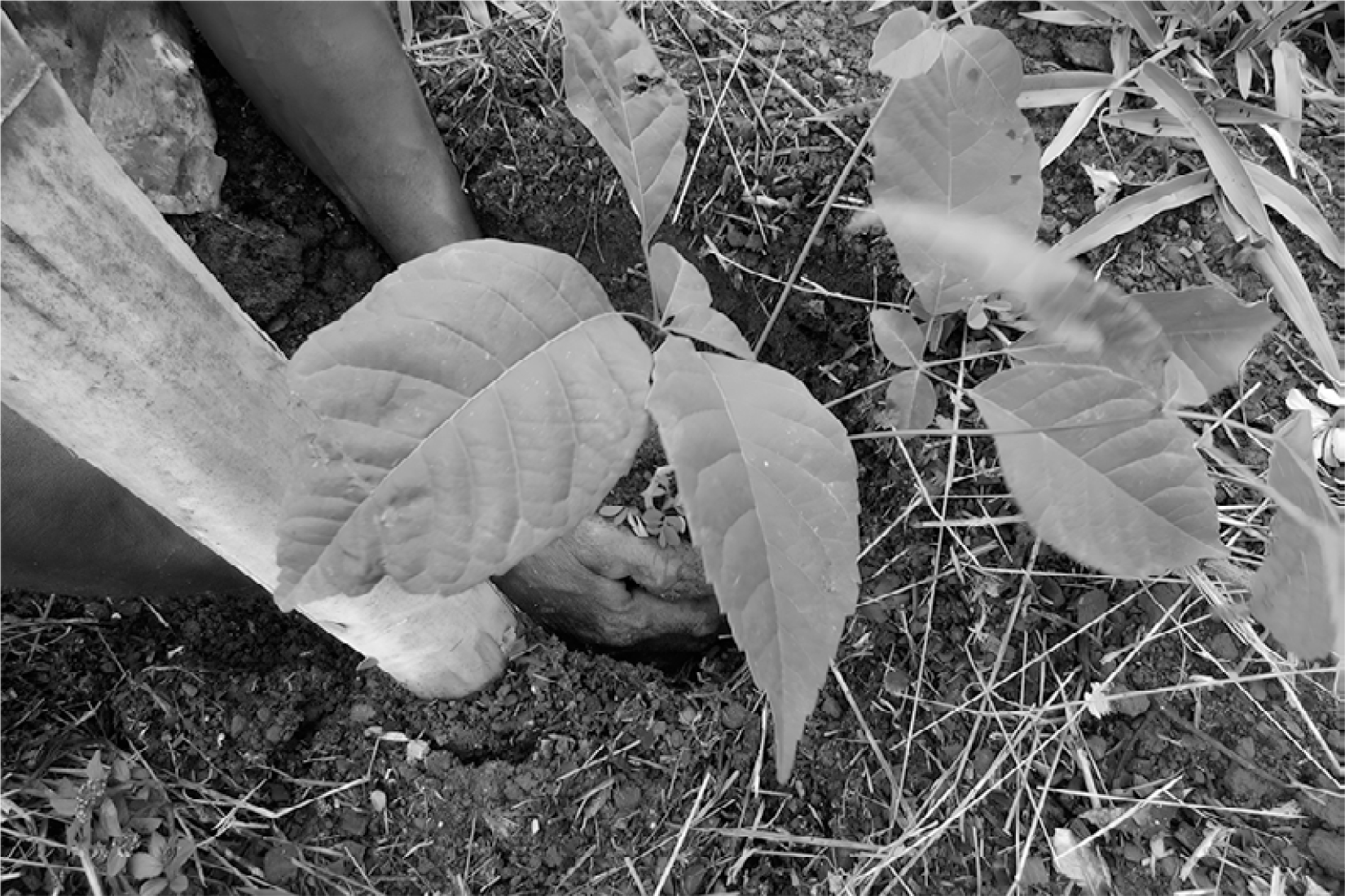
On the second day, participants planted seedlings of medicinal plants in the outdoor area of the Institute of Social Sciences at UnB (figure 1). They also learned about the care involved in planting and maintaining the plants. At this time, the traditional herbalists deepened their teaching on collection and planting techniques, discussing seedlings, seeds, and the ‘muvuca’, an ecological restoration technique that consists of mixing seeds of various native species for planting directly in the soil. This practice is widely used to recover degraded areas.
Next, the participants visited the UnB seedling production center, a place with gardens and where seedlings are planted across the various UnB campuses. This visit allowed for the observation of Cerrado flora in a controlled environment. For the traditional herbalists, the visit provided an opportunity to share more knowledge about species, reinforcing the exchange of knowledge among the participants.
On the third and final day, a field trip was organized to explore the trails near the UnB’s CRAD. Participants were divided into three groups that entered the forest with traditional herbalists, who, along the trail, explained some species of medicinal plants present in that small forest, exemplifying their uses. At the end, there was a discussion about the experience, and the participants were surprised by the richness of plants that the Cerrado offers and their diverse uses.
Reflections on the experience
The traditional peoples and communities of the Cerrado were called ‘Cerrado peoples’ by the historian Paulo Bertrand, as Mejia12 explains, with the aim of emphasizing the historical experience of the peoples who live in the Cerrado, marked by feelings of belonging to the biome. Thus, the traditional traditional herbalists of the Cerrado have lived in this biome for more than 12,000 years, always opting for sustainable coexistence and the promotion of living transformations of the biome12. Currently, the Cerrado peoples include more than 80 indigenous ethnic groups, in addition to quilombola communities, extractive workers, geraizeiras/os, vazanteiras/os, coconut breakers, riverside dwellers, artisanal fishermen/women, fundo and fecho de pasto communities, sertanejas/os, romani, among many others1. In their totality, they are guardians of ancestral knowledge about the biome, promoting sustainable management.
In contemporary times, the Cerrado has been increasingly losing ground to cities and agribusiness production activities. The prevailing development model in the biome condemns not only its plants, animals, and waters, but also promotes epistemicide and the discontinuity of the lives of traditional peoples and communities. The destruction of a biome means the death of the modes of knowledge that emerge from interaction with it. According to Carneiro13, epistemicide occurs when, beyond the annulment and disqualification of the knowledge of subjugated peoples, a persistent process of cultural indigence production takes place, which mortally wounds the rationality of the subjugated, mutilating the capacity to learn. It is a form of kidnapping of reason in a double sense: through the negation of the other’s rationality or through cultural assimilation that, in other cases, is imposed upon them. The discussion is broadened here with the inclusion of the dimension of traditional territories, such as the Cerrado, which, when destroyed, take with them multiple dimensions of knowledge. The lifestyles of the Cerrado peoples, marked mainly by extractive activities, the production of handicrafts and home remedies, as well as family farming, are essential for the conservation of the biome. During the activity, the traditional herbalists of the Cerrado taught that contact with the biome must be carried out in a way that ensures the maintenance of its biodiversity.
The traditional herbalists of Cerrado live in interaction with the territory, avoiding substantial transformations in the environment, as they possess a close subsistence bond, built over hundreds of years. According to Guimarães et al.14(148), the traditional herbalists of the Cerrado:
[...] are central figures in caring for the full lives of people and at the same time care for the Cerrado biome, from which they obtain medicines and food to sustain life. They are heirs to ancestral knowledge [...], energizing a ‘living tradition’, which is embodied in the therapist through whom ancestral wisdom flows. They are part of the working class, from rural or peri-urban areas of the region [Cerrado].
The activity carried out at UnB was quite relevant for the training of the university community involved, because, as residents of the Cerrado, this experience promoted, for many, the discovery of their own territory. The construction of Brasília, in the second half of the 1950s, was marked by the migration of populations from other regions and the accelerated construction of urban environments. The deforestation inherent in this process contributed to the lack of connection of many inhabitants of the Federal District and its surroundings with the biome. After more than six decades, this history still hinders the struggle for socio-environmental conservation, sometimes marked by discourses that portray the biome as an enemy of economic development, legitimizing the exploitation of the territory by agribusiness.
The proposed activity, in addition to contributing to the creation of bonds between the participants and the Cerrado biome, helped to broaden the understanding of the socioeconomic and health impacts resulting from the conservation of this biome. Several traditional herbalists use products from traditional medicine as a primary source of income. Considering their way of life, the threat to the biome is also a threat to health, not only due to the impact on the production of bottled remedies, baths, teas, and other natural medicines, but also on food sovereignty. By destroying the Cerrado and its fruits for the purpose of expanding agribusiness, the diet becomes increasingly less varied, sometimes giving way to industrialized and processed products, including for socioeconomic reasons.
The traditional herbalists present at the activity reported perceiving the negative impacts caused by dietary changes, with increasing contact with chemicals and processed foods, which they relate, in their perception, to various health problems. Dialogue with traditional herbalists allows us to understand how environmental conservation is directly linked to the maintenance of health, which makes this knowledge essential for more inclusive health policies and practices.
The traditional herbalists reported that it is not only traditional and indigenous peoples and communities who will suffer the consequences of the devastation of the Cerrado in their lives and health. The death of the Cerrado means amplifying the climate crisis, given that this biome is the cradle of waters, the headwaters of large hydrographic basins. The end of the Cerrado is the end of where the great rivers of Brazil begin. The consequences of this destruction will be reflected throughout the environmental system, reaching other biomes. Environmental problems are, simultaneously, health problems, since human beings and societies are affected in various dimensions15.
The activity helped participants reflect not only on the importance of the Cerrado biome, but also on how urban green spaces connect to the biome, prioritizing sustainable interaction. While visiting the Esplanade of Ministries in Brasília, Tantinha, a traditional herbalist from the Belo Horizonte metropolitan area16, expressed surprise at seeing only grass and no Cerrado trees. For her, it is important to have trees and grasses from the biome to demonstrate the Cerrado’s importance. In this sense, there is a movement of traditional herbalists from the Cerrado, together with other traditional peoples and communities of the Cerrado, to include the biome in § 4 of article 225 of the Federal Constitution, which provides special protection to some regions and biomes of the country, such as the Pantanal wetlands, the Amazon Rainforest, the Atlantic Forest, the Serra do Mar mountain range, and the Coastal Zone17. These are defined as national heritage, and their use depends on special conditions of exploitation. The struggle of the Cerrado peoples is to have the Cerrado biome included in this constitutional provision.
The activity addressed not only environmental conservation, but also thought about a project to value the Cerrado flora. It is understood that the guardians of this traditional craft are also guardians of their seeds, thus they are involved in reforestation areas and in the creation of nurseries to produce seedlings. As mentioned, during the workshop, the quilombola traditional herbalist taught about collection and planting techniques, seeds, and a technique called muvuca.
The traditional medicine presented in the workshop plays a fundamental role in the area of health, even though it often does not receive due recognition. With colonization, traditional medicine, as well as other cultural practices, was marginalized and, in many contexts, ended up being lost over time. The arrival of the colonizers brought with it a project of epistemicide, in which only Western culture was considered a model of ‘civilization’. This process affected both the way of living, producing and creating technologies, and their healing systems. Western medicine was imposed as the only valid one due to its supposed scientific basis, while traditional knowledge was persecuted and associated with witchcraft and sorcery. Many elders, guardians of this knowledge, were silenced, interrupting the oral transmission of ancestral practices essential to the restoration of the body.
Despite this, traditional medicine remains fundamental to many communities. Beyond healthcare, it also represents a means of livelihood through the production and sale of bottled remedies, teas, oils, and natural pills. In regions marked by poverty and lack of access to healthcare services, this knowledge remains alive as an accessible and effective alternative for care and survival.
The World Health Organization (WHO) has recognized traditional medicine as a health practice since 197018. However, formal recognition does not prevent the continued erasure of this knowledge by the pharmaceutical industry, driven by political and economic interests. As a result, many people end up without access to the benefits that could be provided by the integration between traditional and Western medicine. The invisibility of this knowledge reinforces the perception that it is inferior, when, in reality, it has vast therapeutic potential. Although herbs such as boldo, rue, and barbatimão are sometimes known superficially, most of the population is unaware of the diversity and effectiveness of other medicinal plants. During the workshop with the traditional herbalists, participants were able to gain a broader and deeper understanding of the plants in their entirety, understanding the benefits and even the risks of indiscriminate use without guidance from a traditional herbalists regarding some of them.
Decolonial thinkers have been forcefully discussing the need to decolonize hegemonic thought and strongly criticizing the coloniality of knowledge, which continues to perpetuate itself. For Quijano19, the term ‘colonialism’ evokes the idea of a continuous process, something that has not ended and that has no foreseeable end, manifesting itself as a coloniality that still persists. In this sense, Guimarães et al.20(4) state:
Colonial knowledge is based on the hegemony of a specific type of knowledge-Eurocentric scientific knowledge-which establishes as its central criterion the universal distinction between true and false.
All the knowledge involving the use of herbs is designed for the care of people, but, beyond that, it also aims at the resistance and strengthening of those bodies that suffer daily from the system of oppression. According to Santos et al.21(19111), “traditional quilombola medicine [...] is much more than technique: it is gesture, it is presence, it is spirituality rooted in the territory”.
For the traditional herbalists of the Cerrado, as reported in the workshops, it is necessary to understand the limits of medicinal plants, extracting them consciously, ‘so that only footprints are left in the forest’ and the environment is conserved, thus allowing the Cerrado to renew its medicinal properties, establishing a relationship of exchange. Contact with the land and medicinal plants also strengthens the inner self of those who practice this care, which ranges from caring for the forest and the land to caring for people who need the properties of some medicinal herb21. This inner strengthening establishes a connection with the environment, which also shapes the identity of these people, because, for them, caring for the land and plants is essential, since the territory is of extreme importance to their essence and construction as human beings.
When this territory, laden with history and ancestry, is affected in any way, these guardians are also affected. The traditional herbalists of this biome have the traditional territory of the Cerrado as a central element in the construction of the identity of these collectives, since the reference to the place of origin or belonging has great importance; it is at the root of the collective formulation of a large part of their identities22.
Through the workshops, participants learned that spirituality is directly connected to healing practices. For traditional herbalists, it is necessary to have faith that the medicinal plant used in each person’s treatment, taking into account individual needs, will heal them. Furthermore, it is important to mention the practices of blessing with medicinal herbs, such as rue, using herbs, holy water, and faith in healing. This practice creates a connection between the spiritual, mental, and physical, as do cleansing baths with leaves and roots, which are also used to heal and purify the inner self. By bringing about this spiritual cleansing, the body is also revitalized. It is worth noting that faith in these practices is not linked to a specific religion, as it is used by religious people of different traditions, such as Catholics, Umbandists, Candomblé practitioners, and Kardecists. The practice of blessing is seen as a kind of gift, passed down from generation to generation, maintaining this link with ancestry and spirituality.
In the PET-Health Equity program, students and professionals from Primary Health Care (PHC) interact horizontally, which provides rich learning in their training. However, for a critical and humanized training of these professionals and future health professionals, it is also necessary to break the bubble of academic knowledge and look at popular and traditional knowledge in an integral way, which inevitably influences the health care practices of these populations.
In the activity carried out, contact was established between three spheres: university, traditional knowledge and PHC. The exchange of knowledge provides broad knowledge for all parties, especially for the professionals, preceptors of PET-Health who were present in the activity, as well as for future health professionals who, based on this knowledge, will be able to provide more inclusive, humanized and adapted care to the socio-cultural realities of the populations served, especially the communities that use traditional medicine, recognizing and valuing this knowledge and the importance of conserving the biodiversity of the Cerrado for these peoples.
Final considerations
By including practices such as those described in this report within the university context, the need to consider the environment in which the individual is embedded - in this case, the Cerrado - is reinforced when understanding health practices. In this context, beyond considering how professionals can help traditional communities ensure quality health, the activity also highlights the potential contribution of traditional medicine to the activities of health professionals and other areas of knowledge. In this sense, creating a project for the restoration and recovery of green areas on the UnB campus is an important element, both in creating this network of care for the biome and as a pedagogical practice for the university community. The central point was, therefore, to foster debate about the potential of the biome, which is used by traditional peoples and communities as a source of healing and food.
The target audience for this initiative included, in particular, the university community, which was engaged with valuable epistemologies aimed at the conservation of the Cerrado biome, as well as the traditional herbalists who had a space for dialogue and dissemination of the importance of their craft. The traditional herbalists, while leading workshops and discussion circles, constantly emphasized the importance of the participants paying close attention, avoiding distractions from cell phones, maintaining silence, engaging in dialogue about the topic, and actively participating in the activities. This resulted in an activity with a dialogical communication approach between the parties, breaking with the idea of mere assistance often applied to projects involving traditional communities.
The activity demonstrated enormous immersive pedagogical potential, with actions that stimulated all the senses. The learning process was present in listening to the stories and recipes, in the smell of arnica and amesca, in the contact of hands with the earth when planting caju-do-Cerrado seedlings, in the taste of the baru seed, and in the attentive gaze of the participants.
Practices like these are becoming increasingly necessary in educational institutions, guaranteeing a learning experience based on multidimensionality and wholeness, such as this pedagogy of the traditional herbalists, which is uncommon in institutional pedagogical processes. It is worth noting that, despite the success of the activity, initiatives like this are still rarely implemented at the university, which raises questions about the importance of expanding or institutionalizing them.
Thinking about health beyond a colonized perspective is a challenge facing the health field, requiring reflection on the very construction of scientific knowledge in the area. Society has consolidated the idea that traditional knowledge is merely ‘alternative’ practice, constantly relegated to the periphery or excluded. However, this ancestral knowledge has been refined over generations based on concrete experiences and careful transmission of knowledge, much of which has scientific backing, making it essential to value it, disseminate its effectiveness, and integrate it respectfully into modern medicine.
-
Financial support:
Secretariat of the Environment (SeMA) and Dean of Research and Innovation (DPI) of the University of Brasília (UnB) (SeMA/DPI Notice No. 01/2024); Foundation for Research Support of the Federal District (FAPDF) - Notice 009/2023; Ministry of Health - SGTES/MS Notice No. 11/2023
Data availability:
The research data is contained in the manuscript itself
References
-
1 Rede Cerrado. Dia Mundial do Meio Ambiente: a importância do Cerrado para a biodiversidade [Internet]. Brasília, DF: Rede Cerrado; 2020 [acesso em 2025 jan 27]. Disponível em: https://redecerrado.org.br/dia-mundial-do-meio-ambiente-a-importancia-do-cerrado-para-a-biodiversidade/
» https://redecerrado.org.br/dia-mundial-do-meio-ambiente-a-importancia-do-cerrado-para-a-biodiversidade/ -
2 Rede Cerrado. Uma das frentes de atuação da Rede Cerrado é a defesa e a luta pela conservação do bioma [Internet]. Brasília, DF: Rede Cerrado; [data desconhecida] [acesso em 2025 abr 27]. Disponível em: https://redecerrado.org.br/nossa-atuacao/defesa-do-cerrado/
» https://redecerrado.org.br/nossa-atuacao/defesa-do-cerrado/ -
3 Fonseca MN. Raizeiras: a força do Cerrado está na raiz ou pensamentos com chá de Canela de Perdiz. Rev Indisciplina Linguíst Apl [Internet]. 2024 [acesso em 2025 abr 27];5(1):1-11. Disponível em: https://revistas.ufrj.br/index.php/rila/article/view/65832
» https://revistas.ufrj.br/index.php/rila/article/view/65832 -
4 Rigotto RM, Santos VP, Costa AM. Territórios tradicionais de vida e as zonas de sacrifício do agronegócio no Cerrado. Saúde Debate. 2022;46(Esp 2):13-27. DOI: http://dx.doi.org/10.1590/0103-11042022e201
» http://dx.doi.org/10.1590/0103-11042022e201 - 5 Guimarães SMF. Olhares diversos sobre pessoas e corporalidades: os saberes e práticas de terapeutas populares na região do DF e entorno. In: Guimarães SMF, Silva CD, organizadores. Antropologia e Saúde: diálogos indisciplinados. Juiz de Fora: Editora da UFJF; 2017. p. 68-99.
-
6 Ministério da Saúde (BR), Secretaria de Gestão do Trabalho e da Educação na Saúde. Secretaria de Gestão do Trabalho e da Educação na Saúde. Edital SGTES/MS nº 11, de 16 de setembro de 2023. Seleção para o Programa de Educação pelo Trabalho para a Saúde. Diário Oficial da União [Internet], Brasília, DF. 2023 nov 17 [acesso em 2025 abr 27]; Edição 218; Seção I:189. Disponível em: https://www.in.gov.br/en/web/dou/-/edital-sgtes/ms-n-11-de-16-de-setembro-de-2023-523637034
» https://www.in.gov.br/en/web/dou/-/edital-sgtes/ms-n-11-de-16-de-setembro-de-2023-523637034 -
7 Carvalho JJ. Universidade aberta a novos saberes, sujeitos e epistemologias: um modelo para a refundação das universidades brasileiras. Cienc Cult. 2023;75(1):1-8. DOI: http://dx.doi.org/10.5935/2317-6660.20230002
» http://dx.doi.org/10.5935/2317-6660.20230002 -
8 Mussi RFF, Flores FF, Almeida CB. Pressupostos para a elaboração de relato de experiência como conhecimento científico. Práx Educ. 2021;17(48):60-77. DOI: https://doi.org/10.22481/praxisedu.v17i48.9010
» https://doi.org/10.22481/praxisedu.v17i48.9010 - 9 Moura AF, Lima MG. A reinvenção da roda: roda de conversa: um instrumento metodológico possível. Tem Educ. 2014;23(1):98-106.
- 10 Candau VM. Oficinas pedagógicas de direitos humanos. 2ª ed. Petrópolis, RJ: Vozes; 1995.
- 11 Omiste AS, López MDC, Ramirez J. Formação de grupos populares: uma proposta educativa. In: Candau VM, Sacavino S, organizadores. Educar em direitos humanos: construir democracia. Rio de Janeiro: DP&A; 2000. p. 178-194.
- 12 Mejia L. Educação ambiental e saberes tradicionais das mulheres raizeiras e mulheres benzedeiras do Cerrado [tese]. Brasília, DF: Universidade de Brasília; 2024. 204 p.
- 13 Carneiro S. Dispositivo de racialidade: A construção do outro como não ser como fundamento do ser. Rio de Janeiro: Zahar; 2023. 432 p.
-
14 Guimarães SMF, Maués C, Fonseca C, et al. Terapeutas populares ou tradicionais e o cuidado com as pessoas e o Cerrado: ações de extensão. Rev Particip [Internet]. 2023 [acesso em 2025 abr 27];40:146-53. Disponível em: https://periodicos.unb.br/index.php/participacao/article/view/51286/39233
» https://periodicos.unb.br/index.php/participacao/article/view/51286/39233 -
15 Camponogara S, Kirchhof ALC, Ramos FRS. Uma revisão sistemática sobre a produção científica com ênfase na relação entre saúde e meio ambiente. Ciênc saúde coletiva. 2008;13(2):427-39. DOI: https://doi.org/10.1590/S1413-81232008000200018
» https://doi.org/10.1590/S1413-81232008000200018 -
16 Arruda A. Ervanário São Francisco de Assis: memórias, saberes e práticas de uma raizeira do Cerrado [Internet]. [Belo Horizonte]: REDE; [2020] [acesso em 2025 maio 26]. Disponível em: https://redemg.org.br/wp-content/uploads/2020/12/ervanario-amostra_Livro-Tantinha_web.pdf
» https://redemg.org.br/wp-content/uploads/2020/12/ervanario-amostra_Livro-Tantinha_web.pdf -
17 Dias DO, Miziara F. O Cerrado como patrimônio nacional: a inclusão do Cerrado no §4º do artigo 225 da Constituição Federal. Rev Cerrados. 2021;19(2):323-342. DOI: https://doi.org/10.46551/rc24482692202129%20
» https://doi.org/10.46551/rc24482692202129%20 - 18 Ministério da Saúde (BR). Política Nacional de Práticas Integrativas e Complementares no SUS. Brasília, DF: Ministério da Saúde; 2006. 96 p.
- 19 Quijano A. Colonialidade do poder, eurocentrismo e América Latina. In: Lander E, organizador. A colonialidade do saber: eurocentrismo e ciências sociais: perspectivas latino-americanas. Buenos Aires: Clacso; 2005. p. 107-30.
-
20 Guimarães MB, Nunes JA, Velloso M, et al. As práticas integrativas e complementares no campo da saúde: para uma descolonização dos saberes e práticas. Saúde Soc. 2020;29(1):e190297. DOI: https://doi.org/10.1590/S0104-12902020190297
» https://doi.org/10.1590/S0104-12902020190297 -
21 Santos ANS, Sousa-Júnior FS, Sousa AJZ, et al. Saberes que curam - A farmácia quilombola e o uso de plantas medicinais no cuidado infantil. Aracê. 2025;7(4):19103-35. DOI: https://doi.org/10.56238/arev7n4-199
» https://doi.org/10.56238/arev7n4-199 - 22 Nogueira MCR. Gerais a dentro e a fora: identidade e territorialidade entre Geraizeiros do Norte de Minas Gerais [tese]. Brasília, DF: Universidade de Brasília; 2009. 233 p.
Edited by
-
Editor in charge:
Guilherme Franco Netto, Fundação Oswaldo Cruz (Fiocruz), Rio de Janeiro (Rio de Janeiro/RJ), Brasil. Lattes: http://lattes.cnpq.br/5162760718464160, Orcid: https://orcid.org/0000-0002-8861-8897, e-mail: guilherme.netto@fiocruz.br

 Source: Author’s own elaboration.