
 Evaluation studies on health promotion in primary care: A scoping review Estudos de avaliação em promoção da saúde na atenção primária: uma revisão de escopo
ABSTRACT
This study investigated health promotion evaluations of Primary Health Care (PHC) in public systems. The search was conducted across eight databases and gray literature, following the PRISMAScR guidelines and the JBI Manual for Evidence Synthesis. The selection process was double-blind, with an independent analysis of titles and abstracts, followed by a full-text review. A total of 2,726 studies were identified, of which 517 were excluded due to duplication, 2,179 during the initial screening, and 22 after full-text review, resulting in the inclusion of eight articles published between 2013 and 2022, in Portuguese, English, and Spanish, from four countries. Five studies used qualitative methods, two applied mixed approaches, and one used quantitative method. The evaluations focused on specific programs, such as breastfeeding, diabetes prevention, physical activity, nutritional assistance, and oral health. The studies analyzed different dimensions: three assessed only the process, two focused on outcomes, while the others combined structure, process, and/or outcomes. The study revealed that although evaluations address structural, process, and outcome dimensions highlighting the need to strengthen individual and community capacity, the benefits of health promotion interventions vary. However, the scarcity of evaluative studies on health promotion in PHC highlights a significant knowledge gap.
KEYWORDS
Health promotion; Primary Health Care; Public health systems research; Evaluation study; Scoping review
RESUMO
Este estudo investigou avaliações de promoção da saúde na Atenção Primária à Saúde (APS) em sistemas públicos. A busca foi conduzida em oito bases de dados e literatura cinzenta, seguindo as diretrizes do PRISMA-ScR e do JBI Manual for Evidence Synthesis. A seleção seguiu um processo duplo-cego, com análise independente de títulos e resumos, seguida da leitura completa dos textos. Foram identificados 2.726 estudos, dos quais 517 foram excluídos por duplicidade, 2.179 na triagem inicial e 22 após leitura integral, resultando na inclusão de oito artigos publicados entre 2013 e 2022, em português, inglês e espanhol. Cinco utilizaram métodos qualitativos, dois abordagens mistas, e um utilizou método quantitativo. As avaliações abordaram programas específicos, como amamentação, prevenção do diabetes, atividade física, assistência nutricional e saúde bucal. Os estudos analisaram diferentes dimensões: três avaliaram apenas o processo, dois focaram nos resultados, enquanto os demais combinaram estrutura, processo e/ou resultado. O estudo revelou que, embora as avaliações abordem dimensões estruturais, processuais e de resultados, destacando a necessidade de fortalecer a capacidade individual e comunitária, os benefícios das intervenções em promoção da saúde variam. Entretanto, a escassez de estudos avaliativos de promoção da saúde na APS evidencia uma lacuna de conhecimento significativa.
PALAVRAS-CHAVES
Promoção da saúde; Atenção Primária à Saúde; Pesquisa em sistemas de saúde pública; Estudo de avaliação; Revisão de escopo
Introduction
Health promotion, according to World Health Organization (WHO)1, is a process of capacity development with community participation, based on empowerment and social action2. It goes beyond the technical approach3 by strengthening capacities to deal with the determinants of health. With a broad and integrated approach, it seeks to improve overall well-being, not just treat diseases. It acts on the social macro-determinants, recognizing inequalities as historical constructs that require interdisciplinary and intersectoral actions4.
The complexity of health promotion reflects both the breadth of its objectives and the diversity of the contexts in which it is implemented4. In this sense, health promotion research seeks to produce knowledge and promote social transformation, guided by a solid ethical framework5. Knowledge derived from constantly evolving scientific works contributes to improving professional practice, outlining approaches for evaluating specific interventions, target populations, and programmatic contexts6.
Health promotion evaluation is a meticulous process that seeks to clarify the distinctive characteristics of interventions, involving the detailed analysis of actions and interactions between various agents7. Linear methods do not apply to these programs and it is challenging to establish causal relationships for social phenomena8. Evaluating intersectoral policies and initiatives requires innovative approaches, especially qualitative methodologies that consider cultural contexts. Research principles should guide both quantitative and qualitative methods8.
Promoting health in Primary Health Care (PHC) is fundamental to restructuring the care model, prioritizing approaches based on the social determinants of health9. Although there are several monitoring and evaluation initiatives in PHC, many adopt a normative approach, using conventional process and outcome indicators10. This contrasts with the complexity of evaluating health promotion interventions, highlighting the need to consider the implementation contexts and understand the meaning of participation in the actions11. The evaluation of health promotion initiatives should utilize quantitative-qualitative models that encompass the participation of those involved and the scope of practices, going beyond traditional indicators of morbidity and mortality or service production12.
Conducting scoping and systematic reviews emerges as a crucial step in the methodological framework, essential for determining intervention methods. In this context, two reviews were identified, addressing different facets of health promotion. A scoping review13 focused specifically on interventions related to the exclusive use of alcohol and tobacco, while a systematic review14 explored health promotion in public health, although it did not focus on the evaluation of interventions. The analysis of these reviews revealed a lack of evidence regarding the subject of this investigation.
Therefore, identifying a gap in the literature regarding reviews of evaluative studies on health promotion in PHC, it was decided to conduct a scoping review. This review focuses on investigating evaluation studies of health promotion in PHC within public systems. The purpose is to provide a more comprehensive perspective of existing knowledge, map current literature, analyze the conduct of research in this field, identify knowledge gaps, and suggest directions for future research. Thus, it aims to contribute to the advancement of understanding and practice of health promotion in this specific context.
Material and methods
Scoping reviews represent a refined form of knowledge synthesis, characterized by a systematic approach that comprehensively maps the evidence related to a specific topic. This method not only identifies the main concepts, theories, and relevant sources, but also meticulously delineates the existing gaps in the body of knowledge15,16.
During the initial phase of the investigation, it was verified that there were no systematic or scoping review articles related to the evaluation of health promotion in primary care in the Cochrane database. Additionally, searches were conducted in protocol repositories such as PROSPERO (The International Prospective Register of Systematic Reviews Administered by the University of York’s Centre for Reviews and Dissemination) and OSF (Open Science Framework), but no records included evaluative studies related to general health promotion interventions in primary care or public health services. Given this gap, the Scoping Review (ScR) design was chosen, which stood out among other types of reviews because we understood that, although valuable in themselves, scoping reviews are also useful as precursors to systematic reviews17.
This scoping review was based on the JBI Manual for Evidence Synthesis18, and the report followed the guidelines of the Preferred Reporting Items for Systematic Reviews and Meta-Analyses Extension for Scoping Reviews (PRISMA-ScR)16.
Protocol and register
A protocol was developed based on the Preferred Reporting Items for Systematic Review and Meta-Analysis Protocols (PRISMA-P) guidelines19, along with the PRISMA Extension for Scoping Reviews (PRISMA-ScR) checklist16. This protocol was registered with the OSF on July 31, 2023, DOI: 10.17605/OSF.IO/DWVS4.
Eligibility criteria
PARTICIPANTS, CONCEPT AND CONTEXT
The acronym PCC (Population, Concept and Context) was used to formulate the research question: ‘What evaluation studies have been conducted on health promotion in Primary Health Care?’. In this formulation, Population refers to health promotion interventions; Concept encompasses evaluation studies; and Context relates to primary health care in public health services. The PHC is recognized as a privileged setting for the implementation of health promotion strategies that encompass not only actions focused on risk factors, but also initiatives related to empowerment, social participation, and other aspects20.
The inclusion criteria provide essential guidelines for reviewers to understand the proposal, playing a crucial role in guiding the reviewers’ own decisions regarding which sources to incorporate into the scoping review15. This methodology establishes a robust framework for the delimitation and careful analysis of studies, facilitating a systematic approach to the identification, evaluation, and synthesis of relevant evidence in the area of health promotion in primary care.
TYPES OF STUDIES
The inclusion criteria were designed to encompass evaluative studies, whether qualitative or quantitative, that presented primary data related to health promotion interventions in primary care, within the context of the public health system. There were no restrictions regarding language or publication period. Only studies employing an evaluation methodology were considered.
The exclusion criteria included studies focused on communicable diseases, investigations aimed at clinical care or intervention, randomized clinical trials, quasi-experimental studies, cohort studies, as well as studies that did not specify the type of intervention. Research projects and protocols that did not provide tangible evaluative results were also excluded.
Sources of information and research
The authors had the collaboration of a librarian in designing the search strategy, which included MeSH terms, DeCS terms, keywords, and synonyms. The initial syntax of the model was formulated on April 13, 2023, for the PubMed database. Subsequently, this search syntax was customized for each database, taking into account its particularities.
The following bibliographic databases were used in the electronic search strategy, carried out on June 16, 2023: PubMed/MEDLINE, CINAHL/Ebsco, Cochrane Library, Embase/Elsevier, LILACS, SciELO, Scopus, Web of Science/Clarivate Analytics. Supplementary searches were conducted in grey literature, including ProQuest Dissertations & Theses Global and Google Scholar.
To improve the search strategy, a supplementary step was applied during the selection of included studies. In this process, the textual references of these studies were meticulously analyzed to allow for the possible manual inclusion of bibliographies that had not been initially considered in the final selection.
Selection of sources of evidence
All studies retrieved from databases and grey literature were imported into the online reference manager Mendeley Cite v1.64.0 and subsequently uploaded to Rayyan® (Qatar Computing Research Institute), where duplicate studies were identified and excluded. A pilot test was conducted by two authors responsible for this phase of the study, using the first five articles. In Rayyan®, a double-blind method was adopted, and the selection occurred in two stages. In the first stage, two reviewers independently analyzed the titles and abstracts of all identified references. In the second phase, these same reviewers proceeded to read the texts in full, and the inclusion and exclusion criteria guided the selection of studies. When there was disagreement, a third reviewer acted as a mediator, and decisions were reached through discussions until a consensus was reached. Studies that did not meet the eligibility criteria were excluded.
The data collected included author, publication date, location, study type and method, population, description and duration of the intervention, and identified outcomes, as presented in the tables 1 and 2.
Descriptive summary
A qualitative summary was conducted to group and compare the data of the included studies. The main result of this analysis indicated that, overall, health promotion interventions were beneficial for users, and, on some occasions, implementation did not fully meet the established expectations. The influence of context on strategy implementation was highlighted, emphasizing the association between more favorable contexts and more advanced levels of implementation. Secondary results highlighted the complexity of the field of health promotion research, emphasizing the need for evaluation instruments to ensure the quality and usefulness of the results. Furthermore, the importance of integration between academia, health services, and the community was stressed as fundamental to driving research aligned with the demands of the health field.
Results
Selection of sources of evidence
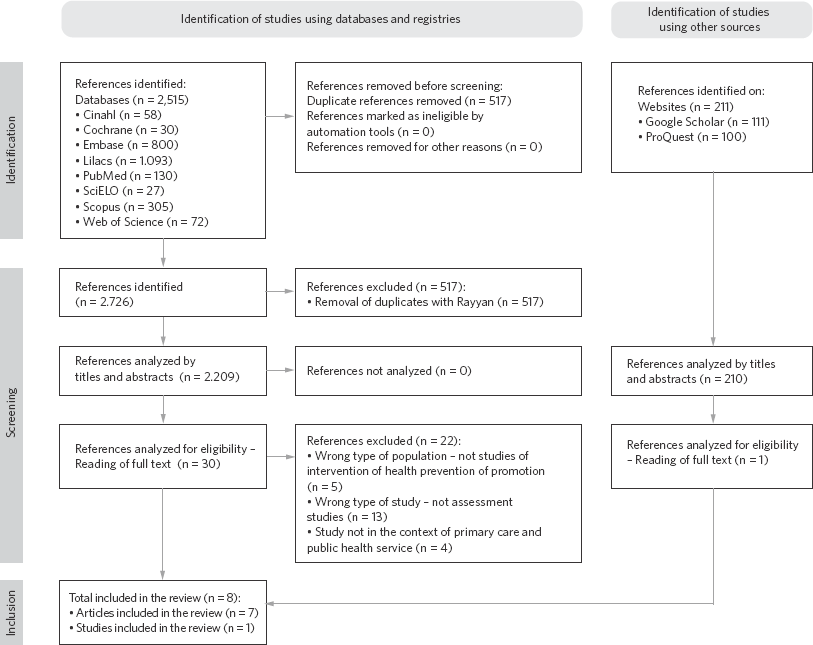
After excluding 517 duplicate references, 2209 studies remained. Of these, 2179 were excluded during the initial selection phase based on titles and abstracts. After evaluating the full texts, 22 studies were excluded, resulting in the inclusion of eight studies (figure 1), seven of which came from conventional databases and one from grey literature. No additional works were identified in the reference lists. The incorporated studies were evaluations published in English, Spanish, and Portuguese.
Diagram of the process for identifying and selecting studies using databases, registries and other sources
Characteristics of the sources of evidence
Eight studies were included in this review, with publications in English (n=4), Spanish (n=1), and Portuguese (n=3). Among these studies, five were conducted in Brazil21–25, one in China26, one in Spain27, and one in England28. The publications cover the period from 2013 to 2022 (table 2).
Results from individual sources of evidence
Complete data regarding the individual characteristics of the selected studies are presented in table 1.
Synthesis of results
Among the eight studies selected, five adopted qualitative methods22,24,26–28, with two of these studies having developed a theoretical model, a logical model, and a judgement matrix22,24. Two studies presented a combination of quantitative and qualitative approaches23,25, Two studies presented a combination of quantitative and qualitative approaches, providing a more comprehensive understanding of the processes and results29, while one study used exclusively quantitative methods21.
Discussion
The analysis of the studies shows that health promotion interventions, while providing significant benefits to users, still face challenges regarding their full implementation. The methodological diversity employed, with a predominance of qualitative approaches and combinations with quantitative methods, reflects the complexity of the field and favors more comprehensive interpretation of the phenomena investigated. Qualitative analysis, crucial for exploring subjectivities and subliminal details, requires rigor in the optimization of techniques, ensuring the credibility of the research30.
The systematization of the method in the development of evaluation instruments was not observed in many of the studies analyzed. Furthermore, the participatory nature of the process of constructing, discussing, and validating the evaluation model for health promotion interventions was not evident in the studies analyzed. These are important limitations identified. Although there are different ways to conduct evaluative studies, the robustness of the results of a research study is directly related to the instrument used31. Assessment instruments must follow an appropriate development and validation process32. According to Coluci, Alexandre and Milani31, to improve the quality of the instruments used, researchers must follow systematized steps and methods. The scientific literature indicates that assessment instruments should exhibit good psychometric qualities31,33–35, such as reliability and validity34.
Another aspect that deserves consideration is the participatory nature of the process of constructing, discussing, and validating the model for evaluating health promotion interventions. Regarding the research design, the involvement of the actors who implement and manage the interventions allows for dialogue between the theory of the intervention and the convictions, experiences, and knowledge of those involved in its practical implementation36,37. This aspect was not adequately highlighted in the studies analyzed.
Regarding the research participants, the studies analysed encompassed different stakeholder profiles: some involved both users and healthcare professionals22,25,26, while others focused exclusively on users27,28 or healthcare professionals21,23,24. The inclusive approach, involving both groups, aims to provide a more comprehensive understanding of the interventions, broadening the perspective and relevance of the analyses performed. Collaborative engagement between technical professionals and citizens plays a significant role in promoting health, both individually and collectively. This involvement is crucial for the formulation and implementation of strategies aimed not only at meeting the needs of the population, but also at encompassing the context in which that population is embedded38.
The geographical and cultural diversity present in studies conducted in countries like Brazil21–25, Spain27, England28 and China26 plays a crucial role in highlighting the importance of context for the implementation and evaluation of health promotion programs. Each country has unique characteristics, ranging from socioeconomic differences to cultural particularities and distinct health systems. This diversity can have significant implications for program outcomes, as interventions may be perceived and responded to in different ways in different contexts11. Therefore, it is essential to adopt contextualized approaches that take into account the specificities of each social, economic, and political context, promoting a dialogue between the different areas involved in research on health promotion5.
The predominance of publications originating from Brazil21–25 in the included studies can be attributed to the significant initiative of the Brazilian Ministry of Health, starting in 2000, aimed at consolidating monitoring and evaluation practices in PHC. Additionally, starting in 2017, self-assessment mechanisms were incorporated as components of the transfer of financial resources, conditional on the performance and quality of services39. The implementation of institutional monitoring and evaluation practices by local teams has boosted the quality of the Family Health Strategy (FHS) in the country, playing a vital role in reducing health inequalities40. In this context, there is broad consensus in Brazil regarding the recognition of the fundamental importance of Primary Health Care (PHC) and the Family Health Strategy (FHS) for the effective implementation of health promotion within the Unified Health System (SUS)41.
The included articles were published between 2013 and 2022. Notably, there is a continuous growth in publications related to the evaluation of health promotion strategies, as evidenced by the significant number of studies found in the initial phase of this review (n = 2,209). The increase in publications on health promotion evaluation reflects a paradigm shift in the approach to public health42. The transition from a predominantly curative model to a proactive approach to disease prevention and health promotion has encouraged research in this area. The rise in chronic diseases and the understanding of the social determinants of health have highlighted the need for strategies more aligned with population demands43–45.
The studies analyzed highlighted the leading role of academics in the evaluations carried out21,23,24,28. Despite this, four studies presented a connection between academia and health services22,25–27, with the participation of professionals linked to the evaluated health services. This integration proves fundamental to driving research that is more aligned with the demands and challenges of the health field. The integration between academia, health services, and the community has the potential to promote reflection and a redefinition of the practices investigated that promote health46.
Expressing a value judgment is an important element in defining the nature of an evaluation. This qualitative judgment, based on pre-established criteria and specific knowledge, is fundamental to the evaluation process, varying according to the nature of the object under analysis47. During the eligibility phase, the exclusion of a considerable number of studies (n = 13) revealed that many of them self-identified as evaluation studies but did not present evaluative models, indicators, or value judgments. Therefore, they did not meet the established criteria for evaluation studies (figure 1). This questionable approach in conducting the evaluations may compromise the quality and usefulness of the results, highlighting the importance of a more rigorous approach in conducting and reporting these studies.
Among the eight studies analyzed, five22,24–26,28 of them aimed to evaluate the implementation of health promotion strategies. Four studies22,25,26,28 demonstrated satisfactory levels of implementation, and only one indicated a partial implementation of the program24, justified by significant challenges in the process dimension. While some studies highlight significant improvements in implementation25,26 and/or in the health outcomes26–28 associated with the interventions, others emphasize substantial challenges and limitations23,24 in these strategies. These limitations encompass issues in processes related to multi-professional collaboration and integration with other sectors or social actors24. Furthermore, the challenge associated with a lack of intersectoral collaboration was also evident23, resulting in unproductive actions and a lack of dialogue between primary and secondary care services. The need to reorganize existing practices is a common point among three studies21,24,26, especially when they identify low levels of implementation24 and/or structural challenges in the execution of the evaluated programs21,24,26.
Among the studies included in the review, three focused their assessments exclusively on the process22,23,25, two exclusively on the outcomes21,28, one evaluated structure and process24, another addressed both structure and outcomes26, and finally one focused on the process and the outcomes27. Donabedian studies propose evaluating quality across the dimensions of structure, process, and outcome, reinforcing the idea that a good structure facilitates an efficient process, increasing the chances of positive health outcomes for individuals48–50. However, although this model is widely recognized and useful for analyzing the quality of care services, its application to evaluate health promotion interventions requires caution. Health promotion presupposes intersectoral actions, social participation, and approaches that transcend the health sector, involving social, environmental, economic, and cultural determinants51. These characteristics demand broader evaluative approaches, capable of capturing complex interactions between sectors and dimensions not restricted to the logic of care.
The studies included in the analysis focus on specific types of health promotion programs, covering areas such as breastfeeding strategies22,25, diabetes prevention26,28, physical activity24,27, nutritional assistance23 and oral health21. The variety of programs highlights the complexity of health promotion, shaped by the strategies of implementing organizations, the socio-political context, and the implementation environment. This diversity of influences justifies various evaluation perspectives, ranging from the impact on improving health conditions to the capacity to instigate processes of social change that affect the determinants of health52. However, the fragmentation of evaluations of specific interventions ultimately fails to represent the totality of health promotion initiatives.
When evaluating health promotion, it is essential to consider the development of individual and community capacity to deal with factors that influence health. Effectiveness evaluation, for example, seeks to determine whether an intervention achieves its objectives, addressing not only technical aspects but also philosophical questions about health, citizens’ rights, and the social responsibility of those involved51, as outlined in the guiding principles of health promotion of empowerment and social participation2.
In this context, the development of health promotion initiatives in PHC is essential to restructure the health care model and implement approaches based on the social determinants of health. This highlights the relevance of health promotion as an integrating strategy of interdisciplinary knowledge in individual and collective care9.
Limitations
In the overall context of this scoping review study, some limitations were identified. One of them is the heterogeneity of the studies analyzed. Although many studies self-identified as evaluation studies, a significant number of them were epidemiological studies, such as randomized clinical trials, quasi-experimental studies, and cohort studies. Furthermore, the included studies did not make a value judgment regarding the nature of the interventions, whether they were in fact aimed at promoting health or preventing disease. These nuances highlight the need for a more careful and specific analysis in the interpretation of the results. Because this is a scoping review, the quality of the studies was not analyzed based on the risk of bias. Although a comprehensive search strategy was developed, some relevant studies may not have been included, especially those published in languages other than those covered (Portuguese, English, and Spanish).
Conclusions
The results of this analysis highlight the importance of evaluating health promotion interventions, not only to identify their outcomes and impacts, but also to improve their implementation over time. In this study, the complexity of this research field and the need for more integrative and standardized approaches in the development and use of evaluation instruments are emphasized.
The integration between academia, health services, and the community, through collaboration among different actors – such as health professionals, academic researchers, and community members – is crucial for reshaping the healthcare model, focusing on the social determinants of health and strengthening both individual and collective care. This integration emerges as a key factor in developing, implementing, and promoting tailored and contextualized interventions and research capable of effectively meeting the specific needs of each population.
This scoping review allowed access to the volume of available studies and an examination of their conduct, revealing a scarcity of evaluative studies on health promotion in PHC. It was found that many studies were presented as evaluations, but did not employ evaluative models, indicators, or value judgments, emphasizing the importance of an evaluative process grounded on specific knowledge and pre-established criteria.
Furthermore, the review highlighted another knowledge gap regarding evaluation studies on health promotion in PHC. In attempting to answer the research question ‘What evaluation studies have been conducted on health promotion in Primary Health Care?’, it was observed that most of the included studies, although focusing on health promotion, concentrated on evaluations of structure, process, and/or outcome dimensions, without considering the development of individual or community capacity to address factors affecting health, as outlined in the guiding principles of health promotion of empowerment and social participation.
Therefore, it is crucial to highlight the urgent need for future research to transcend these segmented approaches, exploring more comprehensive health promotion strategies and utilizing assessment tools with evaluative models and judgment analysis matrices.
-
Financial support:
non-existent
Data availability:
Research data are contained in the manuscript itself
References
- 1 Organização Mundial da Saúde. Primeira Conferência internacional sobre Promoção da Saúde. Carta de Ottawa. Ottawa: OMS; 1986.
-
2 Sícoli JL, Nascimento PR. Promoção de saúde: concepções, princípios e operacionalização. Interface (Botucatu). 2003;7(12):101-22. DOI: https://doi.org/10.1590/S1414-32832003000100008
» https://doi.org/10.1590/S1414-32832003000100008 - 3 Czeresnia DO. Conceito de saúde e a diferença entre prevenção e promoção. In: Czeresnia DO, Freitas CM. Promoção da saúde: conceitos, reflexões, tendências. 2ª ed. rev. e amp. Rio de Janeiro: Fiocruz: 2009. p. 43-57.
- 4 Bodstein RCA. O debate sobre avaliação das práticas e estratégias em promoção da saúde. B Téc Senac. 2009;35(2):6-15.
-
5 Potvin L, Jourdan D. Health promotion research has come of age! Structuring the field based on the practices of health promotion researchers. Glob Health Promot. 2021;28(4):26-35. DOI: https://doi.org/10.1177/17579759211044077
» https://doi.org/10.1177/17579759211044077 - 6 Windsor R. Evaluation of Health Promotion and Disease Prevention Programs. 5th ed. Oxford: Oxford University Press; 2015.
- 7 Potvin L, Mcqueen DV. Health Promotion Evaluation Practices in the Americas. New York: Springer New York; 2009.
-
8 Carvalho AI, Bodstein RC, Hartz Z, et al. Concepts and approaches in the evaluation of health promotion. Ciênc saúde coletiva. 2004;9(3):521-9. DOI: https://doi.org/10.1590/S1413-81232004000300002
» https://doi.org/10.1590/S1413-81232004000300002 -
9 Prado NMBL, Santos AM. Promoção da saúde na Atenção Primária à Saúde: sistematização de desafios e estratégias intersetoriais. Saúde debate. 2018;42(Esp 1):379-95. DOI: https://doi.org/10.1590/0103-11042018S126
» https://doi.org/10.1590/0103-11042018S126 -
10 Medina MG, Aquino R, Vilasbôas ALQ, et al. Promoção da saúde e prevenção de doenças crônicas: o que fazem as equipes de saúde da família? Saúde debate. 2014;38(Esp):69-82. DOI: https://doi.org/10.5935/0103-1104.2014S006
» https://doi.org/10.5935/0103-1104.2014S006 - 11 Organização Pan-americana da Saúde; Ministério da Saúde; Centro de estudos, pesquisa e documentação em cidades saudáveis. Monitoramento e avaliação em promoção da saúde. Brasília, DF: Ministério da Saúde; 2023.
-
12 Lopes ALM, Silva SA, Castro DFA, et al. Avaliação de programas, serviços e tecnologias na perspectiva da promoção da saúde: uma reflexão teórica. Rev Bras Promoc Saude. 2013;26(4):590-94. DOI: https://doi.org/10.5020/18061230.2013.p590
» https://doi.org/10.5020/18061230.2013.p590 -
13 Kania A, Patel AB, Roy A, et al. Capturing the complexity of evaluations of health promotion interventions: A scoping review. Can J Program Eval. 2013;27(1):65-91. DOI: https://doi.org/10.3138/cjpe.027.003
» https://doi.org/10.3138/cjpe.027.003 -
14 Jackson N, Waters E. Criteria for the systematic review of health promotion and public health interventions. Health Promot Int. 2005;20(4):367-74. DOI: https://doi.org/10.1093/heapro/dai022
» https://doi.org/10.1093/heapro/dai022 -
15 Peters MDJ, Godfrey CM, Khalil H, et al. Guidance for conducting systematic scoping reviews. Int J Evid Based Healthc. 2015;13(3):141-6. DOI: https://doi.org/10.1097/xeb.0000000000000050
» https://doi.org/10.1097/xeb.0000000000000050 -
16 Tricco AC, Lillie E, Zarin W, et al. PRISMA Extension for Scoping Reviews (PRISMA-ScR): Checklist and Explanation. Ann Intern Med. 2018;169(7):467-73. DOI: https://doi.org/10.7326/m18-0850
» https://doi.org/10.7326/m18-0850 -
17 Munn Z, Peters MDJ, Stern C, et al. Systematic review or scoping review? Guidance for authors when choosing between a systematic or scoping review approach. BMC Med Res Methodol. 2018;18(143):1-7. DOI: https://doi.org/10.1186/s12874-018-0611-x
» https://doi.org/10.1186/s12874-018-0611-x -
18 Salmond S, Bennett MJ. JBI Manual for Evidence Synthesis. JBI. 2024. DOI: https://doi.org/10.46658/JBIMES-24-01
» https://doi.org/10.46658/JBIMES-24-01 -
19 Shamseer L, Moher D, Clarke M, et al. Preferred reporting items for systematic review and meta-analysis protocols (prisma-p) 2015: Elaboration and explanation. BMJ (Online). 2015;349(21):7647. DOI: https://doi.org/10.1136/bmj.g7647
» https://doi.org/10.1136/bmj.g7647 -
20 Teixeira MB, Casanova A, Oliveira CCM, et al. Avaliação das práticas de promoção da saúde: um olhar das equipes participantes do Programa Nacional de Melhoria do Acesso e da Qualidade da Atenção Básica. Saúde debate. 2014;38(Esp):52-68. DOI: https://doi.org/10.5935/0103-1104.2014S005
» https://doi.org/10.5935/0103-1104.2014S005 -
21 Silveira-Filho AD, Moysés SJ, Kusma SZ, et al. Potencial de efetividade das estratégias de promoção da saúde bucal na atenção primária à saúde: estudo comparativo entre capitais e regiões do Brasil. Rev Bras Epidemiol. 2016;19(4):851-65. DOI: https://doi.org/10.1590/1980-5497201600040014
» https://doi.org/10.1590/1980-5497201600040014 -
22 Venâncio SI, Martins MCN, Sanches MTC, et al. Análise de implantação da Rede Amamenta Brasil: desafios e perspectivas da promoção do aleitamento materno na atenção básica. Cad Saúde Pública. 2013;29(11):2261-74. DOI: https://doi.org/10.1590/0102-311x00156712
» https://doi.org/10.1590/0102-311x00156712 -
23 Neves JA, Zangirolani LTO, Medeiros MAT. Evaluation of nutritional care of overweight adults from the perspective of comprehensive health care. Rev Nutr. 2017;30(4):511-24. DOI: https://doi.org/10.1590/1678-98652017000400010
» https://doi.org/10.1590/1678-98652017000400010 -
24 Guarda FRB, Carneiro RCB, Silva RN, et al. Analysis of the degree of implementation of Health Academy Program in a Brazilian midsize town. Cad Saúde Pública. 2021;37(6):e00075020. DOI: https://doi.org/10.1590/0102-311X00075020
» https://doi.org/10.1590/0102-311X00075020 - 25 Barreto MS. Estudo avaliativo sobre o processo e efeitos da implantação da Estratégia Amamenta e Alimenta Brasil no âmbito municipal [dissertação]. São Paulo: Coordenadoria de Recursos Humanos da Secretaria de Estado da Saúde de São Paulo; 2018. 139 p.
-
26 Zhong X, Wang Z, Fisher EB, et al. Support for Diabetes Management in Primary Care and Community Settings in Anhui Province, China. Ann Fam Med. 2015;13(1):50-8. DOI: https://doi.org/10.1370/afm.1799
» https://doi.org/10.1370/afm.1799 -
27 Llorca MM, Niclos-Esteve M, Egea-Ronda A. Paseos grupales. Evaluación cualitativa, más allá de los números. Rev Comunidad. 2022;24(3):6-12. DOI: https://doi.org/10.55783/comunidad.240302
» https://doi.org/10.55783/comunidad.240302 -
28 Penn L, Rodrigues A, Haste A, et al. NHS Diabetes Prevention Programme in England: formative evaluation of the programme in early phase implementation. BMJ Open. 2018;8:e019467. DOI: https://doi.org/10.1136/bmjopen-2017-019467
» https://doi.org/10.1136/bmjopen-2017-019467 -
29 Serapioni M. Métodos qualitativos e quantitativos na pesquisa social em saúde: algumas estratégias para a integração. Ciênc saúde coletiva. 2000;5(1):187-92. DOI: https://doi.org/10.1590/S1413-81232000000100016
» https://doi.org/10.1590/S1413-81232000000100016 -
30 Guerra C, Brasil CCP, Martín-Cilleros MV, et al. Pesquisa qualitativa: um olhar sempre voltado à excelência dos estudos. NTQR. 2022;15:e773. DOI: https://doi.org/10.36367/ntqr.15.2022.e773
» https://doi.org/10.36367/ntqr.15.2022.e773 -
31 Coluci MZO, Alexandre NMC, Milani D. Construção de instrumentos de medida na área da saúde. Ciênc saúde coletiva. 2015;20(3):925-36. DOI: https://doi.org/10.1590/1413-81232015203.04332013
» https://doi.org/10.1590/1413-81232015203.04332013 - 32 DeVellis RF. Scale development: theory and applications. 4th ed. Los Angeles: SAGE Publications Inc; 2017.
- 33 Loch MR, Lemos EC, Jaime PC, et al. Development and validation of an instrument to evaluate interventions in relation to Health Promotion principles. Epidemiologia e Servicos de Saude. 2021; 30(3): 1–10.
-
34 Souza AC, Alexandre NMC, Guirardello EB. Propriedades psicométricas na avaliação de instrumentos: avaliação da confiabilidade e da validade. Epidemiol Serv Saude. 2021;30(3):e2020627. DOI: https://doi.org/10.1590/s1679-49742021000300005
» https://doi.org/10.1590/s1679-49742021000300005 -
35 Pilatti LA, Pedroso B, Gutierrez GL. Propriedades Psicométricas de Instrumentos de Avaliação: Um debate necessário. Rev Bras Ensino Ciênc Tecnol. 2010;3(1):81-91. DOI: http://dx.doi.org/10.3895/S1982-873X2010000100005
» http://dx.doi.org/10.3895/S1982-873X2010000100005 -
36 Fontenele RM, Sousa AI, Rasche AS, et al. Construção e validação participativa do modelo lógico do Programa Saúde na Escola. Saúde debate. 2017;41(Esp):167-79. DOI: https://doi.org/10.1590/0103-11042017S13
» https://doi.org/10.1590/0103-11042017S13 -
37 Guerra S, Albuquerque AC, Marques P, et al. Construção participativa da modelização das ações educacionais da estratégia de Planificação da Atenção à Saúde: subsídios para avaliação da efetividade. Cad Saúde Pública. 2022;38(3):e00115021. DOI: https://doi.org/10.1590/0102-311X00115021
» https://doi.org/10.1590/0102-311X00115021 -
38 Moysés SJ, Moysés ST, Krempel MC. Avaliando o processo de construção de políticas públicas de promoção de saúde: a experiência de Curitiba. Ciênc saúde coletiva. 2004;9(3):627-41. DOI: https://doi.org/10.1590/S1413-81232004000300015
» https://doi.org/10.1590/S1413-81232004000300015 -
39 Sousa AN. Monitoramento e avaliação na atenção básica no Brasil: a experiência recente e desafios para a sua consolidação. Saúde debate. 2018;42(Esp 1):289-301. DOI: https://doi.org/10.1590/0103-11042018S119
» https://doi.org/10.1590/0103-11042018S119 -
40 Facchini LA, Tomasi E, Dilélio AS. Qualidade da Atenção Primária à Saúde no Brasil: avanços, desafios e perspectivas. Saúde debate. 2018;42(Esp 1):208-23. DOI: https://doi.org/10.1590/0103-11042018S114
» https://doi.org/10.1590/0103-11042018S114 -
41 Rocha DG, Alexandre VP, Marcelo VC, et al. Processo de revisão da Política Nacional de Promoção da Saúde: múltiplos movimentos simultâneos. Ciênc saúde coletiva. 2014;19(11):4313-22. DOI: https://doi.org/10.1590/1413-812320141911.11232014
» https://doi.org/10.1590/1413-812320141911.11232014 -
42 Carvalho SR, Gastaldo D. Promoção à saúde e empoderamento: uma reflexão a partir das perspectivas crítico-social pós-estruturalista. Ciênc saúde coletiva. 2008;13:2029-40. DOI: https://doi.org/10.1590/S1413-81232008000900007
» https://doi.org/10.1590/S1413-81232008000900007 -
43 Marmot M. Social determinants of health inequalities. Lancet. 2005;365(9664):1099-1104. DOI: https://doi.org/10.1016/s0140-6736(05)71146-6
» https://doi.org/10.1016/s0140-6736(05)71146-6 -
44 Kawachi I, Subramanian SV. Social epidemiology for the 21st century. Soc Sci Med. 2018;196:240-5. DOI: https://doi.org/10.1016/j.socscimed.2017.10.034
» https://doi.org/10.1016/j.socscimed.2017.10.034 - 45 Berkman LF, Kawachi I, Glymour MM. Social Epidemiology. 2nd ed. New York: Oxford University Press; 2014.
- 46 Ministério da Saúde (BR), Secretaria de Gestão do Trabalho e da Educação na Saúde, Departamento de Gestão da Educação na Saúde. Política Nacional de Educação Permanente em Saúde: o que se tem produzido para o seu fortalecimento? Brasília, DF: MS; 2018.
- 47 Colussi CF, Calvo MCM. Avaliação da Atenção em Saúde Bucal no Brasil: uma revisão da literatura. Saúde Transform Soc. 2012;3(1):92-100.
-
48 Massaro AF, Basso JF, Adão I, et al. Atenção primária à saúde: avaliação de indicadores de estrutura e de processo em um município de pequeno porte. Rev Adm Saúde. 2020;20(81):e254. DOI: http://dx.doi.org/10.23973/ras.81.254
» http://dx.doi.org/10.23973/ras.81.254 -
49 Donabedian A. Evaluating the quality of medical care. Milbank Q. 2005;83(4):691-729. DOI: https://doi.org/10.1111/j.1468-0009.2005.00397.x
» https://doi.org/10.1111/j.1468-0009.2005.00397.x -
50 McCullough K, Andrew L, Genoni A, et al. An examination of primary health care nursing service evaluation using the Donabedian model: A systematic review. Res Nurs Health. 2023;46(1):159-76. DOI: https://doi.org/10.1002/nur.22291
» https://doi.org/10.1002/nur.22291 - 51 Salazar L. Evaluación de efectividad en promoción de la salud. Guía de Evaluación Rápida. Cali: Cadetes, Universidad del Valle; 2004.
Edited by
-
Editor in charge:
Ingrid D’avilla Freire Pereira

 Source: Prepared by the authors, adapted from PRISMA-ScR