 NURSING CARE MODEL FOR OLDER PEOPLE HOSPITALIZED FOR PALLIATIVE CARE
ABSTRACT
Objective: to describe the methodological process of developing a nursing care model aimed at older people hospitalized for palliative care.
Method: qualitative study, based on Convergent Care Research, which allows the integration between care practice and knowledge production. Six convergence groups were held in May and June 2024, with 18 nurses and 14 nursing technicians working in the special care unit of a public hospital. Data collection took place through guided discussions, recorded and transcribed in full. The analysis followed the stages of apprehension, synthesis, theorization, and transfer, which allowed the collective construction of the model.
Results: the resulting model was structured around three interdependent pillars: (1) control of pain and other physical symptoms, combined with attention to the care environment; (2) support for family members and significant others, which encourages coping and shared decision-making; and (3) promotion of experiences of dignity and respect, aimed at achieving peace and well-being. These pillars guide individualized and humanized interventions, guarantee the autonomy of the older person, and preserve their values, with the purpose of providing comfort and dignity to the older person in palliative care.
Conclusion: the construction of the model promoted critical reflection on the nursing team's know-how, reinforced person-centered practices based on respect, comfort, and dignity in the face of the finiteness of life, and improved the quality of care and qualified palliative care actions.
DESCRIPTORS:
Health care models; Nursing management; Nursing care; Aged; Nursing; palliative care
RESUMO
Objetivo: descrever o processo metodológico de elaboração de um modelo de cuidados de enfermagem direcionado à pessoa idosa hospitalizada em cuidados paliativos.
Método: estudo qualitativo, fundamentado na Pesquisa Convergente Assistencial, que possibilita a integração entre prática assistencial e produção de conhecimento. Foram realizados seis grupos de convergência, nos meses de maio e junho de 2024, com 18 enfermeiros e 14 técnicos de enfermagem atuantes na unidade de cuidados especiais de um hospital público. A coleta de dados ocorreu por meio de discussões orientadas, registradas e transcritas na íntegra. A análise seguiu as etapas de apreensão, síntese, teorização e transferência, o que permitiu a construção coletiva do modelo.
Resultados: o modelo resultante estruturou-se em três pilares interdependentes: (1) controle da dor e de outros sintomas físicos, combinado com atenção ao ambiente de cuidado; (2) suporte aos familiares e pessoas significativas, que estimula o enfrentamento e a tomada de decisões compartilhadas; e (3) promoção de experiências de dignidade e respeito, voltadas à obtenção de paz e bem-estar. Esses pilares orientam intervenções individualizadas e humanizadas, garantem a autonomia da pessoa idosa e preservam seus valores, com o propósito de proporcionar conforto e dignidade à pessoa idosa em cuidados paliativos.
Conclusão: a construção do modelo promoveu reflexão crítica sobre o saber-fazer da equipe de enfermagem, reforçou práticas centradas na pessoa e pautadas no respeito, no conforto e na dignidade diante da finitude da vida, além de elevar a qualidade da assistência e qualificar as ações em cuidados paliativos.
DESCRITORES:
Modelos de assistência à saúde; Gestão de enfermagem; Cuidados de enfermagem; Pessoas idosas; Enfermagem; Cuidados paliativos
RESUMEN
Objetivo: describir el proceso metodológico de desarrollo de un modelo de atención de enfermería dirigido a ancianos hospitalizados para cuidados paliativos.
Método: estudio cualitativo, basado en la Investigación Convergente Asistencial, que posibilita la integración entre la práctica del cuidado y la producción de conocimiento. Se realizaron seis grupos de convergencia en mayo y junio de 2024, con 18 enfermeros y 14 técnicos de enfermería que trabajan en la unidad de cuidados especiales de un hospital público. La recolección de datos se realizó a través de discusiones guiadas, grabadas y transcritas en su totalidad. El análisis siguió las etapas de aprehensión, síntesis, teorización y transferencia, lo que permitió la construcción colectiva del modelo.
Resultados: el modelo resultante se estructuró en torno a tres pilares interdependientes: (1) control del dolor y otros síntomas físicos, combinado con la atención al entorno de cuidado; (2) apoyo a los familiares y otras personas significativas, que fomenta el afrontamiento y la toma de decisiones compartida; y (3) promoción de experiencias de dignidad y respeto, orientadas a lograr la paz y el bienestar. Estos pilares orientan las intervenciones individualizadas y humanizadas, garantizan la autonomía de la persona mayor y preservan sus valores, con el propósito de proporcionar comodidad y dignidad a la persona mayor en cuidados paliativos.
Conclusión: la construcción del modelo promovió la reflexión crítica sobre el saber hacer del equipo de enfermería, reforzó prácticas centradas en la persona basadas en el respeto, el confort y la dignidad frente a la finitud de la vida, además de mejorar la calidad de la atención y cualificar las acciones de cuidados paliativos.
DESCRIPTORES:
Modelos de atención de salud; Gestión de enfermería; Atención de enfermería; Ancianos; Enfermería; Cuidados paliativos
INTRODUCTION
The increase in life expectancy has led to significant demographic and epidemiological changes. As the population ages, there is a greater predisposition to the emergence of chronic non-communicable diseases (CNCDs), which can lead to a progressive decline in health and greater functional dependence. When associated with a general worsening of the health condition, these changes often require palliative care (PC)1. Annually, approximately 22 million older people require PC but do not have access to it, with 78 % of them residing in low-income countries2.
The worsening of CNCDs, especially among the older people, makes hospitals, with their advanced technology and qualified staff, ideal places to provide comfort and alleviate family burdens. As the condition of older people deteriorates, the need for palliative care intensifies, most of which is provided in hospitals3.
The World Health Organization (WHO) defines PC as a comprehensive and active care approach for individuals of all ages (adults and children) who face intense health-related suffering resulting from a serious and chronic illness, especially those nearing the end of life, whose main objective is to improve the quality of life of patients, their families, and their caregivers4.
In Brazil, the Ministry of Health published, in May 2024, the Ordinance GM/MS No. 3,681, which establishes the National Palliative Care Policy (PNCP) within the scope of the Brazilian Public Health System (SUS), whose objective is to integrate PC into the Health Care Network (RAS), with an emphasis on primary care; promote the improvement of the quality of life of people in PC, through safe and humane health care; expand the availability of medications that promote the safe control of symptoms of people in PC; stimulate training, continuing education, appreciation, provision and management of the PC workforce within the SUS; and promote awareness and education about PC in the society5.
Faced with so many demands for care for this patient profile, an essential component is the work of the multidisciplinary team, with emphasis on the work of nursing professionals, as they are, in most cases, those who provide the greatest assistance to the patient in PC, which allows establishing an interpersonal relationship of greater closeness and assistance, in addition to carrying out care practices6. However, some factors, such as physical structure and professional training, are indicated as barriers to the practice of PC7.
Accordingly, it is essential to evaluate, rethink, and contextualize care to systematize actions in nursing practice. In this scenario, care models are understood as word structures that provide a particular nursing perspective through the interrelation of concepts in the structure, using diagrams, symbols, or physical visualization to explain ideas8. Such models emerge as a strategy to support, consolidate and guide care practices, through theorization of care, and allow the systematization of team actions, responding to the real needs of patients9.
Nursing has many theories and conceptual models that guide care practices to be applied by the nursing team in different scenarios. Conceptual models originate from theories or professional practice, are more global and abstract, and theories are more concrete and specific, contributing to conceptually expand nursing care practices10-11. In the area of palliative care, the Theories of Transcultural Care by Madeleine Leininger, Comfort by Katharine Kolcaba, Fundamental Needs by Virginia Henderson, and Adaptation by Callista Roy12, and models aimed at specific population segments or all users with general PC needs13 stand out.
In the palliative care setting, there is also the Peaceful End-of-Life Theory (PELT)14, developed in 1998 by nurses Cornelia Ruland and Shirley Moore. It plays a prominent role, as it aims to investigate the quality of the dying process in patients with serious illnesses and in the process of dying. The PELT14 focuses not only on the final instance of death itself, but also on promoting peaceful and meaningful living during the patients' remaining time.
Therefore, understanding that Nursing Care Models are tools that facilitate the systematization of practices and have the potential to strengthen the quality of care provided, the study aimed to describe the methodological process of constructing a nursing care model aimed at older people hospitalized for palliative care.
METHOD
The study uses Convergent Care Research (CCR) as its methodological framework, whose main characteristic is the intentional articulation of research with care practice. The dialogicity and immersion of the researcher in the practical field are inherent to this methodology and its design presents a methodological character of proximity and distance in the face of healthcare know-how15.
The selection of CCR is due to the fact that it applies inductive-deductive logic with data generated from the reality of nursing practice, with an alliance between pragmatics and science, occupying an important place in the development of care models16. It should also be highlighted that this method enables research emerging from professional practice, based on problems detected in the daily care provided by the nurses themselves, who work on constructing the research. In this regard, adherence to reality is evident and the expansion of results is reflected in new practices, allowing care improvement.
The research was conducted according to the CCR phases15: conception, instrumentation, and scrutiny. In the conception stage, which represents the selection of the theme and the establishment of the research objectives, the researcher had concerns arising from care practice, in line with dialogues with the nursing team, giving rise to the research problem.
The lead researcher is a clinical nurse with knowledge and training in gerontology and palliative care, and works at the hospital that served as the study site, where the model was developed. These requirements align with the attributes of a study that applies the CCR method.
The instrumentation phase encompasses the design of methodological procedures, in which there was a search for scientific evidence to support decisions regarding the selection of the study location, participants and data collection instrument.
The study site was a public hospital in the city of Fortaleza, Ceará, and it was selected because it has a unit intended for patients in PC and in the rehabilitation process, the vast majority of which are older people, called the Special Care Unit (UCE).
The unit, where the research was carried out, has 18 nurses and 32 nursing technicians. Of these, 32 professionals met the inclusion criteria and agreed to participate in the study, all nurses and 14 nursing technicians belonging to the unit. The sampling design in CCR is qualitative and the assessment of the sufficiency of participants is made with the preliminary analysis of the data and reaching saturation with indication of the empirical design of the research15.
The inclusion criteria for participants were: being a nurse and/or nursing technician; having been admitted through public selection; having experience in assisting at least one older person in palliative care. Nursing professionals who were on vacation or on leave for any reason during the data collection period were excluded, as well as cooperative professionals, due to their sporadic work in the unit to cover occasional absences.
The scrutiny phase, which is characterized by rigorous investigation of the collected data, was conducted by creating convergence groups (CG) with nursing professionals to enable everyone's involvement and to converge care with research.
The invitation to professionals was made personally, and five convergence groups were held in person at the hospital, in the local nursing coordination meeting room, located in the unit itself. Each convergence group lasted an average of one hour and addressed a specific topic. However, as it was not possible to gather all participants in a single meeting, the same thematic group (for example, Group 1) was held more than once, with sessions distributed in the morning, afternoon and evening. This organization ensured greater flexibility and allowed professionals to participate according to their availability.
The conversations and debates of all CG were recorded and later transcribed in full for the analysis process. The CG was conducted using a pre-established script, constructed using the results of a semi-structured interview previously made with the study participants. The script was guided by the following themes: PC concepts and definitions; assumptions of PELT and the interface with the principles of PC; needs and particularities of the older people in PC; the know-how of the nursing team in the face of this patient profile; the last CG briefly recapitulated the previous themes and focused on showing the group the care model resulting from the discussions.
The CGs were formed in a mixed manner, consisting both of nurses and nursing technicians, with a composition that, in some cases, showed a slight predominance of one of these categories over the other. Each group had an average of 10 participants. Group formation was organized in a random way, without interference in the members' choices.
The analysis phase, consisting of four stages, began with the apprehension process, in which the transcript of the CGs performed was read and the information was organized. In the synthesis process, data were interpreted, bringing together the relevant elements.
The theorization process resulted in the proposal of a care model in a hospital environment for older people in palliative care, based on the elements identified in the synthesis.
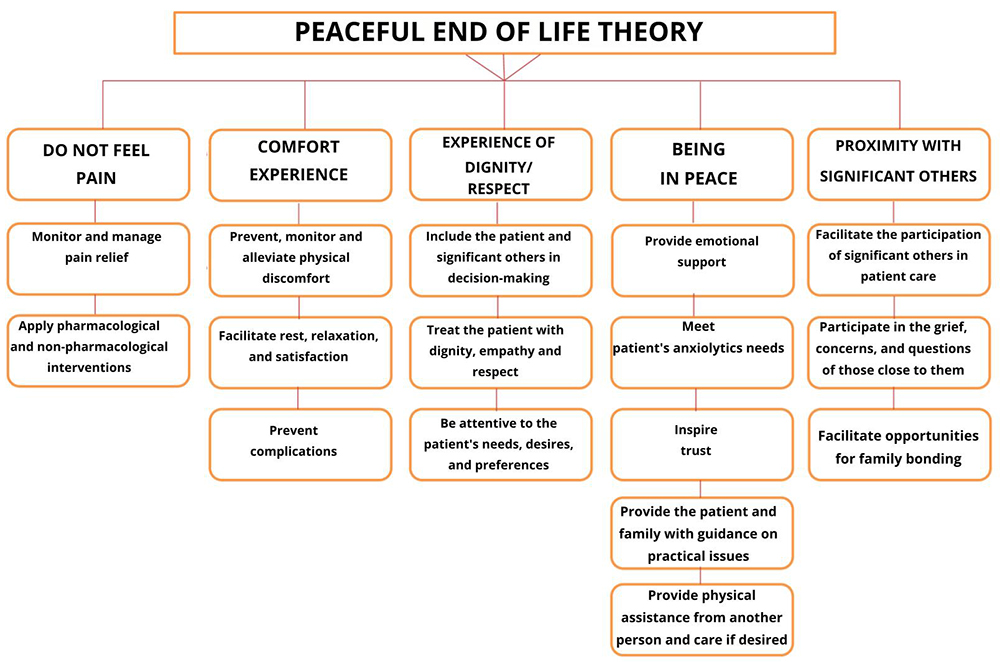
The Nursing Care Model was developed based on the Peaceful End of Life Theory14, which incorporates five well-defined and interrelated fundamental concepts: not feeling pain, experiencing comfort, experiencing dignity/respect, being at peace, and close to significant others. These concepts were integrated with the needs identified in the CGs carried out. It is considered a middle-range and predictive theory. Its “context” is based on Kocalba’s Comfort theory14.
Figure 1 illustrates the concepts of PELT and their relationships, which supported the Model’s proposition.
The transfer process allowed reaching meaning of the findings, and sought to contextualize them with the literature in similar situations, without generalizing to other contexts. The care model was presented to the group, which analyzed and validated its viability in a hospital context.
In CCR, validation occurs continuously in each CG, with participants critically evaluating the applicability of the care model and proposing adjustments according to the practical demands of the service and through joint creation. Based on this process, validation was carried out in groups, where professionals discussed the material produced. At the end, the consolidated content was presented again to the same participants for a final analysis, to ensure the integration between theory and practice and confirm the adequacy of the model to the institution's care and operational reality. The convergence of practical actions and information, in a concrete way, occurs during the obtainment of information in practice or along with it and in other moments of negotiation between the researcher and the members of the practice. An open channel is created to improve care, based on scientific findings developed in the research process15,17.
To illustrate the CCR process, as proposed in the research, a methodological design detailing the phases covered was developed (Figure 2).

Data collection was carried out from May to June 2024 and the participants’ anonymity was ensured by coding their statements, using the expressions “Enf.” (nurse - enfermeiro in Portuguese) and “Tec.” (nursing technician), followed by numbers according to the chronological order of the people discussing in the CG.
The study was approved by the Research Ethics Committee of the Universidade Estadual do Ceará and was submitted for analysis by the Internal Research Committee of the General Hospital Dr. Waldemar Alcântara, which issued a letter of consent for research continuation. Following approval by the Research Ethics Committees, data collection began, with the signing of the Free and Informed Consent Form (FICF).
RESULTS
Regarding the professionals at the research site, there was a predominance of females (68.7 %) and the age range was between 22 and 54 years old. Most professionals had more than five years of experience in the healthcare field, specifically in the hospital context.
Among the nurses working at the institution, all had basic knowledge about palliative care and 61.1 % (n=11) reported having participated in short courses on the subject. Regarding nursing technicians, 85.7 % (n=12) had no theoretical training on palliative care.
As a result of the five CGs carried out, there was an exchange of knowledge and actions by the team, discussion of the difficulties faced in daily life, and definition of the team's competencies in relation to the older person in palliative care.
The first CG aimed to present the research project to the participants, clarify any doubts related to the study, and publicize the schedule of CG activities. This initial moment allowed alignment between the participants and the researcher, ensuring commitment and understanding of the research objectives.
The second CG sought to bring participants closer to the theoretical framework, promoting discussions on the concept of palliative care. In this group, it was evidenced that the professionals did not have specific knowledge about PC, understanding it only as end of life, as they report: […] palliative care is a time when medicine can no longer intervene in much in terms of science, then comes the realization of comfort and well-being, but the patient will pass away at any moment in the short term. (Tec15); [...] There's something I find strange because some patients in palliative care talk and are conscious and I don't understand that. (Tec18).
A group discussion was developed to encourage participants to talk about the scope of PC from the moment a person receives a diagnosis of a serious, life-threatening illness that causes intense suffering until the final moments of life. This way, it was possible for participants to identify the phases in PC, specifically with regard to the end of life.
The third CG discussed and presented the Peaceful End of Life Theory, which underpins the study. Participants analyzed the theoretical assumptions and reflected on the applicability of this theory in nursing practice with a focus on care for the older people: […] it means finding ways to add comfort and peace to patients (Enf01); Our focus is on pain relief and promotion of emotional well-being by providing a loving, non-judgmental caring environment (Enf02); […] it reflects our commitment to the patient's comprehensive well-being. [...] As nurses, we are here to provide emotional support, pain relief, and respect for individual choices, ensuring that every moment counts for our patients and their families (Enf16); […] I believe that it (theory) says that we should adapt our practices to meet the individual needs of each patient, respecting their personal preferences and values (Tec08).
This meeting provided an opportunity for nurses and technicians to discuss their actions based on nursing theory, and include them as practices based on a theoretical-scientific framework.
During the fourth CG, the group reviewed all the considerations made so far, including the notes from the first meeting. This review allowed the visualization and modification of information throughout the different phases. It discussed the know-how of the nursing team in the face of the challenges of caring for older people in palliative care. The discussion drew on theoretical reflections from previous meetings and fostered a dialogue on how to integrate theoretical concepts into daily nursing practices. [...] we prioritize the assessment and appropriate management of pain and other symptoms such as dyspnea, nausea and fatigue. We use symptom control scales to ensure maximum comfort. (Enf01); […] older people have more fragile skin, so we implement skin care protocols to prevent pressure injuries (Enf02); […] we must take care of the place too. A noisy and dirty environment is not ideal for this type of care. (Enf15); […] check vital signs, perform hygiene, administer medication, change diapers, pay attention to pain, dyspnea, fever, talk to the companion and explain things to the patient (Tec22).
In this group, it was possible to demonstrate a lack of standardization of care, as each participant expressed their perceptions and was surprised by the observations of others, as if they had not considered these points previously. The reports, at that moment, reflected the surprise of nursing professionals in realizing the extent of the care they perform and the fact that they often do not recognize in themselves the potential and importance of these actions.
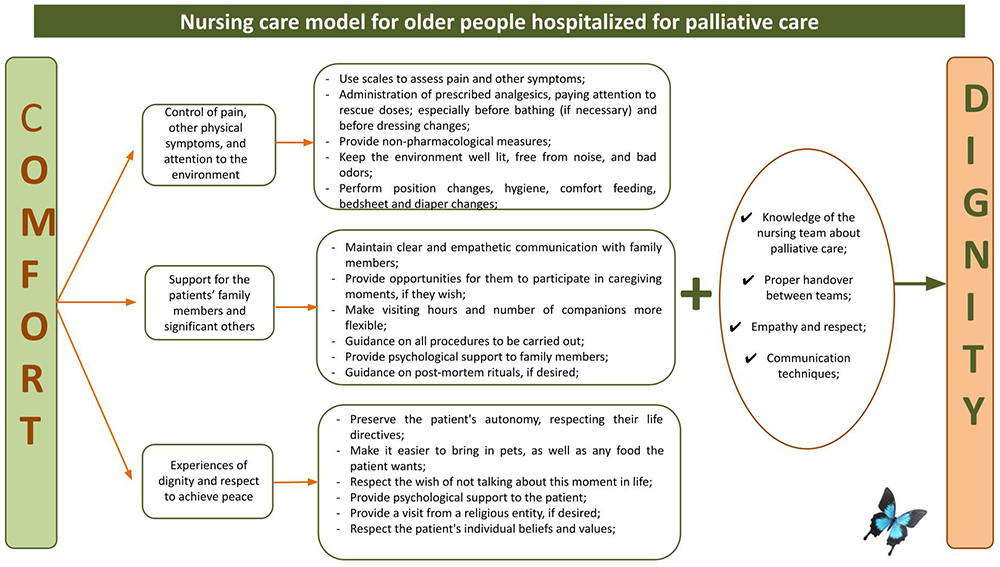
The fifth CG resulted in the conclusion of the meetings and, together with the other stages, was essential for the construction of the care model for older people hospitalized for palliative care, now with the group's perspective and the agreement of ideas for a model, presented in Figure 3.

Nursing care model for older people hospitalized for palliative care. Fortaleza, Ceará, Brazil, 2024.
At the end of the discussion, participants highlighted that, in the context of palliative care, the central objective is to provide comfort to the patient, alleviate suffering, respect the human being, and dignify them. This focus can be achieved through a variety of approaches, which has led to the development of a specific model of palliative care.
The model developed was structured around three fundamental pillars. The first covers the essential activities to be carried out by the nursing team to promote older patients’ comfort in palliative care, with an emphasis on controlling pain and other physical symptoms, as well as attention to the structural environment.
The second focuses on comfort actions aimed at providing support to the patient's family members and significant others.
The third and final section addresses the essential aspects of providing patients with experiences of dignity and respect, focusing on maintaining peace as ways to promote, maintain, and preserve comfort.
DISCUSSION
In nursing, care models are ways of structuring the technologies and materials used in work processes. These models seek to address individual and collective problems, bringing theory closer to practice, with the aim of meeting identified health needs17.
The CCR methodological process, therefore, enabled the integration of science with the improvement of care practice, revisiting the knowledge making up the know-how of everyday life, being essential for care planning. Likewise, the choice of a theoretical foundation aimed at patients in palliative care, with an emphasis on comprehensive comfort, strengthens the proposed model, ensuring quality and care based on respectful and humane assistance.
In this context, the nursing team’s know-how stands out in the incessant search for qualified, humanized and ethical care, with the nurse developing their action planning based on scientific knowledge and, especially, strongly rooted in science together with the multidisciplinary team, since it combines technical and scientific knowledge, and nursing theories, to provide effective and evidence-based care.
The research stages indicated a high number of professionals with insufficient knowledge about PC. Studies6,7,18-19 carried out with already trained nursing professionals and undergraduate students found similar results, highlighting the lack of approach to this topic during academic training, daily professional life, and the lack of awareness among public health management bodies regarding the need for PC.
In this respect, it is pointed out that one of the main difficulties in the daily practice of palliative care is communicating bad news, considering the lack of preparation of health professionals to deal with hopelessness and death. In this context, the lack of clear and continuous communication with the family and the patient compromises the satisfactory execution of palliative services, since these individuals do not receive full information about the disease and the care provided20-21.
A positive aspect identified was the awareness of participants about the need to acquire a theoretical basis in PC to support daily practice, which is necessary, especially considering the current health profiles of the population.
Based on this awareness, the care model was structured. The first pillar was called 'Control of pain, of other physical symptoms, and attention to the environment', which emerged from the professionals' concern in identifying and alleviating issues related to the control of physical symptoms, with an emphasis on pain. Both PELT and PC converge in this aspect, in which the management of pain and other symptoms assumes a priority role in patient care, as well as the concern with the knowledge and practice in the administration of analgesics, much required by the older people.
Recent studies22-23 point out, among nursing professionals, the concern with pain control, in which the use of scales for analgesic assessment, administration of analgesics and/or opioids, as well as the evolution of this care up to palliative sedation, when symptoms can no longer be controlled, were cited as strategies in view of the complexity of approaching pain.
Although nursing professionals are often attentive to pain control, many are unfamiliar with pain assessment scales. Those who use them often lack the conviction that these instruments serve as essential guides for decision-making, such as the administration of medicines23.
A study carried out with patients in PC showed that better prepared and specialized teams have a more satisfactory performance in symptom control when compared to other professionals with no previous prepatation24.
The second pillar, called 'Support for the patients’ family members and significant others', highlights the importance of involving the family and creating opportunities to strengthen the connection with the patient, an idea also shared by PELT14.
According to study participants, an effective approach for this to occur is to develop an environment that promotes comfort, understanding of the modes of pain, trust, and ethical support manifestation among all involved.
The presence of the family was also highlighted as fundamental in PC in other studies23,25, considering that the family caregiver plays an essential role in decision-making together with the healthcare team, as it promotes patient safety and well-being, in addition to encouraging participation in daily care. Dialogue, listening, and embracement, especially when communicating difficult news, are often neglected or inadequately implemented due to the structural limitations of health institutions and the lack of staff training and/or know-how lacking scientific basis.
The third pillar, entitled 'Experiences of dignity and respect to achieve peace', highlighted the importance of paying close attention to psychological and spiritual aspects, recognizing their relevance in the experience with patients in palliative care.
Psychological suffering experienced by patients and their families during the illness process can trigger symptoms such as anxiety, sadness, and fatigue, the manifestations of which are widely variable and individualized. In this context, studies26-27 claim that emotional symptoms, in particular, have been shown to be significantly prevalent and intense, especially among older people.
Fear of the unknown generates a lot of anguish and considering these psychological sufferings based on a psychosocial diagnosis is of fundamental clinical importance for the practice of beneficence and non-maleficence27.
In this third pillar, the decision-making process shared with patients and their families emerges as an expression of respect for autonomy and creates opportunities for joint reflection on therapeutic planning with the care team. Maintaining patients' autonomy until the end of life is challenging and requires a contextualized approach, with the definition of care goals and ethics28.
In addition to emotional demands, the illness process generates spiritual demands that directly affect the patient's well-being, with spirituality being related to quality of life and a lower incidence of symptoms, positively impacting PC outcomes for patients and their families26.
Spirituality helps professionals understand the process a patient goes through and how to best help them. Furthermore, it brings peace of mind and strength to deal with difficult situations, such as the loss of a patient under their care. In the context of palliative care, it is relevant, as health professionals need to improve patient support and care related to people's spirituality, through more effective communication, self-reflection and self-awareness about death and its meaning, generating recognition of the fear of death and greater empathy among patients, family members, and professionals29.
In the daily lives of older people, spirituality is a strategy used to confront challenges, discomforts and uncertainties of the illness process, being characterized as challenging life situations during a search for the meaning of life, which takes place daily when facing the existential void that has been installed30.
It is critical to recognize the uniqueness of each human being, whose beliefs and values profoundly influence their individual behavior, both in attitudes and in their way of thinking. These factors play an essential role in shaping behaviors and decisions, making essential a personalized approach to care and to the understanding of different human perspectives.
CONCLUSION
Convergent care research enabled the development of a nursing care model for older people in palliative care, enabling changes in care practice through the incorporation of new knowledge produced in conjunction with the subjects involved in care. The model responded to the guiding question by offering significant contributions to the qualification of care, based on a gap identified in practice, in the care of older people in a hospital context.
Knowledge translation took place in discussions based on the Peaceful End of Life Theory, supporting convergent care research to systematize practice. It allowed the group to be sensitized through the “dance” between care practice and research, to demonstrate, redefine and propose improvements in care based on the convergence construct.
A limitation of the study is the fact that there are no results from the application of the model in healthcare practice, because although there was convergence between the actions of practice and research, its implementation depends on the management and commitment of the participants, so that the incorporation process occurs consistently and is capable of promoting concrete changes in healthcare practice.
REFERENCES
-
1. Moura RBB, Barbosa JM, Gonçalves MCR, Lima AMC, Melo CB, Piagge CSLD. Nutritional interventions for older adults in palliative care: A scoping review. Rev Bras Geriatr Gerontol [Internet]. 2021 [cited 2023 May 15];24(5):e220063. Available from: https://doi.org/10.1590/1981-22562021024.220063.pt
» https://doi.org/10.1590/1981-22562021024.220063.pt -
2. World Hospice Palliative Care Alliance (WHPCA). Global atlas of palliative care at the end of life [Internet]. 2020 [cited2022 Mar 06]. Available from: http://www.thewhpca.org/resources/item/global-atlas-of-palliative-care-2nd-ed-2020
» http://www.thewhpca.org/resources/item/global-atlas-of-palliative-care-2nd-ed-2020 -
3. Cordeiro FR, Kruse MHL. Is it possible to die at home? Analysis of the Brazilian and French scenarios. Texto Contexto Enferm [Internet]. 2019 [cited2022 Mar 06];28:e20170602. Available from: https://doi. org/10.1590/1980-265X-TCE-2017-0602017-060
» https://doi. org/10.1590/1980-265X-TCE-2017-0602017-060 -
4. Radbruch L, Lima L, Knaul F, Woodruff R, Yong J, Pastrana T. Redefining Palliative Care: A new consensus-based definition. J Pain Symptom Manage [Internet]. 2020[cited2021 Apr 12];60(4):754-64. Available from: https://doi.org/10.1016/j.jpainsymman.2020.04.027
» https://doi.org/10.1016/j.jpainsymman.2020.04.027 -
5. BRASIL. Ministério da Saúde. Portaria GM/MS nº 3.681, de 07 de maio de 2024. Institui a Política Nacional de Cuidados Paliativos [Internet]. 2024 [cited 2025 Mar 24]. Available from: https://bvs.saude.gov.br/bvs/saudelegis/gm/2024/prt3681_22_05_2024.html
» https://bvs.saude.gov.br/bvs/saudelegis/gm/2024/prt3681_22_05_2024.html -
6. Ribeiro BS, Coelho TO, Boery RNSO, Vilela ABA, Yarid SD, Silva RS. Ensino dos cuidados paliativos na graduação em enfermagem do Brasil. Enferm Foco [Internet]. 2019 [cited 2023 May 15];10(6):131-6. Available from: https://doi.org/10.21675/2357-707X.2019.v10.n6.2786
» https://doi.org/10.21675/2357-707X.2019.v10.n6.2786 -
7. Cezar VS, Waterkemper R, Rabin EG, Castilho RK, Reys KZ. Continuous Education in Palliative Care: An Action Research Proposal. Rev Peq [Internet]. 2019 [cited2023 May 15];11(2):324-32. Available from: https://doi.org/10.9789/2175-5361.2019.v11i2.324-332
» https://doi.org/10.9789/2175-5361.2019.v11i2.324-332 - 8. Tomey AM, Alligood MR. Teóricas de Enfermagem e sua obra. 5th ed. Pêro Pinheiro, (PT): Lusociência; 2004.
- 9. Arruda C, Silva DMGV. Modelo de cuidados de enfermagem às pessoas com Diabetes Mellitus hospitalizadas. Porto Alegre, RS(BR): PLUS/Simplíssimo; 2019.
-
10. Fawcett J. A Framework for Analysis and Evaluation of Conceptual Models of Nursing. Nurse Educator [Internet]. 1980 [cited2024 Jun 22];5(6):10-14. Available from: https://doi.org/10.1097/00006223-198011000-00003
» https://doi.org/10.1097/00006223-198011000-00003 -
11. Brandão MAG, Barros ALBL, Primo CC, Bispo GS, Lopes ROP. Nursing theories in the conceptual expansion of good practices in nursing. Rev Bras Enferm [Internet]. 2019 [cited 2022 May 15];72(2):577-81. Available from: https://doi.org/10.1590/0034-7167-2018-0395
» https://doi.org/10.1590/0034-7167-2018-0395 -
12. Ribeiro BMSS, Dalri RCMB. Guiding nursing theories focusing on palliative care. J Nurs Health [Internet]. 2021[cited 2024 Sep 07];12(1):e2212121185. Available from: https://doi.org/10.15210/jonah.v12i1.2254
» https://doi.org/10.15210/jonah.v12i1.2254 -
13. Sullivan DR, Teno JM, Reinke LF. Evolution of palliative care in the department of veterans affairs: Lessons from an integrated health care model. J Palliat Med [Internet]. 2022 [cited 2024 May 17];25(1):15-20. Available from: https://doi.org/10.1089/jpm.2021.0246
» https://doi.org/10.1089/jpm.2021.0246 -
14. Ruland CM, Moore SM. Theory constructions based on standards of care: A proposed theory of the peaceful end of life. Nurs Outlook [Internet]. 1998 [cited 2021 Mar 15];46:169-75. Available from: https://doi.org/10.1016/S0029-6554(98)90069-0
» https://doi.org/10.1016/S0029-6554(98)90069-0 - 15. Trentini M, Paim L, Silva DGV, Souza SS. Um giro pelo processo da pesquisa convergente assistencial. Curitiba, PR(BR): Editora CRV; 2022.
-
16. Rocha PK, Prado ML, Silva DMGV. Pesquisa Convergente Assistencial: uso na elaboração de modelos de cuidado de enfermagem. Rev Bras Enferm [Internet]. 2012 [cited 2021 Jul 23];65(6):1019-25. Available from: https://doi.org/10.1590/s0034-71672012000600019
» https://doi.org/10.1590/s0034-71672012000600019 -
17. Trentini M, Paim L, Silva DMGV. The convergent care research method and its application in nursing practice. Texto Contexto Enferm [Internet]. 2017 [cited 2021 Jul 23];26(4):e1450017. Available from: https://doi.org/10.1590/0104-07072017001450017
» https://doi.org/10.1590/0104-07072017001450017 -
18. Chua JYX, Shorey S. Effectiveness of end-of-life educational interventions at improving nurses and nursing students' attitude toward death and care of dying patients: A systematic review and meta-analysis. Nurse Educ Today [Internet]. 2021 [cited 2023 May 15];101:104892. Available from: https://doi.org/10.1016/j.nedt.2021.104892
» https://doi.org/10.1016/j.nedt.2021.104892 -
19. Gonçalves RG, Oliveira LPBA, Silva CJA, Elias TMN, Nogueira ILA, Menezes RMP. Palliative care in nursing training: Higher education course coordinators’ perception. Rev Bras Enferm [Internet]. 2023 [cited 2024 Sep 07];76(3):e20220222. Available from: https://doi.org/10.1590/0034-7167-2022-0222pt
» https://doi.org/10.1590/0034-7167-2022-0222pt -
20. Verri ER, Bitencourt NAS, Oliveira JAS, Santos Jr R, Marques HS, Porto MA, et al. Nursing professionals: Understanding about pediatric palliative care. Rev Enferm UFPE On Line [Internet]. 2019 [cited 2023 May 15];13(1):126-36. Available from: https://periodicos.ufpe.br/revistas/revistaenfermagem/article/view/234924/31140
» https://periodicos.ufpe.br/revistas/revistaenfermagem/article/view/234924/31140 -
21. Kurogi LT, Vieira CALG, Ramalho RM, Silva AW. Implantação e implementação de serviços em cuidados paliativos. Rev Bioética [Internet]. 2023 [cited 2024 Mar 15];30(4):825-36. Available from: https://www.scielo.br/j/bioet/a/sNrsYtmbycSGChtvSdbc.wtF/
» https://www.scielo.br/j/bioet/a/sNrsYtmbycSGChtvSdbc.wtF/ -
22. Silva TP, Silva LF, Cursino EG, Moraes JRMM, Aguiar RCB, Pacheco STA. Cuidados paliativos no fim de vida em oncologia pediátrica: um olhar da enfermagem. Rev Gaúcha Enferm [Internet]. 2021 [cited 2023 Aug 19];42:e20200350. Available from: https://doi.org/10.1590/1983-1447.2021.20200350
» https://doi.org/10.1590/1983-1447.2021.20200350 -
23. Moscoso CR, Cordeiro FR, Gomes MP, Oliveira SG, Zillmer JGV. Assistance practices of medical and nursing teams for hospitalized people in palliative care. Texto Contexto Enferm [Internet]. 2023 [cited 2024 Aug 19];32:e20230080. Available from: https://doi.org/10.1590/1980-265X-TCE-2023-0080pt
» https://doi.org/10.1590/1980-265X-TCE-2023-0080pt -
24. Silva MAS, Diniz MA, Carvalho RT, Chiba T, Mattos-Pimenta CA. Palliative care consultation team: Symptom relief in first 48 hours of hospitalization. Rev Bras Enferm [Internet]. 2020 [cited 2022 Mar 15];73(6):e20190391. Available from: https://doi.org/10.1590/0034-7167-2019-0391
» https://doi.org/10.1590/0034-7167-2019-0391 -
25. Buljac-Samardzic M, Clark MA, Exel NJAV, Wijngaarden JDHV. Patients as team members: Factors affecting involvement in treatment decisions from the perspective of patients with a chronic condition. Health Expect [Internet]. 2022 [cited 2023 May 15];25(1):138-48. Available from: https://doi.org/10.1111/hex.13358
» https://doi.org/10.1111/hex.13358 -
26. Mendes BV, Donato SCT, Silva TL, Penha RM, Jaman-Mewes P, Salvetti MG. Spiritual well-being, symptoms and functionality of patients under palliative care. Rev Bras Enferm [Internet]. 2023 [cited 2024 Sep 07];76(2):e20220007. Available from: https://doi.org/10.1590/0034-7167-2022-0007pt
» https://doi.org/10.1590/0034-7167-2022-0007pt -
27. Oliveira SG, Pacheco STA, Nunes MDR, Caldas CP, Cunha AL, Peres PLP. Bioethical aspects of the health care provided to older adults at the end of their lives. Rev Enferm UERJ [Internet]. 2020 [cited 2023 May 15];28:e47321. Available from: https://doi.org/10.12957/reuerj.2020.47321
» https://doi.org/10.12957/reuerj.2020.47321 -
28. Tahmasebi M. Ethics and palliative care: A case of patient's autonomy. J Med Ethics Hist Med [Internet]. 2022 [cited 2024 Sep 07];15:16. Available from: https://doi.org/10.18502/jmehm.v15i16.11574
» https://doi.org/10.18502/jmehm.v15i16.11574 -
29. Best M, Leget C, Goodhead A, Paal P. An EAPC white paper on multi-disciplinary education for spiritual care in palliative care. BMC Palliative Care [Internet]. 2022 [cited 2023 May 15];19(1):9. Available from: https://doi.org/10.1186/s12904-019-0508-4
» https://doi.org/10.1186/s12904-019-0508-4 - 30. Frankl VE. Logoterapia e análise existencial: texto de seis décadas. Rio de Janeiro, RJ(BR): Forense Universitária; 2017.
-
ORIGIN OF THE ARTICLE
Extracted from the dissertation - Nursing care model for the older person hospitalized for palliative care, presented to the Programa de Pós-Graduação Cuidados Clínicos em Enfermagem e Saúde, da Universidade Estadual do Ceará, in 2024.
-
APPROVAL OF ETHICS COMMITTEE IN RESEARCH
Approved by the Research Ethics Committee of the Universidade Estadual do Ceará, opinion no. 6.842.503, Certificate of ethical appraisal 77789124.1.0000.5534.
-
TRANSLATED BY
Denise Rodrigues.
-
DATA AVAILABILITY
The data generated and/or analyzed during this study are not publicly available due to ethical and confidentiality restrictions regarding participants, as provided for in the Free Informed Consent Form. Additional information may be obtained upon justified request to the corresponding author.
The data generated and/or analyzed during this study are not publicly available due to ethical and confidentiality restrictions regarding participants, as provided for in the Free Informed Consent Form. Additional information may be obtained upon justified request to the corresponding author.