 LINGUISTIC DIVERSITY IN THE TEACHING OF SPANISH AS A FOREIGN LANGUAGE: A PROPOSAL FOR A DIDACTIC SEQUENCE THROUGH THE SUBTITLING OF THE FILM “EL CAMINO DE XICO”
Abstract
Audiovisual Translation (AVT), besides being a popular translation mode, has become a fertile ground for selecting materials for teaching and learning foreign languages (PARDO, 2022), particularly regarding subtitling (ARAÚJO, 2008; DÍAZ CINTAS; CRUZ, 2008; TALAVAN, 2010, 2011; LERTOLA, 2013, 2015; FERNÁNDEZ-COSTALES, 2021a; PARDO, 2022, among others). In light of this, we present a methodological proposal for a didactic sequence (DOLZ; NOVERRAZ; SCHNEUWLY, 2004) for teaching Spanish as a foreign language to higher education students. This proposal involves a subtitling task using the Mexican animated feature film “El camino de Xico” (NETFLIX, 2020) following the functionalist translation approach of Reiss and Vermeer (1996) and Nord (1991, 2012, 2016), which considers the linguistic and cultural diversity of the source and target texts. Drawing from realistic communicative situations provided by audiovisual materials (VANDERPLANK, 2019), we aim to encourage teachers to use subtitling as a tool to help their students recognize linguistic and extralinguistic factors, beyond the grammatical aspects of the language.
Keywords:
linguistic diversity; Spanish teaching; didactic sequence; audiovisual translation; subtitling
Resumo
A Tradução Audiovisual (TAV), além de ser uma modalidade popular de tradução, tem se tornado um terreno fértil para a seleção de materiais no ensino-aprendizagem de línguas estrangeiras (PARDO, 2022), especialmente em relação à legendagem (ARAÚJO, 2008; DÍAZ CINTAS; CRUZ, 2008; TALAVAN, 2010, 2011; LERTOLA, 2013, 2015; FERNÁNDEZ-COSTALES, 2021a; PARDO, 2022, entre outros). Levando isso em consideração, apresentamos uma proposta metodológica de sequência didática (DOLZ; NOVERRAZ; SCHNEUWLY, 2004) para o ensino de Espanhol como língua estrangeira a estudantes do ensino superior. A proposta envolve uma tarefa de legendagem utilizando o longa-metragem de animação mexicano “El camino de Xico” (NETFLIX, 2020) a partir da abordagem funcionalista de tradução de Reiss e Vermeer (1996) e Nord (1991, 2012, 2016), que considera a diversidade linguística e cultural dos textos-fonte e meta. A partir de situações comunicativas realistas proporcionadas por materiais audiovisuais (VANDERPLANK, 2019), buscamos estimular os professores a utilizarem a tradução em legendas como ferramenta para ajudar seus alunos a perceber fatores linguísticos e extralinguísticos, além dos aspectos gramaticais da língua.
Palavras-chave:
diversidade linguística; ensino de espanhol; tradução audiovisual; legendagem
INTRODUCTION
Constant exposure to foreign films can be a promising approach for learning a new language as watching them is part of everyday recreation and, through this activity, students receive language input from credible, realistic situations that go beyond conventional classroom limitations (TALAVÁN, 2011). As Vanderplank states: “No teacher, no classroom, no textbook can provide the richness, range and variety of language available in television and films” (VANDERPLANK, 2019, p. 182). Besides that, subtitling, being an audiovisual translation mode that enhances the benefits of video by boosting motivation and helping students understand and develop language more effectively (TALAVÁN, 2011), also offers students support to improve their foreign language skills and pragmatic awareness (LERTOLA, 2013).
The use of subtitling for educational purposes has proven beneficial not only through incidental and intentional learning via exposure to a second language (L2) but also through students’ active participation in creating subtitles, as supported by more recent studies (FERNÁNDEZ-COSTALES, 2021a). Building on this perspective, this paper proposes an initial project for a Didactic Sequence (DS) using subtitles from the film “El camino de Xico” (2020). To this end, we consulted the literature in the scope of Functionalist Translation, from the perspective of Reiss and Vermeer (1996) and Nord (1991, 2012, 2016), and the procedure of Didactic Sequences, in the context of the Geneva school (DOLZ; NOVERRAZ; SCHNEUWLY, 2004), with adaptations proposed by Pontes and Pereira (2016, 2021). Additionally, we consulted the literature on the use of translation for foreign language teaching (COOK, 2007, 2010; CARRERES, 2014; PONTES, 2014; PONTES; CARDOSO; FRANCO, 2023; PONTES; PEREIRA; DUARTE, 2024 ), specifically, on the use of subtitling for this purpose (DÍAZ CINTAS; CRUZ, 2008; TALAVÁN, 2010, 2011; LERTOLA, 2013, 2015; BAÑOS; SOKOLI, 2015; PINTADO-GUTIERREZ, 2018; FERNÁNDEZ-COSTALES, 2021a; PARDO, 2022).
Pontes and Pereira (2021) developed a didactic proposal using subtitling as a tool for the teaching-learning process of a foreign language (FL). However, in that study, the authors used automatic subtitling as their initial didactic sequence proposal, i.e., Spanish learners had access to fragments of the film Metegol (2013) - a 106-minute animated film produced by Argentina and Spain - featuring subtitles automatically generated in Spanish by YouTube. The difference between this study and that of Pontes and Pereira (2021) lies in the type of subtitles used and their application within the proposed didactic sequence. In the previous study, the subtitles in the first part of the didactic sequence were simple transcriptions of the dialogues. Although the authors later asked students to translate these subtitles into Portuguese, they did not consider subtitling parameters for this task. While strictly following subtitling parameters is not essential when using subtitling tasks for language teaching, these constraints do guide lexical and grammatical choices during translation activities. Therefore, not instructing students on key subtitling parameters does not align with the goal of making a subtitling task for language learning as realistic as possible. However, the subtitling conventions used should be flexible; for this reason, they should not hinder the linguistic development of foreign language learners (TALAVÁN, 2020).
In this study, our main objective is to present a proposal for a didactic sequence aimed at teaching Spanish in a higher education context through a subtitling task using the film “El camino de Xico” (2020). For the translation task, students will learn essential features of a subtitling software program. Additionally, learners should consider the linguistic and technical conventions of subtitling while reflecting on the cultural differences between the two languages (Mexican Spanish and Brazilian Portuguese) from a functionalist perspective (NORD, 2012, 2016).
This paper is divided into five sections, the first being this introduction. In the second, we address functionalist translation and foreign language teaching. In the third, we present a discussion on Didactic Sequence or the teaching of variation in Spanish. In the fourth section, we review studies developed in Audiovisual Translation, with subtitling as a didactic tool for language teaching. Finally, in the last section, we present an initial proposal for a DS through the audiovisual translation of the film “El camino de Xico” (2020).
1. FUNCTIONALIST TRANSLATION AND LANGUAGE TEACHING
The functionalist field defines translation as an intercultural communication activity, in which the source text and the target text belong to different cultural systems and, for this reason, must be analyzed separately. This kind of analysis considers the text a communicative act that is only completed at the time of reception and the translator, armed with the intentions of the text producer from the source culture, is responsible for producing a new communicative tool (NORD, 2012, 2016).
Concerning the functionalist aspect of translation and its connection to communicative foreign language teaching, Nord (2016) offers valuable reflections that contribute to this approach. For example, the author conceives translation as a process of intercultural communicative interaction that needs a mediator because it is carried out by agents who belong to different cultures. Within the context outlined here, this could be performed by the teacher for they work as mediators in the FL classroom environment.
Analyzing the relationship between language and culture, which is very important in FL teaching, the author reclaims significant considerations by Reiss and Vermeer (1996). According to them, culture is “the set of norms and conventions in effect in a society, as well as all the behaviors to which it gives rise and the products resulting from said behavior” (REISS; VERMEER, 1996, p. 20). In this sense, in their view, every translator must be bicultural, that is, must know both cultures involved in the translation process. Corroborating this proposition, Nord (1991, p. 11) asserts that: “His command of the source culture (SC) must enable him to reconstruct a ST recipient […], whereas his command of the target culture (TC) allows him to anticipate the possible reactions of a TT recipient and thereby verify the functional adequacy of the translation he produces”.
Concerning the practice of translation in the FL classroom, the more bicultural the student is regarding their FL and L1, the more competent they will be when examining the textual and extratextual elements listed by Nord (2012). To facilitate this work, the author also proposed the following questions:
Based on her extensive experience with translation, Nord (2012, p. 155) proposed an analysis model that seeks to explore the following elements during the translation process: sender, sender’s intention, recipient, medium/channel, place, time, motive and text function. For Nord, these elements help in the process of understanding the source text (ST) and in the production of the target text (TT). This model of didactic application can be used in both the scope of professional translation and FL teaching practices since it aims to examine linguistic and extralinguistic factors and the communicative effect of the text. However, we do not see it as a framework to be applied and completed by language students engaged in translation practices, but rather as a didactic way to encourage them to seek preliminary answers and engage in a circular process between analyzing the ST and producing the TT (NORD, 2016). Chart 2 below presents the pre-translation analysis model proposed by Nord:
Upon presenting the pre-translation analysis model shown in Chart 1, Nord (2012, 2016) explains that translation is the production of a functional TT that maintains an interdependence with a ST, specified according to its communicative purpose. To achieve this functionality, it is necessary to analyze the intraand extratextual aspects of the ST and compare them with the context of production of the TT.
Applying that to film translation through subtitles, there are two texts (the characters’ speeches and the oral texts translated into subtitles) that share cultural exchanges that require a pre-translation analysis between the TT, in this case, the subtitles, and the ST - the entire soundtrack of the film.
For teaching Spanish as a Foreign Language to higher education students, we propose a didactic sequence grounded in functionalist translation principles. This sequence will make use of Audiovisual Translation (AVT), specifically subtitling, to enhance students’ understanding of language and culture through practical engagement with audiovisual materials. This educational level was chosen because university students of foreign languages are typically regular viewers of subtitled films available on various streaming platforms.
2. DIDACTIC SEQUENCE, LANGUAGE TEACHING AND TRANSLATION
Before beginning the discussion about the methodological procedures, it is important to point out the concept of DS that we have adopted. We understand DS for teaching as: “[…] a set of school activities organized, in a systematic way, around an oral or written text genre” (DOLZ; NOVERRAZ; SCHNEUWLY, 2004, p. 96). Based on this definition, the basic structure of a DS, as presented by Dolz, Noverraz and Schneuwly (2004), is as follows:
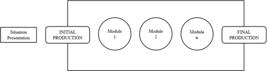
It is possible to observe, in the image above, that the first stage of a DS is the presentation of a communicative situation. After this contextualization, the writing of the first production takes place, which will serve as a basis for the design of the modules of the didactic sequence.
Considering the numerous possibilities of activities related to the production of a text genre, it is possible to carry out a DS with the use of functionalist translation, since, in the circular translation process proposed by Nord (2016), the translator/learner is frequently analyzing the ST, verifying the conditions of production of the TT and producing it. This process, leading up to the final production, provides learners with opportunities to discuss their translation choices and their impact on the meaning-making of the text, especially when the activity takes place within groups. By doing so, learners can experience translation in a more reflective way and understand that purely grammatical knowledge of the languages involved is not sufficient for the TT to achieve pragmatic adequacy.
In addition, within the Language Teaching field, a DS with the use of functionalist translation can be productive to linguistic-cultural learning, since the learner will often contrast and compare various aspects of the languages and cultures involved in translation. Regarding this, Beato-Canato and Cristóvão (2014, p. 218) recognize that the comparison between languages can be a resource of mutual help, for example, when comparing pronouns, adverbs and expressions of opinion, although they indicate that this comparison must go beyond the formal aspect, aiming to establish more conscious connections about the communicative function of these elements in the text. This can be achieved through translation, in a functional perspective, as Laiño (2014), Pontes and Pereira (2016) and Pontes, Pereira and Duarte (2024) attest.
From what has been discussed so far, we have a foundational ground to affirm the feasibility of a DS for language teaching using an approach based on the functionalist translation of texts. In this context, concerning the relationship between translation activities and the understanding of linguistic variation, we propose the elaboration of a DS with the use of subtitling for the teaching of the linguistic varieties of Spanish to Brazilian learners in higher-level education.
3. AUDIOVISUAL TRANSLATION AND THE TEACHING OF FOREIGN LANGUAGES
Still largely associated with a purely formalist approach disconnected to real language use situations, while being “[…] inevitably connected to authoritarian teaching, dull lessons, form rather than function, writing rather than speech, accuracy rather than fluency, and laboured rather than automated production” (COOK, 2007, p. 396-397), translation has largely been excluded from teacher-training courses and, as a result, from foreign language teaching practices. This is mostly because translation is still considered a Grammar-Translation Method practice by many and, likewise, “anathema to the communicative approach” (PARDO, 2022). Unfortunately, this resulted in an “arid period” in the application and advancement of Translation in Language Teaching1 (TILT) (COOK, 2010, p. 156).
Cook (2007) points out that the negative view towards the use of translation in foreign language classes is contrary to the very intuitive state of human learning, which is that of relating what is new to what is given, what is being learned to what is already known. Likewise, the place of translation in language teaching does not correspond to the place it should occupy in both FL teaching practice and Applied Linguistics research.
Yet although translation has long been glibly dismissed in the inner-circle academic literature, it has rather stubbornly refused to die elsewhere, notably in locally written syllabuses around the world, and in the teaching of languages other than English. Most significantly, it has persisted in the spontaneous strategies of actual language learners (as opposed to the controlled learners studied in much SLA research) whose natural inclination as in other areas of human learning, is to try to apprehend the unknown by relating it to the known (COOK, 2007, p. 397).
However, the pessimist evaluation of the use of translation in FL teaching environments has been a subject of reconsideration lately (PINTADO-GUTIERREZ, 2018). According to Pintado-Gutierrez (2018), there has been a notable surge and considerable revitalization in the field, which means a rise in publications, new theories, approaches and methods related to the role and impact of translation in formal educational language settings, vouching for the positive influence of bilingual teaching practices (COOK, 2010).
Within this reasoning, Pardo (2022) asserts that translation, as it brings together both the target language and the students’ L1, suits well Kumaravadivelu’s postmethod pedagogy (2001) for it values local linguistic, sociocultural and political aspects. This would be incompatible with the notion of an “[…] ethnocentric communicative language teaching exported from the United States and Europe” (PARDO, 2022, p. 160), which makes use of “one size-fits-all method” (PARDO, 2022, p. 160). Likewise, the significance of translation practices in foreign language learning also lies on the fact that it helps the learner adjust to the perspective of the target language and interpretation of reality (LERTOLA, 2015).
After all, both translation competence and foreign/second language skills hold considerable points of intersection.
But are translator trainees and language learners well served by this dissociation? By any account, the competent translator and the competent L2 user have a great deal in common. They both possess the ability to understand and produce L2 utterances; they both need to be sensitive to the pragmatic constraints of the L2 and are expected to have, to varying degrees, a good level of intercultural knowledge. A similar argument can be put forward with regard to trainee translators and language learners. If we recognise that there is an overlap in the learning outcomes of the translation and language training curricular designs, we can argue that this is to be reflected in the pedagogy we adopt (CARRERES, 2014, p. 123).
As far as the place of translation in language teaching is concerned, without question, no type of translation has been used more frequently for this purpose than audiovisual translation, which is a mode of translation that enables the linguistic transfer of an audiovisual text (PARDO, 2022). That is not random: the digital revolution, which has changed forever the way that humans communicate, access information and consume leisure, has also brought novelties to the educational side, paving the way for teachers (and kind of forcing them too) to adopt new methods, techniques and materials into their classroom settings. This renewal of teaching practices fits well with using Audiovisual Translation in language learning contexts, as it can be both a resource for developing a foreign/second language and a fruitful pedagogical technique (PARDO, 2022).
Furthermore, using AVT for didactic purposes offers language input from credible, realistic situations, even within fictional works, providing interaction with non-verbal, linguistic and cultural elements of contextualized communication (TALAVÁN, 2011), while also being flexible and adaptable depending on the needs the individuals involved in the process (BAÑOS; SOKOLI, 2015). Besides that, “[…] students can be easily encouraged to use this type of material when learning a language independently” (BAÑOS; SOKOLI, 2015, p. 204). The increase in learners’ motivation and positive attitude towards learning a foreign language as a result of active subtitling tasks has been noted by some studies (TALÁVAN, 2010; FERNÁNDEZ-COSTALES, 2021a).
Audiovisual Translation and Foreign Language Learning has been the focus of a number of studies in Brazil, concerning interlingual subtitling (for the hearing audience), intralingual subtitling (for the deaf and hard-of-hearing) and audio description (for people with visual impairments), which have revealed promising outcomes (ARAÚJO, 2008; BARBOSA, 2009; BARBOSA; IRINEU, 2014; CUNHA, 2007; GOMES, 2006; HARVEY, 2009; OLIVEIRA FILHO, 2008; VIEIRA et al., 2021).
However, it is mainly in Europe that the investigation correlating the integration of these subjects has taken place. In 2008, Díaz Cintas organized the book The Didactics of Audiovisual Translation, with several chapters on AVT studies and the teaching of foreign languages produced by researchers from Europe and Brazil. The discussions demonstrate how AVT modes, inserted in a context of communicative activities, bring the learner closer to a realistic use language and also enable significant changes in the learning of a foreign language (DÍAZ CINTAS; CRUZ, 2008). The main objective of these studies was to understand how pedagogical activities involving the use of AVT could contribute to the learning process of a foreign language, helping learners to cope with the phonological, morphological, syntactic, semantic and pragmatic rules of the target language.
Among AVT modes, subtitling and dubbing have been the ones historically used for teaching-learning practices on a greater extent, with subtitling being the front-runner for a considerable margin (PARDO, 2022). Despite not being created for educational contexts, subtitling brings a lot to the table when we think of stimuli that can be used to enhance learners’ performance both on and off formal learning settings. That would be due to translation and audiovisuals put together and, besides that, due to the variety of language skills that can be enhanced when one goes through the diversified steps required for a subtitling task (NEVES, 2004). Lertola (2013) emphasizes the potential behind this use on improving learners’ L2 production and awareness:
Subtitling is now considered an innovative teaching tool which can enhance language learning. It involves language learners in an AVT task while exposing them to spoken and written dialogue in the original language. Subtitling has the potential to improve language skills (listening, reading and writing) and transferable skills (such as digital literacy), […] and raise awareness of cultural and intercultural issues as well as pragmatic aspects of communication (LERTOLA, 2013, p. 2).
Sánchez-Requena et al. (2022) note that, recently, European institutions have funded several projects aimed at incorporating AVT into teaching and learning environments. The authors mention the following examples of this initiative: i) the LeViS Project (Learning via Subtitles); ii) ClipFlair (Foreign Language Learning through Interactive Revoicing & Captioning of Clips) and iii) PluriTAV (Audiovisual Translation as a Tool for the Development of the Multilingual Competence in the Classroom). Besides those ones, TRADILEX (Audiovisual translation as a didactic resource in foreign language education) is a recent research project that proposes a “[…] innovative methodology for a holistic approach, which incorporates five AVT modes in one structured sequence” (SÁNCHEZ-REQUENÃ et al., 2022, p. 340). In Brazil, however, there has not been a big project like those ones to the best of our knowledge.
In Brazil, as far as subtitling is concerned, the studies developed in the scope of Applied Linguistics revealed promising results on the relationship between subtitling and the teaching of foreign languages. The studies by Gomes (2006), Cunha (2007), Oliveira Filho (2008), Barbosa (2009), Harvey (2009), among others, using subtitles films as objects of study, demonstrated that the group of learners who used subtitles to learn a foreign language obtained better results, such as phonological awareness, better understanding and oral production. Thus, Araújo (2008) argues that, when learners watch subtitled films, they begin to develop a greater lexical repertoire compared to those who only use textbooks. In addition, these learners can observe realistic situations in contextualized, communicative contexts. The studies mentioned above had as participants learners exposed to films with intralingual subtitles, i.e. subtitles and audio track in the same language. However, none of them encouraged learners to produce their subtitles during an interlingual translation task, reflecting on cultural and linguistic issues that are peculiar to the language.
The use of active AVT tasks, subtitling included, is generally supported by teachers and researchers who, while working with them, have observed that those activities stimulate “[...] critical thinking, pragmatic and intercultural awareness both in L1 and L2, as well as the ability to extract and infer information from multisemiotic texts” (INCALCATERRA McLOUGHLIN; LERTOLA, 2018, p. 2). Furthermore, Neves (2004) states that the captivating nature of moving images, the appeal of using computers and electronic devices, and especially the element of fun, can transform tedious tasks into enjoyable ones, making language learning a more pleasurable experience. Subtitling, then, as a translation activity, offers language students “[…] a greater command of language usage, in the broadest of senses and above all, find pleasure in manipulating text to achieve the best possible results” (NEVES, 2004, p. 139). Despite learners’ ultimate goal not being that of becoming professional translators, subtitling as a task “[…] implies involving the learners in a simulated real-world task whose outcome, unlike watching subtitles or using viewing techniques, is a tangible, shareable product: the subtitled video” (SOKOLI; ZABALBEASCOA; FOUNTANA, 2011, p. 20).
3.1 Relevant Practices When Proposing Subtitling Tasks for Foreign Language Learning Purposes
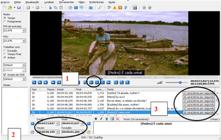
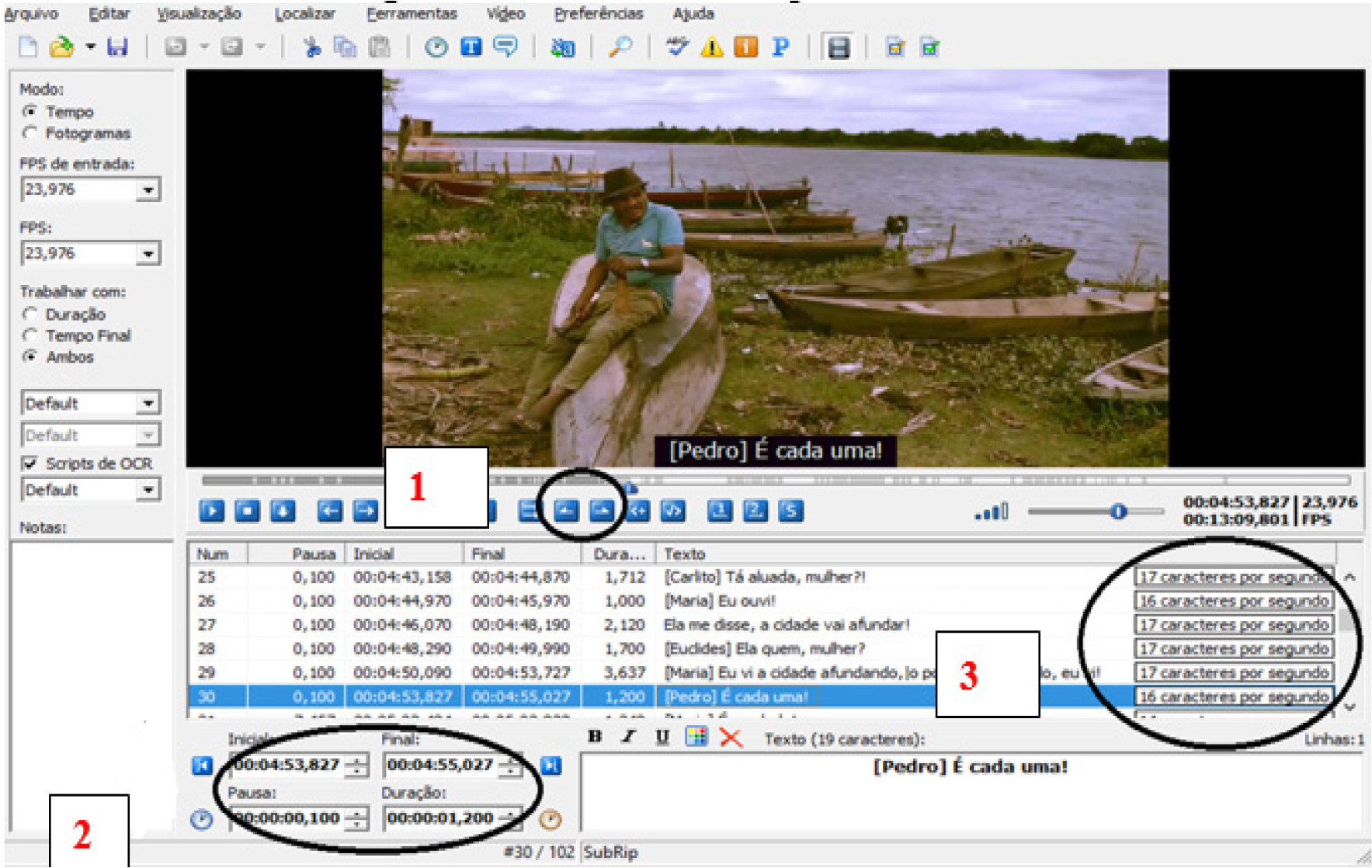
The use of subtitling tasks in language learning contexts is also related to the emergence of free subtitling software programs. With this in mind, we present here one of those software programs: Subtitle Workshop 6.0b. We would like to point out, however, that there are many other free subtitling software programs available, but the preference for Subtitle Workshop is because it presents resources to create, adjust and synchronize subtitles while being practical and user-friendly.
Below, we present some basic functionalities of Subtitle Workshop 6.0b that would be valuable for language learners engaged in subtitling tasks.
Figure 2 shows three important tools for creating subtitles. By using tool 1, the subtitle creator can set the start and end time of each utterance. Tool 2 indicates the start time, end time and duration of the subtitle set by the translator. In tool 3, the learner can observe the speed of each subtitle in characters per second. As far as synchronization is concerned, it should be aligned with the soundtrack, or at least as maximum as possible. That is, subtitles should be on screen when the utterance is spoken and off screen when it is finished.
According to Talaván (2020), the subtitling task used for foreign language learning purposes should be designed to mimic professional subtitling; therefore, students need basic guidelines to understand key aspects of subtitling besides the synchronization aforementioned, such as subtitle length and duration and strategies for text reduction and segmentation. However, the detail provided in these guidelines should match students’ foreign language proficiency and experience with AVT.
With regard to subtitle reading, experimental research on subtitling has observed some characteristics that should provide a better viewing experience of subtitled audiovisual material (D’YDEWALLE et al., 1987) and that should be taken into account by learners during subtitling tasks. For example, subtitles should be displayed in a maximum of two lines and have a duration of at least one and at most six seconds on the screen, which is usually referred to by professional translators as the “six-second rule”. This “rule” says that, on the one hand, if subtitles remain on screen for longer than six seconds, viewers tend to re-read them, which causes unnecessary effort and discomfort. If, on the other hand, subtitles appear on screen for less than one second, viewers might not be able to read them as they will just “blink” on screen. In Brazil, subtitlers have adopted a maximum exhibition time of 4 seconds.
Based on the 6-second rule (D’YDEWALLE et al., 1987), Díaz Cintas and Remael (2007, p. 97-99) present three subtitle reading speeds - 145, 160 and 180 words per minute (wpm) to guide professional translator on their subtitling practice. Díaz Cintas and Remael’s proposal regarding different reading speeds was based on frames per second, as that was the standard measurement used by most subtitling software programs at the time. To make it more intuitive for learners, we present an adapted table (Table 1) that shows reading speeds in minutes (characters per second). Specifically, Table 1 below presents the reading speed of 180 words per minute, which we will use in our didactic sequence proposal, as it is the most commonly employed speed by streaming platforms.
Based on Table 1, students will have an idea of how many characters per second they are allowed to make use of. Besides that, we need to make it clear for them that spaces, letters and punctuation marks are also counted as characters in subtitling. Surely, technical skills, such as time coding and synchronization, are not as relevant as linguistic aspects for teaching contexts, but may optimize students’ time and effort during the task, as well as reflect a striking difference in their finished product (LERTOLA, 2015).
Therefore, it is important for learners to have a basic understanding of technical parameters so that the choices they make are feasible in the practical context of subtitling. In short, students will need not only to consider the relationship between the two texts (source text and target text) but also to structure their subtitles in a way that respects the constraints imposed by the subtitle reading speed adopted.
Additionally, linguistic aspects are obviously very relevant in subtitling. Besides cohesion and coherence, of course, we would like to highlight two linguistic parameters that are central to subtitling: text reduction and segmentation (line breaks). As far as text reduction goes, every subtitling process “[…] implies different types of ‘rewording’, that is, the transfer of some verbal signs into different verbal signs pertaining to a different language or to the same language” (LERTOLA, 2015, p. 246). As different subtitle reading speeds require a certain number of words/characters per second according to the time available for subtitle insertion, text reduction, which can be partial or total, is a linguistic strategy inherent to subtitling. While partial reduction is achieved through condensation and a more concise version of the oral text, total reduction arises from the omission and deletion of lexical items that are considered redundant or irrelevant (DÍAZ CINTAS; REMAEL, 2007).
On the one hand, partial text reduction, also known as condensation or reformulation, can take place both at word level and at sentence level. At word level, Díaz Cintas and Remael (2007) cite some strategies for it, such as simplifying verbal periphrases, using a close synonym or equivalent expression, changing word classes (transforming a verb into a noun, for example, can save some characters), etc. At sentence level, the authors mention transforming indirect questions into direct questions, changing the subject of a sentence, merging two clauses into one, among others.
Total text reduction, on the other hand, also known simply as omission, can also occur at both word and sentence levels. At the word level, among other items, modifiers, adjectives and adverbs might be omitted, as well as greetings, interjections, vocatives, and some repetitions, for example, if the translation thinks they are unimportant for the message being conveyed (DÍAZ CINTAS; REMAEL, 2007). At sentence level, omissions are not always advisable, but sometimes they are unavoidable. It may occur, for example, with speeches that present very little information, or in cases in which many people speak at the same time, among other situations.
Obviously, text reduction strategies need to work together with textual cohesion and coherence, even though auditory and visual channels contribute to understanding the message. Subtitles need to present an intersemiotic cohesion with the simultaneous semiotic systems that are on screen through auditory and visual channels, creating a coherent linguistic-visual whole (DÍAZ CINTAS; REMAEL, 2007). Consequently, teachers also need to inform these aspects to students, so that they are aware, while creating their subtitles, that this AVT mode has its limitations and affordances.
Another relevant aspect of subtitling practice is the division of subtitles according to linguistic parameters. According to Reid (1990) and Karamitroglou (1998), subtitles should follow the flow of speech and respect the highest syntactic level possible. Considering it, Pontes and Pereira (2021) explain how subtitles should be divided into two lines:
Above, on the left side, we can see two-line subtitles that have broken phrases when split into two lines. On the right side, there is a proposal of well-segmented two-line subtitles. This kind of instruction can help students understand how line breaks should be in two-line subtitles.
Obviously, besides the fact that these subtitling norms should be aligned with students` foreign language proficiency, it is crucial to keep these norms flexible. Overly rigid rules could limit language practice and hinder foreign language development (TALAVÁN, 2020). In the following section, we present an initial didactic sequence proposal centered on interlingual subtitles, in which Brazilian students of Spanish at the higher education level2 will create Portuguese subtitles for a Spanish-language audiovisual product. This proposal takes into account the linguistic and cultural diversity of the languages involved in the translation process.
4. AN INITIAL DS PROPOSAL THROUGH A SUBTITLING TASK FOR THE FILM “EL CAMINO DE XICO” (2020)
In this section, we outline a potential methodological approach for creating a didactic sequence making use of a subtitling task, centered around the Mexican animated feature film “El camino de Xico” (85 min.), directed by Eric Cabello and released in 2020. This film is available for streaming on Netflix.
The film “El camino de Xico” (Xico’s Journey, 2020) is a Mexican animated feature that follows the adventures of Copi, his dog Xico and his best friend Gus. The story sets the scene in a close-knit, peaceful community near a mountain. However, this tranquility is disrupted when a group of entrepreneurs, in partnership with Don Manuel, the town’s leader, plans to exploit the mountain for gold. They deceive the townspeople into believing that they will share the wealth, while the environmental consequences would be devastating. Copi’s grandmother, Nana Petra, opposes this idea and holds a secret about the mountain. Determined to intervene, Copi, along with Xico and Gus, embarks on a journey to uncover the mountain’s magic and solve the mystery of the disappearance of Copi’s mother.
The use of audiovisual resources, such as animation, is an attractive possibility to the audience chosen for this DS, Spanish Studies’ students. Thus, we propose the use of a Mexican film to enable contact with this language variety, as well as cultural and identity discussions, and the development of digital and translation skills through the practice of a subtitling task. The duration of this DS proposal can vary based on the teacher’s adaptations and the objectives of the participating groups. However, the DS proposal is initially designed to span at least six 50-minute classes.
We emphasize that the methodological procedure for developing a didactic sequence should align with an evaluation of students’ learning needs, linguistic knowledge, and cultural backgrounds. Therefore, what we propose is an initial step-by-step DS that can be adapted based on the objectives and challenges of the specific application context. The DS may be adapted depending on the class level, software skills, previous knowledge on subtitling, accessibility and language skills in their L1 and FL (Portuguese and Spanish).
We recognize the diverse realities of Spanish education in Brazilian high schools, as well as the varying levels of Spanish proficiency among students in higher education, even in Spanish Studies programs. Regarding this heterogeneity in higher education in Brazil, it is not rare to find students who enter teacher-training or language-related programs without a solid linguistic background in Spanish, for example. Nevertheless, a DS proposal based on AVT tasks can be tailored to address different linguistic, cultural and discursive content. Although subtitling tasks can be introduced to beginners, we recommend implementing this proposal with pre-intermediate or intermediate students, as they generally possess a stronger foundation in morphosyntax and vocabulary. In this proposal, students will use a free subtitling software, so we recommend conducting classes in a computer lab with the software pre-installed, or students can bring their own laptops and install it. Since students will work in groups, a computer for each student is not necessary, making this approach more realistic in the Brazilian context.
The objectives of the DS proposal outlined here are: (i) to develop the language skills of higher education students learning Spanish as a foreign language; (ii) to promote interlingual translation practice; (iii) to increase students’ awareness of the linguistic diversity within Spanish; (iv) to encourage the use of digital resources; and (v) to raise students’ awareness about accessibility in audiovisual materials.
Chart 4 shows the DS proposal based on the subtitling task of the film “El camino de Xico” (2020), available on YouTube. To make sure the lesson has the necessary resources, we believe it is essential for the teacher to use an overhead projector to display the film trailer. We believe that it is important to begin the pre-viewing activity by discussing aspects of Mexican culture and gathering students’ prior knowledge about it, as well as their experiences with audiovisual materials and their expectations about the film. Besides that, watching the trailer together will facilitate discussions about the context of the film, providing students with valuable linguistic and cultural insights for practicing translation through subtitling. We recommend showing the trailer with Spanish subtitles, which will help students better visualize the subtitled text in the source language. It is important to note that the subtitles available on YouTube are automatically generated. These subtitles are produced through speech recognition technology, converting spoken language into text. Students should be informed that this type of subtitling, also known as closed captioning (CC), is not edited to follow the technical and linguistic standards typically applied to subtitles for the hearing, which may result in inaccuracies. These professional subtitles are used in films shown on streaming platforms, DVDs or in cinemas. During the practice of translating subtitles into Brazilian Portuguese, students will be introduced to the technical and linguistic aspects necessary for the subtitling task. The final product of the task will be the subtitles in Brazilian Portuguese for the scenes selected by the students from the film.
In Class 03 of the Didactic Sequence proposal, before beginning the subtitling task, students will answer pre-analysis translation questions adapted from Nord (2012, 2016), as outlined below.
Additionally, this pre-analysis can be conducted collectively with the entire class or in small groups. We recommend dividing students into groups to encourage social interaction. Furthermore, students can share their writings online, facilitating a collaborative written effort aimed at translating the subtitles.
For linguistic and cultural topics to address in the DS modules, it is essential to highlight that students will have the opportunity to reflect on the challenges of translating Mexican expressions from one linguistic variety to another, particularly into the equally diverse Brazilian Portuguese. For example, the teacher/professor might explore the use of interjections specific to Mexican Spanish, which are identified in the original audio of the film in Spanish, such as: “ándale” (to indicate determination or willingness to do something, appears in the first scenes of the film), “Zas” (an expression that imitates the sound of a blow or fall; it can also indicate how quickly something happens4, 1:56); “órale” (interjective expression used to stimulate someone to do something, or to interrupt something, to indicate surprise or acceptance5, 7:18); “hombre” (interjection that can express admiration, surprise, amazement6, 10:00); “Ay, nanita” (expression used when one feels a supposed fear7, 1:55).
Additionally, it is possible to draw attention to the forms of nominal and pronominal address used among the characters, such as the use of “don” and “dueña” to address older neighbors of the village, or the use of nominal forms with the diminutive, indicating affection and intimacy, as in the occurrences observed: “Manuelito” (14:38), “mamita” (15:26), “madrecita” (19:34). We also observed the use of the diminutive in other expressions, such as “permisito”, “espéreme tantito”, “niñita” (11:16), “ahorita” (13:00); “montañita” (13:38); “poquito” (15:00), as a way to soften a petition or situation.
Regarding pronominal forms of address, there is use of the 2nd person pronouns “tú” (13:39) and “usted” (12:35). In these scenes, “usted” is used among the businessmen and the mayor of the city, demonstrating that there is no intimacy between them; while the use of the “tú” is used between Mrs. Petra and Cuca, the mayor’s mother, who are older women and seem to have an old friendship. This scene can be taken as a basis to discuss the relationships between the characters and the choice of forms of address in Spanish in the Mexican variety.
In the film, it is possible to observe several Mexican words and expressions; we mention some examples next. For instance, we observed the use of the expression “chamaca”, which can be used to refer to a child or teenager; “chones” (male or female underwear, scene 1:37); “Nana” (may refer to nanny or grandmother, depending on the Mexican region8, 2:07); “tiradero” (expression that can refer to the place where the garbage is dumped or to a disorder, mess9, 2:24). Moreover, we found the word “gacho” (adjective used to refer to something devalued, ugly, frowned upon10); “rebozo” (piece of cloth with which indigenous or peasant women cover their backs, among other uses11, 6:57); “por piocha” (means one count per head, that is, per each person present, among other meanings12, 10:37); and “Chulada” (an expression that can mean preciousness, beauty or great quality of something or someone, 19:20), among others.
It is worth mentioning that, in a dialogue between two elderly characters of the village, we identify popular refrains, such as: “ya no estamos para esos trotes” (19:58), a popular expression that indicates that someone does not have the physical or mental conditions to perform an activity13; and the expression “A la vejez, viruelas” (19:53), an expression to indicate that something occurs outside of time or occasion, and to evidence that someone of a certain age acts as a youngster14.
To conclude the suggestions for working with the animation “El camino de Xico”, it is useful to address cultural elements such as the blend of Spanish and English, often referred to as “Spanglish.” This phenomenon appears in an early scene where Copi uses a mix of both languages, illustrating the linguistic diversity present in Mexican culture: “Vamos a hacer un challenge” (2:33), and then is reprimanded by her grandmother not to speak that way. Consequently, Copi changes the pronunciation of the foreign word to Spanish, as a way of obeying her grandmother. Other cultural themes that can be addressed are religious beliefs, the characters’ clothes and social profiles, as well as coexistence in society and the clash between the preservation of nature and the village and the private interests of capital, represented by businessmen who wanted to destroy the mountain, with the support of the public power.
As previously mentioned, this is an initial DS that can be adapted based on the challenges the teacher faces during its implementation. The subtitles produced by students may not follow standard subtitling rules due to their limited experience, and some students might struggle with synchronization or accurately calculating subtitle speed. However, this practice opens up the possibility of reflecting on language translation and its relevance in daily activities in the process of learning a foreign language; also, even more crucially, it opens up the possibility of recognizing idiomatic expressions and grammatical patterns of the source language.
FINAL CONSIDERATIONS
This study presented a proposal for a didactic activity aimed at teaching Spanish to university students. The proposal employs a functionalist translation approach through interlingual subtitling and follows a didactic sequence that immerses learners in the Spanish language while considering the cultural and linguistic diversity of the two countries involved (Mexico and Brazil).
Among many other aspects, translation also involves contrast and comparison (RIDD, 2000) as it helps learners develop an understanding of the unique features of both languages involved, highlighting the significant overlap between language learning and the acquisition of translation competence (CARRERES, 2014). Even though the use of translation has been mostly dismissed in language teaching literature, its still recent revitalization in the field brings together new theories, approaches and methods to language teaching (PINTADO-GUTIERREZ, 2018), expanding teachers’ pedagogical repertoire with activities that enhance learners’ potential considering language skills. In the case of AVT, more specifically subtitling, there are also benefits concerning the use of audiovisuals and translation together (NEVES, 2004). Thus, the use of subtitling for foreign language learning purposes can improve language skills (listening, reading and writing, mainly), transferable skills (digital literacy), besides stimulating cultural, intercultural and pragmatic awareness (LERTOLA, 2013), as it was aimed through the didactic sequence proposed here.
In addition, the activities proposed here follow a didactic sequence proposal that aims, through situations of cooperation between groups of students, at systematically minimizing the difficulties of these learners. As they understand the technical and linguistic subtitling parameters, they reflect about the audio track spoken in Spanish, answering pre-translation analysis questions (NORD, 2012, 2016) that will help them perform the task. That is, in addition to translating, observing the sociolinguistic singularities of the source text (audio and subtitles in Spanish), they submit their choices to linguistic and cultural issues of the target text (subtitles in Brazilian Portuguese) while following subtitling parameters.
We hope this paper contributes to the training of Spanish teachers and fosters epilinguistic reflection on language and the role of translation in foreign language learning, especially through active, didactic audiovisual translation tasks like subtitling. As a suggestion for future studies, this procedure could be adapted and applied to learners of Spanish or other foreign languages, across different education levels and with various audiovisual genres. This broader application may offer insights into how translation supports language learning and cultural understanding in diverse educational contexts.
-
1
It is important to note that not all of the causes for the marginalization of translation in language teaching are related to educational matters (CARRERES, 2014). The L2-only approach has, in fact, met the needs of native English speakers abroad who teach speakers of a language that they have limited knowledge of, as well as publishers that write EFL books exclusively in English and provide them to a number of countries throughout the world (SAMPSON, 2012). Additionally, it has helped to keep the native speaker myth alive, which holds that only someone who is fluent in a language can teach it to others (CARRERES, 2014).
-
2
Within higher education settings, the use of didactic audiovisual translation has been mostly used with students of Translation Studies and language-related degrees, as it would be the case of Spanish Studies’ students as the target audience for our DS proposal; however, didactic audiovisual translation should be applicable to any degree as it as it strengthens core communicative language skills essential for higher education (TALAVÁN; LERTOLA; FERNÁNDEZ-COSTALES, 2024).
-
3
Available at: https://www.youtube.com/watch?v=7-eZtWHOizA&ab_channel=Animaci%C3%B3nMexicana. Accessed on: 13 Dec. 2022.
-
4
Source: https://dem.colmex.mx/Ver/zas. Accessed on: 1 Nov. 2023.
-
5
Source: https://dem.colmex.mx/Ver/%c3%b3rale. Accessed on: 1 Nov. 2023.
-
6
Source: https://dem.colmex.mx/Ver/hombre. Accessed on: 1 Nov. 2023.
-
7
Source: http://www.jergasdehablahispana.org/index.php?pais=mx&palabra=ay%2C+nanita&tipobusqueda=3. Accessed on: 1 Nov. 2023.
-
8
Source: https://dem.colmex.mx/Ver/nana. Accessed on: 1 Nov. 2023.
-
9
Source: https://dem.colmex.mx/Ver/tiradero. Accessed on: 1 Nov. 2023.
-
10
Source: https://dem.colmex.mx/Ver/gacho. Accessed on: 1 Nov. 2023.
-
11
Source: https://dem.colmex.mx/Ver/rebozo. Accessed on: 1 Nov. 2023.
-
12
Source: https://dem.colmex.mx/Ver/piocha. Accessed on: 1 Nov. 2023.
-
13
Source: https://dem.colmex.mx/Ver/trotes. Accessed on: 12 Jan. 2023.
-
14
Source: https://cvc.cervantes.es/lengua/refranero/ficha.aspx?Par=58084&Lng=0. Accessed on: 12 Jan. 2023.
DECLARAÇÃO DE DISPONIBILIDADE DE DADOS DA PESQUISA
Os dados públicos que apoiam os estudos teóricos e as conclusões deste estudo se referem a uma densa bibliografia teórica referida na seção cabível, de fácil localização online. Toda a discussão proposta no artigo LINGUISTIC DIVERSITY IN THE TEACHING OF SPANISH AS A FOREIGN LANGUAGE: A PROPOSAL FOR A DIDACTIC SEQUENCE THROUGH THE SUBTITLING OF THE FILM “EL CAMINO DE XICO” é facilmente recuperada pelo acesso online das referências citadas.
REFERENCES
- ARAÚJO, V. L. S. O uso de filmes legendados no ensino/aprendizagem de língua inglesa. In: FREITAS, A. C.; RODRIGUES, L. O.; SAMPAIO, M. L. P. (Org.). Linguagem, discurso e cultura: múltiplos objetos e abordagens. Mossoró: Queima Bucha, 2008. v. 1. p. 163-177.
- BAÑOS, R.; SOKOLI, S. Learning foreign languages with ClipFlair: Using captioning and revoicing activities to increase students’ motivation and engagement. In: BORTHWICK, K.; CORRADINI, E.; DICKENS, A. (Ed.). 10 years of the LLAS elearning symposium: Case studies in good practice. Dublin and Voillans: Research-publishing.net, 2015. p. 203-2013.
- BARBOSA, E. R. O uso da tradução audiovisual para o desenvolvimento da compreensão oral em língua espanhola 2009. Dissertação (Mestrado Acadêmico em Linguística Aplicada) - Centro de Humanidades, Universidade Estadual do Ceará, Fortaleza, 2009.
- BARBOSA, E. R.; IRINEU, L. M. Tradução, acessibilidade e práticas sociais: a audiodescrição no ensino de línguas. In: CARVALHO, T. L.; PONTES, V. de O. (org.). Tradução e Ensino de Línguas: desafio e perspectivas. Mossoró: UERN, 2014. p. 55-69.
- BEATO-CANATO, A. P. M.; CRISTÓVÃO, V. L. L. Proposta de avaliação de sequências didáticas com foco na escrita. In: BARROS, E.; RIOS-REGISTRO, E. S. (org.). Experiências com sequências didáticas de gêneros textuais Campinas: Pontes Editores, 2014. p. 203-233.
-
CARRERES, A. Translation as a means and as an end: reassessing the divide. The Interpreter and Translator Trainer, v. 8, n. 1, p. 123-135, 2014. DOI: 10.1080/1750399X.2014.908561.
» https://doi.org/10.1080/1750399X.2014.908561. - COOK, G. A thing of the future: translation in language learning. International Journal of Applied Linguistics, v. 17, n. 3, p. 396-401, 2007.
- COOK, G. Translation in Language Teaching: An Argument for Reassessment Oxford: Oxford University Press, 2010.
- CUNHA, T. M. O uso de filmes legendados no ensino comunicativo de línguas no desenvolvimento da proficiência oral em nível básico de língua estrangeira 2007. Dissertação (Mestrado Acadêmico em Linguística Aplicada) - Centro de Humanidades, Universidade Estadual do Ceará, Fortaleza, 2007.
- DÍAZ CINTAS, J.; CRUZ, M. F. Using subtitled video materials for foreign language instruction. In: DÍAZ CINTAS, J. (org.). The didactics of audiovisual translation Amsterdam: John Benjamins, 2008. p. 201-214.
- DÍAZ CINTAS, J.; REMAEL, A. Audiovisual Translation: Subtitling. Manchester: St. Jerome Publishing, 2007. ISBN: 978-1900650-95-3/1-900650-95-9.
- DOLZ, J.; NOVERRAZ, M.; SCHENEUWLY, B. Sequências didáticas para o oral e a escrita: apresentação de um procedimento. In: ROJO, R.; CORDEIRO, G. S. (Trad. e Org.). Gêneros orais e escritos na escola Mercado de Letras: Campinas, 2004. p. 95-128.
- EL CAMINO de Xico. Direção: Eric Cabello. Produção: Anima Studios. México: Netflix, 2020.
- FERNÁNDEZ-COSTALES, A. Audiovisual translation in primary education. Students’ perceptions of the didactic possibilities of subtitling and dubbing in foreign language learning. Meta, v. 66, n. 2, p. 280-300, 2021a.
- GOMES, F. W. B. O uso de filmes legendados como ferramenta para o desenvolvimento da proficiência oral de aprendizes de língua inglesa 2006. Dissertação (Mestrado Acadêmico em Linguística Aplicada) - Centro de Humanidades, Universidade Estadual do Ceará, Fortaleza, 2006.
- HARVEY, M. S. S. O uso didático do gênero filme legendado na aprendizagem de leitura de textos do gênero jornalístico/noticioso em inglês: um estudo com alunos de uma escola pública de Fortaleza. 2009. Dissertação (Mestrado Acadêmico em Linguística Aplicada) - Centro de Humanidades, Universidade Estadual do Ceará, Fortaleza, 2009.
- INCALCATERRA MCLOUGHLIN, L.; LERTOLA, J.; TALAVÁN ZANON, N. Audiovisual translation in applied linguistics: Educational perspectives. Translation and Translanguaging in Multilingual Contexts, v. 4, n. 1, p. 1-8, 2018.
- KUMARAVADIVELU, B. Toward a Postmethod Pedagogy. TESOL Quarterly, v. 35, n. 4, p. 537-560, 2001.
- LAIÑO, M. J. A tradução pedagógica como estratégia à produção escrita em LE a partir do gênero publicidade 2014. Tese (Doutorado em Estudos da Tradução) - Centro de Comunicação e Expressão, Universidade Federal de Santa Catarina, Florianópolis, 2014.
- LERTOLA, J. Subtitling in Language Teaching: Suggestions for Language Teachers. In: YVES, G.; CAIMI, A.; MARIOTTI, C. (Ed.). Subtitles and Language Learning Bern: Peter Lang, 2015. p. 245-267.
- LERTOLA, J. Subtitling New Media: Audiovisual Translation and Second Language Vocabulary Acquisition. 2013. Tese (Doutorado) - Università di Bologna, Bologna, 2013.
- NEVES, J. Language Awareness through Training in Subtitling. In: ORERO, P. (Ed.). Topics in Audiovisual Translation Amsterdam: John Benjamins, 2004. p. 127-139.
- NORD, C. Análise textual em tradução: bases teóricas, métodos e aplicação didática. Tradução e adaptação de Meta Elisabeth Zipser. São Paulo: Rafael Copetti Editor, 2016.
- NORD, C. El error en la traducción: categorías y evaluación. In: HURTADO ALBIR, A. Estudios sobre la traducción Castelló: Universitat Jaume I, 1996. p. 91-107.
-
NORD, C. El funcionalismo en la enseñanza de traducción. Mutatis Mutandis, v. 2, n. 2, p. 209-243, 2009. Disponível em: http://aprendeenlinea.udea.edu.co/revistas/index.php/mutatismutandis/article/view/239 Acesso em: 3 mar. 2019.
» http://aprendeenlinea.udea.edu.co/revistas/index.php/mutatismutandis/article/view/239 - NORD, C. Text Analysis in Translation: theory, methodology and didactic application of a model of translation-oriented text analysis. Tradução de Christiane Nord e Penelope Sparrow. Amsterdam/Atlanta: Rodopi, 1991.
- NORD, C. Texto-base-texto-meta: Un modelo funcional de análisis pretraslativo. Tradução e adaptação de Christiane Nord. Castelló de la Plana: Publicacions de la Universitat Jaume I, 2012.
- NORD, C. Traduciendo funciones. In: HURTADO ALBIR, A. (Ed.). Estudios sobre la traducción Castelló: Publicacions de la Universitat Jaume I, 1994. p. 97-112.
- OLIVEIRA FILHO, L. Utilização da legendagem intralinguística no desenvolvimento da proficiência oral em língua francesa 2008. Dissertação (Mestrado Acadêmico em Linguística Aplicada) - Centro de Humanidades, Universidade Estadual do Ceará, Fortaleza, 2008.
-
PARDO, B. S. Revisiting the Use of Audiovisual Translation in Foreign Language Teaching. Quaderns, Revista de Traducció, v. 29, p. 159-174, 2022. Disponível em: https://revistes.uab.cat/quaderns/article/view/v29-soler/66-pdf-en Acesso em: 24 out. 2023.
» https://revistes.uab.cat/quaderns/article/view/v29-soler/66-pdf-en - PINTADO GUTIERREZ, L. Translation in language teaching, pedagogical translation, and code-switching: Restructuring the boundaries. Language Learning Journal, p. 1-21, 2018.
-
PONTES, Valdecy de Oliveira. A tradução da variação linguística e o ensino de língua estrangeira: da teoria à prática docente. Cadernos de Letras da UFF, v. 24, n. 48, 30 jul. 2014. Disponível em: https://periodicos.uff.br/cadernosdeletras/article/view/43495/24840 Acesso em: 12 jan. 2024.
» https://periodicos.uff.br/cadernosdeletras/article/view/43495/24840 -
PONTES, Valdecy de Oliveira.; PEREIRA, Livya Lea Oliveira. A tradução funcionalista do gênero textual peça teatral para o ensino da variação linguística em espanhol. Letras & Letras, Uberlândia, v. 32, n. 1, p. 33-61, 2016. DOI: 10.14393/LL63-v32n1a2016-3. Disponível em: https://seer.ufu.br/index.php/letraseletras/article/view/32652 Acesso em: 17 jan. 2024.
» https://doi.org/10.14393/LL63-v32n1a2016-3.» https://seer.ufu.br/index.php/letraseletras/article/view/32652 -
PONTES, Valdecy de Oliveira; PEREIRA, Livya Lea Oliveira. Possibilidades de uma Sequência Didática (SD) a partir da tradução funcional de legendas automáticas para o ensino da variação linguística em espanhol. Rónai - Revista de Estudos Clássicos e Tradutórios, [S. l.], p. 76-90, 2021. DOI: 10.34019/2318-3446.2021.36183. Disponível em: https://periodicos.ufjf.br/index.php/ronai/article/view/36183 Acesso em: 17 fev. 2024.
» https://doi.org/10.34019/2318-3446.2021.36183.» https://periodicos.ufjf.br/index.php/ronai/article/view/36183 -
PONTES, Valdecy de Oliveira; CARDOSO, Lídia Amélia Barros; FRANCO, Edwin Leonardo Barrera. O uso da tradução no livro English please! Fast track: análise e proposta de reformulação de atividade didática. Belas Infiéis, Brasília, Brasil, v. 12, n. 1, p. 01-18, 2023. DOI: 10.26512/belasinfieis.v12.n1.2023.44081. Disponível em: https://periodicos.unb.br/index.php/belasinfieis/article/view/44081 Acesso em: 16 fev. 2024.
» https://doi.org/10.26512/belasinfieis.v12.n1.2023.44081.» https://periodicos.unb.br/index.php/belasinfieis/article/view/44081 -
PONTES, Valdecy de Oliveira; PEREIRA, Livya LeaOliveira; DUARTE, Denisia Kenia Feliciano. O gênero conto e o ensino de espanhol como língua estrangeira: aliando a tradução funcionalista ao procedimento de sequência didática (SD). Tradterm, São Paulo, Brasil, v. 46, p. 117-140, 2024. DOI: 10.11606/issn.2317-9511.v46p%p. Disponível em: https://revistas.usp.br/tradterm/article/view/220630 Acesso em: 17 nov. 2024.
» https://doi.org/10.11606/issn.2317-9511.v46p%p.» https://revistas.usp.br/tradterm/article/view/220630 - REISS, K.; VERMEER, H. J. Fundamentos para una teoría funcional de la traducción Tradução de Sandra García Reina e Celia Martín de León. Madrid: Ediciones Akal, 1996. 206p.
- RIDD, M. D. Out of Exile: a new role for translation in the teaching/learning of foreign languages. In: SEDYCIAS, J. (org.). Tópicos em Linguística Aplicada Brasília: Editora Plano, 2000, p. 121-148.
- SOKOLI, S.; ZABALBEASCOA, P.; FOUNTANA, M. Subtitling activities for foreign language learning: What learners and teachers think. In: INCALCATERRA MCLOUGHLIN, L.; BISCIO, M.; NI MHÁINNÍN, M. A. (Eds.). Audiovisual translation subtitles and subtitling. Theory and practice Bern: Peter Lang, 2011, p. 219-242.
- TALAVÁN, N. Subtitling as a task and subtitles as support: Pedagogical applications. In: DÍAZ CINTAS, J.; MATAMALA, A.; NEVES, J. (Eds.). New insights into audiovisual translation and media accessibility Rodopi, 2010, p. 285-299.
- TALAVÁN, N. A quasi-experimental research project on subtitling and foreign language acquisition. In: INCALCATERRA McLOUGHLIN, L.; BISCIO, M.; NÍ MHAINNÍN, M. Á. (Eds.). Audiovisual translation subtitles and subtitling: theory and practice Frankfurt am Main: Peter Lang, 2011, p. 197-217.
- TALAVÁN, N. The didactic value of AVT in foreign language education. In: BOGUCKI, Ł.; DECKERT, M. (Eds.). The Palgrave handbook of audiovisual translation and media accessibility London: Palgrave Macmillan, 2020, p. 567-591.
- TALAVÁN, N.; LERTOLA, J.; FERNÁNDEZ-COSTALES, A. Educational bases of didactic AVT in FLE. In: TALAVÁN, N.; LERTOLA, J.; FERNANDEZ-COSTALES, A. (Eds.). Didactic Audiovisual Translation and Foreign Language Education London: Routledge, 2024. p. 54-77.
- SAMPSON, A. Learner Code-Switching Versus English Only. ELT Journal: An International Journal for Teachers of English to Speakers of Other Languages, 2012, v. 66, n. 3, p. 293-303.
- SÁNCHEZ-REQUENA, A.; IGAREDA, P.; BOBADILLA-PÉREZ, M. Multimodalities in didactic audiovisual translation: A teachers’ perspective. Current Trends in Translation Teaching and Learning E, v. 9, p. 337-372, 2022.
- VANDERPLANK, R. Video and informal language learning. In: DRESSMAN, M.; SADLER, R. W. (Eds.). The handbook of informal language learning New York: Wiley and Sons, 2019, p. 181-201.
- VIEIRA, P. A.; HARVEY, M. S. S.; SOUZA, E.S. Legendagem e Ensino. In: ARAÚJO, V. L. S.; VIEIRA, P. A.; MONTEIRO, S. M. M. (Eds.) Guia de Legendagem para Produções Audiovisuais. Curitiba: CRV, 2021, p. 197-216.

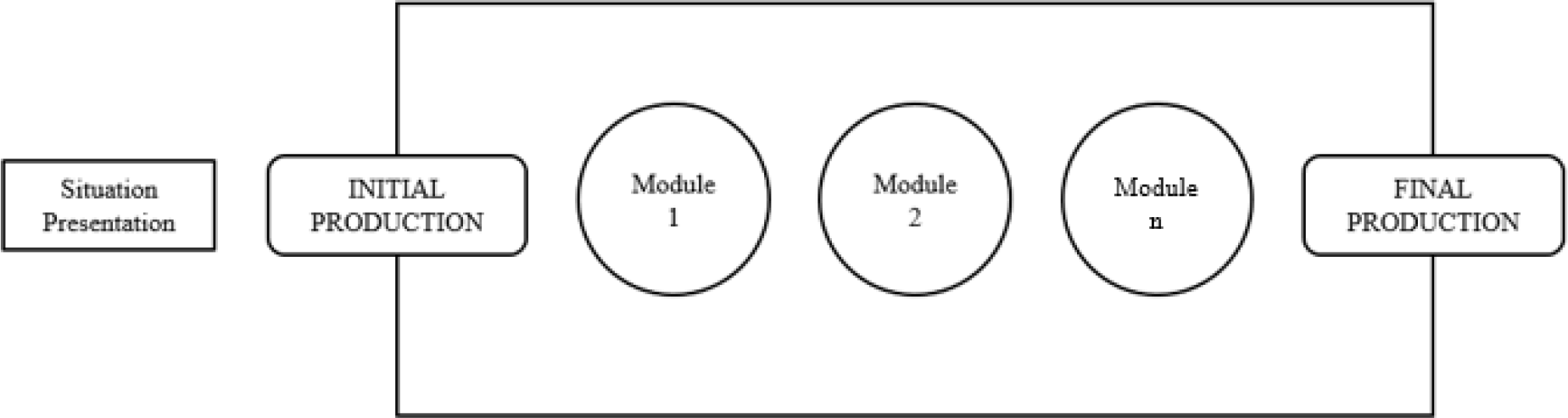 Source: Adapted from Dolz, Noverraz and Schneuwly (
 Source: Subtitle Workshop 6.0b interface screenshot