Cave-dwelling terrestrial isopods (Crustacea: Isopoda: Oniscidea) from Florianópolis Island, Brazil: review and description of three new species
ABSTRACT
Terrestrial isopods are a group of peracarid crustaceans characterized by remarkable taxonomic diversity, and Brazil has a large number of recorded species. In this contribution, three new species of terrestrial isopods are described from caves in the municipality of Florianópolis, Santa Catarina, Brazil. Additionally, the distribution of Atlantoscia meloi Campos-Filho & Araujo, 2015, Benthana picta (Brandt, 1833) (Philosciidae), and Pudeoniscus birabeni Vandel, 1963 (Pudeoniscidae) is expanded to include caves in Florianópolis. Our findings also reveal the first troglobitic species from the island of Florianópolis and the second of the genus. Finally, a distribution map, an identification key, and photographs of the recorded species are provided.
KEYWORDS:
Crustaceans; granite caves; taxonomy; troglobitic; troglophilic
INTRODUCTION
Terrestrial isopods (Oniscidea) represent the only lineage of crustaceans fully adapted to terrestrial life (Hornung 2011, Taiti et al. 2018). This group comprises more than 4,000 species, in more than 500 genera and 38 or 39 families, distributed in almost all terrestrial habitats, including subterranean systems (Schmalfuss 2003, Sfenthourakis and Taiti 2015, WoRMS 2025). In caves, terrestrial isopods are often common and abundant due to the availability of resources (plant debris and guano) and shelter (moist sediment deposits; Trajano and Bichuette 2010, Campos-Filho et al. 2014, Fernandes et al. 2019), making them key components of the soil fauna and contributing to soil formation and nutrient cycling (Abd El-Wakeil 2015, Ŝpaldoňová and Frouz 2014, Zimmer and Topp 1999).
In South America, Oniscidea is represented by approximately 500 species, with over 250 species recorded from Brazil (Boeger et al. 2024). Moreover, about 110 species have been reported from subterranean habitats (Schmalfuss 2003, Campos-Filho et al. 2014, 2015, 2020, 2022a, 2022b, 2023a, 2023b, Ocampo-Maceda et al. 2022, Cardoso et al. 2023, 2024, 2025, López-Orozco et al. 2024a, 2024b, 2024c, Borja-Arrieta et al. 2025, Galo et al. 2025). However, many regions of the country, particularly insular environments, remain poorly surveyed in terms of taxonomic inventories, and the taxonomic impediment continues to represent a major limitation to biodiversity assessment (Ebach et al. 2011, Campos-Filho et al. 2014, 2020, Coleman 2015).
To date, 34 terrestrial isopod species have been recorded from the state of Santa Catarina (Campos-Filho et al. 2018a), underscoring the region’s significance in terms of biodiversity and potential endemism. Florianópolis Island, located in the state of Santa Catarina, constitutes a particularly valuable area for investigating isopod diversity owing to its mosaic of coastal, subterranean, and Atlantic Forest habitats. Islands often function as reservoirs of biodiversity and centers of speciation, often supporting lineages with high levels of endemism (CANARI 2020). Consequently, biodiversity studies are crucial for informing conservation priorities, particularly in subterranean ecosystems, which are increasingly threatened on a global scale (Nanni et al. 2023).
The present study aims to describe three new species of terrestrial isopods from caves on Florianópolis Island, belonging to the genera Alloniscus Dana, 1854 (Alloniscidae), Alboscia Schultz, 1995 (Philosciidae), and Novamundoniscus Schultz, 1995 (Dubioniscidae). Additionally, the distribution of Benthana picta (Brandt, 1833), Atlantoscia meloi Campos-Filho & Araujo, 2015 and Pudeoniscus birabeni Vandel, 1963 is expanded, and a taxonomic key is provided.
MATERIAL AND METHODS
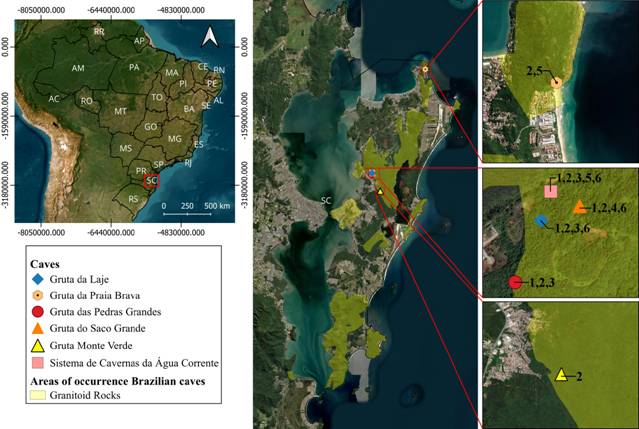
The municipality of Florianópolis (27°35’49”S, 48°32’58”W) is located in southern Brazil, in the state of Santa Catarina. Its territory covers approximately 671.6 km² and possesses significant speleological heritage, with 206 subterranean cavities (SBE 2025) (Fig. 1). The region has a subtropical climate, classified as humid mesothermal, with an average annual temperature of 20.1 °C, and an average annual precipitation of approximately 1,462 mm (Caruso 1983). The vegetation cover is predominantly characterized by Atlantic Forest on the slopes, along with the presence of mangroves, extensive dunes, beaches, and dense ombrophilous forest (Caruso 1983, Veado 2004). Additionally, Florianópolis contains numerous small hydrographic basins, including those of the Ratones, Saco Grande, Itacorubi, and Tavares rivers (PMF 2009).
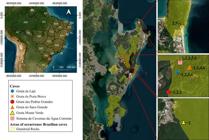
Distribution map of terrestrial isopods in the caves of Florianópolis island, Santa Catarina, Brazil: (1) Benthana picta; (2) Atlantoscia meloi; (3) Alboscia uncinus sp. nov.; (4) Pudeoniscus birabeni; (5) Novamundoniscus rafaeli sp. nov.; (6) Alloniscus erratus sp. nov.
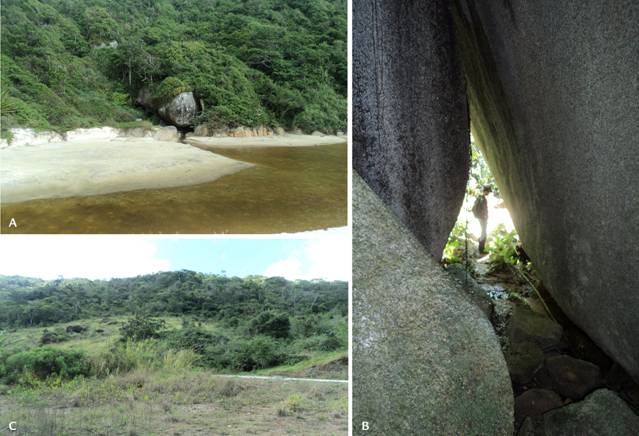
The specimens were collected from six caves: Gruta das Pedras Grandes, Gruta da Praia Brava (Fig. 2A), Gruta da Laje, Gruta Monte Verde, Gruta do Saco Grande (Fig. 2B), and the Sistema de Cavernas da Água Corrente (Fig. 1). These cavities, formed in igneous rocks (Granito Ilha), belong to the Pedras Grandes Suite lithostratigraphic unit (Zanini et al. 1997). These types of cavities often form occasionally or randomly (Hardt 2003). These rocks are alkaline and post-tectonic in nature, with little or no ductile deformation (Tomazzoli and Pellerin 2015). The formation of granite blocks and a network of labyrinthine conduits occupying different superimposed levels (Rodríguez 2011, 2017) characterize these cavities. The walls, ceilings, and floors of these underground systems are irregular and discontinuous, allowing a range of entrances and exits for the penetration of light and organic resources; however, at deeper levels, aphotic zones can be found (Mochiutti and Tomazzoli 2017, 2019, Mochiutti 2020). These habitats in granite rock represent a minority in official cave records in Brazil, accounting for only 3% of all reported natural underground cavities (SBE 2025). However, some caves, such as Gruta do Saco Grande, are strongly influenced by the epigean environment, receiving a significant influx of organic matter transported by flooding (Magalhães et al. 2021), and face multiple threats from urban growth and expansion (Fig. 2C) (Bichuette et al. 2022).
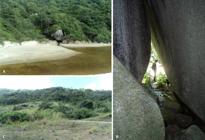
(A) Entrance to Gruta Praia Brava, resurgence of the stream; (B) entrance to Gruta do Saco Grande; (C) surrounding vegetation of the caves, showing anthropogenic impacts.
The specimens were preserved in 75% ethanol. Morphological terminology follows Schmidt (2002) and Segura-Zarzosa et al. (2022). Micropreparations were made in Hoyer’s medium (Anderson 1954). The synonymic list includes the original publication and only citations of records from Brazil. Illustrations were made with the aid of a camera lucida mounted on Zeiss Stemi SV6 stereomicroscope and Leica DMLS microscope. The illustrations were prepared using GIMP software (v. 2.8), following the method proposed by Montesanto (2015, 2016). The examined material is deposited in the Collection of the Laboratório de Estudos Subterrâneos (LES), Universidade Federal de São Carlos, São Carlos, Brazil.
TAXONOMY
Suborder Oniscidea Latreille, 1802
Alloniscidae Schmidt, 2003
Alloniscus Dana, 1854
Type-species: Alloniscus perconvexus Dana, 1854 by monotypy.
Alloniscus erraticus Borja-Arrieta, Bichuette & Campos-Filho, sp. nov.
Figs 1, 3-5, 12F
https://zoobank.org/DE2FFE7F-EE2D-4887-A983-C16740D354E2
Diagnosis. Cephalon lateral lobes well developed, frontal line present, suprantennal line bent downwards on middle; telson with apex rounded; antennula distal article with 12 subapical aesthetascs plus apical pair, uropod endopod inserted proximally, exopod and endopod subequals in length, pereopod 7 ischium slightly depressed on proximal sternal margin; pleopod 1 exopod heart-shaped, distal and inner margins rounded.
Material examined. Holotype: BRAZIL •1 male, (LES 0030693), Gruta do Saco Grande, Florianópolis Island, Santa Catarina, 27°32’11.70”S; 48°29’48.70”W, 30.ix.2016; leg. M.E. Bichuette, JE Gallão, D.L.V.B.V. Bertolini, P. Xavier. Paratype: BRAZIL •1 male, (parts in micropreparations), (LES 0008785), same location of the holotype, 24.i.2017, leg. JE Gallão, P. Xavier; •2 females, (LES 0030692), Gruta da Laje, 27°32’12.84”S; 48°29’52.80”W, 01.v.2016, same collectors of the holotype; •2 males, (LES 0030694) same previous location, 29.xi.2016, same collectors of the holotype; •1 female, (LES 0017942), Sistema de Cavernas da Água Corrente, 27°32’9.96”S; 48°29’51.72”W, 29.ix.2016, same collectors of the holotype; •1 male,1 female, (LES 0008790), same collection data as the holotype.
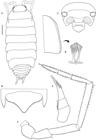
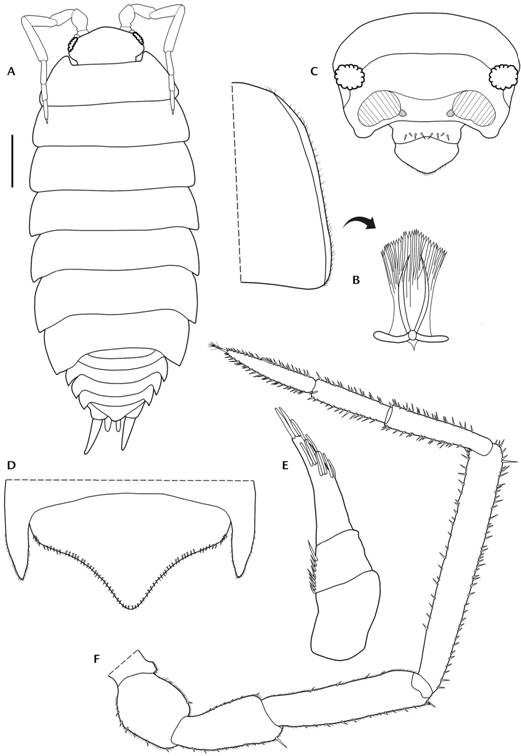
Alloniscus erratus sp. nov., male, LES 0008785: (A) dorsal habitus; (B) scale-seta; (C) cephalon, fronta view; (D) pleonite 5 and telson; (E) antennula; (F) antenna. Scale bar: A = 1 mm.
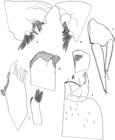
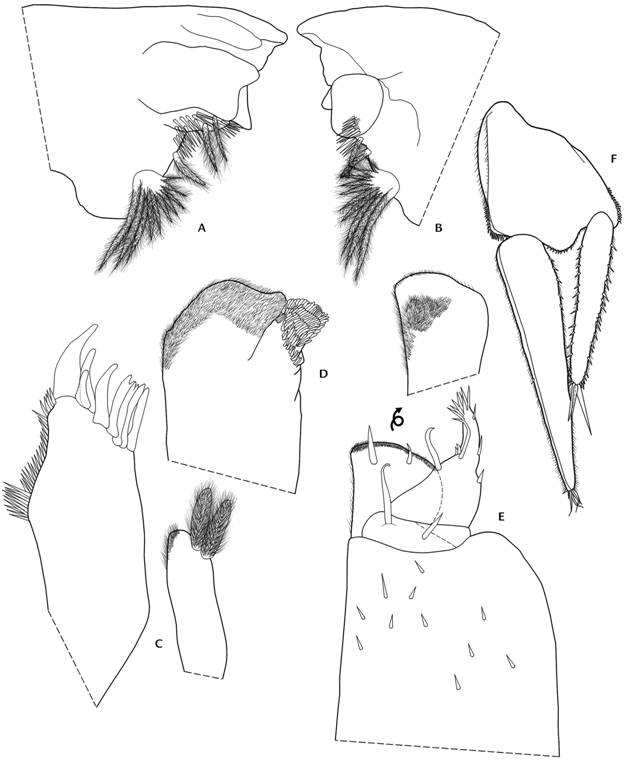
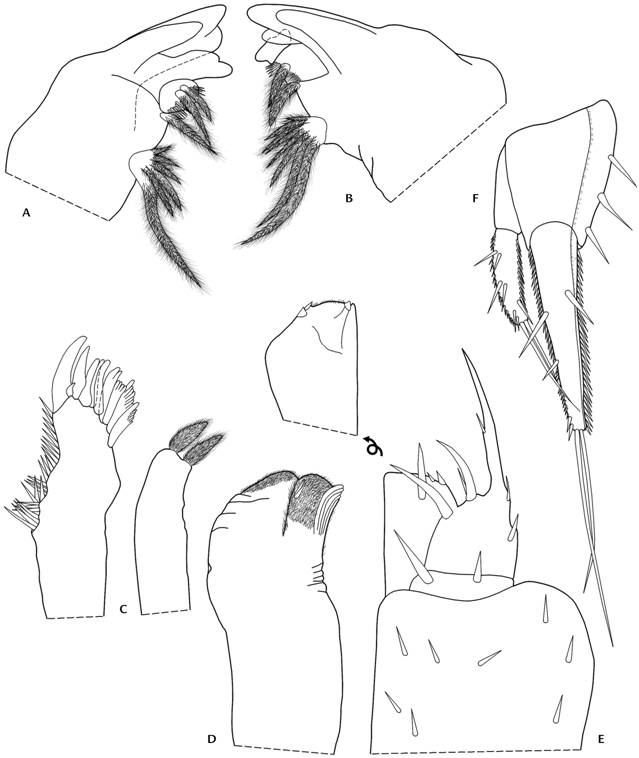
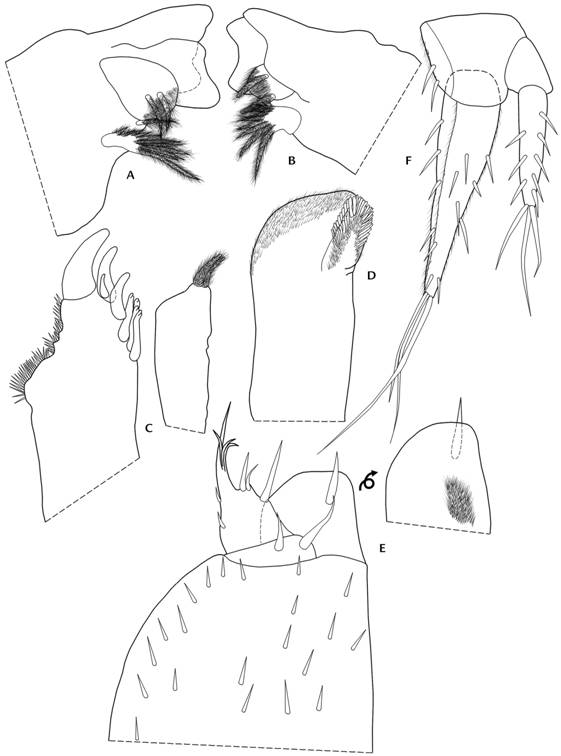
Alloniscus erratus sp. nov., male, LES 0008785: (A) left mandible; (B) right mandible; (C) maxillula; (D) maxilla; (E) maxilliped; (F) uropod.
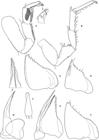
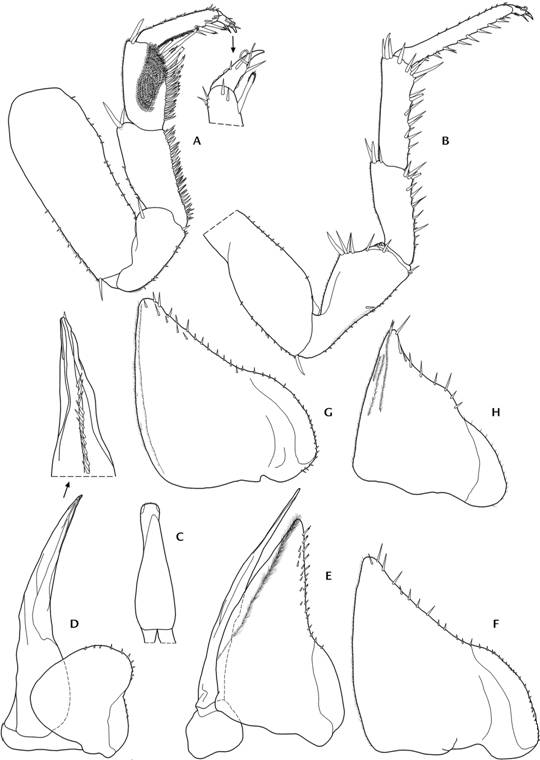
Alloniscus erratus sp. nov., male, LES 0008785: (A) pereopod 1; (B) pereopod 7; (C) genital papila; (D) pleopod 1; (E) pleopod 2; (F) pleopod 3 exopod; (G) pleopod 4 exopod; (H) pleopod 5 exopod.
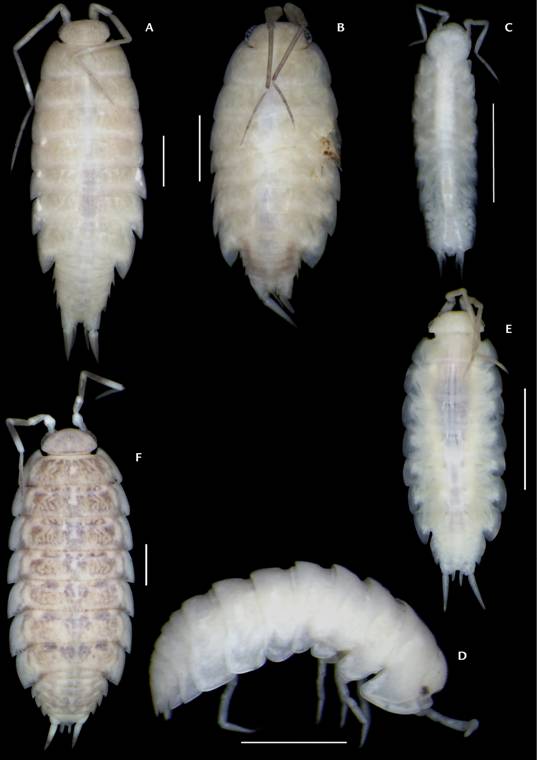
Description. Maximum body length: male, 8.17 mm, female 7.22 mm. Body outline as in Figs 3A, 12F. Color (Fig 12F) light brown; cephalon and antenna with irregular unpigmented spots; pereonites and epimera 1-7 gradually more pigmented on posterior portions, pereonites 1-3 with many unpigmented spots; pleon, telson and uropods pigmented. Body (Fig. 3A) convex; pereonites 1 and 2 epimera directed frontwards, 3-7 gradually more directed backwards. Dorsum covered with fan-shaped (Fig. 3B). Cephalon (Fig. 3C) with lateral lobes well developed, frontal line present, suprantennal line bent downwards on middle; eyes composed of 24 ommatidia. Pleonites 3-5 epimera outline continuous with that of pereonite 7, acute and directed backwards. Telson (Fig. 3D) triangular, lateral sides strongly concave, apex rounded. Antennula (Fig. 3E) triarticulate, distal article longest bearing 12 subapical aesthetascs plus apical pair. Antenna (Fig. 3F) stout, surpassing posterior margin of pereonite 1 when extended backwards; flagellum of three articles subequal in length, third article with lateral aesthetascs. Mandibles with molar penicil of several branches, left mandible (Fig. 4A) with 2+1 penicils, right mandible (Fig. 4B) with 1+1 penicils. Maxillula (Fig. 4C) inner endite with two long hairy penicils, distal margin slightly rounded; outer endite of 4+4 teeth, inner set with two teeth slightly cleft on apex. Maxilla (Fig. 4D) outer lobe wider than inner lobe, covered with thin setae; inner lobe rounded, covered with thick setae. Maxilliped (Fig. 4E) endite subrectangular, distal margin slightly rounded, medial seta surpassing distal margin, small knob-like penicil on ventral margin without minute setae. Pereopods 1-7 long and stout, carpus 1 with longitudinal antennal grooming brush, pereopod 6 ischium and merus, and pereopod 7 base with water conducting system; dactylus with inner claw reaching distal margin of outer claw, dactilar and ungual setae simple. Uropod (Fig. 4F) protopod subquadrangular, protopod and exopod grooved on outer margin bearing glandular pores, endopod inserted proximally, exopod and endopod subequals in length. Pleopods 1-5 exopods with large respiratory areas (Fig. 5D-H).
Male. Pereopods 1-5 merus and carpus bearing brush of setae on sternal margin (Fig. 5A); pereopod 7 ischium slightly depressed on proximal sternal margin (Fig. 5B). Genital papilla (Fig. 5C) with triangular frontal shield and two subapical orifices. Pleopod 1 (Fig. 5D) exopod heart-shaped, bearing small setae along inner and outer margins outer margin sinuous, distal and inner margins rounded; endopod twice as long as exopod, distal portion narrow with small setae on medial margin. Pleopod 2 (Fig. 5E) exopod triangular, outer margin slightly concave with many small setae along outer margin; endopod flagelliform, slightly longer than exopod. Pleopod 3 and 4 exopods as in Fig. 5F, G. Pleopod 5 exopod (Fig. 5H) triangular, outer margin sinuous bearing many small setae, distal margin acute.
Distribution. It is only known from the Sistema de Cavernas da Água Corrente, Gruta do Saco Grande and Laje caves, Florianópolis Island, Santa Catarina, Brazil (Fig. 1).
Etymology. From the Latin: erraticus= wandering. The new species name refers to its atypical or unusual distribution within cave environments.
Remarks. Alloniscus erraticus sp. nov. differs from its closest congener, Alloniscus buckupi Campos-Filho & Cardoso, 2018, in the number of ommatidia (eight vs. 24 in A. erraticus sp. nov.), the number and distribution of aesthetascs on the antennula (eight vs. twelve in A. erraticus sp. nov.), the shape of the telson apex (acute vs. rounded in A. erraticus sp. nov.), the shape of the male pleopod 1 exopod (heart-shaped vs. oval in A. erraticus sp. nov.) and the shape of the male pleopod 5 exopod (outer margin slightly convex and non-projected distal portion vs. sinuous and projected distal portion in A. erraticus sp. nov.) (see also Campos-Filho et al. 2018c). Alloniscus erraticus sp. nov. is considered a troglophile, due to the absence of troglomorphic characters. With the description of this new species, the Alloniscidae family in South America expands to three species, two of which have been reported from Brazil, this being the southernmost.
Philosciidae Kinahan, 1857
Benthana Budde-Lund, 1908
Type-species: Philoscia picta Brandt, 1833 by subsequent designation (Van Name 1936).
Benthana picta (Brandt, 1833)
Figs 1, 12A
Philoscia pictaBrandt 1833: 183. Benthana picta; Gruner 1955: 445, figs. 7-9. Lemos de Castro 1958: 111, figs. 78-86. Vandel 1963: 77. Lenko 1971: 7. Souza-Kury 1998: 659. Araujo et al. 1996: 113, figs. 1-4. Araujo 1999a: 248, fig. 14. Leistikow and Wägele 1999: 14. Araujo and Lopes 2003: 2437. Schmalfuss 2003: 53. Lopes et al. 2005: 101, Tab. 1. Costa et al. 2014: 174, fig. 3. Campos-Filho et al. 2015: 6, figs. 1, 2, 9A. Zimmermann et al. 2015a: 3, Tab. 1. Benthana sp; Zimmermann et al. 2015a: 3, Tab. 1. nec Philoscia picta.
Material examined. BRAZIL •3 females, (LES 0017949), Gruta do Saco Grande, Florianópolis Island, Santa Catarina, 27°32’11.40”S; 48°29’48.48”W, 01.v.2016, leg. M.E. Bichuette, JE Gallão, D.L.V.B.V. Bertolini, P. Xavier; •1 female, (LES 0008687), 30.ix.2016, same location and previous collectors; •1 male, 1 female, (LES 0030686), same previous location, 24.i.2017, leg. JE Gallão, P. Xavier; •1 female, (LES 30690), Gruta das Pedras Grandes, 27°32’18.96”S; 48°29’55.68”W, 29.xi.2016, leg. M.E. Bichuette, JE Gallão, D.L.V.B.V. Bertolini, P. Xavier; •1 male, (LES 0017950), Sistema de Cavernas da Água Corrente, same locality and previous collectors, 27°32’9.96”S; 48°29’51.72”W, 01.v.2016; •1 female, (LES 0030687), same collection data as above; •1 female, (LES 0030689), 01.v.2016, same location and previous collectors; •2 females, (LES 0030688), same previous location, 24.i.2017, leg. JE Gallão, P. Xavier; •1 male, (LES 0008792), Gruta da Laje, same locality and collectors, 27°32’12.84”S; 48°29’52.80”W, 29.ix.2016; •1 female, (LES 0008791), same locality as previous, 23.i.2017, leg. JE Gallão, P. Xavier.
Remarks. Endemic species from South America (Schmalfuss 2003, Campos-Filho et al. 2018a). In Brazil, this species is recorded from the states os Espirito Santo to Rio Grande do Sul (Campos-Filho et al. 2015). This is the first record from Florianópolis Island (Fig. 1).
Atlantoscia Ferrara & Taiti, 1981
Type-species: Atlantoscia alceui Ferrara & Taiti, 1981, by original designation and monotypy.
Atlantoscia meloi Campos-Filho & Araujo, 2015
Figs 1, 12B
Zimmermann et al. 2015b: 704-713, figs 3-6, tabs 1-3. Zimmermann et al. 2018: 475, tabs 1, 2, figs 5, 6.
Material examined. BRAZIL •2 females, (LES 0017945), Gruta do Saco Grande, Florianópolis Island, Santa Catarina, 27°32’11.40”S; 48°29’48.48”W, 01.v.2016, leg. M.E. Bichuette, JE Gallão, D.L.V.B.V. Bertolini, P. Xavier; •1 male, (LES 0030675), same data from previous collection; •1 male, 2 females, (LES 0030676), same data from previous collection; •1 male, (LES 0030679), same data from previous collection; •1 female10 juv. (LES 0030683), same data from previous collection; •1 female, (LES 0030684), same data from previous collection; •1 female, (LES 0017944), same locality and collectors as previous, 30.ix.2016; •1 male, 1 female, (LES 008698), same locality as previous, 24.i.2017, leg. JE Gallão, P. Xavier; 1 male, (LES 0017952), Gruta da Praia Brava, 27°23’31.92”S; 48°24’51.84”W, 02.v.2016, leg. M.E. Bichuette, JE Gallão, D.L.V.B.V. Bertolini, P. Xavier; •2 females, (LES 0017946), Gruta das Pedras Grandes, 27°32’18.96”S; 48°29’55.68”W, 02.v.2016, same collectors as previous; •2 females, (LES 0030680), same data from previous collection; •1 female, 5 juv. (LES 0030682), same data from previous collection, 1 male, (LES 0008695), Sistema de Cavernas da Água Corrente, 27°32’9.96”S; 48°29’51.72”W, 01.v.2016, same collectors as previous; •1 male, 1 female, (LES 0030677), same data from previous collection; 1 male, (LES 0030681), same locality and collectors as previous, 29.ix.2016; •1 female, (LES 0017947), 30.ix.2016, same locality and collectors as previous, 30.ix.2016; 1 female, (LES 0017948), Gruta da Laje, 27°32’12.84”S; 48°29’52.80”W, 29.ix.2016, same collectors as previous; •1 male, (LES 0030685), same previous location, 23.i. 2017, leg. JE Gallão, P. Xavier; •1 male, (LES 0030678), Gruta Monte Verde, 27°33’43.20”S; 48°29’6.00”W, 29.ix.2016, leg. M.E. Bichuette, JE Gallão, D.L.V.B.V. Bertolini, P. Xavier.
Remarks. Endemic species from Brazil (Campos-Filho et al. 2018a). It has been recorded in the municipality of Orleans, Santa Catarina (Zimmermann et al. 2015b). This study expands the knowledge of its distribution to the island of Florianópolis (Fig. 1).
Alboscia Schultz, 1995
Type-species: Alboscia elongata Schultz, 1995, by original designation and monotypy.
Alboscia uncinus Borja-Arrieta, López-Orozco & Campos-Filho, sp. nov.
Figs 1, 6-8, 12C
https://zoobank.org/E27DA543-45C0-43BE-B9F6-F3AA70AEB18C
Diagnosis. Cephalon with lateral lobes not developed, frontal line absent, suprantennal line slightly bent downwards in middle; telson rounded apex; antennule distal article bearing one subapical aesthetasc plus apical pair; uropod exopod longer than endopod; pleopod 1 endopod inner portion with subapical lobe hook-like.
Material examined. Holotype: BRAZIL •1 male (parts in micropreparations), (LES 0017941), Sistema de Cavernas da Água Corrente, Florianópolis Island, Santa Catarina, 27°32’9.96”S; 48°29’51.72”W, 30.ix.2016, leg. M.E. Bichuette, JE Gallão, D.L.V.B.V. Bertolini, P. Xavier; Paratype: BRAZIL •1 female, (LES 0030691), Brazil, Gruta das Pedras Grandes, 27°32’18.96”S; 48°29’55.68”W, 02.v.16, same collectors of the holotype; •2 females, (LES 008793), Gruta da Laje, 27°32’12.84”S; 48°29’52.80”W, 23.i.2017, leg. JE Gallão, P. Xavier.
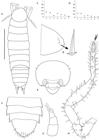
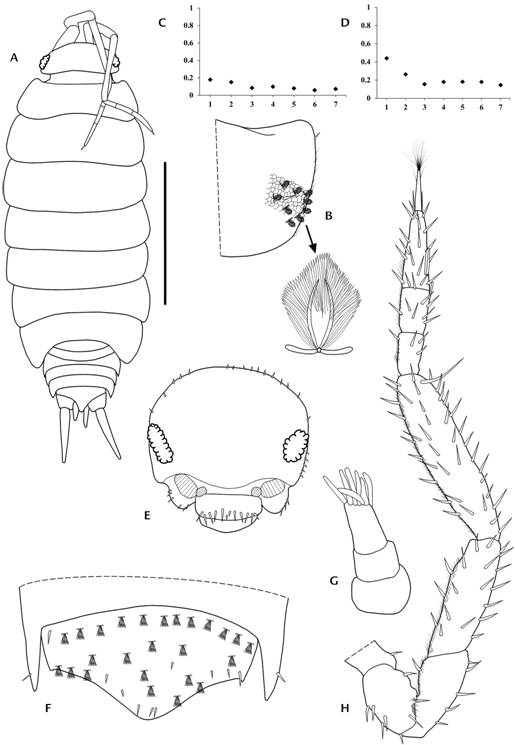
Alboscia uncinus sp. nov., male, LES 0017941: (A) dorsal habitus; (B) scale-seta; (C) noduli laterals d/c coordinates; (D) noduli laterals b/c; (E) cephalon, frontal view; (F) pleonite 5 and telson; (G) antennula; (H) antenna. Scale bar: A = 1 mm.
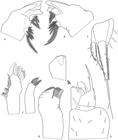
Alboscia uncinus sp. nov., male, LES 0017941: (A) left mandible; (B) right mandible; (C) maxillula; (D) maxilla; (E) maxilliped; (F) uropod.
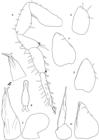
Alboscia uncinus sp. nov., male, LES 0017941: (A) pereopod 7, (B) genital papilla; (C) pleopod 1; (D) pleopod 2; (E) pleopod 3 exopod; (F) pleopod 4 exopod; (G) pleopod 5 exopod.
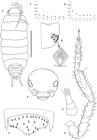
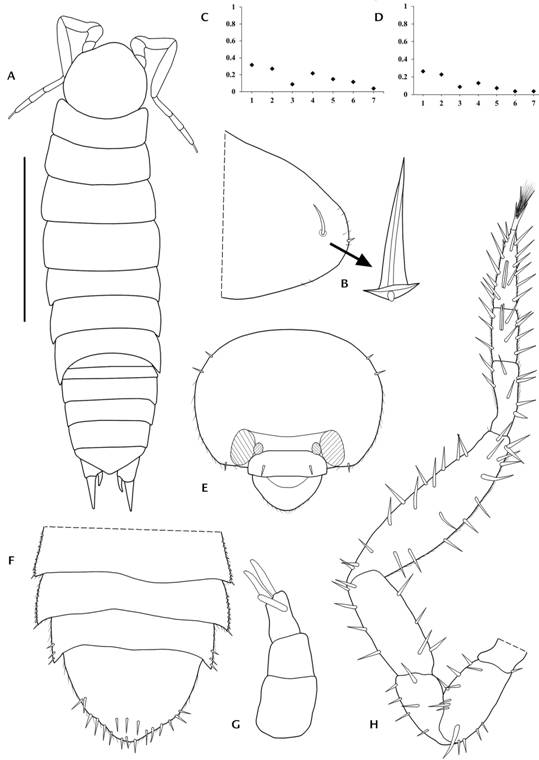
Novamundoniscus rafaeli sp. nov., male, LES 0030695: (A) dorsal habitus; (B) scale-seta; (C) noduli laterals d/c coordinates; (D) noduli laterals b/c; (E) cephalon, frontal view; (F) pleonite 5 and telson; (G) antennula; (H) antenna. Scale bar: A = 1 mm.
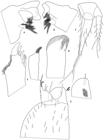
Novamundoniscus rafaeli sp. nov., male, LES 0030695: (A) left mandible; (B) right mandible; (C) maxillula; (D) maxilla; (E) maxilliped; (F) uropod.
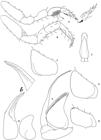
Novamundoniscus rafaeli sp. nov., male, LES 0030695: (A) pereopod 1; (B) pereopod 7; (C) genital papilla; (D) pleopod 1; (E) pleopod 2; (F) pleopod 3 exopod; (G) pleopod 4 exopod; (H) pleopod 5 exopod.
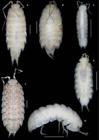
Habitus: (A) Benthana picta; (B) Atlantoscia meloi; (C) Alboscia uncinus sp. nov.; (D) Pudeoniscus birabeni; (E) Novamundoniscus rafaeli sp. nov.; (F) Alloniscus erratus sp. nov. Scale bars: 1 mm.
Description. Maximum body length: male 2.55 mm, female 2.7 mm. Body pigments absent (Fig. 12C). Body (Fig. 6A) elongated and slender with lateral sides almost parallel; dorsal surface smooth, bearing short, triangular scale-setae (Fig. 6B). Noduli laterales very long (Fig. 6B); d/c and b/c coordinates as in Fig. 6C and D, respectively. Cephalon (Fig. 6E) with lateral lobes not developed, frontal line absent, suprantennal line slightly bent downwards in middle; eyes absent (Fig. 6E). Pereonites 1-4 with posterior corners right-angled and posterior margins straight, pereonites 5-7 epimera with anterior corners slightly directed backwards (Fig. 6A). Pleon (Fig. 6A, F) narrower than pereon with epimera reduced. Telson (6F) broad, triangular, convex lateral margins, rounded apex. Antennula (Fig. 6G) triarticulate, distal article bearing one subapical aesthetasc plus apical pair. Antenna (Fig. 6H) slender, reaching second pereonite when extended backwards; flagellum of three articles, distal article longest; apical organ short, bearing two long free sensilla. Mandibles with molar penicil consisting of 6-7 stout branches; right mandible (Fig. 7B) with 1 + 1 penicils, left mandible (Fig. 7A) with 2 + 1 penicils. Maxillula (Fig. 7C) inner endite with distal margin rounded and bearing two penicils; outer endite with four simple teeth plus accessory tooth on outer set, inner set of three pectinate teeth plus one bifid. Maxilla (Fig. 7D) inner lobe rounded, covered with thick and thin setae; outer lobe slightly wider than inner lobe, covered with thin setae. Maxilliped (Fig. 7E) palp with two strong setae on proximal article; endite subrectangular, medial seta strong, distal margin with two hook-like setae, rostral surface with one triangular seta without setose sulcus. Pereopods 1-7 merus to propodus bearing sparse and long setae on sternal margin; dactylus of two claws, inner claw not surpassing outer claw, dactylar and ungual setae simple, not surpassing outer claw. Uropod (Fig 7F) protopod subquadrangular with endopod and exopod inserted at same level; protopod and exopod outer margins grooved, bearing glandular pores; exopod longer than endopod. Pleopod exopods without respiratory structures (Fig. 8C-G).
Male. Pereopod 7 without sexual dimorphism (Fig. 8A). Genital papilla with triangular ventral shield and two apical orifices (Fig. 8B). Pleopod 1 (Fig. 8C) exopod ovoid; endopod stout, about twice as long as exopod, distal portion thickset and slightly bent outwards, bearing small setae on outer margin, inner portion with subapical lobe hook-like (Fig. 8C). Pleopod 2 (Fig. 8D) exopod triangular, outer margin sinuous, bearing three setae, distal margin rounded; endopod stout and longer than exopod. Pleopod 3 and 4 exopods triangular, bearing three long setae (Fig. 8E, F). Pleopod 5 exopod (Fig. 8G) subqudrangular, outer margin convex, bearing three long setae.
Distribution. It is only known from the Gruta da Laje, Gruta da Pedras Grandes and Sistema de Cavernas da Água Corrente, Florianópolis island, Santa Catarina (Fig. 1).
Etymology. Latin. uncinus= hook like. The new species name refers to the hook-shaped lobe in the male pleopod 1 endopod. The name is given in the nominative case.
Remarks. Alboscia uncinus sp. nov. can be easily distinguish from all the congener species in having a subapical hook-like lobe on the male pleopod 1 endopod. Moreover, into a wide comparison with the congeners, it can be distinguished from Alboscia elongata Schultz, 1995, Alboscia silveirensis Araujo, 1999, Alboscia ornata Araujo, 1999, Alboscia itapuensis Araujo & Quadros, 2005 and Alboscia jotajota Campos-Filho, Bichuette & Taiti, 2020 (Schultz 1995, Araujo 1999b, Araujo and Quadros 2005, Campos-Filho et al. 2020) in the absence of eyes, the number of aesthetascs on the antennula and by the shape of pleopods 1 and 2. Alboscia uncinus sp. nov. is considered to be a troglobite due to the presence of classic troglomorphic traits, absence of eyes and pigmentation. This record of the new species consolidates the first troglobitic isopod from Santa Catarina Island and the second troglobitic species of the genus.
Pudeoniscidae Lemos de Castro, 1973
Pudeoniscus Vandel, 1963
Type-species: Pudeoniscus birabeni Vandel, 1963, by original designation and monotypy.
Pudeoniscus birabeni Vandel, 1963
Figs 1, 12D
Pudeoniscus birabeniVandel 1963: 91, figs 16-19. Lemos de Castro 1973: 3. Furlan 1996: 18. Souza-Kury 1998: 665. Leistikow and Wägele 1999:43. Schmalfuss 2003: 226. Schmidt 2002: 381. Schmidt 2003: 79, figs 100-103. Schmidt and Leistikow 2004: 78. Souza et al. 2010: 12. Appel et al. 2011: 124. Lisboa et al. 2013: 395.
Material examined. BRAZIL •1 female, (LES 0008697), Gruta do Saco Grande, Florianópolis Island, Santa Catarina, 27°32’11.70”S; 48°29’48.70”W, 24.i.2017, leg. JE Gallão, P. Xavier.
Remarks. Endemic species from Brazil (Campos-Filho et al. 2018a). It has been recorded from the states of Bahia, Rio de Janeiro, Paraná, São Paulo, and Santa Catarina (Vandel 1963, Lemos de Castro 1973, Lisboa et al. 2013, Schmidt 2003, Campos-Filho et al. 2018b). This work extends the knowledge of its distribution to the municipality of Florianópolis (Fig. 1).
Dubioniscidae Schultz, 1995
Novamundoniscus Schultz, 1995
Type-species: Phalloniscus vandeli Lemos de Castro, 1960, by original designation.
Novamundoniscus rafaeli Borja-Arrieta, Carpio-Díaz & López-Orozco, sp. nov.
Figs 1, 9-12E
https://zoobank.org/AB8C883E-AC9F-4AF7-BCC9-F275029FECEC
Diagnosis. Cephalon rounded lateral lobes, suprantennal line bent downwards in middle; eyes with 16 ommatidia; telson apex rounded; antennule distal article bearing about seven apical aesthetascs; uropod endopod inserted slightly proximal, exopod twice as long as endopod; pleopod 1 exopod subrectangular and pleopod 5 exopod rhomboid.
Material examined. Holoptype: BRAZIL •1 male, (LES 0017940), Sistema de Cavernas da Água Corrente, Florianópolis Island, Santa Catarina, 27°32’9.96”S; 48°29’51.72”W, 30.ix.2016, leg. M.E. Bichuette, JE Gallão, D.L.V.B.V. Bertolini, P. Xavier; Paratype: BRAZIL •1 male, (LES 0030695), (parts in micropreparations), Gruta da Praia Brava, 27°23’31.92”S; 48°24’51.84”W, 02.v.2016, same collectors of the holotype; •1 male, 3 females, (LES 0030696), same data from previous collection; •1 male, (LES 0030863), same data from the holotype collection.
Description. Maximum body length: male 3.04 mm, female, 3.2 mm. Color light brown with typical muscle spots insertions; distal portion of cephalon, pereonites 1-7, pleonites epimera and telson more pigmented. Body outline as in Figures 9A, 12E. Pereonite 1 epimera directed frontwards not surpassing cephalon, pereonites 4-7 gradually directed backwards. Dorsal surface densely covered with fan-shaped scale-setae (Fig. 9B). One line of small piliform noduli laterales per side (Fig. 9B); d/c and b/c coordinates as in Fig. 9C and D, respectively. Cephalon (Fig. 9E) with rounded lateral lobes, suprantennal line bent downwards in middle; eyes with 16 ommatidia. Pleonites 3-5 epimera well developed, acute and directed backwards (Fig. 9A). Telson (Fig. 9F) with lateral side’s concave, apex rounded. Antennula (Fig. 9G) with distal article elongate, distal article bearing about seven apical aesthetascs. Antenna (Fig. 9H) reaching second pereonite when extended backwards; flagellum with first and second articles subequal in length, third article bearing lateral aesthetascs, apical organ bearing two long free sensilla. Mandibles with molar penicil with several branches, left mandible (Fig. 10A) with 2+1 penicils, right mandible (Fig. 10B) with 1+1 penicils. Maxillula (Fig. 10C) inner endite with two hairy penicils, distal margin rounded; outer endite with 4+4 teeth, inner set apically cleft. Maxilla (Fig. 10D) inner lobe rounded covered with thick setae; outer lobe twice as wide as inner lobe covered with thin setae. Maxilliped (Fig. 10E) palp with proximal article bearing two long setae; endite subrectangular, medial seta surpassing distal margin, distal margin slightly sinuous on ventral margin with minute setae. Pereopods 1-7 short, carpus 1 with transverse antennal grooming brush. Dactylus of two claws, inner claw reaching median portion of outer claw, dactilar and ungual setae simple. Uropod (Fig. 10F) protopod subquadrangular, protopod and exopod grooved on outer margin, exopod twice as long as endopod, endopod inserted slightly proximal.
Male. Pereopods 1 and 7 without sexual dimorphism (Fig. 11A, B). Genital papilla (Fig. 11C) with triangular ventral shield, papilla longer than ventral shield bearing two subapical orifices. Pleopod 1 (Fig. 11D) exopod subrectangular, twice as long as wide, inner margin concave, outer margin convex; endopod elongated, directed outwards, bearing small setae on medial portion. Pleopod 2 (Fig. 11E) exopod triangular, outer margin concave bearing one short setae; endopod distinctly longer than exopod. Pleopod 3 and 4 exopods (Fig. 11F, G) triangular, outer margin almost straight bearing setae. Pleopod 5 exopod (Fig. 11H) rhomboid, outer margin almost straight bearing four setae.
Distribution. It is only known from the type localities, the Sistema de Cavernas da Água Corrente and the Praia Brava Cave, Florianópolis Island, Santa Catarina, Brazil (Fig. 1).
Etymology. The new species name is after Rafael Augusto Sotana de Souza, for all his collaboration and support to the Laboratório de Estudos Subterrâneos (LES), Universidad Federal de São Carlos.
Remarks. Novamundoniscus rafaeli sp. nov. is easily distinguished from its congeners by its compound eyes consisting of 16 ommatidia, antennula bearing seven apical aesthetascs, and the shape of male pleopod 1 and 5 exopods. Novamundoniscus rafaeli sp. nov. it is considered a troglophile, due to the absence of troglomorphic characters. With the registration of this new species, the genus increases to 13 species in the South America.
Key to cave species of Oniscidea from Florianópolis Island
1. Animal with conglobation ability and epimera of pereonite 1 with dorsolateral furrow .................... Pudeoniscus birabeni Vandel, 1963
1’. Animal without conglobation ability and epimera of pereonite 1 without dorsolateral furrow .................... 2
2. Eyes present .................... 3
2’. Eyes absent .................... Alboscia uncinus Borja-Arrieta, López-Orozco & Campos-Filho, sp. nov.
3. Pleopods 1-5 exopods with respitory areas .................... 4
3’. Pleopods 1-5 expods without respitory areas .................... Novamundoniscus rafaeli Borja-Arrieta, Carpio-Díaz & López-Orozco, sp. nov.
4. Frontal line present .................... Alloniscus erraticus Borja-Arrieta, Bichuette & Campos-Filho, sp. nov.
4’. Frontal line absent .................... 5
5. Pleopod 1 exopod with dentiform protrusion long with low indentation and simple apical part .................... Benthana picta (Brandt, 1833)
5’. Pleopod 1 exopod heart-shaped, inner margin slightly concave on distal portion, outer margin concave bearing and rounded apex .................... Atlantoscia meloi Campos-Filho & Araujo, 2015
DISCUSSION
In recent years, the cave-dwelling Oniscidea fauna in Brazil has been primarily studied in the states of Bahia, Minas Gerais, and São Paulo (Campos-Filho et al. 2022a, 2022b, 2023a, 2023b, López-Orozco et al. 2024a, 2024b, 2024c). However, no studies have focused on the biodiversity of these crustaceans in subterranean systems of insular regions. The only available studies on insular areas are those by Araujo and Taiti (2007) and Souza et al. (2013), which describe and record species from epigean habitats on the islands of Rocas Atoll, in the state of Rio Grande do Norte, and Trindade, in the state of Espírito Santo, respectively.
Our results indicate that Florianópolis Island offers ideal conditions for Oniscidea diversification due to its environmental heterogeneity. Moreover, subterranean environments play a key role in the speciation process by promoting isolation and the availability of microhabitats (Trajano and Bichuette 2010, Fernandes et al. 2019).
To date, Alboscia has a restricted distribution in South America, with records only from Paraguay and Brazil (Schultz 1995, Araujo 1999b, Araujo and Quadros 2005, Campos-Filho et al. 2020). As noted by Leistikow (2001), the genus is possibly related to Prosekiini; however, its phylogenetic relationship with other genera within the family Philosciidae remains uncertain (Araujo and Quadros 2005). Most species are epigean; only Alboscia jotajota Campos-Filho, Bichuette & Taiti, 2020 is considered troglobitic. This species differs from Alboscia uncinus sp. nov. in the number of aesthetascs on the antennula, the shape of the exopods, and the absence of eyes. The latter characteristic, along with depigmentation and the absence of individuals in the external environment, categorizes it as troglobitic.
Novamundoniscus comprises 12 species reported from Venezuela and Brazil (Schmalfuss 2003, Boyko et al. 2025). In Brazil, its distribution includes the states of Amazonas, Bahia, Goiás, Mato Grosso, Minas Gerais, Pará, Rio de Janeiro, Rio Grande do Sul, and Tocantins, with species adapted to both epigean and hypogean habitats (Souza-Kury 1998, Schmalfuss 2003, Campos-Filho et al. 2014, 2018d, 2023a, Boyko et al. 2025). However, the diversity of this group may be underestimated due to the lack of diagnostic characters (Campos-Filho et al. 2023a).
The record of Alloniscus erraticus sp. nov. in the caves of Florianópolis Island represents an unusual finding, as species of this genus are primarily adapted to coastal environments (Arcangeli 1960, Schmalfuss 2003, Schmidt 2003, Campos-Filho et al. 2018c). This occurrence may be related to the proximity of the caves to coastal habitats or to strong epigean influence (Magalhães et al. 2021), suggesting a possible use of these spaces as alternative refuges. Furthermore, the availability of food and the environmental stability provided by caves could offer adaptive advantages in response to external climatic fluctuations.
Given these factors, it is evident that caves play a crucial role as centers of speciation and isolation, promoting the morphological and genetic differentiation of species that colonize these extreme environments (Culver and Pipan 2009). The present study represents the first investigation of terrestrial isopods in subterranean island ecosystems, highlighting the importance of these habitats in the processes of dispersal, adaptation, and speciation of these crustaceans. Furthermore, it emphasizes the value of caves as reservoirs of biodiversity and the need for studies that expand our understanding of species richness and ecological traits, key elements for the development of effective conservation strategies. The description of these new species not only enhances the national taxonomic inventory but also provides essential information for the conservation of fauna that inhabits subterranean environments.
ACKNOWLEDGMENTS
We thank Deborah Lee V.B.V. Bertolini and Patricia Xavier for helping us with logistics and fieldwork. We are also grateful to the staff of the Instituto Brasileiro de Desenvolvimento e Sustentabilidade (IABS) for their support and logistical management. We also thank the staff of IABS for all support and logistics management. To Research Project titled “Biodiversity of terrestrial isopods (Crustacea: Isopoda: Oniscidea) from Cyprus in the light of integrative taxonomy”, “ONISILOS Research Program - 2018”, funded by the University of Cyprus, for the postdoctoral fellowship granted to ISC-F. To Odete Rocha of the Departamento de Ecologia e Biologia Evolutiva, Universidade Federal de São Carlos, for permission to use the laboratory facilities for the development of illustrations.
LITERATURE CITED
-
Abd El-Wakeil KF (2015) Effects of terrestrial isopods (Crustacea: Oniscidea) on leaf litter decomposition processes. The Journal of Basic & Applied Zoology 69: 10-16. https://doi.org/10.1016/j.jobaz.2015.05.002
» https://doi.org/10.1016/j.jobaz.2015.05.002 -
Anderson LE (1954) Hoyer’s Solution as a Rapid Permanent Mounting Medium for Bryophytes. The Bryologist 57: e242. https://doi.org/10.2307/3240091
» https://doi.org/10.2307/3240091 -
Appel C, Quadros AF, Araujo PB (2011) Marsupial extension in terrestrial isopods (Crustacea, Isopoda, Oniscidea). Nauplius 19: 123-128. https://doi.org/10.1590/S0104-64972011000200003
» https://doi.org/10.1590/S0104-64972011000200003 - Arcangeli A (1960) Revisione del genere Alloniscus Dana. Il sistema respiratorio speciale agli exopoditi dei pleopodi delle specie appartenenti allo stesso genere (Crostacei Isopodi Terrestri). Bollettino dell’Istituto e Museo di Zoologia dell’Università di Torino 6: 15-79.
- Araujo PB (1999a) Subordem Oniscidea (isopodos terrestres, “tatuzinhos”). In: Buckup L, Bond-Buckup G (Eds) Os crustaceos do Rio Grande do Sul. Ed. Universidade/UFRGS, Porto Alegre, 237-256.
-
Araujo PB (1999b) Two new species of Alboscia Schultz, 1995 from Rio Grande do Sul, Brazil (Isopoda, Oniscidea, Philosciidae). Crustaceana 72(5): 487-496. https://www.jstor.org/stable/20106148
» https://www.jstor.org/stable/20106148 -
Araujo PB, Buckup L, Bond-Buckup G (1996) Isópodos terrestres (Crustacea, Oniscidea) de Santa Catarina e Rio Grande do Sul, Brasil. Iheringia, Série Zoologia 81: 111-134. https://archive.org/details/biostor-80146
» https://archive.org/details/biostor-80146 -
Araujo PB, Lopes ER (2003) Three new species of Benthana Budde-Lund (Isopoda, ‘Philosciidae’) from Brazil. Journal of Natural History 37: 2425-2439. https://doi.org/10.1080/00222930210154513
» https://doi.org/10.1080/00222930210154513 -
Araujo PB, Quadros AF (2005) A new species of Alboscia Schultz, 1995 (Crustacea: Isopoda: Oniscidea: Philosciidae) from Brazil. Zootaxa 1018: 55-60. https://doi.org/10.11646/zootaxa.1018.1.4
» https://doi.org/10.11646/zootaxa.1018.1.4 - Araujo PB, Taiti S (2007) Terrestrial isopods (Crustacea, Oniscidea) from Rocas Atoll, Northeastern, Brazil. Arquivos do Museu Nacional, Rio de Janeiro 65(3): 347-355.
-
Bichuette ME, Sperandei VF, Bertolini DLVBV, Simão PXA, Sabbag AF (2022) Frogs of seven granitic caves on Santa Catarina Island, Florianópolis Municipality, Santa Catarina State, Sourthern Brazil. Herpetology Notes 15: 353-359. https://www.biotaxa.org/hn/article/view/68607
» https://www.biotaxa.org/hn/article/view/68607 -
Boeger WA, Valim MP, Zaher H, Rafael JA, Forzza RC, et al. (2024) Catálogo Taxonômico da Fauna do Brasil: setting the baseline knowledge on the animal diversity in Brazil. Zoologia 41: e24005. https://doi.org/10.1590/S1984-4689.v41.e24005
» https://doi.org/10.1590/S1984-4689.v41.e24005 -
Borja-Arrieta R, López-Orozco CM, Carpio-Díaz YM, Gutierrez-Estrada M, Campos-Filho IS, et al. (2025) From surface to caves: new species of Diploexochus Brandt, 1833 (Oniscidea, Armadillidae) from Colombia, with the description of the first troglobitic species. ZooKeys 1223: 263-288. https://doi.org/10.3897/zookeys.1223.133267
» https://doi.org/10.3897/zookeys.1223.133267 -
Boyko CB, Campos-Filho IS, Hadfield KA, Hughes T, Merrin KL, et al. (Eds) (2025) World Marine, Freshwater and Terrestrial Isopod Crustaceans database. Novamundoniscus Schultz, 1995. World Register of Marine Species. https://www.marinespecies.org/aphia.php?p=taxdetails&id=249046 [Accessed: 22/09/2025]
» https://www.marinespecies.org/aphia.php?p=taxdetails&id=249046 - Brandt JF (1833) Conspectus Monographiae Crustaceorum Oniscodorum Latreillii. Byulleten Moskovskogo Obshchestva Ispŷtateleĭ Prirodŷ 6: 171-193.
-
Campos-Filho IS, Araujo PB, Bichuette ME, Trajano E, Taiti S (2014) Terrestrial isopods (Crustacea: Isopoda: Oniscidea) from Brazilian caves. Zoological Journal of the Linnean Society 172(2): 360-425. https://doi.org/10.1111/zoj.12172
» https://doi.org/10.1111/zoj.12172 -
Campos-Filho IS, Mise KM, Sessegolo GC (2015) A new species of Trichorhina Budde-Lund, 1908 (Isopoda: Oniscidea: Platyarthridae) from Paraná caves, southern Brazil. Nauplius 23: 112-119. https://doi.org/10.1590/S0104-64972015002324
» https://doi.org/10.1590/S0104-64972015002324 -
Campos-Filho IS, Cardoso GM, Aguiar JO (2018a) Catalogue of terrestrial isopods (Crustacea, Isopoda, Oniscidea) from Brazil: an update with some considerations. Nauplius 26: e2018038. https://doi.org/10.1590/2358-2936e2018038
» https://doi.org/10.1590/2358-2936e2018038 -
Campos-Filho IS, Lisboa JT, Cardoso GM (2018b) A new genus and two new species of Pudeoniscidae Lemos de Castro 1973 (Crustacea: Isopoda: Oniscidea) from Brazil. Journal of Natural History 52: 457-482. https://doi.org/10.1080/00222933.2018.1437229
» https://doi.org/10.1080/00222933.2018.1437229 -
Campos-Filho IS, Cardoso GM, Aguiar JO (2018c) New species and first record of Alloniscus Dana, 1854 (Isopoda: Oniscidae: Alloniscidae) from Brazil. Nauplius 26: e2018014. https://doi.org/10.1590/2358-2936e2018014
» https://doi.org/10.1590/2358-2936e2018014 -
Campos-Filho IS, Cardoso GM, Aguiar JO (2018d) New species of Novamundoniscus Schultz, 1995 (Isopoda, Oniscidea, Dubioniscidae) from the state of Tocantins, Brazil. Papéis Avulsos de Zoologia 58: e20185860. http://doi.org/10.11606/1807-0205/2018.58.60
» http://doi.org/10.11606/1807-0205/2018.58.60 -
Campos-Filho IS, Fernandes CS, Cardoso GM, Bichuette ME, Aguiar JO, Taiti S (2020) New species and new records of terrestrial isopods (Crustacea, Isopoda, Oniscidea) of the families Philosciidae and Scleropactidae from Brazilian caves. European Journal of Taxonomy 606: 1-38. https://doi.org/10.5852/ejt.2020.606
» https://doi.org/10.5852/ejt.2020.606 -
Campos-Filho IS, Gallo JS, Gallão JE, Torres DF, Carpio-Díaz YM, et al. (2022a) Expanding the knowledge on the diversity of the cavernicolous Styloniscidae Vandel, 1952 (Oniscidea, Synocheta) from Brazil, with descriptions of two new species from the semiarid karst regions. ZooKeys 1101: 35-55. https://doi.org/10.3897/zookeys.1101.79043
» https://doi.org/10.3897/zookeys.1101.79043 -
Campos-Filho IS, Gallo JS, Gallão JE, Torres DF, Horta L, et al. (2022b) Unique and fragile diversity emerges from Brazilian caves - two new amphibious species of Xangoniscus Campos-Filho, Araujo & Taiti, 2014 (Oniscidea, Styloniscidae) from Serra do Ramalho karst area, state of Bahia, Brazil. Subterranean Biology 42: 1-22. https://doi.org/10.3897/subtbiol.42.75725
» https://doi.org/10.3897/subtbiol.42.75725 -
Campos-Filho IS, Sfenthourakis S, Gallo JS, Gallão JE, Torres DF, et al. (2023a) Shedding light into Brazilian subterranean isopods (Isopoda, Oniscidea): expanding distribution data and describing new taxa. Zoosystema 45(19): 531-599. https://doi.org/10.5252/zoosystema2023v45a19
» https://doi.org/10.5252/zoosystema2023v45a19 -
Campos-Filho IS, López-Orozco CM, Carpio-Díaz YM, Borja-Arrieta RL, Gallão JE, et al. (2023b) Everything is similar, everything is different! Trichorhina (Oniscidea, Platyarthridae) from Brazilian caves, with descriptions of 11 new species. Biota Neotropica 23: e20231545. https://doi.org/10.1590/1676-0611-BN-2023-1545
» https://doi.org/10.1590/1676-0611-BN-2023-1545 - CANARI (2020) Hotspot de biodiversidad de las islas del Caribe. Perfil del Ecosistema. Instituto Caribeño de Recursos Naturales, CEPF, Trinidad y Tobago, 100 pp.
-
Cardoso GM, Bastos-Pereira R, Ferreira R (2023) Cave-dwellers Diploexochus (Isopoda, Armadillidae): new species and new records of the genus from Brazil. Nauplius 31: e2023008. https://doi.org/10.1590/2358-2936e2023008
» https://doi.org/10.1590/2358-2936e2023008 -
Cardoso GM, Bento DM, Ferreira R (2024) Unveiling a hidden diversity: descriptions of nine new species of Ctenorillo Verhoeff, 1942 (Isopoda, Armadillidae) discovered in Brazilian caves and their importance for conservation. Zoosystema 46(5): 95-132. https://doi.org/10.5252/zoosystema2024v46a5
» https://doi.org/10.5252/zoosystema2024v46a5 -
Cardoso GM, Bastos-Pereira R, Oliveira MPA, Ferreira R (2025) Investigating Patterns in New Species of Trichorhina Budde-Lund, 1908 Species (Isopoda: Platyarthridae) from Iron Ore Amazon Caves: Taxonomy and Insights into Their Ecomorphology. Taxonomy 5: 30. https://doi.org/10.3390/taxonomy5020030
» https://doi.org/10.3390/taxonomy5020030 - Caruso MML (1983) O desmatamento da Ilha de Santa Catarina de 1500 aos dias atuais. Editora UFSC, Florianópolis, 158 pp.
-
Coleman CO (2015) Taxonomy in times of the taxonomic impediment - Examples from the community of experts on amphipod crustaceans. Journal of Crustacean Biology 25(6): 729-740. https://doi.org/10.1163/1937240X-00002381
» https://doi.org/10.1163/1937240X-00002381 -
Costa SLN, Campos-Filho IS, Araujo PB (2014) New species and new records of Benthana Budde-Lund, 1908 (Isopoda: Oniscidea: Philosciidae) from southern Brazil. Papéis Avulsos de Zoologia 54: 169-176. https://doi.org/10.1590/0031-1049.2014.54.13
» https://doi.org/10.1590/0031-1049.2014.54.13 -
Culver DC, Pipan T (2009) Caves, as Islands. In: Rosemary G, David C (Eds) Encyclopedia of Islands. University of California Press, London, 150-153. https://doi.org/10.1525/9780520943728-035
» https://doi.org/10.1525/9780520943728-035 -
Ebach MC, Valdecasas AG, Wheeler QD (2011) Impediments to taxonomy and users of taxonomy: accessibility and impact evaluation. Cladistics 27: 550-557. https://doi.org/10.1111/j.1096-0031.2011.00348.x
» https://doi.org/10.1111/j.1096-0031.2011.00348.x -
Fernandes CS, Campos-Filho IS, Araujo PB, Bichuette ME (2019) Synopsis of terrestrial isopods (Crustacea: Isopoda: Oniscidea) from Brazilian caves, with emphasis on new records from north, midwest, northeast and southeast regions. Journal of Natural History 53(17-18): 1095-1129. https://doi.org/10.1080/00222933.2019.1634225
» https://doi.org/10.1080/00222933.2019.1634225 - Furlan SA (1996) Indicadores biogeográficos em fragmentos de Mata Atlântica insular e continental e suas possíveis implicações paleoambientais. Revista do Departamento de Geografia 10: 13-28.
-
Galo J, Cardoso GM, Ferreira R (2025) In the depths of the Amazon rainforest: a new troglobitic species of Circoniscus (Isopoda: Scleropactidae) from Brazil. Nauplius 33: e20250545. https://doi.org/10.1590/2358-2936e20250545
» https://doi.org/10.1590/2358-2936e20250545 - Gruner H-E (1955) Die Gattung Benthana Budde-Lund, 1908 (Isopoda, Oniscoidea). Zoologische Jahrbücher, Abteilung für Systematik, Ökologie und Geographie der Tiere 83: 441-452.
-
Hardt R (2003) Cavernas em granito e gnaisse. Aplicação de um sistema de classificação. In: Anais 34º Congresso Brasileiro de Espeleologia, Januária, Minas Gerais, ISSN 2178-2113. https://www.cavernas.org.br/wp-content/uploads/2021/02/27cbe_052-055.pdf [Accessed: 15/02/2025]
» https://www.cavernas.org.br/wp-content/uploads/2021/02/27cbe_052-055.pdf -
Hornung E (2011) Evolutionary adaptation of oniscidean isopods to terrestrial life: Structure, physiology and behaviour. Terrestrial Arthropod Review 4: 95-130. https://doi.org/10.1163/187498311x576262
» https://doi.org/10.1163/187498311x576262 -
Leistikow A (2001) Phylogeny and biogeography of South American Crinocheta, traditionally placed in the family “Philosciidae” (Crustacea: Isopoda: Oniscidea). Organisms, Diversity & Evolution 1(Suppl. 4): 1-85. http://www.senckenberg.uni-frankfurt.de/odes/01-04.htm
» http://www.senckenberg.uni-frankfurt.de/odes/01-04.htm -
Leistikow A, Wägele JW (1999) Checklist of terrestrial isopods of the New World (Crustacea, Isopoda, Oniscidea). Revista Brasileira de Zoologia 16(1): 1-72. https://doi.org/10.1590/S0101-81751999000100001
» https://doi.org/10.1590/S0101-81751999000100001 - Lemos de Castro A (1958) Revisão do gênero Benthana Budde-Lund, 1908 (Isopoda, Oniscidae). Arquivos do Museu Nacional 44: 85-118.
- Lemos de Castro A (1973) Pudeoniscidae, família nova, com descrição de um gênero novo e três espécies novas de isópodos terrestres (Isopoda, Oniscoidea). Boletim do Museu Nacional, Nova Série, Zoologia 287: 1-10.
- Lenko K (1971) Subsidios para o conhecimento dos isópodos inquilinos de formigas no Brasil (Isopoda, Oniscoidea). Revista Brasileira de Entomologia 15: 1-10.
- Lisboa JT, Couto ECG, Santos PP, Delabie JHC, Araujo PB (2013) Terrestrial isopods (Crustacea: Isopoda: Oniscidea) in termite nests (Blattodea: Termitidae) in a cocoa plantation in Brazil. Biota Neotropica 13(3): 393-397.
-
Lopes ERC, Mendonca Jr MS, Bond-Buckup G, Araujo PB (2005) Oniscidea diversity across three environments in an altitudinal gradient in northeastern Rio Grande do Sul, Brazil. European Journal of Soil Biology 41: 99-107. https://doi.org/10.1016/j.ejsobi.2005.11.002
» https://doi.org/10.1016/j.ejsobi.2005.11.002 -
López-Orozco CM, Borja-Arrieta R, Carpio-Díaz YM, Gallão JE, Campos-Filho IS, Bichuette ME (2024a) Describing to preserve-Three new species of Xangoniscus (Oniscidea, Styloniscidae) of unprotected caves in dry areas from Bahia state, northeastern Brazil. Subterranean Biology 50: 79-104. https://doi.org/10.3897/subtbiol.50.139914
» https://doi.org/10.3897/subtbiol.50.139914 -
López-Orozco CM, Campos-Filho IS, Gallo JS, Gallão JE, Carpio-Díaz YM, et al. (2024b) Iron-isopods: new records and new species of terrestrial isopods (Isopoda, Oniscidea) from Brazailian Amazon iron ore caves. European Journal of Taxonomy 921: 116-135. https://doi.org/10.5852/ejt.2024.921.2421
» https://doi.org/10.5852/ejt.2024.921.2421 -
López-Orozco CM, Campos-Filho IS, Cordeiro LM, Gallão JE, Carpio-Díaz YM, et al. (2024c) First amphibios Crinocheta (Isopoda, Oniscidea) from the Neotropics with a troglobitic status: a relictual distribution. Zookeys 1192: 9-27. https://doi.org/10.3897/zookeys.1192.114230
» https://doi.org/10.3897/zookeys.1192.114230 -
Magalhães OM, Cordeiro IDRS, Bichuette ME, Moreira FFF (2021) New records of cave-inhabiting Gerromorpha (Insecta, Hemiptera, Heteroptera) from Brazil. Check List 17(4): 1137-1146. https://doi.org/10.15560/17.4.1137
» https://doi.org/10.15560/17.4.1137 -
Mochiutti NFB (2020) Cavidades naturais subterrâneas em granito: estudo de caso do Sistema de Cavernas da Água Corrente, Ilha de Santa Catarina, SC, Brasil. PhD. Thesis, Universidade Federal de Santa Catarina, Florianópolis, SC, Brasil. https://repositorio.ufsc.br/handle/123456789/216186
» https://repositorio.ufsc.br/handle/123456789/216186 -
Mochiutti NFB, Tomazzoli ER (2017) Espeleotemas de uma caverna granítica na Ilha de Santa Catarina: uma análise preliminar. In: Anais do 34º Congresso Brasileiro de Espeleologia. Ouro Preto, Minas Gerais, ISSN 2178-2113. http://www.cavernas.org.br/anais34cbe/34cbe_327-333.pdf [Accessed: 15/02/2025]
» http://www.cavernas.org.br/anais34cbe/34cbe_327-333.pdf -
Mochiutti NFB, Tomazzoli ER (2019) Cavernas em granito. Precisamos falar sobre elas. In: Anais do 35º Congresso Brasileiro de Espeleologia, Bonito, Mato Grosso do Sul, ISSN 2178-2113, In: Anais do 35º Congresso Brasileiro de Espeleologia, Bonito, Mato Grosso do Sul, ISSN 2178-2113, https://www.cavernas.org.br/wp-content/uploads/2021/07/35cbe_018-029.pdf [Accessed: 15/02/2025]
» https://www.cavernas.org.br/wp-content/uploads/2021/07/35cbe_018-029.pdf -
Montesanto G (2015) A fast GNU method to draw accurate scientific illustrations for taxonomy. ZooKeys 515: 191-206. https://doi.org/10.3897/zookeys.515.9459
» https://doi.org/10.3897/zookeys.515.9459 -
Montesanto G (2016) Drawing setae: a GNU way for digital scientific illustrations. Nauplius 24: e2016017. https://doi.org/10.1590/2358-2936e2016017
» https://doi.org/10.1590/2358-2936e2016017 -
Nanni V, Piano E, Cardoso P, Isaia M, Mammola S (2023) An expert-based global assessment of threats and conservation measures for subterranean ecosystems. Biological Conservation 283: 110136. https://doi.org/10.1016/j.biocon.2023.110136
» https://doi.org/10.1016/j.biocon.2023.110136 -
Ocampo-Maceda AT, Ruelas-Cabana CM, López-Orozco CM, López-Tejeda EL (2022) Catalogue of terrestrial isopods (Isopoda, Oniscidea) from Peru, with new records of Circoniscus ornatus (Scleropactidae) and Ethelum americanum (Eubelidae). Nauplius 30: e2022003. https://doi.org/10.1590/2358-2936e2022003
» https://doi.org/10.1590/2358-2936e2022003 - PMF (2009) Plano Municipal Integrado de Saneamento Básico Florianópolis. Parte 2 - Diagnóstico da caracterização física. MPB Engenharia, Prefeitura Municipal de Florianópolis, Florianópolis, 92 pp.
-
Rodríguez JAM (2011) Génesis de cavidades graníticas en ambientes endógenos y exógenos. PhD Thesis, Universidade de Coruña, Coruña, Espanha, 396 pp. http://hdl.handle.net/2183/9351
» http://hdl.handle.net/2183/9351 -
Rodríguez MV (2017) Cavidades naturales e rocas magmáticas: las cuevas en rocas plutónicas. PhD Thesis, Universidade da Coruña, Coruña, Espanha, 487 pp. http://hdl.handle.net/2183/19154
» http://hdl.handle.net/2183/19154 -
SBE (2025) Cadastro Nacional de Cavernas do Brasil (CNC). Sociedade Brasileira de Espeleologia, Sociedade Brasileira de Espeleologia, http://www.sbe.com.br/cnc [Accessed: 15/02/2025]
» http://www.sbe.com.br/cnc - Schmalfuss H (2003) World catalog of terrestrial isopods (Isopoda: Oniscidea). Stuttgarter Beiträge zur Naturkunde 654: 1-341.
-
Schmidt C (2002) Contribution to the phylogenetic system of the Crinocheta (Crustacea, Isopoda). Part 1. (Olibrinidae to Scyphaidae s. str.). Mitteilungen aus dem Museum für Naturkunde Berlim, Zoosystematics and Evolution 78: 275-352. https://doi.org/10.1002/mmnz.20020780207
» https://doi.org/10.1002/mmnz.20020780207 -
Schmidt C (2003) Contribution to the phylogenetic system of the Crinocheta (Crustacea, Isopoda). Part 2 (Oniscoidea to Armadillidiidae). Mitteilungen aus dem Museum für Naturkunde in Berlin 79: 3-179. https://doi.org/10.1002/mmnz.20030790102
» https://doi.org/10.1002/mmnz.20030790102 - Schmidt C, Leistikow A (2004) Catalogue of genera of the terrestrial Isopoda (Crustacea: Isopoda: Oniscidea). Steenstrupia 28: 1-118.
-
Schultz GA (1995) Terrestrial isopod crustaceans (Oniscidea) from Paraguay with definition of a new family. Revue Suisse de Zoologie 102: 387-424. https://doi.org/10.5962/bhl.part.80471
» https://doi.org/10.5962/bhl.part.80471 -
Segura-Zarzosa IE, Maeda-Martínez AM, Murugan G, Obregón-Barboza H (2022) Redescription of Venezillo stuckchensis (Crustacea: Oniscidea: Armadillidae), a terrestrial isopods from the Baja California Peninsula, Mexico. Revista Mexicana de Biodiversidad 93: e934028. https://doi.org/10.22201/ib.20078706e.2022.93.4028
» https://doi.org/10.22201/ib.20078706e.2022.93.4028 -
Sfenthourakis S, Taiti S (2015) Patterns of taxonomic diversity among terrestrial isopods. ZooKeys 515: 13-25. https://doi.org/10.3897/zookeys.515.9332
» https://doi.org/10.3897/zookeys.515.9332 -
Souza LA, Senna AR, Kury AB (2010) A new species and first record of Gabunillo Schmalfuss & Ferrara, 1983 (Isopoda, Oniscidea, Armadillidae) from the Neotropics. Zootaxa 2677: 1-14. https://doi.org/10.11646/zootaxa.2677.1.1
» https://doi.org/10.11646/zootaxa.2677.1.1 - Souza LL, Azevedo HJCC, Vargas AB, Senna AR, Souza LA (2013) First record of Porcellionides pruinosus (Brandt, 1833) (Oniscidea: Porcellionidae) from Trindade Island, off Espírito Santo state coast, Brazil. Boletim do Museu de Biologia Mello Leitão 32: 71-78.
- Souza-Kury LA (1998) Malacostraca. Peracarida. Isopoda. Oniscidea. In: Young P (Ed.) Catalogue of Crustacea of Brazil. Museu Nacional, Rio de Janeiro, 653-674.
-
Ŝpaldoňová A, Frouz J (2014) The role of Armadillidium vulgare (Isopoda: Oniscidea) in litter decomposition and soil organic matter stabilization. Applied Soil Ecology 83: 186-192. https://doi.org/10.1016/j.apsoil.2014.04.012
» https://doi.org/10.1016/j.apsoil.2014.04.012 -
Taiti S, Montesanto G, Vargas JA (2018) Terrestrial Isopoda (Crustacea, Oniscidea) from the coasts of Costa Rica, with descriptions of three new species. Revista de Biología Tropical 66(1): 187-210. https://doi.org/10.15517/rbt.v66i1.33296
» https://doi.org/10.15517/rbt.v66i1.33296 -
Tomazzoli ER, Pellerin JM (2015) Unidades do mapa geológico da Ilha de Santa Catarina: as rochas. Revista Geosul 30(60): 225-247. https://doi.org/10.5007/2177-5230.2015v30n60p225
» https://doi.org/10.5007/2177-5230.2015v30n60p225 - Trajano E, Bichuette ME (2010) Diversity of Brazilian subterranean invertebrates, with a list of troglomorphic taxa. Subterranean Biology 7: 1-16.
- Van Name WG (1936) The American land and freshwater isopod Crustacea. Bulletin of the American Museum of Natural History 71: 1-535.
- Vandel A (1963) Isopodes terrestres recueillis en Amerique du Sud par Claude Delamare Deboutteville. In: Debouteville CD, Rapoport EH (Eds) Biologie de l’Amerique Austral. Editions du Centre National de la Recherche Scientifique, Paris, vol. 2, 63-100.
- Veado RWA (2004) A vegetação do município de Florianópolis. In: Bastos MDA (Org.) Atlas do Município de Florianópolis. Instituto de Planejamento Urbano de Florianópolis, Florianópolis, 35-41.
-
WoRMS (2025) Oniscidea. World Register of Marine Species, World Register of Marine Species, http://www.marinespecies.org/aphia.php?p=taxdetails&id=146505 [Accessed: 15/02/2025]
» http://www.marinespecies.org/aphia.php?p=taxdetails&id=146505 - Zanini LFP, Branco PM, Camozzato E, Ramgrab GE (1997) Programa Levantamentos Geológicos Básicos do Brasil. Florianópolis (FolhaSH.22-Z-D-V) e Lagoa (Folha SH.22-Z-D-VI). CPRM, Brasília, 252 pp.
-
Zimmer M, Topp W (1999) Relationships between woodlice (Isopoda: Oniscidea) and microbial density and activity in the field. Biology and Fertility of Soils 30: 117-123. https://doi.org/10.1007/s003740050597
» https://doi.org/10.1007/s003740050597 -
Zimmermann BL, Bouchon D, Almerão MP, Araujo PB (2015a) Wolbachia in Neotropical terrestrial isopods. FEMS Microbiology Ecology 91: efiv025. https://doi.org/10.1093/femsec/fiv025
» https://doi.org/10.1093/femsec/fiv025 -
Zimmermann BL, Campos-Filho IS, Deprá M, Araujo PB (2015b) Taxonomy and molecular phylogeny of the Neotropical genus Atlantoscia (Oniscidea, Philosciidae): DNA barcoding and description of two new species. Zoological Journal of the Linnean Society 174: 702-717. https://doi.org/10.1111/zoj.12256
» https://doi.org/10.1111/zoj.12256 -
Zimmermann BL, Campos-Filho IS, Araujo PB (2018) Integrative taxonomy reveals a new genus and new species of Philosciidae (Crustacea: Isopoda: Oniscidea) from Neotropical region. Canadian Journal of Zoology 96: 473-485. https://doi.org/10.1139/cjz-2017-0289
» https://doi.org/10.1139/cjz-2017-0289
ADDITIONAL NOTES
- ZooBank register
-
Data Availability Statement
All data generated and/or analyzed are included in this article.
-
Funding
This work was supported by the Coordenação de Aperfeiçoamento de Pessoal de Nível Superior (Finance Code 001), with scholarships to RB-A and CML-O; the Conselho Nacional de Desenvolvimento Científico e Tecnológico (CNPq), with a scholarship to YMC-D; and the Instituto Chico Mendes de Conservação da Biodiversidade/Vale S.A. (TCCE 01/2018).
-
Ethical Statement
This study did not involve live vertebrate animals and therefore did not require approval by an ethics committee. Field activities were conducted under collection permits issued by SISBIO/ICMBio (permit no. 20165).
-
AI Statement
No artificial intelligence tools were used in the preparation of this manuscript.
-
How to cite this article
Borja-Arrieta R, López-Orozco CM, Carpio-Díaz YM, Gallão JE, Campos-Filho IS, Bichuette ME (2026) Cave-dwelling terrestrial isopods (Crustacea: Oniscidea) from Florianópolis Island, Brazil: review and description of three new species. Zoologia 43: e25058. https://doi.org/10.1590/S1984-4689.v43.e25058
-
Published by
Sociedade Brasileira de Zoologia at Scientific Electronic Library Online - https://www.scielo.br/zool
All data generated and/or analyzed are included in this article.
Data citations
Boyko CB, Campos-Filho IS, Hadfield KA, Hughes T, Merrin KL, et al. (Eds) (2025) World Marine, Freshwater and Terrestrial Isopod Crustaceans database. Novamundoniscus Schultz, 1995. World Register of Marine Species. https://www.marinespecies.org/aphia.php?p=taxdetails&id=249046 [Accessed: 22/09/2025]
WoRMS (2025) Oniscidea. World Register of Marine Species, World Register of Marine Species, http://www.marinespecies.org/aphia.php?p=taxdetails&id=146505 [Accessed: 15/02/2025]