Diversity, distribution and general knowledge of the Brazilian Phoridae (Diptera), the family of flies with most species known in the country
ABSTRACT
The elaboration of the Taxonomic Catalog of the Brazilian Fauna allowed the recognition of Phoridae as the family of flies with most species recorded for Brazil. The phorids are incredibly diverse morphologically, numerous in Malaise trap samples and have diverse ecological interactions with other organisms. Therefore, they are an interesting model to study different biological questions. However, the study of the family has considerable challenges ranging from the lack of specialists relative to its huge diversity to practical difficulties as the minute size of the specimens. To call attention for the opportunities of studying phorids in Brazil, we elaborated this overview of the family in the country focusing on the main aspects of its diversity, distribution and general knowledge. We evaluated how the knowledge of the Brazilian phorid fauna is distributed taxonomically (number of species per genera) and geographically (number of species per State) discussing its possible biases and the total number of species that may exist in the country. We also highlighted interesting discoveries of Phoridae biology in Brazil and provided curatorial techniques for preparing, conserving and identifying phorids. We emphasize how recent advances in the study of the family have opened new possibilities of studies. Hopefully, the potential benefits of better knowing the phorids discussed here bring more attention and researchers to this interesting group of flies.
KEY WORDS:
CTFB; biodiversity; phorids; taxonomy
INTRODUCTION
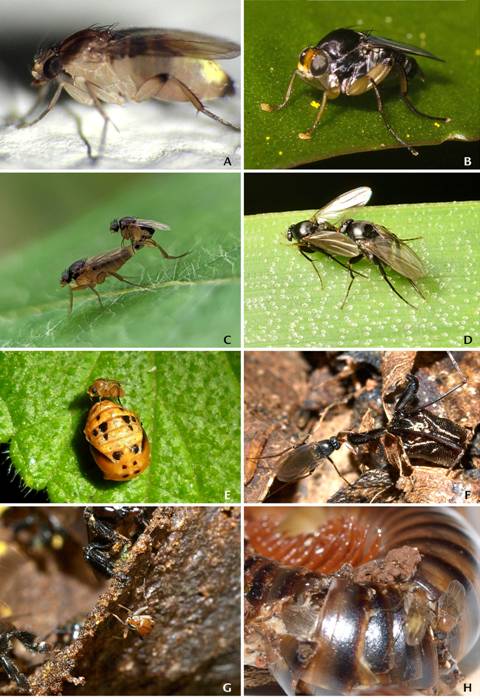
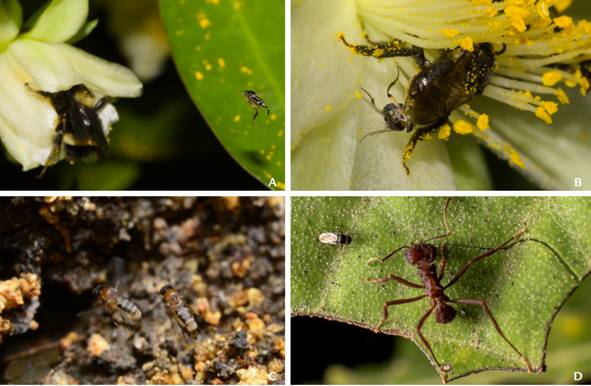
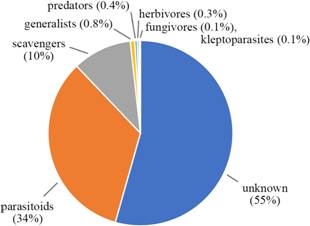
Phoridae are a family of small flies (0.4 to 6 mm) with about 4500 species known (Brown 2022a). They are distributed worldwide and have a wide array of ecological habits especially during the larval stage, which include species that are saprophagous, herbivorous, predators, parasites, kleptoparasites or parasitoids of diverse hosts (Brown 2010, some examples in Figs 1, 3). From the known lifestyles of the species that occur in Brazil (circa 50%, Fig. 3), 73% are parasitoids (Figs 2, 3). The family is also remarkable by its high morphological diversity, often associated with their natural history. Phorids that live in nests of social insects, for example, may have extreme morphological adaptations that are either protective (limuloid) or mimic their hosts (Brown 1993a). Some other phorids are the smallest dipterans ever recorded, probably as an adaptation to a parasitoid habit (Brown 2018).

Examples of brazilian phorids in their habitats: (A) Megaselia sp. from Mato Grosso; (B) Melaloncha ronnai from Rio Grande do Sul; (C) Dohrniphora mating from Brasília; (D) Stichillus sp. mating; (E) Female of Phalacrotophora sp. ovipositing in ladybug pupa; (F) Female of Dohrniphora sp. dragging the head of a Odontomachus sp. Ant; (G) Female of Melaloncha sp. approaching the entrance of a meliponine bee nest; (H) Myriophora sp. attracted to an injured millipede. Photo credits: (A-D) photos from iNaturalist: (A) Sidnei Dantas, id 104471709; (B) Fernando Sessegolo, id 150148405; (C) Jean Martins, id 142680838; (D) Fernando Farache, id 174191044. (E-H) Wendy Porras.

(A, B) Melaloncha ronnai attacking bee; (C) Neodohrniphora sp. flying over ant Acromyrmex sp., not on the photo; (D) Apocephalus sp. and ant Acromyrmex sp. Photo credits: (A, B, D) photos from iNaturalist: (A, B) Fernando Sessegolo, id 71577189; (C) Paulo Robson de Souza; (D) Fernando Sessegolo, id 123617559.

The Phoridae are abundant in many ecosystems, easy to collect with Malaise traps, and are among the most species-rich families of flies in certain areas (Borkent et al. 2018 for Costa Rica, Srivathsan et al. 2019 for Uganda). Like many other megadiverse groups of small insects, the phorids are considerably unknown. It is estimated that only one tenth of the Phoridae species are formally described (Brown 2010). Even common and frequently collected species have been described only recently (Brown 2022b) and new genera are still being found and described (Brown 2018, 2022a). The phorids are diverse and unknown even in large and densely populated cities, as shown by recent studies that described 42 species collected in the urban areas of Los Angeles (Hartop et al. 2015, 2016).
Phoridae abundance and diversity make them useful models to study broad questions. They have been used to investigate patterns of urban diversity (Brown and Hartop 2017), the impact of loss of forest cover (Barrera et al. 2017), as biological control of invasive species (Chen and Fadamiro 2018), and the biological meaning of wing interference patterns (Ament 2021a). However, frequently these investigations are only possible when preceded by a taxonomic revision of the focal group, which is frequently lacking. Phoridae taxonomy is also contributing to general discussions with new approaches to delimit species in hyperdiverse groups (Brown and Wong 2021, Hartop et al. 2022).
Phoridae is the family of Diptera with most species recorded from Brazil, 895 total (Tachinidae is the second most speciose with 819). The phorid species occurring in Brazil were mostly described by Rev. Thomas Borgmeier (585 spp., 65%) (Ament and Pereira 2024), one of the major specialists in the family who focused on the Brazilian phorids between 1922-1975. Today, we are in a special moment in Phoridae studies. Advances have been made increasing the viability of certain projects but at the same time opportunities abound from the lack of knowledge of the family in the country. Even though there is a huge gap of taxonomic studies that slowly has been filled, ecology and biology studies on phorid ant parasitoids are common in Brazil (e.g. Farder-Gomes et al. 2018, de Araújo Galvão et al. 2019, Bragança et al. 2021, Almeida et al. 2023). Researchers from many universities frequently encounter difficulties in finding taxonomists to identify the specimens. Phoridae is the largest Diptera family in Brazil, but no taxonomist or systematist specializing in this group is employed in universities or research centers (Lattes 2024).
Herein, we aim to provide a general assessment of how well Brazilian phorids are studied and how this knowledge is distributed both taxonomically and geographically. Our ultimate goal is to stimulate and guide research on this fascinating group of flies in the country. Additionally, we offer practical suggestions for collecting and curating phorids, which are particularly relevant to this family of flies.
MATERIAL AND METHODS
The species occurrence and distribution data analyzed here were extracted from the Taxonomic Catalog of the Brazilian Fauna (in Portuguese, Catálogo Taxonômico da Fauna do Brasil - CTFB, Ament and Pereira, 2024).
For our discussions, we draw on relevant literature addressing phorid diversity, ecology, and curatorial aspects. We also include insights from our experiences working with collections of Brazilian phorids.
RESULTS AND DISCUSSION
Diversity and distribution of the Brazilian Phoridae
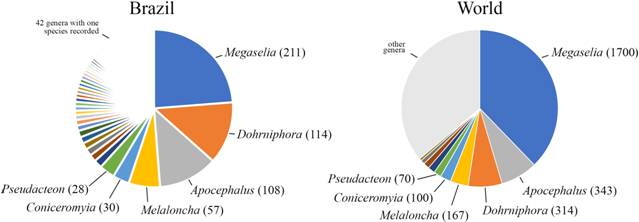
The five most speciose phorid genera in Brazil are: Megaselia Rondani, Dohrniphora Dahl, Apocephalus Coquillett, Melaloncha Brues and Coniceromyia Borgmeier (Fig. 4) (Ament and Pereira 2024). These five genera combined include about 59% of the number of phorid species recorded in the country (with Megaselia alone containing about one quarter of the species recorded). The genera diversity in Brazil is similar to the pattern found worldwide which has Megaselia, Dohrniphora, Apocephalus as the three most speciose genera (Fig. 4). The relative proportions of Dohrniphora, Apocephalus, Melaloncha and Coniceromyia are similar in Brazil and in the world, but Megaselia has a much higher proportion of the total fauna in the world compared to Brazil (Fig. 4) (Ament and Pereira 2024).
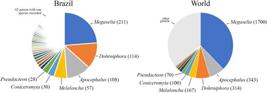
Megaselia is ‘one of the largest, most biologically diverse and taxonomically difficult genera in the entire animal kingdom’ (Marshall 2012). Most of Phoridae diversity in number of species is concentrated in this genus (90% in certain areas, e.g. Uganda, Srivathsan et al 2019) and the taxonomy of Megaselia is central to understanding Phoridae diversity patterns. The Brazilian Megaselia have not received recent taxonomic attention and its number of species and proportion in relation to the total fauna should change considerably whenever its material is properly studied. Melaloncha, Dohrniphora, Apocephalus, and Coniceromyia had recent taxonomic revisions (respectively, Brown and Kung 2006, 2010, Brown 2014, Ament et al. 2020) and can be considered better known than Megaselia in the country. However, lots of new species will probably be found even for these last genera whenever more material is collected and studied.
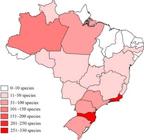
Besides these taxonomic biases, the diversity of the family is also unevenly known geographically in Brazil. The phorid fauna of some States is extremely unknown, with almost no species recorded, especially in the northeastern region, e.g. Ceará, Sergipe and Rio Grande do Norte (Fig. 5). Santa Catarina and Rio de Janeiro are the better-known States with 328 and 274 species, respectively (Ament and Pereira 2024). Santa Catarina high number of species recorded can be explained mostly by the valuable collecting efforts of Fritz Plaumann in Nova Teutônia during 1924-1994 (Lubenow 2016, de Santis 2022). The knowledge of Rio de Janeiro phorid fauna owes much to Thomas Borgmeier who lived in this State between 1915-1928, 1933-1975 and described lots of new species from there (Borgmeier 1968). Finally, a recent survey on phorid diversity in Rio Grande do Sul found an increase of 510% in species richness recorded for the State (Duarte et al. 2018).
How many species of Phoridae are there in Brazil?
This question is hard to answer considering the enormous potential diversity of the family and the taxonomic challenges discussed previously. Answers may come from the extrapolation of studies that tried to measure the diversity of phorids in a single site of tropical forests. Srivathsan et al. (2019) found 650 phorid species in a single site in Uganda and estimated that the total fauna of that site exceeds 1,000 species. Borkent et al. (2018) found 407 species of Phoridae in a site in Costa Rica and possibly a richness estimation curve applied to their data could also reach close to the 1,000 species.
Therefore, it is reasonable to expect that a well-preserved site in the Atlantic Forest or Amazonia, also highly diverse ecosystems, could reach 1,000 Phoridae species. Considering that the Atlantic and Amazonian forests are widely distributed biomes each with their complex biogeographic history and areas of endemism (Ribas et al. 2012, Marques and Grelle 2021), it is expected that different sites in their distribution have distinct species. A very moderate extrapolation could be the number of total species in these biomes reaching at least three to four times the 1000 species of a single site, totalizing for each biome 3,000-4,000 species. Noteworthy, Phoridae taxonomic revisions seem to find that few Phoridae species have distributions reaching both the Atlantic and Amazonian forests (e.g., Ament et al. 2020 figs. 27-29).
The other Brazilian biomes (i.e., Caatinga, Cerrado, Pantanal, Pampa) are even less well known and seem less comparable to the sites studied thoroughly in other countries. If they follow the logic established previously, the Brazilian phorid fauna could have 10,000 or more Phoridae species, about ten times the number of described species for the country. Curiously, this estimative match the global estimative of the family diversity which states that we know only one tenth of the phorid fauna of the world (Brown 2010).
Recent remarkable discoveries about Phoridae biology in the country
We know little about the natural history of the Brazilian phorid species. However, among the amazing recent discoveries about Phoridae biology in Brazil, we highlight three.
The smallest fly (Diptera) ever recorded is a Phoridae! With 0.395 mm of body length, Megapropodiphora arnoldi Brown, 2018 was collected in Brazilian Amazonia and has a flattened, limuloid body with an oviscape thin, pointed, indicating a probable parasitoid lifestyle (Brown 2018). Another remarkable morphological aspect is the greatly enlarged forelegs that they probably use to clutch a host (Brown 2018).
Phoridae have many ways to decapitate their hosts! Some ant-parasitoid phorids are famous for decapitating their hosts, usually caused by internal larval feeding (Brown et al. 2015). In their search for parasitoids in southern Minas Gerais, Brown et al. (2015) injured (crushed with forceps) host ants, Odontomachus chelifer (Latreille, 1802). However, instead of attracting parasitoids, they observed an interesting behavior exhibited by a non-parasitic Phoridae. A female of Dohrniphora longirostrata (Enderlein, 1912) was observed exhibiting a highly specific ‘headhunting’ behavior, in which the fly used its elongated proboscis, resembling a can opener, to separate the ant’s head from the rest of its body. Afterward, the fly dragged the ant’s head away, sometimes for up to 40 minutes, deep into the forest (Fig. 1F). Finally, females and larvae feed on the contents of the ant’s head. This behavior could be common among species of the D. longirostrata species-group as all of them have females with the elongated characteristic proboscis (Brown et al. 2015).
Not only adults as hosts, ant parasitoid phorids are also baby killers! Nearly all ant parasitoid phorids attack adult ants (99%) while most hymenopteran ant parasitoids (87%) attack ant brood (pupa, larva) (Quevillon and Hughes 2018), probably as a resource partitioning case. Brown et al. (2017) described for the first time phorids attacking ant brood in Brazil, Boracéia, São Paulo. They video documented the phorid Ceratoconus setipennis Borgmeier, 1928 ovipositing directly onto larvae and pupae of Linepithema humile (Mayr, 1868) species-group ant. In fact, Borgmeier (1928) stated that the types of C. setipennis were found flying over a L. humile nest. Phoridae parasitism of ant brood apparently has evolved at least twice in the family in two not phylogenetically related genera, Apocephalus grandipalpus Borgmeier group and Ceratoconus (Brown et al. 2017). Brown et al. (2017) hypothesizes that, within the species of the A. grandipalpus group, a possible shift happend from adult ant parasitism to attacking brood due to as mistaken ovipositions of phorids associated with, sometimes chaotic, army ant raids. Since Ceratoconus ecitophilus Borgmeier, 1928 has been recorded associated with army ants raids (Borgmeier 1928) they suggest that studies on this question should be addressed.
The viability of studying phorids in Brazil today
Not long ago, the study of phorids was largely focused on species descriptions, as species of most genera had not yet been thoroughly taxonomically defined, limiting other types of studies. Today, while a significant amount of taxonomic work is still required within the family (see previous sections), global and local efforts have helped fill some knowledge gaps and provided important tools for further research on the family.
One of the main challenges to work with phorids is to find the genera of interest among the sheer number of specimens that are collected with Malaise traps. Even if the phorids have already been separated in the same vial, it can be hard to find certain genera among the numerous Megaselia specimens. The same applies for collections of dried phorids that were mounted by randomly selecting specimens to prepare on pins. In this sense, we have been selecting specimens to prepare and organize in the collections we visited to make some phorid genera more accessible and represented in them. So far, our work has been concentrated on the Museu de Zoologia, Universidade de São Paulo (MZUSP), but the material of at least three other collections have been sorted and is in study and preparation (Entomological Collection of Universidade Federal do Espírito Santo, Vitória; Coleção de Entomologia, Centro de Coleções Taxonômicas da Universidade Federal de Minas Gerais, Belo Horizonte; Instituto Nacional de Pesquisas da Amazônia, Manaus).
Besides becoming more diverse in genera, the collections of Brazilian Phoridae have grown considerably in number of specimens with recent biodiversity projects. To cite a few projects that collected massive amounts of material with Malaise traps, the Biota-Diptera Project collected specimens in several localities along the Atlantic Forest (Amorim and Santos 2018), SISBIOTA Diptera Project sampled the west of Brazil (Lamas et al. 2023), and the vertical stratification Project had one year of collecting in the Amazonia (Amorim et al. 2022). These projects collected thousands of phorids and may contain relevant material for taxonomic revisions and other studies. It is also important to highlight the historical and taxonomical value of the collection of the MZUSP which absorbed the collections of Thomas Borgmeier and Angelo Pires do Prado including the types of many Brazilian species they described.
The recent taxonomic revisions of some genera of the Brazilian phorid fauna made them accessible to studies beyond taxonomy. We highlight the revisions of Neopleurophora Brown (Ament and Amorim 2013), Chaetocnemistoptera Borgmeier (Ament 2014), Coniceromyia Borgmeier (Ament and Amorim 2016, Ament et al. 2020), Hypocerides Schmitz (Ament 2021b) and Neodohrniphora Malloch (Pereira et al. 2022) which examined material from most of the projects cited previously. After Coniceromyia taxonomic revision, for example, studies were conducted on the genus phylogeny and evolution of structures related to sexual selection (Ament et al. 2021) and on the evolution of its wing interference patterns (Ament 2021a).
Recent studies have been elaborating large-scale integrative methods that use next-generation sequencing barcode and morphological validation to delimit and discover species in Phoridae (Srivathsan et al. 2021, Hartop et al. 2022, Caruso et al. 2024). These methods show potential in assessing the huge taxonomic gaps in the family globally and in Brazil. Additionally, they should help in the identification of phorid specimens, especially in Megaselia.
Recommended curatorial techniques for the Phoridae and other information for conservation and identification
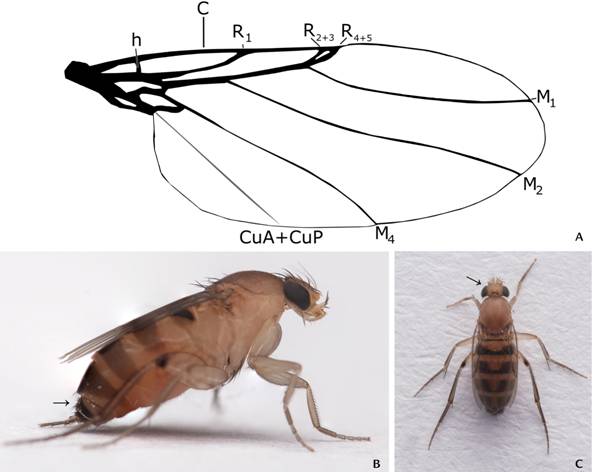
Phoridae is one of the easiest families to recognize among the Brachycera flies, being diagnosable by: antenna comprising scape, pedicel, first flagellomere developed, second and third flagellomere considerably reduced, and arista; ptilinal fissure absent; frons usually with 12 large setae positioned in three horizontal rows with four setae each, and one or two pairs of supra-antennal setae (Fig. 6C black arrow - some groups lost some or all of the frontal setae); wings usually without crossveins (except the humeral), costal and radial veins usually short and strong (Fig. 6A). The genera and species that occur in Brazil can also be separated from other families of small flies with certain resemblance by: eyes never red (some Drosophilids have) and hind femur flattened laterally.
(A) Phoridae wing; (B, C) Megaselia scalaris lateral view (B) and dorsal view (C). C: costal vein; CuA+CuP: anterior branch of cubital vein + posterior branch of cubital vein; h: humeral crossvein; M1, M2 and M4: first, second and forth branch of media; R1: anterior branch of radius; R2+3: second branch of radius; R4+5: third branch of radius. Photo credits: (B, C) photos from iNaturalist: Alenilson Rodrigues, id 139470263.
Among the phorids, Megaselia scalaris (Loew, 1866) is a species which is frequently collected in diverse contexts and deserves a special note herein. Megaselia scalaris is a cosmopolitan and synanthropic species which may feed on a diverse array of organic and inorganic matter (Disney 2008). The females are recognizable by its characteristic sixth abdominal tergite which has a curved ventrally-directed extension (Fig. 6B, black arrow). More details about biology and identification of this species can be found respectively in Disney (2008) and López et al. (2016).
In general, Malaise traps (flight interception) are the most effective way to collect Phoridae flies. A wide diversity of genera and species can be collected with this trap, and they often are among the most abundant family of flies collected with it (Brown 2005, Brown and Hartop 2017, Amorim et al. 2022). Some phorids with specific and known natural histories are best collected by searching for the resources they exploit. Parasitoids and other myrmecophiles and termitophiles, for example, are best collected by searching for their host. Sometimes it is necessary to set a scenario that attracts their phorid parasitoids, e.g. injuring ants, disturbing colonies, providing food to a foraging trail, etc. In this case, using an entomological aspirator or soft forceps is recommended to collect them.
How to prepare phorid specimens for morphological studies
Phorids require a specific method for drying from ethanol in which they are usually collected before they can be mounted on pins. Without the proper preparation, the specimens frequently shrivel and collapse, being impracticable to morphology identification even to genus level.
There are three main products and one drying technique that can be used to dry phorids preserving their morphological characteristics. The technique is to use highly volatile chemical products in a rinse-and-dry protocol. The three products are the hexamethyldisilazane (HMDS), Banana oil (isoamyl acetate) and amyl acetate. The HMDS is highly toxic and, if used, it should be within a fume hood and according to other fundamental safety measures. If one is going to use this product, we recommend contacting a person with experience with it first. The protocol for using HMDS is described in Brown (1993b), a very similar protocol is used for drying small insects with the isomers amyl acetate (Austin and Dillon 1997, Pérez-Benavides et al. 2023) and isoamyl acetate (Dal Molin 2018). According to our experiences, the three products have good results regarding morphology preservation. We see as relevant pros for the isoamyl acetate and amyl acetate their lower toxicity and price.
There is only one study that tested the DNA extraction and PCR from specimens that were dried with HMDS (Austin and Dillon 1997), they find out that it does not affect, although the sampling is relatively small. Pérez-Benavides et al. (2023) highlighted that many molecular-based-studies successfully extracted and amplified DNA of Hymenoptera specimens dried with amyl acetate. Further studies need to be done to better evaluate the impact of how drying specimens using isoamyl acetate affect the molecular studies.
Recommended methods for mounting phorids
Interestingly, the curators of two of the major collections of Phoridae opt for different ways of mounting specimens. Brian Brown, the curator of the Natural History Museum of Los Angeles County (LACM), mount specimens directly glued to a black entomological pin (e.g., Ament et al. 2020: figs 1-7). On the other hand, Henry L. Disney, University of Cambridge Museum of Zoology (UCMZ), mount most of the specimens on slides using Berlese Fluid as described in Disney (1994). There are advantages and disadvantages of each method, but we prefer to recommend mounting specimens directly glued to an entomological pin. Compared to slide-mounted specimens, pinned Phoridae specimens offer several advantages. They can be scanned using SEM and their DNA extracted. Additionally, the pinning process is more cost-effective and time-efficient.
Identification of Phoridae
For genera identification, we recommend the key from the Manual of Central American Diptera (Brown 2010) with the corrections of Brown (2023). Additionally, attention should be paid to some Brazilian genera that are not included in the key, these are: Aristocerina Borgmeier & Prado, Borgmeieriphora Prado, Brachycosta Prado, Brachyphlebina Borgmeier & Prado, Ceratoconus Borgmeier, Chelidophora Borgmeier, Clinochaeta Borgmeier, Colobomeles Borgmeier, Colyeria Borgmeier & Prado, Cryptophora Borgmeier, Cyphometopis Borgmeier, Cyrtophorina Borgmeier & Prado, Dichocerina Borgmeier, Dorsochaeta Borgmeier & Prado, Ectochaeta Borgmeier, Hylophora Borgmeier, Megapropodiphora Brown, Microselia Schmitz, Pelidnophora Borgmeier, Pheidolomyia Schmitz, Pradea Borgmeier, Procliniella Borgmeier, Pulicimyia Dahl, Rhabdomyia Borgmeier, Stenoneurellys Borgmeier, Termitophorides Borgmeier, Trichocerina Borgmeier & Prado, Tubicera Schmitz, Tubiceroides Borgmeier, Veruanus Schmitz, Xenophoromyia Disney.
In order to know which species occur in Brazil and where they are distributed, we recommend the Taxonomic Catalogue of Brazilian Fauna (Ament and Pereira 2024). The online Phorid Catalog (PCAT 2024), the Systema Dipterorum (Evenhuis and Pape 2024) and the catalog of Borgmeier (1968, 1971) are also very helpful to obtain Phoridae taxonomic data.
Final remarks
As discussed, the knowledge of the Brazilian phorid fauna is uneven and lot of taxonomic work is necessary for some genera and regions in the country. The species of some phorid genera, however, are becoming better known and this allows their use in other types of studies. We identify the phorids greatest potential to be as models for investigating general patterns of diversity, abundance, and distribution of species. Studies such as species richness comparisons, biogeography, and morphological diversification, for example, could benefit from a model with Phoridae characteristics. Their study can also find spectacular discoveries as the ones cited here involving adaptations and highly specific interactions with a diverse array of hosts, commensals and preys.
The collecting projects in Brazil will continue to gather thousands of phorids per year, mostly with Malaise traps. The adequate preparation of this material is fundamental to make it accessible for morphological and molecular studies (especially proper drying, for morphology). With limited time and resources, arguments can be made in favor of selecting phorids before mounting aiming genera diversity (otherwise they could be composed mostly of a single genus, Megaselia).
Phoridae is one of the many diverse families of flies that warrant taxonomic attention in Brazil. If one is interested in diversity (morphological, ecological, or species richness), phorids are an excellent choice. Hopefully, the potential benefits of better understanding the phorids discussed here will attract more attention and researchers to this fascinating group of flies.
ACKNOWLEDGEMENTS
We are grateful to the natural history enthusiasts who obtained the photos used in Figs 1, 2 and 6 and to their very kind disposition to share their data by licenses or through personal communication with us, namely: Sidnei Dantas, Jean Martins, Fernando Sessegolo, Fernando Farache, Wendy Porras, Paulo Robson de Souza, Reinaldo de Oliveira Elias, Alenilson Rodrigues. We are also thankful to all museums and collections that received us and supported our research (MZUSP, LACM, INPA, CEUA, RPSP, UFMG, UFES, and AMNH) and to Dalton Amorim, Brian Brown, Giar-Ann Kung, Silvio Nihei, and Eduardo Almeida for support with our research including field work, discussions and mentorship. We also thank José Albertino Rafael and the entire team of the CTFB for supporting our work on the catalog, and two anonymous reviewers and Sionei R. Bonatto, editor of Zoologia, for a careful reading of our manuscript and contributing with suggestions and corrections. TPLP thanks the MCZ Biodiversity Postdoctoral Fellowship program support. DCA is thankful to the Centro de Biodiversidade e Patrimônio Genético and Programa de Pós-graduação em Entomologia, Universidade Federal de Lavras (UFLA), current institutional affiliation.
LITERATURE CITED
-
Almeida JC, Hoshino AT, Pereira TP, Pasini A (2023) Parasitismo de Atta sexdens Forel, 1908 (Hymenoptera: Formicidae) por forídeos (Diptera: Phoridae) em Londrina-PR. Semina: Ciências Agrárias 44(5): 1603-1620. https://doi.org/10.5433/1679-0359.2023v44n5p1603
» https://doi.org/10.5433/1679-0359.2023v44n5p1603 -
Ament DC (2014) Taxonomic revision of the genus Chaetocnemistoptera Borgmeier (Diptera: Phoridae), with the description of five new species. Zootaxa 3753(4): 301-322. https://doi.org/10.11646/zootaxa.3753.4.1
» https://doi.org/10.11646/zootaxa.3753.4.1 -
Ament DC (2021a) The correlation between wing interference patterns and body size in Coniceromyia Borgmeier (Diptera: Phoridae) and its implications to the understanding of the former as a sexually selected trait. Journal of Zoological Systematics and Evolutionary Research 59(8): 1951-1961. https://doi.org/10.1111/jzs.12550
» https://doi.org/10.1111/jzs.12550 -
Ament DC (2021b) Taxonomy and the unusual morphological similarity among Hypocerides Schmitz species (Diptera: Phoridae). Zootaxa 4980(1): 113-126. https://doi.org/10.11646/zootaxa.4980.1.7
» https://doi.org/10.11646/zootaxa.4980.1.7 -
Ament DC, Amorim DDS (2013) Taxonomic revision of the genus Neopleurophora Brown (Diptera: Phoridae), with the description of thirty seven new species. Zootaxa 3657(1): 1-93. https://doi.org/10.11646/zootaxa.3657.1.1
» https://doi.org/10.11646/zootaxa.3657.1.1 -
Ament DC, Amorim DDS (2016) Taxonomic revision of Coniceromyia Borgmeier (Diptera: Phoridae), with the description of three new species from Brazil. Zootaxa 4086(1): 1-87. https://doi.org/10.11646/zootaxa.4086.1.1
» https://doi.org/10.11646/zootaxa.4086.1.1 -
Ament DC, Hash JM, Almeida EA (2021) Remarkable sexually dimorphic features of Coniceromyia (Diptera: Phoridae): evolution in the light of phylogeny and comparative evidence about their function. Biological Journal of the Linnean Society 132(3): 521-538. https://doi.org/10.1093/biolinnean/blaa217
» https://doi.org/10.1093/biolinnean/blaa217 -
Ament DC, Kung G, Brown BV (2020) Forty-one new species of Coniceromyia Borgmeier (Diptera: Phoridae), an identification key, and new distributional records for the species of the genus. Zootaxa 4830(1): 1-61. https://doi.org/10.11646/zootaxa.4830.1.1
» https://doi.org/10.11646/zootaxa.4830.1.1 -
Ament DC, Pereira TPL (2024) Phoridae in Catálogo Taxonômico da Fauna do Brasil. PNUD, PNUD, http://fauna.jbrj.gov.br/fauna/faunadobrasil/183530 [Accessed: 15/11/2024]
» http://fauna.jbrj.gov.br/fauna/faunadobrasil/183530 -
Amorim DS, Brown BV, Boscolo D, Ale-Rocha R, Alvarez-Garcia DM, Balbi MIPA, et al. (2022) Vertical stratification of insect abundance and species richness in an Amazonian tropical forest. Scientific Reports 12: 1734. https://doi.org/10.21203/rs.3.rs-430012/v1
» https://doi.org/10.21203/rs.3.rs-430012/v1 -
Amorim DS, Santos CM (2018) Flies, endemicity, and the Atlantic Forest: a biogeographical study using topographic units of analysis. Australian Systematic Botany 30(6): 439-469. https://doi.org/10.1071/SB16057
» https://doi.org/10.1071/SB16057 -
Austin AD, Dillon N (1997) Extraction and PCR of DNA from parasitoid wasps that have been chemically dried. Australian Journal of Entomology 36(3): 241-244. https://doi.org/10.1111/j.1440-6055.1997.tb01461.x
» https://doi.org/10.1111/j.1440-6055.1997.tb01461.x -
Barrera CA, Becker EL, Elizalde L, Queiroz JM (2017) Parasitoid phorid flies of leaf-cutting ants are negatively affected by loss of forest cover. Entomologia Experimentalis et Applicata 164(1): 66-77. https://doi.org/10.1111/eea.12593
» https://doi.org/10.1111/eea.12593 - Borgmeier T (1928) Investigações sobre phorideos myrmecophilos (Diptera, Phoridae). Archivos do Instituto Biológico de Defensa Agrícola e Animal 1: 159-192.
- Borgmeier T (1968) A catalogue of the Phoridae of the World (Diptera: Phoridae). Studia Entomologica 11: 1-367.
- Borgmeier T (1971) Further studies on phorid flies, mainly of the Neotropical region (Diptera, Phoridae). Studia Entomologica 14: 1-172.
-
Borkent A, Brown BV, Adler PH, Amorim DS, Barber K, Bickel D, et al. (2018) Remarkable fly (Diptera) diversity in a patch of Costa Rican cloud forest: why inventory is a vital science. Zootaxa 4402(1): 53-90. https://doi.org/10.11646/zootaxa.4402.1.3
» https://doi.org/10.11646/zootaxa.4402.1.3 -
Bragança MA, Martins HC, Oliveira RJ, Della Lucia TM (2021) Parasitism of the leaf-cutting ant Atta bisphaerica by phorid flies: biology and seasonal and inter-colonial parasitism rates. Entomologia Experimentalis et Applicata 169(4): 338-349. https://doi.org/10.1111/eea.13020
» https://doi.org/10.1111/eea.13020 -
Brown BV (1993a) Convergent adaptations in Phoridae (Diptera) living in the nests of social insects: a review of the new world Aenigmatiinae. Memoirs of the Entomological Society of Canada 125: 115-137. https://doi.org/10.4039/entm125165115-1
» https://doi.org/10.4039/entm125165115-1 - Brown BV (1993b) A further chemical alternative to critical- point-drying for preparing small (or large) flies. Fly Times 11: 10.
-
Brown BV (2005) Malaise Trap Catches and the Crisis in Neotropical Dipterology. American Entomologist 51(3): 180-183. https://doi.org/10.1093/ae/51.3.180
» https://doi.org/10.1093/ae/51.3.180 - Brown BV (2010) Phoridae. In: Brown BV, Borkent A, Cumming JM, Woodley NE, Wood DM, Zumbado MA (Eds) Manual of Central American Diptera. NRC Research Press, Ottawa, vol. 2, 725-761.
-
Brown BV (2014) Revision of the Apocephalus analis group of ant-decapitating flies (Diptera: Phoridae). Zootaxa 3857(4): 551-570. https://doi.org/10.11646/zootaxa.3857.4.5
» https://doi.org/10.11646/zootaxa.3857.4.5 -
Brown BV (2018) A second contender for “world’s smallest fly” (Diptera: Phoridae). Biodiversity Data Journal 6: e22396. https://doi.org/10.3897/BDJ.6.e22396
» https://doi.org/10.3897/BDJ.6.e22396 -
Brown BV (2022a) Two new genera of phorid flies, Macgrathphora and Aurisetiphora, from Costa Rica (Diptera: Phoridae), with recommendations for naming new genera in the family. Zootaxa 5115(4): 571-581. https://doi.org/10.11646/zootaxa.5115.4.7
» https://doi.org/10.11646/zootaxa.5115.4.7 -
Brown BV (2022b) Some remarkably common, but undescribed, Megaselia Rondani (Diptera: Phoridae) from northwestern Costa Rica. Zootaxa 5120(3): 373-390. https://doi.org/10.11646/zootaxa.5120.3.4
» https://doi.org/10.11646/zootaxa.5120.3.4 - Brown BV (2023) [Some of my] Phoridological errors. Fly Times 71: 15-16.
-
Brown BV, Hartop EA (2017) Big data from tiny flies: patterns revealed from over 42,000 phorid flies (Insecta: Diptera: Phoridae) collected over one year in Los Angeles, California, USA. Urban Ecosystems 20: 521-534. https://doi.org/10.1007/s11252-016-0612-7
» https://doi.org/10.1007/s11252-016-0612-7 -
Brown BV, Hash JM, Hartop EA, Porras W, Amorim DS (2017) Baby killers: Documentation and evolution of scuttle fly (Diptera: Phoridae) parasitism of ant (Hymenoptera: Formicidae) brood. Biodiversity Data Journal 5: e11277. https://doi.org/10.3897/BDJ.5.e11277
» https://doi.org/10.3897/BDJ.5.e11277 -
Brown BV, Kung G (2006) Revision of the Melaloncha ungulate group of bee-killing flies (Diptera: Phoridae). Contributions in Science 507: 1-31. https://doi.org/10.5962/p.241298
» https://doi.org/10.5962/p.241298 -
Brown BV, Kung G (2010) Revision of the New World Dohrniphora Dahl species lacking large hind tibial setae (Diptera: Phoridae). Zootaxa 2699: 1-142. https://doi.org/10.11646/zootaxa.2699.1.1
» https://doi.org/10.11646/zootaxa.2699.1.1 -
Brown BV, Kung G, Porras W (2015) A new type of ant-decapitation in the Phoridae (Insecta: Diptera). Biodiversity Data Journal 3: e4299. https://doi.org/10.3897/BDJ.3.e4299
» https://doi.org/10.3897/BDJ.3.e4299 -
Brown BV, Wong MA (2021) Identification of Megaselia (Diptera: Phoridae) species using wing vein landmarking. Journal of Natural History 54: 2513-2527. https://doi.org/10.1080/00222933.2020.1856431
» https://doi.org/10.1080/00222933.2020.1856431 -
Caruso V, Hartop E, Chimeno C, Noori S, Srivathsan A, Haas M, et al. (2024) An integrative framework for dark taxa biodiversity assessment at scale: A case study using Megaselia (Diptera, Phoridae). Insect Conservation and Diversity: 1-20. https://doi.org/10.1111/icad.12762
» https://doi.org/10.1111/icad.12762 -
Chen L, Fadamiro HY (2018) Pseudacteon phorid flies: host specificity and impacts on Solenopsis fire ants. Annual Review of Entomology 63: 47-67. https://doi.org/10.1146/annurev-ento-020117-043049
» https://doi.org/10.1146/annurev-ento-020117-043049 -
Dal Molin A (2018) Secagem química de pequenos artrópodes. Protocols.io, https://doi.org/10.17504/protocols.io.s9aeh2e
» https://doi.org/10.17504/protocols.io.s9aeh2e -
de Araújo Galvão AR, Bailez O, Viana-Bailez AM, Abib PH, Pimentel FA, Pereira TPL (2019) Parasitism by phorids on leaf cutter ants Atta sexdens (Linnaeus, 1758) (Hymenoptera: Formicidae) in natural and agricultural environments. Zoological Science 36(5): 357-364. https://doi.org/10.2108/zs180190
» https://doi.org/10.2108/zs180190 -
de Santis MD (2022) A bibliographic review of the history of Dexiinae (Diptera, Tachinidae) taxonomy in the Neotropical Region with bibliographic notes on Dominik Bilimek and Fritz Plaumann. Arquivos de Zoologia 53(4): 53-72. https://doi.org/10.11606/2176-7793/2022.53.04
» https://doi.org/10.11606/2176-7793/2022.53.04 -
Disney RHL (1994) Scuttle Flies - the Phoridae. Chapman & Hall, London, 467 pp. https://doi.org/10.1007/978-94-011-1288-8
» https://doi.org/10.1007/978-94-011-1288-8 -
Disney RHL (2008) Natural history of the scuttle fly, Megaselia scalaris Annual Review of Entomology 53: 39-60. https://doi.org/10.1146/annurev.ento.53.103106.093415
» https://doi.org/10.1146/annurev.ento.53.103106.093415 -
Duarte LP, Vaz DB, Krüger RF (2018) New records of phorid flies (Diptera, Phoridae) from Rio Grande do Sul, with five new records to Brazil. Check List 14(1): 125-139. https://doi.org/10.15560/14.1.125
» https://doi.org/10.15560/14.1.125 -
Evenhuis NL, Pape T (2024) Systema Dipterorum. Version 4.4, 4, http://diptera.org/ [Accessed: 02/01/2024]
» http://diptera.org/ -
Farder-Gomes CF, da Silva VP, Pereira TPL, Serrão JE, Pires EM, Oliveira MA (2018) Parasitism, sexual dimorphism and effect of host size on Apocephalus attophilus offspring, a parasitoid of the leaf-cutting ant Atta bisphaerica Plos One 13(12): e0208253. https://doi.org/10.1371/journal.pone.0208253
» https://doi.org/10.1371/journal.pone.0208253 -
Hartop EA, Brown BV, Disney RHL (2015) Opportunity in our ignorance: urban biodiversity study reveals 30 new species and one new Nearctic record for Megaselia (Diptera: Phoridae) in Los Angeles (California, USA). Zootaxa 3941(4): 451-484. https://doi.org/10.11646/zootaxa.3941.4.1
» https://doi.org/10.11646/zootaxa.3941.4.1 -
Hartop EA, Brown BV, Disney RHL (2016) Flies from L.A., The Sequel: Twelve further new species of Megaselia (Diptera: Phoridae) from the BioSCAN Project in Los Angeles (California, USA). Biodiversity Data Journal 4: e7756. https://doi.org/10.3897/BDJ.4.e7756
» https://doi.org/10.3897/BDJ.4.e7756 -
Hartop EA, Srivathsan A, Ronquist F, Meier R (2022) Towards Large-Scale Integrative Taxonomy (LIT): Resolving the Data Conundrum for Dark Taxa. Systematic Biology 71(6): 1404-1422. https://doi.org/10.1093/sysbio/syac033
» https://doi.org/10.1093/sysbio/syac033 -
Lamas CJE, Fachin DA, Falaschi RL, Alcantara DMC, Ale-Rocha R, Amorim DS, et al. (2023) The SISBIOTA-Diptera Brazilian Network: A longterm survey of Diptera from unexplored Brazilian Western Arc of Amazon, Cerrado. Revista Brasileira de Entomologia 67(4): e20230051. https://doi.org/10.1590/1806-9665-RBENT-2023-0051
» https://doi.org/10.1590/1806-9665-RBENT-2023-0051 -
Lattes (2024) Plataforma Lattes. Conselho Nacional de Desenvolvimento Científico e Tecnológico, Brazil. https://lattes.cnpq.br/ [Accessed: 15/01/2024]
» https://lattes.cnpq.br/ -
López CA, Pereira TPL, Antúnez MG, Peichoto ME (2016) Myiasis in the neotropical amphibian Hypsiboas caingua (Anura: Hylidae) by Megaselia scalaris (Diptera: Phoridae). Herpetological Bulletin 138: 18-20. http://hdl.handle.net/11336/40428
» http://hdl.handle.net/11336/40428 - Lubenow AM (2016) Um alemão em Santa Catarina: A coleção entomológica Fritz Plaumann. Museologia e Interdisciplinaridade 5(9): 109-119.
-
Marques MCM, Grelle CEV (2021) The Atlantic Forest history, biodiversity, threats and opportunities of the mega-diverse forest. Springer Nature, Switzerland, 517 pp. https://doi.org/10.1007/978-3-030-55322-7
» https://doi.org/10.1007/978-3-030-55322-7 - Marshall SA (2012) Flies: the natural history and diversity of Diptera. Firefly Books, Buffalo, 616 pp.
-
PCAT (2024) Phorid Catalog - Online data for phorid flies. https://www.phorid.net/pcat/ [Accessed: 15/11/2024]
» https://www.phorid.net/pcat/ -
Pereira TPL, Brown BV, Nihei SS (2022) The Neotropical ant-parasitic genus Neodohrniphora Malloch (Diptera: Phoridae): a taxonomic revision with seven new species and key to species. Insect Systematics & Evolution 53(3): 304-334. https://doi.org/10.1163/1876312X-bja10030
» https://doi.org/10.1163/1876312X-bja10030 -
Pérez-Benavides AL, Ospina-Peñuela E, Gamboa J, Duran-Bautista EH, Mohamed A (2023) Amyl acetate: an alternative technique to dry mount Chalcidoidea (Hymenoptera) from alcohol, faster and inexpensively. Journal of Insect Science 23(2): 1-6. https://doi.org/10.1093/jisesa/iead010
» https://doi.org/10.1093/jisesa/iead010 -
Quevillon LE, Hughes DP (2018) Pathogens, parasites, and parasitoids of ants: a synthesis of parasite biodiversity and epidemiological traits. BioRxiv Preprint: 384495. https://doi.org/10.1101/384495
» https://doi.org/10.1101/384495 -
Ribas CC, Aleixo A, Nogueira ACR, Miyaki CY, Cracraft J (2012) A palaeobiogeographic model for biotic diversification within Amazonia over the past three million years. Proceedings of the Royal Society B: Biological Sciences 279(1729): 681-689. https://doi.org/10.1098/rspb.2011.1120
» https://doi.org/10.1098/rspb.2011.1120 -
Srivathsan A, Hartop EA, Puniamoorthy J, Lee WT, Kutty SN, Kurina O, Meier R (2019) Rapid, large-scale species discovery in hyperdiverse taxa using 1D MinION sequencing. BMC Biology 17: 96. https://doi.org/10.1186/s12915-019-0706-9
» https://doi.org/10.1186/s12915-019-0706-9 -
Srivathsan A, Lee L, Katoh K, Hartop E, Kutty SN, Wong J, et al. (2021) ONTbarcoder and MinION barcodes aid biodiversity discovery and identification by everyone, for everyone. BMC Biology 19: 217. https://doi.org/10.1186/s12915-021-01141-x
» https://doi.org/10.1186/s12915-021-01141-x
ADDITIONAL NOTES
- ZooBank register
-
How to cite this article
Ament DC, Pereira TPL (2024) Diversity, distribution and general knowledge of the Brazilian Phoridae (Diptera), the family of flies with most species known in the country. Zoologia 41: e24010. https://doi.org/10.1590/S1984-4689.v41.e24010
-
Published by
Sociedade Brasileira de Zoologia at Scientific Electronic Library Online - https://www.scielo.br/zool
Data citations
Ament DC, Pereira TPL (2024) Phoridae in Catálogo Taxonômico da Fauna do Brasil. PNUD, PNUD, http://fauna.jbrj.gov.br/fauna/faunadobrasil/183530 [Accessed: 15/11/2024]
Lattes (2024) Plataforma Lattes. Conselho Nacional de Desenvolvimento Científico e Tecnológico, Brazil. https://lattes.cnpq.br/ [Accessed: 15/01/2024]
PCAT (2024) Phorid Catalog - Online data for phorid flies. https://www.phorid.net/pcat/ [Accessed: 15/11/2024]