
 Impacts of the COVID-19 Pandemic on Organ Donation and Transplantation Activities: Global Scenario
ABSTRACT
The objective of this study was to assess the impact of the COVID-19 pandemic on the donation and transplant process in the global context.
Methods: An ecological study was conducted from 2017 to 2021, examining the numbers of donors and transplants, as well as cases and deaths related to COVID-19. Simple linear regression analysis was used in two blocks: between 2017 and 2020, and between 2017 and 2021. We considered rates per million population to assess the impacts.
Results: The study included 10 countries, and Portugal showed the most significant impact on the effective donor rate, with a decrease of 4,463.8 (95% confidence interval [95%CI] -5,103.2–-3,824.4), followed by Spain (-3,964.4; 95%CI -5,850.2–-2,078.6), Mexico (-3,879.3; 95%CI -4,688.6–-3,069.9), and Australia (-309; 95%CI -565.3–-52.7), unlike the United States of America, which showed an increase. In terms of transplant rates, Brazil, Portugal, Spain, France, Iran, and Mexico stood out, also showing decreases.
Conclusion: The COVID-19 pandemic had significant impacts on the donation and transplant process in several countries, and characterizing these effects is fundamental to resuming activities.
Descriptors
Delivery of Health Care; COVID-19; Indicators and Reagents; Organ Transplantation
RESUMO
O objetivo deste estudo foi avaliar o impacto da pandemia de COVID-19 no processo de doação e transplante no contexto global.
Métodos: Foi realizado um estudo ecológico de 2017 a 2021, examinando o número de doadores e transplantes, bem como os casos e óbitos relacionados à COVID-19. A análise de regressão linear simples foi utilizada em dois blocos: entre 2017 e 2020 e entre 2017 e 2021. Foram consideradas taxas por milhão de habitantes para avaliar os impactos.
Resultados: O estudo incluiu 10 países, e Portugal apresentou o impacto mais significativo na taxa de doadores efetivos, com redução de 4.463,8 (intervalo de confiança de 95% [95%CI] -5.103,2–-3.824,4), seguido por Espanha (-3.964,4; 95%CI: -5.850,2–-2.078,6), México (-3.879,3; 95%CI -4.688,6–-3.069,9) e Austrália (-309; 95%CI -565,3–-52,7), ao contrário dos Estados Unidos, que apresentaram aumento. Em termos de taxas de transplante, destacam-se Brasil, Portugal, Espanha, França, Irã e México, que apresentaram redução.
Conclusão: A pandemia de COVID-19 causou impactos significativos no processo de doação e transplante em diversos países, e a caracterização desses efeitos é fundamental para a retomada das atividades.
Descritores
Atenção à Saúde; COVID-19; Indicadores e Reagentes; Transplante de Órgãos
INTRODUCTION
Organ transplantation is a therapy used in severe health scenarios in which the patient, usually due to chronic pathologies, needs to replace his/her injured organ with one with preserved functions. The process for performing a transplant is not only complex, involving several stages, but it also requires multidisciplinary action and a robust, high-quality hospital structure.1-3
In this context, organ transplantation is often the only therapeutic option for patients with terminal failure of different vital organs. In the donation and transplantation process, the donor-recipient binomial is inseparable, and the stages of identification, diagnosis of brain death, validation of the potential donor, family interview, and logistics of organ extraction for donation are essential steps for carrying out the transplant.4
The heterogeneous behavior of countries' health systems regarding the impact of the pandemic caused by the new coronavirus disease (SARS-CoV-2/COVID-19) showed different results in sustaining donation and transplantation activities. The decrease in the number of effective donors and, consequently, the reduction in the number of organ transplants lengthen the waiting lists longer, cause an increase in mortality of patients with indication for transplants, and worsen disparities concerning the access to this therapy.5
All in all, the global pandemic caused by the new coronavirus has significantly impacted donation and transplantation activities worldwide.6-9 Uncertainties regarding the worsening of the disease, difficulties in carrying out the laboratory diagnosis of COVID-19 in potential donors and recipients with subsequent donor ineligibility, and the migration of health professionals working in donation and transplantation activities to join teams caring for patients with COVID-19 and reallocating hospital beds to care for patients with COVID-19 are among the main factors for changes in the donation and transplantation process reported in countries in Europe and Asia, such as Spain, France, Portugal, and Iran.10-12
In the United States of America, after the World Health Organization (WHO) announced the state of public health emergency, the bodies managing the donation and transplantation policy acted quickly to develop regulations and guidelines on activities in the context of the pandemic to protect patients, given the lack of knowledge about COVID-19 and the unavailability of resources and diagnostic tests. Moreover, guidelines for the suspension of elective organ transplantation activities were implemented by management bodies in Brazil, Argentina, Mexico, Canada, and Australia.13-15
With the availability of diagnostic tests for COVID-19, a better understanding of the disease, the publication of initial studies on the use of donors reactive to the virus, and, above all, the advancement of vaccination, countries began to work toward recovering the number of donors and transplants.16 The North American transplantation system is a notable example of the adaptation to the pandemic scenario, having successfully maintained transplant numbers and achieved a record number of effective donors. However, due to economic hardship, represented by decreases in gross domestic product (GDP) indicators, combined with the aforementioned difficulties, several countries renowned for this activity were unable to sustain this new scenario. They struggled to return to pre-pandemic parameters in terms of donor and transplant results.14
The consequences of the COVID-19 pandemic on donation and transplantation actions are serious, evidenced by the significant reduction in the number of effective donors and the suspension of living-donor transplants, which led to an increase in the waiting time on transplant lists, culminating in an increase in mortality. As a result of this scenario, some health centers have disrupted their donation and transplantation teams. Furthermore, the mortality among transplant recipients with COVID-19 has been higher than that of the general population.17
In this context, given the limited scientific production on the subject and its relevance to addressing emergency health conditions, such as those mentioned above, this article aimed to assess the impacts of the COVID-19 pandemic on the donation and transplantation process in a global context.
METHODS
This was a population-based, ecological, cross-sectional, and analytical study. Databases from international repositories were utilized, providing records on the number of donors and organ transplants, as well as data on the COVID-19 pandemic and socioeconomic and demographic indicators.
The compiled data, referring to the number of organ donations and transplants, were extracted from the International Registry of Organ Donation and Transplantation (IRODaT)18 database, statistics on the Eurotransplant19 website, data from the Global Observatory on Donation and Transplantation (GODT),20 and data made available by government agencies in eligible countries.21,22 The numbers related to contagion and deaths from COVID-19 were extracted from the WHO's tables and the Johns Hopkins University’s dashboards.23,24 Socioeconomic data were obtained from World Bank indicators and United Nations database.25,26
For the selection of countries, by the criterion of representation in the period prior to the pandemic, using data from the years 2017 to 2021, the following criteria were used: selection of nations with more than 500 transplants per year, a population greater than 10 million inhabitants, and whose donation and transplantation data were public for tabulation and analysis. Thus, except for the African continent, where no country met the criterion of transplant activity, the selected countries represented at least one example of a transplant system in each continent. Therefore, the countries that met the eligibility criteria were Argentina, Australia, Brazil, Canada, Spain, the United States of America, France, Mexico, Iran, and Portugal.
To qualify the comparison of data values from effective donors, organ transplants performed, number of organs transplanted per donor, and COVID-19 cases and deaths, the rates per million population (PMP) were used.
Descriptive data analysis was performed using absolute values, means, and standard deviations. To evaluate the association between the rate of cases and deaths from COVID-19 PMP and the rates of effective donors, total number of transplants performed, and number of organs transplanted per donor, simple linear regression was used to calculate the beta coefficient and their respective 95% confidence interval (95%CI), considered statistically significant, with p-value < 0.05.
Simple linear regression was used in two blocks: rates from 2017 to 2020, as this last year represents the beginning of the COVID-19 pandemic, in order to assess its impacts on organ donation and transplant indicators used; and rates from 2017 to 2021, to assess whether the impacts persisted even into the second year of the pandemic or to identify possible delayed impacts.
For data analysis, the statistical program STATA (serial number: 3016063315062, version 16.1)27 was used.
RESULTS
The study encompassed 10 countries: Argentina, Australia, Brazil, Canada, Spain, the United States of America, France, Iran, Mexico, and Portugal. The data presented in Fig. 1 demonstrate that all countries experienced a reduction in GDP from 2019 to 2020, likely due to the COVID-19 pandemic. Brazil (-23%) and Iran (-21%) experienced the most significant drops. In the United States of America, the reduction was the lowest (-2%), which can be considered stable. When analyzing the GDP variation between 2020 and 2021, all countries showed recovery, with Iran achieving 70% increase. Brazil stood out because, despite the increase (11%), it was the only country among those selected whose improvement was not enough to overcome the reduction in this indicator and surpass the values presented in 2019.
Regarding the human development index, considering the same period, except for Australia and Canada, which experienced growth of 0.3 and 0.2%, respectively, all countries showed a decrease in the indicator from 2019 to 2020. In 2021, most countries had an increase in this indicator compared to the previous year, but countries such as Brazil and Iran continued to show a reduction, as shown in Fig. 1.
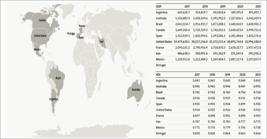
Selected countries in the study with gross domestic product (GDP) values and human development index (HDI) from 2017 to 2021.
The 10 selected countries, together, had an average population of 98,500,000 (± 97,200,000) inhabitants between 2017 and 2021, 2,279 (± 3,390) effective donors per year, 7,036 (± 10,929) transplants per year, 1,209 (± 1,874) living donors, and an average of 2.6 (±0.4) organs transplanted per donor in the same period. In Table 1, based on the rate of effective donors PMP, a substantial reduction in the number of donors can be seen in all countries of the study with the beginning of the pandemic. The variation per million inhabitants in Argentina, comparing the 2019 and 2020 numbers, was -50%. In Mexico, the variation was -68.9%, and in Iran, it was -46%. The United States of America was an exception, given that even in the face of the pandemic, it managed to maintain growth in the number of donors PMP at a rate of 5.3% (n = 718 effective donors). When analyzing the percentage difference between 2020 and 2021, despite the continuous decline in Australia (-9.9%) and Canada (-1.0%), a recovery scenario is evident.
Effective donors rate per million population, organs transplantation rate per million population, and their respective means and standard deviation (SD), from 2017 to 2021.
Similarly, the performance of organ transplants has been highly affected since the onset of COVID-19. All the studied countries showed a decrease in the number of transplants PMP from 2019 to 2020, with Mexico (-69.5%), France (-46.8%), and Argentina (-45.2%) showing the largest percentage declines. When comparing the variation between 2020 and 2021, it is observed, in general, that the countries showed a return to the pre-pandemic pattern of transplants, except for Australia, which continued to decline (2019/2020: -14% and 2020/2021: -6.4%) and Brazil, with minimal recovery (2019/2020: -20.2% and 2020/2021: 0.3%), as can be seen in Table 1.
When analyzing the cases and deaths due to COVID-19 per million inhabitants of each country in 2020 and 2021, it is notable that there is heterogeneity among the selected nations. Regarding cases of COVID-19 (PMP), the United States of America recorded the highest values, with 60,352.3 in 2020 and 161,948.8 in 2021, while in Australia, the values were 1,108.8 and 16,611 in the same period, respectively. Regarding the number of COVID-19 PMP deaths, Spain recorded 1,151.7 and Mexico, 1,171.6, representing the highest rates in 2020, while Brazil, with 2,888.4, and Argentina, with 2,707.7, had the highest numbers in 2021. Similarly to the number of cases, as shown in Table 2, Australia showed the lowest death rates, with rates of 35.4 and 86.9 in 2020 and 2021, respectively.
COVID-19 cases rate and COVID-19 death rate per million population (PMP) and their respective means and standard deviation (SD) in 2020 and 2021.
The data in Table 3 show the impact of a unit PMP of cases and deaths from COVID-19 on the number of effective donors in two intervals 2017–2020 and 2017–2021. In the first interval, considering the statistical significance values in the COVID-19 cases rate, Portugal had the most significant impact among the countries in the study, with a decline of 4,463.8 (95%CI -5103.2–-3824.4) in the rate of effective donors per million population, followed by Spain (-3,964.4; 95%CI -5,850.2–-2,078.6), Mexico (-3,879.3; 95%CI -4688.6–-3069.9) and Australia (-309.0; 95%CI -565.3–-52.7) (Table 3).
Analysis of the association between the COVID-19 cases rate and the COVID-19 deaths rate per million population and the effective donors rate per million population between 2017 and 2020 and 2017 and 2021.
Still in the first interval, from 2017 to 2020, but evaluating the impact of the COVID-19 death rate on the effective donors rate, Mexico (-382.6; 95%CI -462.5–-302.8), Spain (-108.6; 95%CI -160.3–-57), Portugal (-74.2; 95%CI -84.8–-63.6) and Australia (-9.9; 95%CI -18.1–-1.7) continued to show impacts, but in smaller and different proportions (Table 3).
From 2017 to 2021, the scenario changed, and the United States of America experienced an increase in the rate of effective donors, reaching 15,921.6 (95%CI 2,144.1–29,699.1), despite an increase in cases seen in the country. This increase was also noticed in the assessment of the rate of COVID-19-related deaths in the same period, with an increase of 244.6 (95%CI 44.7–444.6), a scenario that was not seen in Australia, which presented a decrease of 15 (95%CI -23–-7), a value even more substantial than that seen in the first period (Table 3).
Regarding the impacts of COVID-19 cases on the organ transplantations rate, the linear regression shown in Table 4 pointed out that Brazil, with a beta coefficient of -4,541.5 (95%CI -7,714.9–-1,368.1) in the analysis from 2017 to 2020, was the country that suffered the most significant impact, followed by Portugal (-2,283.5; 95%CI -4,449.2–-117.9), Spain (-2,014.1; 95%CI -2,682.3–-1,345.8), France (-933.0; 95%CI -1,454.6–-411.3), Iran (-899.2; 95%CI -1,104.9–-693.4), and Mexico (-624.7; 95%CI -763.2–-486.2).
Analysis of the association between the COVID-19 cases rate and the COVID-19 deaths rate per one million population and the transplantations rate per one million population between 2017 and 2020 and 2017 and 2021.
Likewise, Brazil was the country where the death rate from COVID-19 most affected transplantation activities, with reductions in the assessment from 2017 to 2020 (-115.2; 95%CI -195.8–-34.7) and from 2017 to 2021 (-4.3; 95%CI -7.8–-1.0), that is, deaths related to COVID-19 continued to cause a decrease in the transplant rate until 2021. Other countries also had a significant impact on the evaluation of the association between the rate of COVID-19 deaths and the rate of transplantations performed, such as Mexico, Spain, Iran, Portugal, and France, as shown in Table 4.
The impacts caused by the pandemic were also reflected in living-donor transplants and transplantability (rate of organs transplanted per donor).
DISCUSSION
The study revealed that the COVID-19 pandemic had a profound impact on organ donation and transplantation activities worldwide, resulting in significant declines in the number of effective donors, transplants, living-donor transplants, and even the number of organs transplanted per donor, exhibiting heterogeneous behavior among the evaluated countries.
Regarding the number of effective donors, all countries analyzed, except the United States of America, showed a reduction. When assessing the impact of COVID-19 cases and deaths on the number of effective donors per million population, the statistical analysis generally demonstrated a significant impact on this indicator, with varying behaviors among the studied countries. That is, the countries with the highest number of COVID-19 cases and deaths, as measured by PMP, were not necessarily the ones that experienced the most significant decrease in their effective organ donor rate with the advent of the pandemic. The new coronavirus pandemic not only affected the countries included in this study but also significantly impacted organ donation results in countries such as France, Italy, Austria, Israel, and the United Kingdom.28-30
Regarding the number of organ transplants, all countries experienced a reduction in 2020. However, Australia, Brazil, and Canada, unlike the other countries, also faced hardship in recovering the number of transplants in 2021. The non-uniformity in the behavior of countries regarding the impact of the new coronavirus pandemic on transplantation activities, as evidenced by the analysis, demonstrates that the number of COVID-19 cases and deaths per million population responded differently to the decrease in organ transplantations.
Similar to the number of effective donors, the United States of America managed to overcome the first two years of the pandemic by maintaining the number of transplants. The country invested in scenario calculations and computer simulation models to make decisions about progressively suspending activities, considering the analysis carried out by transplant centers for the adoption of restrictive measures.31,32 In addition, the availability, in an adjusted form, of tests for the diagnosis of COVID-19, the advanced stage of vaccination, and the quick access to data and studies that facilitated the flexibilization of the use of infected donors are among the factors that can justify this scenario being different from that of other countries.33,34
As a result of the pandemic, elective surgery activities were suspended. As a result, many countries showed a substantial decline in living-donor kidney transplants. Another factor studied to assess the organ use rate during this period was the number of organ transplants per effective donor. The growth of this transplantability rate, possibly associated with the limitation in the use of expanded criteria donors, demonstrates the use of organs from donors and recipients in conditions of lower ischemic limits and shorter time logistics.35-37
This study's findings demonstrate impacts similar to those seen in other scientific productions, which recognize the overload that the pandemic caused to health systems and the substantial reduction in donation and transplantation procedures.6 In addition, the results reflect the uncertainties of the risk of continuing with organ donation and transplantation activities in the first year of the pandemic, the orientation of institutions regarding the suspension of activities, and the increased gap between the supply and demand of organ donors with the advent of the pandemic, which increased the difficulty of allocating expanded criteria donor organs.36,38,39
The COVID-19 pandemic has caused significant challenges to the healthcare systems of various nations. Aspects such as the number of COVID-19 cases and deaths, economic limitations, the lack of knowledge about the risks, the repurposing of professionals and structures for the care of SARS-CoV-2 patients and, consequently, the suspension of transplantation activities were elements involved in the impact found in the present study. However, it is necessary to delve deeper into other factors that may manifest as residual effects of the pandemic and have an impact on the transplantation process.40
Thus, as a limitation of this study, one can mention the possibility that factors not measured may also have an impact on the association between COVID-19 cases and deaths and transplantation. Moreover, the impossibility of incorporating data that characterize transplantation activities in the countries studied may have hindered the desired in-depth analysis and more accurate evaluations.
As for this study's strengths, we would like to highlight the inclusion of countries representing transplantation systems across different continents, the evaluation of normalized data, and the analysis of the association between cases and deaths of COVID-19 and transplant procedures, including not only organ transplants but also several indicators within this scope, such as effective donors, living-donor transplants and organs transplanted per donor, which characterizes a robust assessment that minimizes interpretation errors with gross values.
Given the points recognized by this work, we encourage that studies be carried out to evaluate the factors associated with the effectiveness of transplantation activities, specifying the behavior of each modality of organ transplant in order to understand better what minimizes the risk of impacts on these activities in the face of health emergencies, as seen in the pandemic. Additionally, assessing the delayed impacts of the COVID-19 pandemic is of great importance.
CONCLUSION
The COVID-19 pandemic has significantly affected organ donation and transplantation activities worldwide, resulting in a significant reduction, increased waiting lists, higher patient mortality rates with transplant indications, and the discontinuation of many transplantation activities. With a better understanding of the risks associated with COVID-19 transmissibility, the importance of social distancing measures, the use of masks, and adaptations to donation and transplantation systems in response to the pandemic, as well as the growth of the vaccinated population, nations have begun to resume activities. However, faced with relevant impact and heterogeneous behavior, some countries continue to show significant difficulties in resuming this activity, which is still far from the results presented before the pandemic.
ACKNOWLEDGEMENT
Not applicable.
-
DECLARATION OF USE OF ARTIFICIAL INTELLIGENCE TOOLS
No artificial intelligence tools were used in this study.
-
FUNDING
Not applicable.
DATA AVAILABILITY STATEMENT
Data supporting the results of this study can be obtained with the corresponding author upon reasonable request.
References
-
1 Medina-Pestana JO, Galante NZ, Tedesco-Silva H Jr, Harada KM, Garcia VD, Abbud-Filho M, Campos HH, Sabbaga E. O contexto do transplante renal no Brasil e sua disparidade geográfica. J Bras Nefrol. 2011; 33 (4): 472-84. https://doi.org/10.1590/S0101-28002011000400014
» https://doi.org/10.1590/S0101-28002011000400014 -
2 Westphal GA, Garcia VD, Souza RL, Franke CA, Vieira KD, Birckholz VRZ, Machado MC, Almeida ERB, Machado FO, Sardinha LAC, Wanzuita R, Silvado CES, Costa G, Braatz V, Caldeira Filho M, Furtado R, Tannous LA, Albuquerque AGN, Abdala E, Gonçalves ARR, Pacheco-Moreira LF, Dias FS, Fernandes R, Di Giovanni F, Carvalho FB, Fiorelli A, Teixeira C, Feijó C, Camargo SM, Oliveira NE, David AI, Prinz RAD, Herranz LB, Andrade J. Guidelines for the assessment and acceptance of potential brain-dead organ donors. Rev Bras Ter Intensiva. 2016; 28 (3): 220-55. https://doi.org/10.5935/0103-507X.20160049
» https://doi.org/10.5935/0103-507X.20160049 -
3 Gois RSS, Galdino MJQ, Pissinati PSC, Pimentel RRS, Carvalho MDB, Haddad MCFL. Efetividade do processo de doação de órgãos para transplantes. Acta Paul Enferm. 2017; 30 (6): 621-7. https://doi.org/10.1590/1982-0194201700089
» https://doi.org/10.1590/1982-0194201700089 - 4 Garcia CD, Pereira JD, Garcia VD, editors. Doação e transplante de órgãos e tecidos. São Paulo: Segmento Farma; 2015.
-
5 Soares LS, Brito ES, Magedanz L, França FA, Araújo WN, Galato D. Solid organ transplantation in Brazil: a descriptive study of distribution and access inequalities, 2001–2017. Epidemiol Serv Saúde. 2020; 29 (1): e2018512. https://doi.org/10.5123/S1679-49742020000100014
» https://doi.org/10.5123/S1679-49742020000100014 -
6 Weiss MJ, Lalani J, Patriquin-Stoner C, Dieudé M, Hartell D, Hornby L, Shemie SD, Wilson L, Mah A. Summary of international recommendations for donation and transplantation programs during the COVID-19 pandemic. Transplantation. 2021;105 (1): 14-7. https://doi.org/10.1097/TP.0000000000003520
» https://doi.org/10.1097/TP.0000000000003520 -
7 Aubert O, Yoo D, Zielinski D, Cozzi E, Cardillo M, Dürr M, Domínguez-Gil B, Coll E, Silva MID, Sallinen V, Lemström K, Midtvedt K, Ulloa C, Immer F, Weissenbacher A, Vallant N, Basic-Jukic N, Tanabe K, Papatheodoridis G, Menoudakou G, Torres M, Soratti C, Krogh DH, Lefaucheur C, Ferreira G, Silva HT Jr, Hartell D, Forsythe J, Mumford L, Reese PP, Kerbaul F, Jacquelinet C, Vogelaar S, Papalois V, Loupy A. COVID-19 pandemic and worldwide organ transplantation: a population-based study. Lancet Public Health. 2021; 6 (10): e709-19. https://doi.org/10.1016/S2468-2667(21)00200-0
» https://doi.org/10.1016/S2468-2667(21)00200-0 -
8 Huang C, Wang Y, Li X, Ren L, Zhao J, Hu Y, Zhang L, Fan G, Xu J, Gu X, Cheng Z, Yu T, Xia J, Wei Y, Wu W, Xie X, Yin W, Li H, Liu M, Xiao Y, Gao H, Guo L, Xie J, Wang G, Jiang R, Gao Z, Jin Q, Wang J, Cao B. Clinical features of patients infected with 2019 novel coronavirus in Wuhan, China. Lancet. 2020; 395 (10223): 497-506. https://doi.org/10.1016/S0140-6736(20)30183-5
» https://doi.org/10.1016/S0140-6736(20)30183-5 -
9 Gaussen A, Hornby L, Rockl G, O'Brien S, Delage G, Sapir-Pichhadze R, Drews SJ, Weiss MJ, Lewin A. Evidence of SARS-CoV-2 infection in cells, tissues, and organs and the risk of transmission through transplantation. Transplantation. 2021; 105 (7): 1405-22. https://doi.org/10.1097/TP.0000000000003744
» https://doi.org/10.1097/TP.0000000000003744 -
10 Turco C, Lim C, Soubrane O, Malaquin G, Kerbaul F, Bastien O, Conti F, Scatton O. Impact of the first COVID-19 outbreak on liver transplantation activity in France: A snapshot. Clin Res Hepatol Gastroenterol. 2021; 45 (4): 101560. https://doi.org/10.1016/j.clinre.2020.10.005
» https://doi.org/10.1016/j.clinre.2020.10.005 -
11 Ahmadi ZH, Mousavizadeh M, Nikpajouh A, Bahsir M, Hosseini S. COVID‐19: A perspective from Iran. J Card Surg. 2021; 36: 1672-6. https://doi.org/10.1111/jocs.15054
» https://doi.org/10.1111/jocs.15054 -
12 Domínguez-Gil B, Coll E, Fernández-Ruiz M, Corral E, del Río F, Zaragoza R, Rubio JJ, Hernández D. COVID‐19 in Spain: Transplantation in the midst of the pandemic. Am J Transplant. 2020; 20 (9): 2593-8. https://doi.org/10.1111/ajt.15983
» https://doi.org/10.1111/ajt.15983 -
13 Goff RR, Wilk AR, Toll AE, McBride MA, Klassen DK. Navigating the COVID‐19 pandemic: Initial impacts and responses of the Organ Procurement and Transplantation Network in the United States. Am J Transplant. 2021; 21 (6): 2100-12. https://doi.org/10.1111/ajt.16411
» https://doi.org/10.1111/ajt.16411 -
14 Suarez-Pierre A, Choudhury R, Carroll AM, King RW, Iguidbashian J, Cotton J, Colborn KL, Kennealey PT, Cleveland JC, Pomfret E, Fullerton DA. Measuring the effect of the COVID-19 pandemic on solid organ transplantation. Am J Surg. 2022; 224 (1): 437-42. https://doi.org/10.1016/j.amjsurg.2021.12.036
» https://doi.org/10.1016/j.amjsurg.2021.12.036 -
15 Chadban SJ, McDonald M, Wyburn K, Opdam H, Barry L, Coates PT. Significant impact of COVID-19 on organ donation and transplantation in a low-prevalence country: Australia. Kidney Int. 2020; 98 (6): 1616-8. https://doi.org/10.1016/j.kint.2020.10.007
» https://doi.org/10.1016/j.kint.2020.10.007 -
16 Kute VB, Godara S, Guleria S, Ray DS, Aziz F, Hegde U, Sharma A, Nayak KS, Siddini V, Sarkar P, Thukral S, Sow Mondal RR, Goswami J, Patel HV, Abraham AM, Pathak V, Anandh U, Jha PK, Bavikar S, Bonu RS, Gulati S, Kumar ABT, Yadav DK. Is it safe to be transplanted from living donors who recovered from COVID-19? Experience from India. Transplantation. 2020; 105 (4): 842-50. https://doi.org/10.1097/TP.0000000000003609
» https://doi.org/10.1097/TP.0000000000003609 -
17 Viana LA, Cristelli MP, Leite VM, Nakamura MR, Custodio LFP, Carneiro VA, Amorim LVP, Martins SBS, Tedesco-Silva H, Medina-Pestana J. Transplanting kidneys from donors with SARS-CoV-2 RNA positivity in Brazil: Early success under surveillance. Transplantation. 2022; 106 (12): e517-9. https://doi.org/10.1097/TP.0000000000004353
» https://doi.org/10.1097/TP.0000000000004353 -
18 International Registry in Organ Donation and Transplantation. 2022 [acesso em: Mar 27, 2022]. Disponível em: https://www.irodat.org/?p=about
» https://www.irodat.org/?p=about -
19 Eurotransplant. Organization. Eurotransplant [acesso em: Mar 27, 2022]. Disponível em: https://www.eurotransplant.org/about-eurotransplant/organization/
» https://www.eurotransplant.org/about-eurotransplant/organization/ -
20 WHO Global Observatory on Donation and Transplantation (GODT). [acesso em: Mar 27, 2022]. Disponível em: http://www.transplant-observatory.org/
» http://www.transplant-observatory.org/ -
21 Associação Brasileira de Transplante de Órgãos (ABTO). [citado Mar 27, 2022]. Disponível em: https://site.abto.org.br/
» https://site.abto.org.br/ -
22 Brasil. Portal saúde: doação de órgãos e tecidos. Brazil: Ministério da Saúde [acesso em: Mar 13, 2022]. Disponível em: https://www.gov.br/saude/pt-br/composicao/saes/snt/transplantes
» https://www.gov.br/saude/pt-br/composicao/saes/snt/transplantes -
23 World Health Organization (WHO). COVID-19 Dashboard. [citado Mar 27, 2022]. Disponível em: https://covid19.who.int
» https://covid19.who.int -
24 Johns Hopkins Coronavirus Resource Center. New COVID-19 cases worldwide. [acesso em: Mar 26, 2022]. Disponível em: https://coronavirus.jhu.edu/data/new-cases
» https://coronavirus.jhu.edu/data/new-cases -
25 United Nations Development Programme. Human Development Reports. United Nations [acesso em: Set 24, 2022]. Disponível em: https://hdr.undp.org/
» https://hdr.undp.org/ -
26 The World Bank. Indicators | Data. World Bank [acesso em: Set 7, 2022]. Disponível em: https://data.worldbank.org/indicator
» https://data.worldbank.org/indicator - 27 StataCorp. Stata Statistical Software: Release 16.1. StataCorp; 2020.
-
28 Legeai C, Malaquin G, Lamotte C, Antoine C, Averland B, Jasseron C, Bayer F, Bastien O, Kerbaul F. Impact of COVID-19 on organ donation and transplantation in France. Transpl Int. 2021; 34: 204-6. https://doi.org/10.1111/tri.13769
» https://doi.org/10.1111/tri.13769 -
29 Manara AR, Mumford L, Callaghan CJ, Ravanan R, Gardiner D. Donation and transplantation activity in the UK during the COVID-19 lockdown. Lancet. 2020; 396 (10249): 465-6. https://doi.org/10.1016/S0140-6736(20)31692-5
» https://doi.org/10.1016/S0140-6736(20)31692-5 -
30 Katvan E, Cohen J, Ashkenazi T. Organ donation in the time of COVID-19: the Israeli experience—ethical and policy implications. Isr J Health Policy Res. 2022; 11: 6. https://doi.org/10.1186/s13584-022-00519-8
» https://doi.org/10.1186/s13584-022-00519-8 -
31 Zhang H, Dai H, Xie X. Solid organ transplantation during the COVID-19 pandemic. Front Immunol. 2020; 11: 1392. https://doi.org/10.3389/fimmu.2020.01392
» https://doi.org/10.3389/fimmu.2020.01392 -
32 Bartelt L, van Duin D. An overview of COVID-19 in solid organ transplantation. Clin Microbiol Infect. 2022; 28 (6): 779-84. https://doi.org/10.1016/j.cmi.2022.02.005
» https://doi.org/10.1016/j.cmi.2022.02.005 -
33 Bock MJ, Vaughn GR, Chau P, Berumen JA, Nigro JJ, Ingulli EG. Organ transplantation using COVID‐19‐positive deceased donors. Am J Transplant. 2022; 22 (9): 2203-16. https://doi.org/10.1111/ajt.17145
» https://doi.org/10.1111/ajt.17145 -
34 Zhang M, Wang G, Li J, Hopp WJ, Lee DD. Pausing transplants in the face of a global pandemic: Patient survival implications. Prod Oper Manag. 2022; 32 (5): 10.1111/poms.13697. https://doi.org/10.1111/poms.13697
» https://doi.org/10.1111/poms.13697 -
35 Passoni R, Gadonski B, Carvalho ARS, Freitas TVS, Peres LAB. The impact of COVID-19 on kidney transplant activities in Brazil: a descriptive study. Sao Paulo Med J. 2023; 14 (1): 60-6. https://doi.org/10.1590/1516-3180.2021.0956.R1.29042022
» https://doi.org/10.1590/1516-3180.2021.0956.R1.29042022 -
36 Kuramitsu K, Yamanaga S, Osawa R, Hibi T, Yoshikawa M, Toyoda M, Shimata K, Yosuke E, Ono M, Kenmochi T, Sogawa H, Natori Y, Yano H, Chen-Yoshikawa T, Yoshida K, Fukumoto T, Yuzawa K, Egawa H. Impact of COVID‐19 on living donor liver and kidney transplantation programs in Japan in 2020. Transpl Infect Dis. 2022; 24 (3): e13845. https://doi.org/10.1111/tid.13845
» https://doi.org/10.1111/tid.13845 -
37 Hilbrands LB, Duivenvoorden R, Vart P, Franssen CFM, Hemmelder MH, Jager KJ, Kieneker LM, Noordzij M, Pena MJ, de Vries H, Arroyo D, Covic A, Crespo M, Goffin E, Islam M, Massy ZA, Montero N, Oliveira JP, Roca Muñoz A, Sanchez JE, Sridharan S, Winzeler R, Gansevoort RT; ERACODA Collaborators. COVID-19–related mortality in kidney transplant and dialysis patients: results of the ERACODA collaboration. Nephrol Dial Transplant. 2020; 35 (11): 1973-83. https://doi.org/10.1093/ndt/gfaa261
» https://doi.org/10.1093/ndt/gfaa261 -
38 Craig-Schapiro R, Salinas T, Lubetzky M, Abel BT, Sultan S, Lee JR, Kapur S, Aull MJ, Dadhania DM. COVID-19 outcomes in patients waitlisted for kidney transplantation and kidney transplant recipients. Am J Transplant. 2021; 21 (4): 1576-85. https://doi.org/10.1111/ajt.16351
» https://doi.org/10.1111/ajt.16351 -
39 Cravedi P, Mothi SS, Azzi Y, Haverly M, Farouk SS, Pérez-Sáez MJ, Redondo-Pachón MD, Murphy B, Florman S, Cyrino LG, Grafals M, Venkataraman S, Cheng XS, Wang AX, Zaza G, Ranghino A, Furian L, Manrique J, Maggiore U, Gandolfini I, Agrawal N, Patel H, Akalin E, Riella LV. COVID-19 and kidney transplantation: Results from the TANGO International Transplant Consortium. Am J Transplant. 2020; 20 (11): 3140-8. https://doi.org/10.1111/ajt.16185
» https://doi.org/10.1111/ajt.16185 -
40 Elias M, Pievani D, Randoux C, Louis K, Denis B, Delion A, Le Goff O, Antoine C, Greze C, Pillebout E, Abboud I, Glotz D, Daugas E, Lefaucheur C. COVID-19 infection in kidney transplant recipients: disease incidence and clinical outcomes. J Am Soc Nephrol. 2020; 31 (10): 2413-23. https://doi.org/10.1681/asn.2020050639
» https://doi.org/10.1681/asn.2020050639
Edited by
-
Section editor:
Ilka de Fátima Santana F. Boin https://orcid.org/0000-0002-1165-2149

 Source: adapted from United Nations Development Programme