
 Do financially sophisticated CEOs receive higher compensation? Evidence from Brazil
ABSTRACT
This study examines the relationship between the financial sophistication characteristics of Chief Executive Officers (CEOs) and executive compensation through an analysis of 272 publicly traded Brazilian companies from 2010 to 2022. The models were estimated using the Generalized Method of Moments (GMM-Sys). The CEOs investigated possessed substantial academic qualifications and professional experience to support decision-making. Academic backgrounds in business and international education have been increasingly sought after and have led to higher compensation, establishing themselves as determinants of remuneration. We identified that companies have been offering higher compensation to CEOs wwho have experience in their sector, experience in the financial sector, and have held previous financial roles. The findings highlight important questions regarding financial constraints that limit the ability to hire highly qualified CEOs due to challenges in providing adequate compensation. This study contributes to both companies and the literature on national and emerging markets by offering insights into how CEOs are compensated and identifying the characteristics that influence compensation variations, addressing areas that remain underexplored in Brazil.
KEYWORDS:
Executive compensation; CEO characteristics; Financial sophistication; Academic qualifications; Professional experience
RESUMO
O estudo analisa a relação entre as características de sofisticação financeira dos Chief executive officers (CEOs) e remunerações executivas por meio de análise com 272 empresas brasileiras de capital aberto de 2010 a 2022. Os modelos foram estimados pelo Generalized Method of Moments (GMM-Sys). Os CEOs investigados possuem considerável formação acadêmica e experiência profissional para subsidiar a tomada de decisão. As características de formação acadêmica nos negócios e formação internacional têm sido requeridas e proporcionado melhores remunerações, constituindo-se como determinantes das remunerações. Identificamos que as empresas têm remunerado mais expressivamente CEOs com experiências no setor de atuação, setor financeiro e em cargos financeiros. Os achados suscitam questões pertinentes sobre restrições financeiras que dificultam a contratação de CEOs com muitas características dada a dificuldade de remunerá-los adequadamente. O estudo contribui com empresas e literatura nacional e de países emergentes, evidenciando aspectos sobre como os CEOs são remunerados e que características têm contribuído para a variação dos salários, conduzindo a constatações importantes e que ainda são incipientes no Brasil.
PALAVRAS-CHAVE:
Remuneração executiva; Características dos CEOs; Sofisticação financeira; Formação acadêmica; Experiência profissional
1. INTRODUCTION
The Chief Executive Officer (CEO) holds the highest position in an organization's hierarchy and is the primary decision-maker. Studies have focused on these executives, hypothesizing that their characteristics influence how they process and use information (Kaplan et al., 2012; Shen, 2021). In this context, the Upper Echelons Theory (UET) by Hambrick and Mason (1984) posits that the observable characteristics of executives can influence corporate performance and outcomes. According to UET, factors such as age, professional experience, and education can shape managers' decision-making behavior. This concept has supported studies seeking to understand the impact of executives on organizations (Conyon et al., 2019; Main & Silva, 2021; Setiawan & Gestanti, 2022).
Hambrick (2007), in an update to UET, highlighted the existence of a relationship between executive characteristics and compensation, as behaviors tend to shift based on the remuneration received. Subsequently, studies emerged exploring this relationship, indicating that much remains to be investigated. The relationship investigated varies across individuals, companies, sectors, countries, and compensation plans, with research predominantly focused on developed economies (Conyon et al., 2019; Malik et al., 2020; Schmid & Baldermann, 2021; Jaggia & Thosar, 2022).
Executive compensation is a controversial topic, as both media and academia have concentrated on the debate surrounding high compensations (Devers et al., 2007; Hendriks et al., 2023). Moreover, the relationship between optimal hiring and remuneration is not straightforward, and the effects of CEO compensation on performance are unclear and heterogeneous among corporations, contributing to the lack of consensus regarding its determinants (Frydman & Jenter, 2010). According to Murphy (1999), factors such as professional experience and education could be considered in defining executive compensations. Thus, compensation would reflect managers' attributes.
Companies tend to seek talented leaders; therefore, a CEO with an academic background and professional expertise would be deemed competent for strategic decision-making, becoming financially sophisticated (Custódio & Metzger, 2014; Bortoli & Soares, 2021). According to Bortoli and Soares (2021), financial sophistication, defined as a cluster of knowledge stemming from academic training and professional experience related to business, can contribute to a CEO's decision-making.
The CEO's academic background has been recognized as a key factor in determining compensation, as it enhances their expertise in business management (Custódio et al., 2013; Gupta & Mahakud, 2020). Professional experience has also been discussed in the executive compensation literature. Custódio et al. (2013) and Conyon et al. (2019) highlight that CEOs who develop skills throughout their professional careers tend to receive higher compensation. Consequently, the financial sophistication characteristics of CEOs represent potentially valuable assets for companies and may impact their remuneration. In light of the above, this study seeks to examine the relationship between CEOs' financial sophistication characteristics and executive compensation.
This study addresses Hambrick's (2007) call, contributing to the theoretical framework and existing studies that have explored this subject. It contributes to the growing body of literature exploring executive characteristics by incorporating financial sophistication into these discussions and linking it to CEO compensation. The research sheds light on potential determinants of CEO compensation and helps to understand whether the investigated characteristics are valued and how they are being rewarded.
This relationship has been more prominently examined in studies on developed economies, where greater transparency facilitates such analyses (Conyon et al., 2019; Schmid & Baldermann, 2021; Jaggia & Thosar, 2022). To address this gap, this study seeks to enrich the literature on emerging markets, particularly in the Brazilian context. In Brazil, studies on this relationship are relatively recent, likely because information on executive compensation only became available following the enactment of CVM Normative Instruction No. 480 in 2009. This regulation also disclosed curriculum details of CEOs in publicly listed companies (Pereira et al., 2016; Oliveira et al., 2021). As such, this paper contributes to the literature on Brazil, which remains underdeveloped (Oliveira et al., 2021; Dutra & Ceretta, 2023).
2. LITERATURE REVIEW
2.1 Financial sophistication charecteristics
CEOs possess valuable characteristics for businesses that can render them financially sophisticated (Custódio & Metzger, 2014). Bortoli and Soares (2021) define the financial sophistication characteristics of CEOs through the construct of "Financial Sophistication," which the authors describe as a combination of knowledge stemming from academic qualifications and professional experience in finance.
Academic qualifications are a key characteristic, as highly educated executives are better equipped to process complex information and act as valuable resources for their companies (Saidu, 2019; Shen, 2021). Such business-focused education provides concrete advantages, offering CEOs keen insight into financial policy decisions (Gupta & Mahakud, 2020). According to Ghardallou et al. (2020), corporate performance improves when a CEO holds a background in management, finance, economics, or accounting. A CEO’s education aligned with business needs influences investments, R&D expenditures, and the company’s financial health (Naseem et al., 2020; Setiawan & Gestanti, 2022). Studies also emphasize the value of international education, highlighting its role in helping CEOs manage economic uncertainties and identify opportunities for foreign investment (Jiang & Liu, 2020; Sun et al., 2021).
Professional experience is another crucial factor examined in the literature, which suggests that more extensive experience enhances a CEO's ability to manage businesses effectively (Ghardallou et al., 2020; Sun et al., 2021). This experience can be gained in various ways: experience as a CEO allows executives to understand the company better and contribute to strategic changes (Naseem et al., 2020; Darouichi et al., 2021), sector-specific experience equips CEOs with acumen to handle competition and identify investment opportunities (Ma et al., 2021; Agnihotri & Bhattacharya, 2021), andexperience in the financial sector enhances the ability to analyze banking information and improves the quality of information disclosure (Gounopoulos & Pham, 2018; Gupta & Mahakud, 2020; Shahab et al., 2020). Financial experience in roles such as CFO, accountant, or controller prepares CEOs for strategic decisions, including debt management and resource acquisition (Serra et al., 2016; Gounopoulos & Pham, 2018; Oradi et al., 2020; Li et al., 2023). International experience broadens strategic global perspectives and fosters sustainable innovation (Jiang & Liu, 2020; Schmid & Baldermann, 2021).
2.2 The influence of CEO characteristic on executive compensation
A CEO’s educational background is a significant determinant of compensation (Banghøj et al., 2010; Cole & Mehran, 2016). CEOs in possession of a business-aligned education demonstrate enhanced skills, and their compensation often serves as an incentive for taking calculated risks (King et al., 2016; Jaggia & Thosar, 2022). According to Malik et al. (2020), well-compensated CEOs play a pivotal role in advancing Corporate Social Responsibility initiatives. Choi et al. (2022) argue that compensation acts as a moderating factor between a CEO's education level and corporate value. In Brazil, studies examining the relationship between CEOs' academic backgrounds and their compensation are relatively recent and have yielded mixed results. Some studies have identified positive relationships (Pereira et al., 2016), while others have reported negative associations (Machado et al., 2023) or no significant relationship (Rissatti et al., 2019; Dutra & Ceretta, 2023).
Research has also delved into the relationship between CEOs' professional experience and their compensation. Findings suggest that executives with professional experience, including international exposure, tend to receive higher compensation packages (Custódio et al., 2013; Conyon et al., 2019; Schmid & Baldermann, 2021). Additionally, Jbir et al. (2021) noted that compensation levels help control opportunistic behavior. In the Brazilian context, studies examining the relationship between compensation and CEO experience have yielded divergent results. Pereira et al. (2016) and Machado et al. (2023) found that tenure and international experience are associated with higher compensation. However, Dutra and Ceretta (2023) argue that CEOs' professional experience does not appear to significantly influence salary determinations.
Considering that CEOs with academic qualifications and professional experience are financially sophisticated, contributing valuable knowledge and skills to their companies, they are likely to receive higher compensation. Based on this premise, the following hypotheses are proposed
H1: The financial sophistication characteristics of CEOs are positively and significantly associated with their compensation in Brazil.
H1a: A CEO's academic background is positively and significantly associated with their compensation in Brazil.
H1b: A CEO's professional experience is positively and significantly associated with their compensation in Brazil.
3. METHODOLOGY
3.1 Sample and data
The sample comprised 272 publicly traded Brazilian companies over the period from 2010 to 2022. Table 1 displays the sample distribution for the study. The selected timeframe is justified by the implementation of CVM Normative Instruction No. 480 in 2009, which standardized the disclosure of information in companies’ reference forms (CRF). This regulation facilitated the identification of CEOs' personal and professional data and mandated the disclosure of executive compensation details.
Data on the personal and financial sophistication characteristics of CEOs were manually collected from several sources, in the following order: (I) Companies' Reference Forms (CRF); (II) Company websites; (III) Bloomberg; (IV) LinkedIn; (V) Refinitiv Eikon®; and (VI) News websites (G1, Veja, Valor, and Estadão). Executive compensation values were manually retrieved from the CRF in the section titled “13 - Compensation of Administrators.” Financial data for the control variables were sourced from the Refinitiv Eikon® database.
3.2 Dependent variables
In Brazil, data on CEO compensation is not disclosed separately. Section 13 of the CRF provides information about the compensation of the Statutory Board, of which the CEO is a member. The CRF includes details on the number of board members, the components of the compensation packages, and the average, minimum, and maximum amounts paid to executives by governing body. Using this information, four proxies were adopted to represent CEO compensation, as shown in Table 2.
Compensation data were adjusted for inflation using 2010 as the base year, referencing the IPCA index based on information from the IBGE website. This adjustment was made to ensure the comparability of values over time, enabling an analysis of the real evolution of compensation and its relationship with the explanatory variables.
3.3 Financial sophistication charecteristics
The variables that comprise the construct of Financial Sophistication proposed by Bortoli and Soares (2021) were utilized. While the authors introduced a metric called the Financial Sophistication Index, this study examines the characteristics in their raw form to analyze the relationships individually. As a result, the characteristics that define the financial sophistication of the CEO are evaluated separately, rather than being combined into a composite index. The definitions and measurements of these sophistication characteristics are grounded in the Upper Echelons Theory and prior studies, as detailed in Table 3 (Custódio et al., 2013; Custódio & Metzger, 2014; Gounopoulos & Pham, 2018; Gupta & Mahakud, 2020; Jiang & Liu, 2020; Oradi et al., 2020; Darouichi et al., 2021; Schmid & Baldermann, 2021; Sun et al., 2021; Ma et al., 2021; Bortoli & Soares, 2021; Ding et al., 2022; Li et al., 2023).
3.4 Control variables
Studies have identified that CEO age (Custódio & Metzger, 2014; Conyon et al., 2019), gender (Oliveira et al., 2021), duality (Dutra & Ceretta, 2023), family CEO status (Graziano & Rondi, 2021), company size (Aguiar & Pimentel, 2017; Zhou et al., 2021), corporate performance (Conyon et al., 2019), leverage (Choi et al., 2022; Machado et al., 2023), company age (Serra et al., 2016), and defined control (Freitas et al., 2020) are important factors in explaining compensation. Additionally, considering that the Covid-19 pandemic had significant impacts on businesses, a dichotomous variable for the period was included. Table 4 presents the control variables and their measurements.
3.5 Econometric procedures
This study recognizes the potential for endogeneity. Executive compensation can both influence and be influenced by the variables under analysis, as well as by the omission of certain variables, which could lead to challenges and compromise the robustness of the findings. To mitigate this problem, the Systemic GMM (Generalized Method of Moments) approach was employed, a method recommended for analyzing compensation and executive characteristics (Aguiar & Pimentel, 2017; Shahab et al., 2020; Oliveira et al., 2021; Zhou et al., 2021; Machado et al., 2023; Dutra & Ceretta, 2023).
GMM was developed by Arellano and Bover (1991) and Blundell and Bond (1998). It is a dynamic panel regression method that effectively addresses endogeneity by using the variables themselves as instruments, ensuring efficiency in the estimation of asymptotic parameters. To adjust and validate the models, first- and second-order autocorrelation tests, along with the Hansen test (Roodman, 2009), were performed. Additionally, to manage outliers, the data were winsorized at the 1st and 99th percentiles. Equations 1 and 2 present the models tested.
When:
RMi,t = Highest compensation of the Statutory Board for company i in period t;
RMEDi,t = Average compensation of the Statutory Board for company i in period t;
RFi,t = Fixed compensation of the Statutory Board for company i in period t;
RVi,t = Variable compensation of the Statutory Board for company i in period t;
FAi,t = Academic background of the CEO of company i in period t;
EPi,t = Professional experience of the CEO of company i in period t.
4. RESULTS AND DISCUSSION
4.1 Descriptive analyses
Table 5 presents executive compensation in a general perspective and by economic sector, adjusted for inflation. As observed in other studies, compensation exhibited significant fluctuations in the Brazilian context during the period from 2010 to 2022 (Pereira et al., 2016; Oliveira et al., 2021).
Regarding total compensation, according to Table 5, CEOs received average salaries of BRL 2,505,137.57 and BRL 1,407,190.35 (Panel A), with a maximum of BRL 56,110,254.73, approximately 22 times the average, indicating exceptionally high compensation levels. Among the sectors, the communications sector has the smallest number of companies but pays the highest compensation, as also noted by Oliveira et al. (2021). This finding aligns with the growth of the technology sectors in the contemporary market. Additionally, it is observed that variable compensation exceeds fixed compensation, a result aligned with prior studies (Rissatti et al., 2019). Variable compensation serves as an incentive for managers to apply their skills effectively in business management.
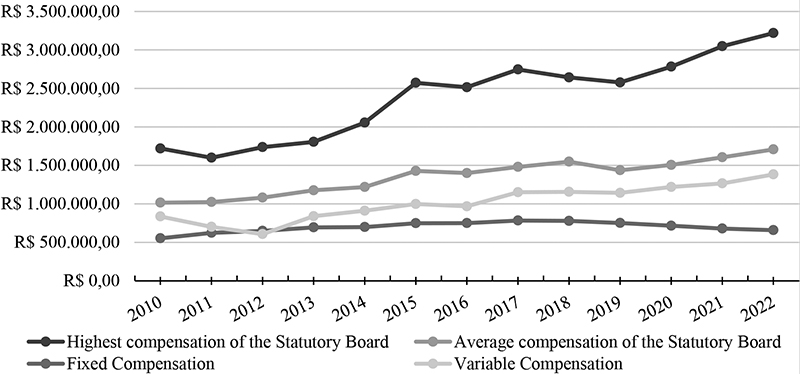
According to Figure 1, compensation levels rise and fall in synchrony, with the variable portion showing an upward trend over time. In recent years, significant salary growth has been observed, as highlighted in recent literature (Hendriks et al., 2023). In 2020 and the subsequent years, despite the widespread impact of the Covid-19 pandemic across all sectors of society, total and variable compensation levels increased. This suggests that CEO compensation in Brazil was minimally affected by the crisis. Such findings reinforce the notion that subjective factors may play a significant role in determining salary structures.
The companies in the sample were led by 613 CEOs during the period from 2010 to 2022. Table 6 presents the financial sophistication characteristics of these CEOs.
According to Table 6, 65.58 % of CEOs have finance-related education, reflecting a high level of theoretical knowledge to support decision-making. Additionally, 35.07 % of CEOs have international education. Regarding experience, 22.19 % of CEOs have experience in the financial sector, while 32.30 % have experience in financial roles, having held positions such as auditor or accountant. Moreover, 20.23 % of CEOs have worked in companies outside Brazil, contributing international experience to their organizations. On average, CEOs have 7 years of experience in their current role and 22.39 years of experience within the same sector, underscoring their strategic insights into competitiveness.
Table 7 provides the descriptive statistics for all variables used in the research.
4.2 Main results
Tables 8, 9, 10, and 11 present the results of the Systemic GMM analyses and the tests for model adjustments. The AR(1) test does not reject the hypothesis of first-order autocorrelation. However, the AR(2) test did not show significance, indicating the absence of second-order autocorrelation in the models, confirming that they are well specified. The Hansen test also did not show significance, supporting the hypothesis that the instruments are exogenous. This affirms the validity of the instrument sets.
The results of the Systemic GMM reveal that the rate of variation in compensation at time t is influenced by the variation in compensation at time t-1. As observed in the descriptive phase and highlighted in recent studies (Hendriks et al., 2023), compensation shows significant growth. In this context, variations in prior salaries serve as a basis for salary increases. Additionally, when defining contracts, promotions, and career progressions, the compensation paid to CEOs in previous years is taken into account, among other parameters. However, it is important to highlight that determining compensation is a complex process influenced by a variety of subjective factors that differ between companies (Frydman & Jenter, 2010).
According to Table 9 (models 1 and 2), academic background characteristics demonstrate a positive and significant relationship, thereby supporting H1a. The results indicate that a background in finance and international education contributes to an 8.1 % and 10.3 % increase in compensation, respectively. Supported by the UET and corroborated by previous studies, CEOs with higher educational levels provide valuable benefits and strengthen strategic management (Hambrick & Mason, 1984; Gupta & Mahakud, 2020). When this education aligns with finance, it enhances corporate performance and positively influences investment decisions, equipping companies to better navigate market challenges (Ghardallou et al., 2020; Naseem et al., 2020; Main & Silva, 2021; Setiawan & Gestanti, 2022). These findings suggest that Brazilian companies recognize the value of CEOs with a business-oriented education, promoting the use of these skills in corporate decision-making.
Furthermore, the results indicate that international academic backgrounds are highly regarded in Brazil. Such qualifications provide CEOs with insights into international business dynamics and facilitate the identification of foreign investment opportunities (Jiang & Liu, 2020; Sun et al., 2021). These findings align with previous studies (Conyon et al., 2019; Schmid & Baldermann, 2021), demonstrating that international education for CEOs is highly valued in Brazil, encouraging companies to offer higher compensation as recognition.
In Brazil, studies examining the relationship between a CEO's academic background and their compensation have yielded mixed results (Pereira et al., 2016; Machado et al., 2023; Dutra & Ceretta, 2023). This study makes a significant contribution by analyzing an extended period, providing valuable insights for the national literature, and highlighting that CEOs' academic backgrounds are in demand and have a measurable influence on their compensation.
Based on Tables 8, 9, 10, and 11, certain characteristics of CEOs' professional experience were not significant, resulting in the rejection of H1b. These findings diverge from international studies (Custódio et al., 2013; Schmid & Baldermann, 2021) but align with the results of Dutra and Ceretta (2023) in the Brazilian context. The results indicate that specific CEO experiences are associated with increases in their compensation.
As shown in Tables 8, 9, 10, and 11 (Model 5), CEO experience in the financial sector is linked to an 8 % increase in total compensation and a 12 % increase in variable compensation. This experience enhances their ability to process banking information, and due to their familiarity with such environments, CEOs tend to better understand debt acquisition processes and demonstrate greater acumen in managing investor relations (King et al., 2016; Shahab et al., 2020). Thus, companies in Brazil appear to value this experience, which is reflected in higher compensation.
According to the data in Tables 9 and 10 (Model 6), the results also reveal that CEOs’ financial experience contributes to a 7 % increase in total compensation and a 5 % increase in fixed compensation. Studies suggest that this type of experience equips managers to effectively navigate dynamic environments, make informed accounting decisions, and strengthen internal controls, thereby minimizing inefficiencies in investments (Gounopoulos & Pham, 2018; Oradi et al., 2020; Li et al., 2023). In Table 10 (Models 4 and 8), the results show that sector-specific experience contributes to a 0.3 % increase in fixed compensation. Sector experience helps CEOs understand the sector’s nuances, optimize resource allocation, and navigate competitive environments (Custódio et al., 2013; Ma et al., 2021; Agnihotri & Bhattacharya, 2021).
The findings from Tables 10 (Models 3 and 8) and 11 (Models 3 and 8) indicate that CEO tenure is associated with a 0.3 % reduction in fixed compensation and a 1.3 % reduction in variable compensation. This trend aligns with the Upper Echelons Theory, which posits that more experienced managers may become less inclined to take risks and could develop opportunistic behavior over time (Naseem et al., 2020; Oware & Awunyo-Vitor, 2021; Jbir et al., 2021). The results suggest that CEOs with extended tenure may be less valued, reflected in reductions to their compensation. An alternative explanation is that newly hired CEOs often receive an initial premium as an incentive to accept the position, which exceeds any subsequent salary increases during their tenure in the same role.
Analyzing the results of the Systemic GMM, it was observed that while some financial sophistication characteristics proved relevant, others were not significant. CEOs with these characteristics possess greater know-how for managing businesses and, as a result of their value, could receive higher compensation (Custódio & Metzger, 2014; Ghardallou et al., 2020; Bortoli & Soares, 2021; Main & Silva, 2021). However, the findings suggest that, in Brazil, the financial sophistication characteristics of CEOs do not appear to significantly influence increases in compensation. This raises important discussions: it underscores that CEO salary definitions are influenced by subjective factors that go beyond technical qualifications; companies may prioritize specific attributes over a broad range of characteristics; and it invites speculation that resource constraints might also limit the characteristics companies seek in their CEOs in emerging markets like Brazil.
4.3 Additional analyses
To assess the effects of the explanatory variables across the distribution of CEO compensation, the sample was divided into the 25th and 75th percentiles for each of the study’s dependent variables. The GMM-Sys method was applied to estimate the models for each segmented sample. The objective was to analyze the relationships between CEO characteristics and various levels of compensation, recognizing that lower and higher salaries may be associated with distinct attributes. This approach has the potential to yield novel findings and provide valuable insights.
Table 12 summarizes the results, offering a comprehensive perspective on the impact of the explanatory variables at the extremes of the compensation distribution. For the model adjustment tests, the AR(2) test did not show significance in any of the models, indicating the absence of second-order autocorrelation in the residuals. Similarly, the Hansen test also showed no significance in any of the tests, further confirming the validity of the instrument sets. The regression analysis applied to the 25th and 75th percentiles reveals significant insights into how CEOs’ academic backgrounds and professional experience relate to their compensation levels.
The 25th percentile represents the companies offering the lowest compensation among the analyzed firms. As shown in Table 12, variations in compensation at these companies are positively associated with academic background, financial sector experience, financial experience, and international experience. Variations in fixed compensation are specifically linked to financial sector experience and financial expertise. In contrast, variations in variable compensation are associated with academic background and CEO tenure.
Given that smaller and younger companies generally offer more modest salaries in line with their size and maturity stage, the results suggest that these companies value the CEO’s academic background as a crucial factor for effective business management. This recognition, reflected in compensation, underscores the understanding that a CEO’s qualifications significantly influence their leadership abilities, decision-making processes, and the company’s growth trajectory. Moreover, the professional expertise of CEOs emerges as a key factor enabling these companies to excel in competitive markets, fostering business expansion and consolidation. All types of experience, except sector-specific experience, were positively associated with compensation variations at the 25th percentile. This suggests that companies with lower salary levels may rely more heavily on the professional experience of their CEOs.
At the 75th percentile, which encompasses companies offering the highest compensation, there is a clear emphasis on valuing CEOs' academic backgrounds. These companies provide superior total and variable compensation packages to those with business-aligned and international education-attributes that equip CEOs to craft strategies ensuring organizational continuity and success. Specific experience, such as CEO tenure, sector-specific expertise, and roles in finance, are linked to increases in total compensation. In terms of fixed compensation, both financial sector experience and broader financial expertise stand out as significant factors driving increases in CEO remuneration.
For companies offering higher salary levels, sector-specific experience is associated with increases in variable compensation. However, CEO tenure and financial sector experience appear to be less influential in this segment. These findings suggest that for companies offering superior compensation packages, the differentiating factor lies less in general sector experience or CEO tenure and more in a blend of academic credentials and targeted professional experiences. As such, larger and more established companies tend to prioritize leadership profiles that are globally oriented and academically robust, capable of fostering innovation and maintaining competitiveness in an ever-evolving business landscape.
Several key points deserve attention. In terms of total compensation, CEOs' financial and international education is significant at the lower percentile but not at the upper percentile. This finding suggests that academic qualifications are more highly valued at lower salary levels, likely because they equip CEOs with essential skills for career advancement. In larger companies, however, this attribute may be supplanted by the executive’s professional expertise. Regarding total compensation, the CEO’s international experience is significant at the lower percentile but not at the upper percentile. This indicates that, at lower salary levels, international experience is perceived as a differentiating factor, providing companies with expertise in global negotiations and facilitating entry into new economic contexts.
For variable compensation, CEO tenure demonstrates negative significance at the upper percentile and positive significance at the lower percentile. This suggests that executives hired at higher salary levels may encounter less generous adjustments over time, or adjustments contingent on meeting specific performance goals. When it comes to financial sector experience, it is negatively significant at the upper percentile, while showing no relevance at the lower percentile. This finding implies that executives with extensive financial sector experience may have their variable compensation tied to stricter performance goals, potentially leading to reduced earnings if these targets are not achieved.
Overall, the results underscore the complexity of the relationship between CEOs' education, experience, and their compensation levels. The factors driving compensation at lower salary ranges may differ from those influencing executives at the upper end of the pay scale. While academic background is valued across both lower and higher-paying companies, the specific experiences that shape compensation vary depending on the organizational and market context. These findings are consistent with prior tests, suggesting that companies employ diverse compensation strategies tailored to their development stage or the unique challenges of their markets, seeking CEOs with profiles that align with their specific needs.
5. CONCLUSIONS
This study examined the relationship between the Financial Sophistication characteristics of CEOs and their compensation in publicly traded Brazilian companies. The findings suggest that CEOs with finance-related academic backgrounds and international education receive higher compensation. In the Brazilian context, as observed in Denmark (Banghøj et al., 2010), the United States (Cole & Mehran, 2016), the United Kingdom (Conyon et al., 2019), China (Choi et al., 2022), and Europe (Schmid & Baldermann, 2021), CEOs’ academic qualifications are increasingly valued, driving higher compensation. Academic education emerges as a key determinant of CEO compensation in Brazil, potentially incentivizing executives to apply their expertise to organizational processes.
However, the results indicate that companies prioritize rewarding specific professional experiences, placing greater value on expertise acquired in the financial sector, roles involving financial responsibilities, and experience within the same industry. In contrast, CEO tenure is linked to reductions in both fixed and variable compensation. This observation aligns with studies from Pakistan (Naseem et al., 2020) and India (Oware & Awunyo-Vitor, 2021), which suggest that long-tenured CEOs may exhibit opportunistic behavior and are often viewed as less valuable investments. Furthermore, the findings indicate that salary adjustment policies may be creating a compensation disparity, favoring newly hired executives over those with longer tenures.
Although academic background appears to be relevant in salary determinations, certain characteristics related to professional experience were not significant, making it impossible to conclude that financially sophisticated CEOs receive higher compensation in Brazil. This finding raises important considerations: in an emerging economy, financial constraints may prevent companies from hiring CEOs with numerous qualifications, owing to challenges in providing adequate compensation. Furthermore, many of the observed characteristics remain underdeveloped among executive directors in Brazil.
Among the study’s limitations, compensation data are restricted to information disclosed in the CRF, which has been available only since 2010 and is sometimes incomplete. Future research could examine compensation in specific sectors-particularly the financial sector-or investigate in greater depth why the communications sector offers the highest compensation. Comparisons of executive compensation in Brazil with that of other emerging economies would also prove insightful. Additionally, new studies could explore other executive attributes, focusing on specific cognitive elements that may inform discussions between national research and studies in emerging economies.
References
- Agnihotri, A., & Bhattacharya, S. (2021). Generalist versus specialist CEO and R&D commitment: Evidence from an emerging market. Journal of Management & Organization, 31(4), 1837-1853.
- Aguiar, A. B. D., & Pimentel, R. C. (2017). Remuneração de executivos e desempenho no mercado brasileiro: relações contemporâneas e defasadas. Revista de Administração Contemporânea, 21, 545-568.
- Arellano, M., & Bond, S. (1991). Some tests of specification for panel data: Monte Carlo evidence and an application to employment equations. The Review of Economic Studies, 58(2), 277-297.
- Banghøj, J., Gabrielsen, G., Petersen, C., & Plenborg, T. (2010). Determinants of executive compensation in privately held firms. Accounting & Finance, 50(3), 481-510.
- Blundell, R., & Bond, S. (1998). Initial conditions and moment restrictions in dynamic panel data models. Journal of Econometrics, 87(1), 115-143.
- Bortoli, C., & Soares, R. O. (2021). De “0 A 1” - Qual é a “Sofisticação Financeira” do diretor presidente? Revista de Educação e Pesquisa em Contabilidade (REPeC), 15(1), 2735.
- Choi, D., James, K. L., Okafor, C. E., Cho, E., & Bhuyan, M. N. H. (2022). The effect of executives' education and compensation on firm value: Evidence from China. Applied Economics, 54(50), 5763-5781.
- Cole, R. A., & Mehran, H. (2016). What do we know about executive compensation at small privately held firms? Small Business Economics, 46, 215-237.
- Conyon, M. J., Hass, L. H., Vergauwe, S., & Zhang, Z. (2019). Foreign experience and CEO compensation. Journal of Corporate Finance, 57, 102-121.
- Custódio, C., Ferreira, M. A., & Matos, P. (2013). Generalists versus specialists: Lifetime work experience and chief executive officer pay. Journal of Financial Economics, 108(2), 471-492.
- Custódio, C., & Metzger, D. (2014). Financial expert CEOs: CEO’ s work experience and firm’s financial policies. Journal of Financial Economics, 114(1), 125-154.
- Darouichi, A., Kunisch, S., Menz, M., & Cannella, A. A. (2021). CEO tenure: An integrative review and pathways for future research. Corporate Governance: An International Review, 29(6), 661-683.
- Devers, C. E., Cannella Jr., A. A., Reilly, G. P., & Yoder, M. E. (2007). Executive compensation: A multidisciplinary review of recent developments. Journal of management, 33(6), 1016-1072.
- Ding, N., Ullah, I., & Jebran, K. (2022). Foreign experienced CEO’s and financial statement comparability. Emerging Markets Finance and Trade, 58(13), 3751-3769.
- Dutra, V. R., & Ceretta, P. S. (2023). Remuneração De Executivos Em Empresas Brasileiras Listadas: O Impacto Do Prestígio, Do Desempenho, Da Governança Corporativa e Da Experiência do CEO. Boletim de Conjuntura (BOCA), 13(39), 157-179.
- Freitas, M. R. O., Pereira, G. M., Vasconcelos, A. C., & Luca, M. M. M. (2020). Concentração acionária, conselho de administração e remuneração de executivos. RAE-Revista De Administração De Empresas, 60(5), 322-335.
- Frydman, C., & Jenter, D. (2010). CEO compensation. Annual Review of Financial Economics, 2(1), 75-102.
- Ghardallou, W., Borgi, H., & Alkalifah, H. (2020). CEO Characteristics and Firm Performance: A Study of Saudi Arabia Listed Firms. The Journal of Asian Finance, Economics and Business, 7(11), 291-301.
- Gounopoulos, D., & Pham, H. (2018). Financial expert CEOs and earnings management around initial public offerings. The International Journal of Accounting, 53(2), 102-117.
- Graziano, C., & Rondi, L. (2021). Product market competition, executive compensation, and CEO family ties. Review of Industrial Organization, 58, 357-397.
- Gupta, N., & Mahakud, J. (2020). CEO characteristics and bank performance: Evidence from India. Managerial Auditing Journal, 35(8), 1057-1093.
- Hambrick, D. C. (2007). Upper echelons theory: An update. Academy of management review, 32(2), 334-343.
- Hambrick, D. C. & Mason, P. A. (1984). Upper echelon: The organization as a reflection of its top managers. Academy of management review, 9, 193-206.
- Hendriks, M., Burger, M., & Commandeur, H. (2023). The influence of CEO compensation on employee engagement. Review of Managerial Science, 17, 607-633.
- Jaggia, S., & Thosar, S. (2022). Education and risk-taking incentives: An analysis of CEO compensation contracts. Applied Economics, 54(26), 3016-3030.
- Jbir, S., Neifar, S., & Makni Fourati, Y. (2021). CEO compensation, CEO attributes and tax aggressiveness: Evidence from French firms listed on the CAC 40. Journal of Financial Crime, 28(4), 1141-1160.
- Jiang, H., & Liu, C. (2020). Economic policy uncertainty, CEO characteristics and firm R&D expenditure: A Bayesian analysis. Applied Economics, 52(34), 3709-3731.
- Kaplan, S. N., Klebanov, M. M., & Sorensen, M. (2012). Which CEO characteristics and abilities matter? The journal of finance, 67(3), 973-1007.
- King, T., Srivastav, A., & Williams, J. (2016). What's in an education? Implications of CEO education for bank performance. Journal of Corporate Finance, 37, 287-308.
- Lam, K. C., McGuinness, P. B., & Vieito, J. P. (2013). CEO gender, executive compensation and firm performance in Chinese‐listed enterprises. Pacific-Basin Finance Journal, 21(1), 1136-1159.
- Li, Z., Pryshchepa, O., & Wang, B. (2023). Financial experts on the top management team: Do they reduce investment inefficiency? Journal of Business Finance & Accounting, 50(1-2), 198-235.
- Ma, Z., Ruan, L., Wang, D., & Zhang, H. (2021). Generalist CEOs and credit ratings. Contemporary Accounting Research, 38(2), 1009-1036.
- Machado, V. N., Sonza, I. B., Nakamura, W. T., & Mendes, J. S. (2023). Does Foreign Experience Influence Executive Compensation in Emerging Markets? Emerging Markets Finance and Trade, 59(11), 3656-3670.
- Main, K. T. D. A., & Silva, V. A. B. (2021). Relações entre características dos CEOs e as decisões de fusões e aquisições realizadas por empresas brasileiras. BBR. Brazilian Business Review, 18, 371-396.
- Malik, F., Wang, F., Naseem, M. A., Ikram, A., & Ali, S. (2020). Determinants of corporate social responsibility related to CEO attributes: An empirical study. Sage Open, 10(1), 2158244019899093.
- Murphy, K. J. (1999). Executive compensation. Handbook of Labor Economics, 3, 2485-2563.
- Naseem, M. A., Lin, J., Rehman, R., Ahmad, M. I., & Ali, R. (2020). Does capital structure mediate the link between CEO characteristics and firm performance? Management Decision, 58(1), 164-181.
- Oliveira, N. G., Vieira, L. K., & Cunha, J. V. A. (2021). Remuneração do Chief Executive Officer (CEO) e criação de valor em empresas brasileiras listadas no IBRX 100. Revista Contemporânea de Contabilidade, 18(49), 38-55.
- Oradi, J., Asiaei, K., & Rezaee, Z. (2020). CEO financial background and internal control weaknesses. Corporate Governance: An International Review, 28(2), 119-140.
- Oware, K. M., & Awunyo‐Vitor, D. (2021). CEO characteristics and environmental disclosure of listed firms in an emerging economy: Does sustainability reporting format matter? Business Strategy & Development, 4(4), 399-410.
- Pereira, B. S., Theiss, V., Lunkes, R. J., Schnorrenberger, D., & Gasparetto, V. (2016). Relación entre las características observables de los CEO y su salario. Contabilidad y Negocios, 11(21), 5-24.
- Ramos, A. A. S., Ferreira, J. S., Carvalho, A. J., & Maragno, L. M. D. (2022). Remuneração dos executivos e os desempenhos econômico-financeiro e socioambiental das empresas do IBRX-50. Revista Ambiente Contábil, 14(2), 94-111.
- Rissatti, J. C., Souza, J. A. S., & Borba, J. A. (2019). O que Informam os Formulários de Referência sobre as Características e Remuneração de Executivos? Sociedade, Contabilidade e Gestão, 14(1), 54-75.
- Roodman, D. (2009). How to do xtabond2: An introduction to difference and system GMM in Stata. The Stata Journal, 9(1), 86-136.
- Saidu, S. (2019). CEO characteristics and firm performance: Focus on origin, education and ownership. Journal of Global Entrepreneurship Research, 9(1), 29.
- Schmid, S., & Baldermann, S. (2021). CEOs’ international work experience and compensation. Management International Review, 61(3), 313-364.
- Setiawan, R., & Gestanti, L. (2022). Ceo Characteristics, Firm Policy, and Firm Performance. International Journal of Business and Society, 23(1), 371-389.
- Serra, F. R., Três, G. S., & Ferreira, M. P. V. (2016). The ‘CEO’ Effect on the Performance of Brazilian Companies: An Empirical Study Using Measurable Characteristics: CEO Characteristics Versus Performance. European Management Review, 13(3), 193-205.
- Shahab, Y., Ntim, C. G., Chen, Y., Ullah, F., Li, H.-X., & Ye, Z. (2020). Chief executive officer attributes, sustainable performance, environmental performance, and environmental reporting: New insights from upper echelons perspective. Business Strategy and the Environment, 29(1), 1-16.
- Shen, Y. (2021). CEO characteristics: A review of influential publications and a research agenda. Accounting and Finance, 61(1), 361-385.
- Sprenger, K. B., Kronbauer, C. A., & Costa, C. M. (2017). Características do CEO e o gerenciamento de resultados em empresas listadas na BM&FBovespa. Revista Universo Contábil, 13(3), 120-142.
- Sun, K., Fung, H.-G., Zeng, Y., & Qiao, P. (2021). CEO’s with global experience and outward foreign direct investment: A contextualized analysis of Chinese firms. Chinese Management Studies, 15(1), 1-23.
- Zhou, B., Li, Y. M., Sun, F. C., & Zhou, Z. G. (2021). Executive compensation incentives, risk level and corporate innovation. Emerging Markets Review, 47, 100798.
The datasets related to this article will be available upon request to the authors.

 Source: Prepared by the authors.