
 The dilemma of choosing the import chain configuration
Abstract
This teaching case seeks to understand the challenge faced by the international logistics manager of a trading company when designing the import chain from China to the warehouse of the new client’s logistics operator in Brazil. Based on the needs of the potential new customer, the manager needs to design the chain to meet the customer’s requirements, analyzing some options for ports of origin and destination. The manager José Carlos and his team must evaluate the advantages and disadvantages of each option, proposing the best solution for the new client. The central dilemma is: What should be the configuration of the import chain of products from the new customer from China to the Brazilian market? They know that choosing the ports of origin/destination has a significant impact on the total logistics cost, the total import lead time and the service level of the import chain. The pedagogical objectives focus on the analysis of configuration options for the import chain, considering implementation challenges, transactional costs of electronic products in an international scenario of uncertainty and high competition, and the application of concepts of foreign trade, international logistics and logistics management. The case is suitable for undergraduate and graduate courses in foreign trade, logistics, supply chain management, and cost management, encouraging reflection on the structure, data analysis, and challenges in the implementation of import chains by service providers of foreign trade services.
Keywords:
International logistics; Logistics costs; Import costs; Supply chain design
Resumo
Este caso para ensino busca compreender o desafio enfrentado pelo gestor de logística internacional de uma trading ao projetar a cadeia de importação da China para o armazém do operador logístico do novo cliente no Brasil. Com base nas necessidades do potencial novo cliente, o gestor precisa projetar a cadeia para atender os requisitos do cliente, analisando algumas opções de portos de origem e destino. José Carlos e sua equipe devem avaliar vantagens e desvantagens de cada opção, propondo a melhor solução para o novo cliente. O dilema central é: Qual deverá ser a configuração da cadeia de importação dos produtos do novo cliente da China para o mercado brasileiro? Eles sabem que a escolha dos portos de origem/destino tem um impacto significativo no custo logístico total, no lead time de importação total e no nível de serviço da cadeia de importação. Os objetivos pedagógicos focam na análise das opções de configuração da cadeia de importação, considerando desafios de implementação, custos transacionais de produtos eletrônicos no cenário internacional de incertezas e alta concorrência, e a aplicação de conceitos de comércio exterior, logística internacional e gestão logística. O caso é adequado para cursos de graduação e pós-graduação em comércio exterior, logística, gestão da cadeia de suprimentos e gestão de custos, incentivando a reflexão sobre a estrutura, a análise de dados e os desafios na implementação de cadeias de importação por empresas prestadoras de serviços de comércio exterior.
Palavras-chave:
Logística internacional; Custos logísticos; Custos de importação; Configuração da cadeia de suprimentos
Resumen
Este caso didáctico busca comprender el desafío que enfrenta el gerente de logística internacional de una trading company al diseñar la cadena de importación desde China hasta el almacén del operador logístico del nuevo cliente en Brasil. Con base en las necesidades del nuevo cliente potencial, el gestor necesita diseñar la cadena para satisfacer los requerimientos del cliente, analizando algunas opciones de puertos de origen y destino. José Carlos y su equipo deben evaluar las ventajas y desventajas de cada opción, proponiendo la mejor solución para el nuevo cliente. El dilema central es: ¿Cuál debe ser la configuración de la cadena de importación de productos del nuevo cliente de China al mercado brasileño? Saben que la elección de los puertos de origen/destino tiene un impacto significativo en el costo logístico total, el tiempo total de entrega de la importación y en el nivel de servicio de la cadena de importación. Los objetivos pedagógicos se centran en el análisis de opciones de configuración de la cadena de importación, considerando los desafíos de implementación, los costos de transacción de los productos electrónicos en un escenario internacional de incertidumbre y alta competencia, y la aplicación de conceptos de comercio exterior, logística internacional y gestión logística. El caso es apto para cursos de pregrado y posgrado en comercio exterior, logística, gestión de cadenas de suministro y gestión de costos, incentivando la reflexión sobre la estructura, el análisis de datos y los desafíos en la implementación de cadenas de importación por parte de los prestadores de servicios de comercio exterior.
Palabras clave:
Logística internacional; Costos logísticos; Costos de importación; Configuración de la cadena de suministro
INTRODUCTION
When we hear about importing, we often associate it with the word “bureaucracy.” However, for cargo to arrive safely and in accordance with regulations at its destination, it is essential that the entire operation be carefully planned in advance. Therefore, even involuntarily, we make this connection, as we know there are rules and steps to follow. This teaching case examines the challenge faced by José Carlos, the international logistics manager of a large Brazilian trading company, as he designs the import operation for a new major client whose supply network involves a logistics operator’s warehouse in Navegantes/SC and suppliers based in Shenzhen, China. The protagonist recognises that, in maritime import operations, it is essential to carefully assess specific criteria when selecting the ports of origin and destination.
By doing so, it is possible to avoid unforeseen extra costs and ensure that the entire operation is completed within the agreed timeframe. Over time and with accumulated experience, it has been learned that, in foreign trade, time is money. Therefore, when choosing the ports of origin and destination for imports, it is important to consider the following factors: (1) the location of the port and its distance from the warehouse where the cargo will be picked up or delivered; (2) the port’s infrastructure and the speed of handling import procedures; (3) depending on the type of cargo imported, special care may be required in addition to the usual precautions; (4) the availability of a variety of shipping companies; and (5) the costs and services that vary from port to port. Thus, port selection directly influences the functionality and overall efficiency of the services provided, offering the importer greater operational reliability and confidence. Moreover, this decision can lead to meaningful cost reductions in warehousing, road freight, and other associated logistics activities. To design the operation, José Carlos and his team are racing against time to present, based on data collection and analysis, the import logistics chain configuration solution for a new and large client that sells printers and professional supplies in the Brazilian market. They understand that multiple factors must be weighed when selecting the ports of origin and destination, since these choices significantly shape total logistics costs, overall lead time, and the service performance of the entire import chain.
THE COMPANY
Velox Internacional is a real company based in Itajaí/SC, although its name has been changed for confidentiality. It operates as a trading company that intermediates and delivers a comprehensive portfolio of foreign trade services, including sourcing1, import and export operations, customs clearance, logistics management and intelligence, and consulting and legal support for international business activities. The company conducts import and export activities across a wide range of sectors, including pharmaceuticals, food products, and machinery and equipment. With more than two decades of experience, the company’s sustained service quality has enabled it to secure profitable contracts, maintain long-term client relationships, and expand its workforce to keep pace with growing market demand. Faced with multiple constraints, trading companies frequently serve as consultants and facilitators in firms’ internationalisation processes (Zilli et al., 2014). The challenges they confront are considerable, as they oversee foreign trade operations and enable effective negotiation between counterparties in different countries. Their business model positions them as intermediaries linking manufacturers to international buyers. By navigating the legal requirements of importing and exporting, performing market and economic feasibility analyses, managing operational and regulatory risks, and supporting the introduction of products into new markets, these firms deliver essential services that underpin the execution and success of cross-border transactions.
Among the principal challenges faced by trading companies are intense competitive pressure, volatility in demand and prices, and the complexity of executing Foreign Trade (Comex) processes. In competitive terms, the trading environment is global and highly dynamic, requiring firms to innovate continuously and differentiate their service portfolios to sustain their competitive position. Demand and price volatility—particularly for agricultural, mineral, and energy commodities—can significantly erode profit margins, as fluctuations are often driven by geopolitical tensions, natural disasters, and shifts in economic policy. With respect to import operations, companies must contend with intricate customs regulations, a substantial tax burden on imported goods, inadequate transport and port infrastructure in Brazil, and persistent challenges in managing acquisition costs amid ongoing exchange-rate fluctuations. Velox Internacional has a mature organisational structure with more than 500 employees, including managers, analysts, and technicians—several of whom appear as protagonists in this case. Among the managers is Mr Luiz, the operations director and one of the company’s founders, who brings over 30 years of experience in foreign trade and holds degrees in Foreign Trade and Administration. Another key figure is Luciano, a sales consultant with more than a decade at the company and substantial prior experience in commercial roles within the same industry. The main protagonist, José Carlos, recently joined the firm as logistics project manager. He specialises in foreign trade and has more than 20 years of experience in importing electronics. His project team includes Felipe and Jair. Felipe is an import analyst responsible for operational activities, with a degree in Foreign Trade and 10 years of experience in import operations. Jair, also an import analyst, holds a degree in International Trade and has 20 years of experience in freight forwarding, working directly with shipping lines.
A POTENTIAL NEW CLIENT
In October 2023, on a sunny morning, a business opportunity arose with a potential new client interested in importing printing equipment from China. The sales consultant, Luciano, inquired with the operations director, Mr. Luiz, about the capacity to serve this potential new client. Mr. Luiz assured him that José Carlos would attend to this demand with special attention to win over this new client. José Carlos’s role would be to analyze and design the import flow, assisting the client throughout the entire operation, from the origin in China to the final destination in Brazil.
Subsequently, Luciano informed Mr. Luiz: “This new client is a major international player in the printer and professional supplies sector that imports its products from Chinese suppliers. Their need is for us to design an import logistics chain based on order-winning competitive criteria, such as cost, reliability, and speed, but, of course, without neglecting other factors, for example, quality and flexibility, which are qualifying factors. From what I understand, the company’s competitive strategy is low-cost, due to the strong competition in this market.”
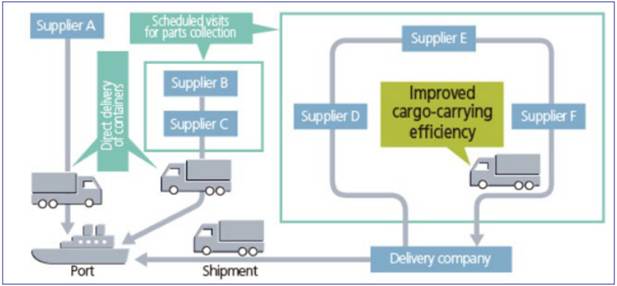
At that moment, Luciano handed over and explained to Mr. Luiz the supply chain design that he had received from the client himself (see Figure 1).
After understanding the needs and supply chain of the new client, all relayed by Luciano, Mr. Luiz called José Carlos and said: “Good morning, José Carlos, how are you? Can you come to my office now? I need to talk to you and explain about a new demand and see if you can make a project proposal for the import logistics chain to present to a potential new client.”
José Carlos replied: “Mr. Luiz, I will only be able to meet at 2 PM, as I am busy helping a client with an import process that is stalled at the Navegantes terminal. Is that alright?” Mr. Luiz then responded and concluded the conversation: “Okay, I’ll see you in my office at 2 PM, then. Thank you and see you later.”
UNDERSTANDING THE CLIENT’S LOGISTICS CHAIN
At 2 PM sharp, José Carlos went to Mr. Luiz’s office and knocked on the door: “Good afternoon, Mr. Luiz, how can I help you?” “José Carlos, I have a great mission for you, and I know you have enough competence to carry it out,” replied the director, continuing after seeing the manager’s proud smile: “This morning Luciano from sales came to talk to me and said that he has a potential new client and that he intends to develop an import operation for printers and professional supplies from China.” To help José Carlos understand the client’s operation more easily, Mr. Luiz presented Figure 1, which describes the client’s current supply chain.
Next, Mr Luiz explained: “As you can see, the client’s supply chain involves six suppliers (A, B, C, D, E, and F) and four road carriers. One carrier collects FTL (Full Truck Load2) containers from supplier A. Another carrier collects containers, also FTL, from suppliers B and C, both following a schedule defined by the new client. These containers are delivered directly to the port of origin. A third carrier collects smaller-volume products using a milk-run3 strategy from suppliers D, E, and F, all located in the Shenzhen region. It then consolidates the smaller loads in the carrier’s warehouse. In this warehouse, the cargo is then loaded into containers (FTL) and shipped to the designated port of origin via a fourth carrier. As you know, in the country of origin, Velox has several partners, including customs brokers and quality control, as needed. In addition, the client already has a contracted logistics operator with facilities in the city of Navegantes/SC, where the cargo should be delivered.” “sent.”
Mr Luiz continued to bombard José Carlos with more information: “According to our sales representative, the forecast for this operation is to bring in 20 40-foot containers per month, with a variation of 5 containers, that is, between 15 and 25 per month.” He then added: “Each container holds 24 pallets with 16 boxes of printers, costing on average R$192,000 each in CIF4 terms. The sales representative also informed that the maritime transport rate will be adjusted by the shipping company for the proposal, based on the ports of origin in Shenzhen and the port of destination in Brazil. The exchange rate will be US$1 = R$5, and the Incoterm5 will be EXW (Ex Works), indicating that the importer assumes all costs and risks. Consider in your calculations that we will have five containers per Import Declaration (DI) and four DIs per month.”
José Carlos noted all the information and looked somewhat confused at Mr. Luiz, who told him: “I would like to emphasize the importance of this new client, and I want you to create a project that guarantees excellence in their operation, that is, that avoids errors that could affect the new client’s experience, since they had problems with the last trader; therefore, we cannot make mistakes.”
After hearing the instructions, José Carlos replied: “Of course, we will carry out an excellent end-to-end import operation. I myself will design and oversee the entire project until implementation. I will design the operation from a port in Shenzhen, as we have several options, to the logistics operator’s warehouse in Navegantes, as we also have several destination port options.”
Smiling at José Carlos, Mr Luiz requested: “I would like you to include in the analysis project the total logistics cost, considering all import costs, in addition to transportation, inventory (cyclical, security, and in transit), and customer warehousing costs. The latter is based on information provided by the customer (as per Table 1). The sales representative informed us that the customer wants an import chain with the lowest total import cost, the shortest total lead time, while maintaining high reliability for the new customer in Brazil. As you know, the shorter the lead time, the lower the inventory level in the import channel. The reliability of the operation will guarantee the availability of the new customer’s products to consumers. Both have an impact on the total import cost.”
Then, Mr Luiz asked José Carlos: “Do you believe it is feasible to present the project to the customer next week?” To which José Carlos replied: “Of course, I will start the surveys immediately.” At the end of the meeting, the director asked the manager if he had understood, and he affirmed that he had. Then Mr Luiz stood up, shook José Carlos’s hand, thanked him, said goodbye, and returned to his computer.
José Carlos then returned to his desk. He knew he would need help and called his team - Felipe and Jair. Felipe is responsible for operational contract management, and Jair is responsible for contacting the shipping companies’ freight forwarders. He began by explaining to the two: “Dear colleagues, I received a mission from Mr Luiz to design an import chain for a new client, and I need your help.” He looked at Jair and asked: “What agreement do we have with the shipping company on the China-to-Brazil route?” Jair replied: “Velox has an agreement with the shipping company’s freight forwarder for 15 days of free time and a daily demurrage of US$80.” José Carlos took note and thanked him.
Next, Felipe asked: “What will be the port of origin in China? And where do the containers need to be delivered?” Then José Carlos replied: “I haven’t done that analysis yet, but I know there are approximately 20 containers per month and that they will leave from one of the ports in Shenzhen and need to be delivered to the logistics operator in Navegantes, from where the products will be distributed to the end customers of this new Velox client. But I also don’t know yet which destination port we will use, as I need to analyse the data first. Please, Felipe, gather all the data on operational costs. According to Mr Luiz, the new client requires the operation to achieve the lowest total import cost and a reduced total lead time, while maintaining high reliability that will impact the service level (stock availability) for the new client’s end consumers. In other words, we cannot fail! I count on your help in this project. Jair, I need the routes from the ports of Shenzhen to Brazil.” “Felipe, don’t forget the data on operational costs and port deadlines.”
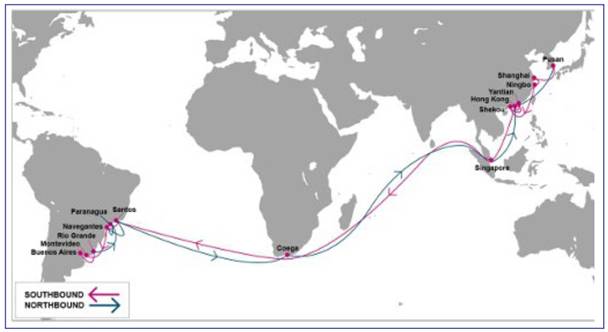
After saying goodbye, everyone returned to their tasks. Based on this information, José Carlos began the operation project, planning to present at least two proposals to the client. He agreed with Mr Luiz to present a flowchart covering all the necessary steps for preparing the proposals, starting with surveying the availability of maritime transport routes from China to Brazil, originating from Shenzhen. At that moment, the data Jair sent about routes from China to Brazil arrived in his inbox, as shown in Figure 2.
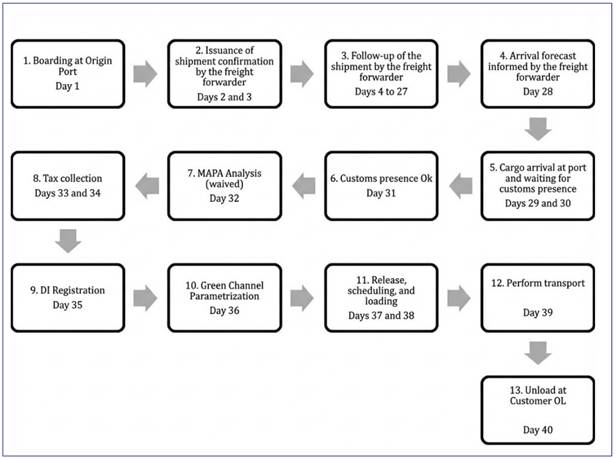
However, as José Carlos already knew, some operational and bureaucratic steps are not included in the total transit time. Therefore, he designed a flowchart detailing all operations (total import lead time) from the port of Shekou to the destination port, the Portonave terminal in Navegantes/SC - as shown in Figure 3. But there were other options.

José Carlos decided to begin the analysis with the direct route used in maritime transport, with a total transit time, including stopovers, of 34 days from the port of origin in Shekou to the final port of the route in Navegantes.
At that moment, Felipe, an import analyst, delivered all the cost and timeframe data for each stage of the import requested by José Carlos (see tables1,2, 3, 4,5,6,7 to 8 in the Appendices), who thanked the employee.
José Carlos and his team knew they could also explore other destination ports for the client’s import, such as Santos/SP, Paranaguá/PR, or Itapoá/SC. In addition, when analysing special customs regimes, customs transit stands out as an efficient mechanism for transferring goods between primary and secondary zones. The proposal could include using the Port of Santos/SP with the Customs Transit Declaration (DTA) resource, including removal costs, but without considering taxes. José Carlos identified the Mercosur Common Nomenclature (NCM), specifically NCM 8477.80.90 (see Table 3), as appropriate, and simulated the taxes collected upon the goods’ arrival (Receita Federal do Brasil, 2023). Felipe assisted by providing operational data on container storage, transportation, and port handling at each port (see Tables 4 5,6,7 to 8 in the Annexes and Appendices). After release, José Carlos planned the land transport to the client’s logistics operator’s warehouse in Navegantes, taking into account distance, transit time, and costs (see Table 2 in the Annexes and Appendices). With the gathered information, it was possible to develop the complete import chain for the new client’s project.
WHAT ARE THE ALTERNATIVES FOR CONFIGURING THE IMPORT LOGISTICS CHAIN?
Before the meeting to present alternative configurations for the import logistics chain for the potential new client, Mr Luiz and Luciano from sales, José Carlos called a preliminary meeting with his team - Felipe and Jair - to clarify some doubts. He began by talking about the ports of origin and destination: “In Shenzhen, we have two port options. We can bring it through the port of Shekou or the port of Yantian, right?”. Upon hearing this, everyone agreed, and José Carlos continued: “Regarding the ports of destination, we have several options, such as the Port of Navegantes, where the client’s logistics operator is located, which will reduce land transport costs. But we can also propose bringing the cargo through the Port of Santos/SP, or Paranaguá/PR, or Itapoá/SC, as we can analyse the fiscal impact, even knowing about the increase in land transport costs.”
The team agreed with José Carlos, who spoke and concluded the meeting: “Now I will do all the necessary quantitative analyses to present the project to Mr Luiz and Luciano from the sales department, before deciding which is the best option to present to the new client. My deadline is too short to analyse all the options. I believe I will focus on the options of bringing it through Shekou, as we already have other operations there and some service providers with customs brokers and quality control at the origin. In Yantian, we will need to develop new service providers. In addition, the Shekou port is closer to the new client’s Chinese suppliers. As a destination port, I will focus on Navegantes, as we will save on road freight, and Santos, as it is more efficient for releasing cargo. Thank you for the data and for your support in the project. If I need any more information, I will contact you.”
Now, José Carlos needs to race against time to analyse his options and prepare the report to present to Mr Luiz and Luciano. But first, he needs to know: What is the logistical cost of the import chain to the chosen ports of origin/destination? What is the total lead time of the import chain through the chosen ports of origin/destination? How to guarantee the reliability of the operation?
These questions have become priorities to win over and guarantee the success of the new client’s operation. Therefore, based on these criteria, what should be the best option for importing the new client’s products from China into the Brazilian market?
References
-
Receita Federal do Brasil(2023). Simulador do Tratamento Tributário e Administrativo das Importações https://www4.receita.fazenda.gov.br/simulador/BuscaNCM.jsp
» https://www4.receita.fazenda.gov.br/simulador/BuscaNCM.jsp - Zilli, J. C., Isoppo, M., Souza, I. R., & Santos, M. H. (2014). Inserção Internacional via Trading Company: Um Estudo Junto as Trading Companies Localizadas em Criciúma-Santa Catarina.Revista de Administração e Negócios da Amazônia, 6(2), 59-74.
-
1
Sourcing is the process of identifying, evaluating, and negotiating with suppliers
-
2
Full Truck Load - is a term used in road transport to refer to the transport of a load that occupies the entire truck. It is also known as full load, full truckload, or dedicated transport.
-
3
Milk run, or “milk delivery run,” is a logistics system that optimizes the distribution of goods. It consists of a predefined route where a single vehicle collects and delivers different items.
-
4
CIF is an acronym that stands for “Cost, Insurance and Freight”. It is a shipping method in which the seller is responsible for the transportation and insurance of the goods until they reach the recipient.
-
5
Incoterms are the International Commercial Terms, a set of rules that define the obligations and responsibilities of buyers and sellers in international transactions.
-
30
TEACHING NOTES - The teaching notes for this case have restricted access and are available only to faculty and instructors affiliated with the academic institution upon request at: https://periodicos.fgv.br/cadernosebape/article/view/94716
-
31
[Translated version]Note: All quotes in English translated by this article’s translator.
-
DATA AVAILABILITY
All the data supporting the results of this study were published in the article itself.
-
REVIEWERS
The reviewers did not authorize the disclosure of their identities.
-
PEER REVIEW REPORT
The peer review report is available at this link: https://periodicos.fgv.br/rap/article/view/97059
-
6
DTA - Stands for Customs Transit Declaration.
-
7
DTC - These are customs regimes that allow the transport of goods between customs-controlled areas.
-
8
TAPS - Fee for document processing and coordination of these procedures under the Customs Transit Declaration, Simplified Customs Transit Procedure, or Export Transit Accompanying Document regime.
-
9
THC2 - is the abbreviation for Terminal Handling Charge 2, which is a port fee charged for the service of segregating and delivering containers in backport terminals or dry ports.
-
10
BL - (Bill of Lading) It is a document that certifies the transport of maritime cargo between ports, and is fundamental for foreign trade. It is also known as a maritime bill of lading.
-
11
Isps Code - The International Ship and Port Facility Security Code is a set of security measures that apply to ships and ports.
APPENDICES
Secondary data obtained from consulting projects by the authors in the area and from public data from port terminals and shipping companies.
Edited by
All the data supporting the results of this study were published in the article itself.

 Source: Elaborated by the authors.
 Source: Elaborated by the authors.
 Source: Elaborated by the authors.