 Adoption of good practices in the maintenance of central venous catheter in a cardiovascular unit: cross-sectional study
ABSTRACT
Objective: Analyze the adherence of the nursing team to good practices related to the maintenance of the central venous catheter in cardiovascular units; and categorize the weaknesses, strengths, opportunities and threats of good practices in these units according to the SWOT matrix.
Method: An observational, transversal, quantitative study with data collected in the cardiovascular units of the University Hospital of Rio de Janeiro, through clinical auditing, aiming at the care opportunities in the maintenance of the central catheter. Analysis by simple descriptive statistics.
Results: The maintenance of curatives had the highest adhesion rate, hand hygiene and waiting for the drying of the alcohol solution after the scrub the hub presented the lowest percentages.
Conclusion: The team adheres to some recommended practices, but the low adherence in hand hygiene and hub disinfection indicates the need for improvement in preventive care.
DESCRIPTORS:
Central Venous Catheters; Cardiology Service; Hospital; Catheter-Related Infections; Patient Safety; Nursing Care.
HIGHLIGHTS
1. There was a high adherence rate in the maintenance of curatives.
2. Hand hygiene achieved low adherence.
3. Economic factors limit practices essential to preventing infections.
4. There is a need to improve the preventive care of BSI.
RESUMO
Objetivo: Analisar a adesão da equipe de enfermagem às boas práticas relacionadas à manutenção do cateter venoso central em unidades cardiointensivas; e categorizar as fragilidades, fortalezas, oportunidades e ameaças das boas práticas nessas unidades de acordo com a matriz SWOT.
Método: Estudo observacional, transversal, quantitativo, com dados coletados nas unidades cardiointensivas de Hospital Universitário do Rio de Janeiro, através de auditoria clínica, visando as oportunidades dos cuidados na manutenção do cateter central. Análise por estatística descritiva simples.
Resultados: A manutenção de curativos teve a maior taxa de adesão, a higienização das mãos e espera pela secagem da solução alcoólica após o scrub the hub apresentaram os menores percentuais.
Conclusão: A equipe adere algumas práticas recomendadas, mas a baixa adesão na higienização das mãos e na desinfecção do hub indica a necessidade de melhoria nos cuidados preventivos.
DESCRITORES:
Cateteres Venosos Centrais; Serviço Hospitalar de Cardiologia; Infecções Relacionadas a Cateter; Segurança do Paciente; Cuidados de Enfermagem.
HIGHLIGHTS
1. Houve alta taxa de adesão na manutenção de curativos.
2. A higiene de mãos obteve baixa adesão.
3. Fatores econômicos limitam práticas essenciais para prevenir infecções.
4. Há necessidade de melhoria nos cuidados preventivos de ICS.
RESUMEN
Objetivo: Analizar la adhesión del equipo de enfermería a las buenas prácticas relacionadas con el mantenimiento del catéter venoso central en unidades de cuidados intensivos cardíacos; y categorizar las debilidades, fortalezas, oportunidades y amenazas de las buenas prácticas en estas unidades de acuerdo con la matriz SWOT.
Método: Estudio observacional, transversal y cuantitativo, con datos recopilados en las unidades de cuidados intensivos cardíacos del Hospital Universitario de Rio de Janeiro, mediante una auditoría clínica, con el objetivo de identificar oportunidades de mejora en el cuidado del mantenimiento de los catéteres centrales. Análisis mediante estadística descriptiva simple.
Resultados: El mantenimiento de los vendajes tuvo la mayor tasa de adherencia, mientras que la higiene de las manos y la espera hasta que se secara la solución alcohólica después del scrub the hub presentaron los porcentajes más bajos.
Conclusión: El equipo sigue algunas prácticas recomendadas, pero la baja adherencia a la higiene de las manos y la desinfección del hub indica la necesidad de mejorar las medidas preventivas.
DESCRIPTORES:
Catéteres Venosos Centrales; Servicio de Cardiología en Hospital; Infecciones Relacionadas con Catéteres; Seguridad del Paciente; Atención de Enfermería.
HIGHLIGHTS
1. Hubo una alta tasa de adherencia al mantenimiento de los vendajes.
2. La higiene de las manos obtuvo una baja adherencia.
3. Los factores económicos limitan las prácticas esenciales para prevenir infecciones.
4. Es necesario mejorar la atención preventiva de la ITS.
INTRODUCTION
The cardio-intensive units aim to assist critical patients with cardiovascular diseases, demanding continuous monitoring and high-complex technological resources. In these scenarios, the use of invasive devices, such as the central venous catheter (CVC), is frequent, although not limited to this environment, as the CVC is widely employed in other hospital units. Despite its relevance for treatment, the use of CVC is associated with important risks, such as bloodstream infections (BSI)1.
BSI in Intensive Care Units (ICU) is a global problem that raises mortality, hospitalization time and healthcare costs. In Brazil, the laboratory-confirmed incidence of primary BSI in 2022 was 3.95 per 1,000 CVC/day in adult ICUs. Few studies evaluate the economic impact of these infections in the country, but estimates point out that the cost of each case can vary from 7,906 to 89,866 U.S. dollars 2-3.
Despite the high incidence, the primary BSI presents a wide possibility of prevention by adopting evidence-based measures, such as adherence to the bundles (packages of good practice), which significantly contribute to both reducing infection rates and qualifying care3-4.
In this context, tools can be employed to evaluate risk factors for health-related complications, such as the SWOT matrix, which identifies strengths and weaknesses in the internal work environment, as well as external opportunities and threats, through four variables: Strengths, Weaknesses, Opportunities and Threats5-6.
Therefore, the study aims to analyze the adherence of the nursing team to good practices related to the maintenance of CVC in cardiovascular units; and categorize the weaknesses, strengths, opportunities and threats of good practices in these units according to the SWOT matrix.
METHOD
Observational, transversal and quantitative study, conducted according to the initiative Strengthening the Reporting of Observational Studies in Epidemiology (STROBE). The data collection took place between May and September 2024, in the morning period, at a large university hospital in Rio de Janeiro (RJ), in the clinical and surgical cardiovascular units. Clinical auditing with sampling was used for convenience, depending on the researcher’s availability and observation opportunities, not setting up daily collection.
Nursing professionals who act in direct care to the patient using CVC, who agreed to participate in the study after submission and signature of the Terms of Free Informed Consent, were eligible as study population.
As inclusion criteria: nursing technicians and nurses from the clinical and surgical cardiovascular units who act directly in patient care. Exclusion criteria: nursing technicians and diarist nurses who work in the administrative and managerial areas of these sectors.
An instrument developed from the best practices described in the literature concerning the maintenance of CVC for the prevention of catheter-related bloodstream infection (CRBSI) was used3,7-9. The checklist considered 15 verification opportunities, including the identification of the professional category responsible for care. The completion was performed by the researcher during the direct observation of the care practice, and the variables analyzed are presented in Chart 1.
The metrics were “compliant”, “non-compliant” and “not applicable”, according to the manipulation of the catheter by the professional.
During the study, the CVC manipulation of each professional was evaluated through direct observation by the researcher and, immediately after the observation, the data collection form was filled in.
For each manipulation of the CVC, the conformity or non-compliance of the checklist items regarding good practices for catheter maintenance was observed. It was considered compliant when the professional adhered to all the items described in the literature necessary for that observed practice.
Minimizing the occurrence of performance biases was a concern in this study, as participants could modify their behavior by knowing they were being observed. To reduce this risk, the data collection took place a few months after the signing of the Ethics and Research Committee and the observation of the manipulation of the CVC was conducted in a discrete manner, keeping it at a distance that allowed the visualization without generating embarrassment or an explicit sense of evaluation.
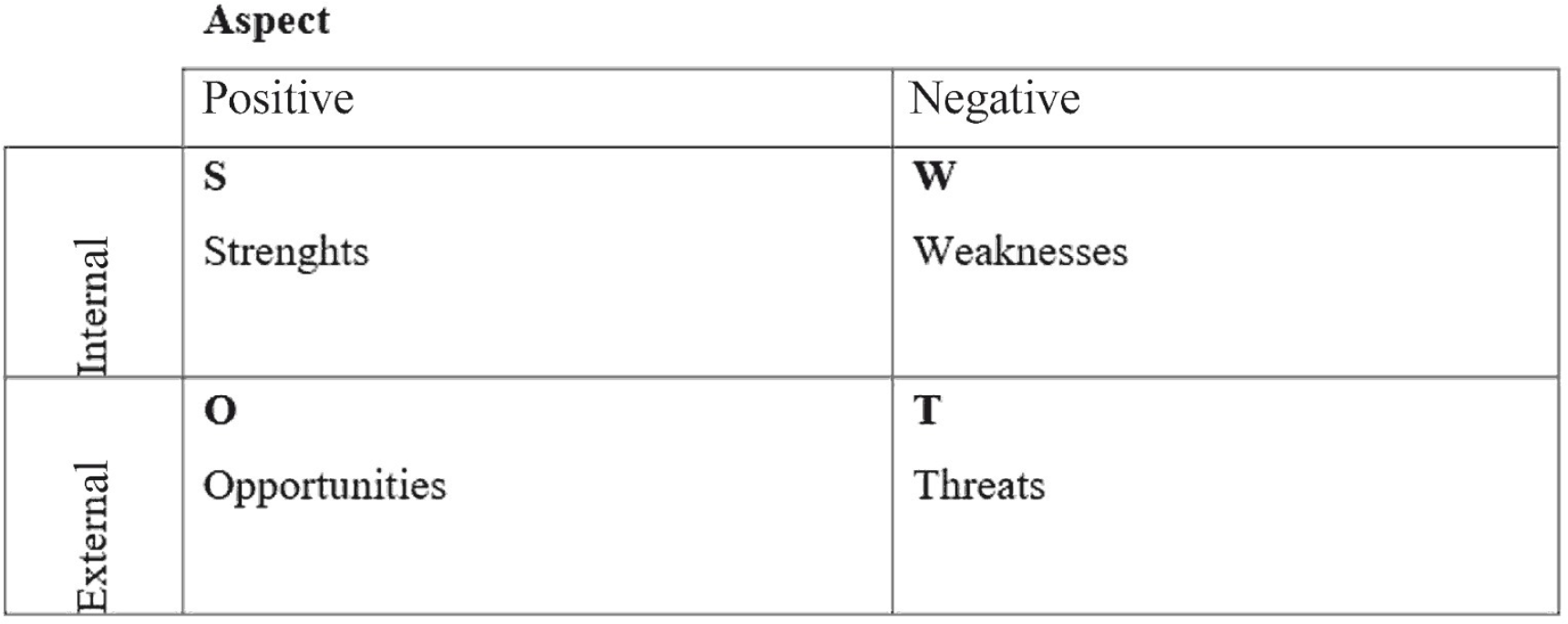
The results obtained were transported to a Microsoft Excel® spreadsheet. Simple descriptive statistical analysis was performed, using the absolute and relative values for the variables of the checklist. The results were categorized using the SWOT matrix (Figure 1).
SWOT matrix. Rio de Janeiro. RJ, Brasil, 2024 Source: Mendes VR, Santos EM, Santos ICJ, Silva IR, Silva LS, Silva CSO (2016)5.
For the execution of this matrix, one must make a list of everything that is/is appropriate or not. Subsequently, separate the internal factors - which the units can directly control - and external ones - that are out of the control of the sectors 10.
Strengths are the factors that stand out, which facilitate the operation of the sector; weaknesses such as what can interfere with the process, issues that can only be manipulated directly. Opportunities and threats are the factors that the environment provides, which are completely out of the institution’s control, but which should be monitored closely.
In this study, the actions that presented a percentage equal to or greater than 70% were considered to conform to the best practices of CVC maintenance. This parameter was defined based on the standards established by entities that assess the quality of care, such as the National Accreditation Organization (ONA), which accredits health institutions that meet or exceed 80% of the quality and safety standards; and the Brazilian Health Regulatory Agency (ANVISA), which classifies as high compliance the percentages between 67% and 100% 11-12.
The study was approved by the Ethics and Research Committee, taking into account the determinations of the Guidelines and Regulatory Standards involving Human Beings established by Resolutions 466/201213 and 510/201614 of the National Council of Health, with opinion number 6653959.
RESULTS
Of the 69 professionals who agreed to participate in the survey, 34 (49%) were nurses and 35 (51%) were nursing technicians. The sample consisted of 110 observation opportunities, considering that the same professional could be observed in more than one occasion.
The applied instrument considered 15 variables related to good CVC maintenance practices. Regarding hand hygiene prior to catheter manipulation, adherence was observed in only 5.5% of the occasions. The scrub the hub before the administration of medications was performed in 38.1%, while the waiting for drying of the solution was recorded in only 5.5%. As for the flushing before and after the administration of drugs, the conformity was 65%, and the change of the sterile connector occurred in 34.6%.
Regarding the care of the curative, 100% adherence was observed both in the aseptic technique and in the absence of dirt. The alcoholic chlorhexidine was used in 58.8% of the curative exchanges, the unidirectional movements were present in 76.4%, and the waiting for drying of the alcoholic solution before occlusion was observed in 64.7%. The occlusion of the CVC osteo with appropriate material showed 100% adherence. In addition, PPE use was recorded in 88.2% of the times.
Finally, the validity of the curative was respected in 95.5% of the occasions, and the insertion of the completion date occurred in 88.2%. The consolidated results are shown in Table 1. According to the conformities and non-conformities found in practices, an analysis applied to the SWOT matrix, described in Chart 2, was carried out.
Frequency of observations related to adherence to good practices. Rio de Janeiro, RJ, Brazil, 2024
SWOT analysis of cardiovascular units regarding CVC manipulation. Rio de Janeiro, RJ, Brazil, 2024
DISCUSSION
Most of the observed professionals did not perform hand hygiene, or did not perform properly. Corroborating with this research, observational studies conducted in adult ICUs showed an adherence rate of only 8% and 23.98% of hand hygiene15-16.
The authors reinforce that hand hygiene is the simplest and most effective practice to reduce and prevent health care-related infections (HCAIs), however, insufficient adherence among professionals remains the main factor in the spread of these infections17.
An integrative review consisting of 27 articles points out that the low adherence to this practice is not only due to theoretical ignorance of the act, but also to the lack of incentive, overload of tasks, misunderstanding of the risks and structural deficiencies of the institution18.
Regarding the administration of medication, a study that evaluated care in the maintenance of peripheral catheters also obtained a high incidence of disconformity in disinfection of the connections, with only 10% of the observed practices in conformity19. Another study, conducted in times of COVID-19, demonstrated 46% adherence of the scrub the hub by the team15.
It is highlighted that disinfecting the connections before each manipulation using alcohol solution with mechanical friction for 5 to 15 seconds is effective in reducing intraluminal contamination and in preventing PBI. In addition, it is essential to respect the drying time of the solution, which is 5 seconds for alcohol and 20 seconds for alcoholic chlorhexidine8.
Additionally, the adhesion of the connector switch is critical to preventing infections and reducing the colonization of microorganisms, minimizing the risk of infections associated with the catheter 20. However, low adherence to this practice was observed in this study, becoming a weakness. This fact may have occurred due to a lack of sterile connector in the units observed.
Unlike what was found in this study, a study conducted in a teaching hospital located in Curitiba demonstrated 67% conformity for the sterile connector replacement after manipulation 21.
It is emphasized that safe practice recommends replacing any single-use and sterile device with another of the same specification, as is the case with these connection occlusors, which once removed, should be discarded7,22.
Regarding the conduct of flushing before and after administration of medication, studies present variation of practices and non-adherence of professionals in its implementation 23-24.
Research that sought to understand the flushing procedure in nursing practices showed that 84.2% of nurses referred to performing it, but with different techniques. Despite this, there were inconsistencies in the washing solution, volume and size of the syringe 25.
Despite the lack of consensus on the best technique of flushing (continuous or pulsatile flow), its realization reduces the risk of thrombosis and precipitates, preventing catheter obstruction, which interrupts intravenous therapy and increases the risk of infection, since coagulated blood can serve as a conducive medium for the growth of microorganisms26.
Regarding the implementation of the treatment, the results of this study are consistent with research conducted in a University Hospital in Fortaleza, which demonstrated the use of PPEs by nurses during the procedure, as well as the totality of the practice performed in the aseptic technique and the use of the recommended coverage. However, only 50% identified the curative 27.
Similarly, another study is similar to identifying the use of 0.5% alcoholic chlorhexidine for catheter osteo antiseptic in 86% of the observations. However, only 44% performed unidirectional movement and 20% waited for spontaneous drying, contrary to what was found in the current study15.
It should be noted that chlorhexidine is a germicidal with immediate action and prolonged residual effect, presenting low toxicity and poor absorption by the entire skin. When combined with alcohol, this action is intensified, making the alcoholic solution more effective. For this reason, it is recommended to use alcoholic chlorhexidine for curing CVC28.
In addition, the literature also guides the use of PPE in the manipulation of CVC and the use of appropriate coverage as a strategy for BSI prevention. However, the delay in the exchange of coverage that loses its integrity or validity is associated with an increase in this infection29,3.
There was low adherence to several practices essential for the prevention of CRBSI. In this context, the SWOT matrix is configured as a relevant tool to identify strengths, weaknesses, opportunities and institutional threats related to the subject, by allowing a strategic analysis of the environments, in addition to offering subsidy for decision-making30.
Among the limitations of the study are the use of a convenience sample, which may compromise the representativity of the results; in addition to the low availability of sterile connectors, a limitation of an institutional nature that may have influenced the results related to CVC maintenance practices.
CONCLUSION
The study made it possible to know the care of the nursing team related to the maintenance of CVC in the cardiovascular units. The analysis demonstrated that the team adheres to some recommended practices, such as performing curatives with aseptic technique and proper catheter occlusion - which were categorized as strengths. In contrast, low adherence was identified in practices such as hand hygiene and hub disinfection, indicating the need for improvements in preventive care.
The SWOT analysis allowed us to identify aspects that need to be evaluated and worked to reach compliance at vulnerability points. The presence of a qualified staff and the use of some safety practices strengthen assistance, but institutional and economic factors limit the adoption of essential practices to prevent infections.
It is suggested for further studies to conduct qualitative analysis to understand the reason for non-conformities in practices, especially hand hygiene and scrub the hub.
The study contributes to the possibility of improving the care practice, improving the aspects that need adjustments and strengthening those that already show good adherence. These actions directly impact patient safety, the quality of care and the reduction of complications related to venous access, as well as the reduction of hospital costs and hospitalization time.
-
HOW TO REFERENCE THIS ARTICLE:
Oliveira VCS, Marins ALC, David MJV, Andrade TQ, Camerini FG, Franco AS, et al. Adoption of good practices in the maintenance of central venous catheter in a cardiovascular unit: cross-sectional study. Cogitare Enferm [Internet]. 2025 [cited “insert year, month and day”];30:e98977en. Available from: https://doi.org/10.1590/ce.v30i.98977en
Data availability:
The authors declare that all data are fully available within the article.
References
-
1 de Brito NNS, Soares SSS, Carvalho EC, de Souza DG, Franco AS, Almeida LF, et al. Environmental stressors in a cardio-intensive unit and Nursing care planning: a descriptive study. Online Braz J Nurs [Internet]. 2021 [cited 2023 Jun 30];20:e20216539. Available from: http://dx.doi.org/10.17665/1676-4285.20216539
» http://dx.doi.org/10.17665/1676-4285.20216539 -
2 Agência Nacional de Vigilância Sanitária (ANVISA) [Internet]. Brasília: ANVISA; [2023] [cited 2023 Nov 12]. Boletim Segurança do Paciente e Qualidade em Serviços de Saúde nº 30: Avaliação Nacional dos indicadores de IRAS e RM 2022;[about 11 screens]. Available from: https://www.gov.br/anvisa/pt-br/centraisdeconteudo/publicacoes/servicosdesaude/boletins-e-relatorios-das-notificacoes-de-iras-e-outros-eventos-adversos-1/boletins-e-relatorios-das-notificacoes-de-iras-e-outros-eventos-adversos
» https://www.gov.br/anvisa/pt-br/centraisdeconteudo/publicacoes/servicosdesaude/boletins-e-relatorios-das-notificacoes-de-iras-e-outros-eventos-adversos-1/boletins-e-relatorios-das-notificacoes-de-iras-e-outros-eventos-adversos -
3 Agência Nacional de Vigilância Sanitária (ANVISA). Medidas de prevenção de infecção relacionada à assistência à saúde. Brasília: ANVISA; 2017 [cited 2023 May 30]. 126 p. Available from: https://www.gov.br/anvisa/pt-br/centraisdeconteudo/publicacoes/servicosdesaude/publicacoes/caderno-4-medidas-de-prevencao-de-infeccao-relacionada-a-assistencia-a-saude.pdf
» https://www.gov.br/anvisa/pt-br/centraisdeconteudo/publicacoes/servicosdesaude/publicacoes/caderno-4-medidas-de-prevencao-de-infeccao-relacionada-a-assistencia-a-saude.pdf -
4 de Lima YC, Firmino MG, Costa ES, Soares TTFL, da Silva JLB, Ramos ASN, et al. Contribuições da enfermagem na prevenção de infecções relacionadas ao cateter venoso central em unidades de terapia intensiva: revisão integrative. Rev Eletrônica Acervo Enferm [Internet]. 2021 [cited 2024 Nov 2];13:e8455. Available from: https://doi.org/10.25248/reaenf.e8455.2021
» https://doi.org/10.25248/reaenf.e8455.2021 -
5 Mendes VR, Santos EM, Santos ICJ, Silva IR, Silva LS, Silva CSO. Matriz SWOT como ferramenta estratégica no gerenciamento da assistência de enfermagem: um relato de experiência em um hospital de ensino. Rev Gest Saúde [Internet]. 2016 [cited 2023 Jun 5];7(3):1236-43. Available from: https://periodicos.unb.br/index.php/rgs/article/view/3643
» https://periodicos.unb.br/index.php/rgs/article/view/3643 -
6 de Souza CC, de Jesus ES, Barreto GMN. Auditoria de enfermagem e sua importância para gestão de qualidade no serviço de saúde. In: DE Farias HPS, organizators. Os desafios das políticas sociais, inclusão e o trabalho em rede na promoção da qualidade de vida. Rio de Janeiro: Editora Epitaya; 2022 [cited 2024 Oct 10]. p. 153-65. Available from: https://portal.epitaya.com.br/index.php/ebooks/article/view/354/245
» https://portal.epitaya.com.br/index.php/ebooks/article/view/354/245 -
7 Bastos CDJ, Cordoba LEN, da Silva ER. Complicações e boas práticas assistenciais relacionadas ao cateter venoso central para hemodiálise: revisão integrativa da literatura. Rev Recien [Internet]. 2022 [cited 2023 Aug 1];12(39):194-208. Available from: https://doi.org/10.24276/rrecien2022.12.39.194-208
» https://doi.org/10.24276/rrecien2022.12.39.194-208 -
8 Gorski LA, Hadaway L, Hagle ME, Broadhurst D, Clare S, Kleidon T, Meyer BM, et al. Infusion therapy standards of practice, 8th Edition. J Infus Nurs [Internet]. 2021 [cited 2023 Nov 20];44(1S):p S1-S224. Available from: https://doi.org/10.1097/NAN.0000000000000396
» https://doi.org/10.1097/NAN.0000000000000396 -
9 Lee J, Chen H. Highlights on revised recommendations on prevention of CABSI. In: Symposium on Prevention of Healthcare-associated Infections in Hospitals and Community Institutions [Internet]; 2019 Jan 17-18; Kowloon, Hong Kong. Hong Kong: Infectious Disease Control Training Centre, Hospital Authority/Infection Control Branch, Centre for Health Protection; 2019 [cited 2023 Nov 25]. Available from: https://icidportal.ha.org.hk/Home/File?path=/Training%20Calendar/139/17.%20CABSI_HAI%20Symposium%202019_icidportal.pdf
» https://icidportal.ha.org.hk/Home/File?path=/Training%20Calendar/139/17.%20CABSI_HAI%20Symposium%202019_icidportal.pdf -
10 Campos, R. Matriz SWOT e a gestão da qualidade. Ministério dos Transportes [Internet]. 2016 Sep 9 [cited 2025 Sep 30];Artigos - Gestão Estratégica:[about 3 screens]. Available from: https://www.gov.br/transportes/pt-br/assuntos/portal-da-estrategia/artigos-gestao-estrategica/matriz-swot-e-a-gestao-da-qualidade
» https://www.gov.br/transportes/pt-br/assuntos/portal-da-estrategia/artigos-gestao-estrategica/matriz-swot-e-a-gestao-da-qualidade -
11 Agência Nacional de Vigilância Sanitária (ANVISA). Relatório da avaliação nacional das práticas de segurança do paciente: hospitais com unidade de terapia intensiva (UTI) - 2023 (Ano VIII) [Internet]. Brasília: ANVISA; 2023 [cited 2024 Jun 3]. 125 p. Available from: https://www.gov.br/anvisa/pt-br/assuntos/servicosdesaude/seguranca-do-paciente/avaliacao-nacional-das-praticas-de-seguranca-do-paciente/RelatorioAvaliacaoPraticasHospitaiscomUTI2023_05.04.24.pdf
» https://www.gov.br/anvisa/pt-br/assuntos/servicosdesaude/seguranca-do-paciente/avaliacao-nacional-das-praticas-de-seguranca-do-paciente/RelatorioAvaliacaoPraticasHospitaiscomUTI2023_05.04.24.pdf -
12 Organização Nacional de Acreditação (ONA) [Internet]. São Paulo: ONA; [2019] [cited 2024 Oct 29]. O que é acreditação?;[about 25 screens]. Available from: https://www.ona.org.br/acreditacao/o-que-e-acreditacao/
» https://www.ona.org.br/acreditacao/o-que-e-acreditacao/ -
13 Conselho Nacional de Saúde (BR). Resolução nº 466, de 12 de dezembro de 2012. Dispõe sobre diretrizes e normas regulamentadoras de pesquisas envolvendo seres humanos. Diário Oficial da União [Internet]. 2013 Jun 13 [cited 2023 Aug 9];150(112 Seção 1):59. Available from: https://pesquisa.in.gov.br/imprensa/jsp/visualiza/index.jsp?data=13/06/2013&jornal=1&pagina=59&totalArquivos=140
» https://pesquisa.in.gov.br/imprensa/jsp/visualiza/index.jsp?data=13/06/2013&jornal=1&pagina=59&totalArquivos=140 -
14 Brasil. Resolução nº 510, de 07 de abril de 2016. Dispõe sobre as normas aplicáveis a pesquisas em Ciências Humanas e Sociais. Diário Oficial da República Federativa do Brasil, Brasília, 2016 May 24. [cited 2023 Aug 09]. Available from: https://www.gov.br/conselho-nacional-de-saude/pt-br/acesso-a-informacao/legislacao/resolucoes/2016/resolucao-no-510.pdf/view
» https://www.gov.br/conselho-nacional-de-saude/pt-br/acesso-a-informacao/legislacao/resolucoes/2016/resolucao-no-510.pdf/view -
15 Dias TO, Assad LG, de Paula VG, de Almeida LF, de Moraes EB, Nassar PRB. Good practices in central venous catheter maintenance in time of COVID-19: an observational study. Rev Bras Enferm [Internet]. 2022 [cited 2024 Oct 21];75(6):e20210397. Available from: https://doi.org/10.1590/0034-7167-2021-0397
» https://doi.org/10.1590/0034-7167-2021-0397 -
16 Valim MD, Reis GF, Santos BS, Goulart LS, Bortolini J, Cardoso JDC. Adherence to hand hygiene technique: an observational study. Acta Paul Enferm [Internet]. 2024 [cited 2024 Oct 10];37:eAPE001262. Available from: http://dx.doi.org/10.37689/acta-ape/2024AO0001262
» http://dx.doi.org/10.37689/acta-ape/2024AO0001262 -
17 Maraş GB, Kocaçal E, Bahar A. Healthcare professionals’ hand hygiene: perspectives of nursing student’s in patients/relatives role. Acta Paul Enferm [Internet]. 2024 [cited 2024 Oct 8];37:eAPE003511. Available from: https://doi.org/10.37689/acta-ape/2024AO00000351
» https://doi.org/10.37689/acta-ape/2024AO00000351 -
18 dos Santos JN, Vador RMF, Cunha FV, Barbosa FAF. Atuação do enfermeiro na prevenção da infecção associada à Cateter Venoso Central (CVC). Braz J Health Rev [Internet]. 2021 [cited 2024 Oct 11];4(3):12328-45. Available from: https://doi.org/10.34119/bjhrv4n3-209
» https://doi.org/10.34119/bjhrv4n3-209 -
19 Gonçalves KPO, Sabino KN, de Azevedo RVM, Canhestro MR. Evaluation of maintenance care for peripheral venue catheters through indicators. REME - Rev Min Enferm [Internet]. 2020 [cited 2024 Oct 10];23:e-1251. Available from: http://dx.doi.org/10.5935/1415-2762.20190099
» http://dx.doi.org/10.5935/1415-2762.20190099 -
20 Sengul T, Guven B, Ocakci AF, Kaya N. Connectors as a risk factor for blood-associated infections (3-way stopcock and needleless connector): a randomized-experimental study. Am J Infect Control [Internet]. 2020 [cited 2024 Oct 28];48(3):275-80. Available from: https://doi.org/10.1016/j.ajic.2019.08.020
» https://doi.org/10.1016/j.ajic.2019.08.020 -
21 de Quadros AI, Stocco JGD, Cristoff C, Alcantara CB, Pimenta AM, Machado BGS. Adherence to central venous catheter maintenance bundle in an intensive care unit. Rev Esc Enferm USP [Internet]. 2022 [cited 2024 Oct 11];56:e20220077. Available from: https://doi.org/10.1590/1980-220X-REEUSP-2022-0077en
» https://doi.org/10.1590/1980-220X-REEUSP-2022-0077en -
22 da Silva JT, Amaral JS, Lima LB, de Aguiar JW. Impacto da técnica Scrub the Hub na prevenção de infecção primária de corrente sanguínea no setor de terapia neonatal. Revista FT [Internet]. 2024 [cited 2024 Oct 10];28(134). Available from: https://doi.org/10.5281/zenodo.11200347
» https://doi.org/10.5281/zenodo.11200347 -
23 Braga LM, Parreira PMSD, Arreguy-Sena C, Carlos DM, Mónico LSM, Henriques MAP. Incidence rate and the use of flushing in the prevention of obstructions of the peripheral venous catheter. Texto & Contexto Enferm [Internet]. 2018 [cited 2024 Oct 21];27(4):e2810017. Available from: https://doi.org/10.1590/0104-07072018002810017
» https://doi.org/10.1590/0104-07072018002810017 -
24 Boord C. Pulsatile flushing: a review of the literature. J Infus Nurs [Internet]. 2019 [cited 2024 Oct 21];42(1):37-4. Available from: https://doi.org/10.1097/NAN.0000000000000311
» https://doi.org/10.1097/NAN.0000000000000311 -
25 Parreira P, Vicente R, Bernardes RA, Sousa LB, Serambeque B, Costa P, et al. The flushing procedure in nursing practices: a cross-sectional study with Portuguese and Brazilian nurses. Heliyon [Internet]. 2020 [cited 2024 Oct 21];6(8):e04579. Available from: https://doi.org/10.1016/j.heliyon.2020.e04579
» https://doi.org/10.1016/j.heliyon.2020.e04579 -
26 Ribeiro GSR, Campos JF, Silva RC. What do we know about flushing for intravenous catheter maintenance in hospitalized adults? Rev Bras Enferm [Internet]. 2022 [cited 2024 Oct 14];75(5):e20210418. Available from: https://doi.org/10.1590/0034-7167-2021-0418
» https://doi.org/10.1590/0034-7167-2021-0418 -
27 Gomes MLS, de Aquino GA, Barros LM, de Queiroz PA, de Oliveira FJG, Caetano JA. Assessment of short-term central venous catheter dressing practices. Rev Enferm UERJ [Internet]. 2017 [cited 2024 Oct 19];25:e18196. Available from: http://dx.doi.org/10.12957/reuerj.2017.18196
» http://dx.doi.org/10.12957/reuerj.2017.18196 -
28 Tostes LCS, Loyola ABAT, Fraga AO, Gazzi LA, Paiva LFD, Juliano Y, et al. Alcohol (70%) versus alcoholic chlorhexidine solution (0.5%) in skin antisepsis for neuraxial blocks: a randomized clinical trial. Rev Col Bras Cir [Internet]. 2021 [cited 2024 Oct 21];48:e20202633. Available from: https://doi.org/10.1590/0100-6991e-20202633
» https://doi.org/10.1590/0100-6991e-20202633 -
29 Barbosa MM, de Almeida EJR, dos Santos TN, Messias KA, Rocha ACS, Silva FL, et al. Medidas preventivas de infecção associado ao cateter venoso central em UTI adulta. Revista FT [Internet]. 2023 [cited 2024 Oct 21];27(121). Available from: https://doi.org/10.5281/zenodo.7891697
» https://doi.org/10.5281/zenodo.7891697 -
30 Farias E, Conterno SFR, Rodrigues RM. Uso da matriz SWOT em análise sobre a formação de um Programa de Residência Multiprofissional sob a ótica de egressos. Cuadernos de Educación y Desarrollo [Internet]. 2024 [cited 2024 Oct 29];16(7):01-24. Available from: https://doi.org/10.55905/cuadv16n7-028
» https://doi.org/10.55905/cuadv16n7-028
-
Associate editor:
Dra. Luciana de Alcantara Nogueira