
 Teething beliefs and amber necklaces: a content analysis of users perspectives from Facebook comments
Abstract
This digital qualitative study conducted an inductive content analysis of 1,000 Facebook comments about the use of amber necklaces for teething symptom relief, aiming to understand users’ perceptions of this practice. The comments were divided into units of analysis (n=2,166) and coded into thematic categories in QDAMiner. Using Word Stat software, category frequencies, word clouds, and cluster analysis were determined. The Chi-square test was used to compare the distribution of categories across three distinct time points. Most comments were made by users with white personas (81.8%), female gender (96.3%), and Brazilian nationality (97.8%). The most frequent categories were “the information is useful or potentially useful” (18.8%) and “acquisition or intention to acquire the necklace” (12.1%), with respective increases of 5.9% to 23.6% and 15.7% to 24.5% over time. The frequencies of “concern/anxiety about the use of the amber necklace” and “teething experience” decreased from 5.8% to 2.0% and from 12.0% to 3.1%, respectively. Despite the reduction in reports of teething symptoms, there is a growing trend among Brazilians to consider the amber necklace a valid solution for teething symptoms.
Key words:
Tooth eruption; Amber; Social media; Qualitative research
Resumo
Estudo qualitativo digital que conduziu uma análise de conteúdo indutiva em 1.000 comentários no Facebook sobre o uso de colares de âmbar para alívio de sintomas da dentição, buscando entender as percepções dos usuários em relação a essa prática. Os comentários foram divididos em unidades de análise (n = 2.166) e codificados em categorias temáticas no QDAMiner. Com o software Word Stat, foram determinadas frequências das categorias, nuvem de palavras e análise de cluster. O teste qui-quadrado foi utilizado para comparar a distribuição das categorias em três tempos distintos. A maior parte dos comentários foi feita por usuários com personas brancas (81,8%), do sexo feminino (96,3%) e brasileiros (97,8%). As categorias mais frequentes foram “a informação é útil ou potencialmente útil” (18,8%) e “aquisição ou intenção de adquirir o colar” (12,1%), com aumentos respectivos de 5,9% para 23,6% e de 15,7% para 24,5% ao longo do tempo. As frequências de “preocupação/ansiedade sobre o uso do colar de âmbar” e “experiência de dentição” diminuíram de 5,8% para 2,0% e de 12,0% para 3,1%, respectivamente. Apesar da redução nos relatos de sintomas de dentição, há uma tendência crescente entre os brasileiros em considerar o colar de âmbar como uma solução válida para os sintomas de dentição.
Palavras-chave:
Erupção dentária; Âmbar; Mídia social; Pesquisa qualitativa
Resumen
Este estudio cualitativo digital analizó 1.000 comentarios en Facebook sobre el uso de collares de ámbar para aliviar la dentición, dividiéndolos en unidades de análisis (n=2166) y codificándolos manualmente en categorías temáticas. Se determinaron las frecuencias de las categorías, nube de palabras y análisis de clúster. La prueba de Chi-cuadrado comparó la distribución de las categorías en tres momentos distintos. El análisis mostró que la mayoría de los comentarios provino de usuarios con perfiles blancos (81,8%), femeninos (96,3%) y brasileños (97,8%). Los comentarios se clasificaron más frecuentemente en las categorías “la información es útil o potencialmente útil” (18,8%) y “adquisición o intención de adquirir el collar” (12,1%). Temporalmente, hubo un aumento en la frecuencia de estas dos mismas categorías (del 5,9% al 23,6% y del 15,7% al 24,5%, respectivamente). Hubo una reducción de los comentarios clasificados como “preocupación/ansiedad sobre el uso del collar de ámbar” (del 7,4% al 5,2%) y “experiencia de dentición” (del 12,0% al 3,1%) a lo largo del tiempo. Aunque han disminuido los relatos sobre síntomas de dentición, sigue creciendo entre los usuarios de habla portuguesa, especialmente en Brasil, la percepción del collar de ámbar como una solución válida y deseable.
Palabras clave:
Erupción dental; Ámbar; Redes sociales; Investigación cualitativa
Introduction
Despite the lack of high-quality scientific evidence, especially prospective cohort studies and systematic reviews based on primary studies, symptoms such as pain, drooling, fever, and irritability are often associated with the eruption of deciduous teeth1. This causes many parents and caregivers to approach the process with apprehension, seeking solutions1-3. Consequently, the amber necklace has emerged as a popular non-pharmacological option among several approaches promising to reduce the discomfort observed during teething. It supposedly works through the analgesic properties of succinic acid, which is released from amber beads and absorbed through the skin. However, the effects of these amulets have been demonstrated to be implausible, as succinic acid-containing amber beads cannot be released without their liquefaction. This would require high-temperature thresholds incompatible with human life4. Additionally, it is well-documented several health risks caused by amber necklaces to babies, such as strangulation, aspiration, ingestion of beads, allergic reactions, and microbial proliferation5-8. Even considering these findings, people are still interested in social media content about amber necklaces for combating teething-related discomfort9.
With over 3 billion monthly active users, Facebook remains the most widely used social media platform worldwide. In this scenario, Brazil represents the largest Latin American market for this platform, being ranked fourth in the highest number of users in the world10. A previous study demonstrated that Facebook users significantly interact with posts containing false information about the effectiveness of amber teething necklaces in relieving symptoms of deciduous teeth eruption11. A population consuming information burdened by myths can contribute to the formation of negative beliefs that shape health discourse, leading individuals to adopt harmful behaviors, which may result in adverse public health consequences, such as discrediting health sciences and professionals12.
Social media activity, including the creation, consumption, and interaction with health content, offers researchers valuable insights into people’s health experiences and behaviors. In this context, this study aimed to qualitatively explore Facebook users’ beliefs, experiences, impressions, knowledge, and interests related to amber necklaces. For that, it examined comments in Portuguese about posts that promoted amber necklaces for teething symptoms relief. For surveillance purposes, this analysis also focused on the timing of the comments and the sociodemographic characteristics of the commenters.
To the best of our knowledge, no other studies have explored users’ comments on social media to assess parents’ and caregivers’ opinions regarding tooth eruption, highlighting the originality of this approach. This study may contribute to dentists and public health professionals in developing strategies that address caregivers’ perceptions and reduce the impact of misinformation on this topic.
Material and methods
The authors followed the recommendations of the Consolidated Criteria for Reporting Qualitative Research (COREQ).
Study design
This is a qualitative digital study with a complementary quantitative approach that conducted a content analysis of comments on Facebook posts containing supportive messages about using amber necklaces to alleviate teething symptoms. These comments were sourced from a primary study that employed the CrowdTangle platform to collect and evaluate posts. One investigator collected a sample of 1,000 comments, which included authors’ sociodemographic characteristics related to their personas (gender, race, and location) and the time since their posting on Facebook (number of days). To perform an inductive thematic content analysis, the investigator used QDAMiner software to divide the comments into units of analysis (sentences, n = 2,166) and manually coded them into predefined and pilot-tested thematic categories. These categories were derived from the model “Seeking Health-Related Information Online”. The frequencies of the categories, word clouds, and cluster analyses were generated using WordStat software.
Ethics
This study was deemed exempt from approval by the Council of Ethics in Human Research of Bauru School of Dentistry, University of São Paulo. The exemption was granted because federal regulations do not apply to research using publicly available data that does not involve human subjects. It is noteworthy that while the user data is publicly accessible, it has been anonymized to ensure confidentiality prior to its inclusion in the data repository.
Inclusion and exclusion criteria
To be included in this analysis, the comments must meet all the following criteria: i) the comment must be published in Portuguese; ii) the comment must be related to the use of amber necklace for preventing teething symptoms; and iii) the comment must contain text expressing Facebook users’ beliefs, experiences, impressions, knowledge, or interests related to amber necklaces. Conversely, the comments did not provide substantial content for the analysis, and duplicates were subsequently excluded from consideration.
Selection of comments
Given the impracticality of manually evaluating all available content, a sample of 1,000 comments was selected based on criteria established in a previous study13. This sample is deemed representative for elucidating the interests of media users. One investigator (OSJ) assessed 3,284 comments from 23 posts with the highest number of total interactions observed in a primary study, which was conducted to evaluate the interaction of Facebook users with amber necklace-related content between August 2016 and August 2021.
In order to reach the number of comments, it was planned to collect 50 comments from each of the 20 posts with the highest number of interactions, totalizing 1,000 posts. Both the posts and comments were presented in order of relevance, as determined by Facebook. If a post had fewer than the required number of comments (fewer than 50 comments), only the comments that met the inclusion criteria were collected, and additional posts were accessed until the final sample size was reached. Comments consisting only of emojis, like “:-)” or those using profile names as markers, such as “Juliana Oliveira” were categorized as having “non-significant content.” Comments not referencing amber necklaces, such as “this little one is getting more beautiful every day!” (sentence translated from Portuguese), were also excluded from the analysis.
Fifty comments were collected from posts ranked #1, #3, #4, #7, #12, #13, #17, #25, and #26. No comments were collected from posts ranked #10, #14, #15, #18, #35, #38, and #39, as none met the inclusion criteria. From posts ranked #2, #5, #6, #8, #9, #11, #16, #19, #20, #21, #22, #23, #24, #27, #28, #29, #30, #31, #32, #33, #34, #36, #37, #40, and #41, the number of comments collected varied from 3 to 49.
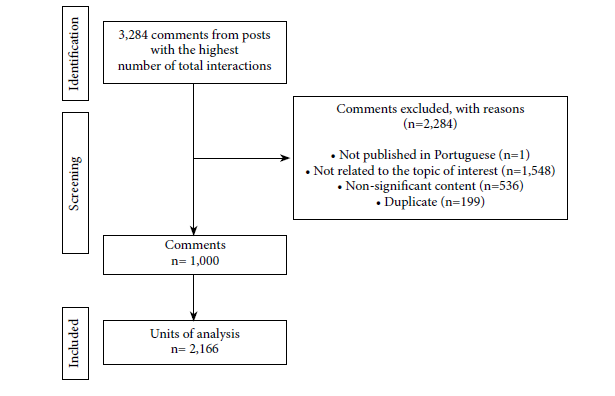
A total of 2,284 comments were excluded from the analysis for the following reasons: a) the comment was not published in Portuguese (n = 1), b) the comments were not related to the topic of interest (n = 1,548), c) the comments did not express significant content for the analysis (n=536), and d) duplicate comments (n = 199) (Figure 1). It is important to emphasize that these exclusions did not influence the study’s findings, as they were a direct consequence of adhering to the inclusion and exclusion criteria. Furthermore, this did not hinder the attainment of the target of 1,000 comments.
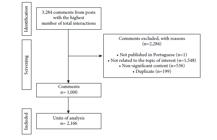
Finally, the database with the 1,000 selected comments was created in Google Docs by copying and pasting directly from the Facebook posts. The date of publication of each comment was recorded. Subsequently, all data were entered into a Google Sheets table (Google, Mountain View, USA).
Preprocessing of comments
The included comments were divided into 2,166 units of analysis (sentences), considering commas, periods, exclamation, question marks, and conjunctions. For example, the following comment was divided into four units of analysis: (1) “It was the best thing I did…” (2) “I had no problems with her teething.” (3) “The first little teeth appeared at 6 months” (4) “and today she has 12 little teeth” (sentences translated from Portuguese).
Conceptual framework
The qualitative analysis was conceptualized based on the Seeking Health-Related Information Online model14, which integrates factors from the three most relevant models related to the topic: the Comprehensive Model of Information Seeking15, the Situational Theory of Problem Solving16, and the Planned Risk Information Seeking Model17. The model comprises psychosocial, instrumental, contextual, and demographic factors.
Psychosocial factors
The Seeking Health-Related Information Online model synthesizes seven psychosocial factors from the models: attitudes towards seeking, subjective norms of seeking, perceived behavioral control over seeking, risk perception, affective responses to risk, perceived knowledge, and knowledge insufficiency. Accordingly, this study interprets the psychosocial factors as a) the user’s self-efficacy in obtaining information on social media, b) the risk perception of teething, c) concern/anxiety about teething symptoms, and d) concern/anxiety about the use of amber necklaces.
Instrumental factors
Instrumental factors are related to the perceived reliability and utility of information-seeking channels. The model identifies four pertinent instrumental factors: i) utility, concerning the satisfaction of an individual’s health information needs and preferences; ii) reliability, denoting the belief in the information source’s dependability; iii) credibility, referring to the trustworthiness of the information conveyed; and iv) quality, regarding the evaluation of the information’s merit. In this context, quality, reliability, and utility were assessed in terms of users’ judgments about the information presented in the posts and Facebook’s effectiveness as a health information source.
Contextual factors
Although the Seeking Health-Related Information Online model introduces Internet usage as a contextual factor, this study does not include it, assuming active Facebook commenters inherently use the Internet for such interactions. Therefore, all analyzed comments came from Internet users.
Demographic factors
Each profile responsible for the comments was analyzed individually, and its sociodemographic characteristics were collected. The gender of the persona (female or male) was classified based on the analysis of the user’s name and profile picture. Race (white or non-white) was determined by analyzing the profile picture, when it depicted a person. In cases where gender and race could not be identified - either due to ambiguity in the name (e.g., Feeh Duarte; Rô Batista) or the absence of a person in the profile picture (such as images of landscapes, animals, or illustrations) - the variables were classified as “undefined”. Additionally, information about the user’s location (country of origin) was recorded, and was also considered “undefined” if this information was unavailable.
Content analysis
The inductive thematic content analysis utilized QDA Miner and Word Stat software (Provalis Research, Montreal, Canada) for coding each unit of analysis (n = 2,166) into a single thematic category, based on the Seeking Health-Related Information Online Model (Chart 1). Initially, two independent investigators (OSJ and JRL) analyzed 10% of the total sample (n=217) to verify the sufficiency of predefined codes and the need for additional ones. The code I1, “neutral experience/knowledge about the amber necklace,” was created for sentences conveying neutral information or curiosities about amber necklaces, e.g., “amber is a fossil resin containing succinic acid” (translated from Portuguese).
To assess variations in the content of comments about amber necklaces over time, the publication dates of comments on Facebook were recorded, allowing them to be divided into three groups. Comments without an available date were classified as “undefined”. For comments with an available date, the median number of days since posting was calculated to differentiate between older and more recent comments. Based on this median value (1,927 days), comments were classified into the following groups: ≤ 1,927 days since posting (n = 491; 774 sentences) and > 1,927 days since posting (n = 493; 1,348 sentences).
Data analysis
QDA Miner software determined the frequency of each code from the manual content analysis. Additionally, automated content analyses through text mining were performed using Word Stat software, generating word clouds of the most frequent words and cluster analyses of word co-occurrences within sentences. The chi-square test (p < 0.05) was used to compare the distribution of categories between the three different times.
Results
Table 1 presents the frequency of sociodemographic characteristics observed in the commenters’ profiles. Most comments were made by users identified as female (963, 96.3%) and white (818, 81.8%). Regarding country of origin, the profiles were predominantly from Brazil (978, 97.8%).
Table 2 displays the distribution of the frequencies of thematic sentence categories in comments, considering the time since the comment was published. In general, the sentences most frequently related to “amber necklace experience” (Code I, n = 594, 27.4%), “information utility” (Code G, n = 420, 19.4%), and “risk perception of teething” (Code B, n = 381, 17.6%). Within these categories, most sentences were classified into “positive experience from using amber necklace” (Code I.2, n = 308, 14.2%), “the information is useful or potentially useful” (Code G.1, n = 407, 18.8%), and “acquisition or intention to acquire the necklace” (Code B.5, n = 263, 12.1%), respectively.
Some notable changes were identified comparing the content of comments over time (Table 2, cui-square = 451.97; p < 0.001). Concerning psychosocial factors, there was an increase in the frequencies of sentences categorized as “receivers’ doubts related to the information” (Code A.3, from 5.6% to 8.1%) and “acquisition or intention to acquire the necklace” (Code B.5, from 5.9% to 23.6%). Conversely, there was a decrease in the frequencies of sentences categorized as “perceived severity by the receiver” (Code B.1, from 4.9% to 0.1%), “severity not perceived by the receiver” (Code B.2, from 1.6% to 0.1%), and “safety warnings” (Code D.1, from 3.4% to 1.0%).
Regarding instrumental factors, an increase was observed in the frequencies of sentences related to “the information being useful or potentially useful” (Code G.1, from 15.7% to 24.5%). In contrast, there was a decrease in the frequencies of sentences categorized as “current experience with teething” (Code H.1, from 5.9% to 0.3%), “past experience with teething” (Code H.2, from 4.8% to 2.5%), “no experience with teething” (Code H.3, from 1.3% to 0.3%), “neutral experience/knowledge about the amber necklace” (Code I.1, from 14.2% to 6.6%), and “positive experience from using the amber necklace” (Code I.2, from 16.3% to 10.3%). Notably, no sentences were categorized as “social media reliability” (Code F) throughout the analysis.
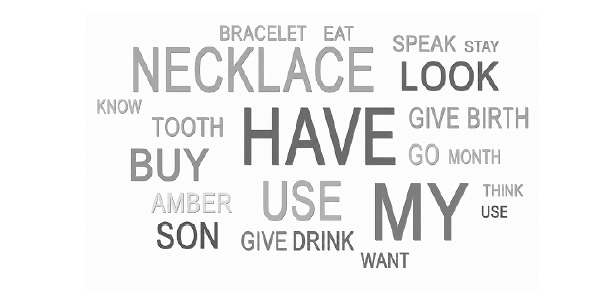
Figure 2 depicts a word cloud of the most frequently found words in the comments. The size of the words is proportional to their frequency within the content, indicating that the larger words were more commonly identified, such as: “ter” (to have), “colar” (necklace), “meu” (my/mine), “usar” (to use), “comprar” (to buy), “olha” (look), “parir” (to give birth), and “dente” (tooth).
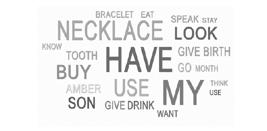
Word cloud of the most frequent words found in the Facebook users’ comments containing false information about amber necklaces.
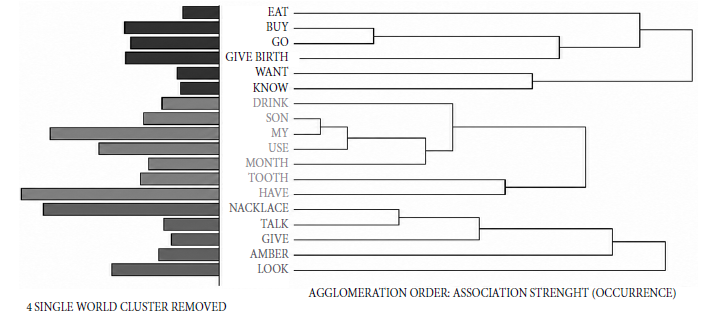
The dendrogram in Figure 3 illustrates the word co-occurrence clusters and their respective distances from each other. Shorter distances between clusters indicate a stronger relationship. Three clusters were identified, representing the concepts: “desire to learn more about amber necklaces for potential acquisition” (dark gray), “parental communication regarding the use of amber necklaces by their children” (light gray), and “highlights the amber necklace as a potentially relevant consideration” (medium gray).
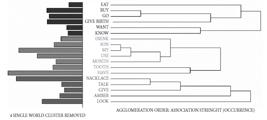
Dendrogram representing the three word clusters represented by dark gray, light gray and medium gray colors.
Discussion
Based on the current state of knowledge, this study represents the first effort to analyze Facebook comments on posts published in Portuguese about amber necklaces. This method proves valuable by directly examining users’ perspectives on amber necklaces and their views on teething experiences in an informal, everyday context. The majority of comments came from users identified as white, female, and Brazilian, with increasing focus on the information value of the posts and the intended purchase of an amulet. However, comments describing personal experiences with teething or expressing concerns about using amber necklaces have significantly declined over time.
The growth of the health industry, along with increased internet access in recent years, has led to people becoming more engaged and interested in healthcare, sometimes challenging the authority of specialized professionals18. This development has popularized the concept of the ‘informed patient’-individuals who have the skills and knowledge to actively participate in decisions and the management of their own health19. This trend, combined with gender stereotypes that often depict women as more involved and responsible for childcare, may have influenced the findings of this study. In particular, women showed significant engagement with the topic of amber necklaces and symptoms associated with the eruption of deciduous teeth. These results are consistent with previous research showing that gender is a significant predictor of online health information-seeking behavior, with women accessing more general health information than men20,21. In the context of amber necklaces, marketed to alleviate children’s teething problems, the Facebook comments section also serves as a vital platform for emotional and social support among caregiving women22. Other studies have similarly highlighted that online platforms, such as blogs and message boards, provide support by offering access to health information related to motherhood, including stories, advice, and encouragement from other women23,24.
In contrast to previous findings that suggest the dominant racial group in a country typically has higher socioeconomic status and better access to health resources25, the majority of Brazil’s population is mixed race (45.3%), compared to 43.5% identifying as white26. This suggests that digital content should engage both white and non-white individuals equally. However, the observed disparities may stem from racial bias in the digital space, where white individuals tend to have easier and faster access to information and communication technologies compared to non-white people27. In Brazil, these social inequalities also influence the distribution of information about amber necklaces, which remain a luxury item more commonly owned by those of higher economic status.
Overall, content related to the risk perception of teething has increased over time, driven by the acquisition or intention to acquire amber necklaces. Interestingly, this rise was not reflected in concerns or anxiety about teething symptoms, which declined across all symptoms attributed to the eruption of deciduous teeth. Similarly, content discussing personal teething experiences also decreased over time. However, there was a rise in users’ doubts about the amber necklace, particularly regarding self-efficacy, which may indicate a growing interest in the product and a desire for more information28. These findings suggest that posts about amber necklaces can generate a desire to purchase the product, even when users do not report experiencing related symptoms. In other words, the concept of teething is so culturally ingrained that it fosters an expectation of symptoms and motivates action3, leading to a perceived need to buy an amber necklace. Additionally, users are influenced by marketing tactics and false claims made by vendors on Facebook11, driven by marketing forces that exploit commodity fetishism, attributing intrinsic value and power to the amulet.
Despite a slight increase in comments about negative experiences with amber necklaces, alongside a decrease in comments regarding positive experiences, reports of positive outcomes still predominated. This suggests that Facebook users remain inclined towards using amber necklaces, likely influenced by widespread beliefs in the product and the deeply ingrained societal perception of teething symptoms. As a result, users may have a skewed perception of the necklace’s effectiveness. Confirmation bias likely plays a role, as the expected relief from teething symptoms upon using the necklace is perceived as proof of its efficacy, regardless of the actual cause, reinforcing a mistaken belief in causality. This perception appears sufficient to persuade the population to consider using the amber necklace29,30.
The frequent detection of content highlighting the usefulness of information may serve as an indicator of its diffusion, as users tag others, inviting them to view the information in the post31. Therefore, a user motivated to share information with a colleague because they find it useful contributes to the spread of inaccurate health information, such as the efficacy of amber necklaces for treating teething symptoms. Additionally, it is observed that individuals who interact more frequently on social media tend to have a greater influence on each other and share more aligned interests, further increasing the likelihood of users adopting amber necklaces into their daily routines32. Moreover, the decline in reports of concerns and anxiety regarding the use of amber necklaces, encompassing safety warnings, fear of accidents, and dentist contraindications, indicates that Facebook users might not be informed about the risks associated with amber necklaces. This also suggests that dentists may not be communicating the contraindications of these necklaces to their patients efficiently.
This study has some limitations. First, the sociodemographic characteristics of users were determined based on information and photos collected from the users’ profiles. This method may lead to the creation of personas that do not accurately reflect the real identities of the users. Second, the study did not include posts with videos in the sample. Although videos often receive high levels of engagement, they were excluded due to the complexity of obtaining, processing, and evaluating them according to the inclusion criteria. Third, the analyses were conducted exclusively in Portuguese. As a result, cultural factors might influence how users interact with posts, and it is not possible to determine if similar findings would apply to other languages and cultures. Finally, the virtual nature of the comments may not fully represent the individuals’ true opinions about amber necklaces, as people tend to modify their discourse to align with their social networks32.
In conclusion, Portuguese-speaking Facebook users, particularly Brazilians, have shown interest in acquiring amber necklaces, even as testimonials about children’s teething symptoms have decreased. The apparent lack of awareness among social media commenters about the misconceptions surrounding amber necklaces may explain the declining expressions of concern regarding the risks the amulet poses to infant health. These findings can help policymakers understand the harmful impact of posts containing false information on communities, prompting the development of guidelines and laws to curb the spread of misinformation. Additionally, dental professionals should be aware of the myths surrounding amber teething necklaces to improve their interactions with patients. Beyond addressing necklace usage, adopting a family-centered care approach that prioritizes the child is essential. This approach includes providing personalized and respectful education to correct misconceptions about dental health, based on the prior identification of family needs and values34. Additionally, ensuring universal access to oral health, enhancing digital health literacy, and offering high-quality dental information through public campaigns are crucial steps to prevent the spread of misleading messages and to increase the resilience of digital consumers against falsehoods.
Acknowledgements
This study was supported by the Conselho Nacional de Desenvolvimento Científico e Tecnológico (grant no. 131813/2021-8) and the Fundação de Amparo à Pesquisa do Estado de São Paulo (grant no. 2021/07339-0). The authors are grateful to Meta Inc. for granting the use of the CrowdTangle™ platform.
References
- 1 Massignan C, Cardoso M, Porporatti AL, Aydinoz S, Canto GL, Mezzomo LAM, Bolan M. Signs and symptoms of primary tooth eruption: a meta-analysis. Pediatrics 2016; 137(3):e20153501.
- 2 Canto FMT, Costa Neto OC, Loureiro JM, Marañón-Vásquez GA, Ferreira DMTP, Maia LC, Pithon MM. Efficacy of treatments used to relieve signs and symptoms associated with teething: a systematic review. Braz Oral Res 2022; 36:e066.
- 3 Pereira TS, Silva CA, Quirino ECS, Xavier Junior GF, Takeshita EM, Oliveira LB, Luca Canto G, Massignan C. Parental beliefs in and attitudes toward teething signs and symptoms: a systematic review. Int J Paediatr Dent 2023; 33(6):577-584.
- 4 Nissen MD, Lau ETL, Cabot PJ, Steadman KJ. Baltic amber teething necklaces: could succinic acid leaching from beads provide anti-inflammatory effects? BMC Complement Altern Med 2019; 19(1):162.
- 5 Karlberg AT, Boman A, Liden C. Studies on the allergenicity of Baltic amber. Contact Dermatitis 1992; 27(4):224-229.
- 6 Chin N, Berns SD. Near-hanging caused by a toy necklace. Ann Emerg Med 1995; 26(4):522-525.
- 7 Soudek L, McLaughlin R. Fad over fatality? The hazards of amber teething necklaces. Paediatr Child Health 2018; 23(2):106-110.
- 8 Abdulsatar F, Matsui D, Miller M, Taheri S. Teething necklaces and bracelets pose significant danger to infants and toddlers. Paediatr Child Health 2019; 24(2):132-133.
- 9 Aktura B, Dertli MH, Ozen EH, Onaran E, Hashimov E, Basibuyuk M, Karabayir N. Knowledge and experiences of families regarding amber necklaces. BMC Complement Med Ther 2023; 23(1):306.
-
10 Statista. Leading countries based on Facebook audience size as of January 2023 (in millions) [Internet]. 2024 [cited 2026 maio 23]. Available from: https://www.statista.com/statistics/268136/top-15-countries-based-on-number-of-facebook-users/
» https://www.statista.com/statistics/268136/top-15-countries-based-on-number-of-facebook-users - 11 Jorge OS, Remiro MS, Lotto M, Zakir Hussain I, Moreira MAA, Morita PP, Cruvinel T. Unveiling deception: characterizing false amber necklace messages on Facebook. Int J Paediatr Dent 2024; 34(2):302-312.
- 12 Tan AS, Lee CJ. Exposure to health (mis)information: lagged effects on young adults' health behaviors and potential pathways. J Commun 2015; 65(4):674-698.
- 13 Jorge OS, Leite JR, Lotto M, Cruvinel T. A study of Facebook comments regarding amber teething necklaces: insights into public perception. Eur Arch Paediatr Dent 2025; 26(1):71-82.
- 14 Wang X, Shi J, Kong H. Online health information seeking: a review and meta-analysis. Health Commun 2021; 36(10):1163-1175.
- 15 Johnson JD, Meischke H. A comprehensive model of cancer-related information seeking applied to magazines. Hum Commun Res 1993; 19(3):343-367.
- 16 Kim JN, Grunig JE. Problem solving and communicative action: a situational theory of problem solving. J Commun 2011; 61(1):120-149.
- 17 Kahlor L. PRISM: a planned risk information seeking model. Health Commun 2010; 25(4):345-356.
- 18 Barker KK. Electronic support groups, patient-consumers, and medicalization: the case of contested illness. J Health Soc Behav 2008; 49(1):20-36.
- 19 Imber JB. Trusting doctors: the decline of moral authority in American medicine. Princeton: Princeton University Press; 2008.
-
20 Fox S. Health topics [Internet]. 2011 [cited 2026 mio 23]. Available from: https://policycommons.net/artifacts/624605/health-topics/1605893/
» https://policycommons.net/artifacts/624605/health-topics/1605893 - 21 Li J, Theng YL, Foo S. Predictors of online health information seeking behavior: changes between 2002 and 2012. Health Informatics J 2016; 22(4):804-814.
- 22 Song FW, West JE, Lundy L, Smith Dahmen N. Women, pregnancy, and health information online: the making of informed patients and ideal mothers. Gend Soc 2012; 26(5):773-798.
- 23 Ratliff C. Policing miscarriage: infertility blogging, rhetorical enclaves, and the case of House Bill 1677. Womens Stud Q 2009; 37(1-2):125-145.
- 24 Romano AM, Gerber H, Andrews D. Social media, power, and the future of VBAC. J Perinat Educ 2010; 19(3):43-52.
- 25 Williams DR, Priest N, Anderson NB. Understanding associations among race, socioeconomic status, and health: patterns and prospects. Health Psychol 2016; 35(4):407-411.
-
26 Instituto Brasileiro de Geografia e Estatística (IBGE). Pesquisa Nacional por Amostra de Domicílios Contínua trimestral: população, por cor ou raça [Internet]. [acessado 2026 maio 23]. Disponível em: https://sidra.ibge.gov.br/tabela/6403
» https://sidra.ibge.gov.br/tabela/6403 - 27 Yoon H, Jang Y, Vaughan PW, Garcia M. Older adults' internet use for health information: digital divide by race/ethnicity and socioeconomic status. J Appl Gerontol 2020; 39(1):105-110.
- 28 Strieder AP, Aguirre PEA, Lotto M, Cruvinel AFP, Cruvinel T. Digital behavior surveillance for monitoring the interests of Google users in amber necklace in different countries. Int J Paediatr Dent 2019; 29(5):603-614.
- 29 Strien JLH, Kammerer Y, Brand-Gruwel S, Boshuizen HPA. How attitude strength biases information processing and evaluation on the web. Comput Human Behav 2016; 60:245-252.
- 30 Peters U. What is the function of confirmation bias? Erkenntnis 2022; 87(3):1351-1376.
- 31 Bakshy E, Rosenn I, Marlow C, Adamic L. The role of social networks in information diffusion. In: Proceedings of the 21st International Conference on World Wide Web; 2012. p. 519-528.
- 32 Hill S, Provost F, Volinsky C. Network-based marketing: identifying likely adopters via consumer networks. Stat Sci 2006; 21(2):256-276.
- 33 Miyazaki K, Uchiba T, Kwak H, An J, Sasahara K. The impact of toxic trolling comments on anti-vaccine YouTube videos. Sci Rep 2024; 14(1):5088.
- 34 Coyne I, Hallström I, Söderbäck M. Reframing the focus from a family-centred to a child-centred care approach for children's healthcare. J Child Health Care 2016; 20(4):494-502.
-
Data availability statement
The data sources adopted in the research are indicated in the article’s body. Link Scielo Data: https://doi.org/10.48331/SCIELODATA.NIDUT2
The data sources adopted in the research are indicated in the article’s body. Link Scielo Data: https://doi.org/10.48331/SCIELODATA.NIDUT2

 Source: Authors.
 Source: Authors.
 Source: Authors.