| PHC in the “Driver’s Seat”21 |
Inspiration from European experiences of PHC, particularly in the United Kingdom and Portugal, to develop RCAPS guidelines. |
| Participatory definition of the Network, construction of Integrated Health Care Territories |
Working meetings for the construction of Integrated Health Care Territories, starting with PA 5.3 and 3.2. |
| Basis of administrative reform and contracting |
Change in the administrative organogram of the Municipal Health Department, Decree-Law on Social Health Organizations, Management Contracts. |
| 2010: Axis I Expansion of Access |
Examples and Actions |
| Leadership and management autonomy |
Selection of leaders for local management of PHC, with the implementation of classes in the Specialization Course in Public Health. |
| Improved accessibility |
Opening and implementation of 17 new units in the new Family Clinics model. |
| Management of Information and Communication Technologies (ICTs) in Health |
Implementation of electronic health records in the first PHC units. |
| Assessment and surveillance |
Greater frequency in updating Health Information Systems; began issuing the first management reports of electronic health records. |
| 2011: Axis II Clinical Governance and Knowledge Management |
Examples and Actions |
| Clinical management |
Creation of clinical protocols based on evidence and in accordance with the reality of SUS in Rio de Janeiro; computerization of the list of municipal medicines (Remume). |
| Knowledge management and professional qualification |
Implementation of the Residency Program in Family and Community Medicine, the Professional Master’s Degree in Primary Health Care, the Specialization Course in Public Health, Proformar-Rio, the Technical Course for Community Health Agents, the Pharmaceutical Care Workshops in PHC and consolidation of the OTICS-Rio Station Network. |
| Innovation and simplification in the provision of care |
Standardization of health procedures and actions for all units: PHC service portfolio. |
| 2012: Axis III Sustainability and Development |
Examples and Actions |
| Service accreditation |
Certificate of Recognition for Quality Care (CRCQ). |
| Financial viability of PHC |
Monthly cost estimate for each Family Health team. |
| Estimated monthly cost of each Family Health team. Communication with citizens and professionals. |
SUBPAV portal (internet) and “Where to be treated?” tool (which links each person’s address to a reference PHC unit), later updated annually by the OTICS-Rio Network. |
| 2013: Axis IV Care Coordination and Accountability |
Examples and Actions |
| Care Coordination |
Family doctors, technical managers of each unit, are responsible for regulating outpatient procedures and exams. |
| People-to people connections, organization of user lists |
Workshops with Community Health Agents and Family Health teams, publication of Statistics and Maps Notebooks (Cemaps-RJ) with maps of teams and micro-areas. |
| Accountability and transparency in results |
Accountability Seminars prepared and presented by each health unit. |
| 2014: Axis V Timely Response and All For SUS |
Examples and Actions |
| Individual responsibilities and deliverables |
Job description of each FHS team member. |
| Timely response |
Study of waiting times for outpatient procedures and exams in Sisreg, SIA-SUS integration, SCNES, and scale of vacancies offered in Sisreg. Integration with hospital and ambulance regulation. |
| Service-research interaction |
“PCATool” evaluation survey with users selected in independent and comparable statistical samples by the City’s Planning Department. |
| 2015: Axis VI Driving Efficiently |
Examples and Actions |
| Transparency and Financial Discipline |
Budget meetings with each unit. |
| Network of relationships between patients and communities |
Expansion of the number of vacancies available at Sisreg through the (re)contracting of providers. |
| Network formation and care lines |
Hospital information management panel and waiting time management. |
| 2016: Axis VII Consolidation of the Reform and Pride in “Being SUS” |
Examples and Actions |
| Consolidation of the values of RCAPS |
Residents of Rio de Janeiro have the highest life expectancy in the country! Reduction in hospital beds due to improved resolution of PHC teams. Significant reduction in inequalities between social indicators. |
| Proud to be SUS |
“I am SUS Pride, and I am committed to making SUS better!” |
| 2017-2019: Axis VIII Reorganization of Primary Care Services |
Examples and Actions |
| Study for resource optimization |
Preparation of the “PHC Services Reorganization Plan”. |
| Reduction of FHS teams |
Extinction of 183 FHS teams with a brutal reduction in access to PHC services. |
| 2020: Axis IX COVID-19 Pandemic - Part 1 |
Examples and Actions |
| Riocentro Field Hospital |
Opening of the Field Hospital to treat COVID-19 (even though the city of Rio de Janeiro had 2,200 beds deactivated at the time due to a lack of professionals in existing units in the municipal and federal networks). |
| Ceasing of the role of PHC during the pandemic |
Implementation of the “PHC Services Reorganization Plan”, which in some regions of the city had its inequity exacerbated by the reduction in FHS teams. |
| 2021: Axis X Pandemic - Part 2: PHC Protagonism in the Fight Against COVID-19 |
Examples and Actions |
| Investment in its own network - Ronaldo Gazolla Municipal Hospital in Acari |
The Ronaldo Gazolla Municipal Hospital became the main reference for COVID-19, expanding the unit’s capacity to 420 beds, 280 of which were ICU beds. |
| Largest vaccination campaign in the city’s history |
Application of around 13 million doses of the COVID-19 vaccine in the city of Rio de Janeiro, which corresponded to 82% of the population of Rio de Janeiro vaccinated with two doses or a single dose at the time. |
| Facing the public health emergency |
Implementation of the Emergency Operations Center (EOC COVID-19 Rio), which fostered integration between technical areas, innovation in epidemiological analyses, institutional partnerships, and transparency in adopted measures. Formation of the first class of Episus Fundamental Rio in field epidemiology training at the basic level. |
| Vaccine, testing, and access |
Opening of 17 COVID-19 Care and Testing Centers throughout the city, which was recognized and served cariocas from all social classes. |
| 2022: Axis XI Recovery of the Healthcare Network as a Priority |
Examples and Actions |
| Return of PHC teams |
Return of more than 140 FHS teams in all PHC units, with the replacement of 6 CHAs per team. Expansion of the Street Clinic and Prison Primary Care teams to 100% coverage. |
| Budget rebalancing |
Improvements in the infrastructure of health units with a balance between investment in partnerships and budget availability. |
| Super Carioca Health Center |
Creation of the public health complex comprising the following units: Centro Carioca do Olho, Centro Carioca de Diagnóstico e Tratamento por Imagem, and Centro Carioca de Especialidades. The complex is modern, efficient and accessible, and aims to offer more services, speeding up care for the population of the city of Rio de Janeiro. |
| Center for Epidemiological Intelligence (CEI) |
The CEI is characterized by epidemiology, integration, innovation, technology, and transparency. It was created as a strategy to work with health data and transform it into information for society and the entire network. |
| 2023: Axis XII We can Live Longer, Better, and Happier |
Examples and Actions |
| Happiness matters |
Ensuring that all service points in the network have connectivity and a system. Launching of the online vaccination booklet and offering at least 10% of consultations remotely. |
| Digital Health and Debureaucratization |
“MinhaSaúde.Rio” delivers all test results, prescriptions, and renewals, in addition to allowing 24-hour access to pre-medical consultations by telephone. |
| Strengthening knowledge centers |
Expansion of the OTICS-Rio Network to the Souza Aguiar Hospital, planning to carry out the PHC user evaluation survey, PCATool “Rio 2024” (10 years after the first). |
| Restore the public-private relationship |
Public-private partnerships (PPP) for hospital hotel services, with the purchase of services and procedures in public units. |
| 2024: Axis XIII Public Health in Rio de Janeiro |
Examples and Actions |
| Reestablishing bonds |
Integration of specialists with each specialty center making its own regulation. |
| New forms of costing and payment |
Units that train their own human resources, with the support of qualifications through the OTICS-Rio Network, and management of the acquisition and incorporation of specialized inputs. |
| 2025: Eixo XIV Strengthening the SUS Network in Rio de Janeiro |
Examples and Actions |
| Ampliação do acesso |
Expansion of 700 beds in the two municipalized federal hospitals - Andaraí and Cardoso Fontes - with plan to create two more Super Health Centers to reduce waiting times, along with the expansion of the functionalities of “MinhaSaúde.Rio”. |

 Fifteen years of the Primary Health Care Reform (RCAPS) in Rio de Janeiro, Brazil
 Thumbnail
 Thumbnail
 Thumbnail
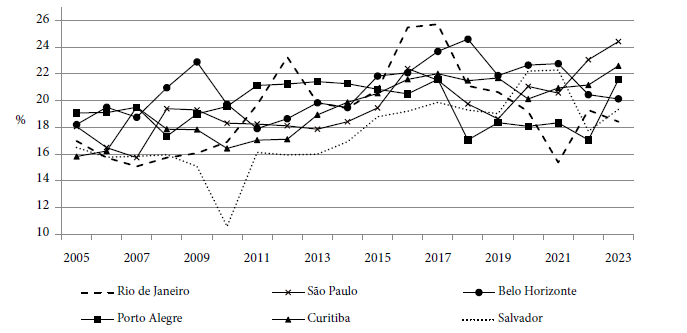 Source: SIOPS, Ministry of Health (available from: http://siops.datasus.gov.br/rel_subfuncao.php). For health data/own prescriptions, http://siops.datasus.gov.br/mctc_seleciona_ente.php [cited 2024 dez 10].
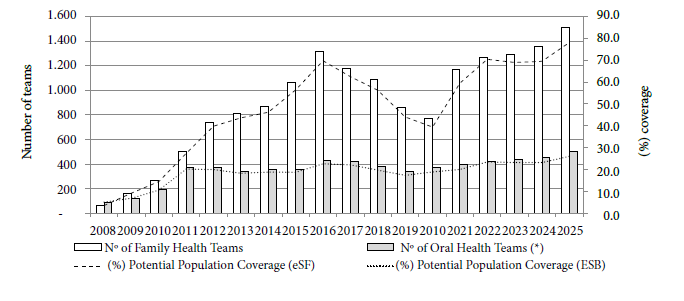 Note: Only family health teams were considered. EAB/EAP were not included. (*) Number of teams planned based on the LOAS (2025) presented to the Rio de Janeiro City Council by SMS-RJ. With this projection, it is estimated that in 2025, the mark of five million Rio residents with Family Health Teams will be surpassed, if we consider that on average an FHS is responsible for 3,450 people. Source: Authors, based on SCNES/Ministry of Health, eGestor APS and population projections and censuses - IBGE.
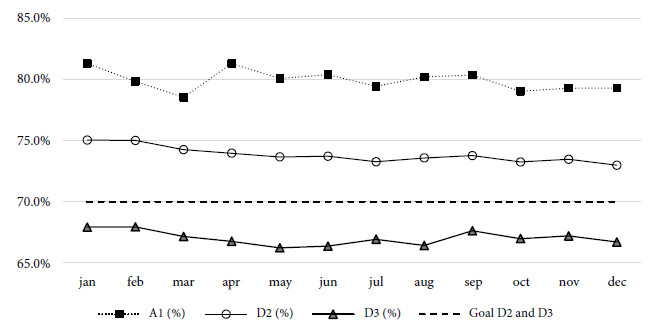 Note: Only FHS teams were considered, with a total of 1,359 teams (code 70) registered in the extraction of indicators from variable part 2 in December 2024. Basic Care (eAB) and Primary Care (eAP) teams were not included. Source: Authors, based on raw data provided by the electronic medical record with data aggregated by SMS-RJ.