 For a Vague Writing: contemplation and (re)generation
ABSTRACT
This article is a reflective dialog between artists/educators/researchers from various Brazilian institutions integrating ecoperformances and Somatics in Artistic Practice as Research. A vagal movement as writing, based on the contemplation of the generative impulse present in ecoperformative practices, shifts the group from an environmental immersion to a textual immersion. The attentional supports - somatic rest, dynamic pause, and tensional contemplation - attune with diverse immersive contexts - geoecological performance, virtual ecoperformance, staging and ecoperformative news. There is a summoning to the field of ecoperformance and Somatics, so the research’s written outwarding is guided by the mobilizing principles of the somatic-performative practice, within an ecocentric ethics.
Keywords:
Somatics; Eco-performance; Artistic Practice as Research; Co-creation; Self-regulation.
RESUMO
Este artigo é um diálogo reflexivo entre pessoas pesquisadoras de diversas instituições brasileiras, integrando ecoperformance e Somática na Prática Artística como Pesquisa. Um movimento vagal como escrita, a partir da contemplação do impulso generativo presente nas práticas ecoperformativas, desloca o grupo da imersão ambiental para a imersão textual. Os apoios atencionais - descanso somático, pausa dinâmica e contemplação tensional - sintonizam-se com os distintos contextos imersivos - performance geoecológica, ecoperformance virtual, encenação e notícias ecoperformativas. Há um convite ao campo da ecoperformance e Somática, para que a externalização escrita das pesquisas seja guiada pelos princípios mobilizadores da prática somático-performativa, numa ética ecocêntrica.
Palavras-chave:
Somática; Ecoperformance; Prática Artística como Pesquisa; Cocriação; Autorregulação
RÉSUMÉ
Cet article est un dialogue réflexif entre des chercheuses de différentes institutions brésiliennes, intégrant l’écoperformances et les somatiques dans la Pratique Artistique en tant que Recherche. Un mouvement vagal ‘en tant qu’écriture, déclenchée à partir de la contemplation de l'impulsion générative présente dans les pratiques éco-performatives du groupe, déplaçant de l’immersion environnementale vers l’immersion textuelle. Les appuis attentionnels - repos somatique, pause dynamique et contemplation tonique - s’accordent avec des divers contextes immersifs - performance géo-écologique, écoperformance virtuelle, mise en scène et actualités éco performatives. Il y a une invitation au champ de l’éco-performance et des somatiques, pour que l'extériorisation écrite des recherches soit guidée par les principes mobilisateurs de la pratique somatico-performative, dans une éthique écocentrique.
Mots-clés:
Somatiques; Éco-performance; Pratique Artistique en tant que Recherche; Cocréation; Autorégulation
Full attention is to be present in your heart. You get there with breathing. You go away from it being busy in your mind and body. And also by forgetting who you are, your purpose, and that you are part of nature (MurphyShigematsu, 2022).
Introduction
This article is a reflexive dialog among five artists/educators/researchers from diverse localities, institutions and research groups. This group of people has been developing projects in various instances, integrating ecoperformances and Somatics in the context of Artistic Practice as Research. In 2021, together with three other researchers - Leonardo Sebiane, Kiran Gorki and Alba Vieira - , we participated in the II Seminar Arts of the Scene and Contemplative Practices, composing a group of studies in which we had the opportunity of sharing weekly online meetings. In these meetings, we investigated the contemplative potential of the somatic practices with which we work, from a perspective of Body Environment Merger (Fernandes, 2023a) in performative processes. Considering the embodied knowledge of this group’s members - such as BodyMind CenteringTM, Somato-Psychopedagogy, Authentic Movement, Laban/Bartenieff Movement System, Practice of Contemplative Dance, Yoga, Ancestral Wisdoms, Meditation in Full Presence, Psychoanalysis, and Choreological Studies - we seek to relate resting and contemplative practices with their ecoperformative unfoldings, from the starting point of selected somatic principles of the referred practices. Principles such as process, pulsion, modulation, self-regulation, countertension, cosmoknowledge, holism, lived experience, cellular consciousness, dynamic stillness, listening of oneself with the world, embodiment of ideas and concepts, and support points.
In our meetings, we investigate how these practices act in immersive processes with beings, elements, densities, rhythms and flows of and with nature. In the environmental explorations, we let ourselves be guided by mineral, vegetal and animal partnerships that inspire, stimulate and guide us in somatic attunement with artistic, pedagogic and writing processes. Expanded alterity has led us to a deep connection with personal multiplicity, pulsional states and somatic listening, affection, amorousness, empathy, compassion, sharing, respect, reception and celebration of diversity and of an infinity of possibilities of being, interacting and transforming (with) a world on the verge of planetary destruction and (also) human extinction.
Through Body Environment Merger, the inventiveness at a cellular level becomes a mode of being which validates and increases somatic wisdom and resilience. Ancestral wisdoms guide approximations between cellular and cosmic body, as well as individual and politicized discourse, in the forms of receiving, building and sharing knowledge. This reaffirms the movement and the ecological experience as a fundamental modality of contemporary critical thinking, in dialog with ancestral knowledge, celebrating contemplative experiences lived with nature. Contemporary discussions that follow this perspective cross different cosmologies, including pandemics, diversity, sustainability, anticolonialism and disability, honoring multiple singularities in movement.
The “outwarding” (Bacon; Midgelow, 2014, p. 26) of a research that emerges from the articulations that spring from artistic creation occurs through sharing, in “a moment of fruition in performance and/or writing (Bacon; Midgelow, 2014, p. 27), according to the authors. In the union between writing and performance, this text - while turning back to the mode of doing linked to the contemplation of immersive action in research, providing existing ecoperformative results - is also a going forward, dislocating this mode of doing towards the pathway of the immersive scripting, along the textual dialog, driving specific associations and perceptions to this text in performance as a public sharing of practice. To organize this thinking in motion, which has integrated the group of research/researchers, we created, in this article, a dialog that is similar to the mode in which we have experienced the researches in collective, collaborative and sensitive format, along each meeting. By adopting this format, we seek to summon the reader to vague around with us - among words, landscapes, perceptions, and sensations - in a pathway that does not intend to be linear, but, rather, porous, shared, and listening with the relational movements and flows of the reading itself. As much as writing, readings are intermodal processes coherent with the ecoperformances and meetings.
Different from the anthropocentric and neurotypical perspective, which organizes places and objects in function of and in service of the human figure, in a relational hierarchy between subject and object, we seek perceptions closer to a plural and neurodiverse context, which is organized in gradations of textures, volumes etc., in mutual and egalitarian learning between human and more-than-human. Afterall, “[m]odes of existence are always plural and relational [...] existence can be found not only in beings, but between them [...]. Modes of existence are intermodal” (Manning; Massumi, 2014, p. 8). Let us then begin our intermodal exchanges, flowing while modulating our perceptions, sensations, writings…
Contemplative ecoperformative pathways for somatic rest in creative processes
Ciane Fernandes: How to write without being busy? Today, while talking to our colleague Kiran Gorki about the vagus nerve - this communication channel of the involuntary mechanisms that transmits signals from all organs to the brain, literally vaguing through the body - I thought that it is important to vague around, to write in a light, pleasurable manner, activating the parasympathetic system, rather than writing under pressure, which activates the fight, flight or freeze and collapse response so common with the deadlines. And, thus, we start this search and keep searching. While we search we keep writing in this wandering around.
Deborah Dodd: Firefly writers!
Diego Pizarro: I am here thinking about what Ciane said. At the same time I am enjoying a contemplative state after having worked as a teacher on the Nervous System and Fluid System courses for the Body-Mind CenteringTM (BMCTM) Somatic Movement Educator program this week (March 2022) in
Paraíba, Brazil. I think that writing requires a sympathetic system modulation, even at rest, because it is an action that considers, from the outset, a sympathetic activation. Unlike the opposition created by the 20th century scientific narrative between sympathetic and parasympathetic, and by embodying these two aspects of the autonomic nervous system through BMCTM practice, we deal with such mutuality in a non-dualistic manner, but in contiguity. Therefore, does writing without being busy mean to give oneself the opportunity to continuously transit through the spectrum of what emerges and what serves as a background for the sensorimotor experience?
Ciane Fernandes: The question seems to be the predominance, because in the alert state the parasympathetic system is not active.
Diego Pizarro: Sympathetic and parasympathetic mutuality. When I go to the parasympathetic state, I find a background where to rebound. In a state of full alertness, the sympathetic one takes the lead, yet the parasympathetic remains as the background support. In fact, if there is a sympathetic predominance, we may end up enhancing a frozen patterned mechanism with no space for modulation. The opposite of this would be lethargy as a single pattern, for example, with parasympathetic predominance. It seems to me that one of the most interesting aspects of Somatics is the search for homeostasis - the quest for balance and modulation between patterns. And this is so to allow for other patterns to emerge not only from unusual and new experiences, but also from known experiences. Thus, instead of aiming for a static balance, we seek a dynamic balance, preparing the person to modulate their states of presence, in order to deal with the diverse demands that come from the external and internal world.
Deborah Dodd: A firefly writing composes its flight, flickering with the para/sympathetic tides of the body.
Ciane Fernandes: But the traumatic response does not allow any kind of option. And if it remains for extended periods of time, it is quite heavy.
Diego Pizarro: Without parasympathetic support it becomes stress.
Ciane Fernandes: Parasympathetic in the background, but very much in the background, perhaps sunk and under pressure.
Diego Pizarro: Yes. Frozen patterns.
Ciane Fernandes: We must differentiate that from contemplative dynamic pause. This also reminds me of that image which came to my mind while teaching a Performance Laboratory class at the Graduate Performing Arts Program of the Federal University of Bahia (PPGAC/UFBA), Brazil, in 2022: an oxygen cylinder to help breathing during a longer diving, in this case, a somatic-performative diving into the research. Do we want the challenge of exercising and prolonging the respiratory process and ability by remaining without the cylinder, or the comfort and safety of having this cylinder there with us? Or maybe both in distinct moments… What is our oxygen cylinder during the fulfilment of fluid researches and writings?
Diego Pizarro: This reminds me that to go deeper into the experience, with cylinder or not, we actually need to dive in. This is perhaps the greatest foundation of Somatics, opening up to the embodiment of things. Because the act of simply talking about things does not mean they are embodied. On the contrary, it tends to distance us from the embodied experience. This is how Bonnie Bainbridge Cohen (2012) invites us to experience the dance of neural aspects, which she presents as a shaped circle, filled with a dark color in the background and full of thin, luminous lines making curves and spirals. In this diagram, the dark background is the parasympathetic state, like the darkness of the deep ocean, the unknown, the void. The luminous lines indicating possible pathways are the sympathetic flow. The circle that demarcates everything, the contour, the shape, the periphery, is the somatic nervous system (voluntary), meaning the very expression in movement, gesture, and voice of this modulation between sympathetic and parasympathetic. When inhabiting these different states of the nervous system, integrating them, enabling the one supporting the other, we may find what is called self-regulation. It is more of a dance of articulations between rest and action than fight/flight/freeze X slow down/pause/sleep. It is a contemplative state.
Ciane Fernandes: Writing in/and self-regulation… That is the question!!!
Deborah Dodd: Circle or circuit?
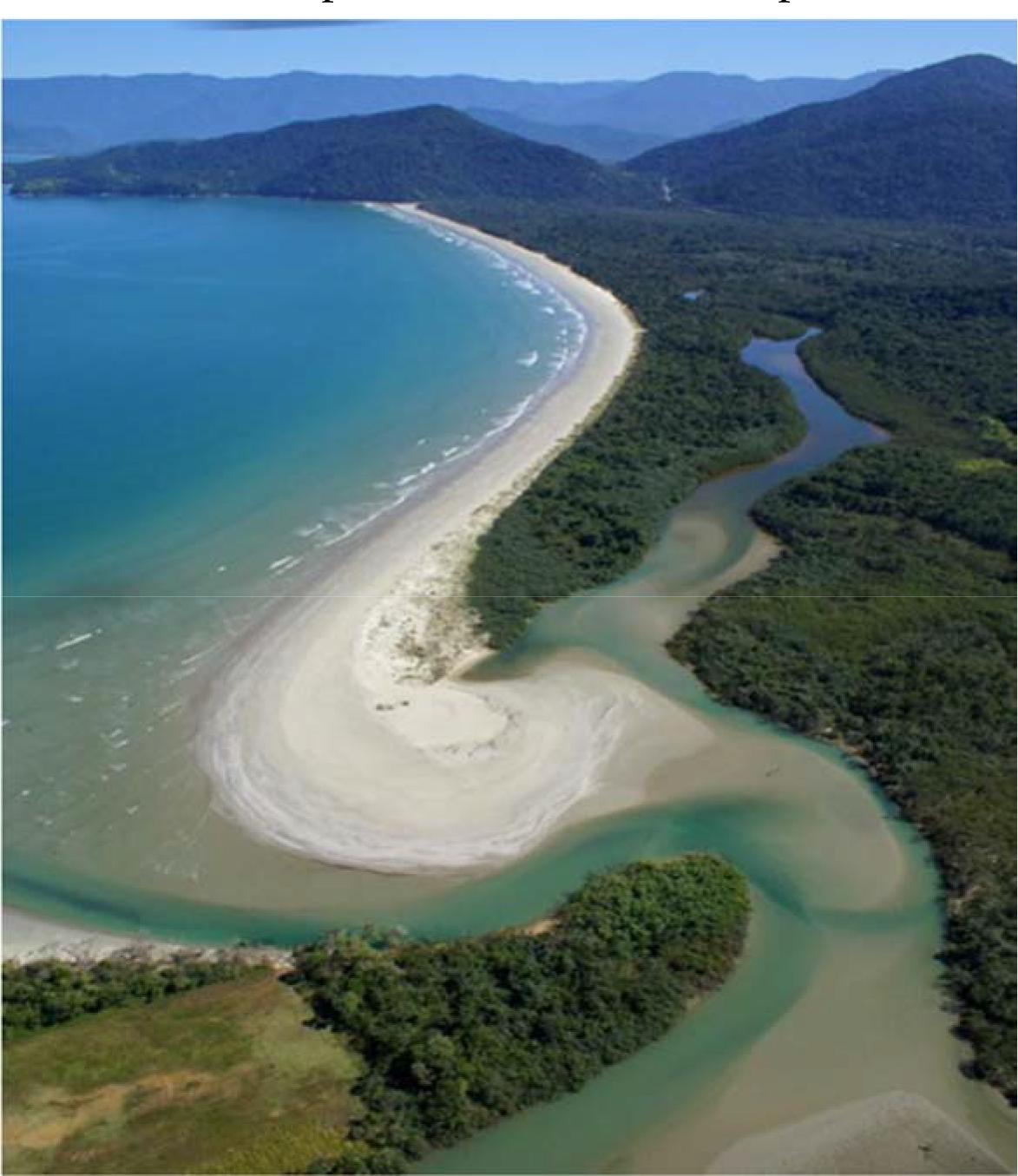
Diego Pizarro: A circle, because I am talking about a diagram that is a dark circle covered by luminous lines. Meditative/contemplative states in the BMCTM somatic system vary from system to system. Dancing this diagram is not a metaphor or a representation to talk about how the nervous system works, but, above all, it is an invitation to literally dance this idea, that is, to make it alive in our own dancing gesture. Then, regarding dynamic pause, we can connect with the proposal that meditative/contemplative states in BMCTM vary from system to system. For example, sitting on the synapse is one thing, hanging on the capillary bed is another, as well as being in the cellular fluid, transiting through the membrane and flowing to the extracellular fluid, and integrating the whole through the interstitial fluid. In fact, every place of transition is a contemplative opportunity, whether in a place located in the inner, or the outer skin. For example, our lungs are physiologically places of transition and transformation, when we do a somatization with the transforming experience of the sponge-lung, transforming gas into liquid and vice versa, we could find a contemplative state of suspension of time and space. The same is true when we focus on the capillary bed, that is, on that place of deep suspension of the circulatory system, where oxygenated and non-oxygenated blood, together with the lymph, are diffused through the cells until they find their corresponding vessel-channel. It is a place of complete suspension of some bodily fluids, meaning another quality for a contemplative state. From the skin to the inside, the places of transition are numerous. From the skin out, estuarine environments, for example, are intense invitations to suspend space-time, in which the density of sea water meets the fluidity of river water, creating a third quality. An estuary is an invitation to deep contemplative experiences. Full-body diving in these places is always a contemplative experience. And when we dive into such an environment, in deep contemplation, there is no room for nonplaces (Augé, 1995), because everything makes sense, even when they do not, at first sight. Furthermore, any place can become a place of contemplative, somatic and estuarine potency, because the poetic capacity of intense diving is transformative in itself. Here I am talking about synchronous dives in places from the skin inwards and from the skin outwards.
I called this experience CorpoEstuário (BodyEstuary) (Pizarro, 2020), as it deals especially with the performativity of transition spaces, in the ecological relationship of the encounters of rivers with the sea. It is in this highly fertile place that Somatics as a field of contemporary Western knowledge is discussed, in the fruitful genesis of a rhizomatic episteme (Deleuze and Guattari, 1995), driven by the wisdoms that already live with us, that are already present in authenticity and in the sensual authority (Johnson, 1999) of our cells. CorpoEstuário moves fluid states of poetic nutrition as inspiration for Artistic Practice as Research, generating multiplicities.
What I propose as CorpoEstuário is the very possibility of transformation, based on self-regulation and access to our membranes for change, the modulation of our most ingrained patterns. CorpoEstuário, in addition to being a performative invitation in itself, is a gateway to the creation of a somatic environment in the dance creation processes that I have been developing over the last ten years. Therefore, everything within our reach to contact our internal space and sensations in general is accessed at this stage of the process, to cross membranes, modulate experiences and seek transformations through the various possibilities of encounters and creation of worlds that this movement incites (Pizarro, 2020, p. 218).
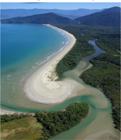
Estuary of the Picinguaba River with the Atlantic Ocean at Praia da Fazenda, northern coast, São Paulo state. Photo: Luisa Garcia Sando. Available at: https://guiadeareasprotegidas.sp.gov.br/ap/parqueestadual-serra-do-mar-nucleo-picinguaba/. Accessed: Sep 15, 2020.
Ciane Fernandes: I have been calling these explorations as Body Environment Merger (2013), while this phase of correlating concepts and even writing as Merger as Research (MaR). Obviously, in BMCTM, for example, these two instances are very associated all the time. It is not just a workshop. It is a continuous thinking-doing, somatic wisdom in co-movement; hence, it is Practice as Research (PaR) (Nelson, 2013). However, it does not always have this emphasis on research or is situated in a research context, also because it has its own pedagogy and content. I started using this Merger as Research terminology from the starting point of Body Environment Merger experiences that I have developed since 2008 in Lençóis, Bahia, Brazil, when I organized the I Meeting of Studies in Movement. The combination between somatic and performative, which became key in the PaR approach I have developed at PPGAC/UFBA (Fernandes, 2018), appears for the first time in my writings as “somatic-performative state of consciousness” (lecture given in 2012, published in 2014), in connection with the sanskrit terminology rasa and its intimate and multiple relationship with fluids and flows, including between performer and audience:
In Rig Veda the word, rasa, is found occurring in the sense of water [...], Soma juice [...], cow's milk [...], and flavour. [...] In the Upanishads rasa stands for the essence or quintessence and self-luminous consciousness [...] In Sanskrit other than the Vedic, the word, rasa, is used for water, milk, juice, essence, tasteful liquid, etc. [...] In the context of Indian aesthetics, rasa is understood as the actor's and especially the spectator’s aesthetic experience (Meyer-Dinkgraefe, 1996, p. 85).
Furthermore, the combination of somatic-performative also appears when I name some key concepts developed in the field trips of the Performance Laboratory graduate program to the Chapada Diamantina National Park (Fernandes, 2012). These ecoperformative explorations were held systematically from 2010 onwards, at both the Chapada Diamantina National Park and the Getúlio Vargas Zoobotanical Park in Salvador, Bahia (where I started to take undergraduate and graduate students). From 2014 onwards, the activities have focused on seashore and maritime environments in Salvador and in diverse locations where I had the opportunity to go with performers of the A-FETO Dance Theatre Collective.
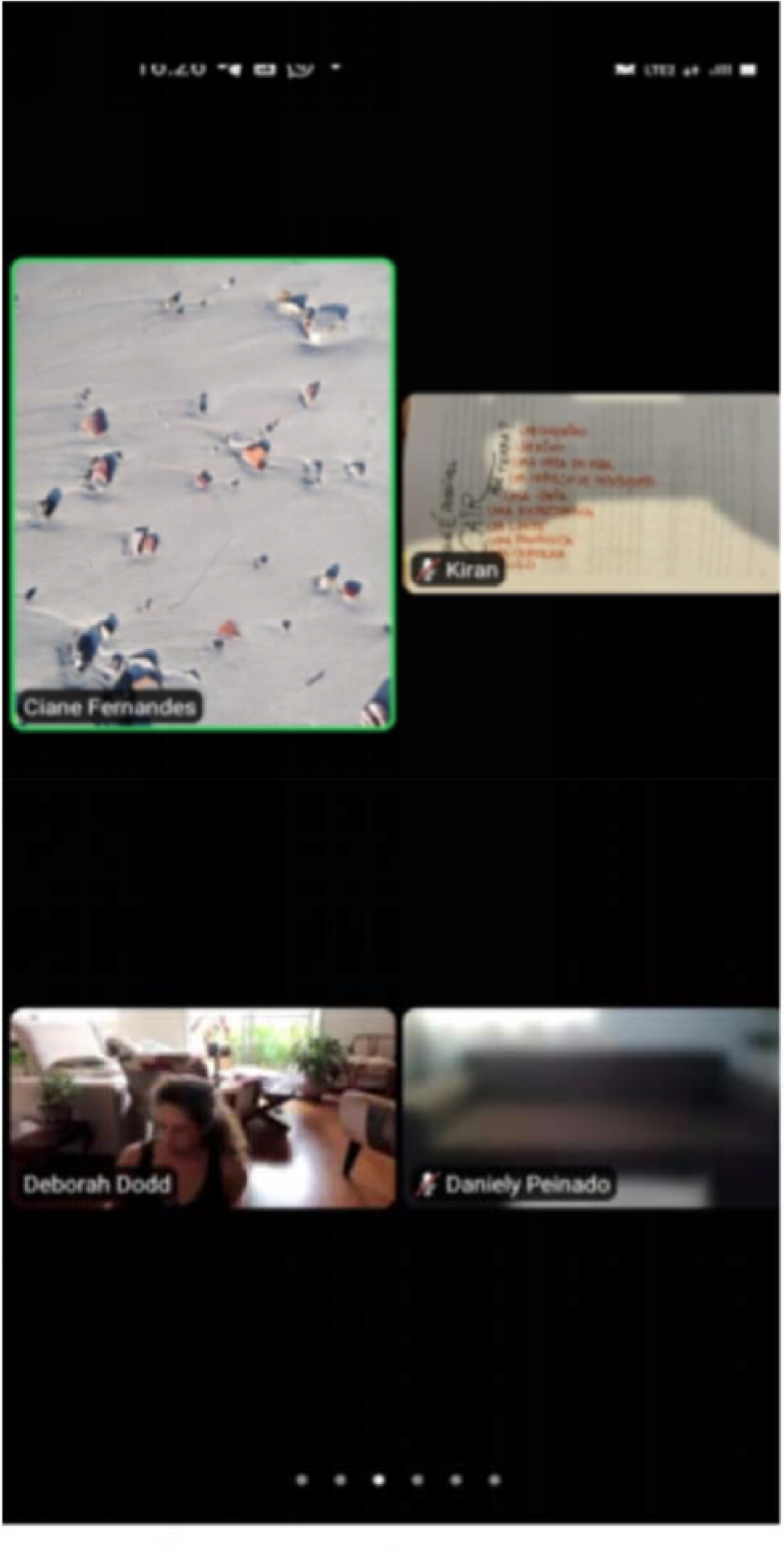
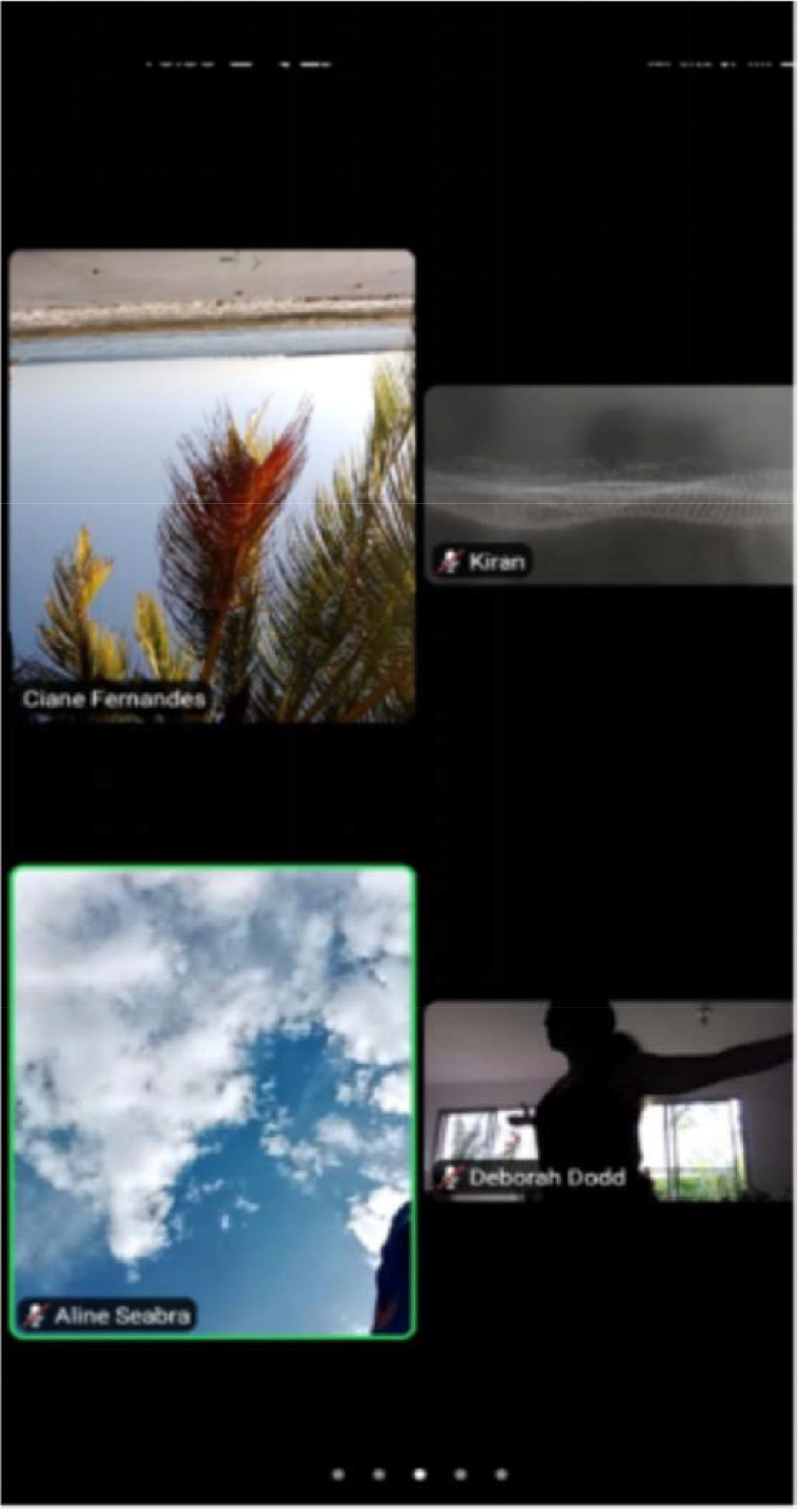
In the period of the COVID-19 pandemic, due to sanitary restrictions, the Performance Laboratory was taught in online mode. Nonetheless, whenever I could, I taught classes in open-air locations, especially by the seashore, transmitting them through a mobile device. In these activities, all were encouraged to interact with their surrounding environment and its materialities, although the main focus is the research movement from a starting point of sensopercepcion and inner impulse. We explored how we move and are moved by the research, tracing the fluid methodology in process together with the environment.

Performance Laboratory of PPGAC/UFBA. Online meetings 2022.1. Source: Ciane Fernandes. Screen print.
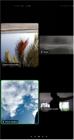
These afternoons of online Body Environment Merger gave rise to somaticperformative improvisations, drawings, writings, and installations. We can associate this multiplicity of formats in fluid, interrelational transit to that which Rudolf Laban called dance-tone-word-plasticity (Tanz-Ton-WortPlastik) (Dörr, 2004), as well as to that which Manning and Massumi call intermodal (2004).
In the context of Artistic Practice as Research and, more specifically, of Merger as Research, Rasa refers to this fluid intermodality between the arts, and between the arts and/with the world, through which we dissolve the (scientific) separation between subject (researcher) and object (of the research). We build knowledge precisely in this process of boundary dissolution of/in research. This dissolution is what Shigenori Nagatomo presents in the concept of somatic attunement:
[T]he term, attunement, is descriptive of the relationship obtaining in the fluid bilaterality between the personal body and the living ambiance. This means that we have shifted the locus of the traditional epistemological investigation away from both the mind as an epistemological subject and the shaped thing as an epistemological object. […] somatic knowing is a fruition of attunement. […] the locus of somatic knowing lies in the personal body (Nagatomo, 1992, p. 200-201).
Melina Scialom: The open environment and nature's elements have also been my collaborators in performances and ecoperformances of research processes I develop. In fact, the rasas were the inspiration for and the theme of a performance that I created and performed between 2007 and 20091. It was conceived as a performative ritual and was finalized as a dance for the stage/scenic space. The performance was created to access and reveal the most internal layers of the performer's corporeality, mobilizing her expression. The disclosure of these internal and expressive layers happens through a ritual that was created aiming to happen during the sunset, in a moment of the day's cycle where the day transitions into the night. This moment of transition is a game of energies and oppositions, such as the solar and the lunar, from the warmth to the cold, from light into darkness. In fact, in Indian medicine - Ayurveda - this transition marks the change between the vata - a more external and agitated energy - to the kapha - a deceleration and an introspection, turning back to oneself and to the origins. These stages are similar to what Bonnie Bainbridge Cohen (2018a) names as the “spermatozoid” (for the vata) and “egg” (for the kapha).
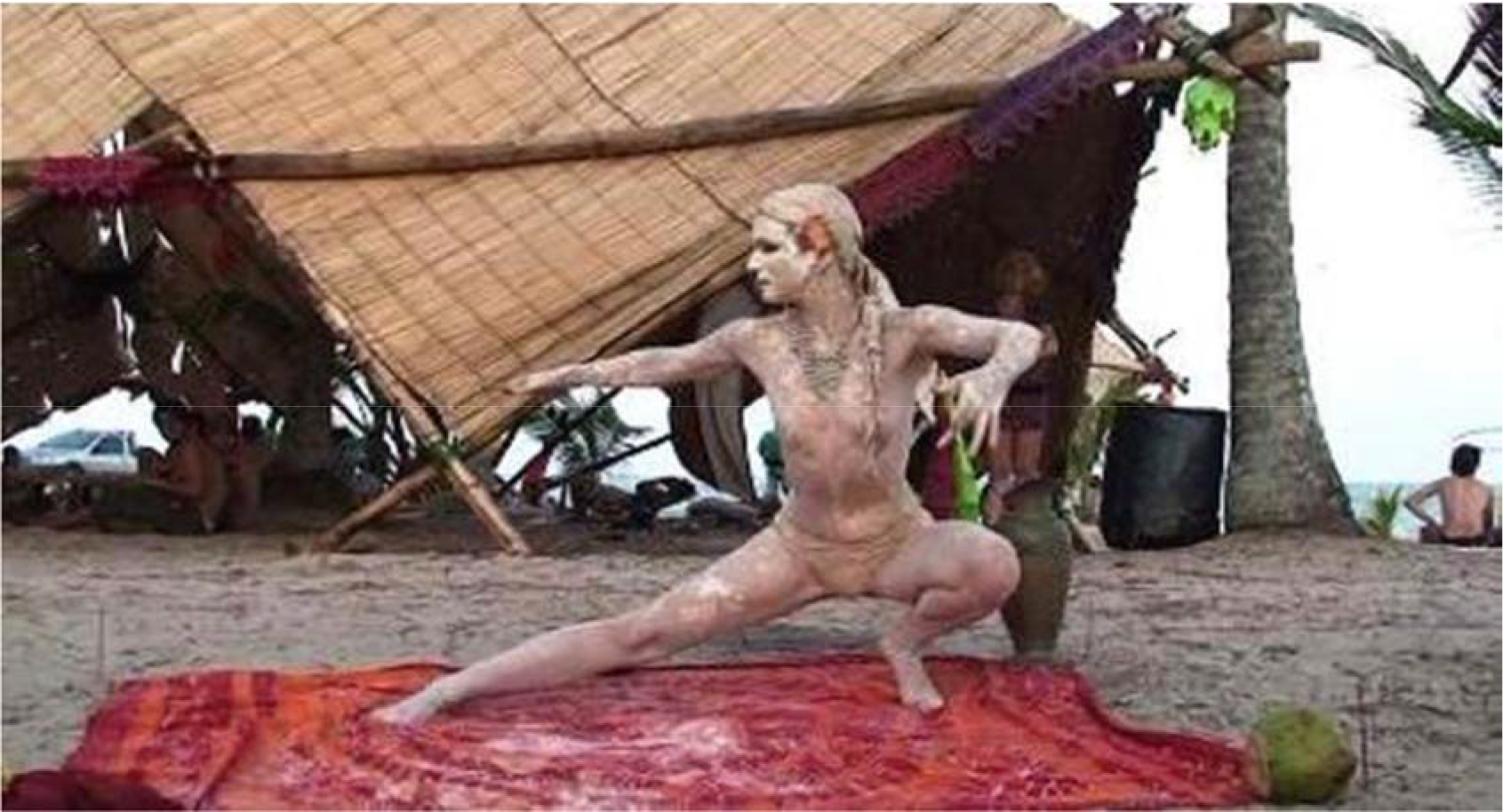
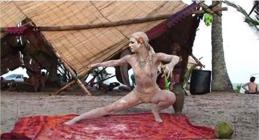
In a combination of dance and performance, I developed a ritual to articulate a process of becoming of myself, becoming egg and moving the expression that inhabits the quality of self. For such, there is a transformation of a being to an animal-human-being. I begin this ritual all covered in white clay that is already dry and cracking. The clay functions as a stiff mineral external layer of the body. It also represents an external layer of a living being that will be dissolved, washed and liquified, revealing a body that contains the essence of the individual, full of dynamic intensities. The clay becomes both a relational element, used to activate the sensation of the skin, and the mechanism to rouse the perception and embodiment of an external layer of the body. Patrícia Caetano (2015, p. 231) notes that the relational elements can be used to trigger the recognition of the inside-outside, acting on the perception of space in a kind of “cartography of the affective body.”
In the awakening of the affective body, the clay becomes a kind of “somatic costume” that, according to Sally Dean (2011), affects the performer in three different ways: on the kinesthetic sensation that it brings to the body; in the visual effects that it triggers in both the one who uses it and the one who sees it; by enticing philosophical issues of a body that thinks through its sensation and kinesthesia. In this case, the kinesthetic sensation of a mineral material stuck to the skin provides a sensation of the limits of the body, but at the same time a deformation of the body's image that I see reflected in the mirror. The body transitions continuously through the sensations and transformations that the clayish costume brings from the outer skin, inwards. This transitioning also happens between the sympathetic and parasympathetic systems in modulations of states that were performatively transformed into layers. These layers, in the ritual, were materialized through the costume - clay, chiffon blouse, accessories (such as necklace, bracelet and ring), body painting, make-up, red lipstick and nail varnish - and were revealed in a process of washing out the clay, using a tin jar containing water. The revealing of each layer (by dissolving the clay with water) incited a particular motion that was determined by movement qualities that were at times more fluid and expansive and at others more condensed and retracted, including the gradation and combination among these polarities. I associate this qualitative/expressive disclosure with the process of awakening the inner estuary that Diego Pizarro suggests. In this case, I would be giving passage to the movement that emerges from the inner estuary, transitioning through the modulations that it holds.
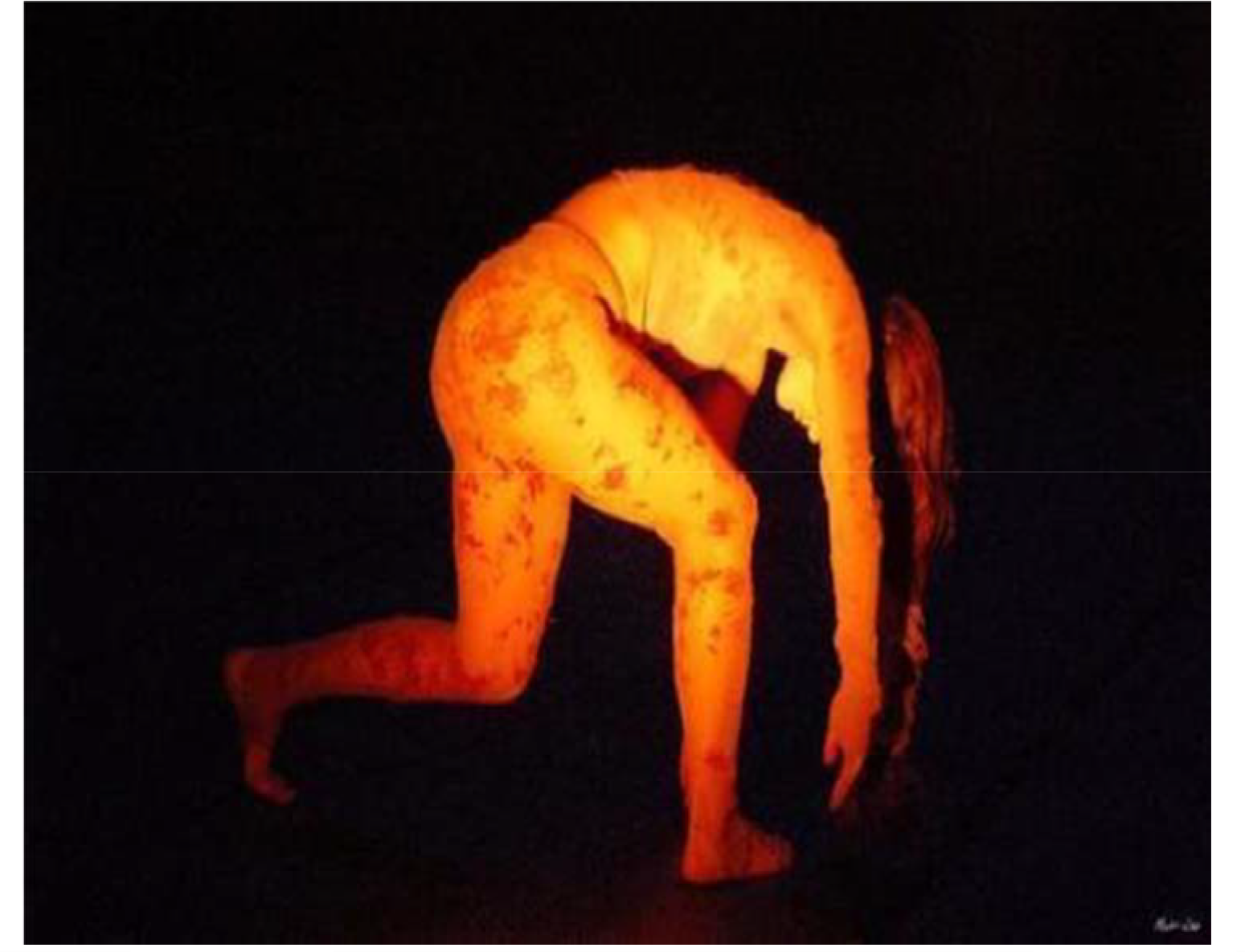
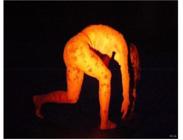
In January 2009, this ritual was restaged in a residency-workshop with the Taanteatro2 company. I investigated the layers, the rasas, and their modulations to discover the expressive qualities of each one. It resulted in a performance called Rasas and Transparencies. In this second performance, I organized the rasas' emerging modulations and the intensities of the sympathetic and parasympathetic systems in a dramaturgy of intensities3. The choreographic framework was totally modified, but the manipulation of the rasas and the costume remained the same. In this dance, the somatic costume was transformed into a unitard with beige tights that covered a bunch of red dried flowers that were also poking my skin. In addition, I was wearing the same red lipstick and nail varnish. During the dance, my face and hair, also covered with beige tights, are revealed. The hair that was tied is loosened and the flowers begin to fall out from the skin and spread onto the space, leaving a red trace throughout the stage. The initial state of passage from egg/kapha to vata/spermatozoid in an awakening of the emotions (rasas), whose intensities vibrate the body within and pours outwards, projected through the space, and revealed through the vigorous movements full of impulses and explosions. Contrarily to the ambient soundscape of the ritual, the choreography received a soundtrack with Gymnopedie, from the composer Erik Satie (1888).
Diego Pizarro: About this search for the modulation of body states… it is incredible how different cultures (Western scientific, Eastern traditional, decolonial anthropophagic) integrate in this aspect. Sperm state/sympathetic/vata/aquatic flows and egg state/parasympathetic/kapha/estuarine bed. All of this manifested as expression in movement in the world/voluntary somatic nervous system and the artistic performance self-regulated by different internal and external environments, here and there, by varied states of contemplative presence. Here, Ciane Fernandes’ initial question about how to write without being busy seems to be modulated by Bainbridge Cohen’s own questions (2012, p. 180): “How do you rest without resting? How do you die without perishing? And how do you say ‘yes’ or ‘no’ without any reference?” In the case of Melina Scialom’s performance, how can one dance the East without having to dance the West? That is, how can one find layer by layer the meaning of one’s dance without necessarily having to attend to the corpses (Foster, 1995) and ghosts (Lepecki, 2006) of Western stage dance? The eco-performative proposals announced so far offer a path on how to think about dance without the trauma of having to attend to an imperative aesthetic demand, even if this means imploding the dance, or imploding the scene.
Recreating the initial question of this article-conversation: how to live a performance without being occupied with some dominant aesthetic model? How to dance without needing to fit into pre-established (colonial) patterns? Recognizing that we have opened more questions and reactions than direct answers, the topics of our conversation, so far, open a debate on how to find a fair modulation of the autonomic nervous system, a somatic and also contemplative state, in which the expressions of the sympathetic and parasympathetic nervous systems can find their dynamic balance. Are we seeking to find contemplative and somatic ways to overcome stress? Would this help to overcome some traumas? Or would we need more ecoperformative immersions for such a profound task? What actions in the world would accomplish this? So far, we have also glimpsed that the practice of BMCTM proposes a dance of the autonomic nervous and neural aspects, promoting a contemplative state between acceleration and deceleration. Our examples came in the form of artistic practice. Ciane Fernandes presented a long history of her Body-Environment Immersions and how they led to the development of the Immersion as Research methodology. She asked us, “What is our oxygen tank when conducting fluid research and writing?” I, Diego Pizarro, gave a testimonial about the practice called CorpoEstuário - a dive into oneself and the world to transform, modulate, selfregulate, reverse patterns, and seek other actions and reactions based on the (re)standardized configuration of the autonomic nervous system. Melina Scialom showed how she organizes emerging modulations in the creative process and in dance work, recognizing the intensities of the sympathetic and parasympathetic systems when developing what she calls dramaturgy of tensions. And the dialog continues to wander below.
Dynamic Stillness
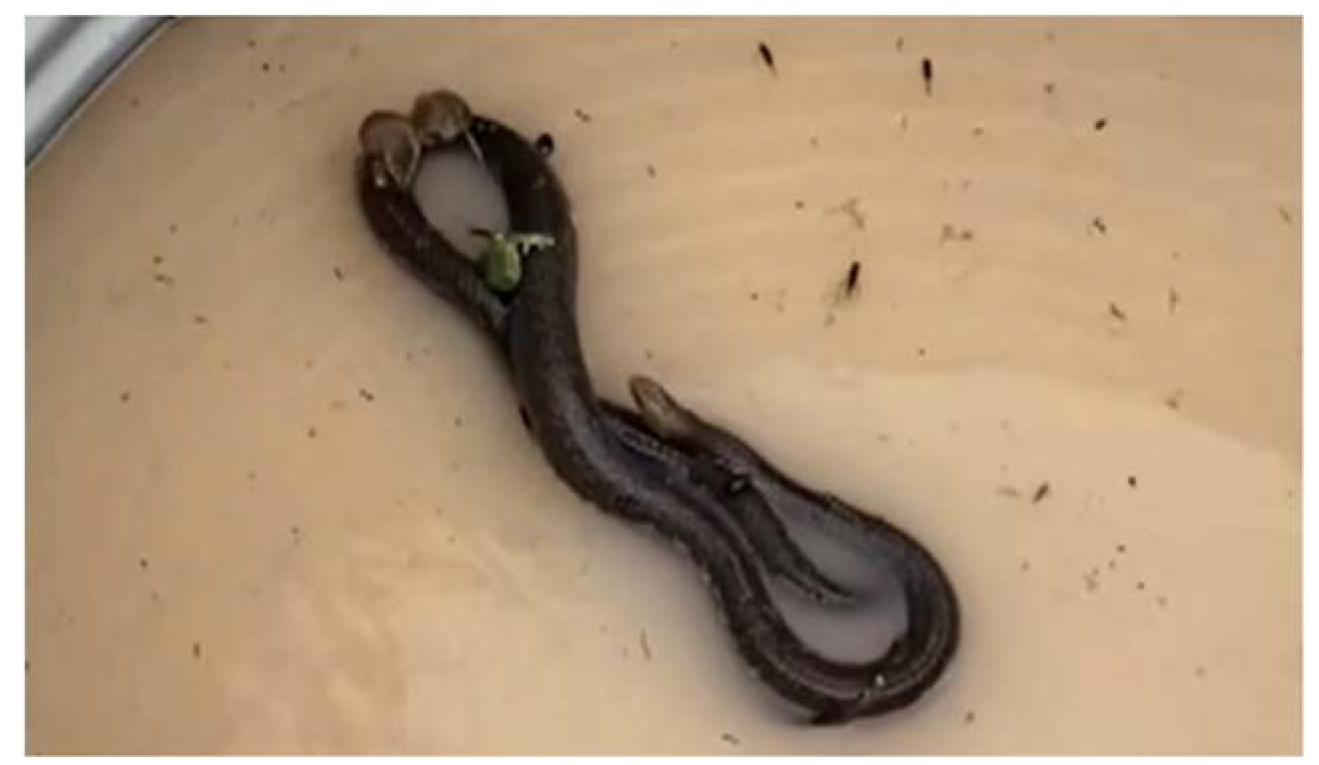
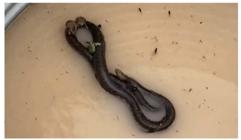
Eduardo Rosa: I keep wondering that this Sympathetic/Parasympathetic opposition, made by Science, is not about a reduced reading, but a “dominant paradigm” (Santos, 2008). This knowledge comes from the retention of animals and controlled stimulations on them, so that the experience model can be constituted and reproduced. It is a very different experience from knowledge built in a contemplative and investigative practice in the first person (singular or plural), integrating and sharing associable knowledge. Thus, the gradients on sympathetic/parasympathetic coactivation can take different forms, depending on the practices in which we constitute ourselves. I absorb this in your conversation, and I have lived it radically… Finding rest while on alert... or how a civilian sleeps in the wreckage in Kiev; how a widower of a landslide jokes in Petrópolis; how a survivor falls in love after going through the equally painful floods in Rio Grande do Sul. Or, even, how to remain in “dynamic stillness?” (Fernandes, 2011), this performative contemplation, which is not freezing - demonstrated by Behaviorists, when the aversive stimulus overloads the organism to the point that it declines both fight and flight. A frog or a rat, on the back of a snake as a means of surviving a flood in Queensland, as shown in the figure below, saves itself from death by drowning, leaning on the predator itself. Contemplation seems to enable a readiness to make the exit that opens up, even if squeezed to the brink of the risk of being the last: is this the fine dimension of a dynamic stillness? And how can it be found off the pressure of obvious risk?
Sometimes this comes through faith, sometimes through the clarity that it is a temporary combination of life, sometimes through a deep practice of meditation/contemplation/self-decentering... In any case, they are practices of parasympathetic-sympathetic mutuality. And, increasingly, our destination to them has become compulsory, in this transitionality of the world as it has been lived until then, in its dismantling/reassembly (?).
Ciane Fernandes: The more relaxed we are, the more we are prepared for an adequate response to the stimuli. This happens because, in alert state, the traumatic experience is automatic, based on previous traumas, and might not be related to the present stimulus, which can function as a trigger associated with those previous experiences (Levine, 1999). That is, the traumatic alert response in reality makes us blind and deaf to the environment, and even to real dangers, because our focus and hearing are very reduced in this state. Therefore, it makes much sense when you consider alert rest, which might be an active rest or mindful resting. I believe this is what BMCTM does when Diego Pizarro refers to associating sympathetic and parasympathetic nervous system in a continuum of survival and repatterning.
Diego Pizarro: When I rebel against science, Eduardo Rosa, I don’t mean that we are separate from it, or that I am against scientism. In fact, both the BMCTM and several other somatic systems of the 20th century are deeply inspired by science, but they move according to another paradigm, the somatic one, which is based on tacit knowledge and the experience of life itself. It becomes a problem when parameters that serve specific purposes are used as unique models for everything and everyone, something typical of a white, colonialist, Euro-American West. In your speech, Ciane Fernandes, as you pointed out the difference in the action of trauma in states of alert, one thought about this is to verify how the dualistic mind/body split enabled by modern science has created a contemporary trauma. Doesn’t this make us feel guilty for not knowing how to “write without being busy”? This seems to have to do with this trauma that scientism has brought to the academic world. When I was writing my doctoral thesis in 2020, in the middle of the pandemics, I would stay immersed for hours on end, then go to sleep and wake up in the middle of the night wanting to write, but still in a state of drowsiness. At those times, I remember well that I was writing while sleeping. I would doze off in the middle of writing and, when I looked up, I had written something that I didn't remember writing. I wrote it while I was in another state of consciousness. Once again, the autonomic nervous system serving as a background for the somatic nervous system, expressing itself in the world.
Deborah Dodd: While the sympathetic and parasympathetic systems operate in continuity and constant collaboration, somatic-contemplative practices - which begin from the soma to access introspective states - offer pathways into this living relationship between action and rest. In somaticpsychopedagogy, an approach developed by Professor Danis Bois, a French physiotherapist and osteopath, principles such as slowness and the Supporting Point (P.S.) act somatically to create experiential fields between the inner movement and its continuities with the soma and the environment. The Supporting Point is a sensorial pause, generally activated in the presence of somatic immobilities, unconsciousness, or insensitivities - understood in somatic-psychopedagogy as latent potentials. This pause favors the emergence of new movement qualities and broadens the sensorial relationship with what is immobile, unconscious, or in a state of insensitivity. In the practices developed by Bois - such as DBM Fasciatherapy, Sensory gymnastics, and Full-Presence Meditation - the P.S. sustains somatic listening by allowing the recognition of tonic modulations, welcoming the rhythms of bodily self-regulation, and sensorially accompanying the unfolding of movements and their sensorimotor transformations.
Initially called sensory introspection, Full-Presence Meditation is the essence of practices of the Sensible (Bois; Eschalier, 2019). In it, the still posture opens a field of embodied attention and a heightened perception, enabling one to perceive the subtleties of inner movement and follow the nuances of its immanent relation with the Sensible4 and the environment. Should a form of “sympathetic voluntarism” be present in this practice, it reveals itself in the conscious choice to open oneself to the perception of the interdependence between the sympathetic and parasympathetic systems - a gesture that sustains sensitive ways of being in the world. Bois’s initial interest in inner movement arose from his practice as an osteopath. As early as the mid-19th century, osteopathy recognized the presence of a vital force that animates the organs and joints of the body. Bois delved into listening to inner movement, as the experience of the Sensible, according to him, emerges from it and requires favorable conditions to be consciously perceived (Bois, 2008). From there, he began to develop practices that follow and support, rather than manipulate, inner movement. The contemplative practices he proposes are experiences of embodied attention and selfpresence, engaging us in a singular relationship with inner movement in a continuous flow of presence and co-creation with the environment (light, temperature, space, time, weight, silence, images). This relational dimension brings new connotations to contemplative practice. While facilitating a Full-Presence Meditation during a workshop at the 2nd Seminar on Performing Arts and Contemplative Practices: Contemplation, Performing Arts and Coexistence (Brazil, 2021), an Indian participant remarked, with amazement, that the practice had not separated her from her body or from the world. Unlike what she was used to experiencing in other meditations, she felt an embodied connection with herself and with the group. When we attune ourselves sensorily in contemplative practices, we simultaneously cultivate qualities of presence that are singular, relational, collective, and shareable. I perceive them as practices of reconnection with a sensorial ecology of shared warmth of life and of the Sensible.
Contemplation and dance. How are the gradients between these apparent moving polarities present in creative processes in dance? And vice versa, how does a dancing person engage in contemplative practices? In my artistic experience, I find that somatic contemplative approaches of/in movement offer a perceptual enrichment that expands the compositional fields in which I am involved. Conversely, I perceive the influence of the inventiveness cultivated through dance processes at work during Full-Presence Meditation. One practice gazes at the other and, together, they develop a particularly (re)generative and compositional relationship with the Sensible and with movement.
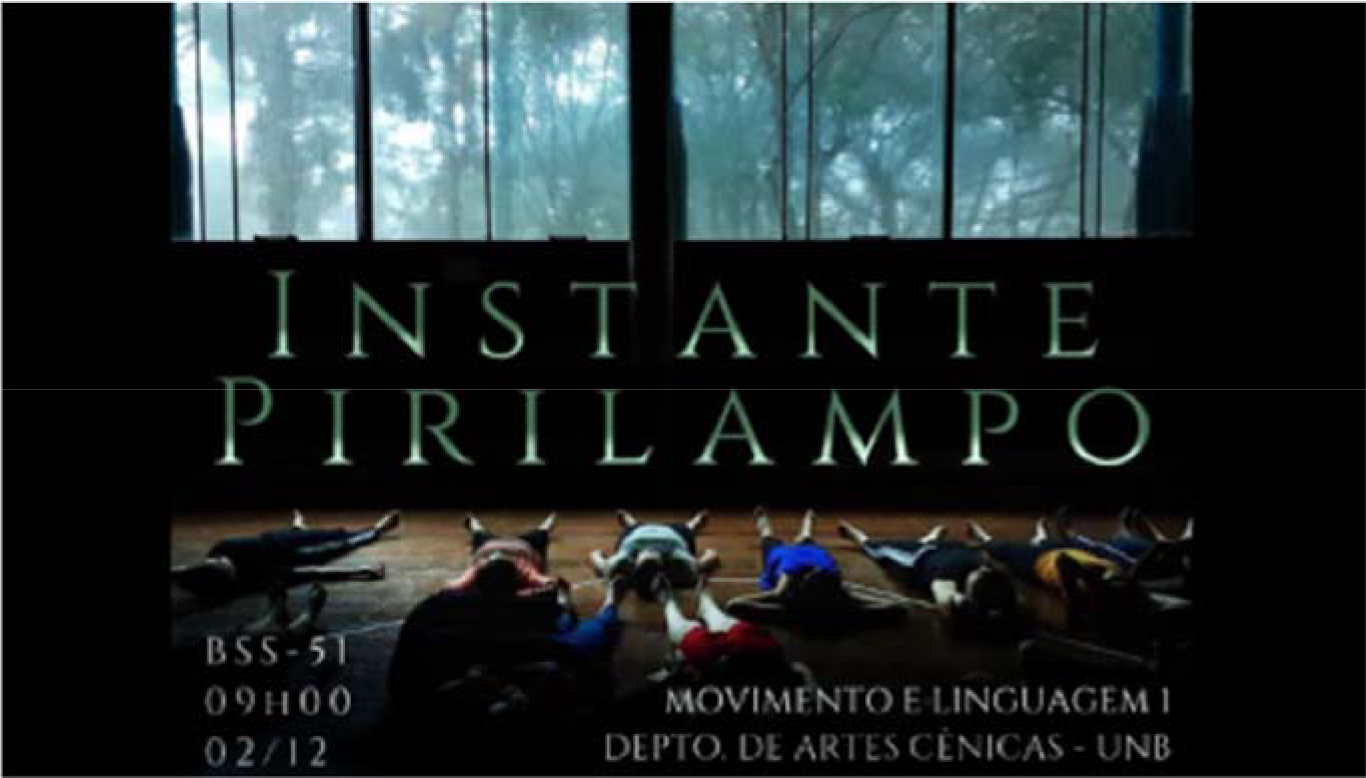
Between 2019 and 2021, I taught the course Movement and Language 1 for undergraduate students in Performing Arts at the University of Brasília. The course was based on an approach that interweaves somatic practices - including contemplative ones - applied to dance. During my master's studies, I was able to explore, invent, and develop this approach, which I eventually named Sensitive Co-creation (Macedo, 2019). In the compositional process I developed with the class from the second semester of 2019 - guided by me but collectively composed by the group -, we brought together some of the themes addressed here in this text. Initially, the creative process was based on variations between tension, tonic dialog, and bodily relaxation, and their relationships with time. On the first day of rehearsal, we were gifted with a massive storm. There was a sudden power outage right in the midst of a pulsating flow of collective improvisation. It was striking. We felt as if the storm were co-creating with us. At that moment, I suggested that we all lie down and contemplate the ecoperformance of the storm through the large glass wall of the studio. This process of aquatic contemplation became both the starting point and the guiding thread of the entire composition, which we came to name Instante Pirilampo (Firefly Instant, 2019, University of Brasília). An image from that moment illustrates the performance poster:

The title of the performance came from one of the embodiment practices, in which we explored compositional states based on variations of the time factor from the Laban/Bartenieff Movement System (LBMS), in connection with a text by Clarice Lispector (1994), as suggested by Fernandes: “But the instant-now is a firefly that lights up and goes out, lights up and goes out. [...] I, alive and flickering like the instants, light myself up and go out, light up and go out, light up and go out.” (Lispector, 1994apudFernandes, 2006, p. 138)5.
The group discovered a poetics between Lispector’s text and the embryonic moment of the choreography, when the lights suddenly went out. This firefly instant, expanded through the experience of contemplating the storm as ecoperformance, created a wild field of somatic-performative images (Fernandes, 2018) that nourished the entire creative process.
Ciane Fernandes: So, it is an imaginary that springs from embodiment, or together with it; it is not something abstract, very much on the contrary, it springs from the materiality of sensopercepcion.
Deborah Dodd: Exactly. And this somatic-performative imaginary may emerge both in the compositional processes of Sensitive Co-creation and in Full-Presence Meditation.
Ciane Fernandes: This is embodied research. They are dynamic non-dual processes which feed themselves mutually, flow to each other in a double spiral between technique and aesthetics, embodiment and the scene, human and more-than-human, performance and writing. In this intermodal continuum, plural meanings emerge from an infinity of ethical-aesthetic relational possibilities, providing unusual contributions to the arts as much as to others fields, as transdisciplinary as the fields of Somatics and of Performance Studies, as well as their unfoldings that are increasingly plural.
Tensional Contemplation
Ciane Fernandes: The sun sets while, in dynamic pause, we are “feeling the earth turning” (Pecci Filho; Moraes, 1979), being co-moved. Movement in the Laban/Bartenieff Movement System (LBMS) (Bartenieff; Lewis, 1980) is the gradation between stillness and stir, so it is eminently a-tensional, in the sense of an attention that transits in the gradation between tension levels, which Dr. Judith Kestenberg named as Flow fluctuations (Kestenberg, 1977; Amighi et al., 1999). That is why in LBMS the spiral and the figure eight or Moebius Band are so important, as, for example, the inner and outer spiral by Escher (Ernst, 1996), at the same time centrifugal and centripetal, which conjugates these gradations in a continuum. If we separate tension from attention, and without tension from without attention, it becomes dual and stagnated, there is no movement. Even because in LBMS attention has to do with focus, and not with flow, but of course they can be associated. Intention has to do with focus, and intensioning has to do with tension, that is, flow.
Eduardo Rosa: In “negation,” according to Freud (1996), it is not a matter of pointing out something that does not exist, but rather of finding a way for the forbidden existing to appear. Thus, the content of a repressed image or idea can make its way into consciousness, provided that it is denied. Negation constitutes a means of becoming aware of what is repressed; in effect, it is already a means of overcoming repression, even though it is marked by it (Freud, 1996, p. 265-266).
A psychoanalysis, when noticing this perversion marking the affirmative plane of consciousness, taken in the sense of the a-tensional, gives indications of a tonic gradient that produces distension, even if there is some lesser pressure sustaining or even directing it. This tensional curvature, given by the negation, can be the performative zone to be experienced, not only to identify a defense, but also to listen to what it wants to perform. One stops investing in the impediment and shifts the tension to destinations in a possible territory. If the use of control in favor of the drive happens with the negation, it is suggested that the a-tension can form similar mechanisms, even off negation: the performer contemplating the impulse, in the flow of the action, can tune in and even assume the composition of the meaning curves, intending the composition in action, determining its polysemy and polymorphism, expanding dehierarchized connections from body to body - which favors an amoral ecocentric ethics. But this thin somatic attunement is escapable. It touches on the Real, on a more sustained provisional duration, based on contemplative attention.
Ciane Fernandes: Tension as censorship is different from tension as liberating creative movement, for example, because we cannot limit the understanding of tension only as something negative, although, yes, it does have to do with control, for example, of the sphincters. But to judge tension as something social (of control) is already to hitch a meaning in the energy, in the flow.
Eduardo Rosa: This would be both extremely enchanting and dangerous. I find it interesting when Deleuze and Guattari (2012) draw attention to prudence in the face of this broad openness to the flow of becoming. In their warning, there is an ethics of safety, since the infinite propagation of immanence is cancerous, insane and deadly, and can dissolve opportunities for experimentation. Prudence, then, is an ethical and aesthetic approach to preserving life, as an “art of doses.” It is capable of making this border zone of life and death habitable, to be touched upon - and not surpassed - in a disposition, they claim, of patience and provisionality. Alive, touching upon death, to leave dead what prevents births from occurring.
Ciane Fernandes: Even for the heart to beat, there must be tension, contraction. I believe that the tension that Eduardo Rosa refers to is specific to the creative impulse. It has to do with selection, criteria, choices, to follow that which calls me up, but also with an attention opened to notice and visibilize that impulse.
Deborah Dodd: It expands, contracts, wanders… combing through the fascial fibers with each heartbeat. This variation in tensions makes me think of the principle of tonicity - rather than resorting to the notion of energy - understood as the living reality of tonic modulation between different impulses. In this context, the fasciae, as a connective system and sensory organ of the body, are directly involved in tonic modulation and in the integration of form, movement, and sensation. The tensegrity relationship, intrinsic to the fasciae, unfolds across a broad spectrum of relaxations, contractions, resistances, and glidings. Within a single connective tissue, in a single movement, gradients of tension and relaxation coexist. These tonal variations of the body enable somatic interactions within the sensory-perceptual relationships with/in the environment. We can feel the tonus in constant modulation, spiraling through webs of force and movement-sense at every instant. The tonic dialog is expressive and leaves traces and flavors through touch, movement, pause, and writing. However, when tensions become fixed and turn into immobilities, they may interrupt inner movement, suspend tonic modulation, and weaken the somatic-performative dialogs that arise from them.
Ciane Fernandes: Yes, Deborah Dodd, tonicity (strength, active weight) differs from tension (flow). I believe that Eduardo Rosa is not referring to tonicity per se, but to control or permission to create in the level of the impulse, that is, consciousness that allows or holds. Everybody needs safety, even a hug is a way of feeling safe; of course, it can be more tense or less tense, with more or less tonicity too, but there is the question of boundary, of the membrane. This also creates tension, besides the oppositions that generate tension. I believe we are talking about various simultaneous levels, such as creative, affective, muscular, energetic, cellular (membrane), material (consistency, texture etc.), conscious, psychological, spiritual etc., therefore somatic, but how this is in movement and changes all the time… somatic-performative.
Eduardo Rosa: Sphincter practices are structuring for living. I think that a civilizing policy raises them to extreme levels, radical gradients of exploitation, slavery and submission, to the point that we build an anti-sphincter culture to deal with this trauma, but also as part and reiteration of the trauma itself. And now we are living in the midst of this social diarrhea. Everyone is allowed to shit wherever and whenever they want. I think that there is, perhaps, a somatic restitution of the sphincter, like the union with the bandhas in Hatha Yoga. On the one hand, it is having clarity about a place, selecting it, investing there, and, on the other hand, it is an opening of circulations, as Diego Pizarro said above.
Diego Pizarro: The sphincters are capable of holding us upright! The mouth-anus connection is the deep relationship of the notion of verticality from the third week of gestation - embodied embryology (Bainbridge Cohen, 2018b) as a Contemplative Dance Practice (CDP) (Dilley, 2015). It was through the sphincters that I learned to position myself in dance, it was through seated meditation and its possible dances that I healed myself from countless emotional after-effects.
sits - breathes - dreams - crackles - takes a deeper breath - breathes into the cell - notices the hair - falls asleep - falls from boredom - falls from hatred - recomposes itself by sucking saliva and finding the front body - mouth - anus - primitive tube - sitting it moves - starts a sphincter dance - of mouths, eyes, ears and assholes inside and out
Eduardo Rosa: French psychoanalyst Françoise Dolto (2012) notes sphincter activity as an original aspect of motor control, therefore, of elaborated motricity, since it is the first situation of movement in which it is not only impulse, but also support. In various body practices, from classical ballet to modern dance techniques or even the practice of asanas, this region appears as a basic element of support for the fluidity of movement/pause. It is interesting to assume control not only as something that impedes, but mainly as something that enables.
Diego Pizarro: After all, even to shit you have to contract your sphincters, as movement educator Ivaldo Bertazzo constantly states in his in-person and online classes. Embryologically embodying the process of formation of the anus and mouth - previously the cloacal membrane and oropharyngeal membrane - respectively, has been worked on in BMCTM as a fundamental process to find our midline and a soft verticality, that is, not rigid, but totally malleable and resilient.
Ciane Fernandes: The question that matters to us as dance artists seems to me to be the reactivation of this ability to somatic attunement (Nagatomo, 1992), not as something quantitatively productive, but precisely a selfinhabiting in a continuous process of merger, differentiation, and integration (Wyman-McGinty, 2007) as growing somas. That is, an activation that superimposes sympathetic and parasympathetic, action and rest, sensitivity, and dynamism. But to do this activation, we make use of a certain deactivation of restrictive patterns, trespassing them and expanding through ecoperformance, in a constant process of dissolution and remaking, as life itself.
Final confluences between contemplative traces of re-existence
Deborah Dodd: Dissolution and (re)generation attune me to the compositional relationship between water and earth. To feel Gaia’s movements as ecosomatic, I need a form of attention that is both sensory-perceptual and relational. The perspective of Body Environment Immersion has expanded my contemplative practice, opening passages for sensitive plunges in which body and environment mutually shape one another. Perceiving the dissolving and (re)gene movements between water and earth in an ecosomatic manner is, for example, akin to perceiving the compositional relationship between solid fascia (which composes and decomposes into collagen fibers) and liquid fascia (interstitial fluids that carry drops of information through the connecting threads of the solid fasciae). Both geographic and anatomical scales compose somatic, sensitive, and transitory landscapes. The somatic-performative compositions that currently occupy me arise from the kinesthetic perception of these confluences and coexistences.
I would like to share with you a moment of contemplation related to this process of composition-decomposition that I experienced recently (2022), during a visit to the exhibition Amazônia by the Brazilian photographer Sebastião Salgado, held at SESC Pompéia in São Paulo. The exhibition itself was an immersive sensorial-poetic experience, in which we witnessed several striking compositions created by water on a grand scale in the Amazon region.
In a photograph6 of the Anavilhanas Archipelago - the largest fluvial island complex in the world - one can be drawn into the pulsating movements in which land, water, clouds, and horizon coil and unfold into deeply comoving ecoperformative compositions. These compositions evoke in me movements akin to those generated by the sensory action of the fasciae, and, thus, they were experienced somatically and performatively.
Ciane Fernandes: This reminds of the “wisdoms of the waters,” referred to by Edir Augusto Dias Pereira (2021) regarding Indigenous and riverside populations of the Amazon, with all their cultural and cosmogonic plurality. In a decolonial cartography of the waters, Pereira overlaps time, doing and knowing of these plural cultures to propose an epistemology of the waters. The author calls our attention precisely to the operating mode of scholars who investigate these cultures by transforming them into objects of study, rather than legitimating them with their own means of creating knowledge. That is, time, doing and knowing do not constitute things (manipulative objects within a post-capitalist productive chain), but, mainly, the modes through which we live and co-create, in a continuous process of building plural forms of knowledge.
In the same manner, it seems to me that many of us artists/researchers create a magic aura around performance or experience, which would be dismantled or destructed or lose its enchantment by being written, because, a priori, writing is a settlement (Baitello Júnior, 2012), the marking off a territory, the fixation of something which is, by nature, slippery and cannot be pinned down. But Lepecki (2004) reminds us of the Derridean trace, through which we can write together with (rather than against) the ephemeral nature of dance (and performance). According to the author, dance is not movement while it is only dance, but precisely it can only become movement while writing: “[...] It is not only the object (the dance) that is in motion; the writer, the viewer, the spectator, is never, ever fixed as well.” Thus, “[...] Dance cannot happen without writing just as writing cannot happen without dancing.” (Lepecki 2004, p. 134,137). This implies that writing is not something steady, or an artifice that pins dance down, but very much on the contrary, it is co-moved by/with it.
Now this movement needs to be understood not as unceasing in the productive chain, but rather as vibrational, pulsing, gradated, fluid, connective, multiple. In this plural context, everything is “interdependent” (Mingus, 2017) and we flow making “intermodal” connections (Manning; Massumi, 2014).
Deborah Dodd: Let’s take a pause to watch the sunset and wander… and share firefly instants…
Ciane Fernandes: Yes, the lights, the hues… Gradations… Day and night, production, and rest… sympathetic and parasympathetic…
Melina Scialom: And the moment of change from vata to kapha, from spermatozoid to egg.
All debating people in unison: This talk-poem-experience among researchersartists-educators proposes, as reflexive contribution, the recognition of Somatics as contemplative ecoperformative practice and as a mode of producing sensitive and interdependent knowledge. It considered the bodyenvironment relationship not as a background, but as live composition, including in the textual creation of this article.
While exploring a writing that allows itself to be affected by dialog, by impermanence, by contemplation and by somato-perceptive intensities, we open the ways for an epistemology that does not separate theory and practice, body and world, art, research and life. The pursuit of integration between parasympathetic and sympathetic systems during the reflexive process of the text proved a regenerative form of writing, recycling, refeeding, continuing and transforming the ideas which were co-created by the authors. This brought us, presumably, an effort modulation - between tension and relaxation - and another writing which arises from mutual affection.
From the starting point of our crossings with water, earth, fascia, sphincter practices, this article advocates that somatic practice, collectively lived, can also be a form of creating pathways of sensitiveness, in which writing is dancing, dancing is a gesture of listening. Therefore, we propose an ecosensibility that pulses between the lines, in the pauses, in the shared gestures, in that which composes and unmakes itself ceaselessly.
We seek here, perhaps, to offer the reader a constellation of experiences that invite to co-movement - a wisdom that does not ceases itself, but flashes as an intermittent, collaborative, plural, unpredictable firefly, through the contemplation of transitory states between art and life, artist and world. In this immersive undoing, it is possible to renew and surprise oneself, remaking ourselves in an expanded field of ethical-aesthetic possibilities in affective and effective meetings, transforming the neurotypical functionality, to which we were conditioned, into intermodal collaborative mutant modes. After all, the conversation between disappearance and reenactment (Franko, 2016) is part of performance’s own nature, in a spiraling time (Martins, 2021) that reverberates and multiplies itself, dribbling growing crisis and conflicts - from personal to social, political and environmental -, always creating new possibilities and unpredictable modalities of existence, resistance, and resilience.
Notes
-
1
The ritual was an aesthetic-performative experience that emerged from an ex-periment with the rasas. It premiered at the Alternative Arts and Culture Festival Universo Paralello, on Dec 31, 2007, being widely performed in events in the states of Bahia and São Paulo, Brazil.
-
2
Taanteatro is the performing arts company founded by Maura Baiocchi in 1991.
-
3
This term is inspired by the work of Maura Baiocchi and Wolfgang Pannek (2007), called Choreographic Theater of Tensions.
-
4
According to Bois (2008), I employ the term Sensible with a capital “S” to denote an embodied subjective experience, as distinct from a sensory-sensitive one. This distinction does not, however, imply a hierarchy between the two.
-
5
N.T.: From the original: “Mas o instante-já é um pirilampo que acende e apaga, acende e apaga. [...] Eu, viva e tremeluzente como os instantes, acendo-me e me apago, acendo e apago, acendo e apago.” In the original text, the external image of the firefly that lights up and goes out (um pirilampo que acende e apaga) is reflected in the inner image of the self that lights itself up and goes out (acendo-me e me apago). Although alternatives such as fade or dim might evoke nuances of inner dissolution, we chose to use go out for its rhythmic correspondence with the central repetition in the original.
-
6
The photograph The Anavilhanas National Park, gelatin silver print 20 x 24, Amazonas, Brazil, 2009, is available at: https://www.artsy.net/artwork/sebastiao-salgadoanavilhanas-national-park-state-of-amazonas-brazil. Accessed: May 22, 2025.
Availability of research data:
the dataset supporting the results of this study is published in the article itself.
-
This original paper, translated by the authors and reviewed by Roberto Candido (Tikinet Edição Ltda.), is also published in Portuguese in this issue of the journal.
References
- AMIGHI, Janet Kestenberg et al The meaning of movement, developmental and clinical perspectives of the Kestenberg Movement profile New York: Routledge, 1999.
- AUGÉ, Marc. Non-places: introduction to an anthropology of supermodernity. Translated by John Howe. London & New York: Verso, 1995.
- BACON, Jane M.; MIDGELOW, Vida L. Creative Articulations Process (CAP). Choreographic Practices, v. 5, n. 1, p. 07-31, 2014.
- BAINBRIDGE COHEN, Bonnie. Sensing, Feeling and Action: the experiential anatomy of Body-Mind Centering® The collected articles for Contact Quarterly dance journal 1980-2009. 3. ed. Northampton, MA: Contact Editions, 2012.
- BAINBRIDGE COHEN, Bonnie. Basic Neurocellular Patterns: exploring developmental movement. El Sobrante: Burchfield Rose, 2018a.
- BAINBRIDGE COHEN, Bonnie. Embodying the embryological foundations of Movement Course Notebook. Berkeley: School for Body-Mind Centering®, 2018b.
- BAIOCCHI, Maura; PANNEK, Wolfgang. Taanteatro: Teatro Coreográfico de Tensões. Rio de Janeiro: Azougue Editorial, 2007.
- BAITELLO JÚNIOR, Norval. O pensamento sentado: sobre glúteos, cadeiras e imagens. São Leopoldo: Unisinos, 2012.
- BARTENIEFF, Irmgard; LEWIS, Dori. Body movement: coping with the environment. Langhorne: Gordon & Breach Science, 1980.
- BOIS, Danis. O Eu Renovado, introdução à Somato-psicopedagogia. Aparecida: Ideias & Letras, 2008.
- BOIS, Danis; ESCHALIER, Isabelle. La méditation en pleine présence: Les sept voies d'accès à la chaleur humaine. Paris: Eyrolles, 2019.
- DEAN, Sally E. Somatic movement and costume: A practical, investigative project, Journal of Dance & Somatic Practices, Bristol, Intellect Limited, v. 3, n. 1 e 2, p. 167-182, 2011.
- DELEUZE, Gilles; GUATTARI, Félix. Mille Plateaux: capitalisme et schizophrénie. Paris: Minuit, 1980.
- DELEUZE, Gilles; GUATTARI, Félix. Como criar para si um Corpo sem Órgãos? In: DELEUZE, Gilles; GUATTARI, Félix. Mil platôs: capitalismo e esquizofrenia 2. São Paulo: Ed. 34, 2012. P. 11-33.
- DILLEY, Barbara. This Very Moment: teaching, thinking, dancing. Boulder: Naropa University Press, 2015.
- DOLTO, Françoise. A imagem inconsciente do corpo São Paulo: Perspectiva, 2012.
- DÖRR, Evelyn. Rudolf Laban: das choreographische Theater: die erste vollstaendige Ausgabe des Labanschen Werkes. Norderstedt: Books on Demand, 2004.
- ERNST, Bruno. Lo specchio magico di Maurits Cornelis Escher Cologne: Benedikt, 1996.
- FERNANDES, Ciane. O corpo em movimento: o Sistema Laban/Bartenieff na formação e pesquisa em artes cênicas. São Paulo: Annablume, 2006.
- FERNANDES, Ciane. Pausa, presenca, público - da Danç a-Teatro à Performan-̧ ce-Oficina. Revista Brasileira de Estudos da Presença, Porto Alegre, v. 1, n. 1, p. 77-106, jan./jun. 2011.
- FERNANDES, Ciane. Sintonia somática e meio ambiente: pesquisas de campo do laboratório de performance do PPGAC/UFBA. Repertório, Salvador, PPGAC/UFBA, n. 18, p. 175-183, 2012.
- FERNANDES, Ciane. Im(v)ersões Corpo Ambiente e a criação coreovideográfica. Cena, Porto Alegre, PPGAC/UFRGS, n. 13, p. 1-14, 2013.
- FERNANDES, Ciane. Abordagem Somático-Performativa. In: SILVA, Igor de Almeida; CONSTÂNCIO, Rudimar (Org.). Ação Cultural: Arte, Educação e Política. Recife: SESC Piedade, 2014. p. 94-109.
- FERNANDES, Ciane. Dança Cristal: Da Arte do Movimento à Abordagem Somático-Performativa. Salvador: EDUFBA, 2018.
-
FERNANDES, Ciane. Do Rio ao MaR: Imersão Corpo Ambiente e Imersão como Pesquisa. In: COOPER NETO, Weber Miranda (Org.). Corpo-Rio Revista/catálogo Cachoeiro do Itapemirim: Edição dos autores, 2023a. P. 55-68. Disponível em: https://corporio.my.canva.site Acesso em: 06 nov. 2023.
» https://corporio.my.canva.site - FERNANDES, Ciane. No movimento das marés: Somática, Imersão como Pesquisa e criação em dança. In: FERNANDES, Ciane; SANTANA, Ivani; SEBIANE, Leonardo (Org.). Somática, Performance e Novas Mídias Salvador: EDUFBA, 2023b. P. 303-320.
- FERNANDES, Ciane; PIZARRO, Diego; SCIALOM, Melina. Prática Artística como Pesquisa, Somática e Ecoperformance São Paulo: Giostri, 2024.
- FOSTER, Susan Leigh. Choreographing History Bloomington; Indianapolis: Indiana University Press, 1995.
- FRANKO, Mark. Epilogue to an epilogue: Historicizing the re-in reenactment. In: COSTAS, Ana Maria Rodriguez et al. (Org.). ABRACE - Arte, corpo e pesquisa na cena: Experiência expandida. Belo Horizonte: ABRACE, 2016. P. 45-70.
- FREUD, Sigmund. Obras psicológicas completas de Sigmund Freud: O ego e o id e outros trabalhos (1923-1925), vol. XIX. Traduzido do inglês sob a direção geral de Jayme Salomão. Rio de Janeiro: Imago, 1996. p. 261-269.
- JOHNSON, Don Hanlon. Body: recovering our sensual wisdom. Berkeley: North Atlantic Books, 1992.
- KESTENBERG, Judith S. The Role of Movement Patterns in Development Vol. I. New York: Dance Notation Bureau, 1977.
- LEPECKI, André. Inscribing Dance. In: LEPECKI. André (Org.). Of the Presence of the Body Middletown: Wesleyan University, 2004. P. 124-139.
- LEPECKI, André. Exhausting Dance: performance and the politics of movement. New York: Routledge, 2006.
- LEVINE, Peter. O despertar do tigre: curando o trauma. São Paulo: Summus, 1999.
- LISPECTOR, Clarice. Água viva São Paulo: Francisco Alves, 1994.
-
MACEDO, Débora Dodd. Cocriação Sensível: a elaboração de uma abordagem da dança em diálogo com a somato-psicopedagogia. In: ENCONTRO INTERNACIONAL DE PRÁTICAS SOMÁTICAS E DANÇA, 1, 2018, Brasília. Anais [...] Brasília: Ed. IFB, 2019. P. 61-67. Disponível em: https://arquivorevistaeixo.ifb.edu.br/index.php/editoraifb/issue/view/113 Acesso em: 17 jun. 2022.
» https://arquivorevistaeixo.ifb.edu.br/index.php/editoraifb/issue/view/113 - MANNING, Erin; MASSUMI, Brian. Thought in the act: passages in the ecology of experience. Minneapolis: University of Minnesota Press, 2014.
- MARTINS, Leda Maria. Performances do Tempo Espiralar: poéticas do corpotela. Rio de Janeiro: Cobogó, 2021.
- MEYER-DINKGRAEFE, Daniel. Consciousness and the Actor: A Reassessment of Western and Indian Approaches to the Actor’s Emotional Involvement from the Perspective of Vedic Psychology. Frankfurt: Peter Lang, 1996.
-
MINGUS, Mia. Access Intimacy, Interdependence and Disability Justice - My remarks from the 2017 Paul K. Longmore Lecture on Disability Studies at San Francisco State University delivered on April 11, 2017. Leaving Evidence, 12 abr. 2017. Disponível em: https://leavingevidence.wordpress.com/2017/04/12/access-intimacy-interdependence-and-disability-justice/ Acesso em: 17 jun. 2022.
» https://leavingevidence.wordpress.com/2017/04/12/access-intimacy-interdependence-and-disability-justice/ -
MURPHY-SHIGEMATSU, Stephen. The art of living & the art of dying: Lessons from a 111-year-old Japanese grandmother. Embodied Social Justice Summit, 2022. Disponível em: https://www.embodiedsocialjusticesummit.com/live-summit-day-3 Acesso em: 18 fev. 2022.
» https://www.embodiedsocialjusticesummit.com/live-summit-day-3 - NAGATOMO, Shigenori. Attunement through the body New York: State University of New York, 1992.
- NELSON, Robin. Practice as research in the arts: Principles, protocols, pedagogies, resistances. Hampshire: Palgrave MacMillan, 2013.
- PECCI FILHO, Antônio (Toquinho); MORAES, Marcus Vinícius da C. M de (Vinícius de Moraes). Tarde em Itapuã. In: PECCI FILHO, Antônio (Toquinho); MORAES, Marcus Vinícius da C. M de (Vinícius de Moraes). 10 Anos de Toquinho e Vinícius [LP]. Hilversum: Philips/Universal Music, 1979.
- PEREIRA, Edir Augusto Dias. Oficina das águas Cametá PA, 2020.
-
PIZARRO, Diego. Anatomia corpoética em (de)composições: Três corpus de práxis somática em dança. 2020. Tese (Doutorado em Artes Cênicas) - Escola de Teatro, Universidade Federal da Bahia, Salvador, 2020. Disponível em: https://repositorio.ufba.br/handle/ri/32962 Acesso em: 17 jun. 2022.
» https://repositorio.ufba.br/handle/ri/32962 - SANTOS, Boaventura de Sousa. Um discurso sobre as ciências São Paulo: Cortez, 2008.
- SATIE, Erik. Gymnopedie 1888. [partitura]
- WYMAN-MCGINTY, Wendy. Merging and Differentiating. In: PALLARO, Patrizia (Ed.). Authentic Movement: Moving the Body, Moving the Self, Being Moved. A Collection of Essays. Volume II. London: Jessica Kingsley, 2007. P. 154-175.
-
Editor in charge: Gilberto Icle

 Source: Ciane Fernandes. Screen print.