 Organizational strategies of primary schools in Pernambuco: comparative analyses of the regulations of 1859 and 1876
Abstract
This article compares the organizational strategies of primary schools in Pernambuco based on the materiality of the 1859 and 1876 School Regulations. Through documentary research that treats these regulations as sociocultural representations generating behaviors (Chartier, 1990), we examine their formal features and compare the organizational strategies inscribed in the regulations (Viñao Frago, 1995; De Certeau, 2004). We conclude that, by the late nineteenth century, Pernambuco’s authorities undertook a variety of measures to standardize primary schools, with the regulations serving as devices for shaping and monitoring the conduct of teachers and students within schools.
Keywords:
school cultures; primary education; representation; 19th century
Resumo
Este artigo compara as estratégias de organização das escolas primárias em Pernambuco, a partir da materialidade dos Regimentos das Escolas de 1859 e 1876. Por meio da pesquisa documental, e entendendo os regimentos como representações socioculturais, geradores de comportamentos (Chartier, 1990), apresentamos seus aspectos formais e comparamos as estratégias de organização das culturas escolares na documentação (Viñao Frago, 1995; De Certeau 2004). Concluímos que, em fins do século XIX, as autoridades governamentais pernambucanas empreenderam esforços variados na uniformização das escolas primárias, sendo os regimentos dispositivos de modelação e vigilância das condutas dos professores/as e alunos/as dentro das escolas.
Palavras-chave:
culturas escolares; instrução primária; representação; século XIX
Resumen
Este artículo compara las estrategias de organización de las escuelas primarias en Pernambuco a partir de la materialidad de los Reglamentos de 1859 y 1876. Mediante investigación documental que concibe estos reglamentos como representaciones socioculturales generadoras de comportamientos (Chartier, 1990), examinamos sus aspectos formales y comparamos las estrategias organizativas inscritas en ellos (Viñao Frago, 1995; De Certeau, 2004). Concluimos que, a finales del siglo XIX, las autoridades de Pernambuco emprendieron diversas medidas para uniformar las escuelas primarias, siendo los reglamentos instrumentos para moldear y vigilar la conducta de profesores y alumnos dentro de las escuelas.
Palabras clave:
culturas escolares; instrucción primaria; representación; siglo XIX
Introduction
Forging an imperial school model in Brazil required the establishment of an administrative-police structure as a central foundation for aligning the “world of disorder” with the ideals of “good society”. This alignment was pursued through a series of reforms, regulations, and school rules that extended into everyday aspects of school life - including student age and conditions, school architecture, the organization of time and knowledge, pedagogical methods, and systems of school inspection. The strategies for organizing schools were linked to hierarchies in the exercises of power destined for “governable subjects” (Mattos, 2004; Gondra, 2018).
Therefore, this study aims to compare the organizational strategies of primary schools in Pernambuco, based on the materiality of the Primary School Regulations of 1859 and 1876. The Regulations are part of the broad and diverse documentary set, entitled “Instructions”, under the custody of the Jordão Emerenciano State Public Archive (Arquivo Público Estadual Jordão Emerenciano - APEJE), which were completely photodigitized. This documentary series is composed of regulations, rules and teaching programs from the second half of the 19th century and the first half of the 20th century.
In the documentation, we identified records relating to education in the province of Pernambuco, among which the following stand out: the creation and provision of primary schools; attributions assigned to local authorities for primary education and Normal Schools; rules for attendance and enrollment of students in primary schools; school subjects and materials; criteria for provision of public schools; selective examination processes for entry into public teaching; rules for the holding and continuation of pedagogical conferences; attributions (rights and duties) assigned to primary teachers (public and private) and to administrative and instruction inspection authorities.
Through documentary research, and using direct, simple and complete transcription (Aróstegui, 2006) of the records found in the school regulations of 1859 and 1876, we tracked down information regarding the spatial organization of schools and the different prescriptions for teachers and students, desired by government authorities in Pernambuco. These regulations aimed to organize and standardize the functioning of public primary schools and were repeatedly cited in the speeches of government authorities and public primary school teachers in Pernambuco until the mid-1880s (Lima, 2014), which is why they were chosen for analysis. Throughout the pages that follow, the information found in the documentation will be linked to the comparative method, with the purpose of
[...] verify how the elements identified through comparison vary in a more specific direction - so that a certain pattern of transformations can be identified over time - and, furthermore, if we have two contiguous realities, how one influences the other, and how the two, based on the reciprocal relationship, end up transforming each other (Barros, 2007, p. 5).
This study will analyze the similarities and differences in teaching methods and curricula, student age groups, the operating hours of public primary schools, and the disciplinary and reward mechanisms within the teaching-learning process, as outlined in the aforementioned school regulations.
Combined with the comparative method, the situations that emerged from the documentation are anchored in the concept of “strategies” defended by Michel de Certeau (2004). We understand “strategies” as the mechanisms of action that condition the “relations of power” and domination, by imposing a certain order on the social structure, with the aim of controlling the behaviors subjected to them.
We dialogue with the assumptions of Cultural History, with the focus of corpus analysis documentary centered on the concept of representation. Among several meanings, it can be understood,
on the one hand, representation as showing an absent thing, which presupposes a radical distinction between that which represents and that which is represented; on the other, representation as the exhibition of a presence, as the public presentation of something or someone. In the first sense, representation is an instrument of mediate knowledge that makes an absent object visible through its replacement by an 'image' capable of reconstituting it in memory and of figuring it as it is (Chartier, 1990, p. 20).
School regulations express a perception of the social that reflects the interests and meanings ascribed to the organization of schools as instruments of mediated knowledge, constructed by public authorities to shape the conduct, habits, and behaviors of school subjects. Michel Foucault’s studies (2007) help us understand the school as a machinery of power, constituted by coercions promoted by discipline - methods that allow for the meticulous control of bodies, which perform the subjection and standardization of individual behaviors and impose docility on them. We observe the efforts undertaken by public authorities to produce and standardize their own school cultures, linked to the hierarchical surveillance of students, making them visible to teachers within the organization.
Approaching school culture as a historical object involves examining a set of institutionalized aspects that define the school as an organization encompassing various modalities or educational levels. From this perspective, school culture can be seen as variable - shaped by specific teaching establishments and contrasted with others, whether rural schools or colleges, within a given territorial context or in comparison to broader sectors of academic and social life. It is possible to examine school culture from individual, organizational, group, or institutional perspectives, focusing on specific aspects such as practices and behaviors, ways of life, habits, and rituals. This includes the everyday culture of schooling - its material objects, their function, use, spatial distribution, symbolism, transformation, and disappearance - as well as forms of thought, shared ideas, and meanings (Viñao Frago, 1995).
The conceptualization of school culture or school cultures has unfolded into a range of research objects in the History of Brazilian Education in diverse provincial realities (Faria Filho et al., 2004), among which the following stand out: the relationship between schooling and social time-spaces (Faria Filho & Vidal, 2000; Schueler, 2002); the material culture of the school: school subjects, teaching materials, teaching methods, teaching content (Schueler, 2002; Cury, 2006; Xavier, 2006; Vidal, 2009); the configuration of primary school based on the dissemination of doctrinal elements of a culture of hygiene (Gondra, 2004; Mariano, 2015); the production of teachers’ “counter-discourse”, through dialogue channels (newspapers, magazines, associations) with society, as a reaction to a school culture imposed by education authorities (Schueler, 2002; Lima, 2021; Santos 2021).
In the case of Pernambuco in the 19th century, Jacilene Clemente's (2013) research stands out for its operationalization of the concept of school cultures from a historiographical point of view. The author, through advertisements for private teachers in the Diário de Pernambuco, which described some of the characteristics of daily school life (primary and secondary) - school addresses, levels of education potentially taught (primary and secondary), subjects offered, moral values guiding teaching and different teaching methods - demonstrated that school cultures in Recife in 1880 were in tune with the hygienist debates, as well as the assumptions of pedagogical philosophies. Moreover, they were constructed in dialogue with the urban cultures in which they were inserted.
The aforementioned theoretical-methodological overview encouraged the organization of the narrative into three parts, in addition to the final considerations. In the introductory part, we highlight the path of the investigation: the theories on which the research on school cultures in the 19th century in Brazil and Pernambuco is anchored and the theoretical-methodological choices guiding the analysis.
In the second part, we will describe the formal aspects of the 1859 and 1876 Regulations: the division of articles in each of them and the organizational aspects of the schools presented in the documentation. We will link this description to the panorama of public primary schools in Pernambuco in the second half of the 19th century.
In the third part, we will compare the strategies for organizing school cultures listed in the documentation - spatial organization of primary schools (division of schools into teaching-learning levels and subjects assigned to each of them; structural and hygienic conditions of school architecture), organization of work carried out by students (school time, school age and division of school work) and organization of teaching-learning, linked to the teacher-student relationship (teaching methods and punishment/reward mechanisms).
It is possible to infer that the social function of the Pernambuco school, based on the organizational strategies, becomes that of disseminating a certain culture, making school regulations objects of representations (Chartier, 1990), which contributed to inculcating habits and behaviors to be maintained inside and outside school spaces1.
Formal aspects of the 1859 and 1876 primary school regulations
In Pernambuco, since the 1930s, schooling practices were negotiated in different ways between teachers, family members and local authorities, serving different audiences - slaves, free people, boys and girls of all colors, foreigners, indigenous people, boys and girls from other provinces in the region, orphans, “illegitimate” boys and girls, boys and girls from “good families”, raised by guardians, grandparents, mothers or alone. These practices also took place in different spaces, such as domestic homes, farms, convents, workshops, churches, among others (Silva, 2007).
From the public authorities' point of view, since the drafting of the Law of 1827 (the first to deal with education in the Empire), public schools in operation were located in more populated areas, because education at that time was not considered a right, but rather a mercy of royal power. Therefore, the opening or closing of public schools or classes was linked to the students' potential attendance. Public authorities tended to consider the creation of classes or schools in less populated areas as a “waste” (Silva, 2007).
In the second half of the 19th century, we observed a gradual increase in the number of primary schools created by the government. From 1864 to 1870, the province added 123 schools, of which 77 were for boys and 21 for girls. In 1870, of the 221 schools created, 49 were for boys and 74 for girls. These numbers tended to grow in the following decades, with 234 public schools created for both sexes between 1870 and 1890, rising from 248 classes in 1871 to 482 classes in 1886. In 15 years (from 1870 to 1885), 99 male classes and 77 female classes were effectively operating in the province (Lima, 2021).
Mixed classes - taught to both sexes in the same school space - were recorded in school statistics in the late 1870s, as a result of the laws of Instruction No. 1124 (1873), No. 1143 (1874), and No. 1219 (1875), which authorized and organized the operation of these spaces. Regarding mixed classes, there was a gradual growth. On average, they went from 18 classes in operation in the late 1870s to 58 classes in the late 1880s, an increase of more than 30% in 10 years (Lima, 2021).
Despite the improvement in the creation of public primary schools, this did not mean that all of them would be operational. Therefore, efforts were made to create alternatives for the distribution and access of primary schools, as well as to create mechanisms that would enable them to function internally. Government officials in Pernambuco often pointed to the lack of resources for educational investments, gaps in teacher training, and low salaries paid to teachers as obstacles to the “smooth running of public education” (an expression used at the time).
As a result of these problems, at the end of the 19th century, there was an increase in mechanisms for monitoring and controlling teachers by government authorities in various matters: requirements for entry into teaching via exams and public competitions, institutionalization and standardization of teacher training in normal schools, creation of instructions and regulations for organizing the school space, with its teaching methods, study subjects and rules of conduct, and regulations for the functioning of teaching associations (Lima, 2021; Santos, 2021).
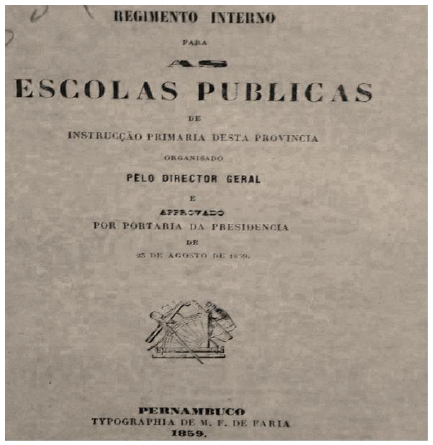
In this context, the regulations were relevant devices for the educational organization of the province. The “Internal Regulations for Public Primary Schools of 1859”, organized by the Director of Education, Baron of Camaragibe, and approved by order of the Presidency of the Province, on August 23, 1859, aimed to comply with §7 of art. 3 of Law No. 369, from May 14, 1855, by determining the organization of the internal regulations of schools and other public education establishments2.
Composed of 68 articles, the 1859 Regulations covered various topics for the organization of public primary schools: “the duties of teachers”, “the furniture and economy of schools”, “the conditions and admission of student enrollment, the subjects covered by primary school education and the discipline of classes”, “student examinations” and “general provisions”. In addition, with 19 articles, the document presented “instructions for distributing students into classes, dividing schoolwork, recording enrollment, maps and class records”. This section contains annexes, which will be analyzed in the next topic, such as tables for the distribution of teaching time and subjects among the various classes of a public primary school and templates for teachers to fill out: class maps, student examination forms, lists of objects received by the school and school attendance (APEJE, 1859). This regulation was in force until the mid-1870s.
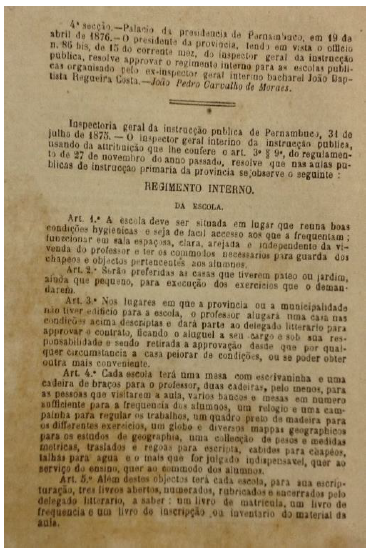
On April 19, 1876, under the responsibility of the Acting Inspector General of Public Education, Dr. João Baptista Regueira Costa, the “Internal Regulations of Public Schools of 1876” were approved. The document aimed to comply with the provisions of §9, art. 3, of the Regulations of Education from November 27, 1874 (or Law No. 1143, of July 8, 1874). It determined the organization of the internal regulations of public schools, submitting them for approval by the president of the province3 (APEJE, 1874).
Repealing the Internal Regulations of 1859, the documentation presents 116 articles, divided into specific themes: “Of the school”, “Of the teacher”, “Of teaching”, “Of rewards”, “Of penalties”, “Of general examinations”, and annexes containing seven models for completion by the teacher of the school inventory, guide for enrollment, school opening term, attendance book, school closing term, student examination term, enrollment map (APEJE, 1876).
The formal aspects of the 1859 and 1876 Regulations, aimed at public primary schools, bring together pedagogical discourses intended for regulating conduct, disciplines, and actions of agents (teachers and students) in the schooling process, specifying criteria for what society and the State “demand, monitor, and punish” (Foucault, 2007). Understood as a manufactured cultural product with distinct and expressive legal characteristics - encompassing language, legal systems, and social practices - school regulations delineate the subjects upon whom the "administrative-police structure" of school governance must act, in order to ensure the intended outcomes of the modern school project (Faria Filho, 1998; Gondra, 2018).
Strategies for organizing school cultures: comparing the regulations of 1859 and 1876
This section is dedicated to comparing strategies for organizing school cultures and is divided into key themes found in both regulations: spatial organization of primary schools (division of schools into teaching-learning levels and subjects assigned to each of them; structural and hygienic conditions of school architecture), organization of work carried out by students (school time, school age and division of school work) and organization of teaching-learning and teacher-student relationships (teaching methods, punishment and reward mechanisms).
Regarding spatial organization, the two regulations were similar in establishing the division of primary schools into two levels, differing in the subjects taught in each of them and the target audience (girls and boys), as shown in Table 1.
In the 19th century, the primary school, as a disseminator of instruction and, later, as a central agent in childhood education, was slowly replaced by elementary education. The word “elementary” retains the idea of “rudimentary”, but also conveys the sense of a direction in teaching and learning of what was “basic, what comes first”, and from which nothing else can be subtracted from the instructional process. The primary school was articulated with the set of knowledge and values considered fundamental by government agents, even if distributed unequally in different educational realities (Faria Filho, 2000).
In Table 1, we can see the aforementioned trend of expanding knowledge, since other knowledge was added to the first letters, such as “rudiments of grammar”, “native language”, “arithmetic” or “rudiments of religious knowledge”. This study plan, divided between “basic knowledge”, “necessary values” and the target audience (boys and girls) for whom it was intended, was commonly standardized by the regulations, rules and school legislation of Pernambuco, with some adjustments in the second half of the 19th century.
The knowledge disseminated was combined with a distinct cultural repertoire for girls and boys, which was indicative of a school organization that scrutinized individuals according to a “supposed nature deposited in each one’s sex” (Gondra, 2018, p. 21). For both sexes, in primary schools, the two regiments maintained the basic knowledge: moral and religious instruction; reading and writing; grammatical analysis; arithmetic; reading of gospels and sacred history; elements of history and geography. The indication of a system of weights and measures was not maintained in the 1876 Regiment. For girls, embroidery and needlework were maintained. In the 1876 Regiment, home economics was added.
In secondary schools, the repertoire of knowledge in both regulations consisted of notions of physical sciences applicable to the use of life, geometry and surveying, linear drawing, notions of music, singing exercises and gymnastics exercises. It is observed that the study of the system of weights and measures was removed and notions of agriculture were added in the 1876 Regulation. For girls, the 1859 Regulation left the teaching of subjects considered to be secondary school subjects to the approval of the Board of Directors. The 1876 Regulation, however, made explicit the knowledge that was prohibited for this public.
In the 1876 Regulation, in primary and secondary schools, the removal of the system of weights and measures subject, followed by the inclusion of notions of agriculture, was related to the economic and political changes in the province of Pernambuco at the end of the 19th century. In the debates led by sugar plantation owners in the “Northern Provinces,” the expansion of agricultural production was directly tied to the early incorporation of boys recently freed under the Free Womb Law into farm labor, starting from their earliest years. In the owners’ perspective, training children in agriculture would allow them to work alongside their mothers and to recruit the necessary and “qualified” labor force during the period of economic crisis (Santos, 2014).
Regarding female education in both regiments, we can observe the positioning derived from the positivist and scientific inspiration of the late 19th and early 20th centuries. This stance promoted an education aimed at shaping girls into future mothers and wives, responsible for the domestic sphere, through a form of schooling aligned with family and social expectations - one that did not challenge men professionally or intellectually (Almeida, 1998).
In the late 1870s, the authorities of Pernambuco advocated the “need to expand school programs”. For the Education Inspectorate, primary education was the most important factor in a “free” country with “great destinies”, aligning it with the ideals of the “scientific spirit of modernity” to expand the mental and civic faculties of a people, delegating to governments the role of providing the population with a quality education (Lima, 2021). This ideology, aligned with educational developments in other provinces at the time - such as the Court (Schueler, 2002), Minas Gerais (Oliveira, 2011), and Paraíba (Mariano, 2015) - encouraged the inclusion of new subjects in primary school curricula. These included domestic economy (for girls), agriculture and horticulture, social economy (for boys), hygiene (for both sexes), and gymnastics (sometimes for boys, sometimes for both), as shown in Table 1. In addition, it embraced female education and the coeducation of boys and girls as guiding principles of public education during the Empire (Lima & Santos, 2024).
These changes were noticed in the criteria for organizing school architecture, a novelty found at the beginning of the 1876 School Regulations. This document determined that schools should be located in places with good hygienic conditions and with easy access for those who attended them. They should operate in spacious, bright, airy rooms, preferably with patios and gardens for outdoor exercises, independent of the teacher's house and with the necessary rooms to store objects belonging to the students (Jordão Emerenciano State Public Archives [APEJE], 1876). Medical and hygienic conditions were a common concern at the time.
The establishment of spaces suitable for teaching - featuring proper ventilation, room divisions, and external lighting - along with the promotion of physical education through increased gym classes and the emphasis on hygiene in the official discourse, reflected alignment with the scientific and hygienist ideals of the late Empire. In this context, it becomes evident that a "culture of hygiene" in primary schools was already adapting to the broader discourse on the medicalization of society, which would gain further prominence in the 20th century (Gondra, 2004; Stephanou, 2006; Mariano, 2015; Macario & Borba, 2020).
In order to organize school work, the operating hours of primary schools were carefully delimited by school regulations into two specific shifts. The 1859 Regulations stated that, in the morning, classes began at 8:00 a.m. and ended at 11:00 a.m. (in summer). In winter, classes began later, at 8:30 a.m., and ended at 11:30 a.m. Afternoon classes ran from 3:00 p.m. to 5:00 p.m. (APEJE, 1859). The 1876 Regulations determined that schools would operate during the day from 9:00 a.m. to 2:00 p.m. During the night, classes ran from 6:30 p.m. to 9:00 p.m. (APEJE, 1876). These opening hours continued at least until the mid-1880s, a very different scenario from that outlined until 1855, in which schools operated for three hours in the morning and two hours in the afternoon, without specific hours determined by law and, therefore, negotiated among teachers, local authorities and parents of students (Silva, 2007). There was, therefore, an increase in the opening hours of primary schools when comparing the two regiments (from 5 hours a day to 7 hours and 30 minutes), divided into specific shifts.
The extension of time within school is in tune with the “liturgy of the modern school”. The invention of a new time circumscribes children to institutional performance, removing them from the continuum of time in life, family, and community. School as a rite also engenders the way of being of the classroom (Boto, 2018), through full permanence and submission to its rules.
In addition to the division of time, there was the organization of school work carried out by students. In this regard, we found in the 1859 Regulations, attached to the main documentation, a study program intended for primary schools. This information was not made explicit in the 1876 Regulations, since it only indicated the future issuance of the study program, which was not found in this investigation (APEJE, 1876).
In ascending order of advancement and with different lessons in each time slot/shift: from the most “delayed”, in the first class, to the most “advanced”, in the last class, boys and girls, over 5 years old and under 15 years old, (APEJE, 1859, p. 3; APEJE, 1876, p. 3), were distributed into eight classes. Each class would only contain students who had the same level of education. In case of overcrowding, the teacher had the authority to arrange them in series, following the order of advancement of students, as observed in Table 2 (APEJE, 1859, p. 9).
The learning of the first letters in the 1859 Regiment was governed by the repetition and memorization of writing, reading, calculation and Christian doctrine, with students placed in lines, hierarchized by “more and less advanced” criteria, and subjected to technical procedures in a gradual manner - format of written letters, types of mathematical operations and learning of values and duties with Christian doctrine - in search of approval.
These technical criteria characterized traditional pedagogy, based on the ideals of “how to teach” centered on the teacher, whose “task is to transmit the knowledge accumulated by humanity according to a logical gradation, with students being responsible for assimilating the content transmitted to them” (Saviani, 2005, p. 02).
The school method was the basis for the teaching process. The 1859 Regulations detailed teaching procedures in light of the mutual method, considered by education authorities to be the most “appropriate” for primary classes. As seen in Table 2, schoolwork was divided into eight classes, with the first being the most delayed and the last being the most advanced. Each class was made up of students with the same level of education. The teacher was in charge of teaching the 8th grade (the most advanced), leaving the assistants (monitors) to teach the others, in accordance with the step-by-step mutual method. The teacher would alternately apply exercises to assess the learning of students in the other classes, keeping them up to date with their level of progress in the lessons (APEJE, 1859).
Becoming a legal apparatus from the Law of October 15, 1827, the mutual or Lancasterian method intended to replace the individual method, which existed since the end of the 18th century4. Named after its mentor, the educator Joseph Lancaster, the mutual method was favorable to the use of students themselves as monitors, with the system of assistant teachers being one of the examples of its applicability5.
Gradually, discussions about the parameters - time, space and teaching materials - caused the mutual method to lose its place in favor of the so-called “mixed method”. This method sought to alternately combine the advantages of the individual method with those of the mutual method, or to combine the positive aspects of the latter with the innovations proposed by the advocates of the simultaneous method. This method was adopted by the 1876 Regulations.
The 1876 Regulation adopted the simultaneous method through the characteristic parameters of intuitive teaching, with the purpose of “practice surpassing theory” (APEJE, 1876, p. 5). The number and length of lessons were graded by age and level of advancement of students, gradually and progressively moving on to more advanced levels of learning. Regarding the way the teacher transmits the teaching, articles 38 and 40 emphasized that:
The teacher will ask questions about the objects of the lessons, to get his disciples used to reflecting, and they will be obliged to explain in their own words what they have learned and to offer examples other than those contained in books or compendiums. [...] Intellectual exercises should be alternated with physical exercises, without causing fatigue to either the mind or the body, but only with a view to instruction, education and hygiene (APEJE, 1876, p. 5).
Of Christian origin and created by Jean-Baptiste de La Salle in the 17th century, the simultaneous method advocated the action of the teacher on several students simultaneously, the optimization of school time, the organization of content at different levels (from the simplest to the most complex), among other elements. To this end, the production of didactic-pedagogical materials for students, such as books and notebooks, and the dissemination of the “blackboard” (an expression at the time), allowed the teacher to keep the different groups occupied at the same time. In Brazil, the practice of the simultaneous method was consolidated in the last decade of the 19th century (Faria Filho & Vidal, 2000).
The use of intuition in teaching, as published in the 1876 Regulations, stems from procedures advocated by the intuitive method, one of the most popular teaching methods in the late 19th century. Research by Jacilene Clemente (2013) emphasized that the intuitive method was widely promoted as “adequate” for use in primary schools. Defending the use of student intuition in the teaching-learning process, the principles of observation and work should replace the mechanical memorization processes, based on reading and writing, arising from the mutual method. In the observation process, students should sharpen their critical perception of the world, progressing from the concrete to the abstract.
The changes in school methods in the analyzed documentation - from mutual to simultaneous - indicate that, in the second half of the 19th century, there were attempts by government authorities in Pernambuco to organize and standardize primary schools, establishing what would be most “appropriate” in the transmission of content by teachers, in tune with the changing trends observed in other imperial locations (Faria Filho & Vidal, 2000; Cury, 2006; Ananias, 2010). It is worth noting, however, that the school methods endorsed by the regulations were not the only ones to be adopted in schools. Studies on the subject point to the coexistence of school methods used in imperial primary schools, as well as the choices and uses of what best suited the teaching preferences of the male and female teachers and the school reality 6.
The 1859 and 1876 Regiments carefully detailed the mechanisms of discipline - punishments and rewards - during the teaching-learning process. And in these aspects, both were quite similar.
The mechanisms of discipline - punishments and rewards - are understood in this study within the transformations of the so-called “art of punishment”, which occurred since the end of the 18th century. Physical torture, considered cruel, was replaced by a new discipline, producing “docile bodies” and trained by the rule to be followed. Disciplinary institutions (among them, schools) have historically differentiated and hierarchized individuals, with the aim of exercising meticulous control over their actions, their time and their activities (Foucault, 2007).
The school regulations of 1859 and 1876 abhorred physical punishments (such as the cane), claiming that they would harm the health and morale of students. At that time, it was appropriate to replace the old forms of punishment with other disciplinary means, following an increasing order of applicability: reprimand, assignment of work outside regular hours, other punishments that exercise humiliation, notification to parents for greater punishments and expulsion from school. Disciplinary means were the responsibility of the teacher and assistant (APEJE, 1859; APEJE, 1876).
In addition to the various mechanisms for punishing students, the school regulations of 1859 and 1876 provided similar means of reprimand to be used by teachers in cases of repeated offenses. Initially, warnings were issued solely for school-related reasons, advising students not to repeat their mistakes. If the mistakes persisted, the regulations gave teachers the authority to demote students from their current position in the class to a lower position, according to the text of the law: “If a student repeats the offense, the teacher must admonish them and move them from one position in the class to a lower position in the same class” (APEJE, 1859, p. 6; APEJE, 1876, p. 7).
In cases where students repeated mistakes, the regulations authorized the use of extreme measures: loud reprimands by the teacher in the presence of all classmates, work outside regular hours, public display of offending the student's name, written in capital letters on the board, and the instigation of humiliation by making the student stand or kneel with open arms for as long as the teacher deemed necessary. Once all punishments had been exhausted, expulsion from school became inevitable (APEJE, 1859).
Studies examining the relationship between punishment, provincial legislation, and school practices - conducted in provinces such as Paraíba (Galvão, 1998), Paraná (Dalcin, 2008), the Imperial Court (Lemos, 2012), and Minas Gerais (Pereira, 2017) - consistently highlight the use of corporal punishment as a significant and legitimate pedagogical tool for correction, discipline, and control. This persisted despite the growing opposition to such practices reflected in the educational regulations of the late 19th century.
In Pernambuco, in the late 18th and early 19th centuries, records of complaints against public school teachers, filed by families and local authorities, indicated that, from the point of view of how classes were run, primary school teachers had autonomy in choosing the content, textbooks and “types of punishments they would apply to their students” (Silva, 2007, p. 170). Even with the radical prohibition imposed by the 1859 and 1876 Regulations and other decrees, corporal punishment practices continued to exist and were known to society, lasting until the first decades of the republican period.
When analyzing the Instruction Regulations between 1890 and 1911, Isabela Tristão pointed out that, despite the attempts of the public authorities to standardize and control the exercise of primary teaching in Pernambuco, through the creation of a set of rules and prerequisites - legal majority, good morality, intellectual capacity, exemption from transgressions -, the practices of physical and moral punishments in primary schools performed “an efficient control over the bodies to maintain discipline in the classroom” (Tristão, 2021, p. 115). Therefore, there were “deviant teaching models”, beyond the prescriptions standardized by the public authorities.
The 1859 and 1876 Regulations rewarded students who were “exemplary in behavior” by demonstrating adequate attendance in classes and performance in subjects. The awards were organized progressively: names were publicly read by the teacher in Saturday classes, a distinguished place in the classroom was awarded, and the name was placed on the honor roll, presented to all visitors to the school (APEJE, 1859, p. 8; APEJE, 1876, pp. 5-6). Finally, the “good performance” was communicated to the family members.
For students who remained at the top of the list of names announced on Saturdays for three consecutive months, the regulations authorized the use of a medal called “Prize: public school of first letters”. The act of awarding the award became a public ceremony, with all the students standing and addressing words of praise to the recipient (APEJE, 1859, p. 8; APEJE, 1876, pp. 5-6).
Another facet of disciplinary practices were the awards for academic merit. They fostered competition among students by promoting the pursuit of prestige and public recognition at a time when social hierarchy was regarded as a coherent and acceptable form of integration within local society (Castanha, 2009). With political and social force, public morality was threatened by the transgression of norms and government authorities were questioned. In the Empire of Brazil, “to be moral was to be orderly, to respect hierarchy, to accept authority, to know one’s place in society” (Castanha, 2006, p. 9). In other words, it was one of the pillars of modeling the conduct of students and teachers in the analyzed school regulations.
Final remarks
The reflections established in this study demonstrated that, through the School Regulations, government authorities disseminated their strategies for organizing and standardizing the functioning of primary schools, in an effort to produce their own cultures (Viñao Frago, 1995). Diffusers of representations that generated conduct, habits and behaviors inside and outside schools, the school regulations were objects of “mediated knowledge” (Chartier, 1990), aiming to disseminate the “civilizing project” of the modern imperial school (Boto, 2018).
In formal aspects, the School Regulations of 1859 and 1876 were structured in detail, with an average of 68 to 116 articles, containing different themes, namely: “teachers' duties”; “school furniture and economy”; “conditions and admission of student enrollment, subjects that comprise primary school teaching and class discipline”; “student examinations” , containing annexed parts on “the distribution of students into classes, division of school work, registration of enrollment, maps and class records”. The documents intended to establish the organization of the primary schools, established by two ordinances that guided public education in Pernambuco, with changes and additions throughout the second half of the 19th century: Law No. 369, of May 14, 1855, and the Instruction Regulation, of November 27, 1874 (or Law No. 1143, of July 8, 1874) (APEJE, 1874).
Despite the possibilities of articulation with the strategies for organizing school realities in other provinces - Imperial Court, Paraíba, Paraná, Minas Gerais -, the comparison of the school regulations of 1859 and 1876, in the context of expanding the number of schools (created and in operation), demonstrated the efforts made by the authorities of Pernambuco in the production of their own school cultures, since: a) they standardized the use of teaching methods appropriate to the objectives of traditional pedagogical discourse and the realities of local schooling - from the mutual method, in the Regulation of 1859, to the intuitive method, in the Regulation of 1876; b) they established the distribution of school time, combined with the regularity of school activities in specific stages, under the hierarchical organization of the classroom with students “more and less advanced in content”; c) they detailed the punishment mechanisms, known and used in Pernambuco schools until the first decades of the republican period; d) they pointed out the award mechanisms, important incentives for competition between students, following the parameters of “public morality” at the time.
In the so-called “culture of educational reforms” of the 19th century (Gondra, 2018), the classroom space was supposed to serve to “transform the behavior of children and young people”. Under the watchful presence and gaze of teachers and monitors, authorities sought to regulate and directly interfere in the control of bodies (Foucault, 2007), in learning levels, in the practical and moral conduct of teachers and students, directing them to “what, how and where” was considered appropriate to the standards of “good school functioning” and the dictates of imperial “Civilization”.
References
- Almeida, J. S. (1998). Mulher e Educação: a paixão pelo possível. São Paulo, SP: Editora UNESP.
-
Ananias, M. (2010, janeiro/abril). A instrução pública primária nos regulamentos provinciais da Parahyba do Norte na década de 1840: a constituição do Estado Nacional. Educação Unisinos,14 (1), p.35-43. Recuperado de: https://revistas.unisinos.br/index.php/educacao/article/view/150/22
» https://revistas.unisinos.br/index.php/educacao/article/view/150/22 - Aróstegui, J. (2006). A pesquisa histórica: teoria e método. Bauru, SP: Edusc.
- Arquivo Público Estadual Jordão Emerenciano (APEJE). (1855). Lei de n. 369 de 14 de maio de 1855. Da organização da instrução pública da província. Livro de Leis da Província de Pernambuco. Recife: Typoghrafia de M. F. de Faria.
- Arquivo Público Estadual Jordão Emerenciano (APEJE). (1859). Regimento interno para as escolas públicas de instrução primária desta província. Livro de Regimentos e Regulamentos da Província de Pernambuco (Série Instruções). Recife: Typoghrafia de M. F. de Faria.
- Arquivo Público Estadual Jordão Emerenciano (APEJE). (1876). Regimento interno para as escolas públicas de instrução primária. Livro de Regimentos e Regulamentos da Província de Pernambuco (Série Instruções). Recife: Typoghrafia de M. F. de Faria.
- Arquivo Público Estadual Jordão Emerenciano (APEJE). (1874). Reorganização do ensino público em Pernambuco. Livro de Regimentos e Regulamentos da Província de Pernambuco (Série Instruções). Recife: Typographia de M. Figuerôa de F. e Filhos.
-
Barros, J. D´A. (2007, junho). História Comparada: um novo modo de ver e fazer história. Revista de História Comparada, 1(1), 01-30. Recuperado de: https://ppghc.historia.ufrj.br/images/publicacoes/2007/numero-1/volume-1-n-1-barros.pdf
» https://ppghc.historia.ufrj.br/images/publicacoes/2007/numero-1/volume-1-n-1-barros.pdf -
Boto, C. (2018, julho/agosto). A civilização escolar pelos compêndios didáticos de formação de professores. Educar em Revista, 34 (70), p. 155-178. Recuperado de: https://doi.org/10.1590/0104-4060.58075
» https://doi.org/10.1590/0104-4060.58075 - Castanha, A. P. (2006). Moralidade pública e educação no século XIX. In. Anais Eletrônicos do IV Congresso Brasileiro de História da Educação (p. 01-10). Goiás (GO).
-
Castanha, A. P. (2009, maio). A prática dos castigos e prêmios na escola primária do século XIX: do legal ao real. Educere et Educare, 4 (8), p. 245-259. Recuperado de: https://doi.org/10.17648/educare.v4i8.3724
» https://doi.org/10.17648/educare.v4i8.3724 - Chartier, R. (1990). A História Cultural: entre práticas e representações. Lisboa, Portugal: DIFEL.
-
Clemente, J. S. Culturas escolares em Recife: escolas particulares e métodos de ensino (1880-1888). (2013). (Dissertação de Mestrado). Universidade Federal de Pernambuco (UFPE), Recife. Recuperado de: https://repositorio.ufpe.br/handle/123456789/13065
» https://repositorio.ufpe.br/handle/123456789/13065 - Cury, C. (2006). Métodos de ensino e formas de controle sobre o cotidiano escolar na instrução pública da Parahyba do Norte. In Scocuglia, A. C, & Machado, C. J. S (Ed.), Pesquisa e historiografia da educação brasileira (p. 41-61). Campinas, SP: Autores Associados.
- Dalcin, T. B. (2008). “Palmatoando” as fontes: os usos dos castigos físicos em nome da disciplinarização e da ordem nas escolas paranaenses da segunda metade do XIX. In: IV Congresso Sulbrasileiro de Ciências do Esporte: ciência e experiência - aproximações e distanciamentos (p. 640-649). Faxinal do Céu, PR.
- De Certeau, M. (2004). A invenção do cotidiano: artes de fazer. Rio de Janeiro, RJ: Vozes.
- Faria Filho, L. M. (1998). Legislação Escolar como fonte para a história da educação: uma tentativa de interpretação. In Faria Filho, L. M. (Ed.), Educação, modernidade e civilização (p. 89-125). Belo Horizonte, MG: Autênti ca.
- Faria Filho, L.M. (2000). Instrução elementar no século XIX. In Lopes, E. M. S. T., Faria Filho, & L. M., Veiga, C.G (Org.), 500 anos de educação no Brasil (2a. ed., Cap. 6, p. 135-150). Belo Horizonte, MG: Autêntica.
- Faria Filho, L. M., Gonçalves, I. A., Vidal, D. G. F., & Paulilo, A. L. (2004, abril). A cultura escolar como categoria de análise e como campo de investigação na história da educação brasileira. Educação e Pesquisa, 30 (1), p. 139-159.
- Faria Filho, L. M. A., & Vidal, D. G. F. (2000, agosto). Os tempos e os espaços escolares no processo de institucionalização da escola primária no Brasil. Revista Brasileira de Educação, (14), p. 19-34.
- Foucault, M. (2007). Vigiar e punir. Petrópolis, RJ: Vozes.
- Vinão Frago, A. (1995, dezembro). História de La educacion y historia cultural: posibilidades, problemas, cuestiones. Revista de educación, (306), p. 245-269.
- Galvão, A. M. de O. A Palmatória era a sua Vara de Condão: práticas escolares na Paraíba (1890-1920). (1998). In Faria Filho, L. M. (Ed.). Modos de Ler, Formas de Escrever (p. 117-142). Belo Horizonte, MG: Autêntica.
- Gondra, J.G. (2004). Artes de civilizar: medicina, higiene e educação escolar na Corte Imperial. Rio de Janeiro, RJ: EdUERJ.
- Gondra, J.G. (2018). A emergência da escola. São Paulo, SP: Cortez.
- Lemos, D. C. A. (2012, agosto). Os cinco olhos do Diabo: os castigos corporais nas escolas do século XIX. Educação e Realidade, 2 (37), p. 627-646.
-
Lima, D. R. P. Sinais do “desconforto” no exercício docência pública em Recife e Olinda (1860-1880). (2014). (Dissertação de Mestrado). Universidade Federal de Pernambuco (UFPE), Recife. Recuperado de: https://repositorio.ufpe.br/handle/123456789/12838
» https://repositorio.ufpe.br/handle/123456789/12838 -
Lima, D. R. P. A docência primária em Pernambuco: estratégias e táticas de organização e hierarquização (1864-1888). (2021). (Tese de Doutorado). Universidade Federal de Pernambuco (UFPE), Recife. Recuperado de: https://repositorio.ufpe.br/handle/123456789/41131
» https://repositorio.ufpe.br/handle/123456789/41131 - Lima, D.R.P., & Santos, Y.S. (2024). Processos de feminização do magistério público primário em Pernambuco: as aulas mistas e a Escola Normal para Senhoras da Sociedade Propagadora da Instrução Pública (1870-1895). In Sá, A. N. M., Burity, L. M. D., & Mariano, N. R. C. (Ed.). Sociedade e Cultura no Nordeste Oitocentista: trajetórias de pesquisa III (p. 268-293). João Pessoa, PB: Editora do CCTA.
- Macario, C. B., & Borba, V. M. R (2020, dezembro). Prevenção que segrega: higienismo em foco nos discursos do I Congresso Médico de Pernambuco (1909). Bilros, 8 (17), p. 108-126.
-
Mariano, N. R. C. (2015). Educação pela higiene: a invenção de um modelo hígido de educação escolar primária na Parahyba do Norte (1849-1886). (Tese de Doutorado). Universidade Federal da Paraíba (UFPB), João Pessoa. Recuperado de: https://repositorio.ufpb.br/jspui/handle/tede/7765?locale=pt_BR
» https://repositorio.ufpb.br/jspui/handle/tede/7765?locale=pt_BR - Mattos, I. (2004). O tempo Saquarema: a formação do Estado Imperial (5a ed.). São Paulo, SP: Hucitec.
-
Oliveira, E. (2011). O processo de produção da profissão docente: profissionalização, prática pedagógica e associativismo dos professores púbicos primários em Minas Gerais (1871 - 1911). (Dissertação de Mestrado), Universidade Federal de Minas Gerais (UFMG), Belo Horizonte. Recuperado de: https://repositorio.ufmg.br/bitstream/1843/BUOS8NEGDD/1/disserta__o_elianadeoliveira_educa__o.pdf.
» https://repositorio.ufmg.br/bitstream/1843/BUOS8NEGDD/1/disserta__o_elianadeoliveira_educa__o.pdf. -
Pereira, J. C. (2017). Os castigos escolares em Minas Gerais (1835-1867). (Dissertação de Mestrado). Universidade do Estado de Minas Gerais (UEMG), Belo Horizonte. Recuperado de: https://sucupira.capes.gov.br/sucupira/public/consultas/coleta/trabalhoConclusao/viewTrabalhoConclusao.jsf?popup=true&id_trabalho=5317789.
» https://sucupira.capes.gov.br/sucupira/public/consultas/coleta/trabalhoConclusao/viewTrabalhoConclusao.jsf?popup=true&id_trabalho=5317789. -
Santos, Y. S. (2014). A Sociedade Propaganda da Instrução Pública e suas ações de qualificação profissional em Recife (1872-1903). (Dissertação de Mestrado). Universidade Federal de Pernambuco (UFPE), Recife. Recuperado de: https://repositorio.ufpe.br/handle/123456789/12919
» https://repositorio.ufpe.br/handle/123456789/12919 -
Santos, Y.S. (2021). Associativismo e docência no Recife: estratégias de atuação sociopolítica de trabalhadores docentes entre os anos de 1872-1915. (Tese de Doutorado). Universidade Federal de Pernambuco (UFPE), Recife. Recuperado de: https://repositorio.ufpe.br/handle/123456789/40183
» https://repositorio.ufpe.br/handle/123456789/40183 -
Saviani, D. (2005). As concepções pedagógicas na História da Educação Brasileira. Campinas, SP: UNICAMP. Recuperado de: https://histedbrantigo.fe.unicamp.br/navegando/artigos_pdf/Dermeval_Saviani_artigo.pdf.
» https://histedbrantigo.fe.unicamp.br/navegando/artigos_pdf/Dermeval_Saviani_artigo.pdf. -
Schueler, A.F. M. (2002). Forma e culturas escolares na cidade do Rio de Janeiro: representação, experiência e profissão docente nas escolas públicas primárias (1870-1890). (Tese de Doutorado). Universidade Federal Fluminense (UFF). Niterói. Recuperado de: https://www.academia.edu/44582581/Forma_e_culturas_escolares_na_cidade_do_Rio_de_Janeiro_1854_1889_representa%C3%A7%C3%B5es_pr%C3%A1ticas_e_experi%C3%AAncias_docentes
» https://www.academia.edu/44582581/Forma_e_culturas_escolares_na_cidade_do_Rio_de_Janeiro_1854_1889_representa%C3%A7%C3%B5es_pr%C3%A1ticas_e_experi%C3%AAncias_docentes - Silva, A.M. P. (2007). Processos de construção das práticas de escolarização em Pernambuco, em fins do século XVIII e primeira metade do século XIX. Recife, PE: Editora Universitária da UFPE.
- Stephanou, M. (2006, agosto). Discursos médicos, educação e ciência: escola e escolares sob exame. Educação e Saúde, 4 (1), p. 33-64.
-
Tristão, I. N. N. (2021). “Os cabouqueiros do edifício nacional” - modelos docentes em disputa em Pernambuco (1889-1911)”. (Dissertação de Mestrado). Universidade Federal da Paraíba (UFPB), João Pessoa. Recuperado de: https://repositorio.ufpb.br/jspui/handle/123456789/21297
» https://repositorio.ufpb.br/jspui/handle/123456789/21297 - Vidal, D. G. (2009, junho). No interior da sala de aula: ensaio sobre cultura e prática escolares. Currículo sem Fronteiras, 9 (1), p.25-41.
-
Xavier, Ana P. S. (2006). A leitura e a escrita na cultura escolar primária de Mato Grosso (1837-1889). (Dissertação de Mestrado). Universidade Federal de Mato Grosso (UFMT), Cuiabá. Recuperado de: https://gem.ufmt.br/gem/sistema/arquivos/04091303201920.pdf
» https://gem.ufmt.br/gem/sistema/arquivos/04091303201920.pdf
-
Peer review rounds:
R1: two invitations; one report received.R2: two invitations; two reports received.
-
How to cite this article:
Lima, D. R. P. (2025). Organizational strategies of primary schools in Pernambuco: comparative analyses of the regulations of 1859 and 1876. Revista Brasileira de História da Educação, 25, e378. DOI: https://doi.org/10.4025/rbhe.v25.2025.e378en
-
Funding:
The RBHE has financial support from the Brazilian Society of History of Education (SBHE) and the Editorial Program (Call No. 30/2023) of the National Council for Scientific and Technological Development (CNPq).
-
1
We emphasize that this study has limitations regarding the scope of the practices of appropriation and reception of the standards by teachers and students. There is no guarantee that what was prescribed in the school regulations was effectively carried out by the schools.
-
2
The 1855 Education Legislation was the result of efforts by the authorities of Pernambuco to demonstrate alignment with the political project for public education in the Imperial Court (Court Law of 1854). The new legislation (re)established administrative and disciplinary rules for primary school teachers; continued to define the functions of the ones responsible for the progress of public education (Directors, Inspectors, Delegates, President, Secretary); determined the conditions for entry into public education (competency tests, public examinations); established the payment values for teachers (hierarchized according to the grades of public schools); established rules for teacher training; established the first provisions for compulsory school attendance; detailed disciplinary mechanisms for students in schools (APEJE, 1855).
-
3
The 1874 Education Regulation established the criteria for compulsory attendance of boys and girls in primary schools; specified the duties of the education inspectors (provincial president, general inspector, literary council, literary delegates and special inspectors); established, in detail, the parameters for classifying primary schools into entrance levels; established the values of teachers' salaries (salaries and bonuses, hierarchized through the division of public schools into entrance levels); determined the rules for the appointment and qualification of teachers, as well as for the provision of classes; described the guidelines for absences from teaching, such as leaves of absence, transfers, allowances and justification for absences; and defined the rights and duties of teachers (Pernambuco, 1874). This regulation was the first to exist in the 1870s.
-
4
The quintessential method of home education required the teacher — despite overseeing multiple students — to deliver lesson content to each one individually. However, the criticism of the individual method — first voiced in Europe at the end of the 18th century and later echoed in Brazil during the early decades of the 19th century — centered on the excessive time students spent waiting for direct interaction with the teacher, which often led to increased indiscipline (Faria Filho, 2000; Cury, 2006; Ananias, 2010).
-
5
The class of “assistant” teachers in Pernambuco, created by the Education Law of 1855, had characteristics similar to those found in other imperial provinces: it was composed of male and female students from primary schools who, as they assisted the permanent teachers, acquired knowledge and techniques, assimilating the rules of teaching through experience. Having passed the exams for the levels in which they worked (during the 3 years of training), they obtained the “Title of Capacity”, an important certification for later applying for a public exam to enter the permanent teaching profession (Pernambuco, 1855, p. 38-39).
-
6
In the History of Education, research into school methods throughout the 19th century has long aroused the interest of researchers. In addition to the references cited in the body of this article, see Bastos, M. H. C., & Faria Filho, L. M. (de F.) (Orgs.). (1999). A escola elementar no século XIX: O método monitorial/mútuo (1ª ed.). Passo Fundo, RS: EdiUPF; Valdemarin, V. T. (2004). Estudando as lições de coisas: Análise dos fundamentos filosóficos do método de ensino intuitivo (1ª ed., 212 p.). Campinas, SP: Autores Associados; Tambara, E. A. C. (2005). O ensino mútuo na Província Cisplatina. Educação, 30(2), 43-54; França, F. F., & de Souza, G. (2012). Modos de fazer, modos de ensinar: Os métodos de ensino na história da educação pública paranaense na segunda metade do século XIX. Linguagens, Educação e Sociedade, (27), 135-160.

 Source: APEJE (1859).
 Source: APEJE (1876).